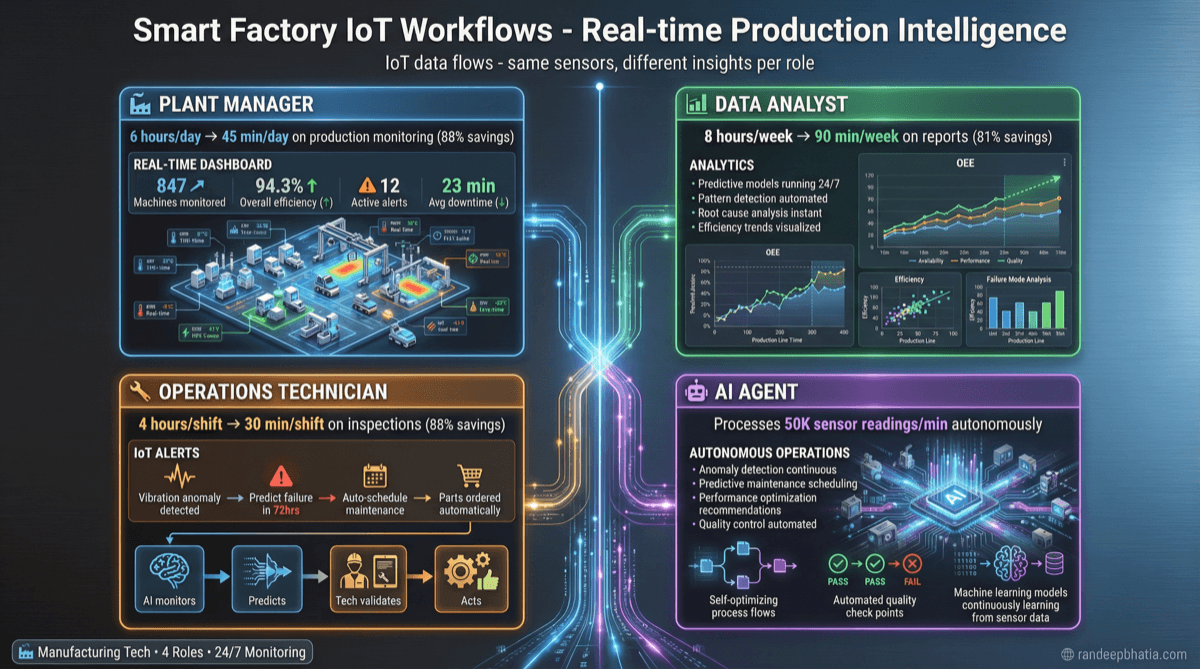
Same sensor data. Four different workflows.
Tuesday you saw the automation code. Today you see how plant managers, data analysts, ops techs, and AI agents each use it differently. Same data, different needs, better collaboration.
Team Workflows
See how different roles use the same system to transform their daily work.Click each role below
Before Automation
With Automation
Dashboard Metrics
Impact By The Numbers
"I finally manage the business instead of chasing machine status."
— Plant Manager, 18 years manufacturing
How Roles Work Together on One Issue
Watch how all four roles collaborate through the system to prevent a $45K production loss.
Bearing Temperature Anomaly on Line 2, Machine 7
✨ Scroll here to watch the workflow
Plant-Wide Impact
| Metric | Before | After | Improvement |
|---|---|---|---|
| Unplanned Downtime | 18 hours/month | 4 hours/month | 78% reduction |
| Emergency Repairs | 12 incidents/month | 3 incidents/month | 75% reduction |
| Production Reports | 6 hours/week to compile | 30 seconds (1-click export) | 99% time savings |
| Overall Equipment Effectiveness | 72% OEE | 87% OEE | +15 percentage points |
Getting Your Team On Board
Technicians worry AI will replace their jobs
Show them predictive alerts: 'You'll spend 78% less time on emergency repairs, more on preventive work that keeps you employed.' Frame AI as early warning system, not replacement.
Techs become advocates when they see fewer 2am calls and more planned maintenance.
Plant managers don't trust sensor accuracy
Run parallel for 30 days: manual checks + AI monitoring. Show 99.4% accuracy rate and 4-hour early detection average.
Managers see AI catches issues they miss during floor walks. Trust builds through data.
Data analysts fear being automated out
Demonstrate time freed: '10 hours/week saved on data cleaning = 10 hours for predictive modeling that makes you indispensable.'
Analysts shift from reactive reporting to strategic forecasting. Career advancement, not replacement.
Finance balks at upfront IoT sensor costs
Calculate ROI: One avoided $45K downtime incident pays for 6 months of sensors. Show 52x ROI on single bearing catch.
CFO approves when payback period is 45 days through downtime prevention alone.
IT worried about integrating legacy systems
Offer phased rollout: Start with 5 machines, prove value, then expand. API connectors for existing SCADA/MES systems included.
IT sees clean integration in Week 1. Becomes champion for plant-wide deployment.
Investment & ROI
Typical payback in 30-45 days through downtime prevention
Pricing
ROI Calculator
Proven Results
From Demo to Live in 3 Weeks
From demo to production in just 3 weeks
- Install IoT sensors on 15 pilot machines (Day 1-2)
- Connect to existing SCADA/MES systems (Day 3)
- Baseline data collection begins (Day 4-7)
- Configure role-specific dashboards
- Train each role on their dashboard (2hr sessions)
- Calibrate AI models with your baseline data
- Run parallel monitoring (manual + AI)
- Adjust alert thresholds based on feedback
- Switch to full AI monitoring
- Daily check-ins for first week
- Measure baseline metrics vs new performance
- Document first prevented downtime incident
Enterprise multi-site deployments: 6-8 weeks per facility with staggered rollouts
2026 Randeep Bhatia. All Rights Reserved.
No part of this content may be reproduced, distributed, or transmitted in any form without prior written permission.