← Monday's Prompts

Automate Smart Factory IoT 🚀

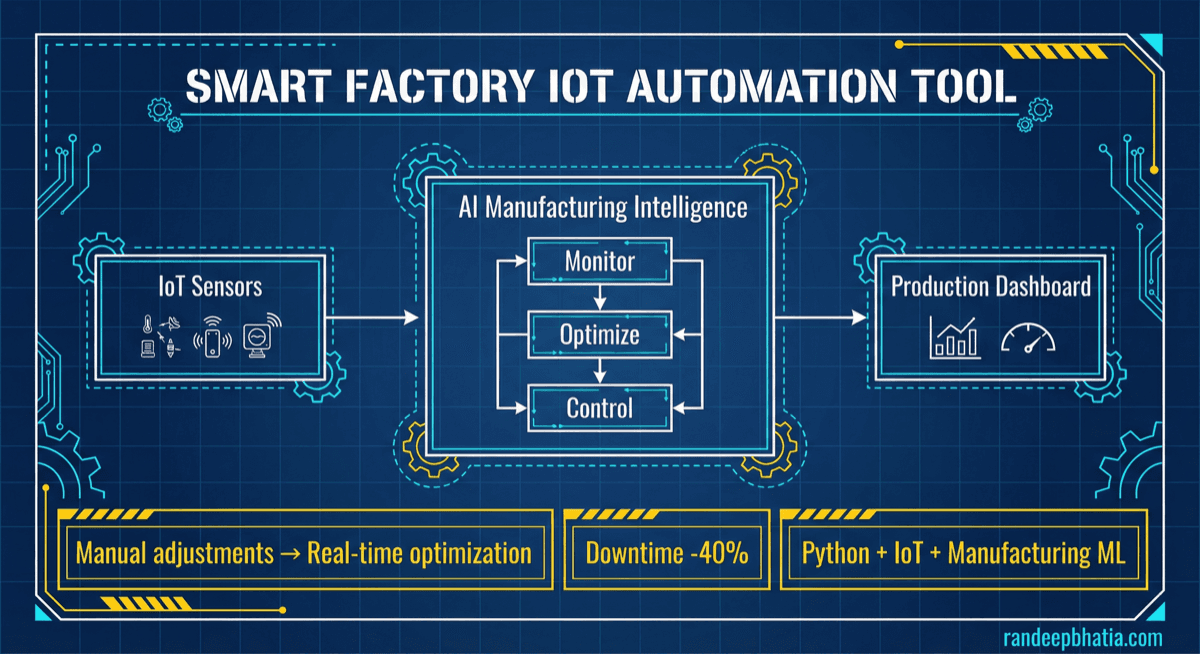
Turn Monday's 3 prompts into production-ready sensor monitoring

August 19, 2025
27 min read
🏭 Manufacturing Tech🐍 Python + TypeScript⚡ 10 → 10,000 sensors/day

The Problem

On Monday you tested the 3 prompts in ChatGPT. You saw how sensor data extraction → anomaly detection → alert generation works. But here's the thing: you can't have operators manually checking dashboards and running prompts for 500 sensors. One engineer spending 4 hours per day monitoring sensor data manually? That's $120/day in labor costs. Multiply that across a factory floor and you're looking at $36,000/year just on reactive monitoring. Plus the 30-minute lag time between anomaly and alert means equipment failures you could have prevented.

4+ hours
Per day manually monitoring sensors
30 min lag
Between anomaly and manual detection
Can't scale
Beyond 10-20 sensors per operator

See It Work

Watch the 3 prompts chain together automatically. This is what you'll build.

Watch It Work

See the AI automation in action

Live Demo • No Setup Required

The Code

Three levels: start simple, add reliability, then scale to production. Pick where you are.

Basic = Quick startProduction = Full featuresAdvanced = Custom + Scale

Simple API Calls

Good for: 10-100 sensors | Setup time: 30 minutes

Simple API Calls
Good for: 10-100 sensors | Setup time: 30 minutes
# Simple IoT Sensor Monitoring (10-100 sensors)
import openai
import json
import os
from datetime import datetime
from typing import Dict, List, Optional

# Set your API key
openai.api_key = os.getenv('OPENAI_API_KEY')

def monitor_sensor_data(sensor_data: str) -> Dict:
    """Chain the 3 prompts: extract → detect anomalies → generate alerts"""
    
    # Step 1: Extract and structure sensor data
    extraction_prompt = f"""Extract IoT sensor data and format as JSON.
Showing 15 of 112 lines

When to Level Up

1

Simple API Calls

  • Basic extraction → analysis → alert chain
  • Manual MQTT subscription
  • Local logging
  • No historical context
Level Up
2

Add Reliability Layer

  • Retry with exponential backoff
  • Redis rate limiting
  • InfluxDB time-series storage
  • MQTT auto-reconnect
  • Historical data queries
  • Structured logging
Level Up
3

Multi-Agent System

  • LangGraph orchestration
  • ML + LLM hybrid analysis
  • Distributed processing
  • Real-time dashboards
  • Advanced alerting (PagerDuty, Slack)
  • Predictive maintenance scoring
Level Up
4

Enterprise Platform

  • Kubernetes orchestration
  • Auto-scaling based on load
  • Multi-region deployment
  • Custom ML model training
  • Advanced analytics dashboard
  • API for third-party integrations
  • Compliance reporting
  • Cost optimization

Manufacturing Tech Gotchas

Real challenges from production deployments. Learn from others' mistakes.

MQTT Message Ordering

Use MQTT QoS 2 for critical sensors. Add sequence numbers and timestamps to messages. Implement buffer window for reordering.

Solution
# MQTT QoS 2 with sequence tracking
import paho.mqtt.client as mqtt
from collections import deque
import time

class OrderedMessageBuffer:
    def __init__(self, window_size=10, timeout=5):
        self.buffer = deque(maxlen=window_size)
Showing 8 of 62 lines

OPC UA Data Type Mapping

Normalize OPC UA data to flat JSON before sending to LLM. Handle null values explicitly. Use type hints.

Solution
# OPC UA to LLM-friendly JSON
from opcua import Client
import json
from typing import Any, Dict

def normalize_opc_value(value: Any) -> Any:
    """Convert OPC UA value to LLM-friendly format"""
    if value is None:
Showing 8 of 56 lines

Time-Series Data Volume

Aggregate historical data before sending to LLM. Use statistical summaries (min, max, mean, std). Only send anomalies in detail.

Solution
# Time-series data aggregation
import pandas as pd
import numpy as np
from datetime import datetime, timedelta

def aggregate_historical_data(
    sensor_id: str,
    hours: int = 24,
Showing 8 of 77 lines

Alert Fatigue from False Positives

Implement alert scoring and suppression. Use LLM to validate ML anomalies against domain knowledge. Batch low-priority alerts.

Solution
# Alert scoring and suppression
from dataclasses import dataclass
from typing import List, Dict
import asyncio

@dataclass
class Alert:
    sensor_id: str
Showing 8 of 165 lines

Cost Management at Scale

Implement tiered processing: ML for screening, LLM only for anomalies. Cache common patterns. Use cheaper models for validation.

Solution
# Cost-optimized processing pipeline
from enum import Enum
import hashlib

class ProcessingTier(Enum):
    ML_ONLY = 1  # $0.001/call
    CHEAP_LLM = 2  # $0.005/call (GPT-3.5)
    PREMIUM_LLM = 3  # $0.02/call (GPT-4)
Showing 8 of 142 lines

Adjust Your Numbers

500
105,000
5 min
1 min60 min
$50/hr
$15/hr$200/hr

❌ Manual Process

Time per analysis:5 min
Cost per analysis:$4.17
Daily volume:500 competitors
Daily:$2,083
Monthly:$45,833
Yearly:$550,000

✅ AI-Automated

Time per analysis:~2 sec
API cost:$0.02
Review (10%):$0.42
Daily:$218
Monthly:$4,803
Yearly:$57,640

You Save

0/day
90% cost reduction
Monthly Savings
$41,030
Yearly Savings
$492,360
💡 ROI payback: Typically 1-2 months for basic implementation
🏭

Want This Running in Your Factory?

We build custom smart factory AI systems that integrate with your existing MQTT/OPC UA infrastructure. From 10 sensors to 10,000, we handle the complexity so you focus on manufacturing.

©

2026 Randeep Bhatia. All Rights Reserved.

No part of this content may be reproduced, distributed, or transmitted in any form without prior written permission.