All Playbooks
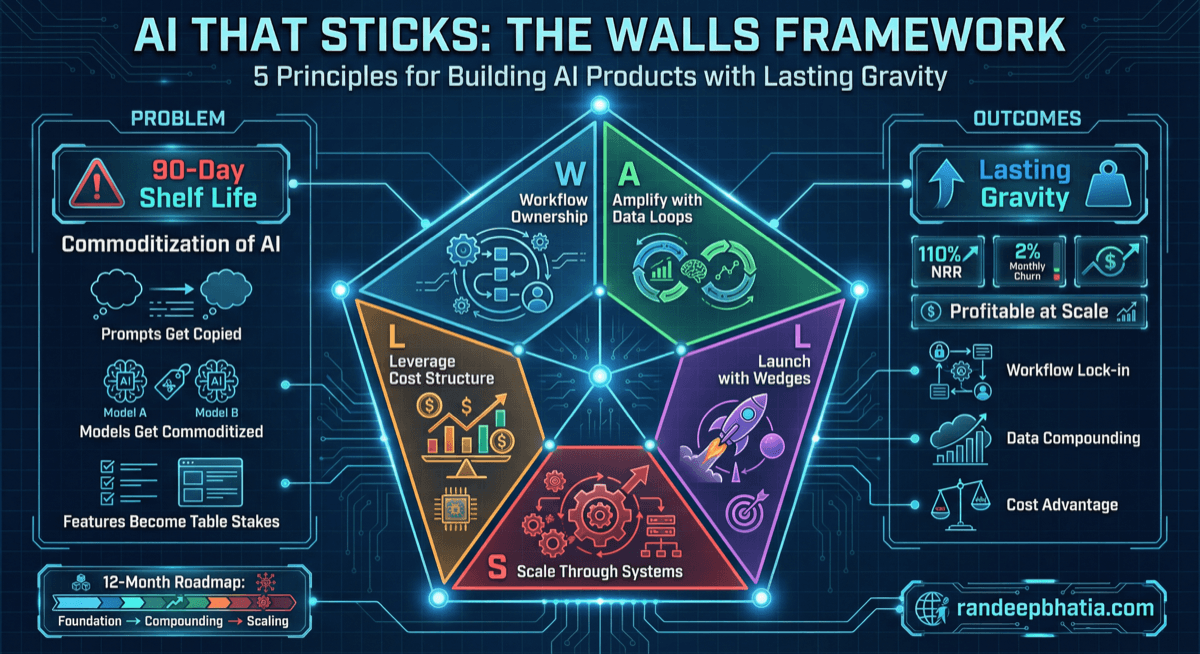
The WALLS Framework

AI That Sticks

Why most AI products get abandoned in 90 days—and the 5 principles that create lasting gravity

15 min readBy Randeep Bhatia5 Core Principles

Your AI product has a 90-day shelf life. Someone just forked your prompt strategy on Twitter, swapped in Claude instead of GPT-4, and launched a competitor by Tuesday. Sound familiar?

Core Thesis

The AI gold rush has created a dangerous myth: that AI capabilities alone create stickiness. They don't. After shipping AI products at scale for the past 4 years, I've learned that lasting AI products are built on workflow ownership, compounding data loops, and smart economics—not from picking the 'best' foundation model or having clever prompts. I call this the WALLS Framework.

Who This Is For

  • Engineering leaders building AI products at startups or enterprises
  • Product managers defining AI product strategy
  • CTOs evaluating build vs. buy decisions for AI capabilities
  • Founders looking to create AI products with lasting gravity

What You'll Learn

  • W: Why Workflow ownership creates gravity that AI capabilities can't
  • A: How to Amplify your product with data loops that compound
  • L: How to Leverage cost structure as a strategic weapon
  • L: How to Launch with wedges that make adoption effortless
  • S: How to Scale through systems, not headcount

The Context

The Problem

The commoditization of AI is happening faster than anyone predicted. GPT-4's capabilities are now available in a dozen models. Vector databases are all converging on similar features. RAG implementations get copied in weeks. Yet some AI products create lasting gravity while others get abandoned for the next shiny thing. The difference isn't technical sophistication—it's strategic architecture.

Common Misconceptions

Better prompts create stickiness (they don't—they get copied in days)

Proprietary data is enough (it's not—you need a generation loop, not just storage)

First-mover advantage matters in AI (it doesn't—fast followers win regularly)

Building on the latest model creates gravity (it creates a liability when that model gets commoditized)

AI features alone make products sticky (they're table stakes within 6 months)

Reality Check

Here's the uncomfortable truth: if your product's gravity disappears when OpenAI or Anthropic releases their next model, you don't have a product—you have a demo. Stickiness in AI comes from owning the workflow, not the model.

The WALLS Framework

Five principles for building AI products that stick: Workflow • Amplify • Leverage • Launch • Scale

Click any principle to expand details below ↓

?Why This Matters

The biggest mistake I see teams make is building 'AI-first' instead of 'workflow-first.' They obsess over prompt engineering and model selection while ignoring the critical question: what workflow are you replacing or creating? Here's the reality: ChatGPT and Claude are functionally identical to most users. The stickiness isn't in picking the better model—it's in owning the end-to-end workflow that the AI enables. Think about how GitHub Copilot succeeded: not by having the best code model, but by embedding into the developer's actual workflow (the IDE, the commit process, the review cycle). The AI is infrastructure. The workflow is the product.

How To Implement

Map the user's current workflow from trigger to outcome—every step, every tool switch, every copy-paste. Identify the 'tax points' (manual steps, context switching, data re-entry). Then design your AI product to eliminate 3+ tax points while staying inside a single workflow container. For example, if you're building AI for sales teams, don't build 'AI that writes emails.' Build a system that lives in their CRM, auto-enriches contacts from calendar events, generates personalized outreach based on meeting notes, and tracks engagement—all without leaving Salesforce. The goal is to make your product the 'path of least resistance' for a critical workflow.

Good Example

Notion AI lives inside Notion where users already work. You're writing a doc, hit space, get AI suggestions, keep writing. Zero context switch. The workflow container (Notion docs) is already sticky; AI makes it stickier.

Bad Example

A 'better ChatGPT for X' that requires uploading files, describing context, waiting for output, then manually integrating results back into your tools. Users churn the moment OpenAI adds that vertical feature.

Anti-Pattern to Avoid

Building a standalone AI chatbot that requires users to copy data from their work tools, paste into your interface, get AI output, then paste back into their work tools. Every copy-paste is a churn risk. Every tool switch is a friction point. Every 'new tab' is a moment where they might just use ChatGPT instead.

Checklist

  • Can users complete their workflow end-to-end in your product without tool-switching?
  • Does your AI enhance an existing habit or require forming a new one?
  • If your AI stopped working tomorrow, would users still open your product?
  • Are you capturing workflow context that competitors can't easily replicate?

Timeline

Workflow lock-in takes 90 days minimum. Week 1-4: Ship basic workflow automation (even without AI). Week 5-8: Layer in AI enhancements. Week 9-12: Add workflow customization. Users who customize a workflow have 80% higher retention at 6 months.

?Why This Matters

Every AI company claims 'we have proprietary data.' But if that data just sits in a vector database getting queried, it's not creating gravity—it's a cost center. The real stickiness comes when user interactions generate data that makes your product better for all users, which attracts more users, which generates more data. This is the difference between Netflix (viewing data improves recommendations for everyone) and a basic RAG chatbot (your queries don't improve my experience). Most teams build the database. Few build the loop.

How To Implement

Design three connected systems: (1) Capture: Log every user interaction, correction, and outcome. Not just what they asked, but what they did with the answer. (2) Improve: Use this data to fine-tune models, update prompts, refine ranking algorithms, or enrich your knowledge base. This should be automated, not manual. (3) Redistribute: Ensure improvements benefit all users, not just the one who generated the signal. For example, when one user corrects an AI-generated code snippet, that correction should improve code suggestions for similar contexts for all users. The loop should complete in days, not months. If you're doing quarterly retraining, you're not compounding—you're batching.

Good Example

Grammarly's correction loop: Users see suggestions, accept/reject them, and those signals improve suggestions for similar writing contexts. After billions of corrections, Grammarly knows which suggestions users actually want in different scenarios. That's nearly impossible to replicate.

Bad Example

A legal AI that searches a static database of case law. Every query is the same experience. No learning, no improvement, no stickiness. A competitor with the same case law database (which is public!) is functionally identical.

Anti-Pattern to Avoid

Building a RAG system that retrieves from a static knowledge base. User queries come in, answers go out, nothing changes. Six months later, your knowledge base is stale and your AI is as good as day one. Meanwhile, competitors with compounding loops have pulled ahead.

Checklist

  • Does user feedback automatically improve the product for others?
  • Can you quantify the improvement rate? (e.g., 'accuracy improves 2% per 10K interactions')
  • Do you have instrumentation to track data loop velocity?
  • Is there a flywheel where better AI → more users → better data → better AI?

Timeline

Month 1: Instrument everything. Month 2-3: Build improvement pipelines. Month 4-6: Automate redistribution. Month 7+: Measure and optimize loop velocity. The goal is to halve the 'time to improvement' every quarter.

?Why This Matters

Everyone obsesses over 'best in class' AI. But most users don't need best in class—they need good enough at a price that makes economic sense. This is where scrappy startups beat Big Tech: by optimizing for cost structure instead of capability ceiling. I've seen this play out repeatedly: a startup builds a narrow AI product using smaller models, aggressive caching, and smart prompt routing, delivers it at 1/10th the cost of GPT-4-powered competitors, and wins SMB and mid-market segments that were price-sensitive. Big Tech can't compete there without cannibalizing their enterprise margins. Cost structure is strategy.

How To Implement

Build a multi-tier inference strategy: (1) Triage: Route 60-70% of requests to smaller, cheaper models (GPT-3.5, Claude Instant, or fine-tuned OSS models). (2) Escalate: Send complex requests to expensive models only when needed. (3) Cache aggressively: Semantic caching can eliminate 30-40% of LLM calls for common queries. (4) Compress: Use prompt compression techniques to reduce token counts by 40-60% without losing quality. (5) Batch: Combine requests when possible to leverage batch processing discounts. For example, instead of calling GPT-4 for every query, use a classifier to identify 'hard' queries (20% of traffic), route those to GPT-4, handle 'easy' queries (80%) with GPT-3.5. You just cut costs by 70% with minimal quality impact. Then pass those savings to customers.

Good Example

Jasper (AI writing tool) built a sophisticated routing system: simple blog intros use GPT-3.5, complex long-form content uses GPT-4, and they fine-tuned smaller models for specific content types. This let them offer a $49/month plan that was profitable at scale, while competitors using GPT-4 for everything couldn't go below $199/month without bleeding money.

Bad Example

A customer service AI that uses GPT-4 for every response. A human support agent costs $15/hour and handles 6 tickets/hour ($2.50/ticket). Your AI costs $0.40 in LLM fees per response. You can only undercut humans by 6x, not the 50x that would make this a no-brainer purchase. Bad unit economics kill adoption.

Anti-Pattern to Avoid

Using GPT-4 for everything because it's 'the best.' Sure, it scores 2% higher on benchmarks. But it costs 30x more than GPT-3.5. Your unit economics are terrible, you can't compete on price, and you're stuck in enterprise-only markets. When OpenAI inevitably drops prices, your only differentiator evaporates.

Checklist

  • What's your cost per user action? (Track this religiously)
  • Can you deliver 80% of premium model quality at <20% of the cost?
  • Do you have automated routing between model tiers?
  • Are you caching aggressively? (Target: 30%+ cache hit rate)

Timeline

Week 1-2: Instrument cost per action. Week 3-4: Build routing logic. Week 5-6: Implement caching. Week 7-8: Test quality vs. cost trade-offs. Week 9-12: Optimize and monitor. You should see 50-70% cost reduction within 90 days while maintaining quality.

?Why This Matters

I've watched too many teams build technically superior AI products that failed because they couldn't get distribution. Meanwhile, inferior products with clever adoption wedges captured markets. Here's the harsh reality: your AI needs to be 10x better to overcome switching costs. Or—and this is the smarter play—you need a wedge that makes adoption trivial. A wedge is a mechanism that delivers immediate value with zero setup, creating a forcing function for usage. Think about how Superhuman grew: not by building the best email client, but by making the onboarding so good that people wanted the product. In AI, wedges are even more critical because skepticism is high.

How To Implement

Identify your 'aha moment'—the instant where users see value. Then design a wedge that delivers that moment in under 60 seconds. Wedge patterns that work: (1) Import existing data: 'Connect your Slack, we'll analyze your team communication in 30 seconds.' Instant value, zero manual work. (2) Free tier with viral loop: 'Get AI analysis of your code repo. Share results with your team, they get free access.' Each user brings more users. (3) Embed in existing workflow: 'Install our Chrome extension, get AI suggestions in tools you already use.' No behavior change required. (4) Value before signup: 'Paste your text, get AI improvements immediately. Sign up to save.' Lower barrier to first value. The key is making the first interaction so valuable that users want to deepen the relationship.

Good Example

Loom's AI summaries: You're already using Loom for video. They added a button: 'Get AI summary.' One click, instant value, zero setup. Usage went from 0 to 40% of videos in 3 months. The wedge was embedding in existing workflow and making value instant.

Bad Example

An AI product that requires: (1) uploading your company data, (2) defining custom taxonomies, (3) training the model for a week, (4) then maybe it works. Most users churn at step 1. The ones who make it to step 4 are already heavily invested (sunk cost fallacy), but you've lost 95% of potential users.

Anti-Pattern to Avoid

Requiring users to: sign up, integrate 5 tools, configure settings, train the AI, wait 24 hours for processing, and then maybe see value. Every step is a 50% drop-off. You just lost 97% of potential users. Or building 'AI for everyone' with no specific wedge. Generic products don't go viral. Specific wedges do.

Checklist

  • Can users see value in under 60 seconds?
  • Is your wedge repeatable or one-time? (Repeatable wedges compound)
  • Does usage create a forcing function for deeper adoption?
  • Are you tracking 'time to aha moment' as a core metric?

Timeline

Week 1-2: Identify your 'aha moment' through user interviews. Week 3-4: Design wedge to deliver that moment instantly. Week 5-8: Ship, measure, iterate. Target: Get 'time to aha' under 60 seconds within 8 weeks. Then optimize conversion from wedge to core product.

?Why This Matters

The most insidious trap in AI products is building something that works beautifully at 10 users but collapses at 1,000. I've seen this pattern dozens of times: a team builds an AI product with lots of manual intervention (human review of outputs, custom prompt engineering per customer, manual data labeling). It works great for early adopters who get white-glove treatment. Then they try to scale, and they realize they need to hire a human for every 50 users. That's not a product, that's a consulting business with an API. The only way to scale profitably is to build systems that handle edge cases, quality control, and improvement loops automatically. No humans in the critical path.

How To Implement

Design for autonomous operation from day one: (1) Automate quality control: Build evals that run automatically on every output. If quality drops below threshold, trigger alerts or fallback to safer models—no human needed. (2) Self-healing prompts: When evals catch failures, automatically A/B test prompt variations to fix them. Use LLMs to generate prompt improvements based on failure patterns. (3) Tiered support: 80% of issues should self-resolve through in-app guidance, 15% through automated escalation paths, 5% through human support. If you're trending above 10% human involvement, your systems aren't good enough. (4) Customer self-service: Let users configure, customize, and troubleshoot without contacting you. Build admin panels, debugging tools, and clear documentation. (5) Usage-based pricing: Charge for value delivered, not seats. This aligns your incentives with automation (more value per customer at lower cost = higher margins).

Good Example

Zapier's AI automation: Users configure workflows through a visual interface, AI helps with mapping and suggestions, and the system automatically validates and tests integrations. They scaled to millions of workflows with minimal human intervention because the system handles edge cases automatically (graceful failures, auto-retry logic, clear error messages).

Bad Example

An AI analytics platform that requires data scientists to manually review every dashboard before sending it to customers. This ensures quality but requires 1 data scientist per 20 customers. They can't scale beyond $2M ARR without hiring a team of 100 data scientists. The founder keeps saying 'we'll automate this eventually,' but eventually never comes because they're too busy hiring more data scientists.

Anti-Pattern to Avoid

Building a 'high-touch' AI product where every customer gets custom prompt engineering, manual training data curation, and dedicated success managers. This works for 10 enterprise customers at $200K each. But you can't scale to 1,000 SMB customers at $10K each—your CAC and support costs are too high. You're stuck in a local maximum. Or assuming 'AI will figure it out' without building systems to verify, correct, and improve. Your AI makes mistakes, users get frustrated, churn is high. You hire support staff to manually fix issues. Your unit economics get worse as you scale.

Checklist

  • What percentage of workflows require human intervention? (Target: <5%)
  • Can customers onboard and see value without talking to you?
  • Do you have automated systems for quality control, not manual review?
  • Are you tracking 'human hours per 1000 users' as a metric?

Timeline

This is a day-one decision. If you build with humans in the loop initially, it's nearly impossible to remove them later (technical debt + customer expectation debt). Start with automated systems from week 1, even if they're imperfect. Improve them over time. If you wait until you 'need to scale,' it's too late.

Bonus Content

Advanced Execution Patterns

These tactical patterns complement the 5 core principles. Reference them as you scale your AI product.

Advanced Pattern

Build vs. Buy Decision Matrix

Build what compounds. Buy what commoditizes.

The AI landscape moves so fast that build vs. buy decisions from 6 months ago are often wrong today. The decision matrix is simple: if a component will generate compounding data or workflow stickiness, build it. If it's infrastructure that's commoditizing, buy it.

Good

A legaltech startup bought: vector database (Pinecone), embeddings (OpenAI), and base LLM (GPT-4). They built: a proprietary citation system, domain-specific ranking algorithm, and workflow automation. Bought = commodities. Built = defensible.

Bad

A startup spent 8 months building a custom vector database. Pinecone shipped those features in month 6. $400K burned on a $100/month SaaS product.

Run this framework quarterly. AI infrastructure commoditizes in 6-12 month cycles.
Advanced Pattern

Design for Iteration Speed, Not Perfection

In AI, the team that learns fastest wins. Perfect is the enemy of shipped.

AI products are fundamentally different from traditional software: you can't fully spec them upfront. User behavior with AI is unpredictable. Edge cases are infinite. Quality is subjective. The winning strategy is to ship fast, instrument everything, and iterate based on real user behavior.

Good

Perplexity shipped with 75% accuracy but deep instrumentation. They tracked everything, shipped updates every 2 weeks. Six months later: 92% accuracy and knew exactly what to fix next.

Bad

A team spent 6 months building to 95% accuracy on benchmarks. Users hated it—not accuracy, but latency and workflow issues. Should have shipped at 80% in 6 weeks and learned.

Roadmap

Implementation Timeline

Foundation (Month 1-2)

Weeks 1-8

1

Focus Areas

Map target workflow end-to-endBuild MVP with basic workflow ...Instrument every interactionSet up eval framework

Key Deliverables

  • Workflow diagram with tax points identified
  • Shipped MVP (even without AI)
  • Instrumentation dashboard tracking key actions

Watch Out For

  • Trying to build 'perfect AI' before validating workflow fit
  • Skipping instrumentation because 'we'll add it later'

Compounding (Month 3-6)

Weeks 9-24

2

Focus Areas

Layer in AI enhancements to wo...Build data collection → improv...Implement multi-tier model rou...Ship adoption wedge

Key Deliverables

  • AI features integrated into core workflow
  • Automated improvement pipeline processing user feedback
  • Cost reduced by 50%+ through smart routing and caching

Watch Out For

  • Adding AI features that don't enhance the core workflow
  • Building data loops that take months to complete (too slow)

Scaling (Month 7-12)

Weeks 25-52

3

Focus Areas

Remove humans from critical pa...Build self-healing systems for...Automate customer onboarding a...Optimize data loop velocity

Key Deliverables

  • Autonomous quality control system (no manual review)
  • Self-service onboarding with <10% human touchpoints
  • Data loop completing in days, not weeks

Watch Out For

  • Scaling before unit economics are profitable (you'll burn cash)
  • Building custom solutions for every large customer (kills scalability)

Leading Indicators

  • Time to aha moment (target: <60 seconds)
  • Workflow completion rate (target: >80%)
  • Cost per user action (track weekly, aim to halve quarterly)
  • Data loop velocity (time from user signal to product improvement)
  • Cache hit rate (target: >30%)
  • Eval pass rate (target: >85%, trending up)

Lagging Indicators

  • Net revenue retention (target: >110% for sticky products)
  • Time to replace your product (how long would it take competitor to replicate?)
  • Customer acquisition cost vs. lifetime value (aim for 1:3 or better)
  • Percentage of revenue from users who've been customers >12 months
  • Market share in target segment (are you winning?)
Real Examples

Case Studies

See these principles in action

1

Cascade (anonymized B2B AI writing tool)

The Situation

Launched AI content generation tool in 2022 using GPT-3.5. Great early traction (500 paying customers), but churn was 8% monthly. Users would use it for a few weeks, then switch to ChatGPT Plus. No stickiness. Founder was worried they'd be dead when OpenAI added their features.

ProblemApproachOutcome

Outcome

18 months later: churn dropped to 2% monthly, NRR hit 125%, and they were profitable at $4M ARR. The key: workflow lock-in + compounding data loop made switching costs high. When OpenAI launched GPT-4 Turbo with better writing, it didn't matter—users stayed because Cascade owned the workflow and understood their writing style better than a generic chatbot could.

Key Lesson

AI capabilities are table stakes. Workflow ownership + compounding data = stickiness. Focus on the job-to-be-done, not the AI.

Principles:
123
2

NexusIQ (anonymized AI code review tool)

The Situation

Built technically superior code review AI—better than Copilot on their internal benchmarks. Spent 9 months perfecting the model, launched with a free tier, got 10K signups. But usage dropped 90% after week one. Founder couldn't understand why their 'better' AI wasn't winning.

ProblemApproachOutcome

Outcome

6 months post-pivot: 40K MAU (4x growth), 15% converting to paid, and healthy NRR. The breakthrough was distribution (IDE plugins + GitHub integration) and the adoption wedge (instant PR reviews). Their AI wasn't better than before—their product was.

Key Lesson

Distribution beats innovation. Your AI can be 2x better, but if it requires behavior change, you'll lose to an inferior product with better distribution. Make the first interaction frictionless.

Principles:
142
3

LegalLens (anonymized legaltech AI)

The Situation

Built AI for contract review. Enterprise-focused, $200K/year contracts, very high touch (dedicated success manager, custom training for each client). Signed 5 customers in year one, but couldn't scale—each customer required 200 hours of services team time for onboarding and maintenance. Math didn't work: $200K revenue, $150K cost-to-serve. Founder realized they'd built a consulting business, not a product.

ProblemApproachOutcome

Outcome

18 months later: 150 SMB customers ($300K MRR), 8 enterprise customers ($1.6M ARR), and a lean team of 12 (vs. needing 40+ for the high-touch model). Gross margin went from 25% to 78%. The key: designing for scale from the start. Systems, not humans, in the critical path.

Key Lesson

If your AI product needs linear headcount to scale, fix it now—not when you 'need to scale.' High-touch feels good early but kills you at scale. Build systems that work autonomously from day one.

Principles:
534
4

DataPulse (anonymized AI analytics tool)

The Situation

Built AI that generated dashboards and insights from raw data. Technically impressive, but CAC was $15K and payback period was 18 months. Every customer required heavy sales engineering, custom integrations, and ongoing support. They were stuck at $3M ARR with 80% of revenue going to sales and support costs. Not venture-scale.

ProblemApproachOutcome

Outcome

12 months post-pivot: 5K users (50x growth), $800K ARR (still early but healthier trajectory), and CAC dropped to $500 with 6-month payback. More importantly, they had a viable wedge to land users, prove value, then expand to teams. The path to $50M ARR was now clear.

Key Lesson

Distribution strategy matters as much as product quality. If your wedge requires 6-month sales cycles and $50K budgets, you'll never get to volume. Find ways to get into users' hands instantly—then expand from there.

Principles:
413
5

PersonalContext (anonymized consumer AI app)

The Situation

Built a 'ChatGPT but with your personal context' app. Users uploaded docs, connected calendars/email, and got personalized AI responses. Great concept, terrible retention. 70% of users churned in month one. The problem: setup took 30+ minutes (connecting accounts, uploading files, configuring privacy settings), and the payoff was unclear. Most users quit before seeing value.

ProblemApproachOutcome

Outcome

Time to first value went from 30 minutes to 30 seconds. Month-one retention jumped from 30% to 68%. Users who connected 2+ accounts had 85% retention at 6 months. The key: instant value before asking for commitment, then progressive onboarding that made each step feel valuable.

Key Lesson

Never ask users to set up your product before they've seen value. Lead with instant gratification, then progressively deepen the relationship. Every setup step is a 50% drop-off. Design backwards from the aha moment.

Principles:
412
Resources

Tools & Templates

Workflow Lock-In Scorecard

Assess how defensible your product workflow is

1

Data Loop Health Check

Measure if your data is compounding or stagnating

2

Cost Structure Analysis Template

Understand your AI unit economics and identify optimization opportunities

3

Adoption Wedge Canvas

Design viral, low-friction entry points to your product

4

System Autonomy Audit

Identify where humans are still in the loop (and remove them)

5

Build vs. Buy Decision Matrix

Stop wasting time building commoditized infrastructure

Watch Out

Common Mistakes

Optimizing for benchmark performance instead of user outcomes

Why it fails: Benchmarks measure AI capabilities in isolation. Users care about end-to-end workflow performance. Your AI can score 95% on MMLU but still deliver a terrible user experience if it's slow, expensive, or doesn't integrate with their tools. I've seen teams obsess over evals while ignoring that users are churning because the product is clunky.

Instead: Measure what users care about: time saved, tasks completed, errors caught, money made. Then work backwards to AI quality. If users are happy with 85% accuracy but 2-second latency, don't waste time getting to 95% accuracy at 8-second latency. Optimize for the user outcome, not the eval score.

Building a 'better ChatGPT' for a vertical

Why it fails: This strategy was viable for about 6 months in 2023. It's not anymore. OpenAI and Anthropic will add your vertical features faster than you can build defensibility. You're competing on a dimension (raw AI capability) where you're structurally disadvantaged—they have more compute, data, and capital than you ever will. Plus, users already have ChatGPT muscle memory. Switching costs are near zero.

Instead: Build the workflow container that uses AI as infrastructure. Don't compete on AI quality; compete on workflow ownership, domain expertise, and data compounding. If your pitch starts with 'We're like ChatGPT but for X,' you're already losing. Start with the workflow: 'We help X professionals do Y task 10x faster by...' The AI is implementation detail.

Treating AI quality as a one-time project

Why it fails: AI products degrade over time. User expectations increase (what felt amazing 6 months ago is now table stakes). User behavior shifts (they find edge cases you didn't anticipate). Foundation models change (your prompt engineering breaks when GPT-5 launches). Competitors improve (their AI gets better, yours stays static). If you're not continuously calibrating, you're falling behind—even if you shipped with great quality on day one.

Instead: Build AI quality improvement into your product development process. Continuous evals, automated analysis of failures, rapid iteration cycles. Your AI quality should be measurably better every month. If it's not, you're doing it wrong. Treat AI products like living systems that need constant tuning, not like traditional software that's 'done' when shipped.

Ignoring cost structure until scale

Why it fails: Unit economics set in early. If you build your product around GPT-4 for everything because you're only serving 100 users and costs are manageable ($500/month in LLM fees), you'll hit a wall at 10,000 users ($50K/month). You can't easily refactor to cheaper models without breaking prompts and user expectations. Meanwhile, your pricing is locked in—you can't 10x prices to match costs. You're stuck with bad margins or need to rebuild the product.

Instead: Design for cost efficiency from day one. Even if you're early and costs are low, build the architecture for multi-tier model routing, caching, and cost optimization. It's much easier to swap in GPT-4 for complex queries later than to refactor from GPT-4-for-everything to a cost-optimized architecture. Track cost-per-action from week one and optimize it like any other product metric.

Building for enterprises first

Why it fails: Enterprise deals feel validating—big logos, big checks. But they're often a trap for AI startups: long sales cycles (9-12 months), heavy customization requirements, slow iteration speed (can't break features for F500 clients), and services revenue disguised as product revenue. Worst of all, enterprise customers don't help you learn fast—they have unique requirements that don't generalize to the broader market. By the time you've customized for 5 enterprise clients, you have 5 different products and no scalable core.

Instead: Build for SMB or prosumer initially. Fast sales cycles, high-volume feedback, pressure to automate (because you can't afford white-glove service). Learn what actually creates value, build a scalable core product, then move upmarket with a product-led growth motion. Enterprises will buy the SMB product if it's good enough. But the reverse rarely works—enterprise products are too complex and expensive to scale down.

Copying Big Tech's AI strategy

Why it fails: What works for Google, OpenAI, or Microsoft doesn't work for startups. They can afford to burn $100M on R&D, train proprietary models, and give away products for free to build market share. You can't. They're playing a different game—they're building platforms and defensibility through scale. You need to win on speed, specialization, and workflow ownership. Trying to out-Google Google on AI infrastructure is a losing strategy.

Instead: Lean into your advantages: speed (ship in weeks, not years), focus (go deep on one workflow vs. building everything), and customer intimacy (you can understand niche users better than Big Tech can). Use their models as infrastructure. Build your stickiness on workflow, data loops, and domain expertise—not on trying to build a better foundation model. Know what game you're playing.

Take Action

Next Steps

This Week

  • Map your target user's workflow end-to-end. Identify 3 'tax points' (friction, manual steps, tool switching) your product could eliminate.
  • Set up instrumentation for every user interaction. If you're not logging inputs, outputs, and outcomes, you can't improve.
  • Calculate your current cost-per-action. Track it weekly. Set a goal to halve it within 90 days.
  • Define your 'aha moment' (the instant users see value) and measure how long it takes users to get there. Aim for under 60 seconds.
  • Run the System Autonomy Audit on your current architecture. Where are humans in the loop? Start planning to remove them.

This Month

  • Design and ship an adoption wedge: instant value with zero setup. Test time-to-aha and conversion rate to core product.
  • Build your first data compounding loop: user signal → product improvement → better experience for all users. Start small, iterate.
  • Implement multi-tier model routing: route simple requests to cheap models, complex to expensive. Measure cost savings and quality delta.
  • Audit your systems for human dependencies. For each manual step, build automated alternative. Aim to remove 50% of human touchpoints within 3 months.

Ongoing

  • Run quarterly WALLS reviews: score your product on all 5 principles. Track trend over time.
  • Continuously optimize cost structure. AI infrastructure costs drop 30-50% annually. Make sure your product benefits from those improvements.
  • Measure and strengthen your stickiness metrics: data loop velocity, workflow completion rates, time to replicate, NRR. These should improve month-over-month.
  • Stay paranoid about commoditization. What you built today will be a feature in a foundation model tomorrow. Always be building the next layer of defensibility.
  • Share your learnings. The AI community moves fast. Contribute frameworks, case studies, and open-source tools. You'll attract customers, talent, and partners.

Ready to Build AI That Sticks?

I've helped dozens of teams design and ship AI products with lasting gravity. Whether you need strategic guidance on the WALLS Framework, technical architecture for cost optimization, or hands-on support building compounding data loops, I can help. Let's talk about your product and map out a path to stickiness.