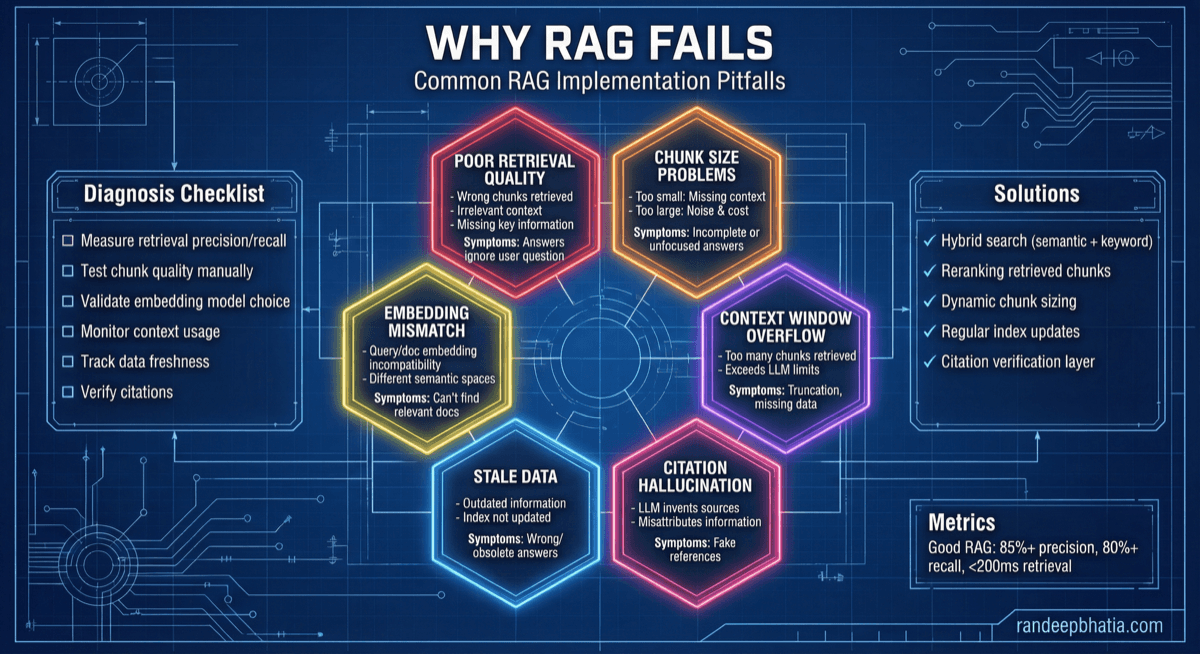
Why RAG Fails in Production
Executive Summary
Executive Summary
RAG fails in production due to compounding errors across retrieval quality, context assembly, embedding drift, chunking misalignment, and the fundamental mismatch between semantic similarity and task relevance.
Retrieval failures account for 60-70% of RAG system errors, stemming from poor chunking strategies, embedding model limitations, query-document semantic gaps, and metadata filtering failures that compound before the LLM ever sees the context.
Production RAG systems face unique challenges absent in demos including embedding drift over time, index staleness, query distribution shift, adversarial inputs, and the cold-start problem for new document types that weren't represented in embedding training.
The gap between semantic similarity (what vector search optimizes for) and task relevance (what users actually need) represents the fundamental architectural limitation of RAG that requires hybrid retrieval, re-ranking, and query transformation to address.
The Bottom Line
RAG systems fail in production not because of a single point of failure but due to cascading errors across a complex pipeline where each component—chunking, embedding, indexing, retrieval, re-ranking, and context assembly—introduces failure modes that multiply rather than add. Success requires treating RAG as a distributed system with proper observability, fallback mechanisms, and continuous evaluation rather than a simple retrieve-and-generate pattern.
Definition
Definition
RAG production failures encompass the systematic breakdown of retrieval-augmented generation systems when deployed at scale, characterized by retrieval of irrelevant or incomplete context, embedding quality degradation, context window mismanagement, and the fundamental disconnect between vector similarity and actual information relevance.
These failures manifest as incorrect answers despite correct information existing in the knowledge base, hallucinations grounded in partially relevant but misleading retrieved content, latency spikes during peak usage, and gradual accuracy degradation as the underlying corpus evolves without corresponding system updates.
Extended Definition
Production RAG failures represent a distinct category of system failures that emerge only when retrieval-augmented generation moves from controlled demonstrations to real-world deployment with diverse queries, evolving document corpora, and user expectations of consistent accuracy. Unlike simple retrieval system failures that return no results or obviously wrong results, RAG failures are often subtle—the system returns plausible-sounding answers that are factually incorrect because the retrieved context was semantically similar but not actually relevant to the query intent. These failures compound across the RAG pipeline: chunking strategies that fragment critical information across multiple chunks, embedding models that fail to capture domain-specific semantics, vector indices that become stale as documents update, retrieval algorithms that optimize for similarity rather than relevance, and context assembly strategies that exceed token limits or include contradictory information. The production environment introduces additional failure modes including query distribution shift from training data, adversarial or malformed inputs, concurrent access patterns that stress infrastructure, and the organizational challenge of maintaining document freshness across distributed teams.
Etymology & Origins
The term 'RAG failures' emerged from the machine learning operations community circa 2023-2024 as organizations moved from proof-of-concept RAG implementations to production deployments and encountered systematic failure patterns not present in academic evaluations. The terminology draws from both the retrieval systems literature (precision/recall failures) and the LLM reliability discourse (hallucinations, prompt injection), combining them to describe the unique failure modes that emerge at the intersection of information retrieval and generative AI.
Also Known As
Not To Be Confused With
LLM hallucinations
LLM hallucinations occur when the model generates false information from its parametric knowledge, while RAG failures specifically involve the retrieval component returning wrong or incomplete context that then causes the LLM to generate incorrect responses—the LLM may be functioning correctly but receiving bad input.
Traditional search failures
Traditional search failures involve keyword matching or BM25 ranking issues, while RAG failures encompass the additional complexity of embedding-based semantic search, the interaction between retrieved context and generative models, and the challenge of assembling coherent context from multiple retrieved chunks.
Fine-tuning degradation
Fine-tuning degradation refers to model performance decline after training on domain data, while RAG failures occur in systems that rely on external retrieval rather than embedded knowledge—RAG failures can happen even with a perfectly functioning base LLM.
Prompt injection attacks
Prompt injection attacks are adversarial attempts to manipulate LLM behavior through malicious input, while RAG failures are typically non-adversarial system breakdowns caused by architectural limitations, data quality issues, or operational problems in the retrieval pipeline.
Vector database outages
Vector database outages are infrastructure failures where the database becomes unavailable, while RAG failures can occur even when all infrastructure is functioning—the system returns results, but those results are wrong or incomplete for the given query.
Context window overflow
Context window overflow is one specific type of RAG failure where retrieved content exceeds token limits, but RAG failures encompass a much broader category including retrieval relevance issues, embedding quality problems, and chunking misalignment that occur well within context limits.
Conceptual Foundation
Core Principles
(8 principles)Mental Models
(6 models)The Telephone Game
RAG failures can be understood as a game of telephone where the original message (user intent) passes through multiple transformations (query embedding, similarity search, chunk retrieval, context assembly, generation) with each step potentially introducing distortion. The final output may be completely disconnected from the original intent despite each individual step appearing reasonable.
The Library with a Bad Catalog
A RAG system is like a library where the catalog (vector index) may not accurately describe the books (documents), the librarian (retrieval system) can only find books listed in the catalog, and the reader (LLM) can only work with books the librarian provides. Even if the perfect book exists, failures in cataloging or retrieval mean it never reaches the reader.
The Leaky Pipeline
Each stage of the RAG pipeline is a filter that can leak relevant information (false negatives) or let through irrelevant information (false positives). The cumulative effect of multiple leaky stages means that even small per-stage error rates result in significant end-to-end degradation.
The Translation Problem
RAG involves multiple 'translations': user intent to query, query to embedding, embedding to retrieved documents, documents to context, context to response. Each translation crosses a semantic gap where meaning can be lost or distorted, similar to translating between languages where some concepts don't have direct equivalents.
The Iceberg Problem
RAG failures visible to users (wrong answers) represent only the tip of the iceberg. Below the surface are near-misses (correct answer was retrieved but not selected), silent failures (user didn't notice the error), and latent failures (system returned correct answer by luck, not design). The visible failures indicate much larger systemic issues.
The Ensemble Voting Problem
When multiple chunks are retrieved, the RAG system must somehow aggregate potentially conflicting information. This is analogous to ensemble voting where different 'voters' (chunks) may disagree, and the aggregation strategy (how the LLM synthesizes context) determines the final outcome. Poor aggregation can produce worse results than any individual voter.
Key Insights
(10 insights)The most common RAG failure mode is not retrieving nothing, but retrieving plausible-but-wrong context that the LLM then faithfully synthesizes into a confident incorrect answer—these failures are harder to detect than obvious retrieval failures.
Embedding model selection has more impact on RAG quality than LLM selection in most production systems, yet organizations typically spend 10x more time evaluating LLMs than embedding models.
Chunking strategy failures are often invisible during development because test queries are unconsciously designed to align with chunk boundaries—production queries have no such alignment.
RAG systems trained on clean, well-structured documents often fail catastrophically on real-world documents with tables, images, headers, footers, and formatting that chunking strategies weren't designed to handle.
The 'needle in a haystack' problem is actually multiple problems: finding the needle (retrieval), recognizing it's a needle (relevance), and not being distracted by similar-looking hay (noise filtering).
Query distribution shift between development and production is the single largest source of unexpected RAG failures—users ask questions in ways developers never anticipated.
Re-ranking is not optional for production RAG—initial retrieval optimizes for recall (finding candidates) while re-ranking optimizes for precision (selecting the best), and skipping re-ranking conflates these distinct objectives.
Most RAG evaluation frameworks measure retrieval and generation separately, missing the critical interaction effects where good retrieval plus good generation can still produce bad results due to context assembly failures.
The cold-start problem for new document types is underappreciated—embedding models may completely fail to represent documents from domains not seen during training, causing systematic retrieval failures for entire document categories.
Hybrid retrieval (combining vector search with keyword/BM25) often outperforms pure vector search not because vectors are bad, but because they fail in predictable ways that keyword search handles well, and vice versa.
When to Use
When to Use
Ideal Scenarios
(12)When debugging a production RAG system that was working in development but fails on real user queries, indicating query distribution shift or edge cases not covered in testing.
When RAG system accuracy metrics show gradual degradation over time without obvious changes to the system, suggesting index staleness, embedding drift, or corpus evolution issues.
When users report that the system 'knows' information but fails to retrieve it for certain query phrasings, indicating semantic gap between query and document embeddings.
When RAG responses contain factually incorrect information despite the correct information existing in the knowledge base, pointing to retrieval relevance or context assembly failures.
When system latency increases significantly under load, suggesting retrieval infrastructure scaling issues or inefficient context assembly strategies.
When adding new document types to the corpus causes disproportionate accuracy drops, indicating embedding model domain limitations or chunking strategy mismatches.
When RAG system performs well on short, specific queries but fails on complex, multi-part questions requiring information synthesis across multiple documents.
When the same query returns inconsistent results across multiple invocations, indicating non-deterministic retrieval or context assembly behavior.
When RAG system accuracy varies significantly across different document sources or formats within the same corpus, suggesting inconsistent preprocessing or indexing.
When production monitoring shows high retrieval latency but low generation latency, indicating that the retrieval pipeline rather than the LLM is the bottleneck.
When user feedback indicates the system provides outdated information despite recent document updates, pointing to index refresh or document versioning failures.
When RAG system handles English queries well but fails on queries in other languages or with code-mixed text, indicating embedding model language limitations.
Prerequisites
(8)Established RAG system in production or late-stage development with measurable accuracy and latency baselines against which failures can be identified.
Logging and observability infrastructure that captures queries, retrieved chunks, relevance scores, and generated responses for failure analysis.
Access to the document corpus, chunking configuration, embedding model details, and retrieval parameters to investigate root causes.
Understanding of the expected query distribution and user information needs to distinguish between system failures and out-of-scope queries.
Ground truth or evaluation dataset that can identify incorrect responses, even if limited to a sample of production queries.
Ability to reproduce failures in a controlled environment for systematic debugging rather than only observing them in production.
Cross-functional access to both the ML/AI team (embeddings, LLM) and infrastructure team (vector database, indexing pipeline) as failures often span both domains.
Documentation of the RAG system architecture including all preprocessing steps, retrieval parameters, re-ranking logic, and context assembly strategies.
Signals You Need This
(10)User complaints about incorrect answers have increased despite no intentional system changes, suggesting environmental or data drift.
A/B tests show that RAG-augmented responses perform worse than baseline LLM responses for certain query categories, indicating retrieval is hurting rather than helping.
Retrieval latency p99 has increased by more than 50% without corresponding increase in corpus size or query volume.
Manual review of failed queries shows that correct information exists in the corpus but was not retrieved or was retrieved but not included in context.
The system frequently returns 'I don't know' or equivalent responses for queries that should be answerable from the knowledge base.
Generated responses contain information that contradicts the retrieved context, indicating context assembly or prompt engineering issues.
Different users report getting different answers to the same question, suggesting non-deterministic behavior in retrieval or generation.
System accuracy drops significantly when queries contain typos, abbreviations, or domain jargon, indicating brittle query understanding.
Monitoring shows that average number of retrieved chunks has decreased over time without configuration changes, suggesting index degradation.
Cost per query has increased significantly due to longer contexts or more retrieval attempts, indicating efficiency degradation.
Organizational Readiness
(7)Engineering team has experience with distributed systems debugging and understands that RAG failures often involve multiple interacting components rather than single root causes.
Organization has established SLOs for RAG system accuracy and latency, providing clear targets for what constitutes acceptable versus failed performance.
Product team understands that RAG systems require ongoing maintenance and evaluation, not just initial deployment, and has allocated resources accordingly.
Data team has processes for document lifecycle management including addition, update, deprecation, and quality assurance of corpus content.
Organization has user feedback mechanisms that can surface RAG failures and provide ground truth for evaluation, even if informal.
Leadership understands that RAG improvements may require investment in evaluation infrastructure, embedding model fine-tuning, or architectural changes rather than quick fixes.
Cross-functional collaboration exists between teams responsible for different RAG components (document processing, embeddings, retrieval, generation) to enable end-to-end debugging.
When NOT to Use
When NOT to Use
Anti-Patterns
(12)Assuming RAG failures are always LLM problems and attempting to fix them through prompt engineering alone without investigating retrieval quality.
Treating RAG as a black box and only measuring end-to-end accuracy without visibility into intermediate pipeline stages.
Optimizing for demo performance on curated queries rather than production robustness on real user query distributions.
Using a single chunking strategy for all document types regardless of structure, length, or information density.
Relying solely on vector similarity without re-ranking, metadata filtering, or hybrid retrieval approaches.
Indexing documents once and assuming the index remains valid indefinitely without refresh or maintenance processes.
Evaluating RAG systems only on retrieval metrics (precision/recall) without measuring generation quality and faithfulness.
Scaling RAG systems by simply adding more compute without addressing fundamental retrieval quality issues.
Assuming that larger embedding models or LLMs will automatically fix retrieval relevance problems.
Ignoring query understanding and transformation, expecting users to phrase queries in ways that align with document embeddings.
Treating all retrieved chunks equally in context assembly without considering relevance scores, recency, or source authority.
Deploying RAG systems without fallback mechanisms for when retrieval fails or returns low-confidence results.
Red Flags
(10)RAG system was deployed to production without systematic evaluation on a held-out test set representative of production queries.
No monitoring exists for retrieval quality metrics—only generation latency and error rates are tracked.
The same chunking parameters used in the original paper or tutorial are applied without validation on the specific corpus.
Embedding model was selected based on benchmark leaderboards rather than evaluation on domain-specific data.
Document corpus has grown 10x since initial deployment but retrieval parameters remain unchanged.
User queries are passed directly to embedding without any preprocessing, normalization, or query understanding.
The team cannot explain why a specific query returned specific chunks—retrieval is treated as opaque.
No process exists for handling documents that fail chunking or embedding due to format issues.
RAG system accuracy has never been measured against a baseline of LLM-only responses to quantify retrieval value.
Production queries that fail are not systematically collected and analyzed for patterns.
Better Alternatives
(8)Query types are predictable and limited, with clear mapping to specific documents
Intent classification with direct document routing
When queries can be reliably classified into categories that map to specific documents, direct routing avoids the uncertainty of semantic retrieval and provides deterministic, auditable results.
Knowledge base is small enough to fit in context window
Full context injection without retrieval
For small knowledge bases (under 50-100K tokens), including all content in context eliminates retrieval failures entirely and lets the LLM determine relevance, though at higher cost per query.
Information needs require complex reasoning across multiple documents
Agentic RAG with iterative retrieval
Single-shot RAG retrieval often fails for complex queries; agentic approaches that can issue multiple queries, evaluate results, and refine searches handle multi-hop reasoning better.
Domain has highly specialized terminology not captured by general embeddings
Hybrid retrieval with domain-specific keyword matching
When domain jargon, acronyms, or technical terms are critical, BM25 or keyword matching can capture exact matches that semantic embeddings miss, especially for rare terms.
Queries require up-to-the-minute information
Real-time search integration rather than static index
RAG indices have inherent staleness; for time-sensitive information, integrating real-time search APIs or live database queries provides fresher results than periodic index updates.
High accuracy is required and incorrect answers have significant consequences
Human-in-the-loop retrieval validation
For high-stakes applications, having humans validate retrieved context before generation catches retrieval failures that automated systems miss, trading latency for accuracy.
Users need to understand why specific information was retrieved
Structured knowledge graphs with explicit relationships
Knowledge graphs provide explainable retrieval paths that vector similarity cannot, enabling users to verify the reasoning chain from query to retrieved information.
Document corpus is highly structured with clear schemas
SQL or structured query over normalized data
For structured data, traditional database queries provide precise, deterministic retrieval that semantic search cannot match, with clear semantics for joins and filters.
Common Mistakes
(10)Blaming the LLM for hallucinations when the root cause is retrieval returning irrelevant or misleading context that the LLM faithfully synthesized.
Increasing top-k retrieval count to improve recall without considering the negative impact on precision and context window utilization.
Using cosine similarity thresholds calibrated on development data that don't generalize to production query distributions.
Chunking documents by fixed token count without considering semantic boundaries, splitting critical information across chunks.
Assuming that because a document was indexed, it will be retrievable—indexing failures can silently exclude documents.
Evaluating retrieval quality using the same queries used to develop the system, missing distribution shift to production queries.
Treating embedding model upgrades as drop-in replacements without re-evaluating chunking strategy and similarity thresholds.
Ignoring metadata that could improve retrieval (document date, source, type) in favor of pure semantic similarity.
Concatenating retrieved chunks in retrieval order rather than optimizing for coherence and information flow in the context.
Assuming users will learn to phrase queries effectively rather than investing in query understanding and transformation.
Core Taxonomy
Core Taxonomy
Primary Types
(8 types)The retrieved documents or chunks are semantically similar to the query but do not contain the information needed to answer it correctly, representing the fundamental gap between embedding similarity and task relevance.
Characteristics
- High similarity scores but low actual relevance
- Retrieved content discusses related topics but not the specific question
- Correct answer exists in corpus but is not retrieved
- Query intent is misunderstood by embedding model
Use Cases
Tradeoffs
Addressing relevance failures often requires re-ranking models, query transformation, or hybrid retrieval, each adding latency and complexity while improving accuracy.
Classification Dimensions
Failure Visibility
Classifying failures by how easily they are detected helps prioritize monitoring and evaluation investments, as silent failures are often more damaging than visible ones.
Failure Frequency
Understanding failure frequency patterns guides debugging approach—systematic failures suggest architectural issues while sporadic failures may indicate race conditions or environmental factors.
Failure Scope
Scope classification helps isolate root causes—query-specific failures suggest query understanding issues while system-wide failures indicate infrastructure or configuration problems.
Failure Root Cause Layer
Mapping failures to pipeline layers enables targeted fixes and helps teams with different expertise collaborate on resolution.
Failure Impact
Impact classification helps prioritize fixes based on user harm—incorrect information may be worse than no information in high-stakes domains.
Failure Recoverability
Recoverability classification informs incident response and helps set appropriate expectations for resolution timelines.
Evolutionary Stages
Naive RAG
Initial deployment through first 1-3 months of productionBasic retrieve-and-generate pattern with fixed chunking, single embedding model, top-k retrieval, simple concatenation. Failures are frequent but often obvious. Common in initial deployments and proofs of concept.
Optimized RAG
3-6 months post-deployment after initial optimizationTuned chunking strategy, re-ranking layer, metadata filtering, basic query preprocessing. Obvious failures are reduced but subtle failures emerge. Monitoring exists but may not capture all failure modes.
Hybrid RAG
6-12 months post-deployment with dedicated optimization effortMultiple retrieval strategies (vector + keyword), domain-adapted embeddings, sophisticated context assembly, query understanding. Failures are less frequent but harder to diagnose due to system complexity.
Adaptive RAG
12-18 months post-deployment with mature MLOps practicesDynamic strategy selection based on query type, continuous evaluation and feedback loops, automated failure detection and routing, graceful degradation. Failures are systematically identified and addressed.
Agentic RAG
18+ months post-deployment, often requiring architecture redesignLLM-driven retrieval planning, iterative search refinement, self-evaluation of retrieval quality, multi-step reasoning. Failures may occur in the reasoning process rather than retrieval, requiring new debugging approaches.
Architecture Patterns
(8 patterns)Naive Single-Stage RAG
The simplest RAG pattern where user queries are directly embedded, top-k chunks are retrieved via vector similarity, and chunks are concatenated into LLM context without additional processing.
Components
- Embedding model for query encoding
- Vector database for similarity search
- LLM for response generation
- Simple prompt template
Data Flow
Query → Embed → Vector Search → Top-K Chunks → Concatenate → LLM → Response
Best For
- Proof of concept and prototyping
- Small, homogeneous document corpora
- Low-stakes applications where occasional errors are acceptable
- Teams new to RAG wanting to establish baseline
Limitations
- No query understanding or transformation
- No relevance re-ranking beyond vector similarity
- Fixed retrieval count regardless of query complexity
- No handling of retrieval failures or low-confidence results
- Chunking strategy applied uniformly to all documents
Scaling Characteristics
Scales linearly with corpus size for indexing, sub-linear for retrieval with approximate nearest neighbor. Latency dominated by embedding and LLM calls.
Integration Points
Document Ingestion Pipeline
Processes raw documents into chunks, generates embeddings, and updates vector indices. Critical for corpus freshness and retrieval quality.
Must handle document updates and deletions, not just additions. Needs monitoring for ingestion failures and index drift. Should support incremental updates without full reindexing.
Vector Database
Stores embeddings and supports efficient similarity search. Core infrastructure component that directly impacts retrieval latency and quality.
Choice of vector database affects scaling characteristics, consistency guarantees, and available filtering options. Must plan for index growth and query load scaling.
Embedding Service
Generates vector representations of queries and documents. Consistency between query and document embeddings is critical for retrieval quality.
Embedding model changes require reindexing entire corpus. Must handle rate limits and failures gracefully. Consider caching for repeated queries.
Re-ranking Service
Improves retrieval precision by re-scoring candidates using more sophisticated models. Bridges gap between embedding similarity and task relevance.
Re-ranker latency directly impacts user experience. Cross-encoders are more accurate but slower than bi-encoders. May need domain-specific fine-tuning.
LLM Gateway
Routes generation requests to appropriate LLM, handles rate limiting, retries, and fallbacks. Abstracts LLM provider details from RAG logic.
Must handle provider outages gracefully. Token limits vary by model and must be respected. Streaming improves perceived latency but complicates error handling.
Observability Stack
Captures metrics, logs, and traces across the RAG pipeline. Essential for debugging failures and monitoring system health.
Must capture intermediate results (retrieved chunks, scores) not just final outputs. Sampling strategy affects debugging capability. Privacy considerations for logging queries and responses.
Evaluation Framework
Systematically measures RAG system quality across retrieval and generation dimensions. Enables data-driven improvement decisions.
Ground truth is expensive to create and maintain. Automated metrics may not capture all quality dimensions. Must evaluate on representative query distribution.
Feedback Collection
Captures explicit and implicit user feedback on RAG responses. Provides ground truth for evaluation and signals for improvement.
Feedback is often sparse and biased. Must design for low-friction collection. Privacy and consent considerations for storing user interactions.
Decision Framework
Decision Framework
Focus on retrieval relevance failures—investigate embedding quality, chunking strategy, and re-ranking effectiveness.
Proceed to check if the issue is with information coverage or generation quality.
This is the most common RAG failure pattern. Requires access to the knowledge base to verify information existence.
Technical Deep Dive
Technical Deep Dive
Overview
RAG systems fail through a complex interplay of components, each introducing potential failure modes that compound through the pipeline. Understanding how RAG works at a technical level is essential for diagnosing where failures originate and how they propagate. The RAG pipeline transforms a user query through multiple stages: query preprocessing and embedding, similarity search against a vector index, candidate re-ranking and filtering, context assembly within token limits, and finally generation with the assembled context. Each stage has distinct failure modes, and errors at earlier stages cascade to later stages, often in non-obvious ways. The fundamental technical challenge is that RAG conflates two distinct problems: information retrieval (finding relevant documents) and information synthesis (generating coherent answers from retrieved content). Traditional IR systems optimize for retrieval metrics like precision and recall, while RAG systems must also ensure that retrieved content can be effectively used by the LLM. A document that is technically relevant may still cause failures if it's poorly formatted, contradicts other retrieved content, or requires context not present in the chunk. At the embedding level, RAG relies on the assumption that semantic similarity in embedding space correlates with relevance for the user's task. This assumption breaks down in multiple ways: embeddings may not capture domain-specific semantics, the query and relevant documents may use different vocabulary, and the user's intent may not be fully expressed in the query text. These embedding-level failures are particularly insidious because they occur before any retrieval logic executes. The vector search stage introduces its own failure modes related to approximate nearest neighbor algorithms, index structure, and similarity metrics. Production vector databases use approximation for efficiency, which means the true nearest neighbors may not be returned. Index configuration (number of clusters, search parameters) trades off between recall and latency, and suboptimal configuration can cause systematic retrieval failures.
Step-by-Step Process
The user query is received and undergoes preprocessing: normalization (lowercasing, punctuation handling), tokenization, and potentially spell correction or query expansion. Some systems also perform intent classification to route queries differently.
Aggressive preprocessing may remove important signals (case-sensitive acronyms, punctuation in code). Spell correction may 'correct' valid domain terms. Intent classification errors route queries to wrong retrieval paths.
Under The Hood
At the embedding level, transformer-based embedding models like sentence-transformers encode text into dense vectors by processing tokens through multiple attention layers and pooling the output. The resulting vectors capture semantic relationships learned during pre-training, but this learning is biased toward the training distribution. When queries or documents contain terminology, structures, or concepts not well-represented in training data, the embeddings may place semantically related content far apart in vector space or unrelated content close together. This is the fundamental source of embedding quality failures. Vector similarity search in production systems uses approximate nearest neighbor (ANN) algorithms rather than exact search for efficiency. Common approaches include HNSW (Hierarchical Navigable Small World graphs), IVF (Inverted File Index), and PQ (Product Quantization). HNSW builds a multi-layer graph where each node connects to nearby nodes, enabling efficient traversal to find approximate nearest neighbors. The algorithm's accuracy depends on construction parameters (M, efConstruction) and search parameters (efSearch), which trade off between recall and latency. Suboptimal parameters can cause systematic retrieval failures where relevant documents are consistently missed. Chunking algorithms determine the atomic units of retrieval and fundamentally limit what can be retrieved. Fixed-size chunking splits documents at token boundaries regardless of semantic content, potentially fragmenting sentences, paragraphs, or logical units. Semantic chunking attempts to identify natural boundaries using sentence detection, paragraph breaks, or topic modeling, but may still split content that should stay together. Hierarchical chunking maintains multiple granularities (document, section, paragraph, sentence) but requires more sophisticated retrieval logic. The chunking decision is irreversible—once information is split across chunks, retrieval cannot reassemble it. Re-ranking with cross-encoders works fundamentally differently from bi-encoder retrieval. While bi-encoders generate independent embeddings for queries and documents that are compared via similarity metrics, cross-encoders process query-document pairs jointly through the full transformer architecture, enabling richer interaction modeling. This joint processing captures relevance signals that independent embeddings miss, such as term importance in context and query-document alignment. However, cross-encoders cannot be pre-computed and must process each query-document pair at query time, making them suitable only for re-ranking a small candidate set rather than initial retrieval. Context assembly involves multiple technical decisions that affect generation quality. Token counting must match the LLM's tokenizer, which varies across models—a context that fits GPT-4's tokenizer may overflow Claude's. Chunk ordering affects attention patterns; transformers have position biases that may cause them to weight earlier or later content differently. When retrieved chunks contain contradictory information, the LLM must somehow reconcile them, and without explicit guidance, it may arbitrarily choose one version or attempt to synthesize both into an incoherent response. Sophisticated context assembly may use additional LLM calls to summarize, deduplicate, or reconcile chunks before final generation.
Failure Modes
Failure Modes
The relevant document exists in the corpus but is not retrieved due to embedding mismatch, index staleness, or overly restrictive filtering. The query and document use different vocabulary or framing that embeddings fail to connect.
- System returns 'I don't know' or equivalent for answerable questions
- Retrieved chunks are completely unrelated to query
- Users report that information exists but system can't find it
- Manual search of corpus finds relevant documents that weren't retrieved
Users lose trust in the system. May cause users to abandon RAG system for manual search. Critical for applications where completeness matters.
Implement hybrid retrieval combining vector and keyword search. Use query expansion to bridge vocabulary gaps. Fine-tune embeddings on domain data. Ensure comprehensive indexing coverage.
Implement fallback to keyword search when vector retrieval returns low-confidence results. Provide 'search tips' to help users reformulate queries. Log misses for analysis and system improvement.
Operational Considerations
Key Metrics (15)
Time from query receipt to retrieval completion, excluding generation. Indicates retrieval infrastructure health and query complexity distribution.
Dashboard Panels
Alerting Strategy
Implement tiered alerting with different severity levels: P1 for complete outages or >50% error rates requiring immediate response, P2 for significant degradation (>20% quality drop, >2x latency) requiring response within 1 hour, P3 for concerning trends (gradual degradation, approaching capacity limits) requiring response within 1 day. Use anomaly detection for metrics without fixed thresholds. Aggregate related alerts to avoid alert fatigue. Include runbook links in alert notifications. Implement alert suppression during known maintenance windows.
Cost Analysis
Cost Analysis
Cost Drivers
(10)Embedding API Calls
Cost per query for query embedding, cost per document for indexing. Can be significant at scale with frequent queries or large corpus updates.
Cache query embeddings for repeated queries. Batch document embeddings during indexing. Consider self-hosted embedding models for high volume.
Vector Database Infrastructure
Storage costs scale with corpus size and embedding dimensions. Compute costs scale with query volume and latency requirements.
Use appropriate embedding dimensions (smaller if quality permits). Implement tiered storage for less-accessed content. Right-size compute for actual load patterns.
LLM Generation Costs
Cost per token for both input (context) and output (response). Often the largest cost component. Scales with context size and response length.
Optimize context assembly to include only necessary content. Use smaller models for simpler queries. Implement response caching for common queries.
Re-ranking Model Inference
Cost per candidate pair scored. Scales with candidate count and query volume.
Reduce candidate count if precision permits. Use efficient re-ranker models. Consider re-ranker result caching.
Document Processing Pipeline
Compute costs for parsing, chunking, and preprocessing. May include OCR or other extraction costs for complex documents.
Process documents incrementally rather than full reprocessing. Optimize parsing for common formats. Cache intermediate processing results.
Storage for Documents and Metadata
Storage costs for original documents, chunks, and metadata. May be significant for large corpora with rich metadata.
Compress stored content. Implement retention policies for outdated content. Use appropriate storage tiers.
Observability and Logging
Storage and processing costs for logs, metrics, and traces. Can be substantial with detailed logging at high query volumes.
Sample detailed logs rather than logging everything. Implement log retention policies. Aggregate metrics to reduce storage.
Evaluation and Testing
LLM costs for automated evaluation. Human annotation costs for ground truth. Infrastructure for evaluation pipelines.
Use efficient evaluation metrics that don't require LLM calls. Sample evaluation rather than evaluating all queries. Leverage user feedback as free evaluation signal.
Redundancy and High Availability
Multiplied infrastructure costs for replicas, failover capacity, and geographic distribution.
Right-size redundancy for actual availability requirements. Use spot/preemptible instances for non-critical workloads. Implement efficient failover rather than hot standby.
Development and Maintenance
Engineering time for system development, debugging, and improvement. Often underestimated but significant.
Invest in tooling and automation. Document common issues and resolutions. Build reusable components.
Cost Models
Per-Query Cost
Cost = (Query_Embedding_Cost) + (Vector_Search_Cost) + (Re-ranking_Cost) + (LLM_Input_Tokens × Input_Price) + (LLM_Output_Tokens × Output_Price)For a query with 1 embedding ($0.0001), 20 re-ranked candidates ($0.002), 4K input tokens at $0.01/1K ($0.04), 500 output tokens at $0.03/1K ($0.015): Total ≈ $0.057 per query
Per-Document Indexing Cost
Cost = (Parsing_Cost) + (Chunks_Per_Doc × Embedding_Cost) + (Storage_Cost_Per_Chunk × Chunks_Per_Doc)For a 10-page document yielding 20 chunks: Parsing ($0.001) + Embeddings (20 × $0.0001 = $0.002) + Storage (20 × $0.00001 = $0.0002/month): Initial cost ≈ $0.003, ongoing ≈ $0.0002/month
Monthly Infrastructure Cost
Cost = (Vector_DB_Compute) + (Vector_DB_Storage) + (Embedding_Service) + (Application_Compute) + (Monitoring_Logging)Mid-scale deployment: Vector DB ($500) + Storage 100GB ($20) + Application ($200) + Monitoring ($100) = $820/month base + usage-based API costs
Total Cost of Ownership
TCO = (Infrastructure × 12) + (API_Costs × Query_Volume × 12) + (Engineering_Hours × Hourly_Rate) + (Evaluation_Costs)Annual TCO for 100K queries/month: Infrastructure ($10K) + API costs ($5K) + Engineering 500 hours ($75K) + Evaluation ($5K) = $95K/year
Optimization Strategies
- 1Implement aggressive caching for query embeddings and retrieval results to reduce API calls
- 2Use smaller embedding models (384-dim vs 1536-dim) if quality impact is acceptable
- 3Batch document processing during off-peak hours using spot instances
- 4Implement tiered LLM usage: smaller models for simple queries, larger for complex
- 5Optimize context assembly to minimize tokens while preserving relevance
- 6Use self-hosted embedding models for high-volume deployments
- 7Implement query routing to skip retrieval for queries answerable from LLM knowledge
- 8Compress stored embeddings using quantization (float16, int8) if quality permits
- 9Set appropriate TTLs on caches to balance freshness vs cost
- 10Monitor and eliminate redundant processing in ingestion pipeline
- 11Use incremental indexing rather than full reindexing for updates
- 12Implement cost attribution to identify expensive query patterns for optimization
Hidden Costs
- 💰Engineering time for debugging production issues often exceeds infrastructure costs
- 💰Evaluation dataset creation and maintenance requires ongoing investment
- 💰User support costs when RAG failures cause confusion or incorrect actions
- 💰Opportunity cost of delayed features due to RAG maintenance burden
- 💰Compliance and security audit costs for systems handling sensitive data
- 💰Training costs for team members learning RAG-specific debugging skills
- 💰Integration costs when RAG system changes affect downstream consumers
- 💰Reputational costs when RAG failures are visible to customers
ROI Considerations
RAG system ROI should be measured against the alternative of not having the system or using simpler approaches. Key value drivers include: reduced time for users to find information (productivity gain), improved accuracy of information access (reduced errors), enablement of use cases not possible without RAG (new capabilities), and reduced load on human experts (cost avoidance). However, ROI calculations must account for the ongoing costs of maintaining RAG quality—a system that degrades over time may have negative ROI if maintenance is neglected. When comparing RAG to alternatives like fine-tuning or larger context windows, consider the total cost including development time, not just inference costs. RAG may have higher per-query costs but lower update costs when knowledge changes frequently. Fine-tuning has lower inference costs but higher update costs and risks of catastrophic forgetting. Break-even analysis should consider query volume thresholds where self-hosted components become more economical than API-based services. For embedding, the break-even is typically 1-10M embeddings/month depending on model size. For LLMs, self-hosting is rarely economical except at very large scale due to GPU costs and operational complexity.
Security Considerations
Threat Model
(10 threats)Data Exfiltration via Retrieval
Attacker crafts queries designed to retrieve sensitive documents they shouldn't have access to, exploiting gaps in access control implementation.
Unauthorized access to confidential information. Compliance violations. Competitive intelligence leakage.
Implement document-level access controls in retrieval. Filter results based on user permissions. Audit retrieval patterns for anomalies. Encrypt sensitive documents at rest.
Prompt Injection via Retrieved Content
Malicious content in indexed documents contains instructions that, when retrieved and included in LLM context, manipulate the model's behavior.
LLM may ignore safety guidelines, reveal system prompts, or generate harmful content. May affect all users if malicious document is frequently retrieved.
Sanitize retrieved content before including in prompts. Use prompt structures that isolate retrieved content. Implement output filtering. Monitor for anomalous LLM behavior.
Index Poisoning
Attacker gains ability to add or modify documents in the corpus, inserting false information that will be retrieved and presented as authoritative.
Users receive incorrect information. Trust in system is undermined. May cause downstream harm if users act on false information.
Implement strict access controls on document ingestion. Verify document sources and authenticity. Implement content review for sensitive corpora. Monitor for unexpected document additions.
Query Logging Exposure
Attacker gains access to query logs containing sensitive user queries, potentially revealing confidential information or user behavior patterns.
Privacy violation. May reveal sensitive business information. Compliance violations (GDPR, HIPAA).
Minimize query logging detail. Encrypt logs at rest and in transit. Implement access controls on log access. Consider query anonymization or aggregation.
Embedding Inversion Attack
Attacker with access to embeddings attempts to reconstruct original text content, potentially revealing sensitive information.
Partial or full recovery of document content. Privacy violation for sensitive documents.
Restrict access to raw embeddings. Consider embedding perturbation techniques. Implement access controls on vector database. Monitor for bulk embedding access.
Denial of Service via Complex Queries
Attacker submits queries designed to be computationally expensive, exhausting system resources and degrading service for legitimate users.
System unavailability. Degraded performance for all users. Increased infrastructure costs.
Implement query complexity limits. Rate limit by user/IP. Set timeouts on expensive operations. Implement query cost estimation and rejection.
Model Extraction via Query Probing
Attacker systematically queries the system to extract information about the embedding model, retrieval algorithm, or indexed content.
Intellectual property theft. Enables more targeted attacks. May reveal sensitive corpus content.
Rate limit queries. Monitor for systematic probing patterns. Limit information in error messages. Consider adding noise to similarity scores.
Supply Chain Attack on ML Components
Compromised embedding model, re-ranker, or other ML component contains backdoors or vulnerabilities.
Unpredictable system behavior. Potential data exfiltration. Compromised retrieval quality.
Use models from trusted sources. Verify model checksums. Implement model scanning. Monitor model behavior for anomalies.
Inference of Corpus Content via Retrieval Patterns
Attacker analyzes which queries return results vs. empty results to infer what content exists in the corpus.
Reveals existence of sensitive topics in corpus. May enable targeted attacks.
Implement consistent response patterns regardless of retrieval results. Add noise to retrieval behavior. Rate limit probing attempts.
Cross-Tenant Data Leakage
In multi-tenant deployments, queries from one tenant retrieve documents belonging to another tenant due to isolation failures.
Severe privacy and compliance violation. Loss of customer trust. Legal liability.
Implement strict tenant isolation in vector database. Verify tenant filtering at multiple layers. Regular security testing for isolation. Audit cross-tenant access attempts.
Security Best Practices
- ✓Implement defense in depth with access controls at document, retrieval, and response layers
- ✓Encrypt all data at rest and in transit, including embeddings and metadata
- ✓Use least-privilege access for all system components and human operators
- ✓Implement comprehensive audit logging for security-relevant events
- ✓Regularly rotate API keys and credentials for external services
- ✓Sanitize and validate all user inputs before processing
- ✓Implement rate limiting and abuse detection at API boundaries
- ✓Use secure defaults and fail-closed behavior for access control decisions
- ✓Conduct regular security assessments and penetration testing
- ✓Maintain incident response procedures specific to RAG system threats
- ✓Implement content filtering on both retrieved content and generated responses
- ✓Use separate indices or databases for different sensitivity levels
- ✓Monitor for anomalous query patterns that may indicate attacks
- ✓Implement secure document ingestion with source verification
- ✓Regular security training for team members on RAG-specific threats
Data Protection
- 🔒Classify documents by sensitivity level before indexing and apply appropriate controls
- 🔒Implement data loss prevention (DLP) scanning on retrieved content before display
- 🔒Use tokenization or pseudonymization for sensitive identifiers in indexed content
- 🔒Implement retention policies that automatically remove outdated sensitive content
- 🔒Encrypt embeddings if they could be used to infer sensitive content
- 🔒Implement secure deletion that removes content from all indices and backups
- 🔒Use separate encryption keys for different data classifications
- 🔒Implement access logging that captures who accessed what content when
- 🔒Regular data protection impact assessments for RAG system changes
- 🔒Implement data masking in non-production environments
Compliance Implications
GDPR (General Data Protection Regulation)
Right to erasure, data minimization, purpose limitation, consent for processing personal data.
Implement document deletion that removes from all indices. Minimize personal data in indexed content. Document lawful basis for processing. Implement consent tracking if applicable.
HIPAA (Health Insurance Portability and Accountability Act)
Protection of Protected Health Information (PHI), access controls, audit trails, breach notification.
Encrypt PHI at rest and in transit. Implement role-based access controls. Maintain comprehensive audit logs. Establish breach detection and notification procedures.
SOC 2 (Service Organization Control 2)
Security, availability, processing integrity, confidentiality, privacy controls.
Document security controls and procedures. Implement monitoring and alerting. Conduct regular security assessments. Maintain evidence of control effectiveness.
CCPA (California Consumer Privacy Act)
Right to know, right to delete, right to opt-out of sale, non-discrimination.
Implement data inventory for indexed content. Support deletion requests across all indices. Document data sharing practices. Ensure equal service regardless of privacy choices.
PCI DSS (Payment Card Industry Data Security Standard)
Protection of cardholder data, access controls, encryption, monitoring.
Never index payment card data. Implement network segmentation. Encrypt all data in scope. Maintain access logs and monitoring.
AI Act (EU Artificial Intelligence Act)
Transparency, human oversight, accuracy requirements for high-risk AI systems.
Document RAG system capabilities and limitations. Implement human review for high-risk decisions. Maintain accuracy metrics and improvement processes. Provide transparency about AI involvement.
Industry-Specific Regulations (Financial, Legal, etc.)
Varies by industry—may include data retention, accuracy requirements, audit trails.
Consult industry-specific guidance. Implement required retention periods. Maintain accuracy documentation. Support regulatory audits.
Data Residency Requirements
Data must remain within specific geographic boundaries.
Deploy infrastructure in required regions. Ensure embeddings and indices respect residency. Verify third-party services comply. Document data flows.
Scaling Guide
Scaling Guide
Scaling Dimensions
Corpus Size
Horizontal scaling of vector database with sharding. Hierarchical indices for very large corpora. Consider multiple specialized indices for different document types.
Single-node vector databases typically handle 1-10M vectors. Distributed systems can scale to billions but with increased complexity and cost.
Larger corpora may require more sophisticated retrieval (hierarchical, filtered) to maintain quality. Index build time increases significantly. Consider incremental indexing strategies.
Query Volume
Add vector database replicas for read scaling. Implement caching at multiple layers. Load balance across replicas.
Caching effectiveness depends on query distribution. Replica consistency may introduce latency. Cost scales linearly with replicas.
Analyze query patterns to optimize caching. Consider read-after-write consistency requirements. Monitor replica lag.
Query Complexity
Implement query routing to match complexity with resources. Use simpler retrieval for simple queries. Reserve complex processing for queries that need it.
Complex queries (multi-hop, aggregation) have inherently higher latency. May need to set complexity limits.
Define query complexity metrics. Implement timeout and fallback for complex queries. Consider async processing for very complex queries.
Latency Requirements
Optimize critical path. Use faster (possibly less accurate) retrieval for strict latency. Implement tiered SLAs.
Fundamental latency floor from embedding + retrieval + generation. Sub-100ms end-to-end is very challenging.
Profile latency by component. Identify optimization opportunities. Consider pre-computation for predictable queries.
Document Update Frequency
Implement streaming ingestion for real-time updates. Use incremental indexing. Consider eventual consistency tradeoffs.
Real-time indexing has higher infrastructure requirements. May introduce temporary inconsistencies.
Define freshness SLAs. Implement index versioning. Monitor ingestion lag.
Geographic Distribution
Deploy regional indices for latency. Implement cross-region replication for availability. Consider data residency requirements.
Cross-region replication adds complexity and cost. Consistency across regions is challenging.
Analyze user distribution. Implement region-aware routing. Plan for regional failures.
Concurrent Users
Horizontal scaling of application layer. Connection pooling for downstream services. Implement request queuing.
Downstream services (embedding, LLM) may have their own concurrency limits. Cost scales with concurrency.
Implement graceful degradation under load. Monitor queue depths. Set appropriate timeouts.
Response Quality
Add re-ranking, query expansion, and other quality improvements. Use more capable models. Implement quality-based routing.
Quality improvements typically add latency and cost. Diminishing returns at high quality levels.
Define quality metrics and targets. A/B test quality improvements. Balance quality vs latency vs cost.
Capacity Planning
Required_Capacity = (Peak_QPS × Safety_Margin) / (Per_Instance_QPS × Target_Utilization). For vector database: Storage = Num_Chunks × Embedding_Dim × Bytes_Per_Float × Replication_Factor. Memory = Storage × Memory_Overhead_Factor (typically 1.5-2x for indices).Provision for 2-3x normal peak traffic to handle unexpected spikes. Maintain 30-40% headroom on compute resources. Plan for growth 6-12 months ahead. Include capacity for index rebuilds and maintenance operations.
Scaling Milestones
- Establishing baseline quality metrics
- Validating chunking and embedding choices
- Building evaluation infrastructure
Single-node deployment sufficient. Focus on quality over scale. Manual processes acceptable.
- First scaling of vector database
- Ingestion pipeline reliability
- Monitoring and alerting setup
Add basic monitoring. Implement automated ingestion. Consider managed vector database. Add caching layer.
- Retrieval quality at scale
- Latency consistency
- Cost management
- Operational maturity
Implement re-ranking. Add hybrid retrieval. Deploy vector database replicas. Comprehensive monitoring. On-call procedures.
- Index management complexity
- Query routing and optimization
- Team scaling and specialization
Sharded vector database. Query complexity routing. Dedicated ingestion pipeline. Advanced caching strategies. Specialized teams for different components.
- Multi-region deployment
- Diverse document types and use cases
- Organizational complexity
Federated architecture with multiple indices. Global load balancing. Platform team supporting multiple RAG applications. Sophisticated cost allocation and optimization.
- Custom infrastructure requirements
- Research-level optimization
- Organizational transformation
Custom vector search infrastructure. ML-optimized hardware. Dedicated research team for optimization. Industry-leading practices.
Benchmarks
Benchmarks
Industry Benchmarks
| Metric | P50 | P95 | P99 | World Class |
|---|---|---|---|---|
| Retrieval Recall@10 | 0.65 | 0.85 | 0.92 | >0.95 |
| Retrieval MRR (Mean Reciprocal Rank) | 0.45 | 0.70 | 0.80 | >0.85 |
| End-to-End Latency (p50) | 2.5s | 1.2s | 0.8s | <0.5s |
| End-to-End Latency (p99) | 8s | 4s | 2.5s | <1.5s |
| Answer Faithfulness (grounded in context) | 0.70 | 0.85 | 0.92 | >0.95 |
| User Satisfaction Rating | 3.2/5 | 4.0/5 | 4.5/5 | >4.7/5 |
| Negative Feedback Rate | 25% | 12% | 6% | <3% |
| Empty Retrieval Rate | 15% | 5% | 2% | <1% |
| Index Freshness Lag | 24 hours | 4 hours | 1 hour | <15 minutes |
| System Availability | 99.0% | 99.9% | 99.95% | >99.99% |
| Cost per Query | $0.15 | $0.05 | $0.02 | <$0.01 |
| Retrieval Latency (p50) | 200ms | 80ms | 40ms | <20ms |
Comparison Matrix
| Approach | Retrieval Quality | Latency | Cost | Complexity | Maintenance | Best For |
|---|---|---|---|---|---|---|
| Naive RAG (vector only) | Medium | Low | Low | Low | Low | Prototypes, simple use cases |
| RAG with Re-ranking | High | Medium | Medium | Medium | Medium | Production systems requiring precision |
| Hybrid RAG (vector + keyword) | High | Medium | Medium | Medium | Medium-High | Domains with specialized terminology |
| Agentic RAG | Very High | High | High | High | High | Complex queries, research tasks |
| Fine-tuned LLM (no RAG) | N/A | Low | Medium | High | High | Stable knowledge, high query volume |
| Full Context (no retrieval) | Perfect | Medium | High | Low | Low | Small knowledge bases |
| Knowledge Graph + RAG | Very High | Medium-High | High | Very High | Very High | Structured domains, explainability needs |
| Hierarchical RAG | High | Medium | Medium-High | High | High | Large corpora with document structure |
Performance Tiers
Naive RAG with minimal optimization. Acceptable for internal tools and low-stakes applications. Retrieval recall 0.5-0.7, latency 3-5s, availability 99%.
Recall@10 > 0.5, Latency p95 < 5s, Availability > 99%
Optimized RAG with re-ranking and monitoring. Suitable for customer-facing applications. Retrieval recall 0.7-0.85, latency 1-3s, availability 99.5%.
Recall@10 > 0.7, Latency p95 < 3s, Availability > 99.5%
Comprehensive RAG with hybrid retrieval, advanced monitoring, and high availability. For mission-critical applications. Retrieval recall 0.85-0.95, latency 0.5-1.5s, availability 99.9%.
Recall@10 > 0.85, Latency p95 < 1.5s, Availability > 99.9%
State-of-the-art RAG with custom optimizations, extensive evaluation, and continuous improvement. For competitive differentiation. Retrieval recall >0.95, latency <0.5s, availability 99.99%.
Recall@10 > 0.95, Latency p95 < 0.5s, Availability > 99.99%
Real World Examples
Real World Examples
Real-World Scenarios
(8 examples)Enterprise Knowledge Base for Customer Support
Large enterprise with 500K+ support documents accumulated over 15 years. Support agents use RAG system to find answers to customer questions. Documents include product manuals, troubleshooting guides, and historical case resolutions.
Implemented hybrid retrieval (vector + BM25) with re-ranking. Used hierarchical chunking to preserve document structure. Added metadata filtering by product and date. Implemented confidence scoring to flag uncertain answers for human review.
Reduced average handle time by 35%. Agent satisfaction improved significantly. However, encountered persistent issues with outdated documents returning for current product versions, requiring ongoing content curation.
- 💡Document lifecycle management is as important as retrieval quality
- 💡Metadata (product version, date) is critical for filtering outdated content
- 💡Agent feedback is valuable signal for identifying retrieval failures
- 💡Re-ranking was essential for distinguishing similar but different product versions
- 💡Initial chunking strategy failed on tables and required custom handling
Legal Document Research System
Law firm implementing RAG for case research across 2M+ legal documents including case law, statutes, and internal memos. Accuracy is critical as incorrect information could affect case outcomes.
Implemented citation-aware chunking that preserves legal references. Used domain-specific embedding model fine-tuned on legal text. Added mandatory source attribution in all responses. Implemented human review workflow for high-stakes queries.
Achieved 92% accuracy on legal research queries. Reduced research time by 60%. However, system struggled with queries requiring synthesis across multiple jurisdictions, requiring fallback to manual research.
- 💡Domain-specific embeddings significantly outperformed general models
- 💡Citation preservation in chunking was essential for legal use case
- 💡Human-in-the-loop is necessary for high-stakes applications
- 💡Cross-jurisdictional queries require more sophisticated retrieval than single-document lookup
- 💡Legal terminology variations (same concept, different terms) required extensive query expansion
Technical Documentation for Developer Platform
Developer platform with 50K+ pages of API documentation, tutorials, and code examples. Developers use RAG-powered assistant for implementation questions. Documentation updates frequently with new API versions.
Implemented code-aware chunking that keeps code blocks intact. Used hybrid retrieval emphasizing exact API name matches. Added version filtering to return documentation for correct API version. Implemented streaming responses for better UX.
Developer satisfaction scores improved 40%. Support ticket volume decreased 25%. Main challenge was handling queries that mixed concepts from multiple API versions.
- 💡Code examples require special chunking to remain functional
- 💡API names and method signatures need exact matching, not just semantic similarity
- 💡Version management is critical—wrong version documentation is worse than no documentation
- 💡Developers often don't specify version, requiring intelligent inference
- 💡Streaming responses significantly improved perceived performance
Healthcare Clinical Decision Support
Hospital system implementing RAG for clinical decision support, searching across clinical guidelines, drug information, and medical literature. HIPAA compliance required. Accuracy is life-critical.
Implemented strict access controls with role-based filtering. Used medical domain embeddings. Added confidence thresholds that require human verification for low-confidence results. Comprehensive audit logging for compliance.
Achieved 95% accuracy on clinical queries in controlled evaluation. Reduced time to find guideline information by 70%. However, adoption was slower than expected due to clinician trust concerns.
- 💡Trust is as important as accuracy in clinical settings
- 💡Confidence indicators and source attribution are essential for clinical adoption
- 💡Medical terminology variations (brand vs generic drug names) required extensive mapping
- 💡Compliance requirements (audit logging, access controls) added significant complexity
- 💡Clinician feedback loop was critical for identifying domain-specific failure modes
E-commerce Product Search Enhancement
E-commerce platform with 10M+ products adding RAG to enhance search with natural language queries. Users ask questions like 'laptop for video editing under $1500' rather than keyword searches.
Implemented query understanding to extract product attributes (category, price range, features). Combined RAG with structured product database queries. Added personalization based on user history.
Conversion rate for RAG-assisted searches improved 15%. However, system struggled with subjective queries ('best laptop') and required fallback to popularity-based ranking.
- 💡Combining RAG with structured data queries is more effective than pure RAG for product search
- 💡Query understanding to extract structured attributes is essential
- 💡Subjective queries ('best', 'good for') require different handling than factual queries
- 💡Product freshness (new arrivals, discontinued items) requires real-time index updates
- 💡User intent varies widely—some want exploration, others want specific products
Financial Research Assistant
Investment firm implementing RAG across 20 years of analyst reports, earnings transcripts, and financial filings. Analysts use system for research on companies and market trends.
Implemented temporal awareness to weight recent documents appropriately. Added entity recognition to link mentions to company database. Used financial domain embeddings. Implemented multi-document synthesis for trend queries.
Research efficiency improved 50%. Analysts discovered relevant historical analyses they would have missed. Challenge was handling queries that required reasoning across time periods.
- 💡Temporal context is critical for financial research—recent vs historical requires different handling
- 💡Entity linking (company names, tickers, subsidiaries) significantly improved retrieval
- 💡Financial jargon and acronyms required domain-specific handling
- 💡Multi-document synthesis for trend analysis required agentic approach
- 💡Analysts valued transparency about information sources and dates
Internal Policy and Compliance System
Large corporation implementing RAG for employee access to HR policies, compliance guidelines, and internal procedures. 10K+ policy documents with frequent updates.
Implemented strict document versioning to ensure only current policies are returned. Added role-based access for sensitive policies. Used query classification to route compliance questions to verified sources.
HR inquiry volume decreased 40%. Compliance audit preparation time reduced significantly. Main challenge was ensuring deprecated policies were never returned.
- 💡Policy versioning and deprecation handling is critical—outdated policies can cause compliance issues
- 💡Role-based access adds complexity but is essential for sensitive content
- 💡Employees phrase policy questions very differently than policy documents are written
- 💡Query classification helped route sensitive queries appropriately
- 💡Regular content audits were necessary to identify outdated indexed content
Academic Research Literature Review
University implementing RAG across 5M+ academic papers for literature review assistance. Researchers use system to find relevant prior work and identify research gaps.
Implemented citation-aware retrieval that considers paper relationships. Used academic domain embeddings. Added filtering by publication date, venue, and citation count. Implemented query expansion with related terms.
Researchers reported finding relevant papers they would have missed with keyword search. Literature review time reduced 30%. Challenge was handling highly specialized queries in niche subfields.
- 💡Citation relationships provide valuable relevance signals beyond content similarity
- 💡Academic writing style differs significantly from queries—query expansion essential
- 💡Niche subfields may not be well-represented in general academic embeddings
- 💡Publication metadata (venue, citations, date) is valuable for ranking
- 💡Researchers valued ability to explore related work, not just answer specific questions
Industry Applications
Healthcare
Clinical decision support, drug interaction checking, medical literature search
HIPAA compliance, life-critical accuracy requirements, medical terminology handling, integration with EHR systems, clinician trust and adoption
Legal
Case research, contract analysis, regulatory compliance checking
Citation accuracy, jurisdiction handling, precedent relationships, confidentiality requirements, legal terminology precision
Financial Services
Research analysis, compliance monitoring, customer service
Regulatory compliance (SEC, FINRA), temporal accuracy, entity disambiguation, market-sensitive information handling
Technology
Developer documentation, code search, technical support
Code-aware chunking, version management, API precision, rapid documentation updates
Manufacturing
Equipment manuals, maintenance procedures, safety guidelines
Technical diagram handling, procedure accuracy, safety-critical information, multilingual support
Retail/E-commerce
Product search, customer service, inventory queries
Product catalog integration, real-time inventory, personalization, handling subjective queries
Education
Course content search, research assistance, administrative queries
Multi-format content (video, documents, assessments), academic integrity, accessibility requirements
Government
Policy search, citizen services, regulatory guidance
Accessibility requirements, multilingual support, version control for regulations, public records requirements
Insurance
Policy information, claims processing support, underwriting research
Policy version accuracy, regulatory compliance, sensitive personal information handling
Telecommunications
Technical support, network documentation, customer service
Technical terminology, rapid technology changes, integration with ticketing systems
Frequently Asked Questions
(20 questions)General
Demo queries are typically crafted to align with the system's strengths—using terminology that matches documents, asking questions that have clear answers in single chunks, and avoiding edge cases. Production queries come from diverse users who phrase questions differently, use varying terminology, ask ambiguous questions, and have expectations shaped by other search experiences. The query distribution shift from demo to production is the primary cause of this gap. Address this by evaluating on production query samples, implementing query understanding, and building robustness to query variations.
Debugging
Implementation
Operations
Quality
Evaluation
Cost
Scaling
Security
Glossary
Glossary
Glossary
(30 terms)Agentic RAG
RAG architectures where an LLM agent plans and executes retrieval strategies, potentially with multiple iterations and self-evaluation.
Context: Agentic RAG can handle complex queries better than single-shot retrieval but introduces new failure modes in agent reasoning.
Approximate Nearest Neighbor (ANN)
Algorithms that find vectors approximately closest to a query vector, trading perfect accuracy for dramatically improved speed. Common algorithms include HNSW, IVF, and PQ.
Context: ANN is essential for production RAG as exact nearest neighbor search is too slow for large corpora, but ANN approximation can cause retrieval misses.
Bi-Encoder
A model architecture that independently encodes queries and documents into embeddings, enabling pre-computation of document embeddings for efficient retrieval.
Context: Bi-encoders enable scalable retrieval but may miss relevance signals that require joint query-document processing.
BM25
Best Matching 25, a ranking function used for keyword-based retrieval that considers term frequency, inverse document frequency, and document length normalization.
Context: BM25 is often combined with vector search in hybrid retrieval to capture exact term matches that semantic embeddings miss.
Chunking
The process of splitting documents into smaller pieces (chunks) for indexing and retrieval. Chunking strategy significantly impacts retrieval quality.
Context: Poor chunking is a common cause of RAG failures—information split across chunks may never be retrieved together.
Confidence Scoring
Estimating the reliability of RAG responses based on retrieval quality, generation characteristics, or other signals.
Context: Confidence scoring enables appropriate handling of uncertain responses, such as requesting human review or acknowledging limitations.
Context Assembly
The process of selecting, ordering, and formatting retrieved chunks into the context provided to the LLM for generation.
Context: Context assembly decisions significantly impact generation quality—poor assembly can waste context window space or confuse the LLM.
Context Window
The maximum number of tokens an LLM can process in a single request, including both input (prompt, retrieved content) and output (generated response).
Context: Context window limits constrain how much retrieved content can be included, requiring careful context assembly.
Cross-Encoder
A model architecture that processes query-document pairs jointly, enabling richer relevance modeling than independent embeddings but at higher computational cost.
Context: Cross-encoders are typically used for re-ranking because they're too slow for initial retrieval but provide superior relevance scoring.
Document Lifecycle Management
Processes for managing documents through creation, updates, versioning, and deprecation in a RAG system.
Context: Poor document lifecycle management causes index staleness and retrieval of outdated information.
Embedding
A dense vector representation of text that captures semantic meaning, enabling similarity comparison between queries and documents.
Context: Embedding quality is fundamental to RAG—if embeddings don't capture relevant semantics, retrieval will fail regardless of other optimizations.
Embedding Drift
Gradual change in embedding model behavior over time, causing historical embeddings to become incompatible with new query embeddings.
Context: Embedding drift can cause silent RAG degradation and may require periodic reindexing to address.
Faithfulness
The degree to which generated responses are grounded in and supported by the retrieved context, without hallucination or extrapolation.
Context: Faithfulness is a key quality metric for RAG—high faithfulness means the system is actually using retrieved information rather than hallucinating.
Grounding
Constraining LLM generation to be based on provided context rather than parametric knowledge, reducing hallucination.
Context: Effective grounding is essential for RAG to provide accurate, verifiable responses based on the knowledge base.
Hallucination
When an LLM generates content that is not supported by its input (in RAG, the retrieved context) or is factually incorrect.
Context: RAG is intended to reduce hallucination by grounding generation in retrieved facts, but can still hallucinate if retrieval fails or context is ignored.
HNSW (Hierarchical Navigable Small World)
A graph-based algorithm for approximate nearest neighbor search that builds a multi-layer navigation structure for efficient similarity search.
Context: HNSW is the most common ANN algorithm in production vector databases due to its balance of speed and accuracy.
Hybrid Retrieval
Combining multiple retrieval methods (typically vector similarity and keyword matching) to leverage the strengths of each approach.
Context: Hybrid retrieval addresses the limitations of pure vector search, especially for domain-specific terminology and exact matches.
Index Staleness
The condition where a vector index does not reflect the current state of the document corpus due to delayed or failed updates.
Context: Index staleness causes RAG to return outdated information or miss recently added documents.
Maximal Marginal Relevance (MMR)
A selection algorithm that balances relevance to the query with diversity among selected items, reducing redundancy in retrieved results.
Context: MMR helps ensure retrieved chunks provide diverse information rather than redundant content.
Mean Reciprocal Rank (MRR)
A retrieval metric that measures the average of reciprocal ranks of the first relevant result across queries. Higher MRR means relevant results appear earlier.
Context: MRR is useful for evaluating RAG retrieval because it emphasizes the position of the first relevant result, which often matters most.
Query Expansion
Augmenting user queries with synonyms, related terms, or reformulations to improve retrieval recall.
Context: Query expansion helps bridge vocabulary gaps between how users phrase queries and how documents express information.
Query Understanding
Processing user queries to extract intent, entities, and structure before retrieval, enabling more effective search.
Context: Query understanding helps bridge the gap between natural language queries and effective retrieval queries.
Re-ranking
A second-stage retrieval process that re-scores initial retrieval candidates using a more sophisticated model to improve precision.
Context: Re-ranking is essential for production RAG because initial vector retrieval optimizes for recall while re-ranking optimizes for precision.
Recall@K
The proportion of relevant documents that appear in the top K retrieved results. Measures retrieval completeness.
Context: Recall@K is a fundamental RAG metric—if relevant documents aren't retrieved, they can't be used for generation.
Reciprocal Rank Fusion (RRF)
A method for combining ranked lists from multiple retrieval systems by summing reciprocal ranks, producing a unified ranking.
Context: RRF is commonly used in hybrid retrieval to combine vector and keyword search results.
Retrieval-Augmented Generation (RAG)
An architecture that enhances LLM generation by first retrieving relevant information from an external knowledge base and including it in the generation context.
Context: RAG enables LLMs to access current, domain-specific information without fine-tuning, but introduces retrieval as a potential failure point.
Semantic Chunking
Chunking documents based on semantic boundaries (sentences, paragraphs, topics) rather than fixed token counts.
Context: Semantic chunking preserves meaning better than fixed-size chunking but requires more sophisticated processing.
Semantic Similarity
A measure of how similar two pieces of text are in meaning, typically computed as cosine similarity between their embeddings.
Context: RAG relies on semantic similarity for retrieval, but similarity doesn't always equal relevance for the user's task.
Top-K Retrieval
Retrieving the K most similar documents or chunks based on similarity scores. K is a key parameter affecting recall vs. precision tradeoff.
Context: Setting appropriate top-K is important—too low misses relevant content, too high includes noise and may overflow context window.
Vector Database
A database optimized for storing and querying high-dimensional vectors, enabling efficient similarity search for RAG retrieval.
Context: Vector database choice affects RAG performance, scaling characteristics, and available features like filtering and hybrid search.
References & Resources
Academic Papers
- • Lewis et al. (2020) - 'Retrieval-Augmented Generation for Knowledge-Intensive NLP Tasks' - The foundational RAG paper introducing the architecture
- • Karpukhin et al. (2020) - 'Dense Passage Retrieval for Open-Domain Question Answering' - Key work on dense retrieval for QA
- • Izacard & Grave (2021) - 'Leveraging Passage Retrieval with Generative Models for Open Domain Question Answering' - Fusion-in-Decoder approach
- • Gao et al. (2023) - 'Retrieval-Augmented Generation for Large Language Models: A Survey' - Comprehensive survey of RAG techniques
- • Shi et al. (2023) - 'REPLUG: Retrieval-Augmented Black-Box Language Models' - Retrieval augmentation for black-box LLMs
- • Asai et al. (2023) - 'Self-RAG: Learning to Retrieve, Generate, and Critique through Self-Reflection' - Self-reflective RAG approach
- • Yan et al. (2024) - 'Corrective Retrieval Augmented Generation' - CRAG approach for handling retrieval failures
- • Ram et al. (2023) - 'In-Context Retrieval-Augmented Language Models' - Analysis of in-context RAG approaches
Industry Standards
- • NIST AI Risk Management Framework - Guidelines for AI system risk management applicable to RAG deployments
- • ISO/IEC 42001 - AI Management System standard relevant to RAG system governance
- • OWASP LLM Top 10 - Security risks for LLM applications including RAG-specific concerns
- • MLOps maturity model - Framework for assessing operational maturity of ML systems including RAG
- • GDPR Article 22 - Automated decision-making requirements relevant to RAG in regulated contexts
- • SOC 2 Type II - Security and availability controls applicable to RAG infrastructure
Resources
- • LangChain RAG documentation - Practical implementation guidance for RAG systems
- • LlamaIndex documentation - Comprehensive RAG framework documentation
- • Pinecone learning center - Vector database and RAG best practices
- • Weaviate documentation - Vector search and RAG implementation guides
- • Anthropic's RAG guidelines - Best practices for RAG with Claude models
- • OpenAI Cookbook RAG examples - Practical RAG implementation patterns
- • Hugging Face RAG tutorials - Open-source RAG implementation resources
- • Google Cloud RAG architecture guides - Enterprise RAG deployment patterns
Continue Learning
Related concepts to deepen your understanding
Last updated: 2026-01-05 • Version: v1.0 • Status: citation-safe-reference
Keywords: RAG failures, RAG production issues, retrieval failures, RAG debugging