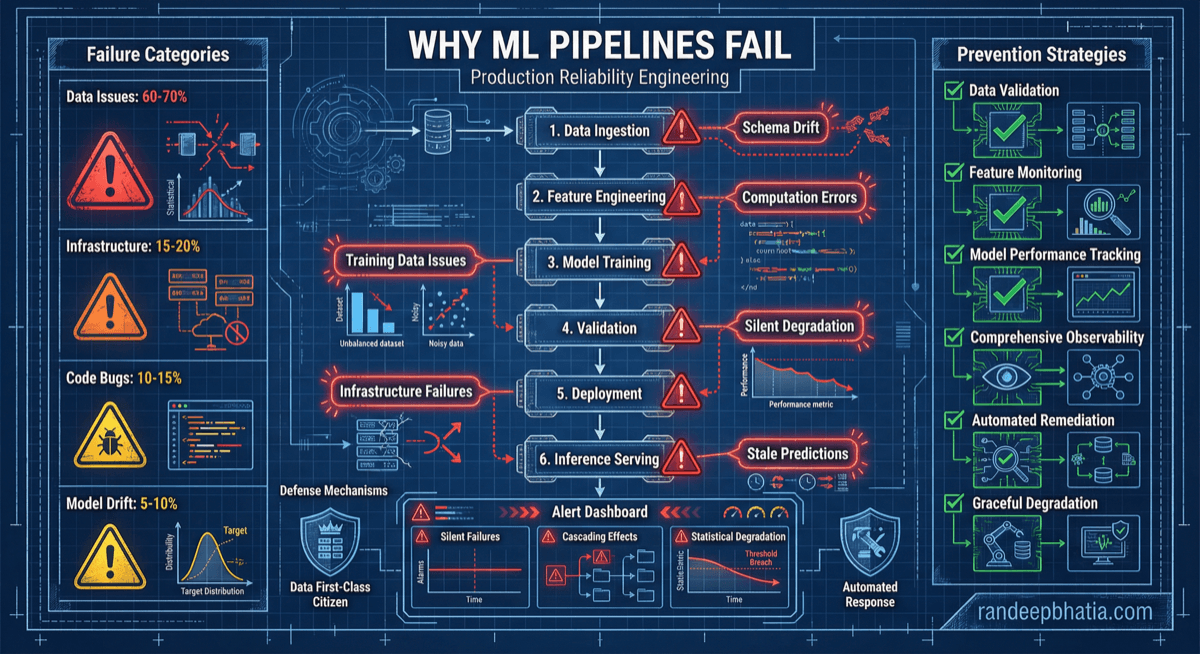
Why Production ML Pipelines Fail

Failure Mode Referencescitation-safe-reference📖 45-55 minutesUpdated: 2026-01-05

Executive Summary

Production ML pipeline failures are systematic breakdowns in the interconnected components of machine learning systems that prevent models from delivering reliable, accurate predictions at scale in real-world environments.

1

ML pipeline failures predominantly originate from data issues (60-70% of incidents), including schema drift, data quality degradation, feature computation errors, and upstream data source changes, rather than model architecture or algorithm problems.

2

The distributed, stateful nature of ML pipelines creates unique failure modes where silent degradation can persist for weeks before detection, as models continue producing outputs that appear valid but are actually based on corrupted or stale data.

3

Successful ML pipeline reliability requires treating data as a first-class citizen with the same rigor applied to code, implementing comprehensive observability across all pipeline stages, and designing for graceful degradation rather than assuming perfect upstream data.

The Bottom Line

Production ML pipelines fail primarily due to the inherent complexity of managing data dependencies, feature computation, model state, and inference serving as a unified system rather than isolated components. Organizations that achieve ML pipeline reliability invest heavily in data validation, feature monitoring, model performance tracking, and automated remediation systems that can detect and respond to issues before they impact downstream consumers.

Definition

Production ML pipeline failures encompass any breakdown, degradation, or unexpected behavior in the end-to-end system that transforms raw data into model predictions, including data ingestion, feature engineering, model training, validation, deployment, and inference serving components.

These failures manifest across multiple dimensions including correctness (wrong predictions), availability (service outages), latency (slow responses), freshness (stale models or features), and efficiency (excessive resource consumption), often with cascading effects that propagate through dependent systems.

Extended Definition

Production ML pipeline failures represent a distinct category of system failures that combine traditional software engineering failure modes with unique challenges specific to machine learning systems. Unlike conventional software where bugs produce deterministic errors, ML pipeline failures often manifest as subtle statistical degradations that remain within normal operating bounds while producing increasingly incorrect results. These failures span the entire ML lifecycle from data collection through model serving, with each stage introducing potential failure points that can silently corrupt downstream components. The interconnected nature of ML pipelines means that a single upstream failure, such as a schema change in a data source, can cascade through feature computation, model training, and inference serving, potentially affecting multiple models and applications simultaneously.

Etymology & Origins

The term 'ML pipeline' emerged from the broader software engineering concept of data pipelines in the early 2010s, as organizations began operationalizing machine learning systems. The 'pipeline' metaphor reflects the sequential flow of data through transformation stages, borrowed from Unix pipe concepts and ETL (Extract, Transform, Load) systems. The focus on 'production failures' specifically arose from the MLOps movement starting around 2018-2019, as practitioners recognized that deploying ML models to production environments introduced failure modes fundamentally different from traditional software deployment, necessitating new frameworks for understanding and preventing these failures.

Also Known As

ML system failuresMLOps incidentsMachine learning production issuesML infrastructure failuresModel pipeline breakdownsML workflow failuresData science pipeline failuresAI system failures

Not To Be Confused With

Model accuracy degradation

Model accuracy degradation refers specifically to declining prediction quality due to concept drift or data distribution shifts, while ML pipeline failures encompass broader system breakdowns including infrastructure issues, data quality problems, and operational failures that may or may not affect model accuracy directly.

Software bugs

Traditional software bugs produce deterministic, reproducible errors, while ML pipeline failures often manifest as statistical degradations, silent data corruption, or gradual performance decline that may not trigger explicit error conditions.

Model training failures

Model training failures are a subset of ML pipeline failures focused specifically on the training phase, while production ML pipeline failures span the entire lifecycle including data ingestion, feature engineering, deployment, and inference serving.

Data pipeline failures

Data pipeline failures in traditional ETL systems focus on data movement and transformation correctness, while ML pipeline failures additionally encompass model-specific concerns like feature drift, prediction quality, and model staleness.

Infrastructure outages

Infrastructure outages are complete service unavailability events, while ML pipeline failures include partial degradations, silent errors, and quality issues that may not cause visible outages but still impact system reliability.

Model bias issues

Model bias issues relate to fairness and ethical concerns in model predictions, while ML pipeline failures focus on operational reliability and system correctness regardless of whether the underlying model exhibits bias.

Conceptual Foundation

Core Principles

(8 principles)

Mental Models

(6 models)

The Iceberg Model

Visible ML pipeline failures (outages, explicit errors) represent only the tip of the iceberg, while the majority of failures lurk beneath the surface as silent degradations, data quality issues, and gradual performance decline that don't trigger alerts but still impact system reliability.

The Supply Chain Model

ML pipelines function like manufacturing supply chains where raw materials (data) flow through processing stages (feature engineering, training) to produce finished goods (predictions). Disruptions at any stage affect downstream production, and quality issues propagate through the chain.

The Biological System Model

ML pipelines exhibit characteristics of biological systems including homeostasis (self-correction), adaptation (retraining), and disease (gradual degradation). Like biological systems, they can appear healthy while harboring underlying conditions that eventually manifest as acute failures.

The Distributed Systems Model

ML pipelines are distributed systems subject to the same fundamental challenges including network partitions, consistency tradeoffs, and partial failures. The CAP theorem and distributed systems principles apply to ML infrastructure.

The Technical Debt Model

ML pipelines accumulate technical debt faster than traditional software due to data dependencies, experimental code, and the rapid iteration common in ML development. This debt manifests as increasingly fragile systems prone to unexpected failures.

The Signal Processing Model

ML pipelines process signals (data) that contain both information and noise. Failures often result from changes in signal characteristics, noise amplification through processing stages, or loss of signal fidelity during transformation.

Key Insights

(10 insights)

The majority of ML pipeline failures (60-70%) originate from data issues rather than model or code problems, yet most organizations invest disproportionately in model development relative to data infrastructure.

Silent failures in ML pipelines can persist for weeks or months because models continue producing plausible-looking outputs even when operating on corrupted or stale data.

Feature engineering pipelines are often the most fragile component of ML systems because they depend on multiple upstream data sources and contain complex transformation logic that is difficult to test comprehensively.

Model retraining failures frequently go undetected because serving systems continue using the previous model version, masking the fact that the pipeline has stopped producing updated models.

The time between a root cause event and observable symptoms in ML pipelines can span days or weeks, making incident investigation significantly more complex than in traditional software systems.

Many ML pipeline failures result from implicit assumptions about data that were true during development but change in production, such as feature value ranges, null handling, or categorical value sets.

Monitoring model prediction distributions is often more effective at detecting issues than monitoring model accuracy, because accuracy metrics require ground truth labels that may not be immediately available.

The complexity of ML pipeline debugging increases non-linearly with the number of features, as each feature introduces potential failure modes and interaction effects with other features.

Recovery from ML pipeline failures often requires coordinated rollback of multiple components including model versions, feature store contents, and pipeline configurations, making recovery significantly more complex than traditional software rollbacks.

Organizations that achieve high ML pipeline reliability typically have dedicated ML platform teams that provide standardized infrastructure, monitoring, and operational tooling to product ML teams.

When to Use

Ideal Scenarios

(12)

When conducting post-incident reviews for ML system outages or degradations to identify root causes and prevent recurrence through systematic analysis of failure patterns.

When designing new ML pipelines to proactively identify potential failure modes and implement appropriate safeguards, monitoring, and recovery mechanisms.

When establishing MLOps practices and standards for an organization to ensure consistent approaches to reliability, monitoring, and incident response across ML systems.

When evaluating ML platform investments to prioritize features and capabilities that address the most common and impactful failure modes in production ML systems.

When training ML engineers and data scientists on production ML best practices to build awareness of failure modes that may not be encountered during development.

When conducting reliability audits of existing ML systems to identify vulnerabilities and prioritize remediation efforts based on failure likelihood and impact.

When designing monitoring and alerting strategies for ML pipelines to ensure coverage of the specific failure modes that affect machine learning systems.

When planning capacity and resource allocation for ML infrastructure to account for failure scenarios and ensure adequate headroom for recovery operations.

When negotiating SLAs and SLOs for ML-powered products to set realistic expectations based on the inherent reliability characteristics of ML systems.

When evaluating build-versus-buy decisions for ML infrastructure to understand the operational complexity and failure modes that must be managed.

When designing data contracts and interfaces between ML systems and upstream data providers to specify quality requirements and failure handling expectations.

When implementing chaos engineering practices for ML systems to systematically test resilience against known failure modes.

Prerequisites

(8)
1

Basic understanding of machine learning concepts including training, inference, features, and model evaluation metrics.

2

Familiarity with data pipeline concepts including ETL processes, data quality, and data transformation.

3

Understanding of distributed systems concepts including consistency, availability, and failure modes.

4

Knowledge of software engineering practices including version control, testing, deployment, and monitoring.

5

Experience with production systems operations including incident response, debugging, and performance optimization.

6

Awareness of MLOps concepts including model versioning, experiment tracking, and continuous training.

7

Understanding of organizational context including team structures, ownership models, and operational responsibilities.

8

Familiarity with monitoring and observability concepts including metrics, logs, traces, and alerting.

Signals You Need This

(10)

ML models in production are experiencing unexplained accuracy degradation that cannot be attributed to concept drift or data distribution changes.

Incident investigations for ML systems frequently conclude with unknown root causes or take significantly longer than incidents in traditional software systems.

Model retraining jobs are failing silently or producing models that fail validation checks without clear explanations.

Feature values in production differ significantly from feature values observed during model development and testing.

Upstream data source changes frequently cause unexpected failures in ML pipelines that were not anticipated or detected proactively.

Model serving latency is increasing over time without corresponding increases in traffic or model complexity.

Different team members have conflicting understandings of how ML pipelines should behave in failure scenarios.

Recovery from ML system incidents requires manual intervention and coordination across multiple teams and systems.

Monitoring dashboards show healthy system metrics while business stakeholders report declining model performance.

New model deployments frequently cause production issues that require rollback or emergency fixes.

Organizational Readiness

(7)

Executive sponsorship for ML reliability investments that may not have immediate feature delivery impact but improve long-term system stability.

Cross-functional collaboration capabilities between data engineering, ML engineering, platform engineering, and operations teams.

Incident management processes that can accommodate the unique characteristics of ML system failures including extended investigation timelines and complex root cause analysis.

Data governance frameworks that establish ownership, quality standards, and change management processes for data used in ML pipelines.

Investment capacity for monitoring, observability, and automation infrastructure that may not directly contribute to model accuracy improvements.

Cultural acceptance of reliability as a first-class concern alongside model performance and feature delivery velocity.

Technical infrastructure maturity including logging, metrics collection, and distributed tracing capabilities.

When NOT to Use

Anti-Patterns

(12)

Applying production reliability patterns to experimental or research ML projects where rapid iteration and failure tolerance are more valuable than stability.

Over-engineering reliability mechanisms for ML pipelines that serve non-critical applications where occasional failures have minimal business impact.

Implementing complex failure handling for ML systems that lack basic monitoring and observability, as failure handling without visibility creates hidden complexity.

Treating all ML pipeline failures as equally important without prioritizing based on business impact, frequency, and remediation cost.

Implementing automated remediation for failure modes that are not well understood, potentially masking underlying issues or causing unintended consequences.

Applying traditional software reliability patterns to ML systems without adaptation for ML-specific failure modes like data drift and model staleness.

Investing heavily in preventing rare failure modes while ignoring common failures that have higher cumulative impact on system reliability.

Implementing failure handling at the wrong abstraction level, such as handling data quality issues in model serving code rather than in data validation pipelines.

Creating complex dependency management systems for ML pipelines that serve single models with simple data requirements.

Applying enterprise-grade reliability patterns to ML systems that are still in the proof-of-concept phase and may be significantly redesigned.

Implementing comprehensive failure mode coverage before establishing basic operational practices like deployment procedures and rollback capabilities.

Treating ML pipeline reliability as a one-time project rather than an ongoing operational concern that requires continuous investment.

Red Flags

(10)

Reliability investments are being made without clear understanding of current failure modes and their business impact.

Complex failure handling is being implemented before basic monitoring and alerting are in place.

Reliability work is being prioritized over fundamental ML pipeline improvements that would eliminate failure modes entirely.

Failure handling mechanisms are adding significant latency or resource consumption to critical path operations.

Automated remediation is being implemented for failure modes that have not been thoroughly analyzed and understood.

Reliability patterns are being copied from other organizations without adaptation for local context and requirements.

Failure mode analysis is focusing exclusively on technical failures while ignoring process and organizational failure modes.

Reliability investments are being made in isolation without coordination with upstream data providers or downstream consumers.

Complex failure handling is being implemented in custom code rather than leveraging platform capabilities and standard patterns.

Reliability work is being treated as a separate workstream rather than integrated into normal ML development practices.

Better Alternatives

(8)
1
When:

Early-stage ML projects with uncertain requirements

Use Instead:

Focus on rapid iteration and learning rather than production reliability

Why:

Investing in reliability for systems that may be significantly redesigned or abandoned wastes resources and slows learning velocity.

2
When:

ML systems with simple, stable data dependencies

Use Instead:

Implement basic monitoring and manual recovery procedures

Why:

Complex automated failure handling adds unnecessary complexity when failures are rare and manual recovery is straightforward.

3
When:

Organizations without MLOps maturity

Use Instead:

Invest in foundational MLOps capabilities before advanced reliability

Why:

Advanced reliability patterns require foundational capabilities like model versioning, deployment automation, and monitoring infrastructure.

4
When:

ML systems where model accuracy is the primary concern

Use Instead:

Focus on model improvement and evaluation rather than pipeline reliability

Why:

If model accuracy is the bottleneck, reliability investments may not address the most impactful problems.

5
When:

Small-scale ML deployments with limited traffic

Use Instead:

Use managed ML services that handle reliability concerns

Why:

Managed services provide reliability capabilities without requiring custom implementation and operational expertise.

6
When:

ML systems with well-defined, stable failure modes

Use Instead:

Implement targeted fixes for known issues rather than comprehensive failure handling

Why:

Targeted solutions are more cost-effective when failure modes are well understood and limited in scope.

7
When:

Organizations with strong data engineering practices

Use Instead:

Leverage existing data quality and monitoring infrastructure

Why:

Existing data infrastructure may already address many ML pipeline failure modes without requiring ML-specific solutions.

8
When:

ML systems in regulated industries with strict change control

Use Instead:

Focus on validation and testing rather than automated recovery

Why:

Regulatory requirements may limit automated remediation, making prevention and detection more valuable than recovery automation.

Common Mistakes

(10)

Assuming that ML pipeline failures are primarily caused by model issues rather than data and infrastructure problems.

Implementing monitoring that only tracks system availability without measuring data quality, model performance, and feature health.

Treating ML pipeline reliability as a one-time project rather than an ongoing operational concern requiring continuous investment.

Failing to establish clear ownership and accountability for ML pipeline reliability across data, ML, and platform teams.

Implementing complex automated remediation before understanding failure modes well enough to handle edge cases safely.

Ignoring the temporal dimension of ML pipeline failures including model staleness, feature freshness, and training data recency.

Assuming that successful model training implies successful deployment without validating model behavior in production environments.

Failing to account for the cascading nature of ML pipeline failures when designing isolation and recovery mechanisms.

Implementing reliability patterns at the wrong abstraction level, such as handling data issues in model code rather than data pipelines.

Neglecting to test failure handling mechanisms, resulting in recovery procedures that fail when actually needed.

Core Taxonomy

Primary Types

(8 types)

Failures caused by issues with the quality, completeness, or correctness of data flowing through ML pipelines, including missing values, incorrect values, schema violations, and distribution anomalies.

Characteristics
  • Often silent with no explicit error messages
  • Can originate from upstream systems outside ML team control
  • May affect only subset of data or features
  • Impact may be delayed until model retraining or inference
  • Difficult to detect without comprehensive data validation
Use Cases
Upstream data source schema changesData provider outages or partial failuresETL job failures or delaysData corruption during storage or transmissionEncoding or format changes in source data
Tradeoffs

Comprehensive data validation adds latency and complexity but is essential for detecting issues before they propagate through the pipeline.

Classification Dimensions

Failure Visibility

Classification based on how easily failures can be detected through standard monitoring and alerting mechanisms.

Explicit failures with error messagesSilent failures with no errorsDegraded performance without failureIntermittent failures

Failure Scope

Classification based on the breadth of impact across ML pipeline components and dependent systems.

Single component failuresMulti-component failuresSystem-wide failuresCross-system failures

Failure Duration

Classification based on the temporal characteristics of failures including duration and recurrence patterns.

Transient failuresPersistent failuresRecurring failuresProgressive failures

Root Cause Origin

Classification based on the source of the underlying issue causing the failure.

Data-originated failuresCode-originated failuresInfrastructure-originated failuresConfiguration-originated failuresExternal dependency failures

Recovery Complexity

Classification based on the effort and expertise required to recover from the failure.

Auto-recoverable failuresSimple manual recoveryComplex manual recoveryRequires rebuild or restore

Business Impact

Classification based on the type of business impact resulting from the failure.

Revenue-impacting failuresUser experience failuresOperational efficiency failuresCompliance or regulatory failures

Evolutionary Stages

1

Ad-hoc Failure Handling

Early ML adoption, first 6-12 months of production ML

Failures are handled reactively on a case-by-case basis without systematic processes or tooling. Incident response depends on individual expertise and availability. Recovery procedures are undocumented and inconsistent.

2

Basic Monitoring and Alerting

12-24 months of production ML experience

Basic monitoring covers system availability and resource utilization. Alerting is configured for critical failures. Incident response processes are documented but not consistently followed. Recovery procedures exist for common failure modes.

3

Comprehensive Observability

2-3 years of production ML experience

Monitoring covers data quality, model performance, and feature health in addition to system metrics. Alerting is tuned to reduce noise and prioritize actionable issues. Incident response is systematic with defined roles and escalation paths.

4

Proactive Reliability Engineering

3-5 years of production ML experience

Failure modes are systematically identified and addressed before causing production incidents. Chaos engineering practices test system resilience. Automated remediation handles common failure scenarios. Reliability is a first-class concern in ML development.

5

Mature ML Platform

5+ years of production ML experience with dedicated platform investment

Standardized platform provides reliability capabilities to all ML teams. Failure handling is built into platform abstractions. Reliability metrics are tracked and improved systematically. ML systems achieve reliability comparable to traditional software systems.

Architecture Patterns

Architecture Patterns

(8 patterns)

Defense in Depth Data Validation

Multiple layers of data validation at different pipeline stages including source validation, transformation validation, feature validation, and inference-time validation, ensuring data quality issues are caught as early as possible.

Components
  • Source data validators
  • Schema enforcement layer
  • Statistical distribution monitors
  • Feature range validators
  • Inference input validators
  • Validation result aggregators
Data Flow

Raw data passes through source validators, then schema enforcement, then statistical monitors during transformation, then feature validators before storage, and finally inference validators before model input.

Best For
  • High-volume data pipelines with diverse sources
  • Critical ML applications where data quality directly impacts business outcomes
  • Pipelines with complex transformation logic
  • Systems with multiple upstream data dependencies
Limitations
  • Adds latency to data processing
  • Requires maintenance of validation rules
  • May generate false positives requiring tuning
  • Cannot catch all semantic data quality issues
Scaling Characteristics

Validation overhead scales linearly with data volume. Distributed validation enables horizontal scaling. Sampling-based validation reduces overhead for high-volume streams.

Integration Points

Data Sources

Provide raw data for feature computation and model training

Interfaces:
Batch data exportsStreaming data feedsAPI-based data accessChange data capture streams

Data source reliability directly impacts pipeline reliability. Schema changes, availability issues, and data quality problems in sources propagate through the pipeline. Contracts and SLAs with data providers are essential.

Feature Store

Centralized storage and serving of computed features

Interfaces:
Feature ingestion APIOnline serving APIOffline retrieval APIFeature registry API

Feature store availability is critical for both training and serving. Consistency between online and offline stores must be maintained. Feature versioning and lineage tracking support debugging and rollback.

Model Registry

Storage and versioning of trained model artifacts

Interfaces:
Model upload APIModel download APIModel metadata APIModel promotion API

Model registry availability is required for deployments and rollbacks. Metadata must capture training lineage, validation results, and deployment history. Access control ensures only validated models are deployed.

Orchestration System

Scheduling and coordination of pipeline jobs

Interfaces:
Job submission APIJob status APIDependency management APITrigger API

Orchestrator failures can halt entire pipelines. Job dependency management must handle failures gracefully. Retry and backoff policies prevent cascade failures during transient issues.

Serving Infrastructure

Real-time model inference at scale

Interfaces:
Prediction APIModel loading APIHealth check APIMetrics API

Serving infrastructure must meet latency and throughput SLAs. Model loading and initialization must be fast enough for rapid deployments. Health checks enable load balancer integration.

Monitoring System

Collection and analysis of pipeline health metrics

Interfaces:
Metric ingestion APILog aggregation APITrace collection APIAlert management API

Monitoring system availability is essential for failure detection. Metric cardinality must be managed to control costs. Alert routing and escalation must be properly configured.

Experiment Tracking

Recording and comparison of model training experiments

Interfaces:
Experiment logging APIMetric comparison APIArtifact tracking APIExperiment search API

Experiment tracking supports debugging of training failures. Integration with model registry enables lineage from experiment to production. Comparison capabilities support model selection decisions.

CI/CD System

Automation of testing, validation, and deployment

Interfaces:
Pipeline trigger APITest execution APIDeployment APIRollback API

CI/CD reliability directly impacts deployment reliability. Test coverage must include ML-specific validations. Rollback capabilities must be tested and maintained.

Decision Framework

✓ If Yes

Initiate incident response, consider immediate rollback or fallback activation

✗ If No

Assess severity and schedule investigation based on impact

Considerations

Production impact severity determines response urgency. Some degradations may be acceptable temporarily while root cause is investigated.

Technical Deep Dive

Overview

Production ML pipelines fail through a complex interplay of data, code, infrastructure, and operational factors that create failure modes unique to machine learning systems. Unlike traditional software where failures typically manifest as explicit errors or crashes, ML pipeline failures often present as subtle degradations in prediction quality, silent data corruption, or gradual performance decline that may persist undetected for extended periods. The fundamental challenge is that ML pipelines are inherently data-dependent systems where the correctness of outputs depends not just on code logic but on the statistical properties of input data. When data characteristics drift from the distribution seen during model training, predictions degrade even though no code has changed and no explicit errors occur. This creates a class of failures that traditional software monitoring and testing approaches are not designed to detect. ML pipeline failures also exhibit unique temporal characteristics. The time between a root cause event (such as an upstream data source change) and observable symptoms (such as degraded model accuracy) can span days or weeks as corrupted data propagates through feature computation, model training, and eventually into production predictions. This extended latency makes root cause analysis significantly more challenging than in traditional software systems where cause and effect are typically closely coupled in time. Furthermore, ML pipelines contain complex dependency graphs where multiple data sources feed into feature computation, multiple features feed into model training, and multiple models may share common features or infrastructure. This interconnection means that failures can cascade through the system in non-obvious ways, affecting components that appear unrelated to the original failure point.

Step-by-Step Process

Failures often begin at the data ingestion layer when upstream data sources experience issues including schema changes, availability problems, data quality degradation, or timing delays. These issues may be caused by changes in source systems, network problems, or upstream pipeline failures.

⚠️ Pitfalls to Avoid

Data ingestion failures may not produce explicit errors if the pipeline continues processing with partial, stale, or malformed data. Lack of schema validation allows corrupted data to enter the pipeline undetected.

Under The Hood

At the infrastructure level, ML pipeline failures often originate from the fundamental tension between the stateless, scalable architectures preferred for web services and the stateful, data-dependent nature of ML systems. ML pipelines maintain significant state including trained model weights (which may be gigabytes in size), feature store contents (which may span terabytes), and historical data used for training and validation. This state must be consistent across distributed systems, versioned for rollback, and protected against corruption. The computational characteristics of ML workloads also create unique failure modes. Training jobs are typically long-running (hours to days), resource-intensive (requiring GPUs or TPUs), and sensitive to interruption. A failure partway through training may require restarting from the beginning, wasting significant compute resources. Checkpointing and recovery mechanisms add complexity and potential failure points. Distributed training across multiple machines introduces additional failure modes related to synchronization, communication, and partial failures. Feature computation pipelines face the challenge of maintaining consistency between online (real-time serving) and offline (batch training) feature stores. The same feature must produce identical values whether computed in real-time for inference or retrieved from historical storage for training. Achieving this consistency requires careful management of feature definitions, computation logic, and data sources. Drift between online and offline features is a common source of training-serving skew that degrades model performance. Model serving infrastructure must balance latency, throughput, and availability requirements while handling the unique characteristics of ML inference. Models may require significant memory (gigabytes for large models), have variable inference latency depending on input characteristics, and may need specialized hardware (GPUs) that is more prone to failure than commodity CPUs. Load balancing must account for model loading time, warm-up requirements, and the potential for inference to fail on specific inputs. The observability challenges in ML pipelines are also significant. Traditional application monitoring focuses on request rates, error rates, and latency. ML pipelines additionally require monitoring of data quality metrics (completeness, validity, distribution), feature health metrics (freshness, drift, coverage), and model performance metrics (accuracy, calibration, fairness). These metrics often require domain-specific thresholds and may not have obvious normal ranges. Correlating issues across these different metric types to identify root causes requires sophisticated observability infrastructure.

Failure Modes

Root Cause

Upstream data provider experiences complete failure, network partition isolates data source, or authentication/authorization failures prevent access

Symptoms
  • No new data arriving in ingestion layer
  • Feature computation jobs failing or producing empty outputs
  • Stale features being served
  • Model predictions based on outdated information
Impact

Predictions become increasingly stale and inaccurate. Business decisions based on outdated information. User experience degradation for real-time applications.

Prevention

Implement data source health monitoring, establish SLAs with data providers, design for graceful degradation with cached data, maintain redundant data sources where possible

Mitigation

Activate fallback to cached data, notify downstream consumers of data staleness, engage data provider for resolution, consider temporary model simplification

Operational Considerations

Key Metrics (15)

Time since last successful data ingestion from each source

NormalWithin scheduled ingestion interval (e.g., < 1 hour for hourly ingestion)
Alert2x scheduled interval or absolute threshold based on business requirements
ResponseInvestigate data source availability, check ingestion job status, engage data provider if external

Dashboard Panels

Pipeline Health Overview: Status of all pipeline stages with freshness and error indicatorsData Quality Trends: Time series of data quality metrics across all sourcesFeature Health Matrix: Grid showing freshness and drift status for all feature groupsModel Performance Comparison: Side-by-side metrics for all production modelsServing Infrastructure Status: Latency, throughput, and error rates for serving layerTraining Pipeline Status: Job success rates, durations, and queue depthsResource Utilization: CPU, memory, GPU, and storage utilization trendsAlerting Summary: Active alerts, recent resolutions, and alert trendsDependency Status: Health and latency of all upstream and downstream dependenciesBusiness Metric Correlation: ML metrics alongside relevant business KPIs

Alerting Strategy

Implement tiered alerting with severity levels based on business impact. Critical alerts (service outages, severe degradation) page on-call immediately. Warning alerts (elevated error rates, approaching thresholds) notify team channels. Informational alerts (minor anomalies, scheduled maintenance) logged for review. Implement alert aggregation to prevent alert storms. Use anomaly detection for metrics without clear thresholds. Establish escalation paths for unacknowledged alerts. Review and tune alert thresholds regularly based on false positive rates.

Cost Analysis

Cost Drivers

(10)

Compute for Model Training

Impact:

Training costs scale with model complexity, data volume, and training frequency. GPU/TPU costs dominate for deep learning models.

Optimization:

Optimize hyperparameters to reduce training time, use spot/preemptible instances for fault-tolerant training, implement early stopping, consider model distillation

Compute for Model Serving

Impact:

Serving costs scale with traffic volume, model complexity, and latency requirements. Over-provisioning for reliability increases costs.

Optimization:

Right-size serving instances, implement autoscaling, optimize model for inference, use model quantization, batch requests where possible

Feature Store Infrastructure

Impact:

Costs scale with feature volume, serving throughput, and retention requirements. Online stores require low-latency infrastructure.

Optimization:

Implement tiered storage, optimize feature encoding, tune retention policies, use caching effectively

Data Storage

Impact:

Storage costs scale with data volume and retention. Multiple copies for redundancy and versioning multiply costs.

Optimization:

Implement data lifecycle policies, use tiered storage, compress data, deduplicate where possible

Data Processing

Impact:

Processing costs scale with data volume and transformation complexity. Inefficient pipelines waste compute resources.

Optimization:

Optimize transformation logic, implement incremental processing, use appropriate compute frameworks, right-size clusters

Monitoring and Observability

Impact:

Costs scale with metric cardinality, log volume, and retention requirements. High-cardinality metrics are expensive.

Optimization:

Control metric cardinality, implement log sampling, tune retention policies, aggregate where appropriate

Network Transfer

Impact:

Costs accumulate for data transfer between regions, services, and cloud providers. Large model artifacts increase transfer costs.

Optimization:

Colocate compute with data, implement caching, compress transfers, minimize cross-region traffic

Incident Response and Recovery

Impact:

Failures incur costs for investigation time, recovery compute, and potential revenue impact. Frequent failures multiply costs.

Optimization:

Invest in prevention, automate recovery, implement efficient debugging tools, reduce mean time to recovery

Development and Experimentation

Impact:

Experimentation requires compute for training variants and infrastructure for experiment tracking. Inefficient experimentation wastes resources.

Optimization:

Implement experiment tracking, reuse computation where possible, set resource quotas, prioritize experiments

Redundancy and Disaster Recovery

Impact:

Redundancy for reliability multiplies infrastructure costs. Multi-region deployment significantly increases costs.

Optimization:

Right-size redundancy based on criticality, use active-passive where appropriate, optimize failover infrastructure

Cost Models

Training Cost Model

Training Cost = (GPU Hours × GPU Price) + (Storage × Storage Price) + (Data Transfer × Transfer Price)
Variables:
GPU Hours: Training time × Number of GPUsGPU Price: Cost per GPU hour (varies by GPU type)Storage: Training data + Checkpoints + ArtifactsData Transfer: Data movement during training
Example:

Training a model for 10 hours on 8 V100 GPUs at $2.50/GPU-hour = $200 compute + storage and transfer costs

Serving Cost Model

Serving Cost = (Instance Hours × Instance Price) + (Requests × Per-Request Cost) + (Data Transfer × Transfer Price)
Variables:
Instance Hours: Number of instances × Hours runningInstance Price: Cost per instance hourRequests: Number of prediction requestsPer-Request Cost: Additional costs per request (e.g., feature retrieval)
Example:

Serving on 10 instances for 720 hours/month at $0.50/hour = $3,600/month base cost + request-based costs

Feature Store Cost Model

Feature Store Cost = (Online Storage × Online Price) + (Offline Storage × Offline Price) + (Read Operations × Read Price) + (Write Operations × Write Price)
Variables:
Online Storage: Size of online feature storeOffline Storage: Size of offline feature store with historyRead Operations: Feature retrieval volumeWrite Operations: Feature ingestion volume
Example:

100GB online storage at $0.25/GB + 10TB offline at $0.02/GB + operations = $225/month storage + operation costs

Total Cost of Ownership Model

TCO = Infrastructure Costs + Personnel Costs + Opportunity Costs + Incident Costs
Variables:
Infrastructure Costs: All compute, storage, and network costsPersonnel Costs: Team time for development, operations, and maintenanceOpportunity Costs: Revenue impact of failures and degradationsIncident Costs: Investigation and recovery costs for failures
Example:

Infrastructure $50K/month + 5 FTE at $15K/month = $125K/month + incident and opportunity costs

Optimization Strategies

  • 1Implement autoscaling for serving infrastructure to match capacity with demand
  • 2Use spot/preemptible instances for fault-tolerant training workloads
  • 3Optimize models for inference efficiency through quantization and pruning
  • 4Implement request batching for throughput-optimized serving
  • 5Use tiered storage with automatic lifecycle policies
  • 6Implement incremental processing to avoid recomputing unchanged data
  • 7Right-size compute resources based on actual utilization
  • 8Consolidate underutilized infrastructure
  • 9Implement caching at multiple levels to reduce redundant computation
  • 10Use reserved instances for predictable baseline capacity
  • 11Optimize data formats and compression for storage efficiency
  • 12Implement cost allocation and chargeback to drive accountability

Hidden Costs

  • 💰Engineering time for debugging and incident response
  • 💰Opportunity cost of delayed feature delivery due to reliability issues
  • 💰Revenue impact of prediction quality degradation
  • 💰Cost of maintaining multiple model versions during gradual rollouts
  • 💰Storage costs for comprehensive logging and monitoring data
  • 💰Network costs for cross-region replication and failover
  • 💰Compute costs for redundant validation and testing
  • 💰Personnel costs for on-call rotations and incident response

ROI Considerations

The return on investment for ML pipeline reliability improvements must be evaluated against the cost of failures. Calculate the expected cost of failures by multiplying failure probability by failure impact (revenue loss, recovery costs, reputation damage). Compare this to the cost of prevention and mitigation measures. For critical ML applications, the cost of a single major outage often exceeds the annual cost of comprehensive reliability infrastructure. Reliability investments also provide indirect returns through improved development velocity (less time spent on firefighting), better team morale (reduced on-call burden), and increased business confidence in ML systems (enabling broader ML adoption). These indirect benefits are harder to quantify but often exceed the direct cost savings from prevented failures. When evaluating specific reliability investments, consider the breadth of impact. Investments in shared infrastructure (monitoring, feature stores, deployment systems) benefit all ML applications, providing leverage that point solutions for individual models cannot match. Platform investments may have higher upfront costs but lower total cost when amortized across all benefiting applications. Finally, consider the cost trajectory over time. As ML systems grow in scale and complexity, the cost of failures typically increases while the relative cost of reliability infrastructure decreases. Early investment in reliability foundations prevents the accumulation of technical debt that becomes increasingly expensive to address.

Security Considerations

Threat Model

(10 threats)
1

Training Data Poisoning

Attack Vector

Adversary injects malicious data into training pipeline to influence model behavior

Impact

Model produces incorrect predictions, potentially in targeted ways that benefit attacker

Mitigation

Implement data provenance tracking, validate data sources, monitor for anomalous training data, use robust training techniques

2

Model Extraction

Attack Vector

Adversary queries model extensively to reconstruct model behavior or extract training data

Impact

Intellectual property theft, privacy violation if training data can be extracted

Mitigation

Implement rate limiting, monitor for extraction patterns, add noise to predictions, restrict API access

3

Adversarial Input Attacks

Attack Vector

Adversary crafts inputs designed to cause model misclassification or unexpected behavior

Impact

Model produces incorrect predictions, potentially bypassing security controls

Mitigation

Implement input validation, use adversarial training, monitor for adversarial patterns, implement defense mechanisms

4

Model Artifact Tampering

Attack Vector

Adversary modifies model artifacts in storage or transit to alter model behavior

Impact

Deployed model behaves differently than validated model, potentially maliciously

Mitigation

Implement artifact signing and verification, use secure storage, verify integrity before deployment

5

Feature Store Data Exfiltration

Attack Vector

Adversary gains unauthorized access to feature store containing sensitive data

Impact

Exposure of sensitive user data, privacy violations, regulatory penalties

Mitigation

Implement access controls, encrypt data at rest and in transit, monitor access patterns, minimize sensitive data retention

6

Pipeline Configuration Manipulation

Attack Vector

Adversary modifies pipeline configurations to alter data processing or model behavior

Impact

Data corruption, model degradation, potential data exfiltration

Mitigation

Implement configuration version control, require approval for changes, audit configuration access

7

Credential Compromise

Attack Vector

Adversary obtains credentials for ML pipeline systems through phishing, breach, or misconfiguration

Impact

Unauthorized access to data, models, and infrastructure

Mitigation

Implement least privilege access, use short-lived credentials, monitor for anomalous access, implement MFA

8

Supply Chain Attack

Attack Vector

Adversary compromises dependencies (libraries, base images, pre-trained models) used in ML pipeline

Impact

Malicious code execution, data exfiltration, model manipulation

Mitigation

Verify dependency integrity, use private artifact repositories, scan for vulnerabilities, minimize dependencies

9

Inference API Abuse

Attack Vector

Adversary abuses inference API for denial of service, resource exhaustion, or cost inflation

Impact

Service unavailability, excessive costs, degraded performance for legitimate users

Mitigation

Implement rate limiting, authentication, cost controls, monitor for abuse patterns

10

Data Leakage Through Predictions

Attack Vector

Model predictions inadvertently reveal sensitive information about training data or other users

Impact

Privacy violations, regulatory penalties, reputation damage

Mitigation

Implement differential privacy, audit predictions for leakage, minimize sensitive data in training

Security Best Practices

  • Implement least privilege access controls for all pipeline components
  • Encrypt data at rest and in transit throughout the pipeline
  • Use secure credential management (secrets managers, short-lived tokens)
  • Implement comprehensive audit logging for all access and changes
  • Validate and sanitize all inputs to the pipeline
  • Sign and verify model artifacts before deployment
  • Implement network segmentation to isolate pipeline components
  • Conduct regular security assessments and penetration testing
  • Maintain inventory of all dependencies and monitor for vulnerabilities
  • Implement data classification and handling procedures
  • Use secure development practices for pipeline code
  • Implement incident response procedures for security events
  • Train team members on security awareness and practices
  • Implement data retention and deletion policies
  • Monitor for anomalous access patterns and behaviors

Data Protection

  • 🔒Implement data classification to identify sensitive data requiring additional protection
  • 🔒Use encryption at rest with appropriate key management
  • 🔒Use encryption in transit (TLS) for all data movement
  • 🔒Implement access controls based on data classification and need-to-know
  • 🔒Minimize collection and retention of sensitive data
  • 🔒Implement data masking or anonymization for non-production environments
  • 🔒Use differential privacy techniques where appropriate
  • 🔒Implement secure data deletion procedures
  • 🔒Monitor for unauthorized data access or exfiltration
  • 🔒Maintain data lineage to track data flow through the pipeline

Compliance Implications

GDPR (General Data Protection Regulation)

Requirement:

Data subject rights, lawful basis for processing, data minimization, right to explanation

Implementation:

Implement data lineage tracking, support data deletion requests, document processing purposes, provide prediction explanations where required

CCPA (California Consumer Privacy Act)

Requirement:

Consumer rights to know, delete, and opt-out of data sale

Implementation:

Implement data inventory, support deletion requests, provide transparency about data use

HIPAA (Health Insurance Portability and Accountability Act)

Requirement:

Protection of protected health information (PHI)

Implementation:

Implement PHI handling procedures, access controls, audit logging, encryption, business associate agreements

SOC 2 (Service Organization Control 2)

Requirement:

Security, availability, processing integrity, confidentiality, privacy controls

Implementation:

Implement comprehensive controls framework, maintain documentation, conduct regular audits

PCI DSS (Payment Card Industry Data Security Standard)

Requirement:

Protection of cardholder data

Implementation:

Implement cardholder data handling procedures, access controls, encryption, network segmentation

AI-Specific Regulations (EU AI Act, etc.)

Requirement:

Risk assessment, transparency, human oversight for high-risk AI systems

Implementation:

Implement risk classification, documentation, explainability, human review mechanisms

Industry-Specific Regulations (Financial, Healthcare, etc.)

Requirement:

Varies by industry and jurisdiction

Implementation:

Consult with compliance and legal teams, implement industry-specific controls

Data Localization Requirements

Requirement:

Data must remain within specific geographic boundaries

Implementation:

Implement data residency controls, use region-specific infrastructure, audit data flows

Scaling Guide

Scaling Dimensions

Data Volume

Strategy:

Implement distributed data processing frameworks, partition data appropriately, use incremental processing, optimize storage formats

Limits:

Limited by storage capacity, processing cluster size, and network bandwidth

Considerations:

Data volume growth often outpaces infrastructure scaling. Plan for 10x growth. Consider data sampling for development and testing.

Model Complexity

Strategy:

Use distributed training, implement model parallelism, optimize model architecture, consider model distillation

Limits:

Limited by GPU memory, training time constraints, and serving latency requirements

Considerations:

Model complexity affects both training and serving. Balance accuracy gains against operational complexity.

Prediction Throughput

Strategy:

Scale serving replicas horizontally, implement request batching, optimize model inference, use caching

Limits:

Limited by model inference time, feature retrieval latency, and infrastructure capacity

Considerations:

Throughput scaling is often more straightforward than latency optimization. Consider async processing for non-real-time use cases.

Number of Models

Strategy:

Implement shared infrastructure, standardize model serving, use multi-model serving, automate operations

Limits:

Limited by operational capacity, infrastructure costs, and team bandwidth

Considerations:

Operational complexity grows with model count. Invest in automation and standardization to manage many models efficiently.

Number of Features

Strategy:

Implement feature store with efficient retrieval, optimize feature computation, use feature selection

Limits:

Limited by feature store capacity, retrieval latency, and computation resources

Considerations:

Feature count affects both training and serving. Regularly review feature importance and retire unused features.

Geographic Distribution

Strategy:

Implement multi-region deployment, use edge serving, optimize data replication

Limits:

Limited by data residency requirements, replication latency, and infrastructure costs

Considerations:

Geographic distribution adds significant complexity. Implement only when latency or compliance requirements demand it.

Team Size

Strategy:

Implement self-service platforms, standardize practices, automate operations, establish clear ownership

Limits:

Limited by platform capabilities, organizational structure, and coordination overhead

Considerations:

Scaling team size requires investment in platforms and practices that enable autonomy while maintaining consistency.

Update Frequency

Strategy:

Implement continuous training pipelines, automate validation and deployment, optimize training efficiency

Limits:

Limited by training time, validation requirements, and deployment capacity

Considerations:

Higher update frequency improves freshness but increases operational load. Balance based on drift rate and business requirements.

Capacity Planning

Key Factors:
Current traffic and growth projectionsModel complexity and inference requirementsData volume and growth rateTraining frequency and resource requirementsFeature store size and access patternsRedundancy requirements for reliabilityBurst capacity for traffic spikesDevelopment and experimentation needs
Formula:Required Capacity = (Peak Traffic × Per-Request Resources × Safety Margin) + (Training Resources × Training Frequency) + (Development Resources)
Safety Margin:

Maintain 30-50% headroom above expected peak for traffic spikes and failure scenarios. Higher margins for critical systems.

Scaling Milestones

10 requests/second, 1 model
Challenges:
  • Establishing basic monitoring and alerting
  • Implementing deployment procedures
  • Setting up development workflow
Architecture Changes:

Single-instance serving may be sufficient. Focus on establishing foundational practices.

100 requests/second, 5 models
Challenges:
  • Managing multiple models consistently
  • Implementing shared feature infrastructure
  • Scaling serving capacity
Architecture Changes:

Implement load balancing and horizontal scaling. Consider centralized feature store. Standardize deployment procedures.

1,000 requests/second, 20 models
Challenges:
  • Operational complexity of many models
  • Feature store performance at scale
  • Training pipeline efficiency
Architecture Changes:

Implement ML platform with self-service capabilities. Optimize feature store for throughput. Automate training and deployment.

10,000 requests/second, 50 models
Challenges:
  • Infrastructure costs at scale
  • Cross-team coordination
  • Debugging complexity
Architecture Changes:

Implement cost optimization strategies. Establish platform team. Invest in observability and debugging tools.

100,000 requests/second, 100+ models
Challenges:
  • Global distribution requirements
  • Organizational scaling
  • Platform reliability at scale
Architecture Changes:

Implement multi-region deployment. Establish federated ownership model. Invest in platform reliability engineering.

1,000,000+ requests/second, enterprise scale
Challenges:
  • Extreme efficiency requirements
  • Complex organizational dynamics
  • Regulatory and compliance at scale
Architecture Changes:

Custom infrastructure optimizations. Dedicated platform organization. Comprehensive governance framework.

Benchmarks

Industry Benchmarks

MetricP50P95P99 World Class
Mean Time to Detection (MTTD)30 minutes4 hours24 hours< 5 minutes
Mean Time to Recovery (MTTR)2 hours8 hours48 hours< 30 minutes
Model Freshness SLO Achievement90%75%50%> 99%
Prediction Availability99.5%99%95%> 99.99%
Data Quality Score95%90%80%> 99%
Training Success Rate90%80%60%> 99%
Deployment Success Rate95%85%70%> 99%
Feature Freshness SLO Achievement95%85%70%> 99%
Silent Failure Detection Rate50%30%10%> 95%
Automated Recovery Rate30%10%0%> 80%
Incident Recurrence Rate30%50%70%< 10%
On-Call Pages per Week102550< 2

Comparison Matrix

CapabilityAd-hoc OperationsBasic MLOpsMature MLOpsWorld-Class MLOps
Monitoring CoverageMinimal, reactiveSystem metrics onlySystem + data + model metricsComprehensive with anomaly detection
Incident ResponseAd-hoc, depends on individualDocumented proceduresSystematic with runbooksAutomated with human oversight
Data ValidationNone or minimalBasic schema validationStatistical validationML-based anomaly detection
Deployment SafetyManual, high riskBasic automationCanary with manual approvalAutomated canary with auto-rollback
Recovery CapabilityManual, slowDocumented manual proceduresPartially automatedFully automated for common failures
Failure PreventionReactive onlyBasic testingComprehensive testingChaos engineering, proactive detection
Team EfficiencyHigh firefighting burdenModerate firefightingBalanced operationsMinimal firefighting, proactive improvement
Cost EfficiencyHigh incident costsModerate incident costsOptimized with some wasteHighly optimized

Performance Tiers

Foundational

Basic monitoring in place, manual incident response, reactive approach to failures

Target:

MTTD < 4 hours, MTTR < 24 hours, Availability > 95%

Operational

Comprehensive monitoring, documented procedures, some automation

Target:

MTTD < 1 hour, MTTR < 4 hours, Availability > 99%

Mature

Proactive monitoring, automated recovery for common failures, systematic improvement

Target:

MTTD < 15 minutes, MTTR < 1 hour, Availability > 99.5%

Advanced

Anomaly detection, extensive automation, chaos engineering practices

Target:

MTTD < 5 minutes, MTTR < 30 minutes, Availability > 99.9%

World-Class

Self-healing systems, predictive failure detection, minimal human intervention

Target:

MTTD < 1 minute, MTTR < 5 minutes, Availability > 99.99%

Real World Examples

Real-World Scenarios

(8 examples)
1

E-commerce Recommendation System Degradation

Context

A major e-commerce platform's recommendation system experienced gradual accuracy degradation over several weeks. The system continued serving recommendations without errors, but click-through rates declined by 15%.

Approach

Investigation revealed that a upstream data source had changed its schema, causing a key user behavior feature to be computed incorrectly. The feature values were within valid ranges but no longer reflected actual user behavior. The issue was detected through business metric monitoring rather than technical alerts.

Outcome

Implemented schema validation at data ingestion, added feature distribution monitoring, and established correlation between ML metrics and business KPIs. Recovery required recomputing features and retraining models.

Lessons Learned
  • 💡Silent failures can persist for weeks without technical alerts
  • 💡Business metric monitoring is essential for detecting quality degradation
  • 💡Schema validation should be comprehensive and enforced at ingestion
  • 💡Feature distribution monitoring can detect issues before they impact predictions
2

Financial Services Model Staleness

Context

A fraud detection model at a financial services company stopped updating for three weeks due to training pipeline failures. The serving system continued using the stale model, and fraud rates increased significantly.

Approach

The training pipeline was failing due to a dependency update that introduced incompatibilities. Alerts were firing but were lost in noise from other non-critical alerts. The issue was discovered when fraud analysts noticed increased false negatives.

Outcome

Implemented model freshness monitoring with business-critical alerting. Established training pipeline health as a key reliability metric. Improved alert prioritization to ensure critical alerts are not lost in noise.

Lessons Learned
  • 💡Model staleness can have severe business impact
  • 💡Training pipeline health is as important as serving health
  • 💡Alert fatigue can cause critical issues to be missed
  • 💡Dependency updates require careful testing and monitoring
3

Healthcare Prediction System Outage

Context

A healthcare organization's patient risk prediction system experienced a complete outage during a feature store infrastructure failure. Clinical workflows dependent on predictions were disrupted.

Approach

The feature store was a single point of failure without adequate redundancy. When the primary instance failed, there was no failover capability. Recovery required manual intervention to restore the feature store from backup.

Outcome

Implemented feature store redundancy with automatic failover. Added fallback prediction capability using simplified models that don't require the feature store. Established clinical workflow fallback procedures.

Lessons Learned
  • 💡Critical infrastructure requires redundancy
  • 💡Fallback mechanisms should be tested regularly
  • 💡Clinical workflows need graceful degradation plans
  • 💡Recovery procedures should be documented and practiced
4

Advertising Platform Feature Drift

Context

An advertising platform's bid optimization model experienced declining performance due to drift in user behavior features. The drift was gradual and within normal variation bounds, making it difficult to detect.

Approach

Traditional threshold-based monitoring did not detect the drift because values remained within historical ranges. The issue was identified through periodic model performance reviews comparing recent accuracy to baseline.

Outcome

Implemented drift detection using statistical tests comparing recent distributions to training distributions. Added automated retraining triggers when drift exceeds thresholds. Established regular model performance review cadence.

Lessons Learned
  • 💡Gradual drift can evade threshold-based monitoring
  • 💡Statistical drift detection is essential for production ML
  • 💡Regular model performance reviews catch issues that automated monitoring misses
  • 💡Automated retraining can address drift before it significantly impacts performance
5

Logistics Optimization Cascade Failure

Context

A logistics company's route optimization system experienced a cascade failure when a data source outage caused feature computation to fail, which caused model serving to return errors, which caused the dispatch system to fail.

Approach

The system lacked circuit breakers and fallback mechanisms. Each component failure propagated to downstream components without isolation. Recovery required manual intervention at each layer.

Outcome

Implemented circuit breakers at component boundaries. Added fallback to cached features and simplified models. Established graceful degradation that maintains basic functionality during partial failures.

Lessons Learned
  • 💡Cascade failures can have disproportionate impact
  • 💡Circuit breakers are essential for complex systems
  • 💡Fallback mechanisms should be designed for each component
  • 💡Graceful degradation is preferable to complete failure
6

Media Streaming Personalization Deployment Failure

Context

A media streaming service deployed a new personalization model that passed all validation checks but caused significant user experience degradation in production. The model performed well on validation data but poorly on certain user segments not well represented in validation.

Approach

The validation data did not adequately represent the diversity of production traffic. The canary deployment detected issues but the analysis window was too short to identify segment-specific problems.

Outcome

Expanded validation data to better represent production diversity. Extended canary analysis windows and added segment-specific metrics. Implemented shadow mode deployment for major model changes.

Lessons Learned
  • 💡Validation data must represent production diversity
  • 💡Canary analysis needs sufficient duration and granularity
  • 💡Shadow mode deployment reduces risk for major changes
  • 💡Segment-specific metrics can reveal issues hidden in aggregate metrics
7

Retail Demand Forecasting Data Corruption

Context

A retail company's demand forecasting system produced incorrect forecasts due to corrupted historical sales data. The corruption occurred during a data migration and affected specific product categories.

Approach

Data validation focused on schema and completeness but did not detect semantic corruption where values were valid but incorrect. The issue was discovered when inventory managers noticed unusual forecast patterns.

Outcome

Implemented semantic validation using historical patterns and cross-referencing with other data sources. Added data lineage tracking to identify corruption sources. Established data quality SLOs with business stakeholder input.

Lessons Learned
  • 💡Schema validation is necessary but not sufficient
  • 💡Semantic validation requires domain knowledge
  • 💡Data migrations are high-risk operations requiring extensive validation
  • 💡Business stakeholders can identify data quality issues that technical checks miss
8

Insurance Claims Processing Model Bias Amplification

Context

An insurance company's claims processing model developed increasing bias over time due to feedback loop effects. The model's predictions influenced claim routing, which affected outcomes, which were used for retraining.

Approach

The feedback loop amplified initial model biases over multiple training cycles. Monitoring focused on overall accuracy but did not track fairness metrics or distribution shifts in predictions.

Outcome

Implemented fairness monitoring with demographic breakdowns. Added holdout validation using independent ground truth. Redesigned feedback loop with dampening mechanisms and bias correction.

Lessons Learned
  • 💡Feedback loops can amplify biases over time
  • 💡Fairness metrics should be monitored alongside accuracy
  • 💡Independent ground truth is essential for detecting feedback loop effects
  • 💡Feedback loop design requires careful consideration of potential amplification effects

Industry Applications

Financial Services

Fraud detection, credit scoring, algorithmic trading

Key Considerations:

Regulatory requirements for model explainability and auditability. High cost of false negatives in fraud detection. Real-time latency requirements for trading. Model staleness can have immediate financial impact.

Healthcare

Diagnostic assistance, patient risk prediction, treatment recommendation

Key Considerations:

Patient safety implications of model failures. Regulatory requirements (HIPAA, FDA). Need for clinical validation beyond technical metrics. Integration with clinical workflows and fallback procedures.

E-commerce

Product recommendations, search ranking, pricing optimization

Key Considerations:

Direct revenue impact of model quality. High traffic volumes requiring scalable serving. Seasonal patterns affecting model performance. A/B testing integration for model evaluation.

Advertising

Ad targeting, bid optimization, conversion prediction

Key Considerations:

Real-time bidding latency requirements. Rapid feedback loops enabling quick iteration. Privacy regulations affecting data availability. High volume of predictions requiring efficient serving.

Manufacturing

Predictive maintenance, quality control, demand forecasting

Key Considerations:

Integration with operational technology systems. Cost of false positives (unnecessary maintenance) and false negatives (equipment failure). Sensor data quality and availability. Long feedback loops for some predictions.

Transportation and Logistics

Route optimization, demand prediction, autonomous systems

Key Considerations:

Real-time decision requirements. Safety implications for autonomous systems. Integration with physical operations. Geographic and temporal variability in patterns.

Media and Entertainment

Content recommendation, personalization, content moderation

Key Considerations:

User experience impact of recommendation quality. Content freshness and cold start challenges. Scale of content and user bases. Balancing personalization with diversity.

Telecommunications

Network optimization, churn prediction, customer service automation

Key Considerations:

Network reliability requirements. Large customer bases with diverse behaviors. Integration with network management systems. Real-time requirements for network optimization.

Energy and Utilities

Demand forecasting, grid optimization, predictive maintenance

Key Considerations:

Critical infrastructure reliability requirements. Regulatory compliance. Long asset lifecycles affecting model relevance. Integration with SCADA and operational systems.

Government and Public Sector

Fraud detection, resource allocation, citizen services

Key Considerations:

Transparency and explainability requirements. Fairness and bias concerns. Procurement and compliance constraints. Public accountability for model decisions.

Frequently Asked Questions

Frequently Asked Questions

(20 questions)

General

Industry experience consistently shows that 60-70% of ML pipeline failures originate from data issues including data quality problems, schema changes, missing data, and distribution drift. Code bugs account for approximately 15-20% of failures, while infrastructure issues cause the remaining 15-20%. This distribution highlights the importance of investing disproportionately in data validation, monitoring, and quality assurance relative to traditional software systems.

Detection

Concepts

Operations

Monitoring

Strategy

Architecture

Data

Organization

Testing

Compliance

Glossary

Glossary

(30 terms)
A

Anomaly Detection

Automated identification of unusual patterns in data or metrics that may indicate problems.

Context: Anomaly detection enables proactive alerting for issues that don't have predefined thresholds.

B

Blast Radius

The scope of impact from a failure, measured by the number of users, systems, or business functions affected.

Context: Minimizing blast radius through isolation and gradual rollouts is a key reliability strategy.

C

Canary Deployment

A deployment strategy that routes a small percentage of traffic to a new version while monitoring for issues before full rollout.

Context: Canary deployments reduce the blast radius of deployment failures by limiting initial exposure to new model versions.

Cascade Failure

A failure that propagates through dependent components, causing widespread system degradation from an initial localized failure.

Context: ML pipelines are susceptible to cascade failures due to complex dependencies between data, features, and models.

Chaos Engineering

The practice of intentionally introducing failures into systems to test resilience and identify weaknesses.

Context: Chaos engineering for ML systems tests resilience against data issues, feature failures, and model degradation.

Circuit Breaker

A design pattern that detects failures and prevents cascade effects by stopping requests to failing components and providing fallback behavior.

Context: Circuit breakers are essential for preventing cascade failures in ML pipelines with multiple dependent components.

Concept Drift

A change in the statistical relationship between model inputs and outputs over time, causing model predictions to become less accurate even when the model and features remain unchanged.

Context: Concept drift is a primary cause of model degradation in production and requires monitoring and periodic retraining to address.

D

Data Contract

A formal agreement between data producers and consumers specifying schema, quality requirements, and change procedures.

Context: Data contracts help prevent upstream data changes from causing unexpected ML pipeline failures.

Data Drift

A change in the statistical distribution of input features over time, also known as covariate shift, which can affect model performance even when the underlying relationships remain stable.

Context: Data drift detection is essential for identifying when models may need retraining or when upstream data sources have changed.

Data Quality Score

A composite metric measuring various dimensions of data quality including completeness, validity, consistency, and timeliness.

Context: Data quality scores provide a single indicator of overall data health for monitoring and alerting.

F

Feature Freshness

A measure of how recently features have been computed or updated, indicating whether features reflect current state.

Context: Feature freshness monitoring detects when feature computation pipelines have failed or fallen behind.

Feature Store

A centralized system for storing, managing, and serving features used in machine learning models, providing consistency between training and serving.

Context: Feature stores are critical infrastructure for preventing training-serving skew and managing feature dependencies across models.

Feedback Loop

A system dynamic where model predictions influence future training data, potentially amplifying biases or errors over time.

Context: Feedback loops in ML systems require careful design to prevent bias amplification and ensure model quality.

G

Graceful Degradation

A design approach where systems continue providing reduced functionality when components fail, rather than failing completely.

Context: Graceful degradation in ML systems may involve serving cached predictions, using fallback models, or returning default values.

I

Immutable Artifacts

Pipeline outputs (data, features, models) that are never modified after creation, only replaced with new versions.

Context: Immutable artifacts enable reliable rollback, reproducibility, and audit trails.

L

Lineage Tracking

Recording the relationships and transformations between data, features, and models throughout the ML pipeline.

Context: Lineage tracking enables root cause analysis and impact assessment for pipeline issues.

M

Mean Time to Detection (MTTD)

The average time between when a failure occurs and when it is detected by monitoring or alerting systems.

Context: MTTD is a key reliability metric that measures the effectiveness of monitoring and alerting systems.

Mean Time to Recovery (MTTR)

The average time between when a failure is detected and when normal service is restored.

Context: MTTR measures the effectiveness of incident response and recovery procedures.

Model Freshness

A measure of how recently a model has been retrained, indicating whether the model reflects recent data patterns.

Context: Model freshness monitoring ensures models are updated according to required schedules.

Model Registry

A centralized repository for storing, versioning, and managing trained model artifacts along with associated metadata.

Context: Model registries enable model versioning, rollback, and lineage tracking essential for ML pipeline reliability.

Model Validation

The process of evaluating a trained model against defined criteria before deployment to production.

Context: Model validation gates prevent deployment of models that don't meet quality or safety requirements.

O

Observability

The ability to understand the internal state of a system by examining its external outputs including metrics, logs, and traces.

Context: Observability is foundational for detecting, diagnosing, and resolving ML pipeline failures.

Orchestration

The coordination and scheduling of pipeline components to execute in the correct order with proper dependencies.

Context: Orchestration system failures can halt entire ML pipelines and require robust failover mechanisms.

P

Point-in-Time Retrieval

The ability to retrieve feature values as they existed at a specific historical timestamp, essential for correct training data construction.

Context: Point-in-time retrieval prevents data leakage by ensuring training uses only features available at prediction time.

R

Runbook

A documented procedure for responding to specific operational scenarios, including diagnosis steps and remediation actions.

Context: Runbooks enable consistent and efficient incident response across team members.

S

Shadow Mode

A deployment pattern where a new model receives production traffic and generates predictions that are logged but not served to users.

Context: Shadow mode enables validation of model behavior on production traffic without risking user impact.

Silent Failure

A failure mode where the system continues operating and producing outputs without explicit errors, but the outputs are incorrect or degraded.

Context: Silent failures are particularly dangerous in ML systems because models will produce predictions for any input regardless of validity.

SLO (Service Level Objective)

A target level of service reliability expressed as a measurable metric, such as availability percentage or latency percentile.

Context: SLOs define reliability targets that guide monitoring, alerting, and prioritization decisions.

T

Technical Debt

The accumulated cost of shortcuts, workarounds, and deferred maintenance that make systems harder to maintain and more prone to failure.

Context: ML systems accumulate technical debt faster than traditional software due to data dependencies and experimental code.

Training-Serving Skew

Differences between the features or data used during model training and those used during production inference, causing degraded production performance.

Context: Training-serving skew is a common source of ML pipeline failures and is addressed through feature stores and consistent feature computation.

References & Resources

Academic Papers

  • Sculley, D., et al. 'Hidden Technical Debt in Machine Learning Systems.' NeurIPS 2015 - Foundational paper on ML systems technical debt
  • Breck, E., et al. 'The ML Test Score: A Rubric for ML Production Readiness and Technical Debt Reduction.' IEEE BigData 2017
  • Polyzotis, N., et al. 'Data Management Challenges in Production Machine Learning.' SIGMOD 2017
  • Amershi, S., et al. 'Software Engineering for Machine Learning: A Case Study.' ICSE-SEIP 2019 - Microsoft's ML engineering practices
  • Paleyes, A., et al. 'Challenges in Deploying Machine Learning: A Survey of Case Studies.' NeurIPS 2020 Workshop
  • Shankar, S., et al. 'Operationalizing Machine Learning: An Interview Study.' arXiv 2021
  • Sambasivan, N., et al. 'Everyone wants to do the model work, not the data work: Data Cascades in High-Stakes AI.' CHI 2021
  • Lwakatare, L.E., et al. 'A Taxonomy of Software Engineering Challenges for Machine Learning Systems.' ESE 2020

Industry Standards

  • Google MLOps Whitepaper - Best practices for ML systems from Google Cloud
  • Microsoft ML Operations (MLOps) - Azure ML operational guidance
  • AWS Well-Architected Machine Learning Lens - AWS ML architecture best practices
  • NIST AI Risk Management Framework - Government guidance on AI system risks
  • ISO/IEC 23053:2022 - Framework for AI systems using ML
  • IEEE P2801 - Recommended Practice for the Quality Management of Datasets for Medical AI

Resources

  • Reliable Machine Learning by Cathy Chen, et al. (O'Reilly) - Comprehensive guide to ML reliability
  • Designing Machine Learning Systems by Chip Huyen (O'Reilly) - Production ML system design
  • Machine Learning Engineering by Andriy Burkov - Practical ML engineering guidance
  • MLOps Community resources and case studies - Community-driven MLOps knowledge
  • Google SRE Books (Site Reliability Engineering, The Site Reliability Workbook) - Foundational reliability practices
  • Uber Engineering Blog ML Platform posts - Real-world ML platform experiences
  • Netflix Tech Blog ML infrastructure posts - Large-scale ML operations insights
  • Airbnb Engineering Blog ML posts - Production ML case studies

Last updated: 2026-01-05 Version: v1.0 Status: citation-safe-reference

Keywords: ML pipeline failures, MLOps issues, production ML, pipeline reliability