Why LLM Inference Gets Expensive
Executive Summary
Executive Summary
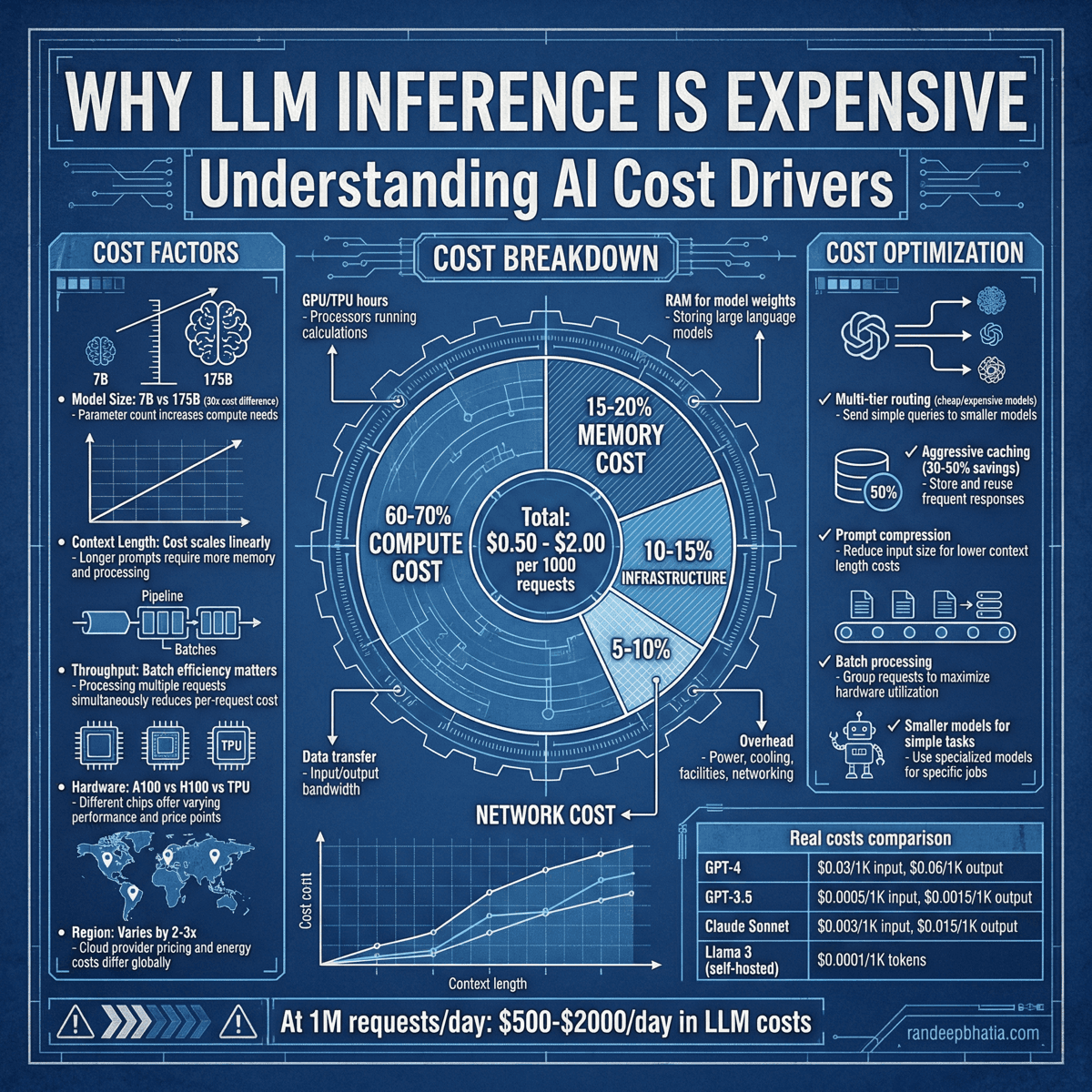
LLM inference costs escalate due to the multiplicative interaction of model size, token volume, latency requirements, and GPU memory constraints that create non-linear cost scaling.
Token costs compound exponentially: input tokens require attention computation across all previous tokens (O(n²) complexity), output tokens require sequential autoregressive generation, and context window utilization directly multiplies both compute and memory requirements.
Hardware economics dominate: GPU memory bandwidth (not compute) is the primary bottleneck, requiring expensive high-bandwidth memory (HBM) GPUs; a single H100 costs $30,000+ and serves limited concurrent requests due to memory constraints.
Hidden multipliers accumulate: retries from failures, prompt engineering overhead, safety filtering, logging, and observability can increase effective costs by 2-5x beyond raw API pricing.
The Bottom Line
LLM inference costs are fundamentally driven by the physics of transformer architecture—quadratic attention complexity, sequential token generation, and massive parameter counts requiring expensive GPU memory. Organizations typically underestimate costs by 3-10x because they fail to account for context length scaling, retry rates, prompt overhead, and the operational infrastructure required for production reliability.
Definition
Definition
LLM inference cost refers to the total computational, infrastructure, and operational expense incurred when generating outputs from large language models, encompassing GPU compute cycles, memory bandwidth utilization, API fees, and supporting infrastructure.
These costs scale non-linearly with model size, context length, output length, and throughput requirements, creating complex cost dynamics that differ fundamentally from traditional software infrastructure.
Extended Definition
The expense of LLM inference stems from the fundamental architecture of transformer models, which require loading billions of parameters into GPU memory for each forward pass and computing attention across all tokens in the context window. Unlike traditional compute workloads where costs scale linearly with usage, LLM inference exhibits quadratic scaling with context length due to self-attention mechanisms and is constrained by GPU memory bandwidth rather than raw compute capacity. This creates a situation where doubling the context window can more than double costs, and where serving latency requirements force underutilization of expensive hardware. The total cost of ownership includes not just raw inference but also the supporting infrastructure for prompt management, response caching, failure handling, safety filtering, and observability—often doubling or tripling the apparent per-token cost.
Etymology & Origins
The term 'inference' in machine learning derives from statistical inference, referring to the process of drawing conclusions from data. In the context of LLMs, inference specifically means the forward pass through the neural network to generate predictions (tokens). The cost concerns emerged prominently in 2022-2023 as organizations moved from research experimentation to production deployment, discovering that the economics of serving transformer models at scale differ dramatically from training costs and from traditional software infrastructure costs.
Also Known As
Not To Be Confused With
Training costs
Training costs are one-time expenses to create or fine-tune a model, while inference costs are ongoing operational expenses that scale with usage. Training is typically 10-1000x more expensive per compute hour but occurs infrequently, whereas inference costs accumulate continuously with every user query.
Fine-tuning costs
Fine-tuning is a form of training that adapts a base model to specific tasks. While fine-tuning can reduce inference costs by enabling smaller models or shorter prompts, the fine-tuning process itself is a capital expense distinct from the operational inference costs.
Embedding costs
Embedding generation (converting text to vectors) is a separate inference operation that is typically 10-100x cheaper per token than generative inference because it requires only a single forward pass without autoregressive token generation.
Storage costs
Model storage costs (storing model weights on disk or in object storage) are negligible compared to inference costs. A 70B parameter model requires ~140GB of storage but costs pennies per month to store, while serving it costs thousands of dollars per day in GPU compute.
Latency costs
Latency refers to time delay, not financial cost. However, latency requirements directly impact costs because meeting strict latency SLAs requires overprovisioning GPU capacity, reducing utilization efficiency and increasing cost per token.
Bandwidth costs
Network bandwidth costs for transmitting prompts and responses are typically negligible (sub-cent per MB) compared to the compute costs of generating those responses, which can be dollars per million tokens.
Conceptual Foundation
Core Principles
(8 principles)Mental Models
(6 models)The Restaurant Kitchen Model
Think of LLM inference like a high-end restaurant kitchen. The model weights are the kitchen equipment (expensive, fixed cost), the GPU is the chef (limited capacity, high hourly rate), input tokens are ingredients (must be prepared/processed), and output tokens are plated dishes (created sequentially, cannot be parallelized). Longer menus (contexts) require more prep space (memory), and rush orders (low latency) mean the chef can't batch efficiently.
The Highway Toll Model
Imagine a toll road where you pay per mile (tokens), but the toll rate increases with traffic (context length), and there's a premium for express lanes (low latency). Additionally, you pay for the car (GPU) whether you're driving or parked, and bigger cars (larger models) cost more per mile but carry more passengers (quality).
The Iceberg Model
The visible API cost (price per token) is the tip of the iceberg. Below the surface are hidden costs: prompt engineering overhead (10-50% of tokens are instructions), retry costs (5-20% of requests fail), safety filtering (adds latency and compute), logging and observability (storage and compute), and context that could be cached but isn't.
The Compound Interest Model
LLM costs compound like interest. Each additional feature (longer context, more retries, additional safety checks, verbose logging) multiplies the base cost. A system with 5 features each adding 20% overhead doesn't cost 100% more—it costs (1.2)^5 = 2.5x more.
The Bathtub Curve Model
Cost efficiency follows a bathtub curve with scale. At low volumes, fixed costs dominate (high per-token cost). At medium volumes, efficiency improves as fixed costs amortize. At very high volumes, new inefficiencies emerge: rate limits, capacity constraints, and the need for multi-region deployment increase per-token costs again.
The Water Pressure Model
Think of inference capacity like water pressure in a building. The pump (GPU) has fixed capacity. More faucets (concurrent requests) reduce pressure (increase latency) for everyone. Larger pipes (more memory bandwidth) help but are expensive. During peak demand, you either accept low pressure (high latency) or need more pumps (more GPUs).
Key Insights
(10 insights)Input tokens are 2-4x cheaper than output tokens in most pricing models because inputs can be processed in parallel while outputs require sequential generation, but many cost estimates incorrectly assume equal pricing.
The KV cache for a single long-context request can consume more GPU memory than the model weights themselves, meaning one user with a 100K context can monopolize resources that would serve hundreds of short-context users.
Prompt caching can reduce costs by 50-90% for repetitive workloads, but most organizations don't implement it because they don't realize how much of their prompt content is identical across requests.
The 'effective' cost per token in production is typically 2-5x the API list price due to retries, prompt overhead, failed requests that still incur costs, and infrastructure overhead.
Streaming responses cost the same as non-streaming but change the latency profile—time-to-first-token improves while total generation time remains constant, creating an illusion of speed without cost benefit.
Self-hosting becomes cost-effective only above approximately $50,000-100,000/month in API spend, and even then only if you have ML infrastructure expertise; below this threshold, the operational overhead exceeds API premiums.
Model quantization (reducing precision from FP16 to INT8 or INT4) can reduce costs by 2-4x with minimal quality degradation for many tasks, but requires careful evaluation and is underutilized in production.
The cost difference between providers for equivalent models can be 2-10x, and this gap changes frequently as providers adjust pricing; continuous cost monitoring and provider arbitrage is a legitimate optimization strategy.
Speculative decoding and other inference optimizations can reduce costs by 30-50% but require custom infrastructure that most organizations lack the expertise to implement and maintain.
The majority of LLM cost in enterprise deployments comes from a small percentage of requests—typically 10% of requests consume 50%+ of costs due to long contexts or outputs, making targeted optimization highly effective.
When to Use
When to Use
Ideal Scenarios
(12)When planning the budget for a new LLM-powered product or feature, understanding cost drivers enables accurate financial projections and prevents budget overruns that can kill projects.
When experiencing unexpectedly high LLM costs in production and needing to diagnose the root causes to implement targeted optimizations rather than blanket cost-cutting.
When evaluating build-vs-buy decisions for LLM infrastructure, comparing self-hosted costs against API provider costs requires understanding all cost components.
When designing system architecture for LLM applications, cost awareness during design prevents expensive rearchitecture later when costs become unsustainable.
When negotiating enterprise contracts with LLM API providers, understanding cost structure enables more effective negotiation on pricing tiers and volume discounts.
When implementing cost allocation and chargeback systems for internal LLM platforms, accurate cost attribution requires understanding the relationship between usage patterns and costs.
When optimizing existing LLM applications for cost efficiency, knowing which optimizations have the highest impact enables prioritization of engineering effort.
When setting usage policies and rate limits for LLM-powered features, cost understanding enables policies that balance user experience with financial sustainability.
When evaluating model selection tradeoffs between capability and cost, understanding the cost implications of model size and architecture enables informed decisions.
When forecasting infrastructure needs for scaling LLM applications, cost models enable capacity planning that accounts for non-linear scaling behavior.
When conducting post-mortems on cost incidents or budget overruns, understanding cost dynamics enables root cause analysis and prevention of recurrence.
When building internal tooling for LLM cost monitoring and optimization, comprehensive cost understanding ensures the tooling captures all relevant cost drivers.
Prerequisites
(8)Basic understanding of transformer architecture and how LLMs generate text through autoregressive token prediction.
Familiarity with GPU computing concepts including memory hierarchy, compute units, and the distinction between memory-bound and compute-bound workloads.
Access to cost data from LLM API providers or self-hosted infrastructure, including per-token pricing, GPU costs, and infrastructure expenses.
Understanding of the specific use cases and workloads being analyzed, including typical prompt lengths, output lengths, and request volumes.
Knowledge of the quality requirements for the application, as cost optimization often involves quality tradeoffs that must be evaluated.
Visibility into the full request lifecycle including retries, failures, and overhead that contribute to effective costs beyond raw token consumption.
Understanding of latency requirements and SLAs, as these constraints significantly impact achievable cost efficiency.
Access to usage analytics and telemetry that enable analysis of cost distribution across users, features, and request types.
Signals You Need This
(10)LLM API costs are growing faster than user growth or revenue, indicating non-linear cost scaling or inefficient usage patterns.
Budget forecasts for LLM costs consistently underestimate actual spend by 50% or more, suggesting missing cost components in the model.
Cost per user or cost per transaction varies wildly across user segments without clear explanation, indicating uncontrolled cost drivers.
Engineering team is proposing cost optimizations without clear prioritization or expected impact, suggesting lack of cost driver understanding.
Leadership is questioning LLM ROI but the team cannot articulate the cost structure or optimization opportunities.
Self-hosting vs API decisions are being made based on incomplete cost comparisons that ignore operational overhead.
New features are being designed without cost impact analysis, risking budget surprises when features launch.
Cost allocation across teams or products is contentious because the cost model is not well understood or agreed upon.
Competitors appear to offer similar LLM-powered features at lower prices, raising questions about cost efficiency.
Infrastructure team is struggling to capacity plan for LLM workloads because cost and resource relationships are unclear.
Organizational Readiness
(7)Finance team is engaged and willing to collaborate on understanding technology cost structures rather than treating LLM costs as a black box.
Engineering team has instrumentation in place to measure token consumption, latency, and error rates at the request level.
Product team is willing to consider feature tradeoffs based on cost impact, not just user experience metrics.
Leadership has established cost targets or constraints that create incentive for optimization rather than unlimited spending.
Organization has experience with cloud cost optimization and understands that technology costs require active management.
Data infrastructure exists to collect, store, and analyze LLM usage data at sufficient granularity for cost attribution.
Cross-functional collaboration mechanisms exist to align engineering optimizations with business priorities and constraints.
When NOT to Use
When NOT to Use
Anti-Patterns
(12)Optimizing costs before validating product-market fit—premature optimization can slow iteration velocity when learning speed matters more than cost efficiency.
Applying generic cost reduction strategies without understanding the specific cost profile of your workload—different workloads have different dominant cost drivers.
Focusing exclusively on per-token API pricing while ignoring the larger costs of prompt engineering, infrastructure, and operational overhead.
Assuming self-hosting is always cheaper at scale without accounting for the full operational costs including engineering time, on-call burden, and infrastructure management.
Optimizing for average cost while ignoring the tail—a small number of expensive requests often dominate total costs and require targeted intervention.
Treating all tokens as equal when input and output tokens have different costs and different optimization strategies.
Implementing complex cost optimization infrastructure for workloads below the threshold where optimization ROI exceeds implementation cost.
Sacrificing reliability for cost savings—failed requests that require retries or manual intervention often cost more than the savings from aggressive optimization.
Ignoring the time value of engineering effort—spending a month of engineering time to save $1,000/month in LLM costs is rarely a good investment.
Optimizing costs in isolation without considering the impact on user experience, feature velocity, or competitive positioning.
Assuming current pricing and cost structures will remain stable—LLM costs are declining rapidly and optimization investments may become obsolete.
Applying cost constraints uniformly across all use cases rather than differentiating based on business value and user willingness to pay.
Red Flags
(10)Cost optimization is being driven by arbitrary budget cuts rather than strategic analysis of value and efficiency.
The team is optimizing costs without measuring the quality or user experience impact of optimizations.
Cost discussions are happening without input from engineering teams who understand the technical constraints and tradeoffs.
Optimization efforts are focused on the easiest changes rather than the highest-impact opportunities.
The organization lacks the instrumentation to measure the impact of cost optimizations, making it impossible to validate effectiveness.
Cost targets are set without understanding the minimum viable cost for acceptable quality and reliability.
Self-hosting decisions are being made based on GPU list prices without accounting for utilization, operations, and opportunity costs.
The team is comparing costs across providers without normalizing for quality, reliability, and feature differences.
Cost optimization is being treated as a one-time project rather than an ongoing operational discipline.
Leadership expects cost reductions without providing resources for implementation or accepting feature tradeoffs.
Better Alternatives
(8)Early-stage product development with uncertain requirements
Focus on iteration speed and learning rather than cost optimization; use the most capable models to maximize feature velocity
The cost of delayed learning and slower iteration typically exceeds LLM costs at early stages. Premature optimization can lock in suboptimal architectures.
Low-volume applications with less than $1,000/month in LLM costs
Accept current costs and focus engineering effort on higher-impact work
The engineering time required for meaningful cost optimization typically exceeds the potential savings at low volumes. Wait until costs reach a threshold where optimization ROI is positive.
Applications where LLM quality directly drives revenue
Optimize for quality and conversion rather than cost; measure cost per conversion rather than cost per token
A 10% improvement in conversion from better LLM responses may be worth 50% higher costs. Cost optimization should be secondary to revenue optimization.
Highly variable workloads with unpredictable demand
Use API providers with pay-per-use pricing rather than investing in self-hosted infrastructure
The cost premium of API providers is offset by avoiding the risk of overprovisioned or underprovisioned self-hosted infrastructure.
Organizations without ML infrastructure expertise
Partner with managed service providers rather than attempting self-hosted optimization
The operational complexity of optimized LLM infrastructure requires specialized expertise. The cost of building this expertise often exceeds the savings from self-hosting.
Use cases where latency is the primary constraint
Optimize for latency first, then optimize costs within latency constraints
Aggressive cost optimization often increases latency. For latency-sensitive applications, the user experience impact of higher latency exceeds the value of cost savings.
Competitive markets where feature velocity matters
Invest in faster development rather than cost optimization; use cost savings from model improvements over time
LLM costs are declining 50%+ annually. Features shipped today at higher costs may naturally become cost-effective as pricing decreases.
Applications with high error rates or reliability issues
Fix reliability first, as failed requests and retries are often the largest hidden cost driver
A 20% error rate with retries increases effective costs by 25%. Reliability improvements often deliver larger cost savings than direct cost optimization.
Common Mistakes
(10)Comparing API costs across providers without accounting for differences in tokenization—the same text can be 20-50% more or fewer tokens depending on the tokenizer.
Ignoring the cost of prompt engineering and system prompts, which can represent 50-80% of input tokens for many applications.
Assuming linear cost scaling when planning for growth—costs often scale superlinearly due to context length increases and infrastructure overhead.
Optimizing for the wrong metric—reducing cost per token while increasing tokens per request can increase total costs.
Implementing caching without measuring cache hit rates—poorly designed caches add infrastructure cost without meaningful savings.
Switching to smaller models without systematic quality evaluation—cost savings are meaningless if quality drops below acceptable thresholds.
Underestimating the operational cost of self-hosting—GPU costs are often less than half of total self-hosted infrastructure costs.
Failing to account for the cost of failures—rate limits, timeouts, and content filter rejections all consume resources without delivering value.
Optimizing average request cost while ignoring the distribution—a few expensive requests often dominate total costs.
Treating cost optimization as an engineering problem when it often requires product changes like shorter responses or simpler prompts.
Core Taxonomy
Core Taxonomy
Primary Types
(8 types)The direct cost of GPU cycles required to perform the matrix multiplications and attention computations that generate LLM outputs. This is the fundamental cost driver that all other costs ultimately derive from.
Characteristics
- Scales linearly with model parameter count
- Scales quadratically with context length for attention computation
- Scales linearly with output token count
- Dominated by memory bandwidth rather than raw compute capacity
- Varies by GPU type with newer GPUs offering better cost efficiency
Use Cases
Tradeoffs
Higher compute costs enable larger models with better quality, but the relationship between compute and quality is logarithmic—doubling compute yields diminishing quality improvements.
Classification Dimensions
Cost Variability
Understanding cost variability is essential for budgeting and capacity planning. Fixed costs dominate at low volumes while variable costs dominate at scale.
Cost Attribution
Accurate cost attribution enables optimization prioritization and internal chargeback. Many organizations struggle to attribute shared and overhead costs accurately.
Cost Timing
Cost timing affects financial planning and ROI calculations. Upfront costs are often underweighted relative to ongoing costs in decision-making.
Cost Controllability
Focusing optimization efforts on controllable costs yields the highest ROI. External costs require strategic responses like provider diversification.
Cost Visibility
Hidden costs often exceed visible costs in production systems. Comprehensive cost visibility requires intentional instrumentation and analysis.
Cost Scaling Behavior
Understanding scaling behavior is essential for accurate growth projections. Non-linear scaling often surprises organizations as they scale.
Evolutionary Stages
Experimentation
0-6 months from project startLow volume, high per-request costs acceptable, focus on capability validation rather than efficiency. API providers preferred for flexibility. Cost tracking minimal or absent.
Initial Production
6-18 months from project startGrowing volume reveals cost scaling issues. Basic cost tracking implemented. First optimization efforts focused on obvious wins like prompt length reduction. API costs become a budget line item.
Scale Optimization
12-24 months from project startCost optimization becomes a dedicated effort. Caching, batching, and model selection optimization implemented. Self-hosting evaluation begins. Cost attribution and chargeback systems deployed.
Mature Operations
24+ months from project startComprehensive cost management infrastructure in place. Continuous optimization processes established. Hybrid self-hosted and API architecture common. Cost efficiency metrics integrated into development processes.
Strategic Cost Management
36+ months from project startCost optimization integrated into product strategy. Provider negotiations leverage volume and alternatives. Custom inference infrastructure for highest-volume workloads. Cost-aware architecture decisions are default.
Architecture Patterns
(8 patterns)Tiered Model Routing
Route requests to different models based on complexity, cost sensitivity, or quality requirements. Simple queries go to smaller, cheaper models while complex queries use larger, more expensive models.
Components
- Request classifier (rule-based or ML)
- Model registry with cost/capability metadata
- Routing logic with fallback handling
- Quality monitoring for routing accuracy
- Cost tracking per tier
Data Flow
Request → Classifier → Router → Selected Model → Response → Quality Check → (Optional Retry with Higher Tier)
Best For
- High-volume applications with diverse query complexity
- Cost-sensitive deployments with quality flexibility
- Applications where 80%+ of queries can use smaller models
Limitations
- Classification errors can impact quality or waste costs
- Requires maintenance of multiple model integrations
- Adds latency for classification step
- Quality monitoring overhead for each tier
Scaling Characteristics
Scales well as classification overhead is minimal. Cost savings scale with traffic volume. Requires ongoing tuning of classification thresholds.
Integration Points
API Gateway
Central point for request routing, rate limiting, authentication, and cost tracking across all LLM requests.
Gateway adds latency but provides essential control and visibility. Must be highly available as it's a single point of failure. Consider edge deployment for latency-sensitive applications.
Cost Tracking System
Collects and aggregates cost data across all inference requests for attribution, budgeting, and optimization.
Must handle high event volumes without becoming a bottleneck. Accuracy depends on comprehensive instrumentation. Consider sampling for very high volumes.
Model Registry
Maintains metadata about available models including capabilities, costs, and routing rules.
Must be highly available as it's queried on every request. Cache aggressively but handle updates correctly. Include cost metadata for routing decisions.
Caching Layer
Stores and retrieves cached responses to reduce redundant inference costs.
Cache hit rate is the key metric. Balance cache size against storage costs. Consider tiered caching with hot/warm/cold storage.
Queue System
Buffers requests for batch processing and handles backpressure during load spikes.
Queue depth indicates capacity issues. Must handle request timeouts gracefully. Consider separate queues for different priority levels.
Monitoring System
Collects metrics, logs, and traces for operational visibility and cost optimization.
Monitoring overhead should be proportional to value. High-cardinality metrics can be expensive. Sample appropriately for high-volume systems.
Provider Abstraction Layer
Provides unified interface across multiple LLM providers for flexibility and cost optimization.
Abstraction adds complexity but enables provider arbitrage. Must handle provider-specific features and limitations. Version carefully as provider APIs change.
Budget Controller
Enforces cost limits and budgets across users, teams, or applications.
Must be low-latency to avoid blocking requests. Handle budget updates and resets correctly. Consider soft limits with warnings before hard limits.
Decision Framework
Decision Framework
Self-hosting evaluation is warranted; proceed to infrastructure capability assessment
API providers are likely more cost-effective; focus on API-level optimizations
This threshold assumes you have or can hire ML infrastructure expertise. Without expertise, the threshold is higher ($100,000+).
Technical Deep Dive
Technical Deep Dive
Overview
LLM inference cost is fundamentally determined by the computational requirements of the transformer architecture, which processes input tokens through multiple layers of attention and feed-forward networks, then generates output tokens autoregressively. The cost structure emerges from the interaction of model size (parameter count), sequence length (context window), batch size (concurrent requests), and hardware constraints (GPU memory and bandwidth). Understanding these interactions is essential for cost optimization because they create non-linear scaling behaviors that are counterintuitive to engineers familiar with traditional software systems. The inference process begins with tokenization, converting text into numerical token IDs using a model-specific vocabulary. These tokens are then embedded into high-dimensional vectors and processed through the transformer layers. Each layer applies self-attention (comparing every token to every other token) and feed-forward transformations. For generation, the model produces one token at a time, with each new token requiring a full forward pass through all layers. This sequential generation is the fundamental reason output tokens are more expensive than input tokens. The hardware economics of inference are dominated by memory bandwidth rather than compute capacity. Modern GPUs have enormous computational throughput (hundreds of teraflops) but limited memory bandwidth (a few terabytes per second). Since inference requires loading model weights from memory for each forward pass, and weights for large models exceed the bandwidth capacity, the GPU compute units spend most of their time waiting for data. This memory-bound nature means that cost optimization often focuses on reducing memory movement rather than reducing computation. The total cost of a request includes not just the raw inference compute but also the supporting infrastructure: API gateway processing, request queuing, response streaming, logging, and monitoring. For API providers, the per-token price includes their infrastructure costs, operational overhead, and profit margin. For self-hosted deployments, these costs are incurred directly but are often underestimated in cost comparisons.
Step-by-Step Process
The request arrives at the API gateway or load balancer, which performs authentication, rate limiting, and initial validation. The prompt text is extracted and prepared for tokenization. Request metadata is logged for cost tracking and debugging.
Gateway processing adds latency and cost. Overly verbose logging can cost more than the inference itself. Rate limiting may reject valid requests, requiring retries that increase costs.
Under The Hood
The transformer architecture that powers modern LLMs creates a specific cost structure rooted in its computational patterns. The self-attention mechanism, which enables the model to consider relationships between all tokens in the context, requires computing attention scores between every pair of tokens. For a sequence of length n, this creates n² attention computations per layer, multiplied by the number of attention heads and layers. A model like GPT-4 with ~100 layers and ~100 attention heads processes billions of attention operations for long contexts. The memory bandwidth bottleneck is the dominant factor in inference cost. A 70B parameter model requires ~140GB of memory in FP16 precision. Each forward pass must load these weights from GPU memory (HBM) to the compute units. Even the fastest GPUs (H100) have memory bandwidth of ~3TB/s, meaning loading 140GB takes ~50ms. The actual matrix multiplications take only a few milliseconds. This means the GPU spends 90%+ of its time waiting for memory transfers, not computing. The KV cache optimization trades memory for computation. Without caching, generating each output token would require recomputing attention for all previous tokens—O(n²) per token, O(n³) total for n output tokens. The KV cache stores intermediate results, reducing generation to O(n) per token. However, the cache consumes substantial memory: for a 70B model with 100 layers and 8K context, the KV cache can exceed 50GB, potentially larger than the model weights themselves. Batching is the primary mechanism for improving GPU utilization. By processing multiple requests simultaneously, the cost of loading model weights is amortized across requests. However, batching is constrained by GPU memory (each request needs its own KV cache) and latency requirements (batching adds wait time). The optimal batch size balances utilization against these constraints. For latency-sensitive applications, batch sizes of 1-4 are common, achieving only 10-30% GPU utilization. Quantization reduces costs by using lower-precision arithmetic. FP16 (16-bit floating point) is standard, but INT8 (8-bit integer) and INT4 (4-bit) quantization can reduce memory requirements and increase throughput by 2-4x with modest quality degradation. Quantization is particularly effective for inference because the precision requirements are lower than for training. However, quantization requires careful calibration and may not be available through API providers.
Failure Modes
Failure Modes
Application design allows unbounded context accumulation (e.g., conversation history, document concatenation) without limits or summarization.
- Exponentially increasing costs over time
- Requests hitting context limits and failing
- Latency degradation as contexts grow
- Memory exhaustion in self-hosted deployments
Can increase costs by 10-100x compared to initial projections. May cause service degradation or outages as limits are hit.
Implement context management strategies: sliding windows, summarization, or explicit context limits. Monitor context length distribution.
Emergency context truncation, temporary feature disabling, or switching to longer-context models (at higher cost).
Operational Considerations
Key Metrics (15)
Total cost including input tokens, output tokens, and overhead for each request. The fundamental unit economics metric.
Dashboard Panels
Alerting Strategy
Implement tiered alerting with different severity levels. Cost alerts should fire at 80% and 95% of budget thresholds. Error rate alerts should escalate based on duration and impact. GPU resource alerts should provide early warning before capacity exhaustion. All alerts should include context (recent changes, affected segments) and suggested actions. Avoid alert fatigue by tuning thresholds based on actionability.
Cost Analysis
Cost Analysis
Cost Drivers
(10)Model Size (Parameter Count)
Linear relationship: 2x parameters ≈ 2x inference cost. Larger models require more memory and compute per forward pass.
Use the smallest model that meets quality requirements. Implement model routing to use smaller models for simpler queries. Consider fine-tuning smaller models for specific tasks.
Context Length
Quadratic for attention computation: 2x context ≈ 4x attention cost. Also increases KV cache memory, reducing batch capacity.
Implement context management (summarization, sliding windows). Optimize RAG to retrieve fewer, more relevant chunks. Use prompt compression techniques.
Output Length
Linear relationship: 2x output tokens ≈ 2x generation cost. Output tokens are typically 2-4x more expensive than input tokens.
Implement output length limits. Use structured outputs to reduce verbosity. Optimize prompts to encourage concise responses.
Request Volume
Linear at API level, but infrastructure costs have economies of scale. High volume enables better GPU utilization.
Implement caching to reduce effective request volume. Batch similar requests where latency allows. Negotiate volume discounts with providers.
Latency Requirements
Strict latency requirements prevent batching, reducing GPU utilization by 2-5x and increasing cost per token proportionally.
Classify requests by latency sensitivity. Use async processing for non-urgent requests. Implement tiered SLAs with different cost structures.
Error and Retry Rate
Direct cost multiplication: 20% error rate with retries ≈ 25% cost increase. Failed requests often still incur partial costs.
Implement robust error handling. Use circuit breakers to prevent retry storms. Optimize requests to reduce error-prone patterns.
Prompt Engineering Overhead
System prompts and few-shot examples can represent 50-80% of input tokens, directly multiplying input costs.
Optimize prompt length while maintaining quality. Consider fine-tuning to reduce prompt requirements. Implement prompt caching for repeated system prompts.
GPU Utilization
Low utilization means paying for idle capacity. Self-hosted deployments often achieve only 20-40% utilization.
Implement continuous batching. Mix workloads with different latency requirements. Right-size GPU allocation based on actual usage.
Provider Selection
2-10x cost difference between providers for similar capabilities. Pricing changes frequently.
Implement provider abstraction for flexibility. Monitor pricing across providers. Negotiate enterprise agreements for volume discounts.
Observability Overhead
Full logging can cost 10-50% of inference costs for storage and processing. Monitoring infrastructure has fixed costs.
Implement log sampling for high-volume endpoints. Use structured logging with selective fields. Tiered retention policies.
Cost Models
API Provider Cost Model
Total Cost = (Input Tokens × Input Price) + (Output Tokens × Output Price) + (Requests × Per-Request Fee if applicable)For GPT-4 Turbo at $10/M input, $30/M output: 1000 requests × (2000 input + 500 output tokens) = 2M input ($20) + 0.5M output ($15) = $35 total
Self-Hosted Cost Model
Total Cost = (GPU Hours × GPU Cost) + (Infrastructure Cost) + (Operations Cost) / Tokens ProcessedH100 at $3/hour, 50% utilization, 1000 tokens/sec when active: 720 hours × $3 = $2160/month GPU + $500 infra + $1000 ops = $3660 for ~1.3B tokens = $2.80/M tokens
Effective Cost Model (with overhead)
Effective Cost = Base Cost × (1 + Retry Rate) × (1 + Prompt Overhead) × (1 + Infrastructure Overhead)Base cost $10/M, 15% retry rate, 60% prompt overhead, 20% infra overhead: $10 × 1.15 × 1.6 × 1.2 = $22.08/M effective cost
Break-Even Analysis (Self-Host vs API)
Break-Even Volume = Fixed Self-Host Costs / (API Cost per Token - Self-Host Variable Cost per Token)Fixed costs $10,000/month, API $15/M tokens, self-host variable $3/M: Break-even = $10,000 / ($15-$3 per M) = 833M tokens/month
Optimization Strategies
- 1Implement semantic caching for repetitive queries—can reduce costs by 40-80% for suitable workloads
- 2Use tiered model routing to send simple queries to cheaper models—typically 30-60% savings
- 3Optimize prompt length by removing redundant instructions and examples—10-30% savings
- 4Implement output length limits appropriate for each use case—20-50% savings on output costs
- 5Batch requests where latency requirements allow—improves GPU utilization by 2-5x
- 6Fine-tune smaller models for high-volume, narrow tasks—can reduce costs by 60-80%
- 7Implement request deduplication to avoid processing identical concurrent requests
- 8Use streaming judiciously—it doesn't reduce costs but changes latency profile
- 9Negotiate volume discounts and committed use agreements with providers
- 10Implement provider arbitrage—route to cheapest provider meeting quality requirements
- 11Reduce retry rates through better error handling and request design
- 12Implement context management to prevent unbounded context growth
Hidden Costs
- 💰Prompt engineering tokens: System prompts and few-shot examples often represent 50-80% of input tokens
- 💰Retry costs: Failed requests that still incur charges plus successful retry costs
- 💰Logging and observability: Storage and processing for request/response logs
- 💰Safety filtering: Additional inference for content moderation
- 💰Development and testing: Non-production usage during development
- 💰Warm-up and health checks: Requests to keep models loaded and verify health
- 💰Context that could be cached: Repeated context across requests within sessions
- 💰Tokenization overhead: Some text patterns tokenize inefficiently
ROI Considerations
When evaluating LLM cost optimization investments, consider the full ROI picture including implementation cost, ongoing maintenance, quality impact, and opportunity cost of engineering time. A $50,000 optimization project that saves $10,000/month has a 5-month payback, but only if quality is maintained and the savings persist. Factor in the risk that LLM pricing is declining rapidly—optimizations that take 6 months to implement may be obsoleted by price reductions. The highest-ROI optimizations are typically those that require minimal implementation effort and have immediate impact: output length limits, basic caching, and prompt optimization. More complex optimizations like model routing and self-hosting have higher potential savings but also higher implementation and maintenance costs. Consider the opportunity cost of engineering time. If your engineers could be building revenue-generating features instead of optimizing costs, the cost optimization must save more than the value of those features. For early-stage companies, this often means accepting higher LLM costs to maintain development velocity. Finally, consider the strategic value of cost optimization capability. Organizations that build robust cost management infrastructure can experiment more freely, scale more confidently, and make better build-vs-buy decisions. The infrastructure investment may be worthwhile even if immediate savings are modest.
Security Considerations
Threat Model
(10 threats)Prompt Injection Cost Attack
Malicious users craft inputs that cause excessive output generation or trigger expensive operations
Direct financial loss from inflated costs, potential service degradation for other users
Implement strict output length limits, input validation, per-user cost limits, anomaly detection on request costs
API Key Theft and Abuse
Stolen API keys used to make unauthorized requests, potentially at high volume
Unexpected costs, potential rate limit impact on legitimate traffic, data exposure
Rotate keys regularly, implement key scoping and restrictions, monitor for anomalous usage patterns, use short-lived tokens
Denial of Wallet Attack
Attacker generates high-cost requests to exhaust budget or cause service degradation
Budget exhaustion, service unavailability, financial loss
Implement per-user and per-endpoint cost limits, rate limiting, anomaly detection, budget alerts with automatic throttling
Data Exfiltration via Prompts
Sensitive data included in prompts is logged, cached, or sent to third-party providers
Data breach, compliance violations, reputation damage
Implement data classification and filtering, use on-premise or private deployments for sensitive data, minimize logging of sensitive content
Model Extraction via API
Systematic querying to extract model behavior or training data
Intellectual property loss (for fine-tuned models), high costs from extraction attempts
Rate limiting, query pattern detection, output perturbation, monitoring for systematic probing
Cache Poisoning
Attacker crafts requests to poison semantic cache with incorrect or malicious responses
Users receive incorrect information, potential for spreading misinformation
Cache entry validation, user-specific cache isolation, cache integrity monitoring, conservative similarity thresholds
Provider Account Compromise
Attacker gains access to LLM provider account, can modify settings or access data
Cost manipulation, data access, service disruption
Strong authentication (MFA), principle of least privilege, audit logging, regular access review
Insider Cost Abuse
Internal users or developers use LLM resources for unauthorized purposes
Unexpected costs, resource contention, potential policy violations
Cost attribution and monitoring, usage policies, separation of development and production resources
Supply Chain Attack on Models
Compromised model weights or inference infrastructure
Malicious outputs, data theft, backdoor access
Verify model provenance, use trusted providers, monitor for anomalous model behavior
Inference Side-Channel Attacks
Timing or resource usage analysis to infer information about other users' requests
Privacy violation, potential data leakage
Request isolation, consistent response timing, resource partitioning
Security Best Practices
- ✓Implement defense in depth with multiple layers of cost controls (per-request, per-user, per-endpoint, global)
- ✓Use API key rotation and short-lived tokens rather than long-lived credentials
- ✓Implement comprehensive audit logging for all LLM requests with tamper-evident storage
- ✓Apply principle of least privilege for API access—scope keys to specific models and endpoints
- ✓Monitor for anomalous usage patterns that may indicate compromise or abuse
- ✓Implement input validation and sanitization before sending to LLM providers
- ✓Use private endpoints or VPC connectivity where available to reduce exposure
- ✓Encrypt sensitive data in transit and at rest, including in caches and logs
- ✓Implement data classification to prevent sensitive data from reaching inappropriate destinations
- ✓Regular security assessments of LLM infrastructure and access controls
- ✓Incident response procedures specific to LLM cost and security incidents
- ✓Employee training on LLM security risks and responsible use policies
- ✓Vendor security assessment for LLM providers and related services
- ✓Implement rate limiting at multiple levels (API gateway, application, provider)
- ✓Use separate environments and credentials for development, staging, and production
Data Protection
- 🔒Classify data before including in LLM prompts—not all data should be sent to external providers
- 🔒Implement PII detection and redaction for prompts containing sensitive information
- 🔒Use data masking or tokenization for sensitive values that must be included in prompts
- 🔒Ensure provider contracts include appropriate data protection terms
- 🔒Implement retention policies for logs and caches containing prompt/response data
- 🔒Consider on-premise or private cloud deployment for highly sensitive use cases
- 🔒Encrypt data at rest in caches and logs
- 🔒Implement access controls for prompt/response data
- 🔒Regular data protection impact assessments for LLM use cases
- 🔒Employee training on data handling in LLM contexts
Compliance Implications
GDPR
Personal data processing must have legal basis, data minimization, right to erasure
Minimize personal data in prompts, implement data retention policies for logs and caches, ensure provider DPAs are in place, enable data deletion workflows
HIPAA
Protected health information must be secured with appropriate safeguards
Use HIPAA-compliant providers with BAAs, implement access controls, encrypt PHI, audit logging, avoid PHI in prompts where possible
SOC 2
Security, availability, processing integrity, confidentiality, privacy controls
Document LLM security controls, implement monitoring and alerting, access management, change management for LLM configurations
PCI DSS
Cardholder data must be protected with specific technical controls
Never include card data in prompts, use tokenization, ensure providers are PCI compliant if processing payment-related queries
CCPA/CPRA
Consumer data rights including access, deletion, and opt-out of sale
Track data flows through LLM systems, implement data subject request workflows, ensure provider contracts address data rights
AI Act (EU)
Risk-based requirements for AI systems including transparency and human oversight
Document AI system purposes and risks, implement human oversight mechanisms, maintain transparency about AI use
Industry-Specific Regulations
Financial services, healthcare, and other industries have specific AI/ML requirements
Consult industry-specific guidance, implement required controls, document compliance measures
Data Residency Requirements
Some jurisdictions require data to remain within geographic boundaries
Use region-specific deployments, verify provider data handling, implement data flow controls
Scaling Guide
Scaling Guide
Scaling Dimensions
Request Volume
Horizontal scaling of inference capacity, load balancing, request queuing for burst absorption
Provider rate limits, GPU availability, budget constraints
Volume scaling is relatively straightforward but costs scale linearly. Focus on efficiency optimizations before scaling capacity.
Context Length
Memory optimization, context management, model selection for long-context support
Model context limits (4K-200K+ depending on model), GPU memory for KV cache
Context length scaling is expensive due to quadratic attention. Implement context management before accepting long contexts.
Concurrent Users
Connection pooling, request queuing, capacity planning for peak concurrency
GPU memory limits batch size, provider connection limits
Concurrency requires balancing latency against throughput. Implement request prioritization for mixed workloads.
Model Capability
Model selection, fine-tuning, ensemble approaches
Available models, fine-tuning data and expertise, cost constraints
Capability scaling often means larger models with higher costs. Evaluate if capability improvements justify cost increases.
Geographic Distribution
Multi-region deployment, edge caching, provider selection by region
Provider regional availability, data residency requirements, operational complexity
Geographic scaling multiplies infrastructure costs. Evaluate if latency or compliance requirements justify multi-region.
Feature Breadth
Modular architecture, feature-specific optimization, cost allocation
Engineering capacity, budget allocation, operational complexity
Each new LLM-powered feature adds cost. Implement cost tracking per feature to enable informed prioritization.
Quality Requirements
Model selection, prompt engineering, evaluation infrastructure
Available model capabilities, cost constraints, latency requirements
Higher quality typically means higher costs. Define quality requirements explicitly and measure continuously.
Reliability Requirements
Redundancy, fallback providers, error handling, monitoring
Cost of redundancy, operational complexity, provider availability
Higher reliability requires redundancy that increases costs. Define SLAs explicitly and design to meet them efficiently.
Capacity Planning
Required GPUs = (Peak Requests/sec × Avg Latency) / (Batch Size × GPU Count per Request) × Safety Margin. For API providers: Required Rate Limit = Peak Requests/sec × Safety Margin. Budget = Projected Tokens × Price per Token × Overhead Factor.Plan for 1.5-2x expected peak load. LLM workloads can have high variance, and capacity shortfalls cause latency degradation or failures. For self-hosted, GPU procurement lead times require planning months ahead.
Scaling Milestones
- Establishing baseline costs and patterns
- Validating quality requirements
- Initial prompt engineering
Simple direct API integration. Focus on functionality over optimization. Implement basic cost tracking.
- Cost visibility and attribution
- Initial optimization opportunities
- Error handling and reliability
Add comprehensive cost tracking. Implement basic caching. Establish error handling patterns. Set up monitoring dashboards.
- Cost scaling faster than revenue
- Latency consistency
- Provider rate limits
Implement semantic caching. Add model routing for cost optimization. Negotiate volume pricing. Consider request batching.
- Self-hosting evaluation
- Multi-provider strategy
- Operational complexity
Evaluate self-hosting economics. Implement provider abstraction. Add fallback providers. Sophisticated cost management infrastructure.
- Infrastructure optimization
- Cost efficiency at scale
- Organizational cost management
Hybrid self-hosted and API architecture. Custom inference optimization. Dedicated capacity agreements. Mature cost allocation and chargeback.
- Custom infrastructure requirements
- Provider relationship management
- Cost as competitive advantage
Custom inference infrastructure. Strategic provider partnerships. Advanced optimization (speculative decoding, custom kernels). Cost optimization as core competency.
- Multi-region complexity
- Data residency compliance
- Consistent global experience
Multi-region deployment. Global load balancing. Region-specific provider selection. Compliance-aware routing.
Benchmarks
Benchmarks
Industry Benchmarks
| Metric | P50 | P95 | P99 | World Class |
|---|---|---|---|---|
| Cost per 1M input tokens (GPT-4 class) | $10-15 | $20-30 | $30-50 | $5-8 (with optimization) |
| Cost per 1M output tokens (GPT-4 class) | $30-45 | $50-75 | $75-100 | $15-25 (with optimization) |
| Effective cost multiplier (vs list price) | 2-3x | 3-5x | 5-10x | 1.2-1.5x |
| Cache hit rate | 20-30% | 40-50% | 50-60% | 60-80% |
| Error/retry rate | 10-15% | 20-30% | 30-50% | <5% |
| GPU utilization (self-hosted) | 30-40% | 50-60% | 60-70% | >80% |
| Prompt overhead (% of input tokens) | 50-60% | 70-80% | 80-90% | <40% |
| Cost per successful task completion | $0.05-0.20 | $0.20-0.50 | $0.50-2.00 | <$0.02 |
| Self-hosted vs API cost ratio | 0.5-0.7x | 0.7-1.0x | 1.0-1.5x | 0.2-0.4x |
| Cost tracking accuracy | 70-80% | 85-90% | 90-95% | >98% |
| Budget forecast accuracy | ±30-40% | ±50-70% | ±70-100% | ±10-15% |
| Time to detect cost anomaly | 4-8 hours | 1-2 days | 3-7 days | <1 hour |
Comparison Matrix
| Provider/Approach | Cost (relative) | Quality | Latency | Flexibility | Operational Burden | Best For |
|---|---|---|---|---|---|---|
| OpenAI GPT-4 | High (1.0x baseline) | Excellent | Good | Limited | Low | Best quality, low ops capacity |
| Anthropic Claude | High (0.9-1.1x) | Excellent | Good | Limited | Low | Long context, safety focus |
| OpenAI GPT-3.5 | Low (0.05-0.1x) | Good | Excellent | Limited | Low | Simple tasks, cost-sensitive |
| Self-hosted Llama 70B | Medium (0.3-0.5x) | Very Good | Variable | High | High | High volume, ML expertise |
| Self-hosted Llama 7B | Very Low (0.05-0.1x) | Moderate | Excellent | High | Medium | Simple tasks, cost-critical |
| Fine-tuned small model | Very Low (0.02-0.05x) | Task-specific | Excellent | Low | High | Narrow, high-volume tasks |
| Hybrid (self-host + API) | Medium (0.4-0.6x) | Excellent | Good | High | High | Variable load, mixed requirements |
| Multi-provider routing | Medium-Low (0.5-0.7x) | Variable | Variable | High | Medium | Cost optimization, redundancy |
Performance Tiers
Direct API usage, no caching, no cost tracking, reactive to bills
Effective cost 3-5x list price, no cost visibility, frequent budget surprises
Cost tracking, output limits, basic caching, prompt optimization
Effective cost 2-3x list price, basic visibility, monthly budget accuracy ±30%
Semantic caching, model routing, context management, multi-provider
Effective cost 1.5-2x list price, full attribution, budget accuracy ±15%
Self-hosting, fine-tuning, custom inference, automated optimization
Effective cost 1.2-1.5x list price, real-time visibility, budget accuracy ±10%
Custom infrastructure, strategic provider relationships, cost as competitive advantage
Effective cost <1.2x list price, predictive cost management, cost-aware product decisions
Real World Examples
Real World Examples
Real-World Scenarios
(8 examples)E-commerce Product Search Enhancement
Large e-commerce platform adding LLM-powered natural language search. Initial deployment used GPT-4 for all queries, resulting in $500K/month costs for 10M daily searches.
Implemented tiered model routing (80% to fine-tuned small model, 15% to GPT-3.5, 5% to GPT-4), semantic caching (60% hit rate for common queries), and output length limits.
Reduced costs to $80K/month (84% reduction) while maintaining search quality metrics. Cache alone saved $200K/month.
- 💡Most search queries are simple and don't need GPT-4
- 💡Product search has high query repetition, ideal for caching
- 💡Quality measurement is essential before optimization
- 💡Tiered routing requires ongoing classifier maintenance
Customer Support Chatbot Scale-Up
SaaS company scaling customer support chatbot from 1K to 100K daily conversations. Costs grew from $5K to $800K/month, exceeding budget.
Implemented conversation summarization (context management), response caching for common questions, and hybrid self-hosted (Llama) + API (Claude for complex) architecture.
Reduced costs to $150K/month while improving response quality through better context management. Self-hosting handled 70% of volume at 0.3x API cost.
- 💡Conversation history accumulation is a major cost driver
- 💡Support queries have high repetition suitable for caching
- 💡Self-hosting requires significant operational investment
- 💡Context summarization improved quality by reducing noise
Document Processing Pipeline
Legal tech company processing 50K documents/day with LLM extraction. Long documents (10K+ tokens) caused costs to exceed $1M/month.
Implemented document chunking with smart overlap, parallel processing of chunks, result aggregation, and fine-tuned extraction model for common document types.
Reduced costs to $200K/month through chunking efficiency and fine-tuned model for 60% of documents. Processing time also improved 3x.
- 💡Long documents require chunking strategy, not just truncation
- 💡Fine-tuning is highly effective for narrow extraction tasks
- 💡Parallel chunk processing improves both cost and latency
- 💡Document type classification enables targeted optimization
Real-Time Content Moderation
Social platform implementing LLM-based content moderation for 1M posts/day. Latency requirements (<500ms) prevented batching, resulting in poor GPU utilization and high costs.
Implemented speculative decoding with small draft model, continuous batching with strict latency bounds, and tiered moderation (fast classifier + LLM for edge cases).
Achieved 2x throughput improvement through speculative decoding, reduced LLM calls by 70% through classifier pre-filtering, total cost reduction of 60%.
- 💡Latency requirements don't preclude all optimization
- 💡Pre-filtering with fast classifiers dramatically reduces LLM load
- 💡Speculative decoding is effective for moderation (predictable outputs)
- 💡Continuous batching helps even with strict latency requirements
Enterprise Knowledge Assistant
Large enterprise deploying internal knowledge assistant. Initial RAG implementation retrieved too many chunks, causing 8K+ token contexts and $300K/month costs for 50K daily queries.
Optimized retrieval to return fewer, more relevant chunks, implemented query routing (simple queries to smaller model), and added response caching for common questions.
Reduced average context from 8K to 2K tokens, costs dropped to $80K/month. Query routing sent 60% of queries to smaller model.
- 💡RAG retrieval quality directly impacts costs
- 💡More chunks doesn't mean better answers
- 💡Enterprise knowledge queries have high repetition
- 💡Query complexity varies widely, enabling routing optimization
Code Generation Tool
Developer tools company offering AI code completion. Output length was unpredictable, with some completions generating 1000+ tokens. Costs were 3x budget.
Implemented smart output length limits based on context, added stop sequences for code boundaries, and used streaming with client-side truncation for long outputs.
Reduced average output from 400 to 150 tokens without quality impact. Costs reduced by 50%. User satisfaction improved due to more focused completions.
- 💡Longer outputs aren't always better for code completion
- 💡Stop sequences are essential for code generation
- 💡Users prefer focused completions over verbose ones
- 💡Output length optimization has immediate ROI
Multi-Language Customer Service
Global company supporting 20 languages. Translation + LLM costs were $400K/month. Quality varied significantly across languages.
Switched to multilingual LLM (Claude) eliminating translation step, implemented language-specific prompt optimization, and added caching per language.
Eliminated $150K/month translation costs, improved quality consistency across languages, total costs reduced to $200K/month.
- 💡Modern LLMs handle multiple languages well
- 💡Translation adds cost and latency without quality benefit
- 💡Language-specific optimization is worthwhile for high-volume languages
- 💡Caching effectiveness varies by language (some have more repetition)
Startup Cost Crisis
AI startup hit $100K/month LLM costs with only $50K MRR. Needed immediate cost reduction without major engineering investment.
Quick wins: output length limits (immediate), prompt optimization (1 week), basic caching (2 weeks), model downgrade for non-critical features (1 week).
Reduced costs to $40K/month within 4 weeks. Quality impact was minimal for most features. Bought time for more systematic optimization.
- 💡Quick wins can achieve significant savings fast
- 💡Not all features need the best model
- 💡Output length limits are the fastest win
- 💡Cost crisis forces prioritization of what actually matters
Industry Applications
Financial Services
Document analysis, compliance checking, customer service
Compliance requirements may mandate specific providers or data handling. High accuracy requirements limit model routing options. Audit trails add logging costs.
Healthcare
Clinical documentation, patient communication, research assistance
HIPAA compliance requires specific providers and data handling. PHI in prompts requires careful management. High stakes require quality over cost optimization.
E-commerce
Product search, recommendations, customer support
High volume enables aggressive optimization. Query repetition makes caching highly effective. Latency impacts conversion, limiting some optimizations.
Legal
Document review, contract analysis, research
Long documents require chunking strategies. High accuracy requirements for legal analysis. Confidentiality concerns may require private deployment.
Education
Tutoring, content generation, assessment
Variable quality tolerance by use case. High volume during peak periods (exams). Content safety is critical for student-facing applications.
Media & Entertainment
Content creation, personalization, moderation
Creative tasks may require higher-capability models. Content moderation has strict latency requirements. High volume for personalization features.
Manufacturing
Documentation, quality analysis, maintenance prediction
Integration with operational systems. May require on-premise deployment for air-gapped environments. Technical accuracy is critical.
Professional Services
Research, document drafting, client communication
Client confidentiality requirements. Variable workload makes capacity planning difficult. Quality directly impacts billable work.
Government
Citizen services, document processing, analysis
Strict compliance and security requirements. May require FedRAMP or equivalent certified providers. Procurement processes affect provider selection.
Telecommunications
Customer service, network analysis, documentation
Very high volume customer interactions. 24/7 availability requirements. Integration with existing customer systems.
Frequently Asked Questions
(20 questions)Fundamentals
Output tokens require sequential autoregressive generation—each token needs a full forward pass through the model and cannot be parallelized. Input tokens can be processed in parallel in a single forward pass. This fundamental architectural difference means output generation is inherently more compute-intensive per token, typically 2-4x more expensive.
Strategy
Optimization
Measurement
Troubleshooting
Operations
Planning
Glossary
Glossary
Glossary
(29 terms)Autoregressive Generation
The process of generating output tokens one at a time, where each new token depends on all previous tokens. This sequential dependency prevents parallelization.
Context: Autoregressive generation is why output tokens are more expensive than input tokens and why generation latency scales linearly with output length.
Batch Size
The number of requests processed simultaneously in a single forward pass through the model. Larger batches improve GPU utilization but increase latency.
Context: Batch size optimization is key to cost efficiency. Latency requirements often force small batches, reducing utilization and increasing per-token costs.
Chargeback
The practice of allocating infrastructure costs to the teams or applications that consume them, creating accountability for resource usage.
Context: LLM chargeback requires accurate cost attribution. It creates incentives for cost optimization but can also create friction if not implemented fairly.
Circuit Breaker
A pattern that prevents cascading failures by stopping requests to a failing service, allowing it to recover.
Context: Circuit breakers are essential for LLM systems to prevent retry storms and cascading failures that multiply costs during incidents.
Context Management
Strategies for controlling context length including summarization, sliding windows, and selective inclusion. Essential for preventing unbounded context growth.
Context: Context management is critical for conversational applications and RAG systems where context naturally accumulates. Unmanaged context growth is a major cost driver.
Context Window
The maximum number of tokens an LLM can process in a single request, including both input and output. Ranges from 4K to 200K+ tokens depending on the model.
Context: Larger context windows enable more information but increase costs quadratically due to attention computation. Context management is a key optimization strategy.
Continuous Batching
Dynamically adding and removing requests from batches as they complete, rather than waiting for all requests in a batch to finish.
Context: Continuous batching improves GPU utilization by 20-50% compared to static batching. Implemented in modern inference frameworks like vLLM.
Cost Attribution
The process of assigning LLM costs to specific users, teams, features, or applications for budgeting and chargeback.
Context: Accurate cost attribution enables optimization prioritization and accountability. Requires comprehensive instrumentation and clear attribution rules.
Effective Cost
The true cost per token or request including all overhead: retries, prompt overhead, infrastructure, and operations. Typically 2-5x the list API price.
Context: Effective cost is the metric that matters for budgeting and optimization. List prices significantly underestimate true costs.
Embedding
A vector representation of text that captures semantic meaning. Used for similarity search in semantic caching and RAG systems.
Context: Embedding generation is much cheaper than text generation (10-100x) but still has costs. Embedding quality affects semantic cache effectiveness.
Fine-Tuning
Adapting a pre-trained model to specific tasks or domains by training on task-specific data. Can enable smaller models to match larger model quality.
Context: Fine-tuning has upfront costs but can dramatically reduce inference costs for high-volume, narrow tasks by enabling use of smaller models.
GPU Utilization
The percentage of GPU compute capacity being actively used. Low utilization means paying for idle capacity.
Context: LLM inference often achieves only 20-40% utilization due to memory bandwidth bottlenecks and latency constraints. Improving utilization is a key optimization lever.
HBM (High Bandwidth Memory)
Specialized memory used in GPUs that provides high bandwidth for data transfer. Essential for LLM inference but expensive and limited in capacity.
Context: HBM capacity and bandwidth are the primary constraints on LLM inference. GPU costs are largely driven by HBM specifications.
Inference Optimization
Techniques to improve inference efficiency including quantization, batching, caching, and custom kernels. Can reduce costs by 2-10x.
Context: Inference optimization requires ML infrastructure expertise and is typically only worthwhile at significant scale. Most organizations should start with higher-level optimizations.
KV Cache
Key-Value cache that stores intermediate attention computations during autoregressive generation, avoiding recomputation for previously processed tokens.
Context: KV cache enables efficient generation but consumes GPU memory proportional to context length, limiting batch size and concurrent requests.
Memory Bandwidth
The rate at which data can be transferred between GPU memory (HBM) and compute units. Measured in TB/s for modern GPUs.
Context: Memory bandwidth, not compute capacity, is typically the bottleneck for LLM inference. This is why larger batches improve efficiency—they amortize memory transfers.
Model Routing
Directing requests to different models based on characteristics like complexity, cost sensitivity, or quality requirements.
Context: Model routing enables cost optimization by using cheaper models for simple queries while reserving expensive models for complex ones. Requires classification logic and quality monitoring.
PagedAttention
A memory management technique that stores KV cache in non-contiguous pages, reducing memory fragmentation and enabling more efficient memory utilization.
Context: PagedAttention, implemented in vLLM, can reduce memory waste by 50-90%, enabling larger batch sizes and longer contexts on the same hardware.
Prompt Engineering
The practice of designing and optimizing prompts to achieve desired LLM outputs. Includes system prompts, few-shot examples, and instructions.
Context: Prompt engineering directly impacts costs—longer prompts mean more input tokens. Optimizing prompt length while maintaining quality is a key cost lever.
Provider Abstraction
A software layer that provides a unified interface across multiple LLM providers, enabling flexibility and cost optimization through provider selection.
Context: Provider abstraction enables cost optimization through provider arbitrage and provides redundancy for reliability. Adds implementation and maintenance complexity.
Quantization
Reducing the numerical precision of model weights (e.g., from FP16 to INT8 or INT4) to reduce memory requirements and increase throughput.
Context: Quantization can reduce costs by 2-4x with modest quality impact for many tasks. It's underutilized in production due to implementation complexity.
RAG (Retrieval-Augmented Generation)
A pattern that retrieves relevant documents and includes them in the LLM context to ground responses in specific knowledge.
Context: RAG increases context length and thus costs. Optimizing retrieval to return fewer, more relevant chunks is a key cost optimization for RAG systems.
Rate Limiting
Restrictions on request volume imposed by API providers, typically measured in requests per minute or tokens per minute.
Context: Rate limits can cause request failures and retries, increasing effective costs. Understanding and planning for rate limits is essential for production systems.
Semantic Caching
Caching LLM responses based on semantic similarity of inputs rather than exact matches, using embedding vectors and similarity search.
Context: Semantic caching can achieve much higher hit rates than exact-match caching for natural language queries, but requires careful tuning of similarity thresholds.
Speculative Decoding
Using a smaller, faster draft model to generate candidate tokens that are verified by the larger model in parallel, reducing sequential generation steps.
Context: Speculative decoding can achieve 1.5-2.5x speedup but requires both models in memory and careful implementation. Not available through most API providers.
Time to First Token (TTFT)
The latency from request submission to receiving the first generated token. Important for perceived responsiveness in streaming applications.
Context: TTFT is primarily determined by input processing time. Streaming improves perceived latency by showing tokens as generated but doesn't reduce total generation time.
Token
The fundamental unit of text processing in LLMs, typically representing 3-4 characters or a common word. Tokens are the basis for pricing and context limits.
Context: Understanding tokenization is essential for cost estimation. Different models use different tokenizers, so the same text may have different token counts across providers.
Tokens Per Second (TPS)
The rate of token generation, measuring inference throughput. Varies by model, hardware, and batch size.
Context: TPS is a key capacity planning metric. Higher TPS means more requests can be served with the same hardware, reducing per-token costs.
vLLM
An open-source LLM inference engine that implements PagedAttention and continuous batching for efficient serving.
Context: vLLM and similar frameworks (TGI, TensorRT-LLM) are essential for cost-effective self-hosted inference. They can improve throughput by 2-10x over naive implementations.
References & Resources
Academic Papers
- • Attention Is All You Need (Vaswani et al., 2017) - Foundational transformer architecture paper explaining attention mechanism
- • FlashAttention: Fast and Memory-Efficient Exact Attention (Dao et al., 2022) - Memory-efficient attention implementation
- • Efficient Memory Management for Large Language Model Serving with PagedAttention (Kwon et al., 2023) - vLLM's PagedAttention paper
- • Speculative Decoding (Leviathan et al., 2022) - Technique for accelerating autoregressive generation
- • LLM.int8(): 8-bit Matrix Multiplication for Transformers at Scale (Dettmers et al., 2022) - Quantization for efficient inference
- • Scaling Laws for Neural Language Models (Kaplan et al., 2020) - Understanding model size vs. performance tradeoffs
- • Training Compute-Optimal Large Language Models (Hoffmann et al., 2022) - Chinchilla scaling laws
- • Efficient Transformers: A Survey (Tay et al., 2020) - Survey of efficient transformer architectures
Industry Standards
- • MLPerf Inference Benchmark - Standard benchmark for ML inference performance
- • OpenAI API Documentation - De facto standard for LLM API design and pricing models
- • Anthropic Usage Policies - Guidelines for responsible LLM usage and cost management
- • NVIDIA Triton Inference Server Documentation - Industry-standard inference serving
- • Hugging Face Text Generation Inference (TGI) - Open-source inference server standard
- • vLLM Documentation - State-of-the-art open-source LLM serving
Resources
- • OpenAI Pricing Page - Current pricing for GPT models
- • Anthropic Pricing Page - Current pricing for Claude models
- • Google Cloud Vertex AI Pricing - Pricing for Google's LLM offerings
- • AWS Bedrock Pricing - Pricing for AWS-hosted models
- • Anyscale Blog on LLM Serving - Practical guidance on efficient inference
- • Modal Labs Blog on GPU Economics - Analysis of GPU costs and optimization
- • Latent Space Podcast - Industry discussions on LLM infrastructure
- • The Gradient Blog - Technical deep dives on ML infrastructure
Continue Learning
Related concepts to deepen your understanding
Last updated: 2026-01-05 • Version: v1.0 • Status: citation-safe-reference
Keywords: LLM costs, inference costs, token costs, cost optimization