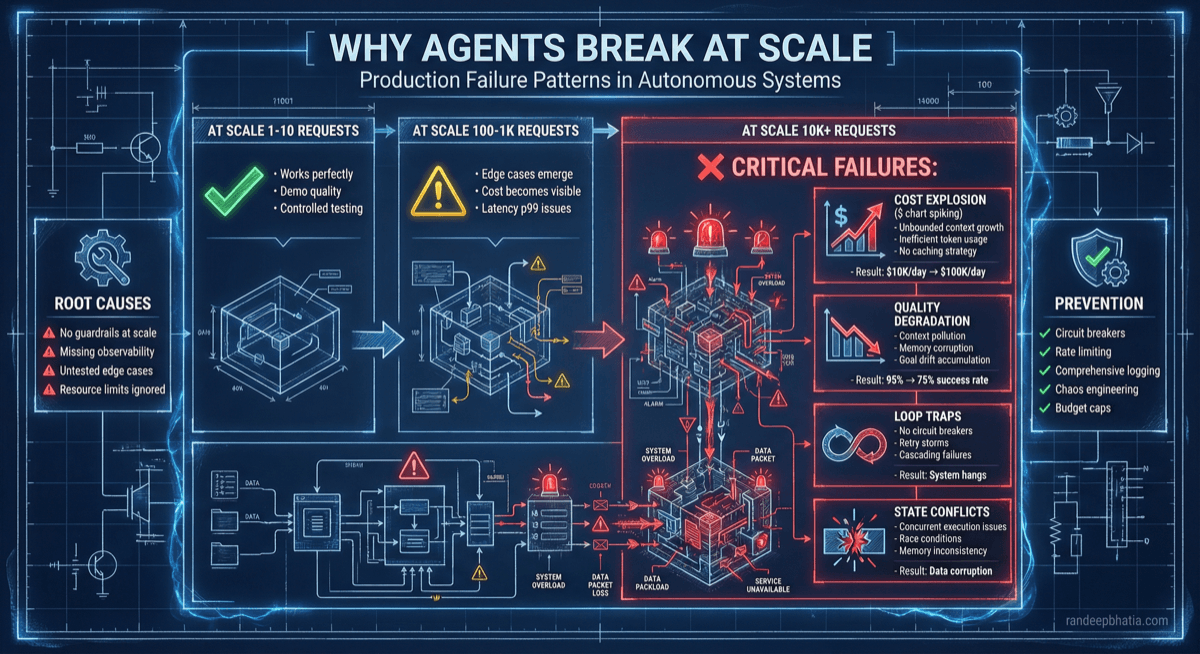
Why AI Agents Break at Scale

Failure Mode Referencescitation-safe-reference📖 45-55 minutesUpdated: 2026-01-05

Executive Summary

AI agents break at scale due to compounding failures across context management, state coordination, tool reliability, cost economics, and emergent behavioral unpredictability that only manifest under production load.

1

Agent failures at scale are fundamentally different from single-agent failures because they involve emergent behaviors, coordination overhead, and cascading failure modes that cannot be predicted from component-level testing alone.

2

The primary scaling bottlenecks occur across five dimensions: context window exhaustion, state synchronization latency, tool call reliability degradation, cost explosion from retry loops, and behavioral drift under adversarial or edge-case inputs.

3

Production-grade agent systems require explicit failure budgets, circuit breakers at every integration point, deterministic fallback paths, and continuous behavioral monitoring that goes far beyond traditional software observability.

The Bottom Line

AI agents that work flawlessly in development and testing environments routinely fail catastrophically at scale because the fundamental assumptions about LLM reliability, tool availability, and coordination overhead break down under real-world conditions. Organizations must architect for failure from day one, treating agent unreliability as a first-class design constraint rather than an edge case to be handled later.

Definition

AI agent scaling failures refer to the systematic breakdown of autonomous or semi-autonomous LLM-based systems when deployed at production scale, characterized by failures that emerge only under high concurrency, extended operation, or real-world input distributions.

These failures manifest across multiple dimensions including context management collapse, inter-agent coordination breakdown, tool integration reliability degradation, cost economics explosion, and emergent behavioral unpredictability that compounds as system complexity and load increase.

Extended Definition

Agent scaling failures represent a distinct category of system failure that differs fundamentally from traditional software scaling challenges. Unlike conventional distributed systems where failures are typically deterministic and reproducible, agent failures often exhibit stochastic characteristics due to the probabilistic nature of LLM outputs. The failure modes compound non-linearly as agents interact with each other, external tools, and accumulated context, creating emergent failure patterns that cannot be predicted from isolated component testing. These failures are particularly insidious because agents may appear to function correctly during development and limited testing, only to exhibit catastrophic behavior when exposed to the full distribution of production inputs, concurrent load, and extended operational periods.

Etymology & Origins

The concept of agent scaling failures emerged from the intersection of distributed systems engineering and the practical deployment of LLM-based autonomous systems starting around 2023. The term draws from classical distributed systems failure analysis (Byzantine failures, cascade failures) combined with novel failure modes specific to probabilistic AI systems. Early practitioners in the AutoGPT, LangChain, and enterprise AI deployment communities documented these patterns as they attempted to move from demonstration systems to production deployments.

Also Known As

Agent reliability degradationLLM agent breakdownAutonomous system scaling failuresMulti-agent coordination collapseAgent orchestration failuresProduction agent instabilityAgent system brittlenessAgentic AI failure modes

Not To Be Confused With

LLM hallucination

Hallucination is a single-inference phenomenon where the model generates factually incorrect content, while agent scaling failures involve system-level breakdowns across multiple components, interactions, and time periods that may or may not involve hallucination as a contributing factor.

Traditional software scaling failures

Traditional scaling failures (database bottlenecks, network saturation) are deterministic and reproducible, while agent failures often involve stochastic elements, emergent behaviors, and failure modes that depend on the specific sequence of LLM outputs and accumulated context.

Model performance degradation

Model degradation refers to declining accuracy of a single model over time due to data drift, while agent scaling failures involve the breakdown of entire systems composed of models, tools, memory, and coordination logic.

Prompt injection attacks

Prompt injection is a security vulnerability involving malicious input manipulation, while agent scaling failures can occur with entirely benign inputs due to systemic issues in architecture, coordination, or resource management.

API rate limiting

Rate limiting is a specific resource constraint that can contribute to agent failures, but agent scaling failures encompass a much broader category of breakdowns including behavioral drift, context corruption, and coordination failures that occur even when rate limits are not exceeded.

Infrastructure scaling issues

Infrastructure scaling involves compute, memory, and network resources, while agent scaling failures can occur even with abundant infrastructure due to logical, behavioral, and coordination issues inherent to agentic systems.

Conceptual Foundation

Core Principles

(8 principles)

Mental Models

(6 models)

The Jenga Tower

Agent systems are like Jenga towers where each successful operation removes a block (consumes context, accumulates state, uses budget). The system appears stable until a critical threshold is crossed, at which point collapse is sudden and complete rather than gradual.

The Telephone Game

Information passing through multiple agent steps degrades like messages in a telephone game, with each step introducing potential distortion, loss, or misinterpretation that compounds across the chain.

The Traffic Jam

Agent coordination overhead is like traffic congestion where adding more agents (cars) beyond a threshold doesn't increase throughput but instead creates gridlock as coordination costs dominate productive work.

The Immune System

Production agent systems need layered defenses like an immune system: first-line defenses (input validation), adaptive responses (retry logic), and escalation mechanisms (human intervention) that activate based on threat severity.

The Pressure Cooker

Agent systems under load accumulate pressure (queued requests, pending state updates, accumulated context) that must be released through explicit relief valves or will cause explosive failures.

The Ecosystem

Multi-agent systems behave like ecosystems where agents compete for shared resources (API quotas, context space, human attention), and imbalances can cause cascading effects analogous to ecological collapse.

Key Insights

(10 insights)

Agent failures at scale are often invisible until catastrophic because the system continues producing outputs that appear reasonable but are subtly wrong or degraded in ways that only become apparent through downstream effects.

The most dangerous agent failures are those where the agent confidently proceeds with incorrect assumptions rather than expressing uncertainty or requesting clarification, as these failures propagate through subsequent steps without triggering error handling.

Context window management is the single most underestimated scaling challenge, with most production failures traceable to some form of context exhaustion, corruption, or mismanagement.

Tool calling reliability follows a bathtub curve where failures are high during initial integration, low during stable operation, and high again as external APIs change, rate limits shift, or edge cases accumulate.

Multi-agent coordination overhead grows faster than linearly with agent count, typically following O(n²) or O(n log n) patterns depending on the coordination topology.

The cost of agent operations at scale is dominated by retry and recovery logic rather than successful operations, often by a factor of 3-10x compared to optimistic estimates.

Behavioral drift in agents is continuous and often undetectable without explicit monitoring, as agents may gradually shift their interpretation of instructions or tool usage patterns over extended operation.

Human-in-the-loop escalation paths that work at low volume become bottlenecks at scale, requiring explicit queuing, prioritization, and timeout strategies.

Agent memory systems (both short-term context and long-term storage) are subject to pollution, where incorrect or outdated information persists and influences future decisions.

The most reliable agent architectures are those that minimize agent autonomy and maximize deterministic control flow, trading flexibility for predictability.

When to Use

Ideal Scenarios

(12)

When conducting post-mortem analysis of agent system failures to identify root causes and prevent recurrence through systematic failure mode understanding.

When designing new agent architectures to proactively incorporate failure handling, circuit breakers, and graceful degradation from the initial design phase.

When evaluating vendor claims about agent reliability to ask informed questions about failure modes, recovery mechanisms, and scaling characteristics.

When establishing SLAs and reliability targets for agent systems to set realistic expectations based on inherent limitations of agentic architectures.

When planning capacity and cost budgets to account for retry overhead, failure recovery costs, and the non-linear scaling of agent operational expenses.

When implementing monitoring and observability to ensure coverage of the specific failure modes and degradation patterns unique to agent systems.

When training engineering teams on agent system operation to build organizational knowledge about failure patterns and appropriate responses.

When making build-vs-buy decisions for agent infrastructure to evaluate whether custom development can address failure modes that off-the-shelf solutions may not handle.

When designing human-in-the-loop workflows to establish appropriate escalation triggers, queue management, and timeout handling for human intervention points.

When conducting security and safety reviews to identify failure modes that could lead to harmful outputs, data exposure, or unintended actions.

When planning disaster recovery and business continuity to ensure agent system failures do not cascade to broader organizational impact.

When negotiating with stakeholders about agent deployment timelines to set realistic expectations about the engineering effort required for production-grade reliability.

Prerequisites

(8)
1

Basic understanding of LLM inference characteristics including latency, token limits, and probabilistic output nature.

2

Familiarity with distributed systems concepts including consistency models, coordination protocols, and failure handling patterns.

3

Knowledge of the specific agent framework or architecture being deployed, including its coordination mechanisms and state management approach.

4

Access to production telemetry and monitoring data to validate theoretical failure modes against actual system behavior.

5

Understanding of the business context and criticality of agent operations to appropriately prioritize failure mode mitigation.

6

Awareness of the external dependencies (APIs, databases, third-party services) that agents interact with and their reliability characteristics.

7

Knowledge of cost structures for LLM inference, tool calls, and infrastructure to evaluate the economic impact of failure modes.

8

Understanding of regulatory and compliance requirements that may constrain failure handling approaches or require specific audit capabilities.

Signals You Need This

(10)

Agent systems that work reliably in development and testing but exhibit unexplained failures in production environments.

Increasing error rates or degraded output quality as agent usage scales beyond initial pilot deployments.

Cost overruns in agent operations that exceed projections based on successful operation assumptions.

User complaints about agent behavior that cannot be reproduced in controlled testing environments.

Monitoring gaps where agent failures occur but are not detected until downstream effects become visible.

Escalating human intervention requirements as agent systems handle more volume or more complex tasks.

Inconsistent agent behavior where the same inputs produce different outputs across different time periods or load conditions.

Context-related errors including truncation warnings, lost information, or agents forgetting earlier conversation elements.

Tool integration failures that occur sporadically and are difficult to diagnose or reproduce.

Multi-agent coordination issues including deadlocks, conflicting actions, or agents working at cross-purposes.

Organizational Readiness

(7)

Engineering teams with experience in distributed systems and failure handling who can implement sophisticated recovery mechanisms.

Operational maturity including on-call rotations, incident response procedures, and post-mortem culture for agent-specific failures.

Budget allocation for observability infrastructure, including logging, tracing, and monitoring specific to agent operations.

Stakeholder alignment on reliability vs. capability tradeoffs, with explicit acceptance of limitations inherent to agent systems.

Data infrastructure capable of capturing and analyzing agent operational telemetry at production scale.

Security and compliance review processes that can evaluate agent-specific risks and failure modes.

Human escalation capacity with trained personnel who can intervene when agents fail or produce uncertain outputs.

When NOT to Use

Anti-Patterns

(12)

Using this knowledge to avoid agent deployment entirely rather than to deploy agents more safely and effectively with appropriate safeguards.

Over-engineering failure handling for simple, low-stakes agent applications where basic retry logic would suffice.

Treating all failure modes as equally likely or equally severe without prioritizing based on actual risk and impact.

Implementing complex failure handling before establishing basic observability that would reveal which failures actually occur.

Using failure mode knowledge to set unrealistically pessimistic expectations that prevent valuable agent deployments.

Focusing exclusively on technical failure modes while ignoring organizational and process failures that contribute to agent system problems.

Applying enterprise-scale failure handling patterns to prototype or experimental agent systems where rapid iteration is more valuable than reliability.

Treating failure mode documentation as a substitute for actual testing and validation of failure handling mechanisms.

Using theoretical failure modes to justify indefinite delays in production deployment rather than iterative hardening.

Implementing failure handling for failure modes that are theoretically possible but practically irrelevant to the specific use case.

Over-investing in rare catastrophic failure prevention while under-investing in common degraded-mode handling.

Treating agent failure modes as static rather than evolving with model updates, API changes, and usage pattern shifts.

Red Flags

(10)

Analysis paralysis where failure mode enumeration prevents any forward progress on agent deployment.

Failure handling complexity that exceeds the complexity of the core agent functionality.

Monitoring and observability costs that exceed the value delivered by the agent system.

Human escalation paths that are so frequently triggered that they negate the automation benefits of agents.

Reliability requirements that cannot be met by any current agent architecture, indicating a mismatch between expectations and technology maturity.

Cost budgets that assume zero failures and cannot accommodate the retry and recovery overhead inherent to agent systems.

Timelines that do not include sufficient margin for failure mode discovery and mitigation during production hardening.

Stakeholder expectations of deterministic, perfectly reliable agent behavior that contradicts the probabilistic nature of LLM-based systems.

Security requirements that prohibit the logging and monitoring necessary to detect and diagnose agent failures.

Organizational resistance to human-in-the-loop escalation that would provide necessary safety nets for agent failures.

Better Alternatives

(8)
1
When:

Simple, single-turn question-answering without tool use or extended reasoning

Use Instead:

Direct LLM inference with standard API error handling

Why:

Agent architectures add complexity and failure modes that are unnecessary for simple inference tasks where basic retry logic and timeout handling provide sufficient reliability.

2
When:

Highly deterministic workflows with well-defined steps and predictable inputs

Use Instead:

Traditional workflow orchestration with LLM components

Why:

Deterministic workflow engines provide stronger reliability guarantees and simpler failure handling than autonomous agents for tasks that don't require adaptive decision-making.

3
When:

Mission-critical operations requiring near-perfect reliability

Use Instead:

Human-primary workflows with AI assistance

Why:

Current agent technology cannot achieve the reliability levels required for truly mission-critical operations; human-in-the-loop designs provide necessary reliability guarantees.

4
When:

Cost-constrained environments with tight operational budgets

Use Instead:

Simpler AI integrations with explicit scope limitations

Why:

The retry and recovery overhead of agent systems can make them economically unviable in cost-constrained environments where simpler integrations would suffice.

5
When:

Regulatory environments requiring full auditability and determinism

Use Instead:

Rule-based systems with AI-assisted decision support

Why:

The non-deterministic nature of agent systems makes them difficult to audit and explain, which may be incompatible with regulatory requirements for certain domains.

6
When:

Real-time applications with strict latency requirements

Use Instead:

Pre-computed responses with dynamic selection

Why:

Agent deliberation and tool-calling latency makes them unsuitable for real-time applications where pre-computed or cached responses can meet latency requirements.

7
When:

Applications requiring consistent behavior across all users

Use Instead:

Templated responses with limited personalization

Why:

Agent behavioral variability can create inconsistent user experiences that may be unacceptable for applications requiring uniform treatment.

8
When:

Early-stage products where requirements are rapidly evolving

Use Instead:

Simpler AI integrations with manual intervention

Why:

The engineering investment in robust agent failure handling may be wasted if product requirements change significantly; simpler approaches allow faster iteration.

Common Mistakes

(10)

Assuming that agent reliability in testing environments predicts production reliability without accounting for distribution shift and scale effects.

Treating LLM inference as a reliable service similar to traditional APIs rather than a probabilistic process requiring explicit uncertainty handling.

Underestimating context window constraints and failing to implement explicit context management strategies for long-running operations.

Implementing retry logic without backoff, circuit breakers, or budget limits, leading to cost explosions during failure scenarios.

Failing to distinguish between transient failures (which should be retried) and persistent failures (which require escalation or fallback).

Designing multi-agent systems without explicit coordination protocols, leading to emergent deadlocks and resource contention.

Relying on agent self-correction without external validation, allowing errors to propagate and compound through subsequent steps.

Implementing monitoring that captures success metrics but not failure modes, creating blind spots for degradation detection.

Assuming that more capable models will solve reliability problems rather than addressing architectural issues.

Treating human escalation as a fallback rather than a designed component with explicit capacity planning and queue management.

Core Taxonomy

Primary Types

(8 types)

Failures arising from the finite nature of context windows, including exhaustion, corruption, and information loss during context management operations.

Characteristics
  • Gradual degradation as context accumulates
  • Sudden capability loss when limits are reached
  • Information loss during summarization or truncation
  • Priority inversion where important context is discarded
  • Context pollution from incorrect or outdated information
Use Cases
Long-running conversational agentsAgents processing large documentsMulti-turn reasoning tasksAgents with extensive tool output accumulation
Tradeoffs

More aggressive context management preserves capacity but risks losing important information; conservative management maintains information but risks exhaustion.

Classification Dimensions

Failure Visibility

Classification based on how apparent the failure is to operators and users, with silent failures being the most dangerous due to delayed detection.

Loud failures (immediate errors)Silent failures (incorrect outputs)Degraded failures (reduced quality)Delayed failures (time-bomb effects)

Failure Scope

Classification based on the blast radius of the failure, from isolated single-request issues to system-wide outages.

Single-request failuresSession failuresAgent instance failuresSystem-wide failures

Failure Recoverability

Classification based on what is required to recover from the failure, informing appropriate handling strategies.

Self-healing (automatic recovery)Retry-recoverable (transient)Intervention-required (manual)Unrecoverable (data loss)

Failure Predictability

Classification based on how predictable the failure is, affecting testing and prevention strategies.

Deterministic (reproducible)Probabilistic (statistically predictable)Emergent (unpredictable)Adversarial (intentionally triggered)

Failure Timing

Classification based on when the failure manifests relative to the operation that caused it.

Immediate (during operation)Delayed (after operation completes)Accumulated (over extended operation)Triggered (by specific conditions)

Root Cause Location

Classification based on where in the system stack the root cause originates.

Model-level (LLM behavior)Integration-level (tool/API)Orchestration-level (coordination)Infrastructure-level (compute/network)

Evolutionary Stages

1

Prototype Reliability

0-3 months of development

Agents work for happy-path scenarios in controlled environments with limited inputs and low concurrency. Failures are addressed ad-hoc as they occur during development.

2

Pilot Reliability

3-6 months, limited production exposure

Basic error handling and retry logic implemented. Agents handle common failure modes but may fail on edge cases. Limited monitoring and manual intervention for failures.

3

Production Reliability

6-12 months of production hardening

Comprehensive failure handling with circuit breakers, fallbacks, and escalation paths. Monitoring covers major failure modes. System handles expected load with acceptable failure rates.

4

Scale Reliability

12-24 months of scale operation

Failure handling optimized for high volume. Automated recovery for most failure modes. Predictive monitoring and proactive intervention. Documented playbooks for all known failure scenarios.

5

Mature Reliability

24+ months with dedicated reliability investment

Continuous improvement based on production telemetry. Failure budgets and SLOs actively managed. Chaos engineering practices validate failure handling. Organization has deep expertise in agent reliability.

Architecture Patterns

Architecture Patterns

(8 patterns)

Circuit Breaker Pattern

Implements automatic failure detection and isolation by monitoring failure rates and temporarily disabling failing components to prevent cascade failures and allow recovery.

Components
  • Failure counter per component
  • Threshold configuration
  • State machine (closed/open/half-open)
  • Fallback handler
  • Recovery probe
Data Flow

Requests pass through circuit breaker which monitors success/failure. When failure threshold exceeded, circuit opens and requests are immediately failed or routed to fallback. Periodic probes test recovery, transitioning to half-open then closed states.

Best For
  • Tool integration protection
  • External API calls
  • Database connections
  • Inter-agent communication
Limitations
  • Requires tuning of thresholds per component
  • May cause temporary unavailability during recovery
  • Does not address root cause of failures
  • Can mask persistent issues if recovery probes succeed intermittently
Scaling Characteristics

Scales horizontally with independent circuit breakers per component instance. Coordination between instances optional but can improve system-wide response to failures.

Integration Points

LLM Inference Endpoint

Core reasoning capability provider

Interfaces:
Completion APIChat APIStreaming APIEmbedding API

Primary failure point for all agent operations. Requires circuit breakers, retry logic, timeout handling, and fallback to alternative models. Rate limiting and quota management critical at scale.

Tool Execution Layer

External capability interface

Interfaces:
Function calling APITool result ingestionError reportingTimeout signaling

Each tool is an independent failure domain. Tool failures should not crash agents. Sandboxing required for code execution tools. Input validation prevents injection attacks.

Memory/Vector Store

Persistent and semantic memory

Interfaces:
Write/upsert operationsSimilarity searchMetadata filteringDeletion/update

Memory corruption can cause persistent behavioral issues. Retrieval failures should trigger graceful degradation. Index consistency critical for multi-agent access.

State Management System

Agent state persistence and coordination

Interfaces:
State read/writeLocking/transactionsEvent streamingSnapshot/restore

State consistency critical for multi-agent coordination. Distributed state requires explicit consistency model. State size growth must be bounded.

Orchestration Layer

Workflow coordination and routing

Interfaces:
Task dispatchResult aggregationTimeout managementPriority handling

Orchestrator failure affects all downstream agents. Stateless orchestration preferred for resilience. Queue depth monitoring prevents backlog accumulation.

Monitoring and Observability

Failure detection and diagnosis

Interfaces:
Metric emissionLog aggregationTrace correlationAlert triggering

Observability overhead should not impact agent performance. Sampling strategies for high-volume systems. Retention policies for cost management.

Human Escalation Interface

Fallback for unresolvable failures

Interfaces:
Escalation queueContext packagingResponse ingestionTimeout handling

Human capacity is finite and expensive. Queue management prevents overload. Context must be sufficient for human understanding. Timeout required for SLA compliance.

Cost Management System

Budget enforcement and optimization

Interfaces:
Usage trackingBudget checkingQuota enforcementCost attribution

Cost overruns can cause sudden service termination. Real-time tracking required for enforcement. Attribution enables optimization. Budget alerts prevent surprises.

Decision Framework

✓ If Yes

Implement retry with exponential backoff and jitter

✗ If No

Escalate to fallback handler or human intervention

Considerations

Transient vs persistent classification requires failure pattern analysis. Some failures appear transient but are actually persistent with intermittent success.

Technical Deep Dive

Overview

Agent systems fail at scale through a combination of probabilistic error accumulation, resource exhaustion, coordination overhead, and emergent behavioral patterns that only manifest under production conditions. Understanding these failure mechanisms requires examining the interaction between LLM inference characteristics, system architecture, and operational load patterns. At the core, LLM inference is a probabilistic process where each call has some probability of producing suboptimal, incorrect, or failed output. In simple single-inference applications, this probability is manageable. However, agentic systems chain multiple inferences together, each building on previous outputs, creating multiplicative error accumulation. A system with 95% per-step reliability across 20 chained steps has only 36% end-to-end reliability. Beyond probabilistic errors, agent systems face resource constraints that become binding at scale. Context windows fill with accumulated history, tool outputs, and retrieved documents. API rate limits constrain throughput. Cost budgets deplete faster than expected due to retry overhead. Human escalation capacity saturates. Each of these constraints creates failure modes that may not appear in testing but become critical in production. The interaction between multiple agents adds another failure dimension. Coordination requires communication, which introduces latency. Shared state requires synchronization, which can create contention and inconsistency. Agents may pursue conflicting goals or compete for limited resources. These coordination failures often exhibit emergent properties that cannot be predicted from individual agent behavior.

Step-by-Step Process

Agent receives request and begins processing. System loads relevant context, retrieves memories, and prepares tool definitions. Initial state is established and request is validated against input constraints.

⚠️ Pitfalls to Avoid

Input validation may miss edge cases. Context loading may fail silently. Memory retrieval may return stale or irrelevant information. Initial state may conflict with concurrent operations.

Under The Hood

At the infrastructure level, agent systems typically run on containerized or serverless compute that introduces its own failure modes. Cold starts can cause latency spikes. Memory limits can cause out-of-memory crashes. Network partitions can isolate agents from dependencies. These infrastructure failures interact with agent-level failures in complex ways. The LLM inference layer presents unique challenges. Unlike deterministic APIs, LLM outputs vary based on temperature settings, random seeds, and subtle prompt variations. This non-determinism makes debugging difficult because failures may not reproduce. Model updates from providers can change behavior without warning. Rate limits and quotas are often opaque and can change based on provider policies. Context management operates through tokenization and attention mechanisms that have hard limits. When context is truncated, the model loses access to information in a way that may not be obvious from the output. Summarization attempts to preserve important information but inevitably loses detail. The choice of what to retain and what to discard significantly impacts agent behavior. Tool integration involves serialization and deserialization at multiple points. Agent output must be parsed to extract tool calls. Tool parameters must be serialized for API calls. Tool responses must be deserialized and integrated into context. Each serialization boundary is a potential failure point where format mismatches, encoding issues, or schema changes can cause failures. Multi-agent coordination typically uses message passing or shared state. Message passing introduces latency and ordering challenges. Shared state requires consistency protocols that add overhead and can create contention. The choice of coordination mechanism significantly impacts both performance and failure characteristics. Distributed consensus protocols provide strong guarantees but at significant performance cost.

Failure Modes

Root Cause

Accumulated conversation history, tool outputs, and retrieved documents exceed model's context limit, causing truncation or failure.

Symptoms
  • Agent forgetting earlier conversation elements
  • Repeated questions about previously provided information
  • Truncation warnings in logs
  • Degraded response quality over conversation length
Impact

Agent loses access to critical information, leading to incorrect or incomplete responses. May cause task failure if essential context is truncated.

Prevention

Implement proactive context management with summarization, selective retention, and context rotation. Monitor context utilization and trigger management before limits.

Mitigation

Summarize and compress context when approaching limits. Implement tiered context with essential information protected from truncation. Consider context handoff to fresh agent instance.

Operational Considerations

Key Metrics (15)

Percentage of agent operations completing successfully without errors or escalations.

Normal95-99%
Alert<95% over 5 minutes
ResponseInvestigate error patterns, check for systemic issues, consider activating degraded mode.

Dashboard Panels

Real-time success rate with trend lineLatency distribution histogramError breakdown by categoryCost accumulation with budget lineQueue depth across all queuesCircuit breaker status matrixTool health status gridMulti-agent coordination topologyContext utilization distributionHuman escalation queue status

Alerting Strategy

Implement tiered alerting with severity levels based on impact and urgency. Use anomaly detection for metrics without clear thresholds. Aggregate related alerts to prevent alert storms. Ensure alerts include actionable context and runbook links. Implement alert suppression during known maintenance windows. Route alerts to appropriate on-call based on affected component.

Cost Analysis

Cost Drivers

(10)

LLM Inference Costs

Impact:

Typically 60-80% of total agent operational cost. Scales with token count and model capability.

Optimization:

Use smaller models for simple tasks. Implement caching for repeated queries. Optimize prompts for token efficiency. Consider fine-tuned models for specific tasks.

Retry Overhead

Impact:

Can multiply base costs by 2-5x during failure scenarios. Often underestimated in budgeting.

Optimization:

Implement smart retry policies with backoff. Use circuit breakers to prevent retry storms. Set per-operation retry budgets. Analyze and address root causes of retries.

Tool Call Costs

Impact:

Variable based on tool pricing. Can be significant for expensive APIs or high-volume tools.

Optimization:

Cache tool results where appropriate. Batch tool calls when possible. Negotiate volume pricing. Consider self-hosted alternatives for high-volume tools.

Memory and Storage

Impact:

Grows with operation history and memory retention. Vector storage can be expensive at scale.

Optimization:

Implement memory expiration policies. Use tiered storage for different retention needs. Optimize embedding dimensions. Consider compression for historical data.

Compute Infrastructure

Impact:

Base cost for running agent orchestration, regardless of operation volume.

Optimization:

Right-size compute resources. Use serverless for variable workloads. Implement auto-scaling. Optimize container images and startup times.

Human Escalation

Impact:

Highest per-unit cost. Can dominate costs if escalation rate is high.

Optimization:

Reduce escalation rate through agent improvement. Implement tiered escalation with auto-resolution. Optimize reviewer efficiency. Consider crowd-sourcing for appropriate tasks.

Observability and Logging

Impact:

Scales with operation volume and retention requirements. Often overlooked in initial budgeting.

Optimization:

Implement sampling for high-volume metrics. Use tiered retention policies. Optimize log verbosity. Consider self-hosted solutions for high volume.

Multi-Agent Coordination

Impact:

Overhead scales with agent count and coordination frequency. Can become dominant at scale.

Optimization:

Minimize coordination requirements. Use efficient coordination protocols. Consider architecture simplification. Batch coordination messages.

Context Management

Impact:

Summarization and context rotation require additional inference. Scales with conversation length.

Optimization:

Optimize summarization prompts. Implement efficient context rotation. Consider specialized summarization models. Cache summaries where possible.

Development and Maintenance

Impact:

Ongoing cost for prompt engineering, debugging, and system evolution.

Optimization:

Invest in tooling and automation. Build reusable components. Document thoroughly. Implement comprehensive testing.

Cost Models

Per-Operation Cost

Cost = (InputTokens × InputPrice + OutputTokens × OutputPrice) × (1 + RetryRate) + ToolCosts + OverheadAllocation
Variables:
InputTokens: Average input token countOutputTokens: Average output token countInputPrice/OutputPrice: Model pricing per tokenRetryRate: Average retries per operationToolCosts: Sum of tool call costsOverheadAllocation: Share of fixed costs
Example:

For a typical operation: (2000 × $0.00001 + 500 × $0.00003) × 1.2 + $0.01 + $0.005 = $0.054 per operation

Monthly Operating Cost

MonthlyCost = OperationVolume × PerOperationCost + FixedInfrastructure + HumanEscalationCost + ObservabilityCost
Variables:
OperationVolume: Monthly operation countPerOperationCost: From per-operation modelFixedInfrastructure: Compute, storage, networkingHumanEscalationCost: Escalations × CostPerEscalationObservabilityCost: Logging, monitoring, tracing
Example:

For 100K operations/month: 100000 × $0.054 + $500 + $200 + $300 = $6,400/month

Failure Cost Impact

FailureCost = BaseOperationCost × (RetryAttempts + 1) + RecoveryCost + OpportunityCost
Variables:
BaseOperationCost: Cost of single attemptRetryAttempts: Number of retry attemptsRecoveryCost: Cost of recovery actionsOpportunityCost: Value of delayed/failed operation
Example:

For a failed operation with 3 retries: $0.054 × 4 + $0.10 + $1.00 = $1.32 per failure

Scale Cost Projection

ScaledCost = CurrentCost × (TargetVolume / CurrentVolume) ^ ScalingExponent + AdditionalFixedCosts
Variables:
CurrentCost: Current monthly costTargetVolume/CurrentVolume: Scale factorScalingExponent: Typically 0.8-1.2 depending on efficiencyAdditionalFixedCosts: New infrastructure at scale
Example:

Scaling 10x from $6,400/month: $6,400 × 10^1.1 + $2,000 = $82,500/month

Optimization Strategies

  • 1Implement intelligent caching for repeated or similar queries to avoid redundant inference
  • 2Use model routing to direct simple tasks to cheaper models while reserving expensive models for complex tasks
  • 3Optimize prompts for token efficiency without sacrificing output quality
  • 4Implement request batching where latency requirements allow
  • 5Use streaming responses to enable early termination when sufficient output is generated
  • 6Implement cost-aware retry policies that consider cumulative spend
  • 7Cache tool results with appropriate TTL to reduce redundant tool calls
  • 8Use fine-tuned smaller models for specific high-volume tasks
  • 9Implement request prioritization to ensure high-value operations complete within budget
  • 10Monitor and optimize context window utilization to reduce summarization overhead
  • 11Negotiate volume pricing with providers for predictable high-volume workloads
  • 12Implement cost attribution to identify and optimize expensive operation patterns

Hidden Costs

  • 💰Retry overhead during failure scenarios, often 2-5x base cost
  • 💰Context summarization inference costs for long conversations
  • 💰Memory embedding costs for storing and indexing agent memories
  • 💰Observability and logging costs at production scale
  • 💰Human escalation costs including reviewer time and tooling
  • 💰Development and maintenance costs for prompt engineering and debugging
  • 💰Opportunity costs from failed or degraded operations
  • 💰Compliance and audit costs for regulated environments

ROI Considerations

Agent system ROI must account for both direct cost savings and indirect value creation. Direct savings come from automation of tasks previously requiring human labor, but must be offset against agent operational costs and the cost of handling agent failures. Indirect value includes faster response times, 24/7 availability, and scalability that may not be achievable with human-only approaches. ROI calculations should include realistic failure rates and their costs, not just successful operation economics. A system with 95% success rate and $0.05 per successful operation may have effective costs of $0.10+ when accounting for retry costs, human escalation for failures, and opportunity costs of failed operations. Time-to-value is also critical. Agent systems typically require significant upfront investment in development, testing, and production hardening before delivering value. Organizations should plan for 6-12 months of investment before achieving positive ROI, with ongoing maintenance costs thereafter. Finally, consider the strategic value of agent capabilities beyond direct cost comparison. Agents may enable new products, services, or customer experiences that were not previously feasible, creating value that cannot be measured purely in cost savings terms.

Security Considerations

Threat Model

(10 threats)
1

Prompt Injection Attack

Attack Vector

Malicious input designed to override agent instructions or extract sensitive information.

Impact

Agent may execute unintended actions, reveal system prompts, or bypass safety controls.

Mitigation

Implement input sanitization, use structured output formats, separate user input from system instructions, add output filtering.

2

Data Exfiltration via Agent

Attack Vector

Manipulating agent to include sensitive data in outputs or tool calls.

Impact

Unauthorized disclosure of confidential information, compliance violations.

Mitigation

Implement data classification and access controls, filter outputs for sensitive patterns, audit tool call parameters.

3

Denial of Service via Resource Exhaustion

Attack Vector

Crafted inputs that cause excessive resource consumption (tokens, tool calls, compute).

Impact

Service unavailability, cost explosion, degraded performance for legitimate users.

Mitigation

Implement per-user rate limiting, input complexity limits, cost budgets per operation, circuit breakers.

4

Tool Abuse

Attack Vector

Manipulating agent to misuse tools for unauthorized purposes.

Impact

Unauthorized actions, data modification, external system compromise.

Mitigation

Implement tool-level authorization, parameter validation, action confirmation for sensitive operations, audit logging.

5

Memory Poisoning

Attack Vector

Injecting false information into agent memory to influence future decisions.

Impact

Persistent incorrect behavior, trust degradation, potential for further exploitation.

Mitigation

Implement memory validation, source tracking, expiration policies, anomaly detection on memory updates.

6

Model Extraction

Attack Vector

Systematic querying to extract model behavior or training data.

Impact

Intellectual property theft, privacy violations, competitive disadvantage.

Mitigation

Implement query rate limiting, output perturbation, monitoring for extraction patterns.

7

Multi-Agent Coordination Exploitation

Attack Vector

Exploiting inter-agent communication to spread malicious instructions or data.

Impact

System-wide compromise, coordinated malicious behavior, difficult detection.

Mitigation

Implement agent authentication, message validation, isolation between agent trust domains.

8

Checkpoint/State Tampering

Attack Vector

Modifying stored agent state to alter behavior or inject malicious context.

Impact

Persistent compromise, difficult detection, potential for escalating attacks.

Mitigation

Implement state integrity verification, encryption at rest, access controls on state storage.

9

Supply Chain Attack via Tools

Attack Vector

Compromised external tools returning malicious data or executing unauthorized actions.

Impact

Agent compromise via trusted tool, difficult attribution, potential for widespread impact.

Mitigation

Vet tool providers, implement tool output validation, monitor for anomalous tool behavior, maintain tool inventory.

10

Insider Threat via Prompt Modification

Attack Vector

Malicious insider modifying system prompts to alter agent behavior.

Impact

Subtle behavior changes, difficult detection, potential for data theft or sabotage.

Mitigation

Implement prompt version control, change approval workflows, behavioral monitoring, audit logging.

Security Best Practices

  • Implement defense in depth with multiple security layers
  • Use principle of least privilege for tool access and permissions
  • Sanitize and validate all user inputs before processing
  • Filter outputs for sensitive information before delivery
  • Implement comprehensive audit logging for security events
  • Use encryption for data at rest and in transit
  • Implement strong authentication for agent-to-agent communication
  • Regularly rotate credentials and API keys
  • Monitor for anomalous behavior patterns
  • Implement rate limiting at multiple levels
  • Use separate environments for development, testing, and production
  • Conduct regular security assessments and penetration testing
  • Maintain incident response procedures for security events
  • Train development teams on agent-specific security risks
  • Implement secure development lifecycle practices

Data Protection

  • 🔒Classify data by sensitivity level and apply appropriate controls
  • 🔒Implement data masking for sensitive information in logs and traces
  • 🔒Use encryption for all data at rest and in transit
  • 🔒Implement access controls based on data classification
  • 🔒Maintain data lineage tracking for compliance and debugging
  • 🔒Implement data retention policies with automated enforcement
  • 🔒Use secure deletion for data subject to retention limits
  • 🔒Implement data loss prevention controls for outputs
  • 🔒Conduct regular data protection impact assessments
  • 🔒Maintain data processing agreements with third-party providers

Compliance Implications

GDPR

Requirement:

Data minimization, right to erasure, data portability, lawful basis for processing

Implementation:

Implement data retention limits, memory deletion capabilities, export functionality, document processing purposes

HIPAA

Requirement:

Protected health information safeguards, access controls, audit trails

Implementation:

Implement PHI detection and filtering, role-based access, comprehensive logging, business associate agreements with providers

SOC 2

Requirement:

Security, availability, processing integrity, confidentiality, privacy controls

Implementation:

Implement controls across all trust service criteria, maintain evidence of control operation, conduct regular audits

PCI DSS

Requirement:

Protection of cardholder data, access controls, monitoring

Implementation:

Prevent agent access to card data, implement tokenization, maintain audit trails, conduct regular assessments

AI-Specific Regulations (EU AI Act)

Requirement:

Risk assessment, transparency, human oversight for high-risk AI

Implementation:

Document risk assessments, implement explainability features, maintain human-in-the-loop capabilities, conduct conformity assessments

CCPA/CPRA

Requirement:

Consumer data rights, disclosure requirements, opt-out mechanisms

Implementation:

Implement data subject request handling, maintain privacy notices, provide opt-out capabilities

Financial Services Regulations

Requirement:

Model risk management, explainability, fair lending compliance

Implementation:

Implement model documentation, bias testing, decision explanation capabilities, regulatory reporting

Industry-Specific Standards

Requirement:

Varies by industry (healthcare, finance, government)

Implementation:

Conduct gap analysis against applicable standards, implement required controls, maintain compliance documentation

Scaling Guide

Scaling Dimensions

Request Volume

Strategy:

Horizontal scaling of agent instances with load balancing. Implement request queuing for burst handling. Use auto-scaling based on queue depth and latency.

Limits:

Limited by LLM API rate limits, cost budget, and coordination overhead. Typical ceiling of 100-10,000 concurrent operations depending on architecture.

Considerations:

Ensure stateless agent design for horizontal scaling. Implement sticky sessions if state is required. Monitor for hot spots in load distribution.

Context Complexity

Strategy:

Implement tiered context management with summarization. Use larger context window models for complex tasks. Consider task decomposition for very complex operations.

Limits:

Hard limited by model context window (4K-128K tokens). Summarization has diminishing returns beyond certain complexity.

Considerations:

Context management overhead increases with complexity. May need specialized approaches for different complexity tiers.

Agent Count (Multi-Agent)

Strategy:

Use hierarchical coordination to limit direct agent-to-agent communication. Implement efficient coordination protocols. Consider eventual consistency for non-critical state.

Limits:

Coordination overhead grows O(n log n) to O(n²). Practical limits of 10-100 agents for tightly coordinated systems, more for loosely coupled.

Considerations:

Architecture choice significantly impacts scaling characteristics. May need to partition agent groups for very large systems.

Tool Integration

Strategy:

Implement tool-level caching and batching. Use circuit breakers per tool. Consider tool redundancy for critical capabilities.

Limits:

Limited by tool API rate limits and latency. Each tool adds failure surface.

Considerations:

Tool scaling may require negotiation with providers. Consider self-hosted alternatives for high-volume tools.

Memory Size

Strategy:

Use tiered storage with hot/warm/cold tiers. Implement memory expiration and pruning. Consider sharding for very large memory stores.

Limits:

Vector search latency increases with memory size. Storage costs grow linearly.

Considerations:

Retrieval quality may degrade with very large memories. May need specialized indexing strategies.

Geographic Distribution

Strategy:

Deploy agent instances in multiple regions. Use regional routing for latency optimization. Implement cross-region state synchronization.

Limits:

Cross-region latency impacts coordination. Data residency requirements may constrain deployment options.

Considerations:

Consistency model choice critical for distributed deployment. May need region-specific configurations.

Operational Duration

Strategy:

Implement checkpointing for long-running operations. Use context rotation to prevent exhaustion. Design for graceful handoff between agent instances.

Limits:

Context accumulation limits operation duration. State size grows with duration.

Considerations:

Very long operations may need fundamentally different architecture. Consider task decomposition.

Output Complexity

Strategy:

Use streaming for large outputs. Implement progressive generation with checkpoints. Consider output caching for repeated requests.

Limits:

Output token limits vary by model. Very large outputs increase latency and cost.

Considerations:

Output validation overhead increases with complexity. May need specialized handling for different output types.

Capacity Planning

Key Factors:
Expected request volume (average and peak)Average tokens per request (input and output)Tool call frequency and latencyExpected retry rate based on historical dataHuman escalation rate and capacityMemory growth rate and retention requirementsCoordination overhead for multi-agent systemsSafety margin for unexpected load
Formula:RequiredCapacity = (PeakVolume × AvgLatency × (1 + RetryRate)) / TargetUtilization + SafetyMargin
Safety Margin:

Typically 30-50% above calculated requirements for production systems. Higher margins for systems with unpredictable load patterns or critical reliability requirements.

Scaling Milestones

10 concurrent users
Challenges:
  • Basic reliability and error handling
  • Initial monitoring setup
  • Manual intervention for failures
Architecture Changes:

Single agent instance may suffice. Focus on correctness over scalability.

100 concurrent users
Challenges:
  • Rate limit management
  • Cost optimization
  • Consistent user experience
Architecture Changes:

Implement request queuing. Add basic auto-scaling. Establish monitoring baselines.

1,000 concurrent users
Challenges:
  • Horizontal scaling
  • State management at scale
  • Human escalation capacity
Architecture Changes:

Implement stateless agent design. Add distributed state management. Establish on-call rotation.

10,000 concurrent users
Challenges:
  • Multi-region deployment
  • Advanced caching strategies
  • Cost management at scale
Architecture Changes:

Deploy to multiple regions. Implement sophisticated caching. Add cost attribution and optimization.

100,000 concurrent users
Challenges:
  • Global distribution
  • Complex coordination
  • Enterprise reliability requirements
Architecture Changes:

Full global deployment. Implement advanced coordination protocols. Add chaos engineering practices.

1,000,000+ concurrent users
Challenges:
  • Extreme scale optimization
  • Custom infrastructure
  • Organization-wide reliability culture
Architecture Changes:

Consider custom model deployment. Implement advanced traffic management. Establish dedicated reliability engineering team.

Benchmarks

Industry Benchmarks

MetricP50P95P99 World Class
Agent Success Rate97%99%99.5%99.9%
End-to-End Latency3 seconds15 seconds45 seconds<2 seconds p50, <10 seconds p95
Human Escalation Rate5%2%1%<0.5%
Mean Time to Detection (MTTD)15 minutes5 minutes2 minutes<1 minute
Mean Time to Recovery (MTTR)60 minutes30 minutes15 minutes<5 minutes
Cost Per Successful Operation$0.10$0.05$0.02<$0.01
Retry Rate15%8%5%<3%
Context Utilization Efficiency50%70%80%>85%
Tool Call Success Rate98%99%99.5%99.9%
Behavioral Consistency Score85%92%95%>98%
Alert Actionability Rate60%80%90%>95%
Runbook Coverage50%80%95%100%

Comparison Matrix

ApproachReliabilityLatencyCostComplexityScalability
No Failure HandlingLow (80-90%)LowLowLowPoor
Basic Retry LogicMedium (90-95%)MediumMediumLowMedium
Circuit Breakers + FallbacksHigh (95-99%)MediumMedium-HighMediumGood
Full Resilience StackVery High (99%+)Medium-HighHighHighExcellent
Human-in-the-Loop PrimaryVery High (99%+)Very HighVery HighMediumPoor
Deterministic Workflow + LLMHigh (95-99%)Low-MediumMediumMediumGood

Performance Tiers

Prototype

Basic functionality, manual error handling, limited monitoring

Target:

80%+ success rate, best-effort latency, no SLOs

Pilot

Basic error handling, initial monitoring, manual intervention for failures

Target:

90%+ success rate, <60s p95 latency, informal SLOs

Production

Comprehensive error handling, full monitoring, documented procedures

Target:

95%+ success rate, <30s p95 latency, formal SLOs

Enterprise

Advanced resilience, predictive monitoring, automated recovery

Target:

99%+ success rate, <15s p95 latency, strict SLOs with error budgets

Mission-Critical

Maximum resilience, real-time monitoring, instant recovery

Target:

99.9%+ success rate, <5s p95 latency, zero-tolerance SLOs

Real World Examples

Real-World Scenarios

(8 examples)
1

Customer Service Agent Scaling Failure

Context

E-commerce company deployed AI agent for customer service. Worked well in pilot with 100 daily conversations. Failed catastrophically when scaled to 10,000 daily conversations during holiday season.

Approach

Post-incident analysis revealed multiple compounding failures: context window exhaustion in long conversations, rate limiting causing retry storms, human escalation queue overflow, and cost budget exhaustion.

Outcome

Implemented context management with aggressive summarization, circuit breakers for rate limit protection, auto-resolution for common escalations, and real-time cost monitoring with alerts.

Lessons Learned
  • 💡Pilot success does not predict production reliability
  • 💡Multiple failure modes compound at scale
  • 💡Human escalation capacity must scale with volume
  • 💡Cost budgets must account for failure scenarios
2

Multi-Agent Research System Deadlock

Context

Research organization deployed multi-agent system for literature review. Agents would search, summarize, and synthesize papers. System would periodically freeze with no progress.

Approach

Investigation revealed circular dependencies where agents waited for each other's outputs. Implemented timeout-based deadlock detection, resource ordering to prevent cycles, and supervisor agent for coordination.

Outcome

Deadlock frequency reduced from daily to monthly. Remaining deadlocks automatically detected and broken within 60 seconds.

Lessons Learned
  • 💡Multi-agent coordination requires explicit deadlock prevention
  • 💡Timeout-based detection is essential for distributed systems
  • 💡Supervisor patterns provide necessary oversight
  • 💡Testing must include concurrent operation scenarios
3

Code Generation Agent Behavioral Drift

Context

Software company deployed agent for code generation assistance. Quality was excellent initially but degraded over months. User complaints increased but no obvious errors in logs.

Approach

Implemented behavioral monitoring comparing outputs to baseline examples. Discovered accumulated context from previous sessions was influencing outputs. Model version update had also changed behavior subtly.

Outcome

Implemented session isolation, behavioral regression testing, and canary deployment for model updates. Quality metrics returned to baseline.

Lessons Learned
  • 💡Behavioral drift is gradual and hard to detect without monitoring
  • 💡Session isolation prevents context pollution
  • 💡Model updates require careful validation
  • 💡Baseline comparison is essential for quality assurance
4

Financial Analysis Agent Cost Explosion

Context

Investment firm deployed agent for financial analysis. Monthly costs were 10x projected budget. No obvious errors or failures in system.

Approach

Cost attribution analysis revealed retry loops on complex analyses, excessive tool calls for data retrieval, and inefficient context management causing repeated summarization.

Outcome

Implemented per-operation cost limits, caching for data retrieval, optimized context management, and cost-aware model routing. Costs reduced to 1.5x original projection.

Lessons Learned
  • 💡Cost attribution is essential for optimization
  • 💡Retry loops can dominate costs without obvious failures
  • 💡Caching provides significant cost reduction
  • 💡Cost-aware design should be implemented from start
5

Healthcare Agent Compliance Failure

Context

Healthcare provider deployed agent for patient communication. Audit revealed agent was occasionally including protected health information in responses to wrong patients.

Approach

Root cause was memory pollution where patient information was incorrectly associated. Implemented strict memory isolation per patient, output filtering for PHI, and comprehensive audit logging.

Outcome

Achieved HIPAA compliance with zero PHI leakage incidents in subsequent audits. Implemented as standard pattern for all healthcare deployments.

Lessons Learned
  • 💡Memory isolation is critical for multi-tenant systems
  • 💡Output filtering provides defense in depth
  • 💡Compliance requirements must drive architecture decisions
  • 💡Audit logging enables incident investigation
6

Legal Document Agent Context Exhaustion

Context

Law firm deployed agent for contract analysis. Agent would lose track of important clauses in long contracts, missing critical issues.

Approach

Analysis showed context window filling with less important content while critical clauses were truncated. Implemented hierarchical summarization with importance scoring and selective retention.

Outcome

Critical clause detection improved from 70% to 95%. Implemented document chunking with cross-reference for very long documents.

Lessons Learned
  • 💡Context management must prioritize important content
  • 💡Simple truncation loses critical information
  • 💡Hierarchical approaches handle long documents better
  • 💡Domain-specific importance scoring improves results
7

Supply Chain Agent Tool Cascade Failure

Context

Manufacturing company deployed agent for supply chain optimization. Single API failure caused system-wide outage lasting 4 hours.

Approach

Investigation revealed tight coupling between tools and lack of circuit breakers. Failure in inventory API caused cascade through dependent planning and ordering tools.

Outcome

Implemented circuit breakers per tool, fallback to cached data, and graceful degradation modes. Subsequent API failures contained to affected functionality.

Lessons Learned
  • 💡Tool failures must be isolated
  • 💡Circuit breakers are essential for external dependencies
  • 💡Cached data provides resilience
  • 💡Graceful degradation maintains partial functionality
8

Marketing Agent Adversarial Input Exploitation

Context

Marketing agency deployed agent for content generation. Competitor discovered they could manipulate agent outputs through carefully crafted inputs.

Approach

Implemented input sanitization, output validation, rate limiting per user, and anomaly detection for unusual input patterns.

Outcome

Blocked identified attack patterns. Ongoing monitoring detects new exploitation attempts. Implemented as security baseline for all public-facing agents.

Lessons Learned
  • 💡Public-facing agents will face adversarial inputs
  • 💡Input sanitization is first line of defense
  • 💡Rate limiting prevents automated attacks
  • 💡Anomaly detection catches novel attack patterns

Industry Applications

Financial Services

Trading analysis, risk assessment, customer service agents

Key Considerations:

Strict regulatory requirements, high reliability needs, audit trail requirements, real-time latency constraints, cost sensitivity for high-volume operations

Healthcare

Patient communication, clinical decision support, administrative automation

Key Considerations:

HIPAA compliance, patient safety requirements, integration with EHR systems, human oversight requirements, liability considerations

E-commerce

Customer service, product recommendations, order management

Key Considerations:

High volume during peak periods, cost optimization critical, customer experience sensitivity, integration with inventory and fulfillment systems

Legal

Document analysis, research assistance, contract review

Key Considerations:

Long document handling, accuracy requirements, confidentiality, audit trails, professional liability

Manufacturing

Supply chain optimization, quality control, maintenance scheduling

Key Considerations:

Integration with operational systems, real-time requirements, safety implications, legacy system compatibility

Education

Tutoring, assessment, administrative support

Key Considerations:

Student data privacy, accessibility requirements, pedagogical effectiveness, cost constraints

Government

Citizen services, document processing, policy analysis

Key Considerations:

Accessibility requirements, transparency obligations, security clearance, procurement constraints, audit requirements

Technology

Developer assistance, documentation, code review

Key Considerations:

Technical accuracy requirements, integration with development tools, intellectual property protection, developer experience

Media and Entertainment

Content generation, personalization, moderation

Key Considerations:

Creative quality requirements, brand safety, content moderation accuracy, scale for viral content

Telecommunications

Customer support, network optimization, fraud detection

Key Considerations:

High volume 24/7 operation, integration with network systems, regulatory compliance, real-time requirements

Frequently Asked Questions

Frequently Asked Questions

(20 questions)

General

Production environments expose agents to the full distribution of real-world inputs, including edge cases, adversarial inputs, and novel combinations not seen in testing. Additionally, production scale introduces resource constraints (rate limits, cost budgets), concurrent operation effects, and extended operation durations that reveal failure modes not apparent in limited testing.

Failure Modes

Reliability

Implementation

Monitoring

Operations

Cost

Multi-Agent

Technical

Security

Scaling

Testing

Architecture

Glossary

Glossary

(30 terms)
A

Agent

An autonomous or semi-autonomous system that uses LLM inference to make decisions and take actions, typically involving tool use, memory, and multi-step reasoning.

Context: AI agents are distinguished from simple LLM applications by their ability to take actions, maintain state, and pursue goals over multiple interaction steps.

B

Behavioral Drift

Gradual change in agent behavior over time due to accumulated context, model updates, or exposure to novel inputs, potentially deviating from intended behavior.

Context: Behavioral drift is a key failure mode that requires continuous monitoring and baseline comparison to detect.

Blast Radius

The scope of impact when a failure occurs, including all systems, users, and operations affected by the failure.

Context: Minimizing blast radius through isolation and circuit breakers is a key reliability strategy.

Bulkhead

A pattern that isolates components into separate failure domains with independent resources.

Context: Bulkheads prevent failures in one area from consuming resources needed by others.

C

Cascade Failure

A failure that propagates from one component to others, often with amplifying effects, potentially causing system-wide outage.

Context: Cascade failures are particularly dangerous in tightly coupled systems and require explicit prevention mechanisms.

Checkpoint

A saved snapshot of agent state that enables recovery from failures without restarting from the beginning.

Context: Checkpointing is essential for long-running operations to minimize progress loss on failure.

Circuit Breaker

A pattern that monitors for failures and temporarily disables failing components to prevent cascade effects and allow recovery.

Context: Circuit breakers are essential for protecting agent systems from tool failures and API outages.

Context Management

Strategies for managing the finite context window including summarization, selective retention, and rotation of content.

Context: Effective context management is critical for agent reliability in extended operations.

Context Window

The maximum amount of text (measured in tokens) that an LLM can process in a single inference, including both input and output.

Context: Context window exhaustion is a primary failure mode for long-running agent operations.

D

Deadlock

A state where multiple agents are waiting for each other to complete, creating a circular dependency that prevents any progress.

Context: Deadlocks are a common failure mode in multi-agent systems requiring explicit detection and prevention.

Degraded Mode

A state where the system operates with reduced capability due to component failures, maintaining partial functionality rather than complete failure.

Context: Graceful degradation to degraded modes improves availability during partial failures.

E

Error Budget

The acceptable amount of failure within a time period, derived from SLO targets, used to balance reliability investment against feature development.

Context: Error budgets provide a quantitative framework for reliability decision-making.

Escalation

The process of routing agent operations to human review when the agent cannot handle them confidently or safely.

Context: Human escalation is a critical fallback mechanism but has limited capacity that must be managed.

Exponential Backoff

A retry strategy where the delay between attempts increases exponentially, preventing thundering herd effects during recovery.

Context: Exponential backoff with jitter is the standard retry strategy for transient failures.

F

Fallback

An alternative approach used when the primary method fails, typically with reduced capability or quality.

Context: Fallback chains provide resilience by offering multiple alternatives when primary methods fail.

G

Graceful Degradation

The ability of a system to maintain partial functionality when components fail, rather than failing completely.

Context: Graceful degradation is a key reliability strategy that prioritizes availability over full functionality.

I

Idempotency

The property where an operation produces the same result regardless of how many times it is executed.

Context: Idempotent operations can be safely retried without risk of duplicate effects.

J

Jitter

Random variation added to retry timing to prevent synchronized retry attempts across multiple clients.

Context: Jitter prevents thundering herd effects when multiple agents retry simultaneously.

M

Memory Pollution

The presence of incorrect, outdated, or malicious information in agent memory that influences future decisions.

Context: Memory pollution can cause persistent behavioral issues that are difficult to diagnose.

MTTD (Mean Time to Detection)

The average time from failure occurrence to detection, dependent on monitoring effectiveness.

Context: Reducing MTTD through comprehensive monitoring enables faster incident response.

MTTR (Mean Time to Recovery)

The average time from failure detection to service restoration, a key reliability metric.

Context: Reducing MTTR through automated recovery and clear procedures is a primary reliability goal.

Multi-Agent System

A system composed of multiple agents that coordinate to accomplish tasks, introducing coordination overhead and failure modes.

Context: Multi-agent systems offer increased capability but require explicit coordination and failure handling.

P

Prompt Injection

An attack where malicious input is designed to override agent instructions or extract sensitive information.

Context: Prompt injection is a primary security concern for agents processing untrusted inputs.

R

Rate Limiting

Constraints on the number of requests that can be made to an API within a time period.

Context: Rate limits are a common cause of agent failures at scale and require explicit handling.

Retry Storm

A situation where many clients retry failed requests simultaneously, overwhelming the system and preventing recovery.

Context: Retry storms can be prevented through exponential backoff, jitter, and circuit breakers.

S

Saga

A pattern for managing multi-step operations with compensating actions for rollback on failure.

Context: Sagas enable atomic-like behavior for agent workflows with external side effects.

SLO (Service Level Objective)

A target level of service reliability, typically expressed as a percentage of successful operations or latency percentile.

Context: SLOs provide quantitative targets for reliability and inform error budget calculations.

T

Tool Calling

The capability of agents to invoke external functions or APIs to perform actions or retrieve information.

Context: Tool calling extends agent capabilities but introduces external dependencies and failure modes.

Transient Failure

A temporary failure that resolves on its own, such as network glitches or temporary overload.

Context: Transient failures should be retried, unlike persistent failures which require different handling.

V

Vector Store

A database optimized for storing and searching vector embeddings, used for semantic memory retrieval.

Context: Vector stores enable semantic memory but introduce retrieval quality and scaling challenges.

References & Resources

Academic Papers

  • Yao et al., 'ReAct: Synergizing Reasoning and Acting in Language Models' (2022) - Foundational work on agent reasoning patterns
  • Shinn et al., 'Reflexion: Language Agents with Verbal Reinforcement Learning' (2023) - Self-correction mechanisms for agents
  • Park et al., 'Generative Agents: Interactive Simulacra of Human Behavior' (2023) - Multi-agent simulation and coordination
  • Wei et al., 'Chain-of-Thought Prompting Elicits Reasoning in Large Language Models' (2022) - Reasoning chain reliability
  • Schick et al., 'Toolformer: Language Models Can Teach Themselves to Use Tools' (2023) - Tool integration patterns
  • Chase, 'LangChain: Building Applications with LLMs through Composability' (2022) - Agent framework architecture
  • Significant-Gravitas, 'Auto-GPT: An Autonomous GPT-4 Experiment' (2023) - Autonomous agent failure modes
  • Nakano et al., 'WebGPT: Browser-assisted question-answering with human feedback' (2022) - Tool-using agent reliability

Industry Standards

  • NIST AI Risk Management Framework - Risk assessment for AI systems
  • ISO/IEC 42001 - AI Management System Standard
  • EU AI Act - Regulatory requirements for AI systems
  • SOC 2 Type II - Security controls for AI services
  • OWASP LLM Top 10 - Security vulnerabilities in LLM applications
  • MLOps Maturity Model - Operational maturity for ML systems

Resources

  • Google SRE Book - Site Reliability Engineering principles applicable to agent systems
  • AWS Well-Architected Framework - Reliability pillar for distributed systems
  • Microsoft Azure Architecture Center - Resilience patterns
  • OpenAI API Best Practices - Official guidance on API usage and error handling
  • Anthropic Claude Documentation - Model-specific reliability considerations
  • LangChain Documentation - Agent framework patterns and best practices
  • Weights & Biases LLM Monitoring Guide - Observability for LLM applications
  • Datadog LLM Observability - Production monitoring patterns

Last updated: 2026-01-05 Version: v1.0 Status: citation-safe-reference

Keywords: agent failures, agent scaling, agent reliability, production agents