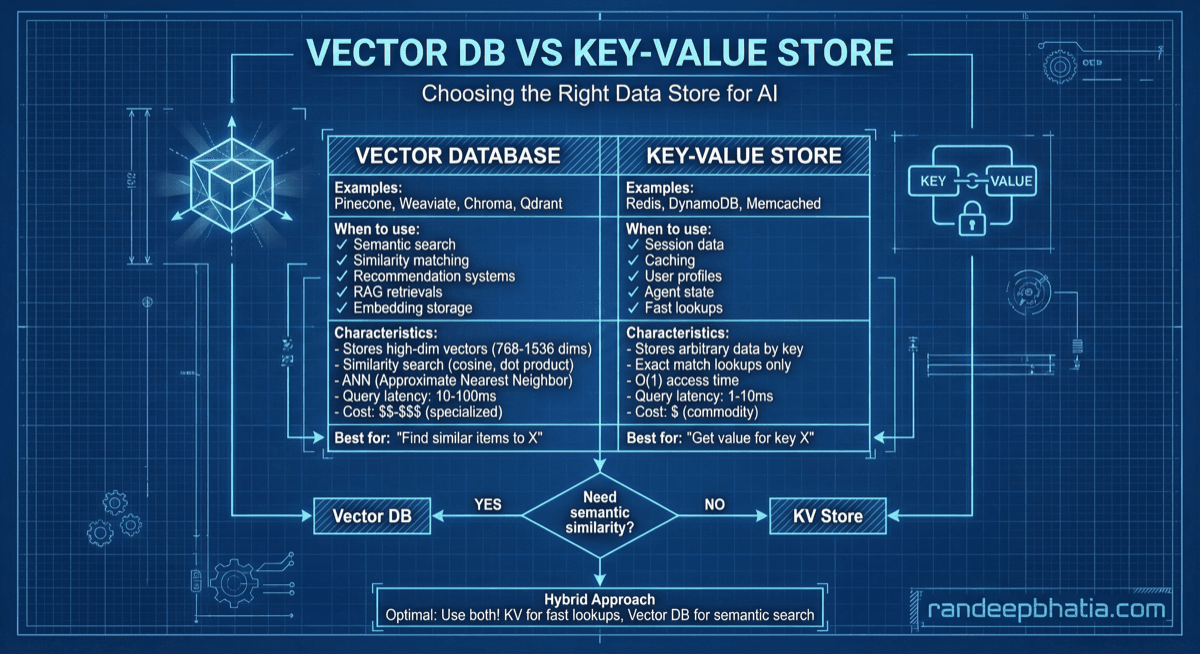
Vector Databases vs Key-Value Stores
Executive Summary
Executive Summary
Vector databases optimize for similarity search over high-dimensional embeddings using approximate nearest neighbor algorithms, while key-value stores optimize for exact-match retrieval by unique identifiers with O(1) lookup complexity.
Vector databases use specialized index structures like HNSW and IVF to enable sub-linear similarity search across millions of embeddings, trading exact accuracy for speed through approximate nearest neighbor algorithms.
Key-value stores provide deterministic O(1) retrieval by exact key match, offering predictable latency and simpler operational characteristics but requiring pre-computed relationships for any similarity-based access patterns.
The choice between them depends on whether your primary access pattern is semantic similarity search (vector database) or exact lookup with optional metadata filtering (key-value store), with hybrid architectures often combining both for production AI systems.
The Bottom Line
Choose vector databases when your application requires finding semantically similar items without knowing exact identifiers, such as RAG retrieval, recommendation systems, or semantic search. Choose key-value stores when you need fast exact-match retrieval, session storage, or caching with predictable latency, and consider hybrid architectures that leverage both for complex AI applications requiring both similarity search and exact lookups.
Definition
Definition
A vector database is a specialized data storage system designed to index, store, and query high-dimensional vector embeddings using approximate nearest neighbor (ANN) algorithms that enable efficient similarity search across millions or billions of vectors.
A key-value store is a non-relational database that uses a simple key-value method to store data, where each unique key maps to exactly one value, enabling O(1) lookup complexity for exact-match retrieval operations.
Extended Definition
Vector databases emerged from the need to efficiently search through high-dimensional embedding spaces generated by neural networks, where traditional database indexes fail due to the curse of dimensionality. They implement specialized index structures such as Hierarchical Navigable Small World graphs (HNSW), Inverted File indexes (IVF), and Product Quantization (PQ) to achieve sub-linear search complexity at the cost of approximate rather than exact results. Key-value stores, in contrast, evolved from distributed hash tables and provide guaranteed O(1) access patterns through consistent hashing and in-memory data structures, making them ideal for caching, session management, and any workload requiring predictable microsecond-level latency. The fundamental distinction lies in the query paradigm: vector databases answer the question 'what items are most similar to this query vector?' while key-value stores answer 'what is the value associated with this exact key?'
Etymology & Origins
The term 'vector database' emerged in the late 2010s as deep learning models began producing dense vector representations (embeddings) of text, images, and other data types, necessitating specialized storage systems. The concept builds on decades of research in approximate nearest neighbor search from computational geometry and information retrieval. 'Key-value store' terminology dates to the early 2000s with the rise of NoSQL databases like Amazon Dynamo (2007) and Redis (2009), though the underlying concept of associative arrays and hash tables predates these systems by decades in computer science.
Also Known As
Not To Be Confused With
Document database
Document databases like MongoDB store semi-structured JSON documents and support complex queries on document fields, while vector databases specifically optimize for similarity search on dense numerical vectors. Some document databases now offer vector search capabilities as an add-on feature, but their core architecture differs fundamentally.
Graph database
Graph databases model relationships between entities as first-class citizens using nodes and edges, optimizing for traversal queries. Vector databases find similar items based on embedding proximity without explicit relationship modeling, though both can be used for recommendation systems with different tradeoffs.
Search engine
Traditional search engines like Elasticsearch use inverted indexes for keyword-based full-text search with BM25 scoring. Vector databases enable semantic search where conceptually similar content is retrieved even without keyword overlap, though modern search engines increasingly incorporate vector search capabilities.
Cache
While key-value stores like Redis are often used as caches, caching is a usage pattern rather than a database type. Caches specifically store temporary copies of data for faster access, while key-value stores can serve as primary data stores with persistence guarantees.
Time-series database
Time-series databases optimize for append-heavy workloads with timestamp-based queries and aggregations. While they may use key-value-like access patterns, their storage engines and query capabilities are specialized for temporal data patterns rather than general-purpose key-value operations.
Feature store
Feature stores manage ML feature data with versioning, lineage tracking, and serving capabilities. While they may use vector databases or key-value stores as underlying storage, feature stores provide higher-level abstractions for ML workflows including feature transformation and point-in-time correctness.
Conceptual Foundation
Core Principles
(7 principles)Mental Models
(6 models)Library Catalog vs Librarian
A key-value store is like a library catalog where you look up a book by its exact call number and retrieve it directly. A vector database is like asking a knowledgeable librarian 'find me books similar to this one' - they use their understanding of content relationships to suggest relevant items without requiring exact identifiers.
GPS Coordinates vs Street Address
Key-value lookup is like finding a location by exact street address - you either have the right address or you don't. Vector similarity search is like finding nearby restaurants given your GPS coordinates - you're searching a continuous space where 'nearby' is relative and results are ranked by distance.
Dictionary vs Thesaurus
A key-value store is like a dictionary where you look up a specific word to get its definition. A vector database is like a thesaurus where you find words related to a concept, discovering connections you didn't explicitly define.
Hash Table vs Spatial Index
Key-value stores are fundamentally hash tables with distribution and persistence added. Vector databases are spatial indexes adapted for high-dimensional spaces where traditional spatial partitioning fails.
Exact Match vs Fuzzy Match
Key-value stores answer 'is there an exact match for this key?' while vector databases answer 'what are the closest matches to this query in the embedding space?' The former is binary, the latter is continuous and ranked.
Index Card File vs Concept Map
A key-value store is like an index card file where each card has a unique label and specific content. A vector database is like a concept map where items are positioned based on their relationships, and you can find related concepts by exploring nearby regions.
Key Insights
(10 insights)Vector databases do not store vectors in a way that allows exact reconstruction by default - many use quantization that trades precision for memory efficiency, meaning the stored representation may differ slightly from the original embedding.
Key-value stores can implement basic similarity search by pre-computing and storing neighbor relationships, but this approach doesn't scale and requires recomputation when embeddings change.
The recall-latency tradeoff in vector databases is tunable at query time in most implementations, allowing different accuracy levels for different use cases within the same index.
Vector database performance degrades gracefully with corpus size (sub-linear scaling) while key-value stores maintain constant-time performance regardless of data volume.
Hybrid architectures using both systems are common in production: vector databases for retrieval and key-value stores for caching retrieved results and storing full document content.
Vector database index building is often the bottleneck in production systems - a 10-million vector index may take hours to build but queries complete in milliseconds.
Key-value stores excel at multi-tenancy through key prefixing, while vector databases often require separate indexes per tenant for isolation, significantly impacting operational complexity.
The effectiveness of vector search depends entirely on embedding quality - a well-tuned key-value store with carefully designed keys may outperform a vector database with poor embeddings.
Vector databases typically require more operational expertise than key-value stores due to index tuning, recall monitoring, and the need to understand accuracy-performance tradeoffs.
Cost models differ fundamentally: key-value stores scale primarily with data size and throughput, while vector databases scale with vector dimensions, corpus size, and query accuracy requirements.
When to Use
When to Use
Ideal Scenarios
(12)Retrieval-Augmented Generation (RAG) systems where you need to find semantically relevant documents or passages to include in LLM context based on query meaning rather than keyword matching.
Semantic search applications where users expect to find relevant results even when their query terms don't exactly match document content, such as finding 'automobile' when searching for 'car'.
Recommendation systems that suggest similar items based on learned embeddings of user behavior, product attributes, or content features without explicitly defined similarity rules.
Image or audio similarity search where you need to find visually or acoustically similar content based on neural network embeddings rather than metadata tags.
Duplicate or near-duplicate detection systems that identify similar content across large corpora, such as plagiarism detection or content deduplication.
Anomaly detection systems that identify outliers by finding data points far from their nearest neighbors in embedding space.
Question-answering systems that retrieve relevant passages from a knowledge base based on semantic similarity to the question.
Multi-modal search applications that find related content across different modalities (text, image, audio) using unified embedding spaces.
Session storage and user state management where you need fast, exact retrieval of user sessions, shopping carts, or application state by user or session identifier.
Caching layers for expensive computations or database queries where results are stored by a deterministic cache key for rapid retrieval.
Real-time feature serving in ML systems where pre-computed features must be retrieved by entity ID with sub-millisecond latency.
Distributed configuration storage where application settings are stored and retrieved by configuration key across a cluster.
Prerequisites
(8)For vector databases: High-quality embeddings that meaningfully capture semantic relationships in your domain, typically requiring validated embedding models and understanding of embedding space properties.
For vector databases: Sufficient computational resources for index building, which may require significant CPU/GPU time and memory during initial indexing and updates.
For vector databases: Clear understanding of acceptable recall-latency tradeoffs for your use case, as these parameters significantly impact system design and cost.
For key-value stores: Well-defined key schema that uniquely identifies values and supports your access patterns without requiring secondary indexes.
For key-value stores: Understanding of consistency requirements, as many key-value stores offer tunable consistency that affects both performance and correctness guarantees.
For both: Capacity planning based on data volume, query patterns, and growth projections to select appropriate infrastructure and avoid costly migrations.
For both: Operational capabilities to monitor, maintain, and troubleshoot the chosen system, including familiarity with system-specific tooling and best practices.
For hybrid architectures: Clear separation of concerns between similarity search and exact lookup workloads to avoid architectural complexity without corresponding benefits.
Signals You Need This
(10)Users complain that search doesn't find relevant results when they use different terminology than what's in the content (signal for vector database).
Your recommendation system requires manually defined rules for item similarity that don't scale or capture nuanced relationships (signal for vector database).
You're building a RAG system and need to retrieve contextually relevant documents without relying on keyword matching (signal for vector database).
Query latency for similarity search is unacceptable using brute-force comparison against your full corpus (signal for vector database).
You need to find similar images, audio clips, or other non-text content where keyword search is impossible (signal for vector database).
Your application requires sub-millisecond retrieval of user sessions, cached results, or configuration data (signal for key-value store).
You need predictable, constant-time performance regardless of data growth for critical path operations (signal for key-value store).
Your access pattern is primarily exact-match lookup by known identifiers with no similarity or range queries needed (signal for key-value store).
You're implementing a caching layer and need simple, fast storage with TTL support (signal for key-value store).
Your system requires both semantic search and fast exact lookups, with different latency and accuracy requirements for each (signal for hybrid architecture).
Organizational Readiness
(7)Engineering team has experience with or willingness to learn vector database concepts including ANN algorithms, recall metrics, and index tuning.
Data science or ML team can produce, validate, and maintain embedding models appropriate for your domain and use case.
Operations team can monitor vector-specific metrics like recall, query latency percentiles, and index health in addition to standard infrastructure metrics.
Organization accepts that vector search results are approximate and has processes to measure and improve retrieval quality over time.
Budget accommodates the typically higher infrastructure costs of vector databases compared to key-value stores for equivalent data volumes.
Development workflow supports the longer iteration cycles often required for embedding model tuning and vector index optimization.
Organization has clear ownership of the embedding pipeline, as embedding quality directly determines vector database effectiveness.
When NOT to Use
When NOT to Use
Anti-Patterns
(12)Using a vector database for exact-match lookups where you know the precise identifier - this adds unnecessary complexity and latency compared to key-value stores.
Storing embeddings in a key-value store and performing brute-force similarity search at query time - this doesn't scale beyond small datasets.
Choosing a vector database solely because it's trendy without validating that similarity search is actually required for your use case.
Using vector databases for transactional workloads requiring ACID guarantees - most vector databases prioritize search performance over transactional consistency.
Implementing vector search when your embeddings are low quality or not validated - garbage embeddings produce garbage results regardless of infrastructure quality.
Using key-value stores for complex queries requiring filtering, aggregation, or joins - these workloads need relational or document databases.
Deploying a vector database for a corpus small enough that brute-force search meets latency requirements - the operational overhead isn't justified.
Choosing based on benchmark performance without considering your actual query patterns, data characteristics, and operational requirements.
Using vector databases for real-time analytics or reporting - they're optimized for similarity search, not aggregation queries.
Implementing a key-value store when your access patterns require range queries or secondary indexes - consider a document database instead.
Using either system as a primary source of truth for data requiring complex relationships - consider a relational or graph database.
Deploying vector databases without understanding the recall-latency tradeoff and how it affects your specific use case.
Red Flags
(10)Your team cannot explain what embeddings represent or how embedding quality affects search results.
You're choosing a vector database because 'everyone is using them for AI' without a specific similarity search requirement.
Your access pattern is 99% exact-match lookups with rare similarity searches that could be handled differently.
You expect vector database queries to be as fast as key-value lookups - they have fundamentally different performance characteristics.
Your data doesn't have meaningful vector representations, or creating quality embeddings would require significant ML investment.
You need strong consistency guarantees that most vector databases don't provide.
Your corpus is small enough (under 10,000 items) that brute-force search would meet your latency requirements.
You're planning to use a key-value store for similarity search by pre-computing all pairwise similarities - this doesn't scale.
Your organization lacks the ML expertise to evaluate embedding quality and debug retrieval issues.
You expect to frequently update vectors in place - most vector databases have expensive update operations.
Better Alternatives
(8)You need exact-match retrieval by known identifiers with sub-millisecond latency
Key-value store (Redis, DynamoDB, Memcached)
Key-value stores provide O(1) lookup complexity with predictable latency, while vector databases add unnecessary overhead for exact-match queries.
Your corpus is small (under 10,000 items) and query latency requirements are relaxed
Brute-force search in application memory or simple database with vector column
The operational complexity of a dedicated vector database isn't justified for small corpora where linear scan meets requirements.
You need keyword-based full-text search with relevance ranking
Search engine (Elasticsearch, OpenSearch, Solr)
Traditional search engines are optimized for text search with mature tooling, while vector databases add complexity without benefit for keyword-based retrieval.
You need to model and query explicit relationships between entities
Graph database (Neo4j, Amazon Neptune)
Graph databases excel at relationship traversal and pattern matching, while vector databases only capture implicit similarity without explicit relationship modeling.
You need complex queries with joins, aggregations, and transactions
Relational database with vector extension (PostgreSQL with pgvector)
Relational databases with vector extensions provide familiar SQL semantics and ACID guarantees while supporting basic vector search.
You need to store and query semi-structured documents with occasional similarity search
Document database with vector capabilities (MongoDB Atlas Vector Search)
Document databases with integrated vector search provide a unified solution without managing separate systems.
Your primary need is caching with TTL support and simple data structures
In-memory cache (Redis, Memcached)
Caching systems provide optimized data structures, TTL management, and operational simplicity that vector databases don't offer.
You need real-time analytics and aggregations over your data
Analytics database (ClickHouse, Apache Druid)
Analytics databases are optimized for aggregation queries and columnar storage, while vector databases focus on similarity search.
Common Mistakes
(10)Assuming vector databases are drop-in replacements for traditional databases - they serve fundamentally different query patterns.
Not validating embedding quality before deploying vector infrastructure - poor embeddings waste infrastructure investment.
Ignoring the recall-latency tradeoff and expecting both perfect accuracy and minimal latency.
Using vector databases for workloads that don't require similarity search, adding unnecessary complexity.
Underestimating the operational complexity of vector databases compared to mature key-value stores.
Not planning for index rebuild time when embeddings need to be updated or the embedding model changes.
Choosing based on single-metric benchmarks without considering your specific data characteristics and query patterns.
Implementing hybrid architectures without clear separation of concerns, creating maintenance nightmares.
Not monitoring recall in production, leading to degraded search quality without awareness.
Assuming key-value stores can handle similarity search with clever key design - they fundamentally cannot at scale.
Core Taxonomy
Core Taxonomy
Primary Types
(8 types)Databases designed from the ground up for vector similarity search, with storage engines, query planners, and APIs optimized for embedding workloads. Examples include Pinecone, Milvus, Weaviate, and Qdrant.
Characteristics
- Native support for multiple ANN algorithms (HNSW, IVF, etc.)
- Optimized storage formats for high-dimensional vectors
- Built-in support for metadata filtering combined with vector search
- Managed scaling and index management
- Vector-specific query APIs and SDKs
Use Cases
Tradeoffs
Highest performance for vector workloads but requires additional systems for non-vector data; typically higher cost and operational complexity than extensions to existing databases.
Classification Dimensions
Deployment Model
How the database is deployed and operated, affecting cost structure, operational burden, and customization flexibility.
Consistency Model
Guarantees about read-after-write visibility and replica synchronization, critical for application correctness requirements.
Index Algorithm Family
The underlying algorithm used for vector indexing, each with different performance characteristics and tradeoffs.
Storage Tier
Where data primarily resides, affecting latency, cost, and capacity characteristics.
Query Capability
The range of query types supported beyond basic similarity search, affecting application flexibility.
Scaling Architecture
How the system scales beyond a single machine, affecting capacity limits and availability characteristics.
Evolutionary Stages
Prototype/Experimentation
0-3 monthsUsing vector search libraries (FAISS, hnswlib) or simple key-value stores with brute-force search. Focus on validating use case and embedding quality rather than production concerns. Data volumes under 100K vectors.
Early Production
3-12 monthsDeploying managed vector database or key-value store with basic monitoring. Single-region deployment with manual scaling. Focus on reliability and establishing operational practices. Data volumes 100K-10M vectors.
Scaled Production
12-36 monthsMulti-region deployment with automated scaling and comprehensive monitoring. Hybrid architectures combining vector databases and key-value stores for different workloads. Advanced index tuning and cost optimization. Data volumes 10M-1B vectors.
Enterprise Scale
36+ monthsGlobal deployment with sophisticated traffic management and failover. Multiple specialized systems for different use cases. Custom tooling for operations and development. Continuous optimization of cost and performance. Data volumes exceeding 1B vectors.
Platform/Infrastructure
48+ monthsInternal platform providing vector and key-value capabilities as a service to multiple teams. Standardized APIs, self-service provisioning, and chargeback models. Focus on multi-tenancy, governance, and efficiency at scale.
Architecture Patterns
(8 patterns)Vector Database for Retrieval, KV Store for Content
Use a vector database to find relevant document IDs through similarity search, then retrieve full document content from a key-value store. This separates the similarity search concern from content storage and delivery.
Components
- Vector database storing embeddings with document IDs
- Key-value store storing full document content by ID
- Embedding service generating query embeddings
- Application layer orchestrating retrieval
Data Flow
Query → Embedding Service → Vector Database (returns IDs) → Key-Value Store (returns content) → Application
Best For
- RAG systems with large document content
- Semantic search with rich result rendering
- Systems where content updates independently of embeddings
Limitations
- Two-hop latency for full retrieval
- Consistency challenges between systems
- Operational complexity of multiple systems
Scaling Characteristics
Vector database scales with corpus size and query volume; key-value store scales with content size and retrieval volume. Can scale independently based on bottleneck.
Integration Points
Embedding Service
Generates vector embeddings from raw content (text, images, etc.) for storage in vector databases and query-time embedding for search.
Embedding service latency directly impacts end-to-end query latency. Consider caching embeddings for frequent queries. Model updates require re-embedding and index rebuilding.
Application Backend
Orchestrates queries across vector databases and key-value stores, handles business logic, and manages user sessions.
Implement circuit breakers for database failures. Handle partial results gracefully. Consider async patterns for non-blocking queries.
Data Pipeline
Ingests, transforms, and loads data into vector databases and key-value stores, including embedding generation and index updates.
Index building can be resource-intensive; schedule during low-traffic periods. Implement idempotent ingestion for retry safety. Monitor embedding drift over time.
Monitoring System
Collects and visualizes metrics from both vector databases and key-value stores, enabling performance optimization and incident response.
Vector-specific metrics (recall, index health) require specialized monitoring. Correlate application metrics with database metrics for root cause analysis.
Authentication/Authorization
Controls access to vector and key-value data, enforcing tenant isolation and permission boundaries.
Vector databases may have limited native auth; implement at application layer if needed. Key-value stores often rely on network isolation rather than fine-grained permissions.
CDN/Edge Cache
Caches frequently accessed content retrieved from key-value stores, reducing origin load and improving global latency.
Vector search results are typically not CDN-cacheable due to personalization. Cache full content after retrieval for repeated access.
ML Platform
Manages embedding model training, versioning, and deployment, providing models used by embedding services.
Model updates trigger re-embedding requirements. Version embeddings alongside models for reproducibility. A/B test embedding models using shadow indexes.
Search/Discovery UI
Presents search results to users, handles query input, and provides feedback mechanisms for search quality improvement.
UI should handle variable result quality gracefully. Implement query suggestions using both vector similarity and historical queries. Collect implicit feedback (clicks, dwell time) for relevance tuning.
Decision Framework
Decision Framework
Vector database is likely needed for the similarity search workload.
Key-value store may be sufficient if access is primarily by known keys.
Consider whether 'similarity' is based on learned embeddings or explicit attributes. Explicit attribute similarity might be handled by filtering in traditional databases.
Technical Deep Dive
Technical Deep Dive
Overview
Vector databases and key-value stores operate on fundamentally different principles optimized for their respective query patterns. Vector databases transform the similarity search problem from O(n) brute-force comparison to sub-linear complexity through specialized index structures that exploit the geometric properties of high-dimensional embedding spaces. These indexes create navigable structures—whether graphs, trees, or clustered partitions—that allow queries to quickly narrow down candidate vectors without examining the entire corpus. Key-value stores, in contrast, use hash-based or tree-based indexes that map keys directly to storage locations, enabling O(1) average-case lookup complexity. The key is transformed through a hash function to determine the storage bucket, and within that bucket, the exact key match is found through comparison. This approach provides predictable, constant-time access regardless of data volume but offers no capability for similarity-based queries. The architectural differences extend beyond indexing to storage layout, memory management, and query processing. Vector databases often store vectors contiguously for cache-efficient distance computations and may use quantization to reduce memory footprint at the cost of precision. Key-value stores optimize for random access patterns and may use log-structured merge trees (LSM) for write optimization or B-trees for read optimization. Understanding these internal mechanisms is essential for capacity planning, performance tuning, and debugging production issues. The choice of index algorithm, quantization strategy, and storage tier directly impacts the latency, throughput, accuracy, and cost characteristics of the system.
Step-by-Step Process
For vector databases, raw content (text, images, etc.) is first transformed into dense vector embeddings using neural network models. These embeddings typically have 384-4096 dimensions depending on the model. The embedding captures semantic meaning in a way that similar content produces similar vectors. For key-value stores, data is stored directly with a designated key, requiring no transformation.
Embedding model choice critically affects search quality. Using mismatched models for indexing and querying produces poor results. Embedding generation can be a latency and cost bottleneck at scale.
Under The Hood
Vector database index structures represent decades of research in approximate nearest neighbor search. HNSW (Hierarchical Navigable Small World) graphs, introduced by Malkov and Yashunin in 2016, build a multi-layer graph where higher layers contain fewer nodes with longer-range connections, enabling logarithmic search complexity. The algorithm constructs the graph by inserting vectors one at a time, connecting each to its approximate nearest neighbors found through greedy search. The key parameters M (number of connections per node) and ef_construction (search width during construction) control the density and quality of the graph. IVF (Inverted File) indexes use clustering to partition the vector space. K-means clustering creates centroids, and each vector is assigned to its nearest centroid. At query time, the query is compared to centroids, and only vectors in the nearest clusters (controlled by nprobe parameter) are examined. Product Quantization (PQ) can be combined with IVF to compress vectors, trading accuracy for memory efficiency. PQ splits vectors into subvectors and quantizes each independently, enabling approximate distance computation without full vector decompression. Key-value stores typically use hash tables for O(1) lookup or LSM trees for write-optimized workloads. LSM trees buffer writes in memory (memtable), periodically flushing to sorted disk files (SSTables). Reads check the memtable first, then search SSTables using bloom filters to skip files that definitely don't contain the key. Compaction merges SSTables to maintain read performance and reclaim space from deleted entries. Memory management differs significantly between systems. Vector databases often require vectors to be memory-resident for low-latency search, though disk-based indexes exist for cost optimization. Quantization reduces memory footprint: scalar quantization converts 32-bit floats to 8-bit integers (4x compression), while product quantization can achieve 32x or higher compression. Key-value stores may use memory as a cache over disk storage, with eviction policies (LRU, LFU) managing the cache contents. Distributed architectures add complexity to both systems. Vector databases may shard by vector ID (requiring scatter-gather for queries) or by embedding space partitions (enabling query routing to relevant shards). Key-value stores typically shard by key hash, with consistent hashing minimizing data movement during rebalancing. Replication strategies (synchronous vs asynchronous, quorum-based) affect consistency and availability tradeoffs.
Failure Modes
Failure Modes
Hardware failures, software bugs, or interrupted index builds can corrupt vector database indexes, causing incorrect results or query failures.
- Queries returning obviously incorrect results
- Sudden drop in recall metrics
- Query errors or crashes
- Inconsistent results for the same query
Complete loss of search functionality until index is rebuilt. May require re-embedding if source vectors are not preserved separately.
Use reliable storage with checksums. Implement index validation checks. Maintain backup indexes. Store source vectors separately from indexes.
Rebuild index from stored vectors. Failover to replica if available. Implement gradual rollout of new indexes with validation.
Operational Considerations
Key Metrics (15)
Time from query receipt to response return, measured at various percentiles to understand typical and tail latency.
Dashboard Panels
Alerting Strategy
Implement tiered alerting with different severity levels. Use anomaly detection for metrics without fixed thresholds. Correlate alerts across components to identify root causes. Implement alert suppression during known maintenance. Ensure on-call has runbooks for each alert type.
Cost Analysis
Cost Analysis
Cost Drivers
(10)Vector Dimensions
Higher dimensions require more memory per vector and more computation per distance calculation. 1536-dimension vectors cost ~4x more than 384-dimension vectors.
Use dimensionality reduction if accuracy permits. Choose embedding models with appropriate dimension for your accuracy needs. Consider Matryoshka embeddings for flexible dimensions.
Corpus Size
More vectors require more storage, memory, and potentially more nodes. Costs scale roughly linearly with corpus size.
Implement data lifecycle policies to remove stale content. Use tiered storage for infrequently accessed vectors. Consider sampling for development environments.
Query Volume
Higher QPS requires more compute capacity. Costs scale with query throughput requirements.
Implement caching for repeated queries. Batch queries where possible. Use appropriate recall settings to avoid over-provisioning.
Recall Requirements
Higher recall requires more computation per query. Moving from 95% to 99% recall may double query cost.
Profile actual recall requirements. Use lower recall for initial filtering with re-ranking. Accept lower recall for non-critical use cases.
Memory vs Disk Storage
In-memory indexes cost 10-50x more than disk-based storage but provide lower latency.
Use disk-based indexes for latency-tolerant workloads. Implement tiered storage with hot/warm/cold tiers.
Replication Factor
Higher replication multiplies storage costs but improves availability and read throughput.
Right-size replication based on availability requirements. Use read replicas only where needed.
Embedding Generation
Generating embeddings for indexing and queries incurs compute costs, especially for large models.
Cache embeddings. Use efficient embedding models. Batch embedding generation. Consider self-hosted models for high volume.
Data Transfer
Cross-region or cross-cloud data transfer incurs network costs, especially for large vectors.
Co-locate components. Compress data in transit. Minimize cross-region queries.
Index Rebuilds
Periodic index rebuilds consume significant compute resources, especially for large corpora.
Use incremental updates where possible. Schedule rebuilds during off-peak hours. Optimize rebuild parameters.
Operational Overhead
Engineering time for operations, monitoring, and troubleshooting represents significant hidden cost.
Use managed services to reduce operational burden. Invest in automation. Standardize on fewer systems.
Cost Models
Vector Database Memory Cost
Monthly Cost = (Vectors × Dimensions × Bytes per Dimension × Replication Factor × Index Overhead) / GB × $/GB/month10M vectors × 1536 dims × 4 bytes × 2 replicas × 1.5 overhead = 184 GB. At $0.10/GB/month = $18.40/month for storage alone.
Key-Value Store Cost
Monthly Cost = (Data Size × Replication Factor × $/GB/month) + (Read Operations × $/read) + (Write Operations × $/write)100 GB data × 3 replicas × $0.25/GB = $75/month storage. 100M reads × $0.25/M = $25/month. 10M writes × $1.25/M = $12.50/month. Total: $112.50/month.
Query Cost Model
Cost per Query = (Compute Time × $/compute-second) + (Data Transfer × $/GB)50ms compute at $0.00001/ms = $0.0005/query. 10KB response at $0.01/GB = $0.0000001/query. ~$0.0005/query or $500/million queries.
Total Cost of Ownership
TCO = Infrastructure Cost + Embedding Cost + Operational Cost + Opportunity CostInfrastructure: $5,000/month. Embeddings: $1,000/month. Operations: 0.25 FTE × $15,000/month = $3,750/month. TCO: $9,750/month.
Optimization Strategies
- 1Use quantization (scalar or product) to reduce vector memory by 4-32x with acceptable accuracy loss
- 2Implement tiered storage with hot/warm/cold tiers based on access patterns
- 3Cache frequent queries and embeddings to reduce compute costs
- 4Right-size recall parameters based on actual accuracy requirements
- 5Use spot/preemptible instances for batch indexing workloads
- 6Implement data lifecycle policies to remove stale content
- 7Choose embedding models with appropriate dimension for your needs
- 8Batch operations to reduce per-request overhead
- 9Use reserved capacity pricing for predictable workloads
- 10Co-locate components to minimize data transfer costs
- 11Implement request coalescing for identical queries
- 12Use managed services to reduce operational overhead for small teams
Hidden Costs
- 💰Embedding generation costs for initial indexing and ongoing updates
- 💰Engineering time for index tuning and recall optimization
- 💰Re-indexing costs when embedding models are updated
- 💰Staging environment costs for testing before production
- 💰Monitoring and observability infrastructure
- 💰Backup storage and disaster recovery infrastructure
- 💰Security and compliance tooling
- 💰Training and documentation for team members
ROI Considerations
Return on investment for vector databases should be measured against the business value of improved search relevance and user experience. Key metrics include conversion rate improvements, user engagement increases, and support ticket reductions from better self-service search. For RAG systems, measure the accuracy improvement in AI responses and reduction in hallucinations. Key-value store ROI is typically measured through latency improvements affecting user experience and system efficiency gains from caching. Calculate the cost of serving requests from primary databases versus cache hits, and the revenue impact of latency improvements. Consider the total cost of ownership including operational overhead, not just infrastructure costs. Managed services may have higher sticker prices but lower TCO when engineering time is factored in. Evaluate build vs buy decisions carefully, accounting for the opportunity cost of engineering time spent on infrastructure rather than product features. For hybrid architectures, ensure the complexity is justified by measurable improvements. Track the marginal benefit of each system component and be willing to simplify if the ROI doesn't materialize.
Security Considerations
Threat Model
(10 threats)Embedding Inversion Attack
Attacker with access to embeddings attempts to reconstruct original content, potentially exposing sensitive information.
Confidential information leakage. Privacy violations. Compliance failures.
Implement access controls on embedding storage. Consider differential privacy for sensitive embeddings. Monitor for unusual embedding access patterns.
Prompt Injection via Retrieved Content
Malicious content indexed in vector database is retrieved and passed to LLM, causing unintended behavior.
LLM manipulation. Data exfiltration. Unauthorized actions.
Sanitize indexed content. Implement content filtering on retrieval. Use prompt hardening techniques. Monitor for anomalous LLM outputs.
Tenant Data Leakage
Bugs or misconfigurations in multi-tenant systems allow queries to return other tenants' data.
Severe privacy violations. Customer trust damage. Legal liability.
Implement defense-in-depth tenant isolation. Regular security audits. Automated testing of isolation boundaries. Per-tenant encryption.
Denial of Service via Complex Queries
Attacker crafts queries that consume excessive resources, degrading service for legitimate users.
Service unavailability. Increased costs. User experience degradation.
Implement query complexity limits. Rate limiting per user/tenant. Resource quotas. Query timeout enforcement.
Data Exfiltration via Similarity Search
Attacker uses similarity search to systematically extract indexed content by querying with variations.
Intellectual property theft. Competitive intelligence leakage. Privacy violations.
Rate limiting on queries. Monitoring for systematic extraction patterns. Access logging and anomaly detection.
Key-Value Store Injection
Attacker manipulates keys or values to inject malicious data or access unauthorized keys.
Data corruption. Unauthorized access. Application compromise.
Input validation on keys and values. Parameterized queries. Principle of least privilege for access.
Man-in-the-Middle Attack
Attacker intercepts unencrypted traffic between application and database, capturing sensitive data.
Data exposure. Credential theft. Session hijacking.
Enforce TLS for all connections. Certificate validation. Network segmentation.
Credential Compromise
Database credentials exposed through code repositories, logs, or configuration files.
Unauthorized database access. Data breach. Data manipulation.
Use secrets management systems. Rotate credentials regularly. Implement least privilege access. Audit credential usage.
Backup Data Exposure
Backups stored without encryption or with weak access controls are accessed by unauthorized parties.
Historical data exposure. Compliance violations. Reputational damage.
Encrypt backups at rest. Implement strict access controls. Regular backup access audits. Secure backup deletion.
Side-Channel Information Leakage
Attacker infers information about data through timing differences, error messages, or resource consumption patterns.
Information disclosure. Privacy violations. Security bypass.
Constant-time operations where possible. Generic error messages. Resource isolation between tenants.
Security Best Practices
- ✓Enable TLS encryption for all database connections
- ✓Implement authentication and authorization for all database access
- ✓Use secrets management systems for credential storage
- ✓Rotate database credentials regularly
- ✓Implement network segmentation to isolate databases
- ✓Enable audit logging for all database operations
- ✓Encrypt data at rest using platform encryption or client-side encryption
- ✓Implement rate limiting to prevent abuse
- ✓Use parameterized queries to prevent injection attacks
- ✓Implement input validation on all user-provided data
- ✓Regular security assessments and penetration testing
- ✓Monitor for anomalous access patterns
- ✓Implement backup encryption and access controls
- ✓Use VPC/private networking for database access
- ✓Implement least privilege access principles
Data Protection
- 🔒Classify data stored in vector databases and key-value stores by sensitivity level
- 🔒Implement encryption at rest using AES-256 or equivalent
- 🔒Use TLS 1.3 for data in transit
- 🔒Implement field-level encryption for highly sensitive data
- 🔒Consider client-side encryption for maximum security
- 🔒Implement data masking for non-production environments
- 🔒Regular data access reviews and certification
- 🔒Implement data loss prevention monitoring
- 🔒Secure data deletion including from backups
- 🔒Document data flows including embedding generation pipelines
Compliance Implications
GDPR
Right to erasure (right to be forgotten) requires ability to delete personal data from vector databases and key-value stores.
Implement data deletion capabilities including from vector indexes. Maintain data lineage to identify all storage locations. Document retention policies.
CCPA
Consumer right to know what personal information is collected and right to deletion.
Implement data inventory including embeddings derived from personal data. Provide deletion mechanisms. Maintain audit trails.
HIPAA
Protected health information must be secured with appropriate safeguards.
Encrypt PHI at rest and in transit. Implement access controls and audit logging. Use BAA-covered services. Conduct risk assessments.
SOC 2
Security, availability, processing integrity, confidentiality, and privacy controls.
Implement comprehensive security controls. Document policies and procedures. Regular audits and assessments. Incident response procedures.
PCI DSS
Cardholder data must be protected with specific security controls.
Avoid storing cardholder data in vector databases or caches. If necessary, implement required encryption and access controls. Regular compliance assessments.
Data Residency Requirements
Various regulations require data to remain within specific geographic boundaries.
Deploy databases in compliant regions. Implement data residency controls. Verify managed service regional capabilities.
AI Regulations (EU AI Act)
Emerging regulations on AI systems including transparency and accountability requirements.
Document AI system components including vector databases. Implement explainability for retrieval decisions. Maintain audit trails.
Financial Services Regulations
Various regulations requiring data integrity, audit trails, and retention.
Implement immutable audit logs. Data retention policies. Regular compliance assessments. Disaster recovery capabilities.
Scaling Guide
Scaling Guide
Scaling Dimensions
Query Throughput
Add read replicas for key-value stores. Add query nodes for vector databases. Implement caching layer. Use connection pooling.
Single-node limits vary by system. Distributed systems can scale to millions of QPS with sufficient nodes.
Ensure even load distribution. Monitor for hot spots. Consider geographic distribution for global traffic.
Data Volume
Implement sharding for both vector databases and key-value stores. Use tiered storage. Implement data lifecycle policies.
Single-node memory limits (typically 100GB-1TB). Distributed systems can scale to petabytes.
Plan sharding strategy early. Consider rebalancing overhead. Monitor shard size distribution.
Vector Dimensions
Use dimensionality reduction or smaller embedding models. Implement quantization. Use specialized hardware (GPU).
Practical limits around 4096 dimensions for most systems. Higher dimensions dramatically increase costs.
Evaluate accuracy impact of dimension reduction. Consider Matryoshka embeddings for flexibility.
Write Throughput
Batch writes. Use write-optimized storage (LSM trees). Implement write-behind caching. Scale write nodes.
Vector database writes limited by index update speed. Key-value stores can achieve millions of writes/second.
Vector index updates are expensive. Consider async indexing for high write volumes.
Geographic Distribution
Deploy in multiple regions. Implement global load balancing. Use active-active or active-passive replication.
Cross-region latency (50-200ms). Consistency challenges with geo-distribution.
Evaluate consistency requirements. Consider data residency regulations. Plan for regional failures.
Tenant Count
Per-tenant indexes for isolation or shared indexes with filtering. Implement tenant-aware routing.
Per-tenant approach limited by operational overhead. Shared approach limited by noisy neighbor effects.
Evaluate isolation requirements. Plan for tenant size variation. Implement fair resource allocation.
Concurrent Connections
Use connection pooling. Implement connection limits. Scale application tier. Use async/non-blocking clients.
Database connection limits (typically thousands to tens of thousands per node).
Monitor connection utilization. Implement connection timeouts. Use connection multiplexing where available.
Query Complexity
Implement query complexity limits. Use query optimization. Scale compute resources. Implement query caching.
Complex queries (high recall, many filters) can be orders of magnitude more expensive.
Profile query patterns. Implement tiered service levels. Educate users on query costs.
Capacity Planning
Required Capacity = (Peak QPS × Query Cost) × Safety Margin × Replication Factor. Where Query Cost accounts for recall settings and data volume.Maintain 30-50% headroom for traffic spikes and growth. Higher margins for systems with unpredictable traffic patterns or strict SLAs.
Scaling Milestones
- Initial architecture decisions
- Embedding pipeline setup
- Basic monitoring
Single-node deployment sufficient. Focus on validating use case and embedding quality.
- Memory management
- Query latency optimization
- Index parameter tuning
May need larger instance or basic replication. Implement caching layer.
- Index build time
- Operational complexity
- Cost optimization
Likely need distributed deployment. Implement comprehensive monitoring. Consider managed services.
- Sharding strategy
- Cross-shard queries
- Operational automation
Sharded deployment required. Implement advanced caching. Dedicated operations team.
- Global distribution
- Cost at scale
- Organizational complexity
Multi-region deployment. Tiered storage. Significant infrastructure investment.
- Custom infrastructure
- Research-level optimization
- Massive operational complexity
Custom solutions likely required. Dedicated infrastructure teams. Significant R&D investment.
- Tenant isolation
- Fair resource allocation
- Billing and metering
Platform architecture with tenant management. Self-service provisioning. Chargeback systems.
Benchmarks
Benchmarks
Industry Benchmarks
| Metric | P50 | P95 | P99 | World Class |
|---|---|---|---|---|
| Vector Search Latency (1M vectors, 95% recall) | 5-15ms | 20-50ms | 50-100ms | <5ms p50, <20ms p99 |
| Key-Value Read Latency (in-memory) | 0.1-0.5ms | 0.5-2ms | 1-5ms | <0.1ms p50, <1ms p99 |
| Key-Value Write Latency (persistent) | 0.5-2ms | 2-10ms | 5-20ms | <1ms p50, <5ms p99 |
| Vector Search Recall@10 | 0.95 | 0.98 | 0.99 | >0.99 with <10ms latency |
| Vector Index Build Time (1M vectors) | 10-30 minutes | 30-60 minutes | 1-2 hours | <10 minutes |
| Query Throughput (vector, single node) | 1,000-5,000 QPS | 5,000-10,000 QPS | 10,000-20,000 QPS | >20,000 QPS |
| Query Throughput (KV, single node) | 50,000-100,000 QPS | 100,000-500,000 QPS | 500,000-1,000,000 QPS | >1,000,000 QPS |
| Memory Efficiency (vectors per GB) | 50,000-100,000 (1536d, float32) | 100,000-200,000 (with quantization) | 200,000-500,000 (aggressive quantization) | >500,000 with acceptable recall |
| Cache Hit Rate | 70-80% | 85-95% | >95% | >98% for stable workloads |
| Replication Lag | <100ms | <500ms | <1s | <10ms for synchronous replication |
| Availability (monthly uptime) | 99.9% | 99.95% | 99.99% | >99.99% (four nines) |
| Recovery Time Objective (RTO) | 1-4 hours | 15-60 minutes | <15 minutes | <1 minute (automatic failover) |
Comparison Matrix
| System | Type | Query Latency | Throughput | Scalability | Operational Complexity | Cost |
|---|---|---|---|---|---|---|
| Pinecone | Managed Vector DB | 10-50ms | High | Excellent | Low | High |
| Milvus | Self-hosted Vector DB | 5-30ms | Very High | Excellent | High | Medium |
| Weaviate | Vector DB | 10-50ms | High | Good | Medium | Medium |
| Qdrant | Vector DB | 5-30ms | High | Good | Medium | Low-Medium |
| pgvector | PostgreSQL Extension | 20-100ms | Medium | Limited | Low | Low |
| Redis | In-memory KV | <1ms | Very High | Good | Low | Medium |
| DynamoDB | Managed KV | 1-10ms | Very High | Excellent | Low | Medium-High |
| Cassandra | Distributed KV | 2-20ms | Very High | Excellent | High | Medium |
| FAISS | Vector Library | 1-10ms | Very High | Single-node | High | Low |
| Elasticsearch | Search Engine + Vector | 20-100ms | High | Good | Medium | Medium |
Performance Tiers
Single-node deployment, relaxed latency requirements, small data volumes
p99 latency < 500ms, <10K vectors, <100 QPS
Replicated deployment, production SLAs, moderate scale
p99 latency < 100ms, <1M vectors, <10K QPS, 99.9% availability
Optimized deployment, strict SLAs, significant scale
p99 latency < 50ms, <100M vectors, <100K QPS, 99.95% availability
Multi-region, highest availability, large scale
p99 latency < 30ms, <1B vectors, <1M QPS, 99.99% availability
Multi-tenant, self-service, massive scale
Variable per tenant, >1B vectors total, >10M QPS aggregate
Real World Examples
Real World Examples
Real-World Scenarios
(8 examples)E-commerce Semantic Product Search
Large e-commerce platform with 10M products wanting to improve search relevance beyond keyword matching. Users often search using different terminology than product descriptions.
Deployed Pinecone for product embeddings with Redis caching layer. Product descriptions and attributes embedded using domain-fine-tuned model. Hybrid search combining vector similarity with keyword matching and business rules (inventory, popularity).
25% improvement in search-to-purchase conversion. 40% reduction in zero-result searches. Significant improvement in long-tail query handling.
- 💡Hybrid search outperformed pure vector search for e-commerce
- 💡Business rules (inventory, margin) still critical for ranking
- 💡Caching essential for cost control at scale
- 💡Embedding model fine-tuning provided significant gains
Enterprise RAG Knowledge Base
Large enterprise with 500K internal documents wanting to enable AI-powered question answering for employees. Documents include policies, procedures, technical documentation.
Deployed Weaviate for document chunk embeddings. Key-value store (Redis) for session management and response caching. Chunking strategy optimized for retrieval quality. Metadata filtering by department and document type.
70% of employee questions answered without human escalation. 50% reduction in time to find information. High user satisfaction scores.
- 💡Chunk size and overlap significantly impact retrieval quality
- 💡Metadata filtering essential for large diverse corpora
- 💡Continuous feedback loop needed for quality improvement
- 💡Access control integration more complex than anticipated
Real-time Recommendation System
Media streaming platform wanting to improve content recommendations using user behavior embeddings. Need to serve recommendations with <100ms latency at 50K QPS.
User and content embeddings stored in Milvus. Recent user activity cached in Redis for real-time personalization. Batch pipeline updates embeddings daily. Online serving combines cached user state with vector similarity.
15% improvement in engagement metrics. Latency targets met with 99.9th percentile. Significant improvement in content discovery for long-tail items.
- 💡Hybrid online/offline architecture essential for freshness vs latency tradeoff
- 💡User embedding drift requires regular recomputation
- 💡Cold start problem required fallback strategies
- 💡A/B testing infrastructure critical for iteration
Customer Support Ticket Routing
SaaS company wanting to automatically route support tickets to appropriate teams based on semantic understanding of ticket content.
Ticket embeddings compared to historical tickets with known resolutions. Qdrant for similarity search. DynamoDB for ticket metadata and routing rules. Confidence thresholds for automatic vs manual routing.
60% of tickets automatically routed correctly. 30% reduction in time to first response. Improved specialist utilization.
- 💡Confidence calibration critical for automation decisions
- 💡Historical data quality directly impacts routing accuracy
- 💡Human-in-the-loop essential for edge cases
- 💡Continuous model updates needed as product evolves
Duplicate Content Detection
Content platform needing to detect near-duplicate submissions to prevent spam and plagiarism. Processing 100K new submissions daily.
Content embeddings generated at submission time. FAISS index for batch duplicate detection. Redis for caching recent submission hashes. Threshold tuning to balance precision and recall.
95% of duplicates detected automatically. 80% reduction in manual review workload. Minimal false positive rate.
- 💡Threshold tuning requires careful analysis of precision/recall tradeoff
- 💡Near-duplicate definition varies by content type
- 💡Batch processing more cost-effective than real-time for this use case
- 💡Appeal process needed for false positives
Multi-tenant SaaS Search Platform
B2B SaaS providing search capabilities to multiple customers, each with their own data and requirements. Need tenant isolation with efficient resource utilization.
Shared Milvus cluster with tenant ID filtering. Per-tenant Redis instances for caching. Tenant-aware query routing. Usage metering for billing.
Successfully serving 500+ tenants on shared infrastructure. 70% cost reduction vs per-tenant deployments. Meeting isolation requirements.
- 💡Noisy neighbor mitigation requires careful capacity planning
- 💡Tenant size variation creates resource allocation challenges
- 💡Metadata filtering performance critical for shared indexes
- 💡Self-service provisioning reduces operational burden
Session Management for High-Traffic Application
Social media application needing to manage user sessions for 100M daily active users with sub-millisecond latency requirements.
Redis Cluster for session storage with geographic distribution. Session data includes user preferences, authentication state, and recent activity. TTL-based expiration with sliding window refresh.
Sub-millisecond session retrieval at 99.9th percentile. 99.99% availability achieved. Seamless geographic failover.
- 💡Key design critical for even distribution
- 💡Memory management requires careful TTL tuning
- 💡Geographic distribution adds complexity but essential for latency
- 💡Graceful degradation needed for cache failures
ML Feature Store Implementation
ML platform team building feature store for real-time model serving. Need to serve pre-computed features with <5ms latency for online inference.
DynamoDB for feature storage with entity ID as partition key. Feature versioning for point-in-time correctness. Batch pipeline for feature computation. Online serving layer with caching.
Feature serving latency <3ms at p99. Consistent features between training and serving. Simplified model deployment.
- 💡Feature versioning more complex than anticipated
- 💡Batch/streaming feature consistency requires careful design
- 💡Schema evolution needs planning from the start
- 💡Monitoring feature freshness critical for model performance
Industry Applications
E-commerce
Semantic product search, visual similarity search, recommendation systems, duplicate listing detection
Business rules integration, inventory awareness, personalization, real-time pricing updates
Healthcare
Clinical document search, similar patient identification, medical image retrieval, drug interaction lookup
HIPAA compliance, audit requirements, high accuracy requirements, integration with EHR systems
Financial Services
Fraud detection, customer service automation, document search, similar transaction identification
Regulatory compliance, audit trails, low latency requirements, high availability
Media & Entertainment
Content recommendation, similar content discovery, copyright detection, personalized search
Real-time personalization, content freshness, multi-modal search, scale requirements
Legal
Case law search, contract analysis, document discovery, precedent identification
Accuracy requirements, citation tracking, privilege protection, audit requirements
Manufacturing
Similar part identification, defect detection, maintenance knowledge search, supplier matching
Integration with PLM systems, CAD file handling, quality requirements
Education
Learning content recommendation, plagiarism detection, question answering, resource discovery
Accessibility requirements, content appropriateness, student privacy
Gaming
Player matchmaking, content recommendation, cheat detection, similar game discovery
Real-time requirements, scale during peak events, player experience optimization
Real Estate
Property similarity search, image-based search, market analysis, lead matching
Geographic relevance, multi-modal search (images, descriptions), market dynamics
Cybersecurity
Threat intelligence matching, malware similarity detection, log analysis, incident correlation
Real-time detection requirements, false positive management, integration with SIEM
Frequently Asked Questions
(20 questions)Fundamentals
Key-value stores are not designed for similarity search and cannot efficiently support this query pattern at scale. While you could store pre-computed similarity relationships or use embedding hashes as keys for approximate matching, these approaches don't scale and miss the fundamental capability of finding similar items without pre-defined relationships. For similarity search, use a vector database or vector search library.
Technology Selection
Technical
Performance
Operations
Architecture
Cost
Reliability
RAG
Security
Glossary
Glossary
Glossary
(30 terms)Approximate Nearest Neighbor (ANN)
A class of algorithms that find vectors approximately closest to a query vector, trading exact accuracy for computational efficiency.
Context: ANN algorithms are the foundation of vector database query performance, enabling sub-linear search complexity.
Bloom Filter
A probabilistic data structure for testing set membership with no false negatives but possible false positives.
Context: Bloom filters are used in LSM-based key-value stores to avoid unnecessary disk reads.
Circuit Breaker
A pattern that prevents cascade failures by failing fast when a dependency is unhealthy.
Context: Circuit breakers are critical for resilient systems using vector databases or key-value stores.
Compaction
The process of merging and reorganizing storage files to reclaim space and improve read performance.
Context: Compaction is a maintenance operation in LSM-based stores that can affect performance.
Connection Pool
A cache of database connections reused across requests to avoid connection establishment overhead.
Context: Connection pooling is essential for performance in both vector databases and key-value stores.
Consistent Hashing
A hashing technique that minimizes key redistribution when nodes are added or removed from a distributed system.
Context: Consistent hashing enables elastic scaling of key-value stores without massive data movement.
Cosine Similarity
A similarity measure based on the cosine of the angle between two vectors, ranging from -1 to 1.
Context: Cosine similarity is commonly used for text embeddings and measures semantic similarity regardless of vector magnitude.
Dimensionality
The number of elements in a vector, determined by the embedding model.
Context: Higher dimensionality increases memory and compute costs but may improve accuracy.
Distance Metric
A function measuring the dissimilarity between two vectors, such as Euclidean distance or cosine distance.
Context: The distance metric must match what the embedding model was trained with.
Embedding
A dense vector representation of data (text, images, etc.) produced by a neural network, where similar items have similar vectors.
Context: Embeddings are the input to vector databases, and their quality determines search effectiveness.
Embedding Model
A neural network that transforms input data into dense vector representations.
Context: Embedding model quality directly determines vector search effectiveness.
Eventual Consistency
A consistency model where replicas will eventually converge to the same state, but reads may return stale data.
Context: Many distributed key-value stores use eventual consistency for availability and performance.
HNSW (Hierarchical Navigable Small World)
A graph-based ANN algorithm that builds a multi-layer navigable graph structure for efficient similarity search.
Context: HNSW is one of the most popular vector index algorithms, offering excellent query performance with moderate memory overhead.
Hot Key
A key that receives disproportionately high traffic, potentially overwhelming a single node.
Context: Hot keys are a common scalability challenge in key-value stores requiring caching or key redesign.
Index Build Time
The time required to construct a vector index from raw vectors.
Context: Index build time can be hours for large corpora and affects update latency.
IVF (Inverted File Index)
A clustering-based ANN algorithm that partitions vectors into clusters and searches only relevant clusters at query time.
Context: IVF is memory-efficient and works well with product quantization for large-scale deployments.
LSM Tree (Log-Structured Merge Tree)
A data structure optimizing write performance by buffering writes in memory and periodically merging to sorted disk files.
Context: LSM trees are used in write-optimized key-value stores like RocksDB and Cassandra.
Metadata Filtering
Restricting vector search results based on non-vector attributes like category, date, or tenant ID.
Context: Metadata filtering is essential for practical vector search applications but has performance implications.
Noisy Neighbor
A tenant whose resource consumption negatively impacts other tenants in a shared system.
Context: Noisy neighbor problems are a challenge in multi-tenant vector database architectures.
Pre-filtering vs Post-filtering
Pre-filtering restricts the search space before ANN search; post-filtering applies filters to ANN results.
Context: The choice affects both performance and result quality, with different tradeoffs.
Product Quantization (PQ)
A compression technique that reduces vector memory by splitting vectors into subvectors and quantizing each to a codebook entry.
Context: PQ enables storing more vectors in memory at the cost of some accuracy, often combined with IVF indexes.
Quantization
Reducing the precision of vector values to decrease memory usage, such as converting float32 to int8.
Context: Quantization enables larger corpora in memory at the cost of some accuracy.
RAG (Retrieval-Augmented Generation)
An AI architecture that retrieves relevant context from a knowledge base to augment LLM generation.
Context: RAG is a major driver of vector database adoption, using similarity search for context retrieval.
Recall@K
The proportion of true K nearest neighbors that appear in the top K results returned by an approximate search.
Context: Recall is the primary accuracy metric for vector databases, typically targeting 95-99% for production systems.
Replication Factor
The number of copies of data maintained across nodes for durability and availability.
Context: Higher replication improves availability but increases storage costs and write latency.
Semantic Search
Search based on meaning rather than exact keyword matching, enabled by vector similarity.
Context: Semantic search is a primary use case for vector databases in AI applications.
Sharding
Horizontal partitioning of data across multiple nodes to scale beyond single-node capacity.
Context: Both vector databases and key-value stores use sharding for large-scale deployments.
Tenant Isolation
Ensuring data and resources of one tenant cannot be accessed by or affect another tenant.
Context: Tenant isolation is a critical requirement for multi-tenant vector database deployments.
TTL (Time To Live)
An expiration time after which data is automatically deleted from the store.
Context: TTL is commonly used in key-value stores for cache management and session expiration.
Vector Index
A data structure enabling efficient similarity search over vectors, such as HNSW or IVF.
Context: The vector index is the core component enabling sub-linear search complexity.
References & Resources
Academic Papers
- • Malkov, Y. A., & Yashunin, D. A. (2018). Efficient and robust approximate nearest neighbor search using Hierarchical Navigable Small World graphs. IEEE Transactions on Pattern Analysis and Machine Intelligence.
- • Jégou, H., Douze, M., & Schmid, C. (2011). Product quantization for nearest neighbor search. IEEE Transactions on Pattern Analysis and Machine Intelligence.
- • DeCandia, G., et al. (2007). Dynamo: Amazon's Highly Available Key-value Store. ACM SIGOPS Operating Systems Review.
- • Lakshman, A., & Malik, P. (2010). Cassandra: A Decentralized Structured Storage System. ACM SIGOPS Operating Systems Review.
- • Johnson, J., Douze, M., & Jégou, H. (2019). Billion-scale similarity search with GPUs. IEEE Transactions on Big Data.
- • O'Neil, P., et al. (1996). The Log-Structured Merge-Tree (LSM-Tree). Acta Informatica.
- • Karger, D., et al. (1997). Consistent Hashing and Random Trees: Distributed Caching Protocols for Relieving Hot Spots on the World Wide Web. ACM Symposium on Theory of Computing.
- • Andoni, A., & Indyk, P. (2008). Near-optimal hashing algorithms for approximate nearest neighbor in high dimensions. Communications of the ACM.
Industry Standards
- • Redis Protocol Specification (RESP)
- • Apache Cassandra Query Language (CQL) Specification
- • Amazon DynamoDB API Reference
- • OpenSearch Vector Search Documentation
- • PostgreSQL pgvector Extension Documentation
- • ONNX (Open Neural Network Exchange) for embedding model interoperability
Resources
- • Pinecone Learning Center - Vector Database Fundamentals
- • Milvus Documentation and Architecture Guide
- • Weaviate Documentation and Tutorials
- • Redis Documentation and Best Practices
- • AWS DynamoDB Developer Guide
- • FAISS Wiki and Tutorials (Facebook AI Research)
- • Qdrant Documentation and Benchmarks
- • Elasticsearch Vector Search Guide
Continue Learning
Related concepts to deepen your understanding
Last updated: 2026-01-05 • Version: v1.0 • Status: citation-safe-reference
Keywords: vector database, key-value store, embedding storage, semantic search