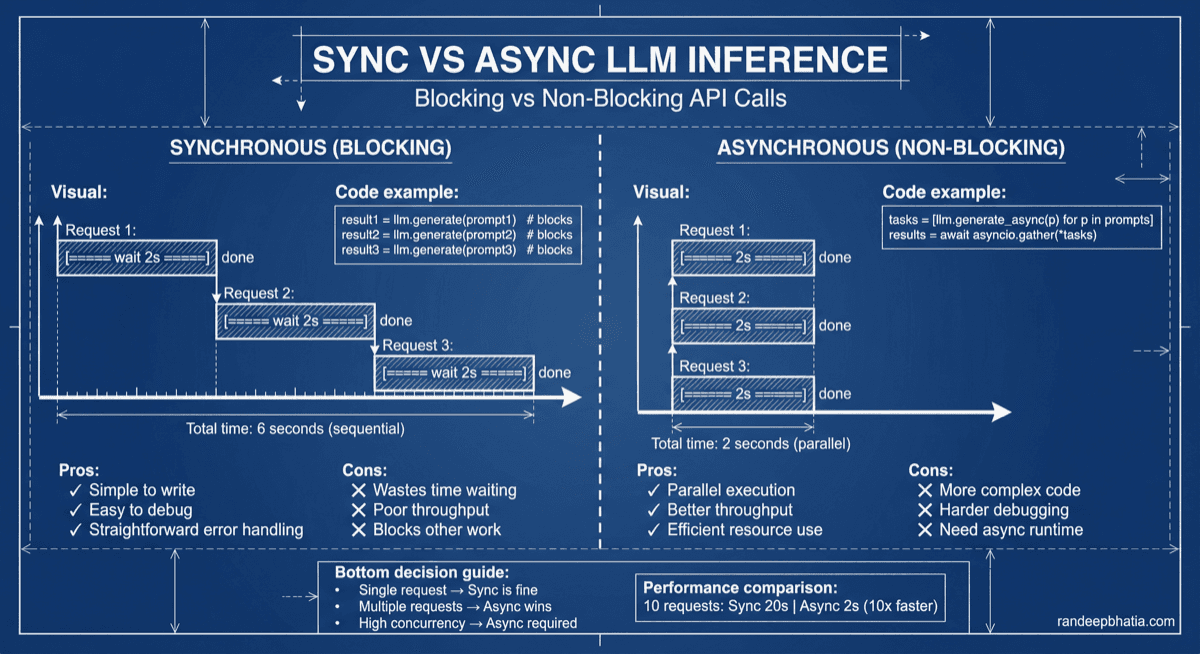
Synchronous vs Asynchronous LLM Inference
Executive Summary
Executive Summary
Synchronous LLM inference blocks execution until completion while asynchronous inference allows concurrent processing and non-blocking operations, each optimizing for different latency, throughput, and resource utilization requirements.
Synchronous inference provides predictable request-response patterns ideal for interactive applications requiring immediate feedback, but limits throughput and can cause resource underutilization during model computation.
Asynchronous inference enables higher throughput through concurrent request handling, queue-based processing, and batch optimization, but introduces complexity in state management, error handling, and result delivery.
The choice between sync and async inference depends on latency requirements, throughput needs, cost constraints, and architectural complexity tolerance, with many production systems employing hybrid approaches.
The Bottom Line
Synchronous inference suits low-latency interactive applications where immediate response is critical, while asynchronous inference excels in high-throughput batch processing and resource-constrained environments. Most production systems benefit from implementing both patterns strategically based on use case requirements.
Definition
Definition
Synchronous LLM inference is a request-response pattern where the calling process blocks and waits for the model to complete generation before continuing execution, providing immediate results but tying up resources during the entire inference duration.
Asynchronous LLM inference decouples request submission from result retrieval, allowing the calling process to continue execution while inference occurs in the background, enabling concurrent processing, batch optimization, and more efficient resource utilization.
Extended Definition
In synchronous inference, a client sends a request to an LLM endpoint and maintains an open connection until the model completes token generation, typically experiencing latencies from hundreds of milliseconds to tens of seconds depending on output length and model size. Asynchronous inference separates the request lifecycle into submission, processing, and retrieval phases, often utilizing message queues, webhooks, or polling mechanisms to deliver results. This architectural distinction fundamentally impacts system design, affecting everything from connection management and timeout handling to error recovery and scaling strategies. The choice between these patterns represents a core architectural decision that influences cost structure, user experience, and operational complexity throughout the system lifecycle.
Etymology & Origins
The terms synchronous and asynchronous derive from Greek roots meaning 'together in time' and 'not together in time' respectively. In computing, these concepts emerged from early operating system design distinguishing blocking I/O operations from non-blocking alternatives. The application to LLM inference became prominent with the rise of large language model APIs in 2020-2023, as practitioners adapted established distributed systems patterns to handle the unique characteristics of neural network inference including variable latency, high computational cost, and streaming token generation.
Also Known As
Not To Be Confused With
Streaming inference
Streaming inference refers to incremental token delivery during generation and can be implemented in both synchronous (server-sent events over persistent connection) and asynchronous (chunked delivery to callback) patterns. Streaming is orthogonal to the sync/async distinction and addresses output delivery granularity rather than request lifecycle management.
Batch inference
Batch inference refers to processing multiple inputs together for efficiency and is commonly associated with asynchronous patterns but can also be implemented synchronously. Batch processing is an optimization technique that can be applied within either inference pattern.
Parallel inference
Parallel inference involves running multiple inference operations simultaneously across hardware resources. While asynchronous patterns often enable parallelism, synchronous inference can also be parallelized across multiple threads or processes. Parallelism is an implementation detail rather than a request pattern.
Model serving vs inference
Model serving encompasses the entire infrastructure for deploying and operating models including load balancing, scaling, and monitoring. Sync vs async inference specifically addresses the request-response pattern within a serving system.
Online vs offline learning
Online and offline learning refer to model training paradigms where models update continuously or in batches. This is distinct from inference patterns which address how trained models process requests.
Hot vs cold inference
Hot and cold inference refer to whether model weights are loaded in memory (hot) or must be loaded from storage (cold). This affects latency but is independent of whether the request pattern is synchronous or asynchronous.
Conceptual Foundation
Core Principles
(7 principles)Mental Models
(6 models)Restaurant Service Analogy
Synchronous inference is like a customer standing at the counter waiting for their order to be prepared, unable to do anything else until food is ready. Asynchronous inference is like placing an order, receiving a ticket number, and being free to find a seat or check phone while waiting for the number to be called.
Pipeline vs Batch Processing
Synchronous inference operates like a single-item assembly line where each item must complete before the next begins. Asynchronous inference operates like a batch processing facility where items are collected, processed in optimized batches, and results distributed when ready.
Phone Call vs Email Communication
Synchronous inference resembles a phone call requiring both parties to be present and engaged simultaneously. Asynchronous inference resembles email where messages are sent, processed at the recipient's convenience, and responses delivered when ready.
Direct vs Queued Traffic
Synchronous inference is like direct point-to-point traffic where each vehicle takes its own route. Asynchronous inference is like a hub-and-spoke model where traffic is collected, optimized, and dispatched in coordinated batches.
Blocking vs Non-Blocking I/O
Synchronous inference follows the blocking I/O model where the calling thread waits for operation completion. Asynchronous inference follows non-blocking I/O where operations are initiated and completion is signaled through callbacks, promises, or polling.
Tight vs Loose Coupling
Synchronous inference creates tight coupling between client and server with shared fate during request processing. Asynchronous inference introduces loose coupling through intermediate queues and storage, allowing independent operation and failure recovery.
Key Insights
(10 insights)The perceived latency of synchronous inference can be reduced through streaming token delivery without changing the fundamental request pattern, allowing users to see partial results while the full response generates.
Asynchronous inference enables request deduplication and caching at the queue level, potentially reducing total inference costs when similar requests arrive within a time window.
Hybrid architectures using synchronous inference for interactive requests and asynchronous inference for background processing often provide the best balance of user experience and cost efficiency.
The overhead of asynchronous infrastructure (queues, state stores, delivery mechanisms) can exceed the efficiency gains for low-volume applications, making synchronous patterns more cost-effective below certain scale thresholds.
Asynchronous patterns enable priority queuing where high-value or time-sensitive requests can be processed before lower-priority batch work, providing more sophisticated resource allocation.
Connection timeout limits in synchronous inference create implicit maximum response length constraints, as longer generations may exceed timeout thresholds before completion.
Asynchronous inference naturally supports request replay and exactly-once processing semantics through message queue features, simplifying error recovery compared to synchronous retry logic.
The choice between sync and async inference affects observability requirements, with asynchronous patterns requiring distributed tracing across queue boundaries and correlation ID management.
Asynchronous inference enables geographic request routing where requests can be queued in one region and processed in another based on capacity and cost, while synchronous inference typically requires regional affinity.
Model warm-up and cold start latencies disproportionately impact synchronous inference where users experience the full delay, while asynchronous patterns can absorb these delays within queue processing time.
When to Use
When to Use
Ideal Scenarios
(12)Interactive chat applications requiring immediate response feedback benefit from synchronous inference with streaming to maintain conversational flow and user engagement.
Real-time content moderation systems where blocking potentially harmful content before display requires synchronous inference to gate content delivery.
Autocomplete and suggestion features where sub-second latency is essential for user experience require synchronous inference to provide timely recommendations.
Batch document processing pipelines where throughput matters more than individual latency benefit from asynchronous inference with request batching.
Background content generation for email campaigns, report generation, or content scheduling benefits from asynchronous inference enabling off-peak processing.
High-volume API services with variable request sizes benefit from asynchronous inference to prevent long-running requests from blocking resources.
Cost-sensitive applications processing non-urgent requests benefit from asynchronous inference enabling spot instance usage and dynamic scaling.
Multi-step agent workflows where individual inference calls can proceed independently benefit from asynchronous patterns enabling parallel execution.
Systems requiring guaranteed delivery and exactly-once processing benefit from asynchronous inference with persistent queues and acknowledgment mechanisms.
Applications with strict SLA requirements benefit from synchronous inference for predictable latency bounds and simpler timeout management.
Mobile applications with unreliable connectivity benefit from asynchronous inference allowing request submission during connectivity windows with later result retrieval.
Systems integrating multiple LLM providers benefit from asynchronous patterns enabling provider-agnostic queuing and failover routing.
Prerequisites
(8)Clear understanding of latency requirements distinguishing between user-facing interactive needs and background processing tolerance.
Defined throughput targets specifying requests per second, concurrent users, and peak load expectations.
Infrastructure capability assessment including queue systems, state stores, and delivery mechanisms for asynchronous patterns.
Error handling strategy defining retry policies, dead letter queues, and failure notification mechanisms.
Monitoring and observability infrastructure capable of tracking requests across synchronous connections or asynchronous queue boundaries.
Cost model understanding including per-request pricing, compute costs, and infrastructure overhead for each pattern.
Team expertise in distributed systems design for asynchronous patterns or simpler request-response architectures for synchronous approaches.
Client capability assessment determining whether consumers can handle asynchronous delivery mechanisms like webhooks or polling.
Signals You Need This
(10)Users complaining about application unresponsiveness during LLM operations indicates need for asynchronous processing or streaming.
Timeout errors occurring frequently during long-running inference requests suggests asynchronous patterns with longer processing windows.
Resource utilization metrics showing threads blocked waiting for inference indicates potential efficiency gains from asynchronous patterns.
Cost analysis revealing significant spend on idle compute during inference wait times suggests asynchronous batching opportunities.
Traffic patterns showing predictable batch workloads alongside interactive requests indicates hybrid sync/async architecture benefits.
Scaling challenges where adding capacity doesn't proportionally improve throughput suggests request pattern optimization opportunities.
Reliability issues where inference failures cascade to client failures indicates need for queue-based decoupling.
Variable response times causing inconsistent user experience suggests need for timeout management and asynchronous fallbacks.
Peak load periods causing service degradation indicates need for queue-based load leveling.
Integration requirements with systems expecting webhook delivery or polling-based result retrieval necessitates asynchronous patterns.
Organizational Readiness
(7)DevOps capability to operate message queue infrastructure including monitoring, scaling, and failure recovery procedures.
Development team familiarity with asynchronous programming patterns, callback handling, and distributed state management.
Operational runbooks covering queue backlog management, dead letter processing, and request correlation debugging.
Monitoring infrastructure supporting distributed tracing across queue boundaries and correlation ID propagation.
Incident response procedures adapted for asynchronous failure modes including queue overflow, delivery failures, and processing delays.
Cost allocation mechanisms capable of tracking inference costs across asynchronous processing stages.
Testing infrastructure supporting asynchronous integration testing, queue simulation, and end-to-end latency measurement.
When NOT to Use
When NOT to Use
Anti-Patterns
(12)Implementing asynchronous inference for simple, low-volume applications where the infrastructure overhead exceeds any efficiency gains.
Using synchronous inference for batch processing workloads where blocking connections waste resources during long processing times.
Forcing asynchronous patterns on interactive applications where users expect immediate feedback, degrading user experience.
Implementing complex queue infrastructure without proper monitoring, leading to invisible failures and lost requests.
Using synchronous inference with very long timeout values, creating resource exhaustion risks and poor failure characteristics.
Mixing sync and async patterns inconsistently within the same user flow, creating confusing and unpredictable behavior.
Implementing asynchronous inference without proper backpressure mechanisms, leading to unbounded queue growth and eventual system failure.
Using synchronous inference for operations that can tolerate delay, missing cost optimization opportunities.
Implementing webhook delivery without retry logic and idempotency handling, causing lost or duplicate results.
Choosing inference pattern based on technical preference rather than actual requirements analysis.
Using asynchronous inference without request deduplication, processing identical requests multiple times.
Implementing synchronous inference without streaming for long-form generation, causing poor perceived latency.
Red Flags
(10)Asynchronous infrastructure costs exceeding the compute savings from batching and optimization.
Queue depths growing continuously indicating processing capacity insufficient for request volume.
Dead letter queues accumulating requests without investigation or remediation processes.
Synchronous timeout errors occurring regularly without triggering architecture review.
User complaints about delayed or missing results from asynchronous processing.
Correlation ID mismatches causing responses to be delivered to wrong requesters.
Memory exhaustion from accumulating pending asynchronous requests without backpressure.
Webhook delivery failures going unnoticed due to fire-and-forget implementation.
Synchronous connections held open for minutes, exhausting connection pools.
Asynchronous processing latency exceeding user tolerance without fallback mechanisms.
Better Alternatives
(8)Simple chatbot with low traffic volume
Synchronous inference with streaming
The overhead of asynchronous infrastructure is not justified for low-volume interactive applications. Streaming provides good user experience while maintaining architectural simplicity.
Batch document processing with strict ordering requirements
Sequential synchronous processing with checkpointing
Asynchronous processing complicates ordering guarantees. Sequential processing with checkpoints provides simpler recovery semantics while maintaining throughput for ordered workloads.
Real-time content filtering requiring sub-100ms latency
Synchronous inference with smaller specialized models
Asynchronous patterns cannot meet strict latency requirements. Using smaller, faster models synchronously provides the required latency while maintaining blocking semantics.
Mobile app with unreliable connectivity needing eventual results
Local queue with background sync
Server-side asynchronous processing doesn't address connectivity issues. Client-side queuing with background synchronization handles offline scenarios more effectively.
High-throughput API with mixed request types
Hybrid architecture with request classification
Pure sync or async approaches suboptimize for mixed workloads. Classifying requests and routing to appropriate processing paths optimizes both latency and throughput.
Development and testing environments
Synchronous inference with mocked responses
Asynchronous complexity hinders rapid development iteration. Synchronous patterns with response mocking accelerate development while production uses appropriate patterns.
Cost-sensitive batch processing with flexible timing
Scheduled batch jobs with spot instances
Real-time asynchronous processing still incurs on-demand pricing. Scheduled batch processing enables spot instance usage for maximum cost efficiency.
Multi-region deployment with data residency requirements
Regional synchronous inference with local processing
Asynchronous cross-region routing may violate data residency requirements. Regional synchronous processing ensures data remains within required boundaries.
Common Mistakes
(10)Assuming asynchronous inference automatically improves performance without measuring actual throughput and latency impacts.
Implementing asynchronous patterns without considering the complexity cost for development, debugging, and operations.
Failing to implement proper timeout handling for synchronous inference, leading to hung connections and resource exhaustion.
Not implementing idempotency for asynchronous request processing, causing duplicate work on retries.
Ignoring backpressure in asynchronous systems until queue overflow causes catastrophic failures.
Using polling for result retrieval without exponential backoff, creating unnecessary load on result storage.
Failing to correlate asynchronous requests with responses, losing track of request status and results.
Not implementing dead letter queue processing, allowing failed requests to accumulate without remediation.
Assuming webhook delivery is reliable without implementing retry logic and delivery confirmation.
Mixing synchronous and asynchronous patterns in the same transaction boundary, creating inconsistent state.
Core Taxonomy
Core Taxonomy
Primary Types
(8 types)Traditional request-response pattern where the client thread blocks completely until inference completes and response is returned. The simplest implementation but ties up client resources for the entire inference duration.
Characteristics
- Single HTTP request-response cycle
- Client thread blocked during processing
- Timeout determines maximum wait time
- Connection held open throughout
- Immediate result availability
Use Cases
Tradeoffs
Simplest to implement and debug but poor resource utilization and limited scalability. Suitable for low-volume applications where simplicity outweighs efficiency concerns.
Classification Dimensions
Result Delivery Mechanism
How inference results are delivered to the requesting client, ranging from immediate response to asynchronous delivery through various mechanisms.
Processing Guarantee
The delivery and processing semantics guaranteed by the inference system, affecting reliability, idempotency requirements, and complexity.
Batching Strategy
How multiple requests are combined for efficient processing, trading latency for throughput based on workload characteristics.
Priority Handling
How request priority is determined and enforced during processing, enabling differentiated service levels and resource allocation.
Failure Recovery
How the system handles processing failures, from simple retry logic to sophisticated recovery mechanisms.
State Management
How request and processing state is managed throughout the inference lifecycle, affecting complexity and recovery capabilities.
Evolutionary Stages
Simple Synchronous
Initial development through early production (0-6 months)Direct API calls with blocking waits, minimal error handling, single-threaded processing. Suitable for prototypes and low-volume applications.
Streaming Synchronous
Early production optimization (3-12 months)Addition of streaming token delivery for improved user experience, basic timeout handling, connection pooling. Common for interactive applications.
Basic Asynchronous
Production scaling phase (6-18 months)Introduction of job queues for background processing, simple webhook delivery, basic retry logic. Enables batch processing and improved resource utilization.
Sophisticated Asynchronous
Mature production systems (12-36 months)Full queue infrastructure with priority handling, dead letter queues, exactly-once semantics, comprehensive monitoring. Enterprise-grade reliability and efficiency.
Hybrid Optimized
Advanced optimization phase (24+ months)Intelligent routing between sync and async paths, adaptive batching, cost optimization, multi-region processing. Maximum efficiency across diverse workloads.
Architecture Patterns
(8 patterns)Direct Synchronous API Gateway
Simplest pattern where API gateway routes requests directly to inference endpoints with synchronous response. Gateway handles authentication, rate limiting, and basic load balancing while inference service processes requests immediately.
Components
- API Gateway
- Load Balancer
- Inference Service
- Model Runtime
- Response Cache
Data Flow
Client → API Gateway → Load Balancer → Inference Service → Model Runtime → Response flows back through same path
Best For
- Interactive applications
- Low-latency requirements
- Simple architectures
- Development environments
Limitations
- Resource inefficiency during inference wait
- Timeout constraints limit response length
- Difficult to implement priority handling
- No request persistence for recovery
Scaling Characteristics
Horizontal scaling of inference services with connection-aware load balancing. Limited by connection pool sizes and timeout constraints. Auto-scaling based on request latency and queue depth.
Integration Points
API Gateway
Entry point for all inference requests handling authentication, rate limiting, and initial routing decisions.
Must support both synchronous response and asynchronous acknowledgment patterns. Timeout configuration critical for sync requests. Connection limits affect concurrent request capacity.
Message Queue
Persistent storage and delivery mechanism for asynchronous requests enabling decoupling and reliability.
Queue selection affects delivery guarantees, ordering, and scaling characteristics. Dead letter queue configuration essential for failure handling. Partition strategy impacts parallelism.
Inference Service
Core processing component executing model inference on incoming requests.
Must support both streaming and non-streaming output. Batching capability affects throughput. Model loading and warm-up impact cold start latency.
Result Store
Persistent storage for inference results in asynchronous patterns enabling retrieval and delivery.
Storage duration affects cost. Access patterns determine optimal storage type. Indexing strategy impacts retrieval performance.
Callback Service
Delivery mechanism for pushing results to client-specified endpoints in webhook patterns.
Retry policy affects delivery reliability. Timeout handling for unresponsive endpoints. Security validation for callback URLs.
Load Balancer
Distribution of requests across inference service instances for availability and performance.
Algorithm selection affects request distribution. Health check configuration impacts failover speed. Connection draining for graceful scaling.
Monitoring System
Collection and analysis of metrics, logs, and traces across the inference pipeline.
Correlation ID propagation essential for async tracing. Metric cardinality management for high-volume systems. Alert threshold tuning for each pattern.
Cache Layer
Storage of frequently requested results to reduce inference load and improve latency.
Cache key design affects hit rate. TTL balances freshness and efficiency. Cache warming strategies for predictable workloads.
Decision Framework
Decision Framework
Lean toward synchronous inference with streaming for optimal user experience.
Asynchronous inference is viable; continue evaluation based on other factors.
Consider perceived latency vs actual latency. Streaming can provide immediate feedback even with longer total generation time.
Technical Deep Dive
Technical Deep Dive
Overview
Synchronous and asynchronous LLM inference represent fundamentally different approaches to managing the request lifecycle in systems that interact with large language models. In synchronous inference, a client initiates a request and maintains an active connection while the inference service loads the prompt into the model, performs forward passes to generate tokens autoregressively, and returns the complete response. The client thread or process is blocked during this entire duration, which can range from hundreds of milliseconds for short completions to tens of seconds for long-form generation. Asynchronous inference separates the request lifecycle into distinct phases: submission, acknowledgment, processing, and delivery. When a client submits a request, it receives immediate acknowledgment (typically a job ID) and is free to continue other work. The request is persisted in a queue or database, processed by worker services when resources are available, and results are delivered through callbacks, polling, or message publication. This decoupling enables sophisticated optimizations including request batching, priority scheduling, and temporal load shifting. The choice between these patterns affects every aspect of system design from connection management and timeout handling to error recovery and cost optimization. Synchronous patterns provide simplicity and predictability at the cost of resource efficiency, while asynchronous patterns provide flexibility and efficiency at the cost of complexity. Most production systems eventually implement both patterns, routing requests based on latency requirements, request characteristics, and system load.
Step-by-Step Process
Client prepares inference request including prompt, model parameters, and metadata. For synchronous requests, client opens HTTP connection and sends request. For asynchronous requests, client sends request with callback URL or retrieves job ID for later polling.
Synchronous: Connection timeout must exceed expected inference time. Asynchronous: Must handle acknowledgment failures and implement retry logic for submission.
Under The Hood
At the infrastructure level, synchronous inference typically uses HTTP/1.1 or HTTP/2 connections with keep-alive for connection reuse. The inference service maintains a thread pool or async event loop to handle concurrent requests, with each request occupying a slot until completion. Connection timeouts are configured at multiple levels: client timeout, load balancer timeout, and service timeout, with the shortest timeout determining effective maximum wait time. Streaming delivery uses Server-Sent Events (SSE) or chunked transfer encoding, maintaining the connection while sending incremental data. Asynchronous inference infrastructure centers on message queues (Apache Kafka, Amazon SQS, RabbitMQ, Redis Streams) that provide durable request storage and delivery guarantees. Producers write requests to queues with configurable acknowledgment modes (fire-and-forget, leader-ack, all-replica-ack) trading durability for latency. Consumers pull requests in batches, process them, and acknowledge completion. Failed requests are retried according to configured policies and eventually moved to dead letter queues for manual intervention. Batching in async systems operates at the consumer level, where workers collect multiple requests before invoking inference. Dynamic batching algorithms balance batch size against waiting time, with larger batches improving throughput but increasing latency for early arrivals. The inference runtime (TensorRT, vLLM, TGI) performs continuous batching where new requests join in-progress batches at natural boundaries, maximizing GPU utilization. Result delivery in async systems uses one of several patterns. Webhook delivery requires the inference service to act as an HTTP client, posting results to callback URLs with exponential backoff retry. Polling requires a result store (Redis, DynamoDB, PostgreSQL) indexed by job ID with appropriate TTL management. Event streaming publishes results to topics that clients subscribe to, enabling fan-out delivery and replay capability. State management differs fundamentally between patterns. Synchronous inference maintains state implicitly in the connection and thread context. Asynchronous inference requires explicit state management: job records track request status, correlation IDs link requests to responses, and distributed locks prevent duplicate processing. This state must be consistent across failures, requiring careful transaction design and idempotency implementation.
Failure Modes
Failure Modes
Long-running inference requests exceed client timeout, causing retries that further overload the system, leading to cascading timeouts across all requests.
- Increasing timeout error rate
- Request queue depth growing
- Retry storm in logs
- CPU/memory spike from retry handling
Complete service unavailability as all requests timeout. Client applications fail. User experience severely degraded.
Set timeouts with sufficient margin above p99 latency. Implement circuit breakers. Use streaming to reset timeout on each chunk. Implement request shedding under load.
Immediately reduce traffic through rate limiting. Increase timeout temporarily. Scale inference capacity. Enable request prioritization to process critical requests first.
Operational Considerations
Key Metrics (15)
Median latency from request receipt to response completion, indicating typical user experience.
Dashboard Panels
Alerting Strategy
Implement tiered alerting with warning and critical thresholds. Warning alerts trigger investigation during business hours. Critical alerts page on-call immediately. Use anomaly detection for metrics without fixed thresholds. Aggregate alerts to prevent alert storms. Include runbook links in all alerts. Implement alert correlation to identify root cause from symptoms.
Cost Analysis
Cost Analysis
Cost Drivers
(10)GPU Compute Time
Primary cost driver, scales with inference duration and GPU type. Larger models and longer outputs increase cost.
Optimize batch efficiency, use appropriate model size, implement caching for repeated queries, consider smaller models for simple tasks.
GPU Memory Allocation
Determines maximum batch size and concurrency. Over-provisioning wastes resources, under-provisioning limits throughput.
Right-size GPU memory for workload. Use memory-efficient attention. Implement dynamic batching to maximize utilization.
Queue Infrastructure
Message storage, throughput, and retention costs. High-volume async systems incur significant queue costs.
Optimize message size, set appropriate retention, use tiered storage for old messages, consider serverless queue options.
Result Storage
Storage costs scale with result size and retention duration. High-volume systems accumulate significant storage.
Minimize retention period, compress results, use tiered storage, implement aggressive TTL policies.
Network Transfer
Data transfer costs for large prompts/responses, especially cross-region. Webhook delivery adds outbound transfer.
Compress payloads, minimize cross-region transfer, batch webhook deliveries, use regional endpoints.
Idle Capacity
Reserved capacity for sync latency SLAs incurs cost even when unused. Over-provisioning for peak wastes resources.
Use auto-scaling, implement request queuing, shift deferrable work to off-peak, use spot instances for async.
Retry and Reprocessing
Failed requests that are retried incur duplicate inference costs. High retry rates significantly increase costs.
Reduce failure rate, implement idempotency, cache partial results, fix root causes promptly.
Cold Start Overhead
Model loading time for cold starts wastes resources and delays processing. Frequent scaling increases cold start frequency.
Maintain warm capacity, implement model caching, use persistent instances for predictable workloads.
Monitoring and Logging
High-cardinality metrics and verbose logging accumulate significant observability costs.
Sample high-volume metrics, aggregate logs, implement log levels, use cost-effective storage tiers.
Webhook Delivery Infrastructure
Outbound HTTP infrastructure, retry queues, and delivery tracking add overhead to async patterns.
Batch deliveries where possible, implement efficient retry policies, use serverless delivery functions.
Cost Models
Synchronous Per-Request Cost
Cost = (GPU_hourly_rate × inference_seconds / 3600) + (network_cost × payload_size) + (overhead_percentage × base_cost)For a $3/hour GPU with 2-second inference and 10KB payload: Cost = ($3 × 2/3600) + ($0.01 × 0.00001) + (0.15 × $0.00167) = $0.00167 + negligible + $0.00025 ≈ $0.002 per request
Asynchronous Batched Cost
Cost = (GPU_hourly_rate × batch_inference_seconds / 3600 / batch_size) + (queue_cost_per_message × 2) + (storage_cost × result_size × retention_hours)For batch of 8 with 4-second total inference: Cost = ($3 × 4/3600 / 8) + ($0.0000004 × 2) + ($0.023/730 × 0.00001 × 24) ≈ $0.00042 per request (75% savings vs sync)
Hybrid Cost Model
Total_Cost = (sync_requests × sync_cost) + (async_requests × async_cost) + fixed_infrastructure_cost1000 sync requests at $0.002 + 10000 async requests at $0.0005 + $50 infrastructure = $2 + $5 + $50 = $57 total, $0.0052 average per request
Capacity-Based Cost
Monthly_Cost = (reserved_GPU_hours × GPU_rate) + (burst_GPU_hours × spot_rate) + (queue_throughput × queue_rate) + storage_cost720 reserved hours at $3 + 100 burst hours at $1 + 10M messages at $0.40/M + $20 storage = $2160 + $100 + $4 + $20 = $2284/month
Optimization Strategies
- 1Implement request caching to avoid redundant inference for identical or similar queries
- 2Use dynamic batching to maximize GPU utilization and reduce per-request cost
- 3Shift deferrable async workloads to off-peak hours for lower spot instance pricing
- 4Right-size GPU instances based on actual memory and compute requirements
- 5Implement request deduplication at queue level to avoid processing duplicates
- 6Use smaller, faster models for simple tasks that don't require full model capability
- 7Implement early stopping for generation when sufficient output is produced
- 8Compress request and response payloads to reduce network transfer costs
- 9Set aggressive TTLs on result storage to minimize storage costs
- 10Use reserved instances for predictable baseline load, spot for variable async load
- 11Implement request prioritization to ensure high-value requests get premium resources
- 12Monitor and reduce retry rates to avoid duplicate inference costs
Hidden Costs
- 💰Engineering time for implementing and maintaining async infrastructure
- 💰Operational overhead for monitoring, debugging, and incident response
- 💰Cost of failed requests that consume resources without delivering value
- 💰Queue infrastructure costs that persist even during low-traffic periods
- 💰Result storage costs that accumulate with retention duration
- 💰Webhook delivery infrastructure and retry overhead
- 💰Cold start costs from frequent scaling or serverless invocations
- 💰Cross-region data transfer for distributed deployments
ROI Considerations
The return on investment for async inference infrastructure depends heavily on request volume and traffic patterns. At low volumes (under 1000 requests/day), the infrastructure overhead of async patterns typically exceeds the efficiency gains, making simple synchronous inference more cost-effective. As volume increases, batching efficiency improves and the fixed infrastructure costs are amortized across more requests, typically reaching break-even around 10,000-50,000 requests/day depending on request characteristics. Beyond cost, async patterns provide value through improved reliability (request persistence), better resource utilization (independent scaling), and operational flexibility (priority handling, temporal shifting). These benefits may justify async investment even when pure cost analysis is marginal. Hybrid architectures often provide the best ROI by using synchronous inference for latency-sensitive interactive requests while routing batch and background work through async pipelines. This approach captures the user experience benefits of sync for critical paths while achieving cost optimization for bulk processing. When evaluating ROI, consider the full cost picture including engineering investment, operational overhead, and opportunity cost of delayed features. A simpler synchronous architecture that ships faster may provide better business value than a sophisticated async system that takes months to implement.
Security Considerations
Threat Model
(10 threats)Prompt Injection via Queue
Malicious prompts submitted to async queue that attempt to manipulate model behavior or extract sensitive information.
Model manipulation, data exfiltration, unauthorized actions if model has tool access.
Input validation and sanitization before queuing. Prompt filtering and monitoring. Output validation before delivery.
Queue Poisoning
Attacker floods queue with malicious or resource-intensive requests to cause denial of service or resource exhaustion.
Service unavailability, increased costs, delayed legitimate requests.
Rate limiting per client. Request validation before queuing. Queue depth limits with backpressure. Anomaly detection on request patterns.
Webhook Endpoint Exploitation
Attacker specifies malicious callback URL to receive results, potentially targeting internal services or third parties.
Data exfiltration to attacker. SSRF attacks against internal services. DDoS against third parties.
Validate callback URLs against allowlist. Block internal network addresses. Implement callback URL verification. Rate limit per endpoint.
Result Store Data Breach
Unauthorized access to result storage exposes inference outputs which may contain sensitive information.
Data breach, privacy violations, compliance failures.
Encrypt results at rest. Implement strict access controls. Minimize retention duration. Audit access logs.
Correlation ID Manipulation
Attacker manipulates correlation IDs to receive results intended for other users.
Data disclosure to unauthorized parties. Privacy violations.
Use cryptographically secure ID generation. Validate ID ownership before result delivery. Implement request signing.
Man-in-the-Middle on Webhook Delivery
Attacker intercepts webhook delivery to capture or modify inference results.
Data interception, result manipulation.
Require HTTPS for all callbacks. Implement webhook signatures. Validate TLS certificates.
Resource Exhaustion Attack
Attacker submits requests designed to maximize resource consumption (long outputs, complex prompts).
Increased costs, service degradation for legitimate users.
Implement token limits. Rate limit by resource consumption. Detect and block abusive patterns. Implement cost caps per client.
Queue Message Tampering
Attacker with queue access modifies messages to change request content or routing.
Unauthorized request modification, routing manipulation.
Encrypt messages in transit and at rest. Implement message signing. Restrict queue access. Audit queue operations.
Inference Result Leakage via Timing
Attacker infers information about other users' requests through timing analysis of shared infrastructure.
Information disclosure through side channels.
Implement request isolation. Add timing noise. Use dedicated resources for sensitive workloads.
Denial of Service via Long Connections
Attacker opens many synchronous connections and keeps them open with slow requests, exhausting connection capacity.
Service unavailability for legitimate users.
Implement connection limits per client. Set aggressive timeouts. Use connection pooling with limits. Implement slowloris protection.
Security Best Practices
- ✓Authenticate all requests using strong authentication (API keys, OAuth, mTLS)
- ✓Implement authorization checks for queue operations and result retrieval
- ✓Encrypt all data in transit using TLS 1.3
- ✓Encrypt sensitive data at rest in queues and result stores
- ✓Validate and sanitize all inputs before processing
- ✓Implement rate limiting at multiple levels (API, queue, per-client)
- ✓Use allowlists for webhook callback URLs
- ✓Sign webhook payloads to prevent tampering
- ✓Implement audit logging for all operations
- ✓Rotate credentials and API keys regularly
- ✓Isolate inference workloads by sensitivity level
- ✓Implement network segmentation for inference infrastructure
- ✓Regular security assessments and penetration testing
- ✓Monitor for anomalous request patterns
- ✓Implement incident response procedures for security events
Data Protection
- 🔒Classify data sensitivity levels for different request types
- 🔒Implement encryption for sensitive prompts and responses
- 🔒Minimize data retention in queues and result stores
- 🔒Implement secure deletion when retention period expires
- 🔒Prevent logging of sensitive content in observability systems
- 🔒Implement data masking for sensitive fields in logs and metrics
- 🔒Use separate infrastructure for highly sensitive workloads
- 🔒Implement access controls based on data classification
- 🔒Audit data access and maintain access logs
- 🔒Implement data loss prevention controls for result delivery
Compliance Implications
GDPR
Personal data in prompts and responses must be handled according to data protection principles including purpose limitation, data minimization, and storage limitation.
Implement data classification for requests. Minimize retention of results containing personal data. Provide data deletion capability. Document processing activities.
HIPAA
Protected health information in inference requests requires safeguards for confidentiality, integrity, and availability.
Encrypt PHI at rest and in transit. Implement access controls and audit logging. Execute BAAs with infrastructure providers. Conduct regular risk assessments.
SOC 2
Security, availability, processing integrity, confidentiality, and privacy controls must be implemented and auditable.
Document security controls. Implement monitoring and alerting. Maintain audit trails. Conduct regular control testing.
PCI DSS
Cardholder data must not be exposed in inference requests or stored in results without appropriate controls.
Implement data masking for payment data. Segment inference infrastructure. Maintain PCI-compliant logging. Regular vulnerability scanning.
CCPA
California consumer data requires disclosure of collection practices and honoring of deletion requests.
Document data collection in privacy policy. Implement deletion capability for stored results. Provide data access mechanisms.
AI Act (EU)
High-risk AI systems require transparency, human oversight, and technical documentation.
Document model capabilities and limitations. Implement human review for high-risk decisions. Maintain technical documentation. Enable auditability.
Data Residency Requirements
Certain data must remain within specific geographic boundaries.
Implement regional processing for restricted data. Prevent cross-region queue routing. Validate data residency in result storage.
Financial Services Regulations
Model risk management and audit requirements for AI in financial decisions.
Implement model versioning and audit trails. Document model validation. Maintain decision logs. Enable regulatory examination.
Scaling Guide
Scaling Guide
Scaling Dimensions
Request Ingestion
Scale API gateway and request handlers horizontally. Implement load balancing across ingestion endpoints. Use auto-scaling based on request rate.
Limited by network bandwidth, connection handling capacity, and downstream queue throughput.
Ingestion scaling is typically easier than processing scaling. Ensure downstream components can handle increased ingestion rate.
Queue Throughput
Increase queue partitions for parallel processing. Scale queue infrastructure vertically or add nodes. Optimize message size and batching.
Queue system limits on partitions, throughput per partition, and total cluster capacity.
Partition count affects parallelism but increases coordination overhead. Consider managed queue services for easier scaling.
Inference Compute
Add GPU instances horizontally. Use larger GPU instances for memory-bound workloads. Implement auto-scaling based on queue depth or latency.
GPU availability, cost constraints, and diminishing returns from batching at very high scale.
GPU scaling has longer lead time than CPU scaling. Maintain warm capacity for latency-sensitive workloads.
Result Storage
Scale storage horizontally through sharding. Use tiered storage for cost optimization. Implement caching for frequently accessed results.
Storage system throughput limits, consistency requirements, and cost constraints.
Write throughput often more challenging than read throughput. Consider eventual consistency for non-critical reads.
Webhook Delivery
Scale delivery workers horizontally. Implement per-endpoint queuing for isolation. Use connection pooling for efficient delivery.
Outbound connection limits, endpoint rate limits, and network bandwidth.
Delivery scaling independent of inference scaling. Implement circuit breakers to prevent cascade from slow endpoints.
Geographic Distribution
Deploy inference capacity in multiple regions. Implement intelligent routing based on latency and capacity. Use global load balancing.
Data residency requirements, cross-region latency, and operational complexity.
Multi-region adds significant complexity. Start with single region and expand based on user distribution.
Model Variants
Deploy multiple model sizes for different use cases. Route requests to appropriate model based on requirements. Share infrastructure where possible.
GPU memory for multiple models, routing complexity, and operational overhead.
Model variants enable cost optimization but increase operational complexity. Consider serverless for low-volume variants.
Tenant Isolation
Implement logical isolation through queues and quotas. Physical isolation for high-value or sensitive tenants. Dedicated capacity for SLA guarantees.
Infrastructure cost of physical isolation, complexity of multi-tenant routing.
Balance isolation requirements against cost. Most tenants can share infrastructure with logical isolation.
Capacity Planning
Required_GPUs = (Peak_RPS × Avg_Latency) / (Batch_Size × Target_Utilization) × Redundancy_FactorMaintain 20-30% headroom above calculated capacity for traffic spikes and operational flexibility. Plan capacity 3-6 months ahead based on growth projections. Implement auto-scaling to handle unexpected spikes within defined cost limits.
Scaling Milestones
- Cold start latency dominates
- Batch efficiency very low
- Infrastructure overhead high relative to usage
Use simple synchronous architecture. Consider serverless for cost efficiency. Minimize infrastructure complexity.
- Inconsistent latency from variable load
- Beginning to see cost impact
- Need for basic monitoring
Implement basic auto-scaling. Add monitoring and alerting. Consider streaming for better UX.
- Batch efficiency becomes important
- Need for async processing for batch workloads
- Cost optimization becomes relevant
Introduce async processing for batch workloads. Implement basic batching. Add cost monitoring.
- Queue infrastructure required
- Multiple GPU instances needed
- Operational complexity increases
Implement full async infrastructure. Deploy multiple inference instances. Add comprehensive monitoring. Implement priority handling.
- Multi-region deployment needed
- Sophisticated load balancing required
- Cost optimization critical
Deploy multi-region infrastructure. Implement intelligent routing. Advanced batching and caching. Dedicated capacity for tiers.
- Global scale operations
- Complex capacity planning
- Significant infrastructure investment
Global deployment with regional optimization. Custom infrastructure components. Advanced ML for traffic prediction and routing. Dedicated teams for operations.
- Hyperscale operations
- Custom hardware considerations
- Industry-leading efficiency required
Custom inference infrastructure. Hardware optimization and custom silicon consideration. Global traffic engineering. Industry-leading operational practices.
Benchmarks
Benchmarks
Industry Benchmarks
| Metric | P50 | P95 | P99 | World Class |
|---|---|---|---|---|
| Synchronous inference latency (7B model, 100 output tokens) | 800ms | 1.5s | 2.5s | <500ms p50 |
| Synchronous inference latency (70B model, 100 output tokens) | 3s | 5s | 8s | <2s p50 |
| Async queue-to-completion time | 5s | 15s | 30s | <3s p50 |
| Batch processing throughput (requests/GPU/hour) | 500 | 800 | 1000 | >1500 |
| GPU utilization during inference | 60% | 75% | 85% | >90% |
| Webhook delivery success rate (first attempt) | 95% | 98% | 99% | >99.5% |
| Request success rate | 99% | 99.5% | 99.9% | >99.95% |
| Time to first token (streaming) | 200ms | 400ms | 800ms | <100ms p50 |
| Batch formation time | 100ms | 500ms | 1s | <50ms p50 |
| Dead letter queue rate | 0.1% | 0.5% | 1% | <0.01% |
| Cost per 1000 tokens (async batched) | $0.002 | $0.005 | $0.01 | <$0.001 |
| Tokens per second per GPU | 50 | 100 | 150 | >200 |
Comparison Matrix
| Aspect | Blocking Sync | Streaming Sync | Queue Async | Webhook Async | Hybrid |
|---|---|---|---|---|---|
| Implementation Complexity | Low | Medium | High | High | Very High |
| Perceived Latency | High | Low | Variable | Variable | Optimized |
| Throughput Efficiency | Low | Low | High | High | High |
| Resource Utilization | Poor | Poor | Excellent | Excellent | Excellent |
| Fault Tolerance | Low | Low | High | Medium | High |
| Cost Efficiency | Low | Low | High | High | High |
| Debugging Ease | Easy | Medium | Hard | Hard | Very Hard |
| Client Complexity | Low | Medium | Medium | High | High |
| Scaling Flexibility | Limited | Limited | Excellent | Good | Excellent |
| Priority Handling | None | None | Excellent | Good | Excellent |
Performance Tiers
Simple synchronous implementation, no batching, minimal monitoring. Acceptable latency and cost for low-volume testing.
P99 latency <10s, success rate >95%, cost not optimized
Streaming sync for interactive, basic async for batch. Standard monitoring and alerting. Reasonable efficiency.
P99 latency <5s sync, success rate >99%, GPU utilization >50%
Full async infrastructure with batching. Priority handling. Comprehensive monitoring. Cost-optimized.
P99 latency <3s sync, queue completion <30s, success rate >99.5%, GPU utilization >70%
Hybrid architecture with intelligent routing. Multi-region deployment. SLA guarantees. Advanced optimization.
P99 latency <2s sync, queue completion <15s, success rate >99.9%, GPU utilization >80%
Custom infrastructure with maximum optimization. Global deployment. Industry-leading efficiency and reliability.
P99 latency <1s sync, queue completion <5s, success rate >99.99%, GPU utilization >90%
Real World Examples
Real World Examples
Real-World Scenarios
(8 examples)E-commerce Product Description Generation
Large e-commerce platform needs to generate product descriptions for millions of items. Interactive editing requires immediate feedback while bulk catalog updates can be processed overnight.
Implemented hybrid architecture with streaming sync for interactive editor (sub-2s time-to-first-token) and queue-based async for bulk updates (processed in nightly batches with 80% cost reduction through batching and spot instances).
Interactive editor achieved 95% user satisfaction with perceived responsiveness. Bulk processing reduced per-description cost by 75% compared to sync approach. System handles 50,000 interactive requests/day and 500,000 batch requests/night.
- 💡User perception of latency matters more than actual latency for interactive use
- 💡Batch processing economics dramatically different from real-time
- 💡Clear separation of interactive and batch workloads simplifies architecture
- 💡Spot instance interruption handling critical for batch reliability
Customer Support Chatbot
Financial services company deploying AI chatbot for customer support. Strict latency requirements for conversational flow. Compliance requirements for audit trail.
Streaming synchronous inference for real-time conversation with sub-500ms time-to-first-token. All requests logged to event stream for compliance. Async processing of conversation summaries for agent handoff.
Achieved 450ms average time-to-first-token, maintaining conversational flow. 100% audit compliance through event logging. Agent handoff summaries available within 30 seconds of conversation end.
- 💡Streaming essential for conversational UX
- 💡Compliance logging can be async without impacting user experience
- 💡Connection management critical for high-concurrency chat
- 💡Graceful degradation needed for model latency spikes
Document Processing Pipeline
Legal tech company processing thousands of contracts daily for clause extraction and summarization. Variable document lengths from 1 page to 500 pages.
Queue-based async processing with priority tiers (urgent, standard, bulk). Dynamic batching based on document length. Result delivery via webhook to document management system.
Processing 10,000 documents daily with 99.5% success rate. Urgent documents processed within 5 minutes, standard within 1 hour, bulk overnight. Cost per document reduced 60% through batching.
- 💡Document length variation requires adaptive batching
- 💡Priority queues essential for mixed urgency workloads
- 💡Webhook reliability critical for integration
- 💡Dead letter queue monitoring prevents silent failures
Real-time Content Moderation
Social media platform requiring content moderation before post publication. Strict latency requirements to not impact posting experience. High volume during peak hours.
Blocking synchronous inference with small, fast model optimized for moderation. Timeout-based fallback to allow posting with async review. Async queue for detailed analysis of flagged content.
P99 moderation latency of 150ms, imperceptible to users. Fallback triggered for <0.1% of posts during extreme load. Detailed async analysis catches 15% additional violations.
- 💡Smaller specialized models can meet strict latency requirements
- 💡Fallback strategies essential for user experience
- 💡Layered approach (fast sync + detailed async) provides best coverage
- 💡False positive rate as important as latency for UX
Multi-tenant SaaS Platform
B2B SaaS offering AI features to enterprise customers with different SLA tiers. Need to guarantee performance for premium customers while efficiently serving free tier.
Priority queue architecture with dedicated capacity for enterprise tier. Free tier uses shared capacity with best-effort processing. Tenant isolation through separate queues and result stores.
Enterprise customers achieve guaranteed P99 latency of 2s. Free tier P99 of 30s during peak, 5s off-peak. Premium tier generates 80% of revenue with 20% of requests.
- 💡Tenant isolation critical for enterprise sales
- 💡Priority systems require careful capacity planning
- 💡Free tier can subsidize infrastructure costs if managed well
- 💡SLA monitoring and reporting essential for enterprise customers
Mobile App with Offline Support
Mobile productivity app with AI writing assistance. Users often in low-connectivity environments. Need to support offline request queuing with eventual processing.
Client-side queue for offline request storage. Background sync when connectivity available. Server-side async processing with result push notification. Local cache for common responses.
App functional in offline mode with queued requests. 95% of requests processed within 5 minutes of connectivity. Local cache serves 30% of requests without server round-trip.
- 💡Client-side queuing essential for mobile reliability
- 💡Push notifications better than polling for mobile
- 💡Local caching dramatically improves perceived performance
- 💡Conflict resolution needed for offline edits
Research Paper Analysis System
Academic institution processing research papers for literature review assistance. Variable paper lengths and analysis depth requirements. Cost-sensitive with limited budget.
Scheduled batch processing during off-peak hours using spot instances. Papers queued throughout day, processed overnight. Results available next morning via email notification.
Processing cost reduced 85% compared to real-time approach. 500 papers processed nightly. Researchers adapted workflow to submit papers end-of-day for morning results.
- 💡Scheduled batch processing enables dramatic cost savings
- 💡User workflow can adapt to async patterns if value is clear
- 💡Spot instance interruption handling critical for batch jobs
- 💡Email delivery simpler than webhook for academic users
Real-time Translation Service
Video conferencing platform adding real-time translation. Strict latency requirements for conversational flow. Multiple language pairs with varying model sizes.
Streaming synchronous inference with language-specific model routing. Smaller models for common language pairs, larger models for rare pairs. Adaptive quality based on latency budget.
Sub-300ms latency for common language pairs. Acceptable 800ms for rare pairs. Translation quality rated 4.2/5 by users. System handles 10,000 concurrent translation streams.
- 💡Model size/quality tradeoffs essential for latency targets
- 💡Language pair frequency should drive infrastructure investment
- 💡Streaming critical for real-time translation UX
- 💡Adaptive quality better than consistent latency violations
Industry Applications
Healthcare
Clinical documentation and medical coding assistance
HIPAA compliance requires encryption and audit logging. Synchronous for real-time documentation, async for batch coding review. Strict accuracy requirements favor human-in-the-loop async workflows.
Financial Services
Fraud detection and transaction analysis
Real-time fraud detection requires synchronous with strict latency SLAs. Batch analysis for pattern detection uses async. Regulatory requirements mandate complete audit trails.
E-commerce
Product recommendations and search enhancement
Search requires synchronous for user experience. Recommendation pre-computation uses async batch processing. A/B testing requires consistent routing for experiment validity.
Media & Entertainment
Content generation and personalization
Interactive content creation needs streaming sync. Bulk content generation for catalogs uses async. Content moderation requires fast sync with async appeals processing.
Legal
Contract analysis and legal research
Document review tolerates async processing. Interactive research assistance needs sync. Confidentiality requires tenant isolation and encryption.
Education
Tutoring and assessment
Interactive tutoring requires streaming sync for engagement. Essay grading can use async batch processing. Accessibility requirements may need specialized sync handling.
Manufacturing
Quality control and predictive maintenance
Real-time quality inspection needs fast sync inference. Predictive maintenance analysis uses async batch processing. Edge deployment may require local sync inference.
Customer Service
Chatbots and ticket routing
Live chat requires streaming sync for conversational flow. Ticket classification can use async. Escalation to human agents needs fast sync response.
Telecommunications
Network optimization and customer insights
Real-time network decisions need fast sync. Customer behavior analysis uses async batch. High volume requires efficient batching and cost optimization.
Government
Document processing and citizen services
Citizen-facing services need responsive sync. Bulk document processing uses async. Compliance and audit requirements extensive. Data residency often required.
Frequently Asked Questions
(20 questions)Architecture Decision
Use synchronous inference when users expect immediate feedback (chatbots, interactive editors, real-time assistance) and latency is critical. Use asynchronous inference when processing can be deferred (batch document processing, background content generation, non-urgent analysis) and throughput or cost optimization is more important than immediate response. Many production systems use both patterns, routing requests based on urgency and characteristics.
Performance
Infrastructure
Reliability
Cost
Implementation
Migration
Operations
Security
Testing
Glossary
Glossary
Glossary
(30 terms)Admission Control
Mechanism to accept or reject requests based on system capacity and request characteristics.
Context: Prevents overload in both sync and async patterns.
Asynchronous Inference
Pattern where request submission is decoupled from result retrieval, allowing non-blocking client operation.
Context: Used for batch processing, background tasks, and throughput optimization.
At-Least-Once Delivery
Message delivery guarantee where messages may be delivered multiple times but never lost.
Context: Common queue guarantee requiring idempotent processing.
Backpressure
Mechanism to slow down producers when consumers cannot keep up with processing rate.
Context: Prevents queue overflow and resource exhaustion in async systems.
Batch Inference
Processing multiple inference requests together in a single forward pass for improved efficiency.
Context: Maximizes GPU utilization and reduces per-request cost in async systems.
Circuit Breaker
Pattern that stops requests to failing service to prevent cascade failures and allow recovery.
Context: Used in both sync (client-side) and async (delivery) patterns.
Cold Start
Initial latency when model weights must be loaded into memory before inference can begin.
Context: Significant factor in serverless and auto-scaled inference deployments.
Consumer Lag
Difference between newest message in queue and last message processed by consumer.
Context: Key metric for async system health and capacity planning.
Continuous Batching
Technique allowing new requests to join in-progress batches at token generation boundaries.
Context: Maximizes GPU utilization without waiting for batch completion.
Correlation ID
Unique identifier linking a request through all processing stages to its result.
Context: Essential for tracking and delivering results in async systems.
Dead Letter Queue (DLQ)
Queue that receives messages that cannot be processed successfully after exhausting retry attempts.
Context: Used for failure handling and manual intervention in async systems.
Dynamic Batching
Automatically combining incoming requests into batches based on arrival rate and configurable thresholds.
Context: Balances latency and throughput in variable-load environments.
Exactly-Once Processing
Guarantee that each message is processed exactly one time despite failures and retries.
Context: Strongest guarantee, requires careful implementation with idempotency.
Fan-out
Pattern where single input triggers multiple downstream operations.
Context: Async patterns naturally support fan-out through message queues.
Graceful Degradation
System behavior that maintains partial functionality when components fail or are overloaded.
Context: Design principle for robust sync and async inference systems.
Idempotency
Property where repeated operations produce the same result as a single operation.
Context: Essential for safe retry handling in async inference.
KV Cache
Cached key-value pairs from attention computation, reused during autoregressive generation.
Context: Major memory consumer affecting batch size limits.
Load Shedding
Deliberately dropping requests to prevent system overload and maintain service for remaining requests.
Context: Last-resort protection mechanism for both sync and async patterns.
Message Queue
Infrastructure component that stores and delivers messages between producers and consumers with configurable guarantees.
Context: Core component of async inference for request persistence and delivery.
Polling
Client repeatedly querying a status endpoint to check for result availability.
Context: Alternative to webhooks for async result retrieval, simpler but less efficient.
Priority Queue
Queue that processes messages based on priority rather than arrival order.
Context: Enables SLA differentiation in multi-tenant async systems.
Request Deduplication
Identifying and eliminating duplicate requests to avoid redundant processing.
Context: Cost optimization technique in async systems.
Result Store
Storage system holding inference results for async retrieval.
Context: Typically key-value store with TTL support.
Server-Sent Events (SSE)
HTTP-based protocol for server-to-client streaming over persistent connections.
Context: Common implementation for streaming synchronous inference.
Streaming Inference
Incremental delivery of generated tokens as they are produced rather than waiting for complete response.
Context: Improves perceived latency for long-form generation in both sync and async patterns.
Synchronous Inference
Request-response pattern where the client blocks and waits for inference completion before continuing execution.
Context: Used for interactive applications requiring immediate feedback.
Temporal Decoupling
Separation of request submission time from processing time enabled by async patterns.
Context: Enables workload smoothing and off-peak processing.
Throughput
Number of requests or tokens processed per unit time.
Context: Primary optimization target for batch and async inference systems.
Time to First Token (TTFT)
Latency from request submission to receipt of first generated token in streaming inference.
Context: Key metric for perceived responsiveness in interactive applications.
Webhook
HTTP callback mechanism where results are pushed to client-specified endpoints upon completion.
Context: Efficient result delivery for async inference without polling.
References & Resources
Academic Papers
- • Orca: A Distributed Serving System for Transformer-Based Generative Models (2022) - Continuous batching techniques
- • FlexGen: High-Throughput Generative Inference of Large Language Models with a Single GPU (2023) - Memory-efficient inference
- • vLLM: Easy, Fast, and Cheap LLM Serving with PagedAttention (2023) - Efficient KV cache management
- • Efficiently Scaling Transformer Inference (Google, 2022) - Large-scale inference optimization
- • DeepSpeed Inference: Enabling Efficient Inference of Transformer Models at Unprecedented Scale (2022)
- • Serving DNNs like Clockwork: Performance Predictability from the Bottom Up (2020) - Predictable inference serving
- • Nexus: A GPU Cluster Engine for Accelerating DNN-Based Video Analysis (2019) - Batching strategies
- • Clipper: A Low-Latency Online Prediction Serving System (2017) - Model serving architecture
Industry Standards
- • OpenAPI Specification for REST API design
- • gRPC for high-performance RPC
- • CloudEvents specification for event-driven architectures
- • AMQP (Advanced Message Queuing Protocol) for message queue interoperability
- • Server-Sent Events (SSE) W3C specification
- • HTTP/2 specification for multiplexed connections
Resources
- • NVIDIA Triton Inference Server documentation - Production inference serving
- • TensorRT-LLM documentation - Optimized LLM inference
- • vLLM documentation - High-throughput LLM serving
- • Hugging Face Text Generation Inference documentation
- • AWS SageMaker Inference documentation - Managed inference patterns
- • Google Cloud Vertex AI documentation - Enterprise inference
- • Azure Machine Learning inference documentation
- • Ray Serve documentation - Scalable model serving
Continue Learning
Related concepts to deepen your understanding
Last updated: 2026-01-05 • Version: v1.0 • Status: citation-safe-reference
Keywords: sync inference, async inference, batch inference, real-time inference