👤
🤖

What is Streaming LLM Architecture

Canonical Definitionscitation-safe-reference📖 45-55 minutesUpdated: 2026-01-05

Executive Summary

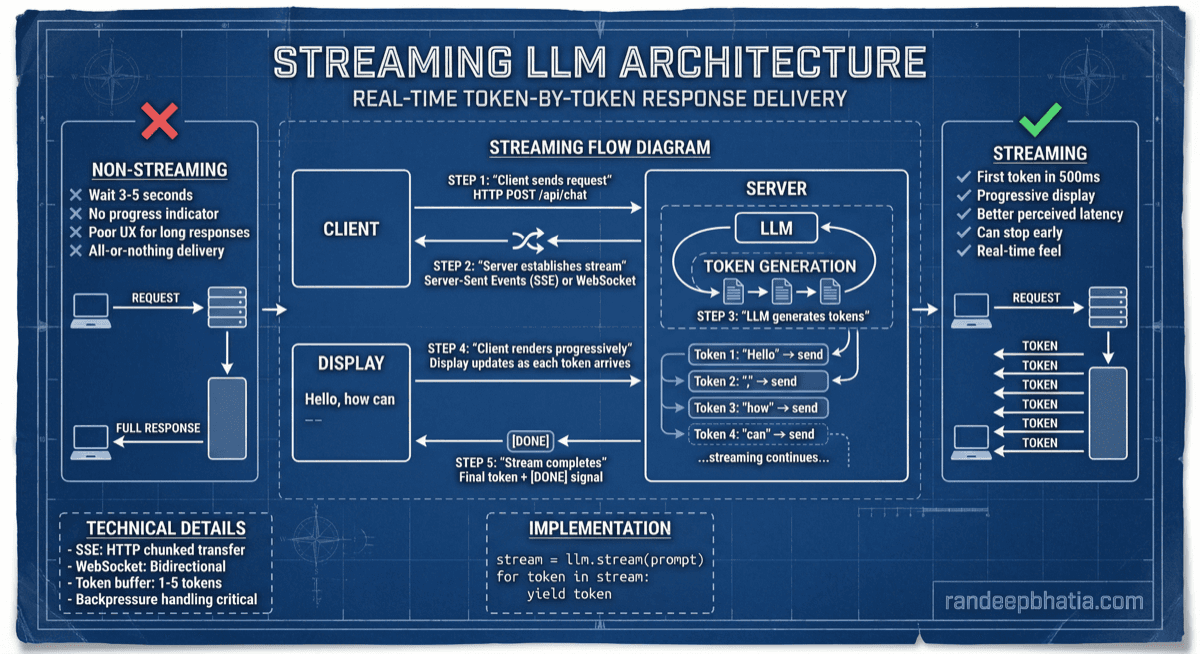
Streaming LLM Architecture is a system design pattern that delivers generated tokens incrementally to clients as they are produced, rather than waiting for complete response generation before transmission.

1

Streaming reduces perceived latency by delivering the first token in milliseconds rather than waiting seconds for complete generation, fundamentally changing user experience from waiting to progressive engagement with content.

2

The architecture requires coordinated implementation across inference servers, transport protocols (SSE, WebSocket, gRPC), and client-side rendering to maintain connection stability while handling partial responses.

3

Production streaming systems must handle backpressure, connection failures, token buffering, and graceful degradation while maintaining consistency guarantees and enabling features like stop generation and response modification.

The Bottom Line

Streaming LLM Architecture is essential for any production AI application where user experience matters, as it transforms the interaction model from synchronous request-response to progressive content delivery. Organizations implementing streaming can achieve 10-50x improvements in time-to-first-token while enabling new interaction patterns like real-time editing and early termination.

Definition

Streaming LLM Architecture refers to the end-to-end system design that enables large language models to transmit generated tokens to clients incrementally as they are produced by the autoregressive decoding process, rather than buffering the complete response before transmission.

This architecture encompasses the inference server's token emission mechanism, transport layer protocols for maintaining persistent connections, client-side parsing and rendering of partial responses, and the operational infrastructure required to manage thousands of concurrent streaming connections at scale.

Extended Definition

The streaming architecture fundamentally changes the temporal characteristics of LLM interactions by decoupling token generation from token delivery. In traditional batch inference, clients experience latency equal to the full generation time plus network round-trip, which can range from 2-30 seconds for typical responses. Streaming architectures reduce the time-to-first-token (TTFT) to 50-500 milliseconds while maintaining the same total generation time, creating a perception of immediate responsiveness. The architecture must handle the inherent tension between pushing tokens as fast as possible for user experience while managing server resources, connection stability, and the ability to implement features like content filtering, response modification, and graceful error handling mid-stream.

Etymology & Origins

The term 'streaming' in this context derives from media streaming technologies developed in the 1990s and 2000s, where audio and video content was delivered progressively rather than requiring complete download before playback. The application to LLM inference emerged around 2022-2023 as transformer-based models became widely deployed in user-facing applications, and the autoregressive nature of token generation (one token at a time) naturally aligned with streaming delivery patterns. The term 'Server-Sent Events' (SSE) comes from the HTML5 specification published in 2009, which standardized unidirectional server-to-client streaming over HTTP.

Also Known As

Token streamingIncremental inferenceProgressive response deliveryReal-time token generationChunked LLM responseLive text generationStreaming completionAsync token delivery

Not To Be Confused With

Batch inference

Batch inference processes multiple requests simultaneously for throughput optimization but still delivers complete responses, while streaming focuses on incremental delivery of individual responses regardless of batching strategy.

Continuous batching

Continuous batching is a server-side optimization that dynamically groups requests to maximize GPU utilization, which can be combined with streaming but addresses a different concern (throughput vs. latency perception).

Real-time inference

Real-time inference refers to low-latency synchronous processing with strict timing guarantees, while streaming specifically describes incremental delivery and may or may not meet real-time latency requirements.

Async inference

Async inference refers to non-blocking request patterns where clients poll or receive callbacks for results, while streaming maintains a persistent connection for continuous token delivery.

WebSocket communication

WebSocket is a bidirectional transport protocol that can be used for streaming, but streaming LLM architecture can also use SSE, gRPC streaming, or other protocols; WebSocket is one implementation option, not the architecture itself.

Long polling

Long polling is a technique where clients repeatedly request updates with extended timeouts, creating pseudo-streaming behavior, while true streaming maintains a single persistent connection with server-pushed updates.

Conceptual Foundation

Core Principles

(7 principles)

Mental Models

(6 models)

The Water Pipe Model

Think of streaming as water flowing through a pipe rather than filling a bucket and then pouring. The source (inference engine) continuously produces flow (tokens), the pipe (transport layer) carries it with some capacity limits, and the destination (client) consumes at its own rate. Backpressure occurs when consumption cannot keep up with production.

The Live Broadcast Model

Streaming LLM responses are like live television broadcasts: content is produced and transmitted simultaneously, viewers see it as it happens, there's no rewind during live transmission, and if you miss something, it's gone unless recorded. The broadcast continues regardless of individual viewer issues.

The Assembly Line Model

Token generation and delivery form an assembly line where each station (generation, encoding, transmission, parsing, rendering) processes items sequentially. The line's throughput is limited by its slowest station, and work-in-progress accumulates before bottlenecks.

The Conversation Model

Streaming creates a pseudo-conversational dynamic where the LLM 'speaks' word by word and the user 'listens' in real-time. This is fundamentally different from receiving a complete written response, changing user expectations and interaction patterns.

The Checkpoint Model

Think of the token stream as having implicit checkpoints: positions where the response could be safely truncated, where errors could be recovered, or where content filtering could intervene. Not all positions are equal for these operations.

The Multiplexing Model

A streaming server manages many concurrent streams like a telephone switchboard, routing tokens from multiple inference processes to multiple clients. Each stream is independent but shares server resources, and congestion on one stream can affect others.

Key Insights

(10 insights)

Time-to-first-token (TTFT) has a disproportionate impact on perceived performance compared to total generation time; users perceive 100ms TTFT with 10s total time as faster than 2s TTFT with 8s total time.

Streaming does not reduce total generation time or computational cost—it only changes when tokens are delivered. The same GPU cycles are consumed whether streaming or batching.

The optimal token emission rate is not 'as fast as possible' but rather matched to human reading speed (200-300 words per minute) for chat interfaces, as faster delivery provides no UX benefit and wastes transport resources.

Connection stability becomes a critical reliability concern with streaming because a dropped connection mid-response requires either response reconstruction or regeneration, both of which have significant costs.

Streaming fundamentally changes error handling semantics: errors can occur mid-response, requiring decisions about whether to deliver partial responses, retry from checkpoints, or fail completely.

Content filtering and safety systems must operate on partial responses in streaming mode, which is significantly more complex than filtering complete responses and may require speculative execution.

The choice between SSE and WebSocket has operational implications beyond technical capabilities: SSE works through more proxies and load balancers, while WebSocket provides bidirectional communication for features like stop generation.

Streaming creates new cost optimization opportunities through early termination—users can stop generation when they have sufficient information, saving compute that would be wasted on unwanted continuation.

Client-side token buffering is often necessary for smooth rendering, as network jitter causes uneven token arrival that would create jarring visual effects if rendered immediately.

Streaming architectures must handle the 'slow client' problem where clients cannot consume tokens as fast as they're generated, requiring either server-side buffering (memory cost) or client disconnection (poor UX).

When to Use

Ideal Scenarios

(12)

Interactive chat applications where users expect immediate feedback and will read responses as they appear, making perceived latency critical to user satisfaction and engagement.

Code generation tools where developers can begin reviewing and understanding generated code before completion, enabling early detection of incorrect approaches and time savings through early termination.

Content creation applications including writing assistants, email drafters, and document generators where users benefit from seeing the creative direction early and can guide or stop generation.

Customer service chatbots where response time perception directly impacts customer satisfaction scores and where streaming creates a more natural conversational feel.

Real-time translation or transcription services where the value of output is time-sensitive and users need information as quickly as possible.

Educational applications where step-by-step explanations benefit from progressive reveal, allowing students to follow along with reasoning as it develops.

Search and research assistants where users can begin evaluating relevance of results before complete generation, enabling faster iteration on queries.

Creative writing tools where authors want to see narrative development in real-time and may want to intervene or redirect the story mid-generation.

API services where downstream systems can begin processing partial responses, enabling pipelining of multi-stage workflows.

Mobile applications where network conditions are variable and streaming provides better degradation characteristics than all-or-nothing batch responses.

Voice-enabled interfaces where text-to-speech can begin on partial responses, reducing the silence gap between user query and audible response.

Collaborative editing tools where multiple users benefit from seeing AI suggestions appear progressively rather than as sudden complete insertions.

Prerequisites

(8)
1

Client infrastructure capable of handling streaming protocols (SSE, WebSocket, or gRPC streaming) including proper connection management and partial response parsing.

2

Network infrastructure (load balancers, proxies, CDNs) configured to support long-lived connections without premature timeout or buffering that defeats streaming benefits.

3

Inference infrastructure that supports token-by-token emission rather than only batch response generation, which may require specific model serving frameworks.

4

Application architecture designed for progressive rendering that can meaningfully display and utilize partial responses rather than requiring complete data.

5

Error handling strategies for partial response scenarios including user communication about incomplete responses and recovery mechanisms.

6

Monitoring and observability systems capable of tracking streaming-specific metrics including connection duration, token rates, and partial completion states.

7

Capacity planning that accounts for the increased connection concurrency and longer connection durations inherent in streaming workloads.

8

Security infrastructure that can handle authentication and authorization for long-lived connections, including token refresh and session management.

Signals You Need This

(10)

Users complain about slow response times even when total generation time is reasonable, indicating perceived latency is the issue rather than actual computation time.

Analytics show high abandonment rates during the waiting period between request submission and response display.

Competitive products offer streaming and users explicitly request or expect similar real-time feedback in your application.

User research indicates that the 'waiting' experience is a significant pain point affecting satisfaction and engagement metrics.

Your application involves long-form generation (multiple paragraphs, full documents, extensive code) where batch response times exceed 5-10 seconds.

Users frequently need to regenerate responses because they only discover problems after seeing the complete output, suggesting early visibility would save time.

Your use case involves time-sensitive information where even seconds of delay reduce the value of the response.

You're building conversational interfaces where natural dialogue flow requires responses to appear progressively like human typing.

Cost optimization is a priority and you want to enable users to stop generation early when they have sufficient information.

Your application serves mobile users or users in regions with high-latency networks where streaming provides better perceived performance.

Organizational Readiness

(7)

Engineering team has experience with asynchronous programming patterns, event-driven architectures, and handling streaming data in production systems.

DevOps capabilities include managing WebSocket or SSE connections at scale, including load balancer configuration, connection draining, and graceful deployment strategies.

Frontend development resources can implement streaming UI patterns including progressive rendering, loading states, and handling partial response errors gracefully.

QA processes can test streaming scenarios including connection interruption, slow networks, and partial response handling, which require different testing approaches than batch APIs.

Monitoring infrastructure can capture and visualize streaming-specific metrics, and on-call teams understand how to diagnose streaming-related incidents.

Product team understands the UX implications of streaming and can design interfaces that leverage progressive display rather than treating it as a technical detail.

Security team has evaluated the implications of long-lived connections for authentication, session management, and potential denial-of-service vectors.

When NOT to Use

Anti-Patterns

(12)

Batch processing pipelines where responses are stored for later use and no human is waiting for real-time display, as streaming adds complexity without benefit.

Applications where complete responses are required before any action can be taken, such as structured data extraction that needs full JSON before parsing.

High-throughput backend services where maximizing requests per second is more important than individual request latency, as streaming reduces batching efficiency.

Environments with infrastructure that cannot support persistent connections, such as serverless functions with short timeouts or proxies that buffer responses.

Use cases requiring response validation or transformation before delivery, where streaming would expose unvalidated content to users.

Applications where response length is very short (single sentences, classifications) and streaming overhead exceeds the latency benefit.

Scenarios requiring transactional semantics where partial delivery is worse than no delivery, such as financial transactions or critical notifications.

Systems where clients are other machines that will batch-process responses anyway, adding streaming complexity without end-user benefit.

Applications with strict content filtering requirements that cannot be reliably applied to partial responses without significant false positive rates.

Legacy integration scenarios where downstream systems expect complete responses and cannot be modified to handle streaming.

Cost-sensitive deployments where the infrastructure overhead of maintaining persistent connections exceeds the value of improved perceived latency.

Regulatory environments where complete audit trails of responses are required and partial response logging creates compliance complexity.

Red Flags

(10)

Infrastructure team expresses concerns about supporting long-lived connections at your expected scale, indicating potential reliability issues.

Load balancers or proxies in your stack are known to have issues with WebSocket or SSE connections, requiring significant infrastructure changes.

Your application already has acceptable latency with batch responses and users have not indicated dissatisfaction with response times.

The primary use case involves programmatic API consumption where streaming provides no benefit to the consuming system.

Security requirements mandate complete response scanning before delivery, which is incompatible with streaming's incremental nature.

Your deployment environment has connection duration limits (e.g., 30-second Lambda timeouts) that would truncate typical streaming responses.

Network conditions for your user base are extremely unreliable, making connection stability a larger concern than initial latency.

Your team lacks experience with streaming protocols and the project timeline doesn't allow for learning curve and debugging time.

Existing monitoring and alerting infrastructure cannot be extended to handle streaming metrics without significant investment.

The application requires response modification or personalization that depends on complete response content.

Better Alternatives

(8)
1
When:

Backend data processing pipelines that store LLM outputs for later use

Use Instead:

Batch inference with async job queues

Why:

Streaming provides no benefit when no user is waiting for real-time display, and batch processing allows for better throughput optimization and simpler error handling.

2
When:

Applications requiring complete structured output (JSON, XML) before processing

Use Instead:

Batch inference with response validation

Why:

Partial JSON is not parseable, so streaming would only show unusable fragments until completion. Batch mode allows validation before delivery.

3
When:

Very short responses (classifications, yes/no, single values)

Use Instead:

Standard HTTP request-response

Why:

The overhead of establishing streaming connections exceeds the latency benefit when responses complete in under 500ms anyway.

4
When:

Serverless environments with strict timeout limits

Use Instead:

Async inference with polling or webhooks

Why:

Streaming connections that exceed function timeouts will be terminated mid-response. Async patterns handle long-running generation gracefully.

5
When:

High-throughput API services prioritizing requests per second

Use Instead:

Batch inference with continuous batching

Why:

Streaming reduces batching efficiency and increases per-request overhead. Throughput-optimized services benefit from batch-oriented architectures.

6
When:

Applications with mandatory complete-response content filtering

Use Instead:

Batch inference with post-generation filtering

Why:

Content filtering on partial responses has higher false positive rates and may expose problematic content before filters can act.

7
When:

Integration with legacy systems expecting complete responses

Use Instead:

Adapter pattern with internal streaming, external batching

Why:

Maintain streaming benefits internally while presenting batch interface to systems that cannot be modified.

8
When:

Mobile applications with extremely unreliable network conditions

Use Instead:

Optimistic UI with background generation and local caching

Why:

Streaming over unreliable connections creates poor UX with frequent interruptions. Background generation with notification provides more reliable experience.

Common Mistakes

(10)

Implementing streaming without corresponding UI changes, resulting in jarring character-by-character display instead of smooth word or phrase rendering.

Failing to implement backpressure handling, causing server memory exhaustion when clients cannot consume tokens fast enough.

Using streaming for all API endpoints regardless of use case, adding complexity to simple queries that don't benefit from incremental delivery.

Neglecting connection timeout configuration in load balancers and proxies, causing streams to be terminated before completion.

Not implementing reconnection logic, leaving users with incomplete responses when connections drop without clear error indication.

Streaming raw tokens without buffering, exposing users to partial words, broken markdown, or incomplete code blocks.

Failing to handle the 'stop generation' user action, continuing to consume compute resources for unwanted output.

Not accounting for streaming in capacity planning, underestimating the connection concurrency requirements compared to batch workloads.

Implementing streaming without corresponding monitoring, making it impossible to diagnose connection issues or measure streaming-specific metrics.

Assuming streaming reduces total latency rather than just time-to-first-token, leading to incorrect performance expectations and optimization efforts.

Core Taxonomy

Primary Types

(7 types)

Unidirectional streaming over HTTP where the server pushes events to the client through a persistent connection. The client initiates a standard HTTP request and the server responds with a text/event-stream content type, sending events as they occur.

Characteristics
  • HTTP-based, works through most proxies and firewalls
  • Unidirectional server-to-client communication
  • Automatic reconnection built into browser implementations
  • Text-based protocol with simple event format
  • Limited to text data (binary requires encoding)
Use Cases
Web-based chat interfacesBrowser-based AI assistantsApplications requiring proxy/firewall compatibilitySimple streaming implementations without bidirectional needs
Tradeoffs

SSE offers excellent compatibility and simplicity but lacks bidirectional communication, requiring separate requests for user actions like stop generation. The text-based format adds overhead for high-frequency token delivery.

Classification Dimensions

Token Granularity

The unit of delivery in the stream, ranging from individual tokens to larger semantic units. Finer granularity provides faster perceived response but higher overhead.

Single token streamingToken batch streamingWord-level streamingSentence-level streamingSemantic chunk streaming

Connection Multiplicity

How streams map to network connections, affecting resource utilization, failure isolation, and scalability characteristics.

Single-stream single-connectionMulti-stream single-connectionSingle-stream multi-connectionDistributed multi-stream

State Management

Where stream state (position, context, metadata) is maintained, affecting reconnection capability, scalability, and failure recovery.

Stateless streamingServer-side stateClient-side stateDistributed state

Delivery Guarantee

The reliability guarantees provided by the streaming system, with stronger guarantees requiring more complex implementation and typically higher latency.

Best-effort deliveryAt-least-once deliveryExactly-once deliveryOrdered delivery

Flow Control Strategy

How the rate of token delivery is controlled, affecting backpressure handling, buffer requirements, and client-server coupling.

Push-based (server-controlled)Pull-based (client-controlled)Hybrid push-pullCredit-based flow control

Error Handling Mode

How errors during streaming are handled, from immediate termination to sophisticated recovery mechanisms.

Fail-fast streamingGraceful degradationCheckpoint recoveryFull regeneration

Evolutionary Stages

1

Basic Streaming

Initial implementation, 1-2 weeks of development

Simple token-by-token delivery over SSE or WebSocket with minimal error handling. Connections are treated as ephemeral, and failures result in incomplete responses requiring full regeneration.

2

Production Streaming

3-6 months after initial deployment

Robust connection management with reconnection logic, proper backpressure handling, monitoring integration, and graceful error handling. Supports basic features like stop generation.

3

Advanced Streaming

6-12 months of production operation

Sophisticated features including checkpoint-based recovery, content filtering on partial responses, adaptive rate control, and multi-region failover. Streaming-aware caching and response modification.

4

Enterprise Streaming

12-24 months with enterprise requirements

Full observability with streaming-specific SLOs, compliance-ready audit logging, sophisticated load balancing across streaming connections, and integration with enterprise security infrastructure.

5

Platform Streaming

24+ months for platform maturity

Streaming as a platform capability supporting multiple use cases, with self-service configuration, multi-tenant isolation, and advanced features like response branching and speculative streaming.

Architecture Patterns

Architecture Patterns

(7 patterns)

Direct Streaming Pattern

The simplest architecture where clients connect directly to inference servers that emit tokens as they are generated. Each inference server handles both generation and streaming delivery.

Components
  • Client application with streaming support
  • Load balancer with sticky sessions
  • Inference server with integrated streaming
  • GPU cluster for model execution
Data Flow

Client establishes connection through load balancer to inference server. Server loads model context, begins generation, and emits tokens directly to client as produced. Connection terminates on completion or error.

Best For
  • Simple deployments with moderate scale
  • Low-latency requirements
  • Homogeneous inference workloads
  • Teams with limited infrastructure complexity tolerance
Limitations
  • Tight coupling between inference and delivery
  • Server failure loses in-flight streams
  • Difficult to implement cross-server features
  • Connection capacity limits scaling
Scaling Characteristics

Scales horizontally by adding inference servers. Load balancer must support sticky sessions for connection duration. Scaling limited by per-server connection capacity and GPU availability.

Integration Points

Load Balancer

Distributes incoming streaming connections across inference servers while maintaining connection affinity for the duration of the stream.

Interfaces:
HTTP/1.1 with Connection: keep-aliveHTTP/2 with stream multiplexingWebSocket upgrade handlingHealth check endpoints

Must support long-lived connections without timeout, sticky sessions or consistent hashing for connection routing, and graceful connection draining during deployments. Connection limits per backend must be configured appropriately.

Inference Server

Executes model inference and emits tokens as they are generated, providing the source of the token stream.

Interfaces:
Token emission callback/iteratorGeneration control (stop, pause)Context management APIHealth and metrics endpoints

Must support token-by-token emission rather than batch-only generation. Should provide generation metadata (token probabilities, timing) for advanced features. Memory management for concurrent generations is critical.

API Gateway

Handles authentication, rate limiting, request validation, and protocol translation for streaming requests.

Interfaces:
Client-facing streaming protocolsBackend inference protocolsAuthentication/authorization APIsRate limiting state store

Must pass through streaming responses without buffering. Rate limiting must account for streaming duration, not just request count. Authentication tokens may need refresh during long streams.

Observability Stack

Collects, stores, and visualizes streaming-specific metrics, traces, and logs for monitoring and debugging.

Interfaces:
Metrics emission (Prometheus, StatsD)Distributed tracing (OpenTelemetry)Structured loggingAlerting webhooks

Must handle high-cardinality metrics from many concurrent streams. Trace spans must represent streaming duration accurately. Log volume from token-level events requires sampling or aggregation.

Content Safety System

Filters or flags potentially harmful content in the token stream before delivery to clients.

Interfaces:
Token/chunk classification APIPolicy configurationOverride/appeal workflowAudit logging

Must operate on partial content with acceptable latency. False positive handling is complex mid-stream. May require buffering to evaluate multi-token patterns. Should not block streaming for low-confidence detections.

Caching Layer

Stores and serves previously generated responses for identical or similar requests, reducing inference load.

Interfaces:
Cache lookup by request hashStreaming cache populationCache invalidationPartial match/prefix cache

Streaming complicates caching as responses are generated incrementally. Prefix caching can serve initial tokens while generating remainder. Cache key design must balance hit rate with storage.

Client SDK

Provides application developers with a clean interface for consuming streaming responses, handling protocol details internally.

Interfaces:
Async iterator/stream interfaceEvent callbacks (token, error, complete)Connection managementRetry configuration

Must handle reconnection transparently when possible. Should provide both low-level token access and high-level text accumulation. Error handling must distinguish recoverable from fatal errors.

State Store

Maintains stream state for recovery, multi-server scenarios, and features requiring state persistence.

Interfaces:
Stream state read/writeCheckpoint storageTTL-based expirationDistributed locking

Must provide low-latency access for real-time streaming. State size grows with stream length. Cleanup of abandoned streams is necessary. Consider Redis, DynamoDB, or similar for this role.

Decision Framework

✓ If Yes

Streaming likely beneficial - proceed to evaluate implementation options

✗ If No

Batch inference is probably sufficient - streaming adds unnecessary complexity

Considerations

Consider indirect human impact - even if immediate consumer is a system, does it feed a human-facing interface?

Technical Deep Dive

Overview

Streaming LLM architecture operates by intercepting the token generation process at the inference engine level and immediately transmitting each token (or small batch of tokens) to the client through a persistent connection. The fundamental mechanism leverages the autoregressive nature of transformer-based language models, which generate text one token at a time by repeatedly predicting the next token given all previous tokens. The inference server maintains a generation loop that produces tokens sequentially. In batch mode, this loop runs to completion before returning the full response. In streaming mode, each iteration of the loop triggers a callback or emits an event that pushes the newly generated token to a transport layer. The transport layer maintains an open connection to the client and serializes tokens into the appropriate protocol format (SSE events, WebSocket frames, or gRPC messages). The client receives these incremental updates and progressively builds the complete response, typically rendering each token or group of tokens as they arrive. This creates the characteristic 'typing' effect where text appears progressively rather than all at once. The client must handle connection management, including detecting disconnections, implementing reconnection logic, and managing partial response state. The architecture must also handle the completion of generation, signaling to the client that the stream has ended normally. This is distinct from error conditions or client-initiated termination, and the protocol must clearly distinguish these cases to enable appropriate client behavior.

Step-by-Step Process

Client sends HTTP request with appropriate headers indicating streaming capability (Accept: text/event-stream for SSE, Upgrade: websocket for WebSocket, or gRPC streaming call). Request includes prompt, generation parameters, and any authentication credentials.

⚠️ Pitfalls to Avoid

Forgetting to set correct headers results in batch response. Some proxies strip or modify headers. Authentication tokens may have short expiry that doesn't account for stream duration.

Under The Hood

At the inference engine level, streaming requires modifications to the standard generation loop. Most inference frameworks (vLLM, TensorRT-LLM, Hugging Face Transformers) provide callback mechanisms or async iterators that yield tokens as they're generated. The key is that the generation loop doesn't block on I/O—tokens are handed off to a separate thread or async task for transmission while generation continues. The KV cache plays a crucial role in streaming performance. As tokens are generated, their key-value pairs are cached to avoid recomputation on subsequent tokens. This cache grows linearly with sequence length and must be managed carefully in concurrent streaming scenarios. Some systems implement paged attention or other memory optimization techniques to handle many concurrent streams efficiently. At the transport layer, the choice of protocol affects both implementation complexity and performance characteristics. SSE uses a simple text-based format where each event is a set of field: value lines separated by blank lines. The 'data' field contains the payload, and optional 'event' and 'id' fields enable event typing and resumption. WebSocket uses a binary framing protocol with opcodes for text, binary, ping/pong, and close frames. The framing overhead is lower than SSE for high-frequency small messages. Backpressure handling is critical for production systems. When clients can't consume tokens fast enough, the server must either buffer (risking memory exhaustion), drop tokens (losing data), or slow generation (wasting GPU cycles). Sophisticated systems implement credit-based flow control where clients signal their consumption capacity. HTTP/2 and gRPC have built-in flow control at the stream level. Connection management in streaming architectures must handle various failure modes: client disconnection (detected via failed writes or heartbeat timeout), server shutdown (requiring graceful drain of active streams), network interruption (potentially recoverable with reconnection), and resource exhaustion (requiring load shedding). Each failure mode requires specific handling to maintain system stability and provide appropriate user feedback. For multi-tenant systems, isolation between streams is important. One slow or misbehaving client should not affect other streams. This requires per-stream resource limits, separate buffers, and potentially separate threads or processes. The inference engine itself may need tenant-aware scheduling to prevent one tenant's long generations from blocking others.

Failure Modes

Root Cause

Server process termination due to OOM, segfault, or infrastructure failure during active generation.

Symptoms
  • Client connection closes unexpectedly
  • Partial response received without completion signal
  • Server metrics show sudden drop in active connections
  • Error logs show process termination
Impact

Users receive incomplete responses. Without recovery mechanism, entire response is lost. Poor user experience and potential data loss if response was being used for important task.

Prevention

Implement memory limits per stream, monitor memory pressure, use process isolation, implement graceful degradation under load.

Mitigation

Checkpoint stream state periodically, implement client-side reconnection with position tracking, provide clear error indication to users, offer regeneration option.

Operational Considerations

Key Metrics (15)

Median time from request receipt to first token delivery, measuring the primary user-perceived latency.

Normal100-500ms depending on model size and prompt length
Alert>1s for p50, >3s for p99
ResponseInvestigate inference server load, model loading times, and queue depth. Check for cold start issues.

Dashboard Panels

Real-time TTFT distribution (histogram with p50, p95, p99 lines)Active streams over time (line chart with capacity threshold)Token throughput (tokens/second aggregate and per-server)Stream completion funnel (started → streaming → completed/failed)Error rate by type (connection, timeout, server, client)GPU memory utilization per server (gauge with threshold)Geographic distribution of active streams (map visualization)Stream duration distribution (histogram)Backpressure events over time (event timeline)Top errors by frequency (table with error details)

Alerting Strategy

Implement tiered alerting with different severity levels. P1 alerts for complete streaming failure or >50% error rate requiring immediate response. P2 alerts for degraded performance (high TTFT, low completion rate) requiring response within 30 minutes. P3 alerts for concerning trends (increasing errors, approaching capacity) for next business day review. Use anomaly detection for metrics with variable baselines. Implement alert correlation to avoid alert storms during cascading failures.

Cost Analysis

Cost Drivers

(10)

GPU compute time

Impact:

Primary cost driver. Streaming doesn't change total compute but enables early termination savings. Cost scales with token count and model size.

Optimization:

Implement early termination, use efficient models, optimize batch sizes for concurrent streams, consider spot/preemptible instances for non-critical workloads.

Connection infrastructure

Impact:

Load balancers, proxies, and connection management infrastructure scale with concurrent connections, not requests. Streaming increases connection duration.

Optimization:

Right-size connection limits, use efficient connection handling (epoll/kqueue), consider connection multiplexing, optimize timeout settings.

Memory for KV cache

Impact:

GPU memory for KV cache limits concurrent streams per GPU. More memory enables more streams without additional GPUs.

Optimization:

Use paged attention, implement KV cache compression, optimize context lengths, consider memory-optimized GPU instances.

Network egress

Impact:

Token-by-token delivery has higher overhead than batch. Metadata per token adds to egress volume.

Optimization:

Batch tokens where acceptable, minimize metadata, use efficient encoding, consider regional deployment to reduce cross-region egress.

State store operations

Impact:

Checkpoint storage and retrieval for recovery capability. Scales with stream count and checkpoint frequency.

Optimization:

Reduce checkpoint frequency, use efficient state encoding, implement TTL-based cleanup, consider stateless mode where recovery not needed.

Observability overhead

Impact:

Per-token metrics and logging can generate significant volume. Tracing long-running streams adds storage costs.

Optimization:

Sample metrics and logs, aggregate before storage, use appropriate retention periods, implement smart sampling for traces.

Edge infrastructure

Impact:

Edge deployment for latency reduction adds significant infrastructure cost across multiple locations.

Optimization:

Deploy edge only where latency benefit justifies cost, use CDN providers with streaming support, implement regional routing.

Redundancy and failover

Impact:

High availability for streaming requires redundant infrastructure that may be underutilized during normal operation.

Optimization:

Use active-active where possible, implement graceful degradation to reduce redundancy needs, consider managed services.

Development and operations

Impact:

Streaming adds complexity requiring specialized skills for development, debugging, and operations.

Optimization:

Use managed streaming services where available, invest in tooling and automation, build team expertise.

Content filtering compute

Impact:

Real-time content filtering on token streams requires additional compute that scales with token throughput.

Optimization:

Optimize filter models, use sampling-based filtering, implement tiered filtering based on risk.

Cost Models

Per-token cost model

cost = (input_tokens × input_price) + (output_tokens × output_price) + (stream_duration × connection_cost_per_second)
Variables:
input_tokens: number of prompt tokensoutput_tokens: number of generated tokensinput_price: cost per input token (typically $0.001-0.01 per 1K)output_price: cost per output token (typically $0.002-0.03 per 1K)stream_duration: time from start to completionconnection_cost_per_second: infrastructure cost per connection-second
Example:

1000 input tokens at $0.003/1K + 500 output tokens at $0.006/1K + 10 seconds at $0.0001/second = $0.003 + $0.003 + $0.001 = $0.007 per request

Infrastructure capacity cost model

monthly_cost = (gpu_instances × gpu_price) + (connection_capacity × lb_price) + (egress_gb × egress_price) + (state_store_gb × storage_price)
Variables:
gpu_instances: number of GPU instances for inferencegpu_price: monthly cost per GPU instanceconnection_capacity: maximum concurrent connections provisionedlb_price: load balancer cost per connection capacityegress_gb: monthly network egress in GBegress_price: cost per GB egressstate_store_gb: state storage capacitystorage_price: cost per GB storage
Example:

4 A100 instances at $3000/month + 10K connection capacity at $500/month + 1000GB egress at $0.05/GB + 100GB state at $0.10/GB = $12,000 + $500 + $50 + $10 = $12,560/month

Early termination savings model

savings = avg_termination_rate × avg_tokens_saved × output_token_price × monthly_requests
Variables:
avg_termination_rate: percentage of streams terminated earlyavg_tokens_saved: average tokens not generated due to early terminationoutput_token_price: cost per output tokenmonthly_requests: total monthly streaming requests
Example:

20% termination rate × 200 tokens saved × $0.006/1K tokens × 1M requests = 0.20 × 200 × 0.000006 × 1,000,000 = $240/month savings

Streaming vs batch comparison model

streaming_premium = (streaming_infra_cost - batch_infra_cost) / total_requests
Variables:
streaming_infra_cost: total infrastructure cost for streamingbatch_infra_cost: equivalent batch infrastructure costtotal_requests: monthly request volume
Example:

Streaming infrastructure $15,000/month vs batch $10,000/month for 1M requests = $5,000 / 1,000,000 = $0.005 premium per request for streaming capability

Optimization Strategies

  • 1Implement early termination UI to allow users to stop generation when satisfied, saving 20-40% of compute for interactive use cases
  • 2Use response caching for common queries, serving cached responses as simulated streams to reduce inference cost
  • 3Implement tiered service levels with streaming for premium users and batch for cost-sensitive use cases
  • 4Optimize model selection based on query complexity, using smaller models for simple queries
  • 5Implement request queuing during peak times to smooth load and reduce over-provisioning
  • 6Use spot/preemptible instances for non-critical streaming workloads with graceful degradation
  • 7Batch tokens for transmission (2-5 tokens) to reduce per-token overhead while maintaining streaming feel
  • 8Implement connection pooling and reuse to reduce connection establishment overhead
  • 9Use regional deployment to reduce cross-region network costs for geographically concentrated users
  • 10Implement smart sampling for observability to reduce logging and metrics costs
  • 11Optimize KV cache management to maximize streams per GPU
  • 12Consider hybrid architectures that route appropriate requests to batch processing

Hidden Costs

  • 💰Increased debugging complexity requiring more senior engineering time
  • 💰Client SDK development and maintenance across multiple platforms
  • 💰Training and documentation for teams unfamiliar with streaming patterns
  • 💰Increased testing complexity for streaming scenarios
  • 💰Higher monitoring and alerting infrastructure costs
  • 💰Incident response complexity for streaming-specific failures
  • 💰Technical debt from streaming-specific code paths
  • 💰Vendor lock-in to streaming-capable infrastructure

ROI Considerations

The ROI of streaming LLM architecture depends heavily on the use case and user expectations. For consumer-facing chat applications, streaming is often table stakes—users expect it based on experiences with ChatGPT and similar products. The ROI here is measured in user satisfaction, engagement, and retention rather than direct cost savings. For enterprise applications, ROI calculation should consider: (1) productivity gains from faster perceived response times, (2) cost savings from early termination, (3) reduced support costs from better user experience, and (4) competitive differentiation. A typical enterprise deployment might see 15-25% improvement in user task completion rates due to better perceived performance. The break-even point for streaming infrastructure investment typically occurs at moderate scale (10K+ daily active users) where the UX benefits justify the infrastructure complexity. For smaller deployments, managed streaming services or simpler implementations may provide better ROI than building sophisticated streaming infrastructure. Consider also the opportunity cost of not implementing streaming—if competitors offer streaming and you don't, the cost may be measured in lost users rather than infrastructure savings.

Security Considerations

Threat Model

(10 threats)
1

Connection hijacking

Attack Vector

Attacker intercepts or takes over an established streaming connection to receive sensitive response data or inject malicious content.

Impact

Data breach of response content, potential injection of malicious content into user's view, session compromise.

Mitigation

Use TLS for all streaming connections, implement connection-level authentication, validate connection state server-side, use secure WebSocket (wss://).

2

Denial of service via connection exhaustion

Attack Vector

Attacker opens many streaming connections without sending requests or consuming tokens, exhausting server connection capacity.

Impact

Legitimate users cannot establish connections, service unavailability, resource exhaustion.

Mitigation

Implement connection limits per IP/user, require authentication before resource allocation, timeout idle connections aggressively, use connection rate limiting.

3

Prompt injection via streaming context

Attack Vector

Attacker crafts input that causes the model to generate harmful content that bypasses streaming content filters.

Impact

Harmful content delivered to users, reputation damage, potential legal liability.

Mitigation

Implement robust input validation, use streaming-aware content filtering, maintain context awareness in filters, implement output monitoring.

4

Token theft via response interception

Attack Vector

Attacker intercepts streaming responses to extract sensitive information being generated (PII, credentials, proprietary data).

Impact

Data breach, privacy violations, exposure of sensitive business information.

Mitigation

Enforce TLS, implement end-to-end encryption for sensitive content, minimize sensitive data in responses, audit response content.

5

Resource exhaustion via long-running streams

Attack Vector

Attacker initiates streams with prompts designed to generate extremely long responses, consuming GPU and memory resources.

Impact

Resource starvation for legitimate users, increased costs, potential service degradation.

Mitigation

Implement maximum token limits, timeout long-running generations, implement per-user resource quotas, monitor for anomalous generation patterns.

6

Authentication bypass via connection reuse

Attack Vector

Attacker exploits connection reuse or session handling flaws to access streams belonging to other users.

Impact

Unauthorized access to other users' responses, privacy breach, potential account compromise.

Mitigation

Implement per-stream authentication, validate user context on each operation, use secure session management, audit connection-user binding.

7

Information leakage via timing analysis

Attack Vector

Attacker analyzes token timing patterns to infer information about response content or system state.

Impact

Partial information disclosure, potential inference of sensitive content characteristics.

Mitigation

Add timing jitter to token delivery, normalize token batching, avoid content-dependent timing variations.

8

Man-in-the-middle on streaming connection

Attack Vector

Attacker positions between client and server to intercept, modify, or inject tokens in the stream.

Impact

Data interception, response manipulation, potential injection of malicious content.

Mitigation

Enforce TLS with certificate validation, implement certificate pinning for mobile apps, use integrity checks on token streams.

9

Replay attacks on streaming requests

Attack Vector

Attacker captures and replays streaming requests to generate duplicate responses or exhaust resources.

Impact

Resource consumption, potential duplicate actions if responses trigger side effects.

Mitigation

Implement request nonces, timestamp validation, idempotency keys for requests with side effects.

10

Cross-site WebSocket hijacking

Attack Vector

Malicious website initiates WebSocket connection to streaming endpoint using victim's credentials via CSRF.

Impact

Unauthorized access to streaming API, potential data exfiltration, resource consumption.

Mitigation

Validate Origin header, implement CSRF tokens, use SameSite cookies, require explicit authentication for WebSocket upgrade.

Security Best Practices

  • Enforce TLS 1.3 for all streaming connections with strong cipher suites
  • Implement authentication at connection establishment, not just request level
  • Use short-lived tokens with refresh capability for long-running streams
  • Validate and sanitize all input before passing to inference engine
  • Implement streaming-aware content filtering that operates on partial responses
  • Set maximum token limits to prevent resource exhaustion attacks
  • Implement per-user and per-IP rate limiting for connection establishment
  • Log all connection events with sufficient detail for security analysis
  • Implement connection timeout for idle streams to prevent resource holding
  • Use secure random generation for stream IDs and session tokens
  • Validate Origin header for WebSocket connections to prevent CSRF
  • Implement integrity checking for token streams where tampering is a concern
  • Audit streaming access patterns for anomaly detection
  • Implement graceful handling of malformed streaming requests
  • Regularly rotate credentials and certificates used for streaming infrastructure

Data Protection

  • 🔒Encrypt all streaming data in transit using TLS 1.3
  • 🔒Implement field-level encryption for sensitive data within streams where required
  • 🔒Minimize retention of streaming logs containing user data
  • 🔒Implement data classification to identify sensitive content in streams
  • 🔒Use tokenization or masking for sensitive data that must appear in streams
  • 🔒Implement access controls for streaming logs and stored stream data
  • 🔒Ensure streaming infrastructure is included in data protection impact assessments
  • 🔒Implement secure deletion for streaming data when retention period expires
  • 🔒Use separate streaming infrastructure for different data classification levels
  • 🔒Implement data loss prevention (DLP) scanning on streaming content where required

Compliance Implications

GDPR

Requirement:

Personal data in streaming responses must be protected, and users must be able to exercise data rights including deletion.

Implementation:

Implement data classification for streaming content, ensure streaming logs are included in data subject requests, implement right to be forgotten for stored stream data.

HIPAA

Requirement:

Protected health information (PHI) in streaming responses requires encryption in transit and access controls.

Implementation:

Enforce TLS for all PHI-containing streams, implement audit logging for healthcare streaming access, ensure BAA coverage for streaming infrastructure.

SOC 2

Requirement:

Streaming infrastructure must meet security, availability, and confidentiality trust service criteria.

Implementation:

Document streaming security controls, implement monitoring and alerting, maintain streaming infrastructure in SOC 2 scope, conduct regular assessments.

PCI DSS

Requirement:

Payment card data must not appear in streaming responses, or streaming must meet PCI DSS requirements.

Implementation:

Implement content filtering to prevent card data in responses, or ensure streaming infrastructure is PCI compliant, segment payment-related streaming.

CCPA

Requirement:

California consumers have rights regarding personal information in streaming responses.

Implementation:

Include streaming data in privacy disclosures, implement opt-out mechanisms, ensure streaming logs support data access requests.

AI Act (EU)

Requirement:

High-risk AI systems including certain LLM applications must meet transparency and documentation requirements.

Implementation:

Document streaming system capabilities and limitations, implement human oversight mechanisms, maintain records of streaming interactions for high-risk use cases.

FedRAMP

Requirement:

Federal systems using streaming must meet FedRAMP security requirements.

Implementation:

Deploy streaming infrastructure in FedRAMP-authorized environments, implement required security controls, maintain continuous monitoring.

FINRA

Requirement:

Financial industry streaming communications may be subject to record-keeping requirements.

Implementation:

Implement comprehensive logging of streaming interactions, ensure retention meets regulatory requirements, implement supervision capabilities.

Scaling Guide

Scaling Dimensions

Concurrent connections

Strategy:

Horizontal scaling of connection-handling tier (load balancers, streaming servers) with connection-aware load balancing. Use connection pooling and efficient event loops (epoll/kqueue).

Limits:

Single server typically handles 10K-100K connections depending on hardware and connection activity. Load balancer limits vary by provider (often 100K-1M).

Considerations:

Connection count scales with active users × average stream duration. Plan for peak concurrent users, not average. Connection draining during deployments requires careful orchestration.

Token throughput

Strategy:

Scale inference GPU capacity horizontally. Use continuous batching to maximize GPU utilization. Implement request routing based on GPU availability.

Limits:

Per-GPU throughput depends on model size and batch efficiency. Typical range: 1K-10K tokens/second per GPU for large models.

Considerations:

Throughput and latency trade off—higher batching improves throughput but increases per-request latency. Balance based on SLO requirements.

Geographic distribution

Strategy:

Deploy edge streaming servers in multiple regions. Use global load balancing to route users to nearest edge. Maintain inference capacity in strategic locations.

Limits:

Edge deployment cost scales with number of regions. Inference GPU availability varies by region.

Considerations:

Edge reduces latency but adds operational complexity. Evaluate latency improvement vs. cost for each region. Consider CDN providers with streaming support.

Request rate

Strategy:

Implement request queuing with backpressure. Scale inference capacity based on queue depth. Use admission control to prevent overload.

Limits:

Request rate limited by inference capacity and queue depth tolerance. Typical: 100-10K requests/second depending on infrastructure.

Considerations:

Request rate and concurrent streams are related but distinct. High request rate with short streams differs from lower rate with long streams.

State storage

Strategy:

Use distributed state store (Redis Cluster, DynamoDB) with sharding. Implement TTL-based cleanup. Consider stateless mode for simpler scaling.

Limits:

State store throughput and storage capacity. Typical: 100K+ operations/second with proper sharding.

Considerations:

State storage is optional for basic streaming but required for recovery features. Evaluate necessity vs. complexity tradeoff.

Observability data

Strategy:

Implement sampling for high-volume metrics. Use streaming-optimized time-series databases. Aggregate before storage where possible.

Limits:

Observability backend ingestion and storage capacity. Can become significant cost at scale.

Considerations:

Balance observability depth with cost. Implement tiered retention with detailed data for recent period, aggregated for historical.

Multi-tenancy

Strategy:

Implement tenant isolation at connection, inference, and state layers. Use tenant-aware routing and resource allocation.

Limits:

Isolation overhead reduces efficiency. Per-tenant minimums create capacity fragmentation.

Considerations:

Noisy neighbor problems are amplified in streaming due to long-running connections. Implement strict per-tenant limits.

Model variants

Strategy:

Implement model routing based on request characteristics. Use model caching to reduce loading overhead. Consider model-specific scaling.

Limits:

GPU memory limits number of loaded models. Model switching has latency cost.

Considerations:

Multiple models multiply infrastructure complexity. Evaluate consolidation vs. specialization tradeoffs.

Capacity Planning

Key Factors:
Peak concurrent users (not average)Average stream durationAverage tokens per streamGeographic distribution of usersGrowth rate projectionsSeasonal or event-driven traffic patternsSLO requirements (TTFT, completion rate)Redundancy requirements for availability
Formula:Required inference capacity = (peak_concurrent_streams × avg_tokens_per_stream) / (tokens_per_gpu_second × target_utilization). Required connection capacity = peak_concurrent_streams × safety_margin. Required state storage = peak_concurrent_streams × avg_state_size × retention_factor.
Safety Margin:

Plan for 2x peak capacity for redundancy and burst handling. Maintain 30% headroom on GPU memory for KV cache variability. Size connection capacity for 3x average concurrent streams to handle bursts.

Scaling Milestones

100 concurrent streams
Challenges:
  • Basic infrastructure setup
  • Initial monitoring implementation
  • Team learning curve
Architecture Changes:

Single server deployment sufficient. Direct streaming pattern. Basic monitoring. Manual scaling.

1,000 concurrent streams
Challenges:
  • Connection management at scale
  • GPU memory optimization
  • Monitoring data volume
Architecture Changes:

Multiple inference servers with load balancing. Implement connection draining for deployments. Add structured logging and metrics.

10,000 concurrent streams
Challenges:
  • Load balancer configuration
  • State management for recovery
  • Operational complexity
Architecture Changes:

Dedicated connection tier separate from inference. Implement state store for recovery. Add auto-scaling based on metrics. Formalize on-call procedures.

100,000 concurrent streams
Challenges:
  • Multi-region deployment
  • Observability at scale
  • Cost optimization
Architecture Changes:

Edge deployment in multiple regions. Implement sampling for observability. Add sophisticated cost monitoring. Consider dedicated infrastructure team.

1,000,000+ concurrent streams
Challenges:
  • Global infrastructure management
  • Complex failure modes
  • Organizational scaling
Architecture Changes:

Full edge architecture with regional inference. Implement chaos engineering. Dedicated streaming platform team. Custom tooling for scale-specific challenges.

Benchmarks

Industry Benchmarks

MetricP50P95P99 World Class
Time to First Token (TTFT)150-300ms500-800ms1-2s<100ms p50, <500ms p99
Tokens per Second (per stream)30-50 tokens/s20-30 tokens/s10-20 tokens/s>50 tokens/s sustained
Stream Completion Rate99%98%95%>99.5%
Connection Error Rate0.1%0.5%1%<0.05%
Reconnection Success Rate95%90%80%>98%
Concurrent Streams per Server500-1000200-500100-200>2000 with efficient implementation
GPU Utilization During Streaming60-70%50-60%40-50%>80% with continuous batching
End-to-End Latency Overhead20-50ms50-100ms100-200ms<20ms overhead
Early Termination Rate10-15%5-10%2-5%Depends on use case, 15-25% for chat
Backpressure Event Rate0.5%1-2%3-5%<0.1%
Connection Establishment Time50-100ms100-200ms200-500ms<50ms with connection reuse
Memory per Active Stream10-50MB50-100MB100-200MB<10MB with optimized KV cache

Comparison Matrix

ProtocolTTFTThroughputBidirectionalBrowser SupportProxy CompatibilityComplexity
SSELowMediumNoExcellentExcellentLow
WebSocketLowHighYesExcellentGoodMedium
gRPC StreamingVery LowVery HighYesLimited (gRPC-Web)LimitedHigh
HTTP/2 PushLowHighLimitedGoodGoodMedium
Long PollingHighLowNoExcellentExcellentLow
Chunked HTTPMediumMediumNoExcellentVariableLow

Performance Tiers

Basic

Simple SSE implementation, no recovery, basic monitoring. Suitable for internal tools and low-scale applications.

Target:

TTFT <1s, completion rate >95%, <1000 concurrent streams

Production

Robust error handling, reconnection support, comprehensive monitoring. Suitable for customer-facing applications.

Target:

TTFT <500ms, completion rate >99%, <10000 concurrent streams

Enterprise

Full feature set including recovery, content filtering, multi-region. Suitable for large-scale enterprise deployments.

Target:

TTFT <300ms, completion rate >99.5%, <100000 concurrent streams

World-Class

Optimized at every layer, edge deployment, advanced features. Suitable for consumer-scale applications.

Target:

TTFT <100ms, completion rate >99.9%, 1M+ concurrent streams

Real World Examples

Real-World Scenarios

(8 examples)
1

Consumer Chat Application Launch

Context

A startup launching a consumer AI chat application needed to match user expectations set by ChatGPT for real-time response streaming. Initial batch implementation had 5-10 second wait times that users found unacceptable.

Approach

Implemented SSE-based streaming with token-by-token delivery. Used a simple direct streaming architecture with managed inference API. Client SDK buffered tokens into words for smooth rendering. Implemented basic reconnection logic.

Outcome

TTFT reduced from 5-10 seconds to 200-400ms. User engagement metrics improved 40%. Session duration increased as users engaged more naturally with streaming responses. Support tickets about 'slow responses' dropped 90%.

Lessons Learned
  • 💡Token-by-token rendering looked jarring; word-level buffering improved UX significantly
  • 💡Mobile network variability required more aggressive reconnection logic than expected
  • 💡Users expected stop generation feature that wasn't initially implemented
  • 💡Streaming made response quality issues more visible as users read in real-time
2

Enterprise Code Assistant Integration

Context

A large enterprise integrating AI code generation into their IDE needed streaming for developer productivity. Developers were abandoning the tool due to long wait times for code suggestions.

Approach

Implemented WebSocket streaming for bidirectional communication enabling stop generation. Deployed behind corporate proxy with special configuration. Integrated with existing authentication infrastructure. Implemented syntax-aware token buffering.

Outcome

Developer adoption increased 3x after streaming implementation. Average time-to-useful-output reduced by 60%. Stop generation feature used in 25% of requests, saving significant compute. Developer satisfaction scores improved significantly.

Lessons Learned
  • 💡Corporate proxies required specific configuration that wasn't documented
  • 💡Syntax-aware buffering (complete statements) was critical for code generation UX
  • 💡Integration with IDE required careful handling of concurrent requests
  • 💡Security review took longer than expected due to long-lived connection concerns
3

Global Customer Service Platform

Context

A multinational company deploying AI-powered customer service chatbots needed low latency for users worldwide. Single-region deployment had unacceptable latency for distant users.

Approach

Implemented edge streaming architecture with streaming servers in 5 regions. Used SSE for simplicity and proxy compatibility. Implemented regional inference with global routing. Added comprehensive monitoring for per-region performance.

Outcome

Global p95 TTFT reduced from 2s to 400ms. Customer satisfaction scores improved in previously underserved regions. Operational complexity increased but was managed through automation. Cost increased 40% but justified by improved metrics.

Lessons Learned
  • 💡Regional inference placement was critical; edge alone wasn't sufficient
  • 💡Different regions had different network characteristics requiring tuning
  • 💡Monitoring across regions required significant investment
  • 💡Failover between regions needed careful design to avoid user disruption
4

High-Volume API Service

Context

An API provider offering LLM capabilities to developers needed to add streaming to remain competitive. Existing batch API was well-established but customers were requesting streaming.

Approach

Added streaming endpoints alongside existing batch API. Implemented both SSE and WebSocket options. Used feature flags for gradual rollout. Maintained backward compatibility throughout.

Outcome

60% of API traffic migrated to streaming within 6 months. Customer churn reduced as streaming matched competitor offerings. New customers specifically cited streaming as selection factor. Batch API maintained for programmatic use cases.

Lessons Learned
  • 💡Offering both SSE and WebSocket increased adoption by supporting more client types
  • 💡Documentation and SDK quality were critical for developer adoption
  • 💡Pricing model needed adjustment for streaming (connection time vs. just tokens)
  • 💡Some customers preferred batch for their use cases; maintaining both was valuable
5

Real-Time Translation Service

Context

A translation service needed to provide real-time translation for live events and meetings. Batch translation introduced unacceptable delays for live content.

Approach

Implemented low-latency gRPC streaming for service-to-service communication. Optimized for minimum TTFT with aggressive model warming. Implemented sentence-level chunking for coherent translation units.

Outcome

Translation latency reduced to under 500ms for first translated segment. Enabled live captioning use cases previously impossible. Quality maintained through sentence-level processing. Service differentiated from batch-only competitors.

Lessons Learned
  • 💡Sentence boundary detection was critical for translation quality
  • 💡gRPC provided necessary performance but limited client compatibility
  • 💡Model specialization for streaming improved both speed and quality
  • 💡Handling incomplete sentences at stream end required special logic
6

Mobile-First AI Assistant

Context

A mobile app company building an AI assistant needed streaming that worked well on variable mobile networks. Initial implementation had frequent failures on poor connections.

Approach

Implemented adaptive streaming with automatic quality adjustment. Used SSE with aggressive reconnection and position tracking. Implemented client-side buffering and offline queue. Added network quality detection.

Outcome

Stream completion rate improved from 85% to 98% on mobile networks. User retention improved as reliability increased. Battery impact minimized through efficient connection management. App store ratings improved.

Lessons Learned
  • 💡Mobile networks required much more robust reconnection than expected
  • 💡Battery impact of persistent connections needed careful optimization
  • 💡Offline handling and queuing improved perceived reliability
  • 💡Network quality detection enabled proactive UX adjustments
7

Regulated Financial Services

Context

A financial services firm implementing AI assistance needed streaming while meeting strict compliance requirements. Audit logging and content controls were mandatory.

Approach

Implemented streaming with comprehensive audit logging of all tokens. Added real-time content filtering for financial advice compliance. Used encrypted connections with certificate pinning. Implemented per-user session controls.

Outcome

Passed regulatory audit with streaming implementation. User experience matched consumer expectations while maintaining compliance. Audit trail enabled investigation of any compliance concerns. Security review approved architecture.

Lessons Learned
  • 💡Audit logging at token level created significant data volume
  • 💡Content filtering latency needed optimization to not impact UX
  • 💡Compliance team involvement early prevented late-stage redesign
  • 💡Session management for long-lived connections required special attention
8

Migration from Third-Party to Self-Hosted

Context

A company using third-party LLM API wanted to migrate to self-hosted models while maintaining streaming capability. Cost and data privacy drove the migration.

Approach

Implemented compatible streaming interface matching third-party API. Used vLLM for inference with native streaming support. Migrated traffic gradually using feature flags. Maintained fallback to third-party during transition.

Outcome

Successfully migrated 100% of traffic to self-hosted. Cost reduced 60% at scale. Data privacy concerns addressed. Performance matched or exceeded third-party. Team gained operational expertise.

Lessons Learned
  • 💡API compatibility reduced client migration effort significantly
  • 💡Self-hosted required more operational investment than anticipated
  • 💡Performance tuning took several iterations to match third-party
  • 💡Fallback capability was used several times during migration

Industry Applications

Healthcare

Real-time clinical documentation assistance where physicians dictate and see AI-generated notes appear progressively, enabling immediate correction and reducing documentation time.

Key Considerations:

HIPAA compliance for streaming PHI, integration with EHR systems, high reliability requirements for clinical settings, physician workflow integration.

Legal

Contract analysis and drafting assistance where lawyers see AI suggestions appear in real-time, enabling interactive refinement of legal documents.

Key Considerations:

Attorney-client privilege considerations, accuracy requirements for legal content, integration with document management systems, audit trail requirements.

Education

Interactive tutoring systems where students see explanations develop step-by-step, mimicking human teaching patterns and enabling real-time clarification requests.

Key Considerations:

Age-appropriate content filtering, accessibility requirements, integration with learning management systems, engagement optimization for learning outcomes.

E-commerce

Real-time product recommendation explanations and shopping assistance where customers see personalized suggestions with streaming rationale.

Key Considerations:

Integration with product catalogs, personalization at scale, conversion optimization, handling high traffic during sales events.

Media and Entertainment

Interactive storytelling and content creation tools where creators see AI-generated content develop in real-time, enabling collaborative human-AI creation.

Key Considerations:

Creative quality requirements, copyright considerations, integration with content management systems, support for various media formats.

Financial Services

Real-time market analysis and investment research assistance where analysts see AI-generated insights appear progressively during research sessions.

Key Considerations:

Regulatory compliance (FINRA, SEC), accuracy requirements for financial advice, audit trail requirements, integration with trading systems.

Customer Service

AI-powered customer service chatbots that respond with human-like typing patterns, improving customer experience and enabling natural conversation flow.

Key Considerations:

Integration with CRM systems, escalation to human agents, sentiment analysis, multi-language support, 24/7 availability requirements.

Software Development

Code generation and completion tools integrated into IDEs where developers see suggestions appear in real-time as they type.

Key Considerations:

Low latency requirements for IDE integration, syntax awareness, security scanning of generated code, integration with version control.

Manufacturing

Real-time troubleshooting assistance for equipment operators where diagnostic suggestions stream as operators describe problems.

Key Considerations:

Integration with equipment systems, safety-critical accuracy requirements, offline capability for factory floor, multi-modal input support.

Government

Citizen service chatbots providing real-time assistance with government services, forms, and information requests.

Key Considerations:

Accessibility compliance (Section 508), multi-language support, FedRAMP compliance, transparency requirements, audit logging.

Frequently Asked Questions

Frequently Asked Questions

(20 questions)

Fundamentals

No, streaming does not reduce total generation time. The same computational work is performed whether streaming or batching. Streaming reduces perceived latency by delivering tokens as they're generated rather than waiting for completion. A response that takes 10 seconds to generate will still take 10 seconds total, but with streaming, users see the first token in ~200ms instead of waiting the full 10 seconds.

Protocols

Reliability

Performance

Features

Safety

Scaling

Cost

Architecture

Testing

Operations

Implementation

Security

Deployment

Glossary

Glossary

(29 terms)
A

Autoregressive Generation

The process by which language models generate text one token at a time, with each new token conditioned on all previously generated tokens.

Context: The sequential nature of autoregressive generation is what enables and motivates streaming delivery.

B

Backpressure

A flow control mechanism where downstream components signal upstream components to slow down when they cannot process data fast enough, preventing buffer overflow and resource exhaustion.

Context: In streaming, backpressure occurs when clients cannot consume tokens as fast as they're generated.

C

Chunked Transfer Encoding

An HTTP/1.1 mechanism that allows servers to send response data in chunks without specifying the total content length upfront.

Context: Chunked encoding is the underlying HTTP mechanism that enables SSE and basic HTTP streaming.

Circuit Breaker

A design pattern that detects failures and prevents cascading failures by temporarily stopping requests to a failing service.

Context: Circuit breakers protect streaming systems from cascade failures when downstream services fail.

Connection Draining

The process of gracefully shutting down a server by stopping acceptance of new connections while allowing existing connections to complete.

Context: Connection draining is essential for zero-downtime deployments of streaming services.

Continuous Batching

An inference optimization that dynamically groups requests to maximize GPU utilization, adding new requests to batches as slots become available.

Context: Continuous batching improves throughput but must be balanced with streaming latency requirements.

E

Edge Streaming

Deploying streaming servers at edge locations close to users to reduce latency for geographically distributed users.

Context: Edge streaming reduces TTFT for users far from central inference infrastructure.

End-of-Sequence Token (EOS)

A special token that signals the model has completed generation, indicating the response is finished.

Context: EOS detection triggers stream completion and resource cleanup.

Event Loop

A programming construct that waits for and dispatches events or messages, enabling efficient handling of many concurrent connections without dedicated threads.

Context: Efficient event loops (using epoll, kqueue) are essential for scaling streaming to many concurrent connections.

G

Graceful Degradation

The ability of a system to maintain partial functionality when some components fail, rather than failing completely.

Context: Streaming systems should gracefully degrade to batch mode when streaming infrastructure fails.

gRPC Streaming

The streaming capabilities of gRPC, supporting server streaming, client streaming, and bidirectional streaming using HTTP/2 and Protocol Buffers.

Context: gRPC streaming offers high performance for service-to-service communication but has limited browser support.

H

Heartbeat

A periodic signal sent over a connection to indicate it is still alive and detect disconnections.

Context: Heartbeats (ping/pong in WebSocket, comments in SSE) maintain connection health during idle periods.

I

Inference Server

A server component that loads machine learning models and executes inference requests, producing predictions or generations.

Context: The inference server must support token-by-token emission for streaming capability.

K

KV Cache (Key-Value Cache)

A cache storing the key and value tensors computed during attention operations, allowing subsequent token generation to reuse these computations rather than recalculating for the entire context.

Context: KV cache size is a primary constraint on concurrent streaming capacity per GPU.

L

Long Polling

A technique where clients make HTTP requests with extended timeouts, receiving responses when data is available, simulating push behavior.

Context: Long polling is a fallback for environments where true streaming protocols are unavailable.

P

Paged Attention

A memory management technique for KV cache that stores attention keys and values in non-contiguous memory pages, improving memory utilization.

Context: Paged attention enables more concurrent streams per GPU by reducing memory fragmentation.

Protocol Upgrade

The HTTP mechanism for switching from HTTP to a different protocol (like WebSocket) on the same connection.

Context: WebSocket connections begin with an HTTP upgrade handshake.

R

Response Streaming

The general capability of delivering HTTP responses incrementally as data becomes available rather than buffering the complete response.

Context: Response streaming is the HTTP-level capability that enables LLM streaming implementations.

S

Sampling Parameters

Configuration values (temperature, top-p, top-k) that control the randomness and diversity of token selection during generation.

Context: Sampling parameters affect generation quality and speed, with implications for streaming behavior.

Server-Sent Events (SSE)

A standard for server-to-client streaming over HTTP where the server pushes events to the client through a persistent connection using the text/event-stream content type.

Context: SSE is widely supported in browsers via the EventSource API and is simpler than WebSocket for unidirectional streaming.

Speculative Decoding

An optimization technique that uses a smaller model to draft tokens that are then verified by the larger model, potentially improving throughput.

Context: Speculative decoding can improve streaming throughput but adds implementation complexity.

Sticky Sessions

A load balancing strategy that routes requests from the same client to the same backend server, maintaining session affinity.

Context: Sticky sessions may be needed for streaming to ensure all tokens from a generation reach the same client connection.

Stream Multiplexing

The ability to handle multiple independent streams over a single connection, as supported by HTTP/2 and WebSocket.

Context: Multiplexing reduces connection overhead when serving multiple concurrent streams to the same client.

Stream State

The information needed to track a streaming session, including position, context, and connection metadata.

Context: Stream state management enables features like reconnection and recovery.

T

Time to First Token (TTFT)

The elapsed time from when a streaming request is received until the first token is delivered to the client. This is the primary latency metric for streaming systems as it determines perceived responsiveness.

Context: TTFT is typically measured in milliseconds and should be optimized independently from total generation time.

Token

The fundamental unit of text processing in language models, typically representing a word, subword, or character depending on the tokenization scheme.

Context: Streaming delivers tokens as they're generated; token granularity affects streaming overhead and rendering smoothness.

Token Buffering

The practice of accumulating multiple tokens before transmission or rendering to improve efficiency or visual smoothness.

Context: Client-side token buffering into words or phrases improves rendering quality at slight TTFT cost.

Token Rate

The speed at which tokens are generated and delivered, typically measured in tokens per second.

Context: Token rate affects user experience; too slow feels sluggish, too fast provides no additional benefit.

W

WebSocket

A communication protocol providing full-duplex communication channels over a single TCP connection, enabling bidirectional real-time data exchange between client and server.

Context: WebSocket is preferred when client-to-server communication is needed during streaming, such as for stop generation functionality.

References & Resources

Academic Papers

  • Attention Is All You Need (Vaswani et al., 2017) - Foundation of transformer architecture enabling autoregressive generation
  • Efficient Streaming Language Models with Attention Sinks (Xiao et al., 2023) - Techniques for efficient streaming with long contexts
  • vLLM: Easy, Fast, and Cheap LLM Serving with PagedAttention (Kwon et al., 2023) - Paged attention for efficient KV cache management
  • Orca: A Distributed Serving System for Transformer-Based Generative Models (Yu et al., 2022) - Continuous batching for efficient serving
  • FlexGen: High-Throughput Generative Inference of Large Language Models with a Single GPU (Sheng et al., 2023) - Memory optimization techniques
  • Speculative Decoding (Leviathan et al., 2023) - Techniques for faster autoregressive generation
  • Fast Inference from Transformers via Speculative Decoding (Chen et al., 2023) - Speculative decoding improvements
  • DeepSpeed Inference: Enabling Efficient Inference of Transformer Models at Unprecedented Scale (Aminabadi et al., 2022) - Large-scale inference optimization

Industry Standards

  • HTML Living Standard - Server-Sent Events (WHATWG) - Definitive SSE specification
  • RFC 6455 - The WebSocket Protocol - WebSocket protocol specification
  • RFC 7540 - Hypertext Transfer Protocol Version 2 (HTTP/2) - HTTP/2 specification including streaming
  • gRPC Documentation - Streaming RPCs - Official gRPC streaming documentation
  • OpenAPI Specification 3.1 - Callbacks and Webhooks - API specification for async patterns
  • CloudEvents Specification - Standard for event data format applicable to streaming

Resources

  • OpenAI API Documentation - Streaming - Production streaming API reference
  • Anthropic API Documentation - Streaming Messages - Claude streaming implementation
  • vLLM Documentation - Serving with Streaming - Open-source streaming inference
  • TensorRT-LLM Documentation - In-flight Batching - NVIDIA streaming optimization
  • Hugging Face Text Generation Inference - Streaming - Open-source streaming server
  • AWS Bedrock Streaming Documentation - Managed streaming service
  • Google Cloud Vertex AI Streaming - GCP streaming implementation
  • LangChain Streaming Documentation - Framework streaming support

Last updated: 2026-01-05 Version: v1.0 Status: citation-safe-reference

Keywords: streaming LLM, token streaming, SSE, real-time inference