RAG vs Fine-Tuning vs Agents
Executive Summary
Executive Summary
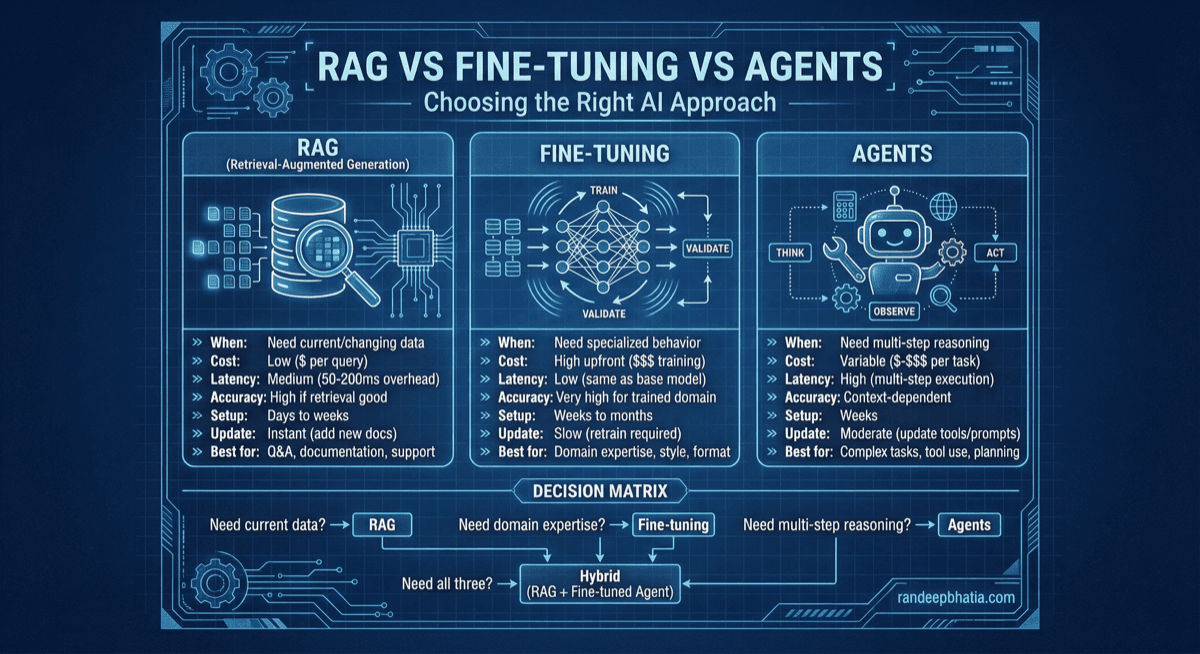
RAG retrieves external knowledge at inference time, fine-tuning embeds knowledge into model weights, and agents orchestrate multi-step reasoning with tool use—each addressing distinct LLM enhancement requirements.
RAG excels when knowledge changes frequently, requires attribution, or exceeds context window limits, with lower upfront cost but per-query retrieval overhead and potential relevance failures.
Fine-tuning is optimal for encoding stable domain knowledge, specific output formats, or behavioral modifications into model weights, requiring significant upfront investment but delivering consistent low-latency inference.
Agents provide autonomous multi-step reasoning and tool orchestration capabilities, enabling complex workflows but introducing significant complexity, latency, and failure mode management requirements.
The Bottom Line
The choice between RAG, fine-tuning, and agents depends on knowledge volatility, latency requirements, cost constraints, and task complexity. Most production systems combine multiple approaches, using fine-tuning for stable behavioral patterns, RAG for dynamic knowledge retrieval, and agents for complex multi-step orchestration.
Definition
Definition
RAG (Retrieval-Augmented Generation), fine-tuning, and agents represent three fundamentally different approaches to enhancing Large Language Model capabilities, each with distinct mechanisms for incorporating external knowledge and extending model functionality.
RAG dynamically retrieves relevant information at inference time and injects it into the model's context, fine-tuning modifies model weights through additional training on domain-specific data, and agents orchestrate multi-step reasoning processes with access to external tools and APIs.
Extended Definition
Retrieval-Augmented Generation operates by embedding documents into vector representations, storing them in specialized databases, and retrieving semantically similar content when processing queries to augment the model's context window with relevant information. Fine-tuning involves continued training of a pre-trained model on curated datasets to adjust internal weight distributions, effectively encoding new knowledge or behavioral patterns directly into the model's parameters. Agents extend LLM capabilities through autonomous reasoning loops that decompose complex tasks, invoke external tools, maintain state across interactions, and synthesize results from multiple operations. These approaches exist on a spectrum from external knowledge injection (RAG) to internal knowledge modification (fine-tuning) to capability extension through orchestration (agents), and production systems frequently combine multiple approaches to address different aspects of their requirements.
Etymology & Origins
RAG was introduced by Facebook AI Research in 2020 as a method to ground language model outputs in retrieved documents, combining the generative capabilities of transformers with the precision of information retrieval systems. Fine-tuning as a concept predates modern LLMs, originating in transfer learning research where pre-trained models are adapted to downstream tasks through additional training. The agent paradigm in AI systems traces back to symbolic AI and expert systems of the 1980s, with modern LLM-based agents emerging from research on chain-of-thought prompting, tool use, and autonomous reasoning systems like ReAct (Reasoning and Acting) introduced in 2022.
Also Known As
Not To Be Confused With
Prompt Engineering
Prompt engineering optimizes input formatting without modifying model weights or adding external retrieval, relying solely on crafting effective instructions within the existing context window, whereas RAG adds external knowledge, fine-tuning modifies weights, and agents add reasoning capabilities.
In-Context Learning
In-context learning provides examples within the prompt to guide model behavior without weight modification or external retrieval, while RAG dynamically retrieves relevant context, fine-tuning permanently alters model parameters, and agents execute multi-step reasoning.
Knowledge Graphs
Knowledge graphs are structured representations of entities and relationships that can be queried deterministically, whereas RAG uses semantic similarity for retrieval, fine-tuning encodes knowledge probabilistically in weights, and agents can interact with knowledge graphs as tools.
Model Distillation
Model distillation transfers knowledge from a larger teacher model to a smaller student model through training on teacher outputs, focusing on model compression rather than knowledge augmentation or capability extension.
Embedding Models
Embedding models convert text to vector representations and are a component used within RAG systems for retrieval, but do not themselves generate text or perform the augmented generation that characterizes RAG.
Chatbots
Chatbots are conversational interfaces that may use RAG, fine-tuning, or agents internally, but the term refers to the user-facing application rather than the underlying LLM enhancement technique.
Conceptual Foundation
Core Principles
(8 principles)Mental Models
(6 models)Library vs Textbook vs Research Assistant
RAG is like having access to a library where you can look up information for each question. Fine-tuning is like studying a textbook until the knowledge becomes internalized. Agents are like having a research assistant who can consult multiple sources, use tools, and synthesize findings.
External Memory vs Internal Memory vs Executive Function
RAG provides external memory that can be accessed and updated independently of the model. Fine-tuning modifies internal memory by changing how the model processes and generates information. Agents add executive function capabilities for planning, tool use, and multi-step reasoning.
Read-Time vs Write-Time vs Runtime Optimization
RAG optimizes at read-time by retrieving relevant information when queries arrive. Fine-tuning optimizes at write-time by encoding knowledge during training. Agents optimize at runtime by dynamically selecting actions and tools based on task requirements.
Retrieval vs Parametric vs Procedural Knowledge
RAG provides retrieval-based knowledge that can be verified against sources. Fine-tuning creates parametric knowledge embedded in model weights. Agents encode procedural knowledge about how to accomplish tasks through tool orchestration.
Augmentation vs Modification vs Extension
RAG augments model capabilities by providing additional context. Fine-tuning modifies model capabilities by changing internal representations. Agents extend model capabilities by adding external action-taking abilities.
Static vs Dynamic vs Adaptive Systems
Fine-tuned models are static between training runs, providing consistent but unchanging responses. RAG systems are dynamic, with responses varying based on retrieved content. Agent systems are adaptive, adjusting their approach based on intermediate results and feedback.
Key Insights
(10 insights)Fine-tuning does not reliably inject factual knowledge into models; it primarily modifies behavior, style, and format, making it unsuitable as a sole solution for knowledge-intensive applications.
RAG retrieval quality is often the primary bottleneck in system performance, with embedding model selection and chunking strategy having greater impact than the generation model choice.
Agent systems exhibit emergent failure modes at scale that do not appear in small-scale testing, including reasoning loops, tool abuse, and state corruption that require production-grade observability.
The effective context window for RAG is significantly smaller than the model's maximum context length due to attention degradation and the 'lost in the middle' phenomenon.
Fine-tuning on small datasets risks catastrophic forgetting of base model capabilities, requiring careful evaluation of general performance alongside domain-specific improvements.
Hybrid RAG-agent architectures often outperform pure approaches by combining retrieval grounding with multi-step reasoning capabilities.
Cost optimization strategies differ fundamentally: RAG benefits from caching and retrieval optimization, fine-tuning from model compression, and agents from reasoning step reduction.
Attribution requirements increasingly drive architecture decisions as regulatory frameworks mandate explainability and source citation for AI-generated content.
The maintenance burden of fine-tuned models compounds over time as base models evolve, requiring re-training to incorporate improvements from newer foundation models.
Agent tool design quality has outsized impact on system reliability, with poorly specified tools causing cascading failures that are difficult to diagnose and resolve.
When to Use
When to Use
Ideal Scenarios
(12)Use RAG when knowledge changes frequently (daily, weekly, or monthly updates) and the system must reflect current information without retraining.
Use RAG when source attribution and citation are required for regulatory compliance, legal defensibility, or user trust.
Use RAG when the knowledge corpus exceeds what can be encoded in model weights or provided in a single context window.
Use fine-tuning when consistent output format, style, or structure is required across all responses regardless of input variation.
Use fine-tuning when domain-specific terminology, jargon, or communication patterns must be reliably produced.
Use fine-tuning when the base model lacks behavioral patterns required for the application, such as specific reasoning approaches or response structures.
Use agents when tasks require multi-step reasoning with intermediate verification or correction.
Use agents when external tool access is required, such as database queries, API calls, or code execution.
Use agents when task complexity varies significantly and the system must adapt its approach based on requirements.
Use hybrid RAG-fine-tuning when stable behavioral patterns must be combined with dynamic knowledge access.
Use hybrid RAG-agent when complex reasoning must be grounded in retrieved factual information.
Use all three approaches when building enterprise knowledge systems requiring consistent behavior, current information, and complex task handling.
Prerequisites
(8)RAG requires a document corpus that can be chunked, embedded, and indexed in a vector database with appropriate metadata for filtering.
RAG requires embedding infrastructure capable of processing documents and queries with acceptable latency.
Fine-tuning requires curated training datasets with hundreds to thousands of high-quality input-output examples.
Fine-tuning requires compute infrastructure for training runs, which may take hours to days depending on model size and dataset.
Fine-tuning requires evaluation frameworks to measure both domain-specific improvements and general capability retention.
Agents require well-defined tool interfaces with clear input/output specifications and error handling.
Agents require orchestration infrastructure capable of managing multi-step execution with state persistence.
All approaches require baseline evaluation metrics to measure improvement over the base model.
Signals You Need This
(10)Base model responses lack domain-specific knowledge that exists in your documentation or knowledge base—consider RAG.
Model outputs are factually correct but formatted incorrectly or use inappropriate tone—consider fine-tuning.
Tasks require accessing external systems, databases, or APIs that the model cannot reach—consider agents.
Users report outdated information in responses despite knowledge updates—RAG with proper indexing needed.
Response quality varies significantly based on how questions are phrased—fine-tuning for robustness needed.
Simple queries are handled well but complex multi-part questions fail—agent orchestration needed.
Regulatory audits require citation of sources for AI-generated content—RAG with attribution needed.
Model behavior drifts or becomes inconsistent across different use cases—fine-tuning for behavioral anchoring needed.
Tasks require verification steps or human-in-the-loop approval—agent workflows needed.
Knowledge updates require model retraining, causing unacceptable delays—RAG for dynamic knowledge needed.
Organizational Readiness
(7)RAG implementation requires teams with expertise in information retrieval, vector databases, and embedding models.
Fine-tuning requires ML engineering capabilities for training pipeline development, hyperparameter optimization, and model evaluation.
Agent development requires software engineering expertise in distributed systems, state management, and API integration.
All approaches require MLOps infrastructure for deployment, monitoring, and iteration.
Organizations must have data governance processes to ensure training data and knowledge bases meet quality and compliance requirements.
Budget allocation must account for ongoing operational costs, not just initial implementation.
Cross-functional collaboration between domain experts, ML engineers, and product teams is essential for all approaches.
When NOT to Use
When NOT to Use
Anti-Patterns
(12)Do not use RAG when the knowledge corpus is small enough to fit in the context window and changes infrequently—simple prompt injection is more efficient.
Do not use RAG when retrieval latency is unacceptable for the use case and knowledge can be pre-computed or cached.
Do not use fine-tuning to inject factual knowledge that may become outdated—the model will confidently produce stale information.
Do not use fine-tuning when you lack sufficient high-quality training examples—poor data leads to degraded model performance.
Do not use fine-tuning when rapid iteration is required—training cycles create unacceptable feedback loops.
Do not use agents for simple question-answering tasks that do not require multi-step reasoning or tool access.
Do not use agents when latency requirements preclude multiple LLM calls per request.
Do not use agents when task success cannot be verified programmatically, leading to undetected failures.
Do not combine all three approaches without clear justification—complexity compounds failure modes and operational burden.
Do not use RAG with poorly chunked documents—retrieval quality degrades significantly with inappropriate chunk boundaries.
Do not use fine-tuning to fix prompt engineering problems—proper prompting should be exhausted first.
Do not use agents without comprehensive tool error handling—tool failures cascade unpredictably.
Red Flags
(10)Stakeholders expect fine-tuning to make the model 'know' specific facts with 100% reliability.
RAG implementation proceeds without evaluation of retrieval quality independent of generation quality.
Agent systems are deployed without rate limiting or cost controls on tool invocations.
Fine-tuning datasets are created by filtering model outputs without human verification.
RAG chunk sizes are chosen arbitrarily without experimentation on retrieval effectiveness.
Agent tool descriptions are vague or incomplete, leading to inappropriate tool selection.
No baseline measurements exist to evaluate whether the enhancement approach improves performance.
The team lacks expertise in the chosen approach and no training or hiring plan exists.
Cost projections do not account for the full operational lifecycle including updates and maintenance.
Failure modes and fallback strategies are not defined before production deployment.
Better Alternatives
(8)Need to add a small amount of stable context to every request
System prompts with static context injection
System prompts add no latency overhead, require no infrastructure, and are sufficient when context is small and stable.
Want to improve response quality on specific query types
Few-shot prompting with curated examples
Few-shot examples can significantly improve performance without training overhead and allow rapid iteration.
Need to access a structured database for factual queries
Text-to-SQL or structured query generation
Structured queries provide deterministic, verifiable results without the uncertainty of semantic retrieval.
Want consistent output formatting
Output parsing with structured generation (JSON mode, function calling)
Structured generation modes enforce format compliance without fine-tuning overhead.
Need to handle multi-turn conversations with context
Conversation memory with context window management
Proper conversation management may address the need without full agent orchestration complexity.
Want to reduce hallucination on factual queries
Confidence calibration with abstention
Teaching models to express uncertainty and abstain from low-confidence responses may be more effective than knowledge injection.
Need to execute deterministic workflows
Traditional workflow orchestration with LLM components
Deterministic workflows are more reliable than agent autonomy when the process is well-defined.
Want to improve domain-specific language understanding
Domain-specific embedding models for RAG
Specialized embedding models can improve retrieval quality without fine-tuning the generation model.
Common Mistakes
(10)Treating fine-tuning as a knowledge database rather than a behavioral modification tool.
Implementing RAG without measuring retrieval precision and recall independently of generation quality.
Building agent systems without comprehensive logging and observability for debugging.
Using maximum context window size for RAG without accounting for attention degradation.
Fine-tuning on synthetic data without validation against real-world use cases.
Deploying agents without cost controls, leading to runaway API expenses.
Chunking documents by arbitrary character counts rather than semantic boundaries.
Failing to version control fine-tuning datasets and training configurations.
Not implementing fallback strategies when RAG retrieval returns low-relevance results.
Assuming agent tool calls will always succeed without implementing retry and error handling logic.
Core Taxonomy
Core Taxonomy
Primary Types
(10 types)Basic retrieval-augmented generation using single-stage retrieval with direct context injection into the prompt.
Characteristics
- Single embedding model for queries and documents
- Top-k retrieval based on cosine similarity
- Direct concatenation of retrieved chunks with query
- No re-ranking or filtering of retrieved results
Use Cases
Tradeoffs
Lowest implementation complexity but limited retrieval quality; suitable for prototypes and low-stakes applications but often insufficient for production requirements.
Classification Dimensions
Knowledge Update Frequency
Classification based on how frequently the system's knowledge can be updated, ranging from real-time retrieval to static model weights.
Latency Profile
Classification based on the number of operations required per request and resulting latency characteristics.
Autonomy Level
Classification based on the degree of autonomous decision-making and action-taking capability.
Knowledge Source
Classification based on where knowledge resides and how it is accessed during inference.
Customization Depth
Classification based on what aspect of model behavior is being customized.
Infrastructure Requirements
Classification based on the infrastructure and operational complexity required for each approach.
Evolutionary Stages
Prompt Engineering Baseline
Week 1-4 of LLM application developmentInitial deployment using carefully crafted prompts, system messages, and few-shot examples without external retrieval, weight modification, or agent capabilities.
RAG Integration
Month 1-3 after initial deploymentAddition of retrieval capabilities to ground responses in external knowledge, typically starting with naive RAG and evolving to advanced pipelines.
Fine-Tuning Optimization
Month 3-6 after production validation of core use casesIntroduction of fine-tuned models to address behavioral consistency, output formatting, or domain-specific communication requirements not met by RAG alone.
Agent Capabilities
Month 6-12 after establishing stable RAG and fine-tuning foundationsAddition of agent orchestration for complex multi-step tasks, tool integration, and autonomous reasoning capabilities.
Hybrid Architecture Maturity
Year 1+ with ongoing refinementSophisticated integration of all approaches with dynamic routing, fallback strategies, and continuous optimization based on production metrics.
Architecture Patterns
(8 patterns)RAG-First Architecture
Architecture prioritizing retrieval-augmented generation as the primary knowledge injection mechanism, with fine-tuning and agents as optional enhancements.
Components
- Document ingestion pipeline
- Embedding service
- Vector database
- Retrieval service
- Context assembly module
- LLM inference service
- Response post-processing
Data Flow
Documents are chunked and embedded during ingestion, stored in vector database. At query time, query is embedded, similar chunks retrieved, assembled into context, and passed to LLM for generation. Response may be post-processed for formatting.
Best For
- Knowledge-intensive applications with frequently changing information
- Applications requiring source attribution
- Document-grounded question answering
Limitations
- Retrieval quality ceiling limits overall system quality
- Context window constraints limit retrieved information volume
- Cannot modify model behavior or output format
Scaling Characteristics
Scales horizontally through vector database sharding, embedding service replication, and LLM inference scaling. Retrieval latency is primary bottleneck at scale.
Integration Points
Vector Database
Stores document embeddings and enables semantic similarity search for RAG retrieval.
Selection impacts retrieval latency, scalability, and feature availability. Consider managed vs self-hosted, filtering capabilities, and hybrid search support.
Embedding Service
Converts text to vector representations for both document indexing and query processing.
Embedding model choice significantly impacts retrieval quality. Consider domain-specific models, dimensionality, and inference latency.
LLM Inference Service
Provides text generation capabilities for RAG response generation, fine-tuned model inference, and agent reasoning.
Model selection, hosting approach (API vs self-hosted), and inference optimization significantly impact cost and latency.
Training Infrastructure
Provides compute resources for fine-tuning jobs, including GPU clusters and training frameworks.
Training infrastructure costs can be significant. Consider managed services vs self-hosted, spot instances, and training optimization techniques.
Tool Registry
Manages available tools for agent systems, including definitions, access control, and usage tracking.
Tool design quality directly impacts agent effectiveness. Clear schemas, comprehensive error handling, and usage limits are essential.
State Management
Maintains agent state across multi-step interactions, including conversation history, intermediate results, and execution context.
State management complexity increases with agent sophistication. Consider persistence requirements, cleanup policies, and state size limits.
Observability Stack
Provides monitoring, logging, and tracing capabilities across all system components.
Comprehensive observability is essential for debugging complex systems. Ensure correlation across RAG, fine-tuning, and agent components.
Evaluation Framework
Provides automated and human evaluation capabilities for measuring system quality across approaches.
Evaluation must cover retrieval quality, generation quality, and agent behavior. Consider both automated metrics and human evaluation.
Decision Framework
Decision Framework
RAG is likely required for dynamic knowledge access. Proceed to evaluate RAG implementation options.
Fine-tuning may be sufficient if knowledge is stable. Evaluate whether knowledge can be encoded in model weights.
Consider not just current update frequency but anticipated future requirements. Regulatory or competitive pressures may require more frequent updates.
Technical Deep Dive
Technical Deep Dive
Overview
RAG, fine-tuning, and agents each modify the LLM inference pipeline at different points to enhance model capabilities. RAG intercepts the inference process to inject retrieved context before generation, effectively expanding the model's knowledge without weight modification. Fine-tuning modifies the model's internal weight matrices through gradient descent on domain-specific data, permanently altering how the model processes inputs and generates outputs. Agents wrap the LLM in an orchestration layer that enables multi-step reasoning, tool invocation, and state management across interactions. The fundamental distinction lies in where enhancement occurs: RAG operates at the input level by augmenting context, fine-tuning operates at the model level by modifying weights, and agents operate at the system level by orchestrating multiple inference calls and external interactions. This architectural difference has profound implications for latency, cost, capability, and failure modes. Understanding the technical mechanisms of each approach is essential for making informed architectural decisions. RAG's effectiveness depends on embedding quality, retrieval algorithms, and context assembly strategies. Fine-tuning effectiveness depends on training data quality, hyperparameter selection, and evaluation methodology. Agent effectiveness depends on prompt engineering, tool design, and orchestration logic. Production systems increasingly combine these approaches, using fine-tuning to establish behavioral baselines, RAG to inject dynamic knowledge, and agents to handle complex multi-step tasks. The technical challenge lies in integrating these approaches coherently while managing the compounded complexity.
Step-by-Step Process
Source documents are processed through a chunking pipeline that splits content into segments appropriate for embedding and retrieval. Chunking strategies include fixed-size chunks with overlap, semantic chunking based on content structure, and hierarchical chunking that preserves document organization. Chunk size selection balances retrieval granularity against context coherence.
Inappropriate chunk sizes lead to either fragmented context (too small) or diluted relevance (too large). Chunking at arbitrary boundaries can split critical information across chunks, degrading retrieval effectiveness.
Under The Hood
RAG systems fundamentally rely on the mathematical properties of embedding spaces where semantic similarity corresponds to geometric proximity. Modern embedding models use transformer architectures trained on contrastive objectives that pull similar content together and push dissimilar content apart in the embedding space. The quality of this learned space directly determines retrieval effectiveness. Vector databases implement approximate nearest neighbor (ANN) algorithms that trade exact search for dramatic speed improvements, with HNSW (Hierarchical Navigable Small World) graphs being the most common approach, constructing multi-layer graph structures that enable logarithmic search complexity. Fine-tuning operates through the same gradient descent optimization as initial model training, but starting from pre-trained weights rather than random initialization. This transfer learning approach leverages the general capabilities learned during pre-training while adapting to specific tasks or domains. The key insight is that later layers of transformer models encode more task-specific information, which is why techniques like LoRA (Low-Rank Adaptation) can achieve strong results by modifying only a small subset of parameters. LoRA specifically decomposes weight updates into low-rank matrices, dramatically reducing the number of trainable parameters while maintaining adaptation quality. Agent systems implement control loops that interleave LLM inference with external actions. The ReAct pattern explicitly separates reasoning (generating thoughts about what to do) from acting (executing tool calls), creating interpretable traces of agent behavior. More sophisticated agents implement planning algorithms that decompose tasks into dependency graphs, enabling parallel execution of independent subtasks. State management in agents must handle both short-term working memory (current task context) and long-term memory (persistent information across sessions), often using a combination of context window management and external storage. The interaction between these approaches in hybrid systems requires careful architectural consideration. When combining RAG with fine-tuning, the fine-tuned model's behavioral modifications apply to both the query understanding and the generation from retrieved context. When combining RAG with agents, retrieval can occur at multiple points in the agent loop, with different retrieval strategies for different reasoning stages. The orchestration layer must manage the complexity of multiple enhancement approaches while maintaining coherent system behavior. Performance optimization differs significantly across approaches. RAG optimization focuses on retrieval latency (index structure, caching, query optimization) and context efficiency (compression, selection, ordering). Fine-tuning optimization focuses on inference efficiency (quantization, batching, hardware utilization) and model size (distillation, pruning). Agent optimization focuses on reducing reasoning steps (better prompts, tool design) and parallelizing independent operations. Production systems must profile and optimize each component while considering end-to-end latency and cost.
Failure Modes
Failure Modes
Query-document semantic gap, embedding model limitations, or insufficient corpus coverage for the query topic.
- Low similarity scores for all retrieved chunks
- Retrieved content unrelated to query
- Model responses indicate lack of information
- High user dissatisfaction on specific query types
Model generates responses without grounding, potentially hallucinating or providing generic unhelpful answers. User trust erodes.
Comprehensive corpus coverage analysis, query-document alignment testing, embedding model evaluation on domain-specific queries, fallback detection mechanisms.
Implement relevance thresholds with fallback responses, query expansion techniques, hybrid retrieval combining dense and sparse methods, human escalation for low-confidence retrievals.
Operational Considerations
Key Metrics (15)
Time from query embedding to retrieval results returned, measuring vector search performance.
Dashboard Panels
Alerting Strategy
Implement tiered alerting with severity levels based on user impact. Critical alerts for complete failures or SLA violations requiring immediate response. Warning alerts for degradation trends requiring investigation within hours. Informational alerts for anomalies requiring review within days. Use alert aggregation to prevent alert fatigue. Implement runbooks for common alert scenarios. Ensure on-call rotation covers all system components.
Cost Analysis
Cost Analysis
Cost Drivers
(10)RAG Embedding Generation
Cost per document chunk embedded during indexing, plus cost per query embedded at inference time. Scales with corpus size and query volume.
Batch embedding for indexing efficiency, cache query embeddings for repeated queries, use efficient embedding models, implement incremental indexing.
RAG Vector Storage
Storage costs scale with corpus size and embedding dimensionality. Memory costs for high-performance indices.
Use appropriate index types for scale, implement tiered storage for less-accessed content, consider dimensionality reduction, optimize metadata storage.
RAG Retrieval Compute
Compute costs for similarity search, scaling with query volume and index size.
Optimize index configuration, implement caching layers, use approximate search appropriately, scale horizontally for load distribution.
Fine-tuning Training Compute
GPU hours for training runs, scaling with model size, dataset size, and training duration. Can be substantial for large models.
Use PEFT methods to reduce compute, optimize hyperparameters for faster convergence, leverage spot instances, implement early stopping.
Fine-tuned Model Hosting
Ongoing GPU costs for serving fine-tuned models, scaling with model size and traffic volume.
Use quantization to reduce model size, implement efficient batching, leverage serverless inference for variable load, consider model distillation.
Agent LLM Inference
Token costs multiplied by number of reasoning steps. Agents can consume 5-20x tokens of single-call approaches.
Optimize prompts for conciseness, implement step limits, use smaller models for simple reasoning steps, cache intermediate results.
Agent Tool API Costs
Costs for external API calls made by agents, varying by tool and usage patterns.
Implement tool result caching, batch API calls where possible, use cost-aware tool selection, negotiate volume discounts.
Infrastructure Operations
Costs for monitoring, logging, and operational tooling across all approaches.
Implement log sampling for high-volume systems, use tiered retention, optimize metric cardinality, leverage managed services appropriately.
Data Preparation and Curation
Human effort for training data creation, corpus curation, and quality assurance.
Implement efficient annotation workflows, leverage synthetic data generation, use active learning for targeted curation.
Evaluation and Testing
Compute and human effort for ongoing quality evaluation across approaches.
Automate evaluation where possible, implement sampling strategies, use efficient evaluation metrics.
Cost Models
RAG Total Cost of Ownership
TCO = (corpus_size × embedding_cost) + (corpus_size × storage_cost × time) + (query_volume × (query_embedding_cost + retrieval_cost + generation_cost))For 1M chunks at $0.0001/embedding, $0.01/1K vectors/month storage, 100K queries/month at $0.002/query generation: Monthly cost ≈ $100 (initial embedding) + $10 (storage) + $10 (query embeddings) + $200 (generation) = $320/month ongoing
Fine-tuning Total Cost of Ownership
TCO = training_cost + (hosting_cost × time) + (retraining_frequency × training_cost)For 7B model: Training cost ~$500 (10 GPU hours at $50/hr), hosting ~$2000/month (dedicated GPU), quarterly retraining: Year 1 cost = $500 + ($2000 × 12) + ($500 × 3) = $26,000
Agent Cost Per Task
Task_Cost = (avg_steps × tokens_per_step × token_cost) + (tool_calls × avg_tool_cost)For task with 8 steps, 2000 tokens/step at $0.01/1K tokens, 3 tool calls at $0.05/call: Task cost = (8 × 2000 × $0.00001) + (3 × $0.05) = $0.16 + $0.15 = $0.31/task
Hybrid System Cost
Total_Cost = (RAG_queries × RAG_cost) + (fine_tuned_queries × FT_cost) + (agent_tasks × agent_cost) + infrastructure_overheadMonthly: 50K RAG queries at $0.005, 100K fine-tuned at $0.002, 5K agent tasks at $0.30, $1000 infrastructure: Total = $250 + $200 + $1500 + $1000 = $2,950/month
Optimization Strategies
- 1Implement intelligent routing to direct simple queries to cheaper approaches and reserve expensive agent processing for complex tasks
- 2Use caching aggressively for RAG embeddings, retrieval results, and agent intermediate results
- 3Leverage PEFT methods (LoRA, QLoRA) to reduce fine-tuning compute requirements by 90%+
- 4Implement query complexity classification to avoid agent overhead for simple tasks
- 5Use smaller, faster models for agent reasoning steps that don't require full capability
- 6Batch embedding operations for RAG indexing to maximize throughput efficiency
- 7Implement tiered storage for RAG indices with hot/warm/cold tiers based on access patterns
- 8Use spot instances for fine-tuning training runs with checkpointing for interruption recovery
- 9Optimize agent prompts to reduce token consumption while maintaining quality
- 10Implement tool result caching to avoid redundant API calls
- 11Use quantized models for fine-tuned inference to reduce GPU requirements
- 12Implement request coalescing for similar queries to amortize retrieval costs
Hidden Costs
- 💰Data preparation and curation effort for fine-tuning datasets, often requiring significant human time
- 💰Ongoing corpus maintenance for RAG, including content updates, quality reviews, and stale content removal
- 💰Debugging and incident response time for agent failures, which can be complex to diagnose
- 💰Evaluation infrastructure and human evaluation costs for quality assurance
- 💰Training and onboarding costs for teams learning new approaches
- 💰Technical debt from rapid iteration without proper architecture planning
- 💰Opportunity cost of engineering time spent on optimization vs feature development
- 💰Compliance and security audit costs for AI systems handling sensitive data
ROI Considerations
ROI analysis must consider both cost reduction and value creation dimensions. RAG provides ROI through reduced hallucination (avoiding costly errors), improved user satisfaction (retention), and reduced human escalation (support costs). Fine-tuning provides ROI through consistent quality (brand value), reduced prompt engineering effort (development efficiency), and lower per-inference costs at scale (operational efficiency). Agents provide ROI through task automation (labor replacement), complex task handling (capability expansion), and improved outcomes on high-value tasks (revenue generation). Break-even analysis should compare the total cost of each approach against the baseline (prompt engineering only) and against each other. Consider that approaches may have different break-even points: RAG may break even quickly due to low upfront costs, while fine-tuning requires higher volume to amortize training investment. Agent ROI depends heavily on task value—high-value tasks justify higher per-task costs. Long-term ROI must account for maintenance costs, which differ significantly across approaches. RAG requires ongoing corpus maintenance but avoids model retraining. Fine-tuning requires periodic retraining as requirements evolve or base models improve. Agents require ongoing tool maintenance and prompt optimization. Factor these ongoing costs into multi-year projections. Risk-adjusted ROI should consider failure costs. RAG failures (retrieval misses) may have lower impact than fine-tuning failures (systematic errors) or agent failures (incorrect actions). The cost of a single high-impact failure may exceed months of operational savings, making reliability investment essential for positive ROI.
Security Considerations
Threat Model
(10 threats)RAG Corpus Poisoning
Attacker injects malicious content into document corpus through compromised data sources or ingestion pipeline vulnerabilities.
Model generates harmful, misleading, or manipulated responses based on poisoned context. Potential for widespread misinformation.
Implement source authentication, content validation during ingestion, access controls on ingestion pipeline, regular corpus audits, anomaly detection for unusual content.
Fine-tuning Data Poisoning
Attacker introduces malicious examples into training data through compromised data collection or insider threat.
Model learns harmful behaviors or biases that persist across all inferences. Difficult to detect without comprehensive evaluation.
Rigorous data curation with human review, data provenance tracking, comprehensive red-teaming of trained models, anomaly detection in training data.
Agent Tool Exploitation
Attacker crafts prompts that cause agent to misuse tools, access unauthorized resources, or perform harmful actions.
Unauthorized data access, unintended actions with real-world consequences, resource abuse, potential for lateral movement.
Strict tool access controls, parameter validation, confirmation requirements for sensitive actions, sandboxed execution, comprehensive logging.
Prompt Injection via RAG
Malicious instructions embedded in retrieved documents that hijack model behavior when injected into context.
Model follows injected instructions instead of user intent, potentially leaking data, generating harmful content, or bypassing safety measures.
Input sanitization for retrieved content, instruction hierarchy enforcement, output filtering, prompt injection detection.
Model Extraction via Fine-tuning
Attacker with access to fine-tuned model extracts proprietary training data or base model weights through inference attacks.
Loss of intellectual property, competitive advantage erosion, potential exposure of sensitive training data.
Access controls on model endpoints, rate limiting, output perturbation, monitoring for extraction patterns.
Agent State Manipulation
Attacker manipulates agent state storage to alter agent behavior or inject malicious context.
Agent performs unintended actions based on corrupted state, potential for persistent compromise across sessions.
State integrity verification, encrypted state storage, access controls, state validation before use.
RAG Index Tampering
Attacker modifies vector index to alter retrieval results, promoting or suppressing specific content.
Biased or manipulated retrieval results affecting all users, potential for targeted misinformation.
Index integrity monitoring, access controls on index modification, audit logging, anomaly detection for retrieval patterns.
Sensitive Data Leakage via RAG
RAG system retrieves and exposes sensitive information to unauthorized users through insufficient access controls.
Privacy violations, regulatory non-compliance, reputational damage, potential legal liability.
Document-level access controls, user context-aware retrieval filtering, sensitive content detection, output filtering.
Agent Credential Exposure
Agent tool credentials exposed through logging, error messages, or prompt injection attacks.
Unauthorized access to external systems, potential for broader compromise through exposed credentials.
Credential isolation, secure credential storage, credential rotation, logging sanitization, least-privilege tool access.
Fine-tuned Model Backdoor
Attacker introduces backdoor triggers in training data that cause specific behaviors when triggered in production.
Model behaves normally except when triggered, enabling targeted attacks that evade standard evaluation.
Training data auditing, backdoor detection techniques, diverse evaluation including adversarial testing, model behavior monitoring.
Security Best Practices
- ✓Implement defense in depth with multiple security layers across all approaches
- ✓Apply principle of least privilege for all system components and tool access
- ✓Encrypt data at rest and in transit for RAG corpora, training data, and agent state
- ✓Implement comprehensive audit logging for all operations across approaches
- ✓Conduct regular security assessments and penetration testing
- ✓Establish incident response procedures specific to AI system compromises
- ✓Implement input validation and sanitization at all system boundaries
- ✓Use secure development practices for all custom components
- ✓Maintain security patches for all dependencies and infrastructure
- ✓Implement rate limiting and anomaly detection for abuse prevention
- ✓Establish data classification and handling procedures for sensitive content
- ✓Conduct regular access reviews and credential rotation
- ✓Implement network segmentation to limit blast radius of compromises
- ✓Establish secure model and data supply chain practices
- ✓Train development and operations teams on AI-specific security risks
Data Protection
- 🔒Classify all data in RAG corpora, training datasets, and agent state by sensitivity level
- 🔒Implement encryption for all sensitive data at rest and in transit
- 🔒Apply access controls based on data classification and user authorization
- 🔒Implement data loss prevention (DLP) controls for sensitive content in outputs
- 🔒Establish data retention and deletion policies with automated enforcement
- 🔒Implement anonymization and pseudonymization for personal data where appropriate
- 🔒Conduct privacy impact assessments for new data sources and use cases
- 🔒Establish data processing agreements with all third-party services
- 🔒Implement secure data transfer mechanisms for cross-boundary data flows
- 🔒Maintain data lineage tracking for compliance and audit purposes
Compliance Implications
GDPR (General Data Protection Regulation)
Right to erasure, data minimization, purpose limitation, and transparency for personal data processing.
Implement document-level deletion in RAG indices, training data tracking for fine-tuning, clear disclosure of AI use, data retention policies.
CCPA (California Consumer Privacy Act)
Consumer rights to know, delete, and opt-out of sale of personal information.
Implement data inventory for RAG corpora and training data, deletion capabilities, opt-out mechanisms for data collection.
HIPAA (Health Insurance Portability and Accountability Act)
Protection of protected health information (PHI) with access controls, audit trails, and breach notification.
PHI detection and filtering in RAG, BAA requirements for cloud services, comprehensive audit logging, encryption requirements.
SOC 2
Security, availability, processing integrity, confidentiality, and privacy controls.
Implement controls across all approaches, maintain documentation, conduct regular audits, establish incident response procedures.
EU AI Act
Risk-based requirements for AI systems including transparency, human oversight, and technical documentation.
Risk classification of AI applications, documentation of approaches used, human oversight mechanisms, transparency about AI use.
Financial Services Regulations (various)
Model risk management, explainability, fair lending, and audit requirements.
RAG for explainability through citations, model documentation, bias testing, comprehensive audit trails.
Industry-Specific Data Residency
Data must remain within specific geographic boundaries.
Region-specific RAG indices, training data localization, agent tool restrictions, infrastructure deployment constraints.
Intellectual Property Protection
Protection of proprietary information and trade secrets.
Access controls on RAG corpora, training data protection, output filtering for sensitive information, NDA enforcement.
Scaling Guide
Scaling Guide
Scaling Dimensions
RAG Corpus Size
Horizontal scaling through index sharding, tiered storage for access patterns, incremental indexing for updates.
Single index practical limits vary by implementation (millions to billions of vectors). Sharding required beyond single-node capacity.
Retrieval latency may increase with corpus size. Consider relevance degradation as corpus grows. Implement corpus curation to maintain quality.
RAG Query Volume
Horizontal scaling of retrieval services, caching layers, load balancing across index replicas.
Scales linearly with infrastructure. Caching effectiveness depends on query distribution.
Cache hit rates critical for cost efficiency. Consider read replicas for high availability. Monitor for hot spots in query patterns.
Fine-tuning Model Size
Distributed training across multiple GPUs, gradient checkpointing, PEFT methods for resource efficiency.
Practical limits based on available GPU memory and training time constraints. Largest models require specialized infrastructure.
Larger models may not provide proportional quality improvements. Consider model distillation for deployment efficiency.
Fine-tuning Inference Volume
Horizontal scaling of inference servers, batching optimization, model quantization, serverless inference for variable load.
Scales with GPU infrastructure. Batching provides efficiency gains up to memory limits.
Latency vs throughput tradeoffs with batching. Consider model replication vs larger instances. Monitor GPU utilization.
Agent Concurrent Tasks
Horizontal scaling of agent orchestrators, distributed state management, parallel tool execution.
Limited by state management infrastructure and tool API quotas. Coordination overhead increases with concurrency.
State consistency critical at scale. Tool rate limits may become bottleneck. Consider task prioritization and queuing.
Agent Task Complexity
Hierarchical agent architectures, task decomposition, specialized sub-agents for different task types.
Reasoning quality may degrade with excessive complexity. Cost increases non-linearly with complexity.
Define complexity boundaries for agent handling. Implement human escalation for edge cases. Monitor reasoning quality at scale.
Multi-Region Deployment
Regional RAG indices, distributed fine-tuned model serving, region-aware agent routing.
Data residency requirements may constrain architecture. Cross-region consistency adds complexity.
Latency optimization through regional deployment. Consider data synchronization strategies. Implement failover across regions.
Multi-Tenant Isolation
Tenant-specific RAG indices or filtering, tenant-specific fine-tuned models or adapters, isolated agent state.
Resource efficiency decreases with full isolation. Shared infrastructure requires careful access control.
Balance isolation requirements with efficiency. Consider noisy neighbor effects. Implement tenant-level monitoring and quotas.
Capacity Planning
Required_Capacity = (Peak_Volume × Safety_Margin) / (Instance_Throughput × Target_Utilization), where Safety_Margin typically 1.5-2x, Target_Utilization typically 60-70%Maintain 50-100% headroom for traffic spikes. Higher margin for less predictable workloads. Consider auto-scaling capabilities and spin-up time.
Scaling Milestones
- Establishing baseline metrics
- Validating approach effectiveness
- Initial infrastructure setup
Single-instance deployments acceptable. Focus on functionality over scalability. Manual operations acceptable.
- Reliability requirements increase
- Need for monitoring and alerting
- Cost optimization becomes relevant
Implement basic redundancy. Add monitoring and logging. Establish operational procedures. Consider managed services.
- Performance optimization required
- Operational complexity increases
- Cost management critical
Implement caching layers. Add auto-scaling. Optimize retrieval and inference. Establish SLAs and monitoring.
- Infrastructure complexity significant
- Team scaling required
- Advanced optimization needed
Implement sharding strategies. Add regional deployment. Establish dedicated teams. Implement advanced caching and optimization.
- Global scale requirements
- Complex multi-tenant needs
- Sophisticated operations required
Full multi-region deployment. Advanced routing and load balancing. Comprehensive automation. Dedicated platform team.
- Custom infrastructure may be required
- Extreme optimization needed
- Complex organizational coordination
Custom infrastructure components. Advanced ML optimization techniques. Dedicated research and infrastructure teams. Continuous innovation required.
Benchmarks
Benchmarks
Industry Benchmarks
| Metric | P50 | P95 | P99 | World Class |
|---|---|---|---|---|
| RAG Retrieval Latency | 20-50ms | 50-150ms | 100-300ms | <20ms p50, <50ms p95 |
| RAG Retrieval Precision@5 | 0.6-0.7 | 0.8-0.9 | 0.9+ | >0.85 average |
| Fine-tuned Model Inference Latency (7B) | 100-200ms | 200-400ms | 300-600ms | <100ms p50 with optimization |
| Agent Task Completion Rate | 75-85% | 90-95% | 95%+ | >90% for well-defined tasks |
| Agent Steps Per Task (Simple) | 3-5 steps | 5-8 steps | 8-12 steps | <4 average for simple tasks |
| End-to-End RAG Response Time | 500ms-1s | 1-2s | 2-4s | <500ms p50 |
| Fine-tuning Training Time (7B, 10K examples) | 2-4 hours | 4-8 hours | 8-16 hours | <2 hours with optimization |
| RAG Hallucination Rate | 10-20% | 5-10% | <5% | <5% with proper grounding |
| Agent Cost Per Task (Simple) | $0.10-0.30 | $0.30-0.50 | $0.50-1.00 | <$0.10 with optimization |
| RAG Index Update Latency | 1-5 minutes | 5-15 minutes | 15-60 minutes | <1 minute for incremental updates |
| Fine-tuned Model Quality Retention | 90-95% of base capability | 95-98% | 98%+ | >98% with PEFT methods |
| System Availability | 99.5% | 99.9% | 99.95% | 99.99% |
Comparison Matrix
| Dimension | RAG | Fine-tuning | Agents | Hybrid |
|---|---|---|---|---|
| Knowledge Currency | Real-time to daily | Weeks to months | Real-time via tools | Best of all |
| Latency | Medium (+100-500ms) | Low (baseline) | High (seconds) | Variable |
| Cost Per Query | Medium | Low | High | Optimizable |
| Upfront Investment | Low-Medium | High | Medium-High | High |
| Attribution | Built-in | None | Via traces | Configurable |
| Behavioral Control | Limited | Strong | Via prompts | Strong |
| Capability Extension | Knowledge only | Behavior only | Tools + reasoning | Full |
| Implementation Complexity | Medium | Medium-High | High | Very High |
| Maintenance Burden | Corpus updates | Retraining | Tool + prompt maintenance | All of above |
| Failure Predictability | Medium | High | Low | Variable |
Performance Tiers
Single approach implementation with default configurations. Suitable for prototypes and low-stakes applications.
Functional correctness, basic latency SLA, cost awareness
Optimized single approach or simple hybrid. Monitoring and operational procedures in place.
p95 latency SLA, 99.5% availability, cost optimization, quality metrics
Sophisticated hybrid architecture with intelligent routing. Comprehensive optimization and monitoring.
p99 latency SLA, 99.9% availability, cost-optimized routing, continuous quality improvement
Full hybrid with multi-region deployment, advanced security, and compliance. Dedicated team and infrastructure.
99.95%+ availability, global latency optimization, comprehensive compliance, world-class quality
State-of-the-art implementation with custom optimizations, research-level techniques, and continuous innovation.
Industry-leading metrics across all dimensions, continuous improvement, innovation leadership
Real World Examples
Real World Examples
Real-World Scenarios
(8 examples)Enterprise Customer Support Knowledge Base
Large enterprise with 50,000+ support articles, 10,000 daily support queries, requirement for accurate and current information with source citations.
Implemented advanced RAG with hybrid retrieval (dense + BM25), cross-encoder re-ranking, and metadata filtering by product and version. Fine-tuned response model for consistent support tone and format.
40% reduction in escalations to human agents, 25% improvement in first-contact resolution, 90%+ user satisfaction with cited sources.
- 💡Chunking strategy critical—semantic chunking by section outperformed fixed-size
- 💡Metadata filtering essential for large, diverse corpora
- 💡Fine-tuning for tone more effective than prompt engineering alone
- 💡Regular corpus audits necessary to remove outdated content
Legal Document Analysis Platform
Law firm requiring analysis of case law, contracts, and regulatory documents with strict accuracy and citation requirements.
RAG over curated legal corpus with document-level access controls. Agentic workflow for multi-document analysis tasks. Fine-tuned model for legal terminology and citation format.
60% reduction in research time for associates, improved citation accuracy, successful compliance audit for AI use in legal work.
- 💡Access controls at document level essential for confidentiality
- 💡Agent workflows valuable for complex multi-document analysis
- 💡Legal domain requires specialized embedding models
- 💡Human review workflow critical for high-stakes outputs
E-commerce Product Recommendation Agent
Online retailer wanting conversational shopping assistant that can search products, check inventory, and process orders.
Tool-calling agent with access to product search, inventory, and order APIs. RAG over product descriptions and reviews. Fine-tuned for brand voice and upselling patterns.
15% increase in conversion rate, 20% increase in average order value, high user engagement with conversational interface.
- 💡Tool reliability critical—API failures cascade to poor user experience
- 💡Rate limiting essential to prevent cost overruns
- 💡Fine-tuning for brand voice significantly impacted user perception
- 💡Fallback to simpler flows when agent struggles improves overall experience
Healthcare Clinical Decision Support
Hospital system requiring AI assistance for clinical decisions with strict accuracy, explainability, and compliance requirements.
RAG over clinical guidelines and medical literature with HIPAA-compliant infrastructure. No fine-tuning to maintain model provenance. Agent workflow for multi-step clinical reasoning with mandatory human checkpoints.
Successful deployment with regulatory approval, improved guideline adherence, reduced time for literature review.
- 💡Regulatory requirements drove architecture decisions
- 💡Attribution through RAG essential for clinical acceptance
- 💡Human-in-the-loop mandatory for clinical decisions
- 💡Audit logging requirements significant infrastructure investment
Financial Services Report Generation
Investment firm requiring automated generation of client reports from market data, portfolio information, and research.
Agent with tools for data retrieval, calculation, and chart generation. RAG over research reports and market commentary. Fine-tuned for firm's report style and compliance language.
80% reduction in report generation time, consistent quality and compliance, scalable to handle increased client base.
- 💡Structured output generation critical for report formatting
- 💡Tool orchestration complexity required significant engineering
- 💡Fine-tuning for compliance language reduced review cycles
- 💡Version control for generated reports essential for audit
Developer Documentation Assistant
Software company wanting AI assistant for developer documentation with code examples, API references, and troubleshooting guides.
RAG over documentation corpus with code-aware chunking. Fine-tuned code model for example generation. Agent capability for running code examples in sandbox.
50% reduction in support tickets, improved developer satisfaction, faster onboarding for new developers.
- 💡Code-aware chunking essential—standard chunking broke code examples
- 💡Fine-tuned code model significantly improved example quality
- 💡Sandbox execution valuable but security-critical
- 💡Documentation freshness sync with product releases challenging
Internal Knowledge Management System
Large enterprise wanting to make institutional knowledge accessible across departments with varying access levels.
RAG with department-level access controls and metadata filtering. No fine-tuning to maintain neutrality across departments. Simple agent for cross-department queries requiring multiple retrievals.
Significant reduction in knowledge silos, improved cross-department collaboration, high adoption across organization.
- 💡Access control complexity underestimated—required significant design
- 💡Metadata quality critical for filtering effectiveness
- 💡Change management as important as technical implementation
- 💡Regular content audits necessary to maintain quality
Automated Content Moderation System
Social platform requiring scalable content moderation with evolving policies and multiple content types.
RAG over policy documents for current guidelines. Fine-tuned classifier for high-throughput initial screening. Agent workflow for complex cases requiring policy interpretation.
90% of content handled automatically, consistent policy application, rapid adaptation to policy changes.
- 💡RAG enables rapid policy updates without retraining
- 💡Fine-tuned classifier essential for throughput at scale
- 💡Agent for edge cases balances accuracy with efficiency
- 💡Human review sampling critical for quality assurance
Industry Applications
Healthcare
Clinical decision support, medical literature search, patient communication
HIPAA compliance, clinical validation requirements, liability concerns, integration with EHR systems, human oversight mandates
Financial Services
Research analysis, client reporting, compliance monitoring, customer service
Regulatory compliance (SEC, FINRA), audit requirements, model risk management, data security, explainability for decisions
Legal
Case research, contract analysis, document review, legal writing assistance
Attorney-client privilege, citation accuracy, jurisdiction-specific requirements, professional responsibility rules
E-commerce
Product search, customer service, personalization, content generation
Real-time inventory integration, personalization at scale, conversion optimization, brand consistency
Manufacturing
Technical documentation, maintenance guidance, quality control, supplier communication
Safety-critical information accuracy, integration with IoT systems, multilingual requirements, legacy system integration
Education
Tutoring systems, content creation, assessment, administrative support
Pedagogical effectiveness, accessibility requirements, student data privacy, academic integrity
Media & Entertainment
Content recommendation, creative assistance, metadata generation, audience engagement
Creative quality standards, copyright considerations, personalization vs filter bubbles, real-time content
Government
Citizen services, policy research, document processing, internal knowledge management
Transparency requirements, accessibility mandates, security clearances, procurement processes
Telecommunications
Customer support, network troubleshooting, service recommendations, billing inquiries
High volume requirements, integration with network systems, regulatory compliance, multilingual support
Insurance
Claims processing, underwriting support, customer service, fraud detection
Regulatory compliance, actuarial accuracy, claims documentation, fair lending requirements
Frequently Asked Questions
(20 questions)Architecture
Yes, combining RAG and fine-tuning is a common and effective pattern. Fine-tuning establishes consistent behavior, output format, and domain-specific communication style, while RAG provides dynamic knowledge access and attribution. The fine-tuned model processes retrieved context more effectively when trained on similar patterns. This hybrid approach addresses both behavioral and knowledge requirements.
Fine-tuning
Decision Making
Evaluation
Agents
RAG
Security
Implementation
Performance
Operations
Glossary
Glossary
Glossary
(30 terms)Agent
An AI system that uses an LLM to reason about tasks, make decisions, and take actions through tool invocation and multi-step processing.
Context: Used when tasks require planning, tool use, or autonomous multi-step execution.
Agentic RAG
Architecture combining agent capabilities with RAG, where the agent orchestrates retrieval as part of reasoning.
Context: Enables multi-step retrieval and dynamic query formulation based on task requirements.
Attribution
Citing the sources used to generate a response.
Context: Natural capability of RAG systems, important for trust and compliance.
Bi-Encoder
A model that independently encodes query and document into vectors for similarity comparison.
Context: Enables pre-computation of document embeddings for efficient retrieval in RAG.
BM25
A probabilistic ranking function for keyword-based document retrieval.
Context: Used in hybrid RAG systems alongside dense retrieval.
Catastrophic Forgetting
The phenomenon where fine-tuning causes a model to lose previously learned capabilities.
Context: Key risk in fine-tuning that requires careful hyperparameter selection and evaluation.
Chunking
The process of splitting documents into smaller segments for embedding and retrieval in RAG systems.
Context: Critical RAG design decision affecting retrieval granularity and context coherence.
Context Compression
Techniques to reduce the size of retrieved content while preserving important information.
Context: Used when retrieved content exceeds context window limits.
Context Window
The maximum amount of text (measured in tokens) that an LLM can process in a single inference call.
Context: Constrains how much retrieved content can be included in RAG and how much history agents can maintain.
Cross-Encoder
A model that processes query and document together to produce a relevance score, used for re-ranking.
Context: More accurate than bi-encoder similarity but cannot be pre-computed, used in re-ranking stage.
Embedding
A dense vector representation of text that captures semantic meaning, enabling similarity comparison between texts.
Context: Fundamental to RAG retrieval, converting both documents and queries to comparable vector representations.
Fine-tuning
The process of continuing to train a pre-trained model on domain-specific data to adapt its behavior, style, or capabilities for particular use cases.
Context: Used when consistent behavioral modifications or domain-specific patterns are required.
Grounding
Anchoring model outputs in factual sources to reduce hallucination.
Context: Primary benefit of RAG, ensuring responses are based on retrieved evidence.
Hallucination
When an LLM generates plausible but factually incorrect information.
Context: Key problem that RAG addresses through grounding in retrieved sources.
HNSW (Hierarchical Navigable Small World)
A graph-based algorithm for approximate nearest neighbor search in high-dimensional spaces.
Context: Most common index structure in vector databases for RAG retrieval.
Hybrid Search
Retrieval combining dense (semantic) and sparse (keyword) methods for improved coverage.
Context: Advanced RAG technique addressing limitations of pure semantic search.
Instruction Tuning
Fine-tuning on diverse instruction-following examples to improve the model's ability to follow instructions.
Context: Common fine-tuning approach for improving general instruction following.
LoRA (Low-Rank Adaptation)
A parameter-efficient fine-tuning method that trains small adapter matrices rather than modifying all model weights.
Context: Enables fine-tuning with dramatically reduced compute requirements and preserved base capabilities.
PEFT (Parameter-Efficient Fine-Tuning)
Family of techniques that fine-tune only a small subset of model parameters.
Context: Includes LoRA, QLoRA, adapters, and prefix tuning for efficient model adaptation.
Prompt Injection
An attack where malicious instructions are inserted into model input to hijack behavior.
Context: Security concern for RAG (via retrieved content) and agents (via tool outputs).
Query Expansion
Techniques to reformulate or augment queries to improve retrieval coverage.
Context: Advanced RAG technique for handling ambiguous or incomplete queries.
RAG (Retrieval-Augmented Generation)
A technique that enhances LLM responses by retrieving relevant information from external sources and including it in the model's context during generation.
Context: Used when dynamic knowledge access, attribution, or knowledge beyond model training is required.
Re-ranking
A second-stage retrieval process that re-scores initial candidates using a more accurate but slower model.
Context: Advanced RAG technique for improving retrieval precision at the cost of additional latency.
ReAct (Reasoning and Acting)
An agent paradigm that interleaves explicit reasoning traces with action execution for improved interpretability and accuracy.
Context: Common pattern for implementing agents with transparent reasoning processes.
Reasoning Trace
The recorded sequence of reasoning steps and actions taken by an agent during task execution.
Context: Essential for debugging agents and providing explainability.
Reciprocal Rank Fusion (RRF)
A method for combining ranked results from multiple retrieval methods.
Context: Used in hybrid RAG to merge dense and sparse retrieval results.
Semantic Search
Search based on meaning similarity rather than keyword matching, typically using embeddings.
Context: Core retrieval mechanism in RAG, enabling finding relevant content even with different wording.
Tool Calling
The capability of LLMs to invoke external functions or APIs based on structured tool definitions.
Context: Enables agents to interact with external systems and extend capabilities beyond text generation.
Tool Registry
A system component that manages available tools for agents, including definitions and access control.
Context: Essential infrastructure for agent systems with multiple tools.
Vector Database
A specialized database optimized for storing and querying high-dimensional vectors, enabling efficient similarity search.
Context: Core infrastructure component for RAG systems, storing document embeddings for retrieval.
References & Resources
Academic Papers
- • Lewis et al. (2020) - 'Retrieval-Augmented Generation for Knowledge-Intensive NLP Tasks' - Original RAG paper from Facebook AI
- • Hu et al. (2021) - 'LoRA: Low-Rank Adaptation of Large Language Models' - Foundational PEFT method
- • Yao et al. (2022) - 'ReAct: Synergizing Reasoning and Acting in Language Models' - Agent reasoning paradigm
- • Izacard & Grave (2021) - 'Leveraging Passage Retrieval with Generative Models for Open Domain Question Answering' - Fusion-in-Decoder for RAG
- • Schick et al. (2023) - 'Toolformer: Language Models Can Teach Themselves to Use Tools' - Tool-augmented LLMs
- • Gao et al. (2023) - 'Retrieval-Augmented Generation for Large Language Models: A Survey' - Comprehensive RAG survey
- • Wei et al. (2022) - 'Chain-of-Thought Prompting Elicits Reasoning in Large Language Models' - Foundation for agent reasoning
- • Dettmers et al. (2023) - 'QLoRA: Efficient Finetuning of Quantized LLMs' - Memory-efficient fine-tuning
Industry Standards
- • NIST AI Risk Management Framework - Guidelines for AI system risk management
- • ISO/IEC 42001 - AI Management System standard
- • EU AI Act - Regulatory framework for AI systems in European Union
- • SOC 2 Type II - Security and availability controls for service organizations
- • OWASP LLM Top 10 - Security risks specific to LLM applications
- • MLOps Maturity Model - Framework for ML operations maturity assessment
Resources
- • LangChain Documentation - Comprehensive framework documentation for RAG and agents
- • LlamaIndex Documentation - RAG-focused framework with extensive guides
- • Hugging Face PEFT Library - Parameter-efficient fine-tuning implementation
- • OpenAI Fine-tuning Guide - Best practices for fine-tuning OpenAI models
- • Anthropic Claude Documentation - Agent and tool use patterns
- • Pinecone Learning Center - Vector database and RAG best practices
- • Weights & Biases ML Guides - MLOps and experiment tracking
- • Google Cloud AI Documentation - Enterprise AI deployment patterns
Continue Learning
Related concepts to deepen your understanding
Last updated: 2026-01-05 • Version: v1.0 • Status: citation-safe-reference
Keywords: RAG vs fine-tuning, when to use RAG, agents vs RAG, LLM customization