📄
🔢
🔍
📚

What is Retrieval-Augmented Generation (RAG)

Canonical Definitionscitation-safe-reference📖 45-60 minutesUpdated: 2026-01-05

Executive Summary

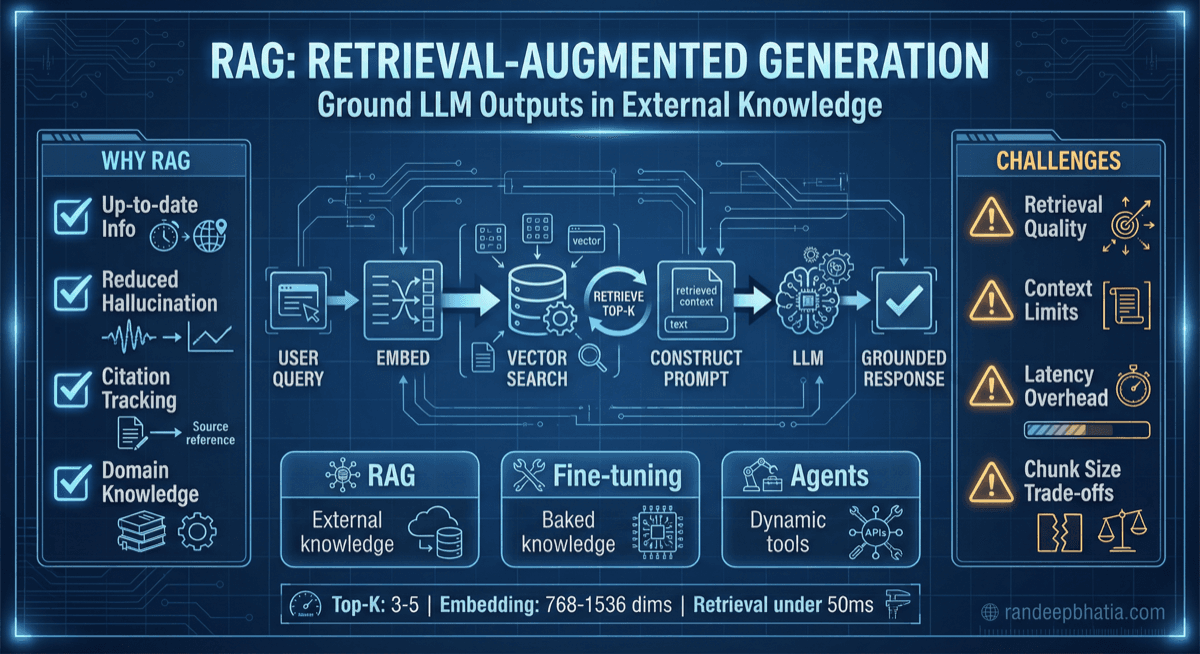
Retrieval-Augmented Generation (RAG) is an AI architecture pattern that enhances large language model outputs by retrieving relevant external knowledge at inference time and injecting it into the generation context.

1

RAG addresses LLM knowledge limitations by dynamically retrieving relevant documents from external knowledge bases during inference, enabling responses grounded in current, domain-specific, or proprietary information without model retraining.

2

The architecture consists of three core components: an indexing pipeline that processes and embeds documents, a retrieval system that finds semantically relevant content using vector similarity search, and an augmented generation step that synthesizes retrieved context with the user query.

3

RAG provides a cost-effective alternative to fine-tuning for knowledge-intensive tasks, offering advantages in maintainability, transparency, and the ability to cite sources while reducing hallucinations through grounded generation.

The Bottom Line

RAG has become the standard architectural pattern for building knowledge-intensive AI applications that require access to specific, current, or proprietary information. Organizations should implement RAG when they need LLM-powered systems that can accurately reference their own data while maintaining the ability to update knowledge without retraining models.

Definition

Retrieval-Augmented Generation (RAG) is a hybrid AI architecture that combines information retrieval systems with generative language models, enabling the model to access and incorporate external knowledge sources during the generation process.

The system retrieves relevant documents or passages from a knowledge base using semantic similarity search, then provides this retrieved context alongside the user query to the language model, which synthesizes the information to produce grounded, contextually accurate responses.

Extended Definition

RAG operates on the principle that language models can produce more accurate and reliable outputs when provided with relevant factual context at inference time, rather than relying solely on knowledge encoded in their parameters during training. The architecture typically employs dense vector representations (embeddings) to encode both the knowledge base documents and incoming queries into a shared semantic space, enabling efficient similarity-based retrieval. This retrieved context is then formatted and injected into the language model's prompt, effectively augmenting the model's parametric knowledge with non-parametric, retrievable information. The approach allows organizations to leverage the reasoning and language capabilities of foundation models while grounding outputs in their specific, potentially proprietary, and continuously updateable knowledge bases.

Etymology & Origins

The term 'Retrieval-Augmented Generation' was coined by Lewis et al. in their 2020 paper published by Facebook AI Research (now Meta AI), titled 'Retrieval-Augmented Generation for Knowledge-Intensive NLP Tasks.' The name directly describes the mechanism: generation (by a language model) that is augmented (enhanced or supplemented) by retrieval (fetching relevant information from external sources). The concept builds on decades of information retrieval research combined with the emergence of transformer-based language models, representing a convergence of search technology and generative AI.

Also Known As

Retrieval-Augmented Language ModelsRetrieval-Enhanced GenerationKnowledge-Grounded GenerationRetrieval-Based GenerationContext-Augmented GenerationDocument-Grounded GenerationKnowledge-Augmented LLMSemantic Search Generation

Not To Be Confused With

Fine-tuning

Fine-tuning modifies the model's internal parameters through additional training on domain-specific data, permanently encoding knowledge into the model weights. RAG keeps the model unchanged and provides knowledge externally at inference time, making it easier to update and maintain knowledge without retraining.

Prompt Engineering

Prompt engineering involves crafting effective instructions and examples within the prompt to guide model behavior. While RAG uses prompts, it specifically focuses on dynamically retrieving and injecting relevant external content rather than static prompt optimization.

In-Context Learning

In-context learning refers to a model's ability to learn from examples provided in the prompt. RAG is a specific application that uses retrieval to select which context to provide, whereas in-context learning is the underlying capability that makes RAG effective.

Knowledge Graphs

Knowledge graphs are structured representations of entities and relationships. While RAG can use knowledge graphs as a retrieval source, RAG itself is an architecture pattern that can work with various knowledge representations including unstructured text, structured data, or hybrid approaches.

Semantic Search

Semantic search is a retrieval technique that finds content based on meaning rather than keyword matching. RAG incorporates semantic search as its retrieval component but extends beyond search to include the generation step that synthesizes retrieved information into coherent responses.

Vector Databases

Vector databases are storage systems optimized for similarity search over high-dimensional vectors. They are a common infrastructure component in RAG systems but represent only the storage and retrieval layer, not the complete RAG architecture.

Conceptual Foundation

Core Principles

(8 principles)

Mental Models

(6 models)

Open-Book Examination

RAG is analogous to an open-book exam where the student (language model) can reference materials (retrieved documents) while answering questions, rather than relying solely on memorized knowledge. The quality of answers depends on both the student's reasoning ability and their skill in finding and using relevant reference materials.

Library Research Assistant

The RAG system functions like a research assistant who, when asked a question, first searches a library for relevant books and articles, then synthesizes the found information into a coherent answer. The assistant's value comes from both their search skills and their ability to understand and communicate the found information.

Two-Stage Funnel

RAG operates as a two-stage funnel: the retrieval stage broadly identifies potentially relevant content from a large corpus, then the generation stage deeply processes this filtered content to produce a precise response. Each stage has different optimization criteria and failure modes.

Memory Hierarchy

RAG creates a memory hierarchy similar to computer architecture: the knowledge base is like disk storage (large, persistent, slow to access), retrieved documents are like RAM (limited size, fast access, temporary), and the model's attention is like CPU cache (very limited, immediate access). Effective RAG manages data movement through this hierarchy.

Evidence-Based Reasoning

RAG implements an evidence-based reasoning pattern where claims in the generated output should be supported by evidence in the retrieved documents. The system's reliability depends on the quality of evidence retrieval and the model's faithfulness to that evidence.

Query Routing and Dispatch

The RAG retrieval process can be viewed as a routing and dispatch system that must determine which knowledge sources are relevant to each query and dispatch the query appropriately. Complex RAG systems may route to multiple indexes, databases, or even external APIs based on query characteristics.

Key Insights

(10 insights)

Retrieval quality has a multiplicative effect on overall system quality: a 10% improvement in retrieval precision often yields more than 10% improvement in answer quality because the language model can better utilize higher-quality context.

The optimal chunk size for retrieval is task-dependent and often differs from intuitive expectations; smaller chunks improve retrieval precision but may lose necessary context, while larger chunks preserve context but dilute relevance signals.

Embedding models trained on general web text may perform poorly on domain-specific content; evaluating embedding quality on representative queries from your actual use case is essential before committing to an embedding strategy.

Hybrid retrieval combining dense vector search with sparse keyword matching (BM25) often outperforms either approach alone, particularly for queries containing specific entities, technical terms, or rare words.

The 'lost in the middle' phenomenon means language models pay less attention to information in the middle of long contexts; placing the most relevant retrieved content at the beginning or end of the context improves utilization.

Query transformation techniques (query expansion, hypothetical document generation, multi-query retrieval) can dramatically improve retrieval recall for ambiguous or underspecified user queries.

Metadata filtering before or during vector search can improve both retrieval quality and latency by reducing the search space to contextually appropriate documents.

Reranking retrieved results with a cross-encoder model before generation significantly improves precision but adds latency; this tradeoff is often worthwhile for quality-sensitive applications.

The same document may need to be chunked differently for different retrieval use cases; a single chunking strategy rarely optimizes for all query types an application must handle.

RAG systems exhibit emergent failure modes at scale that are not apparent in small-scale testing, including embedding space degradation, retrieval latency variance, and context window competition between retrieved documents.

When to Use

Ideal Scenarios

(12)

Building question-answering systems over proprietary document collections such as internal wikis, policy documents, technical documentation, or research papers where the information is not in the language model's training data.

Creating customer support chatbots that need to reference product documentation, FAQs, troubleshooting guides, and support ticket histories to provide accurate, consistent responses.

Developing enterprise search applications that need to return not just relevant documents but synthesized answers that combine information from multiple sources.

Implementing compliance and legal research tools that must ground responses in specific regulatory documents, case law, or policy texts with citation requirements.

Building healthcare information systems that need to reference current medical literature, drug databases, clinical guidelines, and patient records while maintaining accuracy.

Creating educational assistants that can answer questions based on course materials, textbooks, and lecture content specific to an institution or curriculum.

Developing financial analysis tools that need to incorporate current market data, company filings, analyst reports, and news articles into their responses.

Building technical support systems for software products that must reference version-specific documentation, known issues databases, and configuration guides.

Implementing knowledge management systems that help employees find and synthesize information from across organizational knowledge repositories.

Creating research assistants that can search and synthesize findings from large collections of academic papers, patents, or technical reports.

Building content recommendation systems that need to explain recommendations based on content analysis and user preference data.

Developing due diligence tools that must analyze and synthesize information from multiple document types including contracts, financial statements, and regulatory filings.

Prerequisites

(8)
1

A well-defined corpus of documents or knowledge sources that contain the information needed to answer expected user queries, with sufficient coverage of the target domain.

2

Document content that is primarily text-based or can be meaningfully converted to text; RAG is less effective for knowledge encoded primarily in images, videos, or complex structured formats without text extraction.

3

Queries that can be meaningfully answered by retrieving and synthesizing existing content rather than requiring novel reasoning, computation, or real-time data not in the knowledge base.

4

Sufficient computational resources for embedding generation, vector storage, similarity search, and language model inference at the expected query volume.

5

Tolerance for retrieval latency added to the response time; RAG adds 100-500ms or more to response latency compared to direct language model queries.

6

Ability to maintain and update the knowledge base as source documents change; RAG systems require ongoing data pipeline maintenance.

7

Clear understanding of the query patterns and information needs of target users to inform chunking, embedding, and retrieval strategy decisions.

8

Acceptance that RAG reduces but does not eliminate hallucination; critical applications still require output validation or human review.

Signals You Need This

(10)

Users are asking questions that require information not in the language model's training data, such as recent events, proprietary information, or specialized domain knowledge.

The language model is generating plausible but incorrect answers because it lacks access to the specific facts needed to answer accurately.

You need to update the knowledge available to the system frequently without the cost and complexity of model fine-tuning.

Compliance or trust requirements mandate that generated responses be traceable to source documents with citations.

Users need answers that synthesize information from multiple documents rather than simply finding a single relevant document.

The knowledge base is too large to fit in a single prompt context, requiring selective retrieval of relevant portions.

You need to restrict the model's responses to information from approved sources rather than its general training data.

Fine-tuning experiments have shown limited improvement for your use case, suggesting the model architecture is capable but lacks access to necessary knowledge.

Users are frustrated with generic responses and need answers grounded in specific organizational context.

The application requires different knowledge bases for different users, tenants, or contexts that cannot be efficiently handled through fine-tuning.

Organizational Readiness

(7)

Data engineering capability to build and maintain document processing pipelines that extract, clean, chunk, and embed content from source systems.

Infrastructure team capacity to deploy and operate vector databases, embedding services, and language model inference at production scale.

Content ownership clarity to ensure documents in the knowledge base are appropriate for use and have clear update responsibilities.

Evaluation framework capability to measure retrieval quality, generation quality, and end-to-end system performance on representative queries.

Cross-functional alignment between teams responsible for content, infrastructure, and application development on quality standards and update processes.

Budget allocation for ongoing compute costs including embedding generation, vector storage, retrieval operations, and language model inference.

Security and compliance review processes that can evaluate data flows, access controls, and retention policies for RAG system components.

When NOT to Use

Anti-Patterns

(12)

Using RAG when the required knowledge is already well-represented in the language model's training data and parametric knowledge is sufficient for the use case.

Implementing RAG for tasks that require complex reasoning, computation, or multi-step problem-solving rather than knowledge retrieval and synthesis.

Applying RAG to queries that require real-time data (stock prices, weather, live sports scores) without integrating appropriate real-time data sources.

Using RAG when the knowledge base is poorly organized, contains contradictory information, or lacks the content needed to answer expected queries.

Implementing RAG for creative writing, brainstorming, or open-ended generation tasks where grounding in specific documents would constrain desired creativity.

Applying RAG when latency requirements are extremely strict (sub-100ms) and the retrieval overhead cannot be tolerated.

Using RAG as a substitute for proper data validation when the application requires guaranteed accuracy that exceeds what retrieval-augmented generation can provide.

Implementing RAG for simple classification or extraction tasks that can be handled more efficiently with fine-tuned models or traditional NLP approaches.

Applying RAG when the document corpus is extremely small (fewer than 100 documents) and could be included directly in the prompt without retrieval.

Using RAG for multilingual applications without ensuring embedding models and retrieval strategies work effectively across all target languages.

Implementing RAG when documents contain primarily structured data that would be better served by SQL queries or structured data retrieval approaches.

Applying RAG to highly sensitive applications where the risk of retrieving and exposing incorrect or inappropriate content is unacceptable.

Red Flags

(10)

The knowledge base contains significant amounts of outdated, incorrect, or contradictory information that would degrade response quality.

User queries are highly ambiguous and cannot be effectively matched to relevant documents without extensive query understanding capabilities.

The expected query volume and latency requirements would make RAG infrastructure costs prohibitive compared to alternatives.

Documents in the knowledge base are primarily in formats that cannot be effectively converted to text (complex diagrams, handwritten notes, video content).

The organization lacks the data engineering resources to maintain document processing pipelines and keep the knowledge base current.

Security requirements prevent storing document embeddings or require encryption that would prevent similarity search.

The use case requires perfect recall where missing any relevant document would be a critical failure.

Users expect conversational interactions with complex context tracking that simple RAG architectures cannot support.

The domain has highly specialized terminology that general-purpose embedding models cannot effectively represent.

Evaluation shows that retrieval quality is fundamentally limited by the nature of the documents and query patterns.

Better Alternatives

(8)
1
When:

The required knowledge is stable, well-defined, and can be encoded into model parameters

Use Instead:

Fine-tuning or continued pre-training

Why:

Fine-tuning encodes knowledge directly in model weights, eliminating retrieval latency and infrastructure complexity while potentially achieving better integration of knowledge with the model's reasoning capabilities.

2
When:

Queries require structured data lookups with exact matching requirements

Use Instead:

SQL databases with natural language interfaces

Why:

Structured query systems provide exact matches and aggregations that vector similarity search cannot guarantee, with better performance for queries over structured data.

3
When:

The knowledge base is small enough to fit in the context window

Use Instead:

Direct context injection without retrieval

Why:

If all relevant content fits in the prompt, retrieval adds unnecessary complexity and latency without improving quality.

4
When:

The task requires multi-step reasoning with tool use

Use Instead:

Agent architectures with tool calling

Why:

Agents can dynamically decide when to retrieve information, call APIs, or perform computations, providing more flexibility than static retrieval-then-generate patterns.

5
When:

Users need to find specific documents rather than synthesized answers

Use Instead:

Traditional search with semantic ranking

Why:

When users want to read source documents rather than generated summaries, search interfaces with good ranking provide better user experience than RAG.

6
When:

The application requires guaranteed factual accuracy with no tolerance for errors

Use Instead:

Rule-based systems or human-in-the-loop workflows

Why:

RAG reduces but does not eliminate generation errors; applications requiring guaranteed accuracy need deterministic systems or human verification.

7
When:

Real-time data is essential and changes frequently

Use Instead:

API-based retrieval with function calling

Why:

Live data sources accessed through APIs provide current information that static knowledge bases cannot match.

8
When:

The use case involves primarily code generation or technical implementation

Use Instead:

Code-specialized models with repository context

Why:

Code-focused models with repository-aware context management often outperform general RAG approaches for software development tasks.

Common Mistakes

(10)

Assuming RAG will work out-of-the-box without significant tuning of chunking strategies, embedding models, and retrieval parameters for the specific use case.

Using default chunk sizes without evaluating how different sizes affect retrieval quality for representative queries from the target application.

Selecting embedding models based on general benchmarks rather than evaluation on domain-specific content and query patterns.

Neglecting to implement hybrid retrieval (combining dense and sparse methods) for queries containing specific entities or technical terms.

Failing to implement reranking, resulting in suboptimal document ordering that degrades generation quality.

Ignoring the 'lost in the middle' phenomenon and placing important context in positions where the model pays less attention.

Not implementing query transformation for ambiguous or underspecified user queries that retrieve poorly with direct embedding.

Treating RAG as a one-time implementation rather than a system requiring ongoing monitoring, evaluation, and optimization.

Underestimating the importance of document preprocessing and cleaning in determining retrieval quality.

Failing to implement proper evaluation frameworks that measure both retrieval and generation quality independently.

Core Taxonomy

Primary Types

(8 types)

The simplest RAG implementation following a linear retrieve-then-generate pattern without advanced optimization techniques. Documents are chunked, embedded, and stored; queries are embedded and matched to retrieve top-k chunks; retrieved chunks are concatenated into the prompt for generation.

Characteristics
  • Single-stage retrieval without reranking
  • Fixed chunk sizes and overlap
  • Direct query embedding without transformation
  • Simple top-k retrieval based on similarity scores
  • Concatenation of retrieved chunks in retrieval order
Use Cases
Proof-of-concept implementationsLow-complexity knowledge basesApplications with relaxed quality requirementsInitial baseline for RAG system development
Tradeoffs

Simplest to implement and maintain but often produces suboptimal retrieval quality; serves as a baseline but rarely sufficient for production applications with quality requirements.

Classification Dimensions

Retrieval Granularity

The unit of content retrieved from the knowledge base, ranging from entire documents to individual tokens, with tradeoffs between context preservation and retrieval precision.

Document-level retrievalPassage-level retrievalSentence-level retrievalToken-level retrievalHierarchical retrieval

Retrieval Method

The algorithmic approach used to identify relevant content, with different methods excelling for different query and document characteristics.

Dense retrieval (vector similarity)Sparse retrieval (BM25, TF-IDF)Hybrid retrieval (dense + sparse)Learned sparse retrieval (SPLADE)Graph-based retrieval

Knowledge Source Type

The type of knowledge source from which information is retrieved, each requiring different indexing and retrieval strategies.

Unstructured text documentsStructured databasesKnowledge graphsAPIs and live data sourcesMulti-modal content

Retrieval Timing

When retrieval occurs relative to the generation process, affecting the ability to adapt retrieval based on generation needs.

Pre-generation retrievalInterleaved retrieval during generationPost-generation verification retrievalIterative retrieval with refinement

Context Integration Method

How retrieved content is integrated with the language model, ranging from simple prompt augmentation to architectural modifications.

Prompt concatenationFusion-in-decoderCross-attention integrationMemory-augmented generation

Deployment Architecture

The infrastructure architecture for deploying RAG systems, affecting scalability, latency, and operational characteristics.

Monolithic single-serviceMicroservices-basedServerless event-drivenEdge-deployedHybrid cloud-edge

Evolutionary Stages

1

Prototype RAG

1-4 weeks

Initial implementation using default configurations, single embedding model, basic chunking, and naive retrieval. Focus on proving the concept works for the use case with minimal optimization.

2

Optimized RAG

1-3 months

Tuned chunking strategies, evaluated and selected embedding models, implemented hybrid retrieval and reranking, established evaluation frameworks, and addressed major quality issues identified in prototype.

3

Production RAG

3-6 months

Full observability and monitoring, automated evaluation pipelines, established update processes for knowledge base, implemented caching and performance optimization, security hardening, and operational runbooks.

4

Advanced RAG

6-12 months

Sophisticated retrieval strategies including agentic or modular approaches, multi-source retrieval, advanced query understanding, continuous learning from user feedback, and integration with broader AI systems.

5

Enterprise RAG Platform

12-24 months

Multi-tenant architecture, self-service knowledge base management, automated quality monitoring, governance and compliance frameworks, integration with enterprise systems, and platform capabilities for multiple applications.

Architecture Patterns

Architecture Patterns

(8 patterns)

Basic Retrieve-and-Generate

The foundational RAG pattern where a query is embedded, similar documents are retrieved from a vector store, and retrieved content is concatenated into a prompt for the language model to generate a response.

Components
  • Embedding model for query encoding
  • Vector database for document storage and retrieval
  • Language model for response generation
  • Prompt template for context integration
Data Flow

User query → Query embedding → Vector similarity search → Top-k document retrieval → Prompt construction with retrieved context → LLM generation → Response

Best For
  • Simple knowledge-base Q&A applications
  • Initial RAG implementations and prototypes
  • Use cases with straightforward query-document matching
  • Applications with moderate quality requirements
Limitations
  • No query transformation for ambiguous queries
  • Single retrieval strategy may miss relevant content
  • No reranking to optimize document ordering
  • Limited handling of multi-hop or complex queries
Scaling Characteristics

Scales horizontally by adding vector database replicas and LLM inference capacity. Retrieval latency scales logarithmically with corpus size using approximate nearest neighbor algorithms. Generation latency depends on context length and model size.

Integration Points

Document Processing Pipeline

Ingests raw documents from source systems, extracts text, applies cleaning and normalization, chunks content, generates embeddings, and loads into vector storage.

Interfaces:
Source system connectors (S3, databases, APIs)Document parsing libraries (PDF, HTML, Office)Embedding model APIVector database write API

Must handle diverse document formats, maintain provenance metadata, support incremental updates, and scale with document volume. Error handling for malformed documents is critical.

Vector Database

Stores document embeddings and metadata, provides similarity search capabilities, supports filtering and hybrid queries, and maintains index freshness.

Interfaces:
Write API for document ingestionQuery API for similarity searchMetadata filtering interfaceIndex management operations

Selection impacts latency, scale limits, cost, and feature availability. Must evaluate consistency guarantees, backup/recovery, and multi-tenancy support for production use.

Embedding Service

Generates vector representations for both documents during indexing and queries during retrieval, ensuring consistent embedding space for similarity matching.

Interfaces:
Batch embedding API for documentsSingle embedding API for queriesModel versioning interface

Embedding model selection significantly impacts retrieval quality. Must plan for model updates and re-embedding requirements. Consider latency and throughput for query-time embedding.

Retrieval Service

Orchestrates the retrieval process including query transformation, multi-source retrieval, result fusion, and reranking to produce the optimal set of documents for generation.

Interfaces:
Query input interfaceVector database query interfaceReranker model interfaceRetrieved documents output

Central point for retrieval optimization. Should support configurable retrieval strategies, A/B testing, and detailed logging for debugging retrieval quality issues.

Language Model Service

Generates responses based on the constructed prompt containing retrieved context and user query, handling prompt formatting, inference, and response parsing.

Interfaces:
Prompt submission APIStreaming response interfaceToken usage reportingModel selection interface

May use external APIs or self-hosted models. Must handle rate limits, retries, and failover. Context window limits constrain how much retrieved content can be used.

Observability Stack

Collects metrics, logs, and traces across all RAG components to enable monitoring, debugging, and continuous improvement of system quality and performance.

Interfaces:
Metrics collection endpointsStructured logging interfaceDistributed tracing integrationAlerting webhook interface

Essential for production operations. Must capture retrieval quality signals, generation quality indicators, latency breakdowns, and cost metrics. Enable correlation across pipeline stages.

Evaluation Framework

Systematically measures RAG system quality including retrieval relevance, generation faithfulness, answer correctness, and end-to-end user satisfaction.

Interfaces:
Test dataset managementAutomated evaluation pipelineHuman evaluation interfaceMetrics reporting dashboard

Critical for iterative improvement. Must support both offline evaluation on test sets and online evaluation of production traffic. Consider LLM-as-judge approaches for scalable evaluation.

Knowledge Base Management

Provides interfaces for content owners to add, update, and remove documents from the knowledge base, with appropriate access controls and audit logging.

Interfaces:
Document upload interfaceMetadata managementAccess control configurationUpdate scheduling

Enables knowledge base maintenance without engineering involvement. Must handle document versioning, deletion propagation to indexes, and validation of uploaded content.

Decision Framework

✓ If Yes

RAG is likely appropriate; proceed to evaluate implementation approach

✗ If No

Consider whether fine-tuning or prompt engineering alone might suffice

Considerations

Evaluate the knowledge gap between LLM capabilities and application requirements. Test the base model on representative queries to assess baseline performance.

Technical Deep Dive

Overview

Retrieval-Augmented Generation operates through a coordinated pipeline that bridges information retrieval systems with generative language models. The fundamental insight is that language models can produce more accurate, grounded responses when provided with relevant factual context at inference time, rather than relying solely on knowledge encoded during training. This is achieved by converting both the knowledge base and incoming queries into a shared vector representation space where semantic similarity can be efficiently computed. The system maintains a knowledge base of documents that have been processed through an indexing pipeline. During indexing, documents are split into manageable chunks, each chunk is converted into a dense vector embedding that captures its semantic meaning, and these embeddings are stored in a vector database optimized for similarity search. When a user submits a query, the same embedding process converts the query into a vector, which is then compared against all document vectors to find the most semantically similar content. The retrieved documents are then formatted and injected into the prompt sent to the language model, providing it with relevant context for generating a response. The language model synthesizes this retrieved information with its parametric knowledge and reasoning capabilities to produce a coherent, contextually grounded answer. This architecture allows the system to access knowledge that may not be in the model's training data, provide up-to-date information, and cite specific sources for generated claims. The effectiveness of RAG depends critically on the quality of each pipeline stage: document processing must preserve relevant information while creating retrievable units, embeddings must capture semantic meaning relevant to expected queries, retrieval must surface the most relevant content, and generation must faithfully use the provided context. Weaknesses in any stage propagate through the pipeline, making end-to-end evaluation essential.

Step-by-Step Process

Raw documents are collected from source systems (databases, file storage, APIs, web crawlers) and loaded into the processing pipeline. Documents may be in various formats including PDF, HTML, Word, Markdown, or plain text. Metadata such as source, date, author, and access permissions is extracted and preserved alongside the content.

⚠️ Pitfalls to Avoid

Failing to handle diverse document formats leads to content loss. Not preserving metadata limits filtering capabilities. Ignoring document structure (headers, sections) loses valuable organizational information.

Under The Hood

At the core of RAG's retrieval mechanism are dense vector embeddings produced by transformer-based encoder models. These models, trained on large text corpora with contrastive learning objectives, learn to map semantically similar text to nearby points in a high-dimensional vector space. The embedding process involves tokenizing input text, passing tokens through transformer layers that apply self-attention to capture contextual relationships, and pooling the output representations (typically using the [CLS] token or mean pooling) into a fixed-size vector. The resulting embeddings capture semantic meaning in a way that enables similarity computation through simple vector operations. Vector databases employ approximate nearest neighbor (ANN) algorithms to enable efficient similarity search over millions or billions of vectors. The most common approach is Hierarchical Navigable Small World (HNSW) graphs, which build a multi-layer graph structure where each node connects to its nearest neighbors. Search traverses this graph from a random entry point, greedily moving to closer neighbors until reaching a local minimum. This achieves sub-linear search complexity (typically O(log n)) with recall rates above 95% for well-tuned parameters. Alternative approaches include Inverted File (IVF) indexes that partition the vector space into clusters and only search relevant clusters, and Product Quantization (PQ) that compresses vectors to reduce memory requirements. The reranking stage employs cross-encoder models that process the query and document together, enabling rich interaction between their representations through cross-attention. Unlike bi-encoders that independently embed query and document, cross-encoders can capture fine-grained relevance signals but require O(n) inference calls for n candidates, making them impractical for initial retrieval but valuable for reranking a small candidate set. Modern rerankers are typically fine-tuned on relevance judgment datasets and can significantly improve precision over bi-encoder retrieval alone. Context integration with the language model leverages the model's in-context learning capabilities. When relevant documents are included in the prompt, the model's attention mechanism can attend to this information during generation, effectively using it as an external memory. The model learns during pre-training to incorporate provided context into its responses, though the degree to which it relies on context versus parametric knowledge varies based on prompt design, context relevance, and model characteristics. Research has shown that models exhibit a 'lost in the middle' phenomenon where information in the middle of long contexts receives less attention, motivating careful context ordering strategies. The chunking process fundamentally shapes retrieval quality. Chunks must be small enough to be retrievable (a document about many topics will match many queries poorly) but large enough to be useful (a single sentence may lack necessary context). Advanced chunking strategies include semantic chunking that uses embedding similarity to identify natural break points, parent-child chunking that maintains links between chunks and their containing documents, and proposition-based chunking that extracts atomic facts. The optimal strategy depends on document characteristics and query patterns, often requiring empirical evaluation.

Failure Modes

Root Cause

Query-document semantic mismatch, poor embedding model fit for domain, chunking that fragments relevant content, or knowledge base lacking coverage for the query topic.

Symptoms
  • Generated responses are generic or based on model's parametric knowledge
  • Low retrieval similarity scores across all results
  • User feedback indicates answers don't address their questions
  • High rate of 'I don't know' or hedged responses
Impact

Users receive unhelpful or potentially incorrect responses. Trust in the system degrades. The primary value proposition of RAG (grounded generation) is not delivered.

Prevention

Evaluate embedding models on domain-specific queries before deployment. Implement query coverage analysis to identify knowledge gaps. Use hybrid retrieval to capture both semantic and keyword matches.

Mitigation

Implement fallback strategies for low-confidence retrieval. Add query transformation to improve matching. Surface retrieval confidence to users. Route to human support for unhandled queries.

Operational Considerations

Key Metrics (15)

Time from query receipt to retrieval completion, including embedding generation, vector search, and reranking.

Normalp50: 50-150ms, p95: 150-300ms, p99: 300-500ms
Alertp95 > 500ms sustained for 5 minutes
ResponseInvestigate vector database performance, check for resource contention, review recent changes to retrieval configuration.

Dashboard Panels

End-to-end latency distribution with p50/p95/p99 trend linesLatency breakdown by pipeline stage (embedding, retrieval, reranking, generation)Retrieval quality metrics (recall, precision, MRR) over timeError rates by stage and error typeCache hit rate and cache size trendsKnowledge base freshness and ingestion lagToken usage distribution and cost trackingQuery volume and throughput trendsUser feedback sentiment over timeTop failing queries and error patterns

Alerting Strategy

Implement tiered alerting with different severity levels. P1 alerts for complete outages or data leakage require immediate response. P2 alerts for significant quality degradation or latency SLA violations require response within 1 hour. P3 alerts for trending metrics approaching thresholds require investigation within 24 hours. Use anomaly detection for metrics with variable baselines. Implement alert aggregation to prevent alert fatigue during incidents.

Cost Analysis

Cost Drivers

(10)

LLM Inference (Generation)

Impact:

Typically 40-70% of total RAG cost. Scales with query volume, context length, and response length. Varies significantly by model choice.

Optimization:

Use smaller models where quality permits. Implement response caching. Optimize context length. Consider self-hosted models at scale. Use streaming to enable early termination.

Embedding Generation

Impact:

10-20% of cost. Includes both indexing (one-time per document) and query-time embedding (per query).

Optimization:

Batch embedding requests. Cache query embeddings. Use efficient embedding models. Consider self-hosted embedding for high volume.

Vector Database Storage and Compute

Impact:

10-25% of cost. Scales with corpus size, query volume, and performance requirements.

Optimization:

Right-size instances. Use appropriate index types. Implement data lifecycle policies. Consider serverless options for variable load.

Reranking Model Inference

Impact:

5-15% of cost. Scales with query volume and candidate set size.

Optimization:

Limit candidate set size. Use efficient reranker models. Skip reranking for high-confidence retrievals. Cache reranking results.

Document Processing Pipeline

Impact:

5-10% of cost. Includes parsing, chunking, and preprocessing compute.

Optimization:

Use efficient parsing libraries. Batch processing. Optimize chunking algorithms. Use spot/preemptible instances for batch jobs.

Network and Data Transfer

Impact:

2-10% of cost. Includes API calls, data transfer between services, and egress charges.

Optimization:

Co-locate services. Compress data in transit. Minimize cross-region traffic. Use private endpoints where available.

Observability and Logging

Impact:

3-8% of cost. Scales with query volume and log verbosity.

Optimization:

Sample logs appropriately. Use log levels effectively. Implement log retention policies. Aggregate metrics before storage.

Development and Maintenance Labor

Impact:

Often exceeds infrastructure costs. Includes initial development, ongoing optimization, and operational support.

Optimization:

Use managed services to reduce operational burden. Invest in automation. Build reusable components. Document thoroughly to reduce knowledge silos.

Evaluation and Testing

Impact:

5-10% of ongoing cost. Includes LLM-based evaluation, human evaluation, and test infrastructure.

Optimization:

Use efficient evaluation methods. Sample appropriately. Automate evaluation pipelines. Balance LLM and human evaluation based on cost-quality tradeoffs.

Redundancy and Disaster Recovery

Impact:

20-50% additional infrastructure cost for high availability.

Optimization:

Right-size redundancy to actual requirements. Use cloud-native HA features. Implement cost-effective backup strategies.

Cost Models

Per-Query Cost Model

Cost per query = (embedding_cost) + (retrieval_cost) + (reranking_cost) + (generation_cost)
Variables:
embedding_cost = query_tokens * embedding_price_per_tokenretrieval_cost = base_query_cost + (results_count * per_result_cost)reranking_cost = candidates * reranker_price_per_pairgeneration_cost = (input_tokens + output_tokens) * llm_price_per_token
Example:

For a typical query: embedding ($0.0001) + retrieval ($0.0005) + reranking ($0.001) + generation (4000 input + 500 output tokens at $0.01/1K = $0.045) = ~$0.047 per query

Monthly Infrastructure Cost Model

Monthly cost = (vector_db_cost) + (compute_cost) + (storage_cost) + (api_costs) + (observability_cost)
Variables:
vector_db_cost = instance_cost * instances + storage_gb * storage_pricecompute_cost = application_instances * instance_price * hoursstorage_cost = document_storage_gb * storage_priceapi_costs = (queries * per_query_api_cost) + (embeddings * embedding_api_cost)observability_cost = log_gb * log_price + metrics_count * metric_price
Example:

Medium deployment: Vector DB ($500) + Compute ($300) + Storage ($50) + APIs ($2000) + Observability ($150) = ~$3000/month base + variable API costs

Indexing Cost Model

Indexing cost = documents * (parsing_cost + chunking_cost + embedding_cost + storage_cost)
Variables:
parsing_cost = document_size * parsing_compute_ratechunking_cost = document_tokens * chunking_compute_rateembedding_cost = chunks_per_doc * tokens_per_chunk * embedding_pricestorage_cost = chunks_per_doc * (vector_size + metadata_size) * storage_price
Example:

Indexing 100K documents (avg 10 pages each): Parsing ($50) + Chunking ($20) + Embedding ($200) + Storage ($100) = ~$370 one-time cost

Total Cost of Ownership Model

Annual TCO = (infrastructure_cost * 12) + (development_cost) + (maintenance_cost) + (opportunity_cost)
Variables:
infrastructure_cost = monthly compute + storage + API costsdevelopment_cost = engineering_hours * hourly_ratemaintenance_cost = ongoing_engineering + vendor_supportopportunity_cost = time_to_market_delay * business_value
Example:

Year 1 TCO: Infrastructure ($36K) + Development ($100K) + Maintenance ($30K) = ~$166K, decreasing in subsequent years as development amortizes

Optimization Strategies

  • 1Implement semantic caching to serve repeated or similar queries without full pipeline execution, potentially reducing costs by 20-50% depending on query distribution
  • 2Use tiered model selection: route simple queries to smaller, cheaper models while reserving expensive models for complex queries
  • 3Optimize context length by retrieving fewer documents or using summarization, reducing LLM token costs
  • 4Batch embedding requests during indexing to reduce API call overhead and potentially access volume discounts
  • 5Implement query deduplication to avoid processing identical concurrent queries multiple times
  • 6Use spot or preemptible instances for batch processing workloads like document indexing
  • 7Right-size vector database instances based on actual query patterns rather than peak theoretical load
  • 8Implement data lifecycle policies to archive or delete outdated content, reducing storage and search costs
  • 9Consider self-hosted models for embedding and generation at scale where the break-even point favors owned infrastructure
  • 10Use streaming responses to enable users to get value faster and potentially terminate early, reducing output tokens
  • 11Implement request prioritization to ensure high-value queries get resources while lower-priority queries can be queued or degraded
  • 12Monitor and optimize token usage in prompts, removing unnecessary instructions or examples that inflate costs

Hidden Costs

  • 💰Re-indexing costs when embedding models are upgraded or chunking strategies change, potentially requiring processing of entire corpus
  • 💰Evaluation costs for ongoing quality monitoring, including LLM-based evaluation and periodic human evaluation
  • 💰Incident response costs when quality issues or outages require engineering time to diagnose and resolve
  • 💰Training and onboarding costs for team members learning RAG-specific skills and tools
  • 💰Technical debt costs from quick implementations that require later refactoring
  • 💰Vendor lock-in costs if architecture becomes dependent on specific providers, limiting negotiating leverage
  • 💰Compliance costs for auditing, documentation, and controls required in regulated industries
  • 💰Opportunity costs from engineering time spent on RAG maintenance rather than new features

ROI Considerations

RAG ROI should be evaluated against the alternatives: fine-tuning, larger context windows, or human-powered information retrieval. Fine-tuning has higher upfront costs but lower per-query costs for stable knowledge; RAG is more cost-effective when knowledge changes frequently or when multiple knowledge bases are needed. Compared to human information retrieval, RAG typically provides 10-100x cost reduction per query while enabling 24/7 availability and consistent response times. The primary value drivers for RAG ROI include: reduced time for users to find information (productivity gains), improved accuracy of information access (reduced errors and their costs), enablement of new use cases not feasible with manual processes, and reduced load on human experts for routine questions. Organizations should quantify these benefits against their specific use cases. Break-even analysis should consider both direct costs (infrastructure, APIs) and indirect costs (development, maintenance). A typical RAG implementation breaks even within 6-12 months for applications with sufficient query volume (>1000 queries/day) and clear productivity benefits. Smaller scale deployments may have longer payback periods but can still be justified by strategic value or user experience improvements. Risk-adjusted ROI should account for implementation uncertainty, potential quality issues, and the possibility that RAG may not fully solve the target use case. Pilot implementations with clear success criteria help de-risk larger investments.

Security Considerations

Threat Model

(10 threats)
1

Prompt Injection via Retrieved Content

Attack Vector

Malicious content in knowledge base contains instructions that manipulate model behavior when retrieved and included in the prompt.

Impact

Model may ignore system instructions, reveal sensitive information, generate harmful content, or behave unexpectedly.

Mitigation

Sanitize content before indexing. Use prompt structures that clearly separate instructions from content. Implement output filtering. Limit knowledge base to trusted sources. Regular security scanning of indexed content.

2

Data Exfiltration via Query

Attack Vector

Attacker crafts queries designed to retrieve and expose sensitive documents they shouldn't have access to.

Impact

Unauthorized access to confidential information. Compliance violations. Competitive intelligence leakage.

Mitigation

Implement robust access control at retrieval time. Filter results based on user permissions. Log and monitor query patterns for anomalies. Implement rate limiting.

3

Knowledge Base Poisoning

Attack Vector

Attacker introduces malicious or false content into the knowledge base through compromised data sources or ingestion pipelines.

Impact

System provides incorrect or harmful information. Reputation damage. Potential legal liability.

Mitigation

Validate content sources. Implement content review workflows. Monitor for anomalous content patterns. Maintain audit trails for all content changes.

4

Model Output Data Leakage

Attack Vector

Model inadvertently includes sensitive information from retrieved documents in responses to users who shouldn't see that information.

Impact

Privacy violations. Confidential information exposure. Regulatory penalties.

Mitigation

Implement output filtering for sensitive patterns. Apply access controls before retrieval. Use separate indexes for different sensitivity levels. Regular auditing of responses.

5

Embedding Inversion Attack

Attack Vector

Attacker with access to embeddings attempts to reconstruct original text content from vector representations.

Impact

Exposure of document content even if original text is protected.

Mitigation

Protect embedding storage with appropriate access controls. Consider embedding encryption. Limit embedding API access. Monitor for bulk embedding extraction.

6

Denial of Service via Complex Queries

Attack Vector

Attacker submits queries designed to consume excessive resources (very long queries, queries triggering expensive retrievals).

Impact

Service degradation or unavailability. Increased costs. Impact on legitimate users.

Mitigation

Implement query length limits. Set resource quotas per user. Rate limiting. Query complexity analysis and rejection.

7

Multi-Tenant Data Leakage

Attack Vector

Insufficient isolation between tenants allows queries from one tenant to retrieve documents belonging to another.

Impact

Severe privacy violation. Customer trust destruction. Legal liability. Regulatory penalties.

Mitigation

Implement strict tenant isolation at all layers. Use separate indexes or robust filtering. Regular security audits. Penetration testing for isolation.

8

API Key or Credential Exposure

Attack Vector

Embedding or LLM API keys exposed through logs, error messages, or code repositories.

Impact

Unauthorized API usage. Cost exposure. Potential access to other resources.

Mitigation

Use secrets management. Rotate keys regularly. Audit key usage. Implement key scoping and least privilege.

9

Supply Chain Attack on Models

Attack Vector

Compromised embedding or language models contain backdoors or malicious behavior.

Impact

Unpredictable system behavior. Data exfiltration. Harmful outputs.

Mitigation

Use models from trusted sources. Verify model checksums. Monitor model behavior for anomalies. Maintain ability to quickly switch models.

10

Inference of Private Information

Attack Vector

Attacker uses patterns in retrieval results or model responses to infer information about the knowledge base or other users.

Impact

Privacy leakage through side channels. Competitive intelligence exposure.

Mitigation

Add noise to retrieval scores. Implement differential privacy where appropriate. Monitor for inference attack patterns.

Security Best Practices

  • Implement defense in depth with security controls at every pipeline stage
  • Apply principle of least privilege for all service accounts and API keys
  • Encrypt data at rest and in transit throughout the pipeline
  • Implement comprehensive audit logging for all data access and modifications
  • Use separate indexes or strict filtering for different sensitivity levels
  • Sanitize and validate all content before indexing
  • Implement input validation and output filtering
  • Regular security assessments and penetration testing
  • Maintain incident response procedures specific to RAG systems
  • Implement rate limiting and abuse detection
  • Use secure defaults and fail-closed behavior
  • Regular rotation of API keys and credentials
  • Monitor for anomalous query patterns and access attempts
  • Implement content security policies for user-facing outputs
  • Maintain security documentation and threat model updates

Data Protection

  • 🔒Classify all documents in knowledge base by sensitivity level before indexing
  • 🔒Implement encryption for embeddings and document content at rest using industry-standard algorithms
  • 🔒Use TLS 1.3 for all data in transit between RAG components
  • 🔒Implement access controls that enforce data classification at retrieval time
  • 🔒Maintain separate indexes for different data sensitivity levels to prevent cross-contamination
  • 🔒Implement data retention policies with automated deletion of expired content
  • 🔒Use tokenization or pseudonymization for sensitive fields where full content is not needed
  • 🔒Implement secure deletion that removes both documents and their embeddings
  • 🔒Maintain data lineage tracking from source through embedding to retrieval
  • 🔒Regular data protection impact assessments for RAG systems handling personal data

Compliance Implications

GDPR (General Data Protection Regulation)

Requirement:

Right to erasure, data minimization, purpose limitation, and cross-border transfer restrictions for EU personal data.

Implementation:

Implement document deletion that propagates to embeddings. Maintain data processing records. Ensure embedding storage complies with transfer requirements. Support data subject access requests.

HIPAA (Health Insurance Portability and Accountability Act)

Requirement:

Protection of Protected Health Information (PHI) with technical safeguards, access controls, and audit trails.

Implementation:

Implement BAA with all vendors processing PHI. Encrypt PHI at rest and in transit. Comprehensive access logging. Minimum necessary access principle.

SOC 2

Requirement:

Security, availability, processing integrity, confidentiality, and privacy controls with evidence of effectiveness.

Implementation:

Document all security controls. Implement monitoring and alerting. Maintain evidence of control effectiveness. Regular control testing.

CCPA/CPRA (California Consumer Privacy Act)

Requirement:

Consumer rights to know, delete, and opt-out of sale of personal information.

Implementation:

Implement data inventory including RAG knowledge bases. Support deletion requests. Provide transparency about data use in RAG.

PCI DSS (Payment Card Industry Data Security Standard)

Requirement:

Protection of cardholder data with specific technical and operational requirements.

Implementation:

Ensure cardholder data is not indexed in RAG systems. If necessary, implement full PCI DSS controls on RAG infrastructure.

FINRA/SEC Regulations

Requirement:

Record retention, supervision, and compliance requirements for financial services communications.

Implementation:

Retain RAG interactions as required. Implement supervision workflows. Ensure generated content complies with advertising rules.

AI-Specific Regulations (EU AI Act, etc.)

Requirement:

Transparency, human oversight, and risk management for AI systems, with specific requirements based on risk level.

Implementation:

Document RAG system capabilities and limitations. Implement human oversight mechanisms. Conduct risk assessments. Maintain technical documentation.

Industry-Specific Regulations

Requirement:

Various requirements depending on industry (healthcare, finance, legal, etc.).

Implementation:

Conduct regulatory analysis for specific industry. Implement required controls. Maintain compliance documentation. Regular compliance audits.

Scaling Guide

Scaling Dimensions

Query Volume (Throughput)

Strategy:

Horizontal scaling of retrieval and generation services. Add vector database replicas for read scaling. Implement request queuing and load balancing. Use caching to reduce backend load.

Limits:

Limited by LLM inference capacity and cost. Vector database query throughput per replica. Network bandwidth between services.

Considerations:

Cost scales linearly with query volume for API-based LLMs. Consider self-hosted models at high volume. Implement request prioritization for mixed workloads.

Knowledge Base Size (Corpus Scale)

Strategy:

Use scalable vector databases with sharding support. Implement hierarchical retrieval for very large corpora. Consider index partitioning by domain or time.

Limits:

Single-node vector database limits (typically 10-100M vectors). Query latency increases with corpus size even with ANN algorithms.

Considerations:

Larger corpora require more sophisticated retrieval strategies. Consider pre-filtering to reduce search space. Monitor retrieval quality as corpus grows.

Document Ingestion Rate

Strategy:

Parallelize document processing pipeline. Use queue-based architecture for ingestion. Batch embedding requests. Implement incremental indexing.

Limits:

Embedding API rate limits. Vector database write throughput. Processing pipeline compute capacity.

Considerations:

Balance freshness requirements against processing efficiency. Implement priority queues for urgent content. Monitor ingestion lag.

Context Length (Retrieved Content)

Strategy:

Use models with larger context windows. Implement context compression and summarization. Optimize chunk selection to maximize information density.

Limits:

Model context window limits (4K-128K+ tokens). Latency and cost increase with context length. 'Lost in the middle' effect.

Considerations:

Longer context enables more retrieved content but increases cost and may reduce quality. Evaluate optimal context length for use case.

Concurrent Users

Strategy:

Implement connection pooling and request queuing. Use auto-scaling based on concurrent request metrics. Implement graceful degradation under load.

Limits:

Backend service connection limits. Memory for maintaining concurrent contexts. Response time SLAs under load.

Considerations:

Concurrent users create bursty load patterns. Implement request coalescing for identical queries. Consider reservation systems for guaranteed capacity.

Multi-Tenancy

Strategy:

Implement tenant isolation at data and compute levels. Use tenant-specific indexes or robust filtering. Consider dedicated resources for large tenants.

Limits:

Overhead of tenant isolation. Complexity of multi-tenant operations. Noisy neighbor effects.

Considerations:

Balance isolation strength against operational complexity. Implement tenant-level quotas and monitoring. Plan for tenant onboarding and offboarding.

Geographic Distribution

Strategy:

Deploy in multiple regions for latency and compliance. Implement data replication strategies. Use edge caching where appropriate.

Limits:

Data residency requirements may prevent replication. Cross-region latency for centralized components. Consistency challenges.

Considerations:

Evaluate latency requirements against data residency constraints. Consider read replicas in user regions with writes to primary. Implement region-aware routing.

Response Latency Requirements

Strategy:

Implement caching at multiple levels. Use streaming responses. Optimize each pipeline stage. Consider pre-computation for predictable queries.

Limits:

Fundamental latency of LLM inference. Network latency between services. Trade-off between latency and quality.

Considerations:

Identify latency budget for each stage. Implement adaptive quality based on latency constraints. Use async processing where real-time not required.

Capacity Planning

Key Factors:
Expected query volume (queries per second, daily/monthly totals)Query complexity distribution (simple vs. multi-hop)Knowledge base size (document count, total tokens)Knowledge base growth rateResponse latency requirements (p50, p95, p99 targets)Availability requirements (uptime SLA)Concurrent user expectationsGeographic distribution of usersBudget constraints
Formula:Required capacity = (peak_qps * safety_margin) / (throughput_per_instance * (1 - target_utilization)). For vector database: storage = documents * chunks_per_doc * (embedding_dims * 4 bytes + metadata_size) * index_overhead. For LLM: required_throughput = qps * avg_tokens_per_request / tokens_per_second_per_instance.
Safety Margin:

Plan for 2-3x expected peak load to handle traffic spikes and provide headroom for growth. Maintain at least 30% unused capacity during normal operations. Plan infrastructure changes 3-6 months ahead of projected needs.

Scaling Milestones

Prototype (< 100 queries/day)
Challenges:
  • Proving concept viability
  • Establishing quality baselines
  • Defining evaluation criteria
Architecture Changes:

Single-instance deployment acceptable. Focus on functionality over scalability. Use managed services to minimize operational overhead.

Pilot (100-1,000 queries/day)
Challenges:
  • Handling diverse real user queries
  • Establishing operational processes
  • Gathering user feedback systematically
Architecture Changes:

Implement basic monitoring and alerting. Add caching for common queries. Establish backup and recovery procedures.

Production (1,000-10,000 queries/day)
Challenges:
  • Meeting latency SLAs consistently
  • Managing knowledge base updates
  • Cost optimization
Architecture Changes:

Implement redundancy for critical components. Add comprehensive observability. Implement CI/CD for configuration changes. Consider hybrid retrieval.

Growth (10,000-100,000 queries/day)
Challenges:
  • Scaling infrastructure cost-effectively
  • Maintaining quality at scale
  • Operational complexity
Architecture Changes:

Implement auto-scaling. Add semantic caching. Consider self-hosted models for cost. Implement advanced retrieval strategies.

Enterprise (100,000-1,000,000 queries/day)
Challenges:
  • Multi-region deployment
  • Complex multi-tenancy
  • Sophisticated cost management
Architecture Changes:

Distributed architecture across regions. Dedicated infrastructure for large tenants. Advanced caching and pre-computation. Platform capabilities for multiple applications.

Hyperscale (> 1,000,000 queries/day)
Challenges:
  • Extreme cost optimization
  • Global consistency
  • Custom infrastructure requirements
Architecture Changes:

Custom-built components for critical paths. Sophisticated traffic management. ML-based optimization of all parameters. Dedicated teams for each major component.

Benchmarks

Industry Benchmarks

MetricP50P95P99 World Class
Retrieval Recall@100.700.850.92> 0.95
Retrieval MRR (Mean Reciprocal Rank)0.550.750.85> 0.90
Answer Faithfulness0.750.880.94> 0.95
Answer Relevance0.700.850.92> 0.95
End-to-End Latency (p50)2.5s1.5s1.0s< 0.8s
End-to-End Latency (p95)5.0s3.0s2.0s< 1.5s
Retrieval Latency (p50)150ms80ms50ms< 30ms
Hallucination Rate15%8%4%< 2%
Cache Hit Rate25%45%60%> 70%
System Availability99.0%99.9%99.95%> 99.99%
Cost per Query$0.08$0.04$0.02< $0.01
Knowledge Base Freshness48 hours12 hours2 hours< 15 minutes

Comparison Matrix

ApproachKnowledge CurrencySetup CostPer-Query CostLatencyAccuracyCitabilityMaintenance
RAGReal-time possibleMediumMediumMedium (1-5s)High (grounded)ExcellentMedium
Fine-tuningStatic (training time)HighLowLow (<1s)Medium-HighPoorHigh (retraining)
Large ContextReal-timeLowHighHigh (context dependent)MediumMediumLow
Parametric OnlyTraining cutoffNoneLowLowVariableNoneNone
Traditional SearchReal-timeLowVery LowVery LowN/A (retrieval only)ExcellentLow
RAG + Fine-tuningReal-time + embeddedVery HighMediumMediumVery HighExcellentVery High
Agentic RAGReal-time + dynamicHighHighHigh (variable)High (complex queries)GoodHigh
Graph RAGReal-timeVery HighMedium-HighMediumHigh (relationships)ExcellentVery High

Performance Tiers

Basic

Naive RAG with default configurations. Suitable for internal tools and low-stakes applications.

Target:

Recall@10 > 0.6, Latency p95 < 8s, Availability > 99%

Standard

Optimized RAG with hybrid retrieval and reranking. Suitable for most production applications.

Target:

Recall@10 > 0.75, Faithfulness > 0.8, Latency p95 < 5s, Availability > 99.5%

Advanced

Sophisticated RAG with advanced retrieval, caching, and quality optimization. Suitable for customer-facing applications.

Target:

Recall@10 > 0.85, Faithfulness > 0.9, Latency p95 < 3s, Availability > 99.9%

Enterprise

Full-featured RAG platform with multi-tenancy, advanced security, and comprehensive observability. Suitable for mission-critical applications.

Target:

Recall@10 > 0.9, Faithfulness > 0.95, Latency p95 < 2s, Availability > 99.95%

World-Class

State-of-the-art RAG with custom models, advanced architectures, and continuous optimization. Suitable for competitive differentiation.

Target:

Recall@10 > 0.95, Faithfulness > 0.97, Latency p95 < 1.5s, Availability > 99.99%

Real World Examples

Real-World Scenarios

(8 examples)
1

Enterprise IT Helpdesk Automation

Context

Large enterprise with 50,000 employees generating 10,000 IT support tickets monthly. Existing knowledge base of 5,000 articles covering common issues, procedures, and policies. Goal to automate resolution of routine queries while routing complex issues to human agents.

Approach

Implemented RAG system indexing IT knowledge base, past ticket resolutions, and system documentation. Used hybrid retrieval with BM25 for technical terms and dense retrieval for conceptual queries. Implemented confidence scoring to route low-confidence queries to humans. Added feedback loop to identify knowledge gaps.

Outcome

Achieved 65% automation rate for tier-1 tickets. Average resolution time reduced from 4 hours to 15 minutes for automated cases. User satisfaction maintained at 4.2/5.0. Identified 200+ knowledge gaps leading to documentation improvements.

Lessons Learned
  • 💡Technical terminology required hybrid retrieval for effective matching
  • 💡Confidence thresholds needed careful tuning to balance automation and quality
  • 💡Feedback loops essential for continuous improvement
  • 💡Integration with ticketing system was more complex than anticipated
  • 💡User training on how to phrase queries improved system effectiveness
2

Legal Research Assistant

Context

Law firm with 200 attorneys needing to research case law, statutes, and internal precedents. Existing document management system with 500,000 documents. Requirement for accurate citations and source verification.

Approach

Built RAG system with hierarchical retrieval: first identifying relevant cases/statutes, then retrieving specific passages. Implemented strict citation requirements in prompts. Added verification step comparing generated citations against retrieved documents. Used domain-specific legal embedding model.

Outcome

Reduced initial research time by 60%. Citation accuracy achieved 98% with verification step. Attorneys reported finding relevant precedents they would have missed with manual search. System became standard part of research workflow.

Lessons Learned
  • 💡Legal domain required specialized embedding model for effective retrieval
  • 💡Citation verification was essential for attorney trust
  • 💡Hierarchical retrieval significantly improved relevance for long documents
  • 💡Access control complexity required careful architecture
  • 💡Integration with existing document management was critical for adoption
3

Customer Support for SaaS Product

Context

B2B SaaS company with 10,000 customers and 50,000 monthly support interactions. Product documentation spanning 2,000 pages across multiple product versions. Goal to provide instant, accurate support while reducing human agent load.

Approach

Implemented RAG with version-aware retrieval, filtering documents by customer's product version. Added conversation history for multi-turn support. Implemented escalation triggers for billing, security, and complex technical issues. Used streaming responses for better UX.

Outcome

Handled 70% of support queries without human intervention. Customer satisfaction improved from 3.8 to 4.3/5.0. Support team able to focus on complex issues and proactive customer success. Response time reduced from hours to seconds.

Lessons Learned
  • 💡Version-aware retrieval critical for accurate product support
  • 💡Multi-turn conversation context significantly improved resolution rates
  • 💡Clear escalation paths maintained customer trust
  • 💡Streaming responses improved perceived responsiveness
  • 💡Regular sync with product updates essential for accuracy
4

Healthcare Clinical Decision Support

Context

Hospital system implementing clinical decision support for physicians. Knowledge base including clinical guidelines, drug databases, and medical literature. Strict accuracy and compliance requirements.

Approach

Built RAG with medical-specific embedding model and extensive validation. Implemented mandatory citation for all clinical recommendations. Added confidence indicators and explicit uncertainty communication. Integrated with EHR for patient context. Extensive human oversight and audit logging.

Outcome

Deployed as physician assistant tool (not autonomous). Reduced time to find relevant guidelines by 75%. Improved adherence to clinical protocols. Zero adverse events attributed to system recommendations. Achieved regulatory compliance.

Lessons Learned
  • 💡Medical domain required specialized models and extensive validation
  • 💡Human oversight was non-negotiable for clinical decisions
  • 💡Uncertainty communication was as important as answers
  • 💡Regulatory compliance shaped entire architecture
  • 💡Integration with clinical workflow was critical for adoption
5

Financial Services Compliance Q&A

Context

Investment bank needing to answer compliance questions from traders and advisors. Regulatory documents spanning thousands of pages across multiple jurisdictions. Requirement for accurate, auditable responses.

Approach

Implemented RAG with jurisdiction-aware retrieval and temporal filtering for regulation versions. Added mandatory source citation with direct links to regulatory text. Implemented comprehensive audit logging. Regular updates synchronized with regulatory changes.

Outcome

Reduced compliance query response time from days to minutes. Improved consistency of compliance guidance across organization. Audit trail satisfied regulatory examination requirements. Compliance team productivity increased 40%.

Lessons Learned
  • 💡Temporal awareness critical for regulations that change over time
  • 💡Jurisdiction filtering essential for multi-market operations
  • 💡Audit requirements shaped logging and citation architecture
  • 💡Regular regulatory updates required robust sync processes
  • 💡Compliance team review of edge cases improved system over time
6

E-commerce Product Discovery

Context

Online retailer with 100,000 products wanting to improve product discovery beyond traditional search. Product catalog with descriptions, specifications, reviews, and Q&A. Goal to help customers find products matching their needs.

Approach

Built RAG system indexing product information, reviews, and Q&A. Implemented conversational product discovery allowing natural language queries. Added personalization based on browsing history. Used multi-modal retrieval for product images.

Outcome

Increased conversion rate by 15% for users engaging with RAG discovery. Average order value increased 12%. Customer satisfaction with product discovery improved significantly. Reduced return rate by helping customers find better-matched products.

Lessons Learned
  • 💡Conversational discovery complemented rather than replaced traditional search
  • 💡Review content provided valuable matching signals
  • 💡Personalization significantly improved relevance
  • 💡Multi-modal retrieval helped for visually-driven categories
  • 💡A/B testing essential for measuring business impact
7

Internal Knowledge Management Platform

Context

Technology company with 5,000 employees and knowledge scattered across wikis, documents, Slack, and email. Goal to create unified knowledge access reducing time spent searching for information.

Approach

Built RAG platform indexing multiple knowledge sources with unified search. Implemented source-aware retrieval respecting access controls. Added knowledge gap identification to surface missing documentation. Integrated with collaboration tools for seamless access.

Outcome

Reduced time spent searching for information by 50%. Identified 500+ documentation gaps leading to knowledge base improvements. Cross-team knowledge sharing improved. New employee onboarding time reduced by 30%.

Lessons Learned
  • 💡Multi-source indexing required careful schema normalization
  • 💡Access control across sources was complex but essential
  • 💡Knowledge gap identification provided unexpected value
  • 💡Integration with existing tools drove adoption
  • 💡Content freshness varied significantly by source
8

Educational Learning Assistant

Context

Online education platform wanting to provide personalized learning support. Course materials including videos, textbooks, and practice problems. Goal to help students understand concepts and prepare for assessments.

Approach

Built RAG system indexing course materials with concept-aware chunking. Implemented Socratic dialogue approach guiding students to understanding rather than giving direct answers. Added progress tracking and personalized recommendations. Integrated with learning management system.

Outcome

Student engagement increased 40%. Assessment scores improved 15% for students using the assistant. Reduced instructor time on routine questions by 60%. Students reported feeling more supported in their learning.

Lessons Learned
  • 💡Educational context required different generation approach than Q&A
  • 💡Concept-aware chunking improved pedagogical effectiveness
  • 💡Integration with LMS was essential for tracking and personalization
  • 💡Different subjects required different retrieval strategies
  • 💡Student feedback loop improved system over time

Industry Applications

Healthcare

Clinical decision support, medical literature search, patient education, drug interaction checking, clinical trial matching

Key Considerations:

Requires medical-specific models, strict accuracy validation, regulatory compliance (HIPAA, FDA), human oversight for clinical decisions, and comprehensive audit trails.

Financial Services

Compliance Q&A, investment research, customer service, fraud detection explanation, regulatory reporting assistance

Key Considerations:

Requires temporal awareness for regulations, jurisdiction handling, audit logging for compliance, integration with trading and banking systems, and strict data security.

Legal

Case law research, contract analysis, legal document drafting assistance, compliance checking, due diligence support

Key Considerations:

Requires legal-specific embeddings, citation accuracy, jurisdiction awareness, privilege protection, and integration with document management systems.

Technology

Technical documentation search, code assistance, internal knowledge management, customer support, developer onboarding

Key Considerations:

Requires code-aware processing, version-specific retrieval, API documentation handling, and integration with development tools.

Retail/E-commerce

Product discovery, customer service, inventory queries, personalized recommendations, return policy assistance

Key Considerations:

Requires product catalog integration, real-time inventory awareness, personalization, multi-modal retrieval for images, and conversion optimization.

Manufacturing

Equipment documentation, maintenance procedures, safety protocols, quality control guidance, supplier information

Key Considerations:

Requires technical document handling, safety-critical accuracy, equipment-specific retrieval, and integration with manufacturing systems.

Education

Learning assistance, course material search, assessment preparation, research support, administrative Q&A

Key Considerations:

Requires pedagogical approach, concept-aware retrieval, progress tracking, accessibility compliance, and integration with learning management systems.

Government

Citizen services, policy information, regulatory guidance, internal knowledge management, public records search

Key Considerations:

Requires accessibility compliance, multi-language support, public records handling, security clearance awareness, and transparency requirements.

Insurance

Policy information, claims guidance, underwriting support, regulatory compliance, customer service

Key Considerations:

Requires policy-specific retrieval, claims history integration, regulatory compliance, and actuarial data handling.

Telecommunications

Technical support, service information, network documentation, customer service, field technician assistance

Key Considerations:

Requires technical documentation handling, service-specific retrieval, network topology awareness, and integration with CRM and network management systems.

Frequently Asked Questions

Frequently Asked Questions

(20 questions)

Fundamentals

RAG retrieves relevant information from external sources at inference time and provides it as context to the language model, keeping the model unchanged. Fine-tuning modifies the model's internal parameters through additional training, permanently encoding knowledge into the model weights. RAG is better for frequently changing knowledge, provides citations, and is easier to update. Fine-tuning is better for stable knowledge that benefits from deep integration with model capabilities and doesn't require source attribution.

Implementation

Troubleshooting

Quality

Architecture

Evaluation

Operations

Security

Cost

Performance

Glossary

Glossary

(30 terms)
A

Agentic RAG

RAG architectures where an agent dynamically decides when and how to retrieve, potentially performing multiple retrieval rounds or combining retrieval with other tools.

Context: Agentic RAG handles complex queries that require adaptive retrieval strategies.

Approximate Nearest Neighbor (ANN)

Algorithms that find vectors similar to a query vector without exhaustive comparison, trading perfect accuracy for dramatically improved speed. Common algorithms include HNSW, IVF, and LSH.

Context: ANN algorithms enable RAG to scale to millions of documents while maintaining sub-second retrieval latency.

B

Bi-Encoder

A neural network architecture that independently encodes queries and documents into fixed-size vectors, enabling efficient similarity computation through vector operations.

Context: Bi-encoders are used for initial retrieval in RAG because they allow pre-computing document embeddings.

BM25

A probabilistic ranking function used for sparse retrieval, scoring documents based on term frequency, inverse document frequency, and document length normalization.

Context: BM25 is often combined with dense retrieval in hybrid RAG systems to capture exact keyword matches.

C

Chunking

The process of splitting documents into smaller segments suitable for embedding and retrieval, balancing granularity for precise retrieval against context preservation.

Context: Chunking strategy significantly impacts RAG quality and is often the first optimization target.

Context Compression

Techniques to reduce the length of retrieved content while preserving relevant information, enabling more content to fit in the context window.

Context: Context compression can improve RAG efficiency when retrieved content exceeds context budgets.

Context Window

The maximum number of tokens a language model can process in a single inference call, including both input (prompt + retrieved content) and output.

Context: Context window limits constrain how much retrieved content can be provided to the model.

Cross-Encoder

A neural network that processes query and document together, enabling rich interaction between their representations for more accurate relevance scoring.

Context: Cross-encoders are used for reranking in RAG because they provide higher quality scores than bi-encoders.

D

Dense Retrieval

Retrieval method using dense vector representations (embeddings) to find semantically similar content through vector similarity operations.

Context: Dense retrieval enables RAG to find relevant content even when queries and documents use different words.

E

Embedding

A dense vector representation of text that captures semantic meaning in a high-dimensional space where similar content has similar vectors.

Context: Embeddings are the foundation of semantic search in RAG systems.

F

Faithfulness

The degree to which a generated response is supported by and consistent with the retrieved context, without adding unsupported claims.

Context: Faithfulness is a key quality metric for RAG, measuring whether the model uses retrieved context appropriately.

G

Grounded Generation

Text generation that is explicitly based on and supported by provided source material, as opposed to generation from parametric knowledge alone.

Context: RAG enables grounded generation by providing retrieved documents as the basis for responses.

H

Hallucination

Generated content that is factually incorrect, unsupported by context, or fabricated, despite appearing plausible and confident.

Context: RAG aims to reduce hallucination by grounding generation in retrieved facts.

HNSW (Hierarchical Navigable Small World)

A graph-based algorithm for approximate nearest neighbor search that builds a multi-layer navigable graph structure for efficient similarity search.

Context: HNSW is the most common indexing algorithm in vector databases used for RAG.

Hybrid Retrieval

Combining multiple retrieval methods (typically dense and sparse) to leverage the strengths of each approach.

Context: Hybrid retrieval often outperforms either method alone, especially for queries with specific entities.

HyDE (Hypothetical Document Embeddings)

A query transformation technique where an LLM generates a hypothetical answer, which is then embedded and used for retrieval instead of the original query.

Context: HyDE can improve retrieval for queries that don't match document language patterns.

I

In-Context Learning

The ability of language models to adapt their behavior based on examples or information provided in the prompt, without parameter updates.

Context: RAG leverages in-context learning by providing retrieved documents as context for the model to use.

K

Knowledge Base

The collection of documents, data, and information that is indexed and made available for retrieval in a RAG system.

Context: Knowledge base quality and coverage directly impact RAG system effectiveness.

L

Lost in the Middle

The phenomenon where language models pay less attention to information in the middle of long contexts compared to the beginning and end.

Context: This effect influences how retrieved documents should be ordered in RAG prompts.

M

Mean Reciprocal Rank (MRR)

A retrieval evaluation metric that measures the average of reciprocal ranks of the first relevant document across queries.

Context: MRR is useful for evaluating RAG retrieval when only the top result matters most.

Metadata Filtering

Restricting retrieval results based on document metadata such as date, source, category, or access permissions.

Context: Metadata filtering improves RAG precision by narrowing the search space to relevant documents.

P

Parametric Knowledge

Knowledge encoded in a model's parameters during training, as opposed to non-parametric knowledge accessed through retrieval.

Context: RAG augments parametric knowledge with retrieved non-parametric knowledge.

Q

Query Transformation

Techniques that modify or expand user queries before retrieval to improve matching, including query expansion, rewriting, and decomposition.

Context: Query transformation can significantly improve retrieval quality for ambiguous or underspecified queries.

R

Recall@k

A retrieval metric measuring the proportion of relevant documents that appear in the top-k retrieved results.

Context: Recall@k indicates whether RAG retrieval is finding the relevant documents in the knowledge base.

Reciprocal Rank Fusion (RRF)

A method for combining ranked lists from multiple retrieval systems that uses reciprocal rank positions rather than scores.

Context: RRF is commonly used to fuse dense and sparse retrieval results in hybrid RAG.

Reranking

A second-stage retrieval process that re-scores initial retrieval results using a more powerful model to improve precision.

Context: Reranking typically improves RAG quality significantly at the cost of additional latency.

S

Semantic Search

Search that finds content based on meaning and intent rather than exact keyword matching, typically using embeddings and vector similarity.

Context: Semantic search is the core retrieval mechanism in most RAG systems.

Sparse Retrieval

Retrieval methods using sparse representations like TF-IDF or BM25 that match based on term overlap.

Context: Sparse retrieval complements dense retrieval in hybrid RAG systems.

T

Top-k Retrieval

Retrieving the k most similar documents to a query based on similarity scores.

Context: The choice of k in RAG balances retrieval coverage against context window constraints.

V

Vector Database

A database optimized for storing and querying high-dimensional vectors, providing efficient similarity search capabilities.

Context: Vector databases are essential infrastructure for RAG systems at scale.

References & Resources

Academic Papers

  • Lewis, P., et al. (2020). 'Retrieval-Augmented Generation for Knowledge-Intensive NLP Tasks.' NeurIPS 2020. - The foundational paper introducing RAG.
  • Karpukhin, V., et al. (2020). 'Dense Passage Retrieval for Open-Domain Question Answering.' EMNLP 2020. - Introduced DPR for dense retrieval.
  • Izacard, G., & Grave, E. (2021). 'Leveraging Passage Retrieval with Generative Models for Open Domain Question Answering.' EACL 2021. - Fusion-in-Decoder approach.
  • Guu, K., et al. (2020). 'REALM: Retrieval-Augmented Language Model Pre-Training.' ICML 2020. - Pre-training with retrieval augmentation.
  • Borgeaud, S., et al. (2022). 'Improving Language Models by Retrieving from Trillions of Tokens.' ICML 2022. - RETRO architecture for retrieval at scale.
  • Asai, A., et al. (2023). 'Self-RAG: Learning to Retrieve, Generate, and Critique through Self-Reflection.' - Self-reflective RAG approach.
  • Shi, W., et al. (2023). 'REPLUG: Retrieval-Augmented Black-Box Language Models.' - RAG for black-box models.
  • Liu, N.F., et al. (2023). 'Lost in the Middle: How Language Models Use Long Contexts.' - Analysis of context utilization.

Industry Standards

  • NIST AI Risk Management Framework - Guidelines for AI system risk management applicable to RAG deployments.
  • ISO/IEC 23894:2023 - Information technology — Artificial intelligence — Guidance on risk management.
  • OWASP Top 10 for LLM Applications - Security considerations for LLM-based systems including RAG.
  • EU AI Act - Regulatory framework affecting AI system deployment in European markets.
  • SOC 2 Type II - Security and availability controls relevant to RAG infrastructure.
  • GDPR - Data protection requirements affecting RAG knowledge base management.

Resources

  • LangChain Documentation - Comprehensive RAG implementation patterns and best practices.
  • LlamaIndex Documentation - Framework for building RAG applications with extensive guides.
  • Pinecone Learning Center - Vector database concepts and RAG architecture guidance.
  • Weaviate Documentation - Vector search and RAG implementation resources.
  • OpenAI Cookbook - Practical RAG implementation examples and optimization techniques.
  • Anthropic Documentation - Best practices for context utilization and prompt engineering.
  • Hugging Face RAG Documentation - Open-source RAG models and implementations.
  • RAGAS Documentation - RAG evaluation framework and metrics.

Last updated: 2026-01-05 Version: v1.0 Status: citation-safe-reference

Keywords: RAG, retrieval augmented generation, vector search, semantic search