API
DB
LLM
Cache

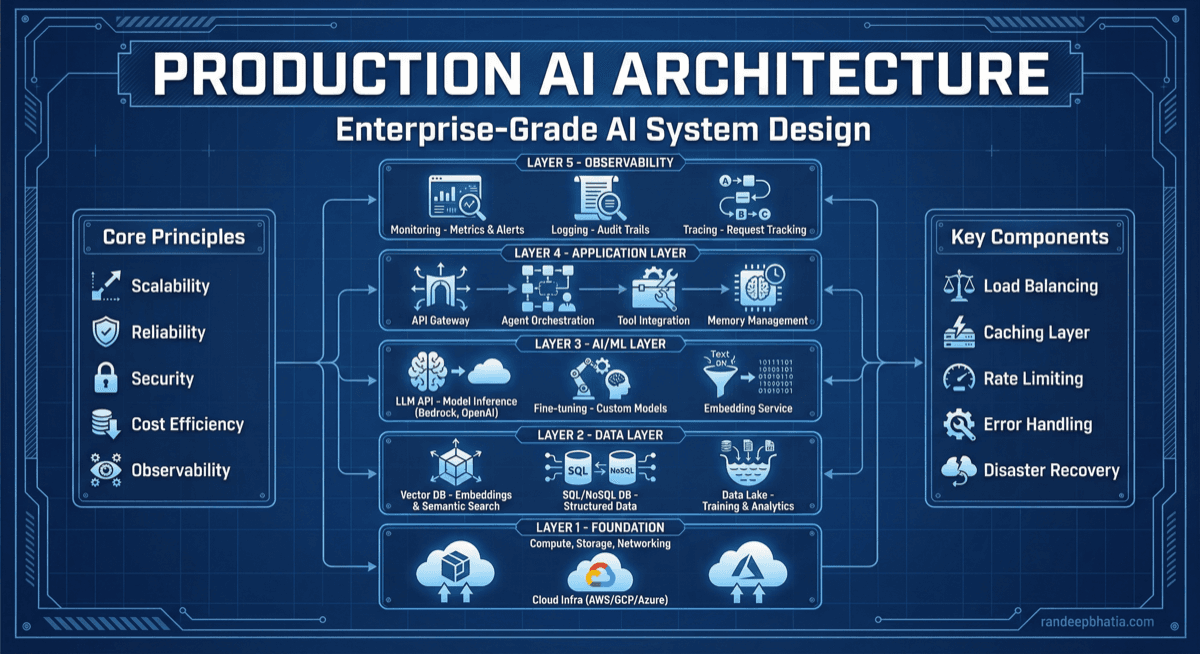
What is Production AI Architecture

Canonical Definitionsāœ“ citation-safe-referencešŸ“– 45-60 minutesUpdated: 2026-01-05

Executive Summary

Production AI Architecture is the systematic design of infrastructure, components, and processes required to deploy, operate, and maintain AI/ML systems at scale with reliability, security, and cost-efficiency.

1

Production AI Architecture encompasses the entire lifecycle from model training infrastructure through inference serving, monitoring, and continuous improvement, requiring integration of compute resources, data pipelines, model registries, serving infrastructure, and observability systems.

2

Unlike research or prototype environments, production AI systems must satisfy strict requirements for latency, throughput, availability, security, compliance, and cost management while handling real-world data drift, model degradation, and failure scenarios.

3

Successful production AI architectures balance competing concerns including inference speed versus accuracy, horizontal versus vertical scaling, real-time versus batch processing, and build versus buy decisions across the technology stack.

The Bottom Line

Production AI Architecture is the foundation that determines whether AI investments deliver business value or become expensive technical debt. Organizations that invest in robust production AI architecture achieve 3-10x better model utilization, 50-80% lower operational costs, and significantly faster time-to-value for new AI capabilities.

Definition

Production AI Architecture refers to the comprehensive technical design and implementation of systems, infrastructure, and processes that enable artificial intelligence and machine learning models to operate reliably, securely, and efficiently in real-world production environments serving actual users and business processes.

This architecture encompasses model serving infrastructure, data pipelines, feature stores, model registries, monitoring and observability systems, security controls, scaling mechanisms, and operational procedures that collectively transform trained models into dependable production services.

Extended Definition

Production AI Architecture extends beyond simple model deployment to address the full spectrum of concerns required for enterprise-grade AI systems. This includes designing for high availability with appropriate redundancy and failover mechanisms, implementing comprehensive monitoring that tracks both system health and model performance metrics, establishing data pipelines that ensure consistent feature computation between training and inference, and creating governance frameworks that maintain compliance with regulatory requirements. The architecture must also accommodate the unique characteristics of AI workloads, including GPU/TPU resource management, handling of large model artifacts, management of embedding stores and vector databases, and the implementation of feedback loops that enable continuous model improvement. Modern production AI architectures increasingly incorporate support for large language models, retrieval-augmented generation systems, and AI agents, each introducing additional architectural considerations around context management, tool integration, and safety guardrails.

Etymology & Origins

The term 'Production AI Architecture' emerged from the convergence of software engineering practices and machine learning operations in the mid-2010s. 'Production' derives from manufacturing terminology adopted by software engineering to denote systems serving real users, while 'Architecture' comes from the software architecture discipline focused on high-level system structure. The combination reflects the maturation of AI from research experiments to mission-critical business systems, with the term gaining widespread adoption alongside the rise of MLOps practices around 2018-2020.

Also Known As

ML Infrastructure ArchitectureAI Platform ArchitectureMachine Learning Systems ArchitectureMLOps ArchitectureAI Operations InfrastructureProduction ML ArchitectureEnterprise AI ArchitectureAI System Design

Not To Be Confused With

Model Architecture

Model architecture refers to the internal structure of a machine learning model (layers, attention mechanisms, etc.), while production AI architecture refers to the infrastructure and systems that deploy and operate those models in production environments.

Data Architecture

Data architecture focuses on the design of data storage, integration, and governance systems broadly, while production AI architecture specifically addresses the infrastructure needed for AI/ML workloads, though it incorporates data architecture principles for feature stores and training data management.

MLOps

MLOps refers to the practices, processes, and tools for operationalizing machine learning, while production AI architecture is the technical design that implements those practices. MLOps is the discipline; production AI architecture is the blueprint.

Cloud Architecture

Cloud architecture encompasses the design of cloud-based systems generally, while production AI architecture specifically addresses AI/ML workload requirements, though production AI systems are frequently deployed on cloud infrastructure.

Software Architecture

Software architecture is the broader discipline of designing software systems, while production AI architecture is a specialization that addresses the unique requirements of AI/ML systems including model versioning, feature consistency, and inference optimization.

AI Strategy

AI strategy refers to organizational planning for AI adoption and value creation, while production AI architecture is the technical implementation that enables that strategy to be realized through working systems.

Conceptual Foundation

Core Principles

(8 principles)

Mental Models

(6 models)

The AI Factory

Conceptualize production AI architecture as a factory with raw materials (data), manufacturing processes (training), quality control (validation), warehousing (model registry), distribution (serving), and customer feedback (monitoring). Each stage requires specific infrastructure and processes, and bottlenecks at any stage limit overall throughput.

The Dual-Loop System

Production AI operates in two loops: a fast inner loop handling real-time inference requests with millisecond latencies, and a slow outer loop handling model training, evaluation, and deployment over hours or days. Architecture must optimize both loops while managing their interaction.

The Reliability Stack

Production AI reliability is built in layers: infrastructure reliability (compute, network, storage), platform reliability (orchestration, scaling, failover), model reliability (accuracy, consistency, drift detection), and business reliability (SLAs, fallbacks, escalation). Each layer depends on those below it.

The Feature-Model-Prediction Pipeline

Every AI prediction flows through three stages: feature computation (transforming raw data into model inputs), model inference (computing predictions from features), and prediction delivery (formatting and routing results). Each stage has distinct latency, scaling, and reliability characteristics.

The Experiment-Production Spectrum

AI systems exist on a spectrum from pure experimentation (notebooks, ad-hoc analysis) to full production (SLA-bound services). Architecture should support smooth progression along this spectrum, with clear gates and increasing rigor at each stage.

The Cost Iceberg

Visible AI costs (compute, storage) are the tip of the iceberg, with hidden costs (engineering time, opportunity cost, technical debt, compliance) comprising the majority. Architecture decisions should consider the full iceberg, not just visible costs.

Key Insights

(10 insights)

The majority of production AI system complexity lies not in the model itself but in the surrounding infrastructure for data management, feature computation, serving, and monitoring—often called the 'ML infrastructure tax.'

Model accuracy improvements beyond a threshold often provide diminishing business value compared to improvements in serving reliability, latency, and operational efficiency.

Feature stores provide value not primarily through feature reuse but through ensuring training-serving consistency, which is the root cause of many production ML failures.

GPU utilization in production inference is typically 10-30% without careful optimization, representing significant cost waste that architecture can address through batching, model optimization, and workload scheduling.

The time from model training completion to production deployment is often 10-100x longer than the training time itself, making deployment automation a higher-leverage investment than training optimization for many organizations.

Production AI systems fail gradually rather than catastrophically, with model drift and data quality degradation causing slow accuracy decay that may go unnoticed without proper monitoring.

The cost of AI inference scales with usage while the cost of model training is fixed, meaning production architecture optimization has compounding returns as usage grows.

Most production AI incidents are caused by data issues (schema changes, missing values, distribution shift) rather than model or infrastructure failures, requiring data-centric monitoring approaches.

Successful production AI architectures prioritize debuggability and observability over raw performance, as the ability to diagnose issues quickly reduces overall downtime more than marginal latency improvements.

The boundary between AI systems and traditional software is increasingly blurred, with production AI architecture adopting software engineering best practices while introducing AI-specific concerns around model versioning, feature management, and prediction monitoring.

When to Use

Ideal Scenarios

(12)

Deploying machine learning models that will serve real users or automated business processes with reliability and latency requirements that exceed what ad-hoc deployment can provide.

Operating multiple ML models across different use cases that would benefit from shared infrastructure, standardized deployment processes, and unified monitoring.

Scaling AI capabilities beyond a single team or use case to become an organizational capability with governance, security, and compliance requirements.

Transitioning from batch predictions to real-time inference where latency, availability, and throughput become critical business requirements.

Implementing AI systems in regulated industries where auditability, reproducibility, and compliance documentation are mandatory.

Building AI-powered products where model performance directly impacts revenue, customer experience, or safety.

Operating AI systems that require continuous improvement through feedback collection, retraining, and safe deployment of updated models.

Managing AI costs at scale where inference compute represents a significant budget line item requiring optimization.

Deploying large language models or generative AI systems that require specialized infrastructure for context management, safety guardrails, and cost control.

Implementing multi-model systems, AI agents, or complex AI workflows that require orchestration, state management, and inter-model communication.

Supporting data science teams with infrastructure that enables them to focus on model development rather than operational concerns.

Building AI capabilities that must integrate with existing enterprise systems, data sources, and security infrastructure.

Prerequisites

(8)
1

Clear business use cases for AI with defined success metrics that justify the investment in production infrastructure.

2

Trained models that have demonstrated value in offline evaluation and are ready for production deployment.

3

Data infrastructure capable of providing the features and inputs required by models with appropriate quality and freshness.

4

Engineering capacity to build and maintain production AI infrastructure, either internally or through managed services.

5

Organizational commitment to ongoing investment in AI operations, not just initial deployment.

6

Security and compliance frameworks that can be extended to cover AI-specific concerns.

7

Monitoring and observability infrastructure that can be extended or integrated with AI-specific metrics.

8

Clear ownership model for AI systems spanning data, models, infrastructure, and business outcomes.

Signals You Need This

(10)

Models that work well in notebooks fail or perform poorly when deployed to production environments.

Significant engineering time is spent on ad-hoc deployment and maintenance of individual models rather than systematic approaches.

Model updates are infrequent or risky due to lack of automated testing, deployment, and rollback capabilities.

Production incidents are difficult to diagnose due to lack of visibility into model inputs, outputs, and behavior.

Different teams are building redundant infrastructure for similar AI deployment needs.

AI costs are growing faster than value delivered, indicating inefficient resource utilization.

Compliance or security audits reveal gaps in AI system governance and auditability.

Model performance degrades over time without clear visibility into when or why.

Feature computation differs between training and serving, causing prediction quality issues.

Scaling AI to new use cases requires starting from scratch rather than leveraging existing infrastructure.

Organizational Readiness

(7)

Executive sponsorship for AI infrastructure investment with understanding that returns are realized over multiple use cases and time.

Cross-functional collaboration between data science, engineering, operations, and security teams.

Willingness to standardize on common tools and practices rather than allowing each team to build custom solutions.

Capacity to operate and maintain production systems with appropriate on-call and incident response processes.

Data governance maturity sufficient to ensure data quality and appropriate access controls for AI systems.

Culture of measurement and continuous improvement that will leverage monitoring and feedback capabilities.

Tolerance for initial productivity decrease as teams adopt new infrastructure and practices before realizing efficiency gains.

When NOT to Use

Anti-Patterns

(12)

Building production AI infrastructure before having validated AI use cases with demonstrated business value, resulting in infrastructure that doesn't match actual needs.

Over-engineering infrastructure for small-scale deployments where simpler solutions would suffice, adding unnecessary complexity and cost.

Adopting complex microservices architectures for AI systems that could be effectively served by monolithic deployments.

Building custom infrastructure for capabilities available in mature managed services, unless specific requirements justify the investment.

Prioritizing infrastructure sophistication over model quality when model improvements would deliver more business value.

Implementing real-time serving infrastructure for use cases where batch predictions would meet business requirements at lower cost and complexity.

Creating separate production AI architectures for each team or use case rather than building shared infrastructure.

Focusing on cutting-edge infrastructure capabilities while neglecting fundamentals like monitoring, testing, and documentation.

Deploying models to production without adequate validation, using production infrastructure as a substitute for proper testing.

Building production infrastructure without involving operations teams, resulting in systems that cannot be effectively maintained.

Optimizing for peak performance without considering operational simplicity, creating systems that are difficult to debug and maintain.

Implementing every architectural pattern regardless of actual requirements, adding complexity without corresponding value.

Red Flags

(10)

No clear business metrics or success criteria for AI systems being deployed.

Data science team has no involvement in production architecture decisions.

Operations team has no visibility into or ownership of AI system reliability.

Infrastructure decisions are driven by technology preferences rather than requirements.

No plan for ongoing maintenance, monitoring, or improvement of deployed systems.

Security and compliance requirements are undefined or deferred.

Cost projections do not account for inference compute at production scale.

No fallback strategy for when AI systems fail or perform poorly.

Model training and serving environments are completely disconnected.

No process for collecting feedback or measuring production model performance.

Better Alternatives

(8)
1
When:

Early-stage AI exploration with unvalidated use cases

Use Instead:

Managed ML platforms or serverless inference services

Why:

Managed services provide production capabilities without infrastructure investment, allowing focus on validating AI value before committing to custom architecture.

2
When:

Single model serving a single application with simple requirements

Use Instead:

Embedded model deployment within the application

Why:

For simple cases, deploying the model as part of the application eliminates network latency and infrastructure complexity while meeting requirements.

3
When:

Batch predictions with relaxed latency requirements

Use Instead:

Scheduled batch inference jobs

Why:

Batch processing is simpler, cheaper, and more efficient than real-time serving when latency requirements allow, avoiding the complexity of serving infrastructure.

4
When:

Prototyping and experimentation phase

Use Instead:

Notebook-based or local deployment

Why:

Production infrastructure adds friction to experimentation; simpler environments enable faster iteration until use cases are validated.

5
When:

Limited engineering capacity with standard ML use cases

Use Instead:

Fully managed AI services (AutoML, pre-built APIs)

Why:

Managed services handle infrastructure complexity, allowing small teams to deploy AI capabilities without building production architecture.

6
When:

AI capabilities that can be provided by third-party APIs

Use Instead:

Third-party AI API integration

Why:

When third-party APIs meet requirements, integration is faster and cheaper than building custom production infrastructure.

7
When:

Infrequent predictions with tolerance for higher latency

Use Instead:

On-demand serverless inference

Why:

Serverless inference eliminates idle resource costs and infrastructure management for sporadic workloads.

8
When:

AI systems with minimal customization needs

Use Instead:

Low-code/no-code AI platforms

Why:

These platforms provide production capabilities with minimal engineering investment for standard use cases.

Common Mistakes

(10)

Underestimating the operational complexity of production AI systems, leading to inadequate staffing and processes for maintenance.

Treating production AI architecture as a one-time project rather than an ongoing capability requiring continuous investment.

Failing to involve data scientists in architecture decisions, resulting in infrastructure that doesn't support actual ML workflows.

Over-optimizing for inference latency when business requirements would be met by simpler, slower solutions.

Neglecting monitoring and observability in favor of features, making production issues difficult to diagnose and resolve.

Building infrastructure for anticipated scale rather than current needs, adding complexity before it's justified.

Assuming cloud provider managed services will handle all production concerns without understanding their limitations.

Failing to plan for model updates and retraining, treating initial deployment as the end state.

Ignoring security and compliance requirements until late in development, requiring expensive retrofitting.

Not establishing clear ownership and accountability for production AI systems across teams.

Core Taxonomy

Primary Types

(8 types)

Architecture optimized for processing large volumes of predictions on a scheduled basis, typically using distributed computing frameworks to process data in bulk and store results for later retrieval.

Characteristics
  • High throughput optimization over low latency
  • Scheduled or triggered execution
  • Results stored in databases or data warehouses
  • Efficient resource utilization through batching
  • Simpler operational model than real-time systems
Use Cases
Recommendation pre-computationRisk scoring for loan applicationsFraud detection on transaction batchesCustomer segmentation updates
Tradeoffs

Lower infrastructure complexity and cost but cannot serve real-time use cases; prediction freshness limited by batch frequency; may waste compute on predictions that are never used.

Classification Dimensions

Deployment Model

Classification based on where AI infrastructure is deployed and operated, affecting latency, security, compliance, and operational complexity.

Cloud-nativeOn-premisesHybrid cloudMulti-cloudEdge-cloud hybrid

Scaling Strategy

Classification based on how the architecture handles varying load, affecting cost efficiency, latency consistency, and operational complexity.

Horizontal scalingVertical scalingAuto-scalingServerlessFixed capacity

Model Update Frequency

Classification based on how frequently models are updated in production, affecting infrastructure requirements and operational processes.

Static modelsPeriodic retrainingContinuous learningOnline learningReal-time adaptation

Integration Pattern

Classification based on how AI capabilities are integrated with consuming applications, affecting coupling, latency, and deployment flexibility.

API-firstEvent-drivenEmbeddedSidecarService mesh

Compute Substrate

Classification based on the hardware used for inference, affecting performance, cost, and model compatibility.

CPU-onlyGPU-acceleratedTPU-basedFPGA-acceleratedCustom ASIC

State Management

Classification based on how the architecture manages state across requests, affecting scalability, consistency, and failure recovery.

StatelessSession-statefulPersistent stateDistributed stateEvent-sourced

Evolutionary Stages

1

Ad-hoc Deployment

Initial AI adoption, typically 0-6 months into AI journey

Models deployed manually, often directly from notebooks or scripts. No standardized infrastructure, monitoring, or processes. Each deployment is unique.

2

Standardized Serving

Early production maturity, typically 6-18 months

Common serving infrastructure established. Basic monitoring in place. Deployment processes defined but may be manual. Limited automation.

3

Automated MLOps

Intermediate maturity, typically 18-36 months

CI/CD for models implemented. Automated testing and validation. Feature stores operational. Comprehensive monitoring. Self-service deployment for data scientists.

4

Platform-as-Product

Advanced maturity, typically 3-5 years

AI platform treated as internal product. Self-service capabilities for multiple teams. Advanced features like A/B testing, shadow deployment. Cost optimization automated.

5

Continuous Intelligence

Leading edge, typically 5+ years of sustained investment

Fully automated feedback loops. Real-time model adaptation. Sophisticated experiment infrastructure. AI-assisted AI operations. Predictive scaling and optimization.

Architecture Patterns

Architecture Patterns

(8 patterns)

Model-as-Service

Pattern where models are deployed as independent services with well-defined APIs, enabling loose coupling between model development and consuming applications. Each model service handles its own scaling, versioning, and monitoring.

Components
  • Model serving container
  • API gateway
  • Load balancer
  • Model registry
  • Feature service
  • Monitoring stack
Data Flow

Request arrives at API gateway, routes to load balancer, which distributes to model serving containers. Containers fetch features from feature service, compute predictions, and return responses. All interactions logged to monitoring stack.

Best For
  • Organizations with multiple consuming applications
  • Teams requiring independent model deployment cycles
  • Use cases requiring high availability
  • Scenarios where models are shared across teams
Limitations
  • Network latency added to every prediction
  • Operational overhead of managing services
  • Complexity of service discovery and routing
  • Potential for cascading failures
Scaling Characteristics

Horizontal scaling of model containers based on request volume. Each model scales independently. Load balancer distributes traffic across instances. Auto-scaling based on latency or queue depth.

Integration Points

API Gateway

Entry point for all inference requests, handling authentication, rate limiting, request routing, and protocol translation.

Interfaces:
REST APIgRPCGraphQLWebSocket

Must handle AI-specific concerns like streaming responses, large payloads, and variable latency. Should support request/response logging for debugging and auditing.

Feature Store

Provides consistent feature values for model inference, ensuring training-serving consistency and enabling feature reuse across models.

Interfaces:
Online serving APIBatch export APIFeature registration APILineage query API

Latency critical for online serving. Must handle feature freshness requirements. Should support point-in-time lookups for debugging.

Model Registry

Central repository for model artifacts, metadata, and lineage information, enabling model versioning, discovery, and governance.

Interfaces:
Model upload/download APIMetadata query APIVersion management APILineage tracking API

Must handle large model artifacts efficiently. Should integrate with CI/CD pipelines. Must support model approval workflows.

Monitoring System

Collects and analyzes metrics, logs, and traces from all AI system components, enabling observability and alerting.

Interfaces:
Metrics ingestion APILog aggregation APITrace collection APIAlert management API

Must handle high-volume telemetry data. Should support AI-specific metrics like prediction distributions. Must enable correlation across components.

Data Pipeline

Ingests, transforms, and delivers data for both training and inference, ensuring data quality and freshness.

Interfaces:
Batch ingestion APIStream ingestion APIData quality APISchema registry API

Must ensure data consistency between training and serving. Should handle schema evolution. Must support data lineage tracking.

Experiment Platform

Manages A/B tests, feature flags, and gradual rollouts for model deployments, enabling safe experimentation.

Interfaces:
Experiment configuration APIAssignment APIResults analysis APIFeature flag API

Must ensure consistent user assignment. Should integrate with monitoring for experiment metrics. Must support rapid experiment iteration.

Security Infrastructure

Provides authentication, authorization, encryption, and audit logging for AI systems.

Interfaces:
Authentication APIAuthorization APIKey management APIAudit logging API

Must handle AI-specific threats like model extraction and prompt injection. Should support fine-grained access control. Must enable compliance auditing.

Orchestration Platform

Manages deployment, scaling, and lifecycle of AI workloads across compute infrastructure.

Interfaces:
Deployment APIScaling APIHealth check APIResource management API

Must handle GPU scheduling and allocation. Should support AI-specific deployment patterns. Must enable zero-downtime updates.

Decision Framework

āœ“ If Yes

If sub-100ms latency required, design for real-time serving with optimized inference infrastructure and consider model optimization techniques.

āœ— If No

If latency requirements are relaxed (seconds to minutes acceptable), batch inference or serverless options may be more cost-effective.

Considerations

Consider both average and tail latency (p99). Account for network latency if serving is remote. Evaluate whether caching can meet latency requirements.

Technical Deep Dive

Overview

Production AI architecture operates as a coordinated system of components that transform trained models into reliable, scalable services. At its core, the architecture manages the lifecycle of models from training through deployment, serving, monitoring, and retirement. The system must handle the unique characteristics of AI workloads, including large model artifacts, GPU-intensive computation, feature consistency requirements, and the need for continuous monitoring of model behavior in addition to system health. The architecture typically consists of several interconnected subsystems: a model development and training environment, a model registry for artifact management, a feature store for consistent feature computation, a serving infrastructure for handling inference requests, a monitoring system for observability, and an orchestration layer for managing deployments and scaling. These components communicate through well-defined interfaces, enabling teams to evolve individual components independently while maintaining system integrity. Data flows through the architecture in multiple patterns. Training data flows from data lakes through feature engineering pipelines into training jobs, producing model artifacts stored in the registry. Inference requests flow through API gateways to serving infrastructure, which retrieves features from the feature store, loads models from the registry, computes predictions, and returns results while emitting telemetry. Feedback data flows from production back to training pipelines, enabling continuous improvement. The architecture must balance competing concerns across multiple dimensions: latency versus throughput, cost versus performance, flexibility versus simplicity, and safety versus speed. These tradeoffs are managed through careful design of each component and their interactions, with configuration and policy layers enabling adjustment without architectural changes.

Step-by-Step Process

Data scientists develop and train models using training infrastructure, which may include distributed computing clusters, GPU resources, and experiment tracking systems. Models are validated against held-out test sets and business metrics before being considered for production deployment.

āš ļø Pitfalls to Avoid

Training environment may differ from production, causing models that work in development to fail in production. Validation metrics may not reflect real-world performance. Insufficient documentation of model assumptions and limitations.

Under The Hood

At the infrastructure level, production AI architecture relies on container orchestration platforms like Kubernetes to manage model serving workloads. Model containers are scheduled onto nodes with appropriate resources, including GPU allocation for models requiring hardware acceleration. The orchestration platform handles health checking, automatic restart of failed containers, and scaling based on configured metrics. Service meshes may provide additional capabilities including traffic management, security, and observability. Model serving frameworks handle the mechanics of loading models into memory, managing inference requests, and optimizing throughput. These frameworks implement batching strategies that group multiple requests for efficient GPU utilization, manage model versions for A/B testing and gradual rollouts, and provide APIs for health checking and metrics export. Popular frameworks include TensorFlow Serving, TorchServe, Triton Inference Server, and various cloud-specific solutions. Feature stores implement a dual-database architecture with an online store optimized for low-latency point lookups and an offline store optimized for large-scale batch reads. The online store typically uses key-value databases like Redis or DynamoDB, while the offline store uses data warehouses or object storage. Feature computation pipelines, often implemented using stream processing frameworks like Apache Flink or Spark Streaming, maintain consistency between stores. For large language model serving, additional infrastructure handles the unique requirements of transformer models. KV cache management optimizes memory usage for long contexts. Continuous batching techniques maximize GPU utilization by dynamically grouping requests. Token streaming infrastructure delivers partial responses before completion. Prompt management systems handle template rendering and context assembly. The monitoring stack typically combines metrics systems (Prometheus, CloudWatch), logging systems (Elasticsearch, CloudWatch Logs), and tracing systems (Jaeger, X-Ray) to provide comprehensive observability. AI-specific monitoring adds statistical analysis of prediction distributions, drift detection algorithms, and correlation with business outcomes. Alerting systems evaluate metrics against thresholds and route notifications to appropriate responders. Security infrastructure implements multiple layers of protection. Network security controls traffic flow between components. Identity and access management controls who can deploy models and access predictions. Encryption protects data in transit and at rest. AI-specific security measures detect adversarial inputs, prevent model extraction, and protect against prompt injection attacks.

Failure Modes

Root Cause

Infrastructure failure, resource exhaustion, or deployment error causing model serving endpoints to become unreachable or unresponsive.

Symptoms
  • HTTP 5xx errors from inference endpoints
  • Connection timeouts
  • Health check failures
  • Increased error rates in dependent services
Impact

Complete loss of AI functionality for affected models. Dependent features fail or degrade. Revenue impact for AI-powered products. Customer experience degradation.

Prevention

Implement redundancy across availability zones. Use health checks and automatic instance replacement. Maintain capacity headroom. Test failure scenarios regularly.

Mitigation

Activate fallback mechanisms (cached predictions, rule-based defaults, human escalation). Route traffic to healthy instances. Scale up healthy capacity. Communicate status to stakeholders.

Operational Considerations

Key Metrics (15)

Time from request receipt to response delivery, measured at various percentiles to understand both typical and tail latency.

Normalp50: 10-100ms, p95: 50-500ms, p99: 100-1000ms (varies by model complexity)
Alertp99 > 2x baseline for 5 minutes
ResponseInvestigate resource utilization, check for traffic spikes, review recent deployments, consider scaling.

Dashboard Panels

Real-time inference latency heatmap showing p50/p95/p99 over timeRequest throughput and error rate time series with deployment markersModel prediction distribution histogram compared to training baselineGPU utilization and memory usage across serving fleetFeature freshness status for all critical featuresActive model versions with traffic distributionCost tracking with daily/weekly/monthly trendsGeographic distribution of requests and latency by regionFallback and degradation mode activation timelineAlert status and recent incidents summary

Alerting Strategy

Implement tiered alerting with different severity levels and response expectations. Critical alerts (service down, error rate spike) page on-call immediately. Warning alerts (latency increase, capacity pressure) notify during business hours. Informational alerts (drift detected, cost trending) aggregate into daily reports. Use alert correlation to reduce noise and identify root causes. Implement alert fatigue prevention through proper threshold tuning and alert grouping.

Cost Analysis

Cost Drivers

(10)

GPU Compute for Inference

Impact:

Often 50-80% of total infrastructure cost for GPU-intensive models. Scales with traffic volume and model complexity.

Optimization:

Optimize batch sizes for GPU utilization. Use model quantization to reduce compute requirements. Implement request batching. Consider spot instances for fault-tolerant workloads.

Model Storage and Transfer

Impact:

Significant for large models (LLMs). Includes registry storage, artifact transfer, and model caching.

Optimization:

Implement model compression. Use efficient artifact formats. Cache models at edge locations. Deduplicate shared model components.

Feature Store Infrastructure

Impact:

Scales with feature count, entity count, and query volume. Online store typically more expensive than offline.

Optimization:

Right-size storage tiers. Implement feature TTLs. Optimize query patterns. Consider feature importance for storage decisions.

Data Pipeline Compute

Impact:

Scales with data volume and transformation complexity. Includes both batch and streaming processing.

Optimization:

Optimize transformation logic. Use incremental processing where possible. Right-size compute resources. Consider serverless for variable workloads.

Monitoring and Logging

Impact:

Scales with request volume and retention requirements. Can become significant at high scale.

Optimization:

Implement intelligent sampling. Use tiered storage with appropriate retention. Aggregate metrics where possible. Optimize log verbosity.

Network Transfer

Impact:

Significant for distributed architectures and cross-region deployments. Includes data transfer and API calls.

Optimization:

Minimize cross-region traffic. Use compression for large payloads. Implement caching to reduce redundant transfers. Optimize API payload sizes.

Development and Experimentation

Impact:

Training compute, experiment tracking, and development environments. Often overlooked in production cost analysis.

Optimization:

Use spot instances for training. Implement experiment resource limits. Share development resources. Clean up unused experiments.

LLM API Costs

Impact:

For systems using external LLM APIs, token costs can dominate. Scales with usage and context length.

Optimization:

Optimize prompts for token efficiency. Implement caching for repeated queries. Use smaller models where appropriate. Batch requests when possible.

Security and Compliance

Impact:

Includes encryption, access management, audit logging, and compliance tooling.

Optimization:

Right-size security controls to risk level. Use managed security services. Automate compliance processes. Optimize audit log retention.

Human Operations

Impact:

On-call support, incident response, and manual maintenance tasks. Often the largest hidden cost.

Optimization:

Invest in automation. Implement self-healing systems. Reduce alert noise. Improve documentation and runbooks.

Cost Models

Per-Request Cost Model

Cost per request = (Compute cost / Requests) + (Feature retrieval cost / Requests) + (Logging cost / Requests)
Variables:
Compute instance cost per hourRequests per hourFeature store query costLogging cost per GB
Example:

For a system processing 1M requests/day on $2/hour GPU instances achieving 100 RPS: Compute = $48/day, Feature store = $10/day, Logging = $5/day. Cost per request = $0.000063

LLM Token Cost Model

Cost = (Input tokens Ɨ Input price) + (Output tokens Ɨ Output price) + Infrastructure overhead
Variables:
Average input tokens per requestAverage output tokens per requestToken pricing (input/output)Infrastructure overhead percentage
Example:

For 1000 requests with average 500 input tokens ($0.01/1K) and 200 output tokens ($0.03/1K): Token cost = $5 + $6 = $11. With 20% infrastructure overhead: Total = $13.20

Total Cost of Ownership Model

TCO = Infrastructure + Engineering time + Opportunity cost + Risk cost
Variables:
Monthly infrastructure spendEngineering hours Ɨ hourly costDelayed feature valueIncident cost Ɨ probability
Example:

Infrastructure: $50K/month, Engineering: 2 FTE Ɨ $15K = $30K/month, Opportunity cost: $10K/month, Risk: $5K/month. TCO = $95K/month

Scaling Cost Model

Cost at scale = Base cost + (Marginal cost Ɨ Additional units) - (Efficiency gains Ɨ Scale factor)
Variables:
Fixed infrastructure costsCost per additional request/userEfficiency improvement rateScale factor
Example:

Base: $10K/month, Marginal: $0.001/request, Efficiency: 20% at 10x scale. At 10M requests: Cost = $10K + $10K - $2K = $18K (vs. $20K linear)

Optimization Strategies

  • 1Implement request batching to improve GPU utilization from typical 20-30% to 60-80%
  • 2Use model quantization (INT8, FP16) to reduce compute requirements by 2-4x with minimal accuracy impact
  • 3Deploy spot/preemptible instances for fault-tolerant workloads, saving 60-90% on compute
  • 4Implement intelligent caching for repeated predictions, reducing compute by 20-50% for many workloads
  • 5Use auto-scaling with appropriate metrics to match capacity to demand, avoiding over-provisioning
  • 6Optimize feature store queries to retrieve only needed features, reducing query costs
  • 7Implement tiered storage with hot/warm/cold tiers based on access patterns
  • 8Use reserved instances or committed use discounts for baseline capacity (30-60% savings)
  • 9Optimize LLM prompts to reduce token usage while maintaining quality
  • 10Implement request routing to use smaller/cheaper models when appropriate
  • 11Consolidate workloads to improve resource utilization across teams
  • 12Regular cost review and optimization sprints to identify and address waste

Hidden Costs

  • šŸ’°Engineering time for infrastructure maintenance and incident response
  • šŸ’°Opportunity cost of delayed AI features due to infrastructure limitations
  • šŸ’°Technical debt accumulation from shortcuts in production architecture
  • šŸ’°Compliance and audit costs for regulated industries
  • šŸ’°Training and onboarding costs for complex infrastructure
  • šŸ’°Vendor lock-in costs limiting future optimization options
  • šŸ’°Data transfer costs often underestimated in distributed architectures
  • šŸ’°Development environment costs for data scientists and ML engineers

ROI Considerations

Production AI architecture ROI should be evaluated across multiple dimensions beyond direct cost savings. Infrastructure investment enables faster time-to-market for new AI capabilities, which may have significant revenue impact. Reliability improvements reduce incident costs and protect revenue from AI-powered features. Standardization reduces per-model deployment costs, improving ROI as the number of models grows. The break-even point for production AI infrastructure investment typically occurs when organizations operate 3-5 production models or when AI directly impacts significant revenue. Before this point, managed services or simpler approaches may provide better ROI despite higher per-unit costs. Cost optimization efforts should be prioritized based on impact. GPU compute optimization typically provides the highest return for inference-heavy workloads. For LLM applications, prompt optimization and caching often provide 2-5x cost reduction. Feature store optimization becomes important as feature count and query volume grow. Long-term ROI depends on architecture flexibility. Investments in abstraction layers and standardization enable future optimization without major rearchitecture. Lock-in to specific vendors or technologies may provide short-term savings but limit long-term optimization options.

Security Considerations

Threat Model

(10 threats)
1

Model Extraction Attack

Attack Vector

Attacker queries model repeatedly to reconstruct model behavior or extract model weights through API access.

Impact

Intellectual property theft. Competitive advantage loss. Enables adversarial attack development.

Mitigation

Implement rate limiting. Monitor for extraction patterns. Add noise to outputs. Restrict API access. Use watermarking techniques.

2

Training Data Extraction

Attack Vector

Attacker crafts inputs to cause model to reveal training data, particularly for LLMs that may memorize sensitive information.

Impact

Privacy violations. Compliance failures. Exposure of proprietary data.

Mitigation

Implement differential privacy in training. Filter outputs for sensitive patterns. Limit model memorization through regularization. Monitor for extraction attempts.

3

Prompt Injection

Attack Vector

Malicious inputs designed to manipulate LLM behavior, bypass safety controls, or execute unintended actions.

Impact

Safety control bypass. Unauthorized actions. Information disclosure. Reputation damage.

Mitigation

Implement input validation and sanitization. Use prompt engineering best practices. Deploy output filtering. Separate user input from system prompts. Monitor for attack patterns.

4

Adversarial Input Attack

Attack Vector

Carefully crafted inputs designed to cause model misclassification or unexpected behavior.

Impact

Incorrect predictions. Safety system bypass. Business logic manipulation.

Mitigation

Implement input validation. Use adversarial training. Deploy input anomaly detection. Implement confidence thresholds.

5

Data Poisoning

Attack Vector

Attacker injects malicious data into training pipeline to corrupt model behavior or insert backdoors.

Impact

Compromised model integrity. Backdoor access. Incorrect predictions on targeted inputs.

Mitigation

Validate training data provenance. Implement data quality checks. Use robust training techniques. Test for backdoors. Monitor model behavior changes.

6

Model Supply Chain Attack

Attack Vector

Compromised pre-trained models, libraries, or dependencies introduce vulnerabilities or malicious behavior.

Impact

Backdoor access. Data exfiltration. System compromise.

Mitigation

Verify model and library provenance. Scan dependencies for vulnerabilities. Use trusted sources. Implement integrity verification.

7

Inference API Abuse

Attack Vector

Unauthorized or excessive use of inference APIs for purposes beyond intended use.

Impact

Resource exhaustion. Cost overruns. Service degradation for legitimate users.

Mitigation

Implement authentication and authorization. Deploy rate limiting. Monitor usage patterns. Implement cost controls.

8

Feature Store Data Breach

Attack Vector

Unauthorized access to feature store containing sensitive user or business data.

Impact

Privacy violations. Compliance failures. Competitive intelligence exposure.

Mitigation

Encrypt data at rest and in transit. Implement access controls. Monitor access patterns. Implement data masking for sensitive features.

9

Model Registry Tampering

Attack Vector

Unauthorized modification of model artifacts in registry to deploy compromised models.

Impact

Compromised predictions. Backdoor deployment. System integrity loss.

Mitigation

Implement access controls. Use immutable storage. Verify artifact integrity. Implement approval workflows. Monitor for unauthorized changes.

10

Insider Threat

Attack Vector

Malicious or negligent insider with access to AI systems causes harm through data theft, model manipulation, or system sabotage.

Impact

Data breach. Model compromise. System unavailability. Intellectual property theft.

Mitigation

Implement least privilege access. Monitor user activity. Implement separation of duties. Conduct background checks. Implement audit logging.

Security Best Practices

  • āœ“Implement defense in depth with multiple security layers
  • āœ“Use strong authentication for all AI system access (OAuth 2.0, mTLS)
  • āœ“Implement fine-grained authorization based on least privilege principle
  • āœ“Encrypt all data at rest using industry-standard algorithms (AES-256)
  • āœ“Encrypt all data in transit using TLS 1.3
  • āœ“Implement comprehensive audit logging for all access and changes
  • āœ“Conduct regular security assessments and penetration testing
  • āœ“Implement input validation for all model inputs
  • āœ“Deploy output filtering for sensitive content
  • āœ“Monitor for anomalous access patterns and potential attacks
  • āœ“Implement rate limiting to prevent abuse and extraction attacks
  • āœ“Use secure model serving frameworks with regular updates
  • āœ“Implement network segmentation to isolate AI infrastructure
  • āœ“Conduct regular vulnerability scanning of all components
  • āœ“Implement incident response procedures specific to AI systems

Data Protection

  • šŸ”’Classify data by sensitivity level and apply appropriate controls
  • šŸ”’Implement data encryption at rest using customer-managed keys where required
  • šŸ”’Use field-level encryption for highly sensitive data elements
  • šŸ”’Implement data masking for non-production environments
  • šŸ”’Deploy data loss prevention (DLP) controls for AI outputs
  • šŸ”’Implement secure data deletion procedures including model unlearning where required
  • šŸ”’Use differential privacy techniques for sensitive training data
  • šŸ”’Implement access logging for all data access
  • šŸ”’Deploy data residency controls for geographic requirements
  • šŸ”’Implement backup encryption and secure backup procedures

Compliance Implications

GDPR (General Data Protection Regulation)

Requirement:

Right to explanation for automated decisions. Data minimization. Purpose limitation. Data subject rights.

Implementation:

Implement prediction explanation capabilities. Document data usage. Implement data deletion workflows. Maintain processing records.

CCPA (California Consumer Privacy Act)

Requirement:

Disclosure of data collection. Opt-out rights. Data deletion rights. Non-discrimination.

Implementation:

Document AI data usage in privacy policy. Implement opt-out mechanisms. Support data deletion requests. Ensure consistent service regardless of privacy choices.

HIPAA (Health Insurance Portability and Accountability Act)

Requirement:

Protected health information security. Access controls. Audit trails. Business associate agreements.

Implementation:

Implement PHI encryption. Deploy access controls. Maintain audit logs. Execute BAAs with vendors.

SOC 2

Requirement:

Security, availability, processing integrity, confidentiality, privacy controls.

Implementation:

Implement required controls across AI infrastructure. Maintain documentation. Conduct regular audits. Address findings promptly.

PCI DSS (Payment Card Industry Data Security Standard)

Requirement:

Cardholder data protection. Access controls. Network security. Monitoring.

Implementation:

Isolate AI systems processing payment data. Implement required controls. Conduct regular assessments.

EU AI Act

Requirement:

Risk classification. Transparency requirements. Human oversight. Technical documentation.

Implementation:

Classify AI systems by risk level. Implement required transparency. Enable human review. Maintain technical documentation.

NIST AI RMF (Risk Management Framework)

Requirement:

AI risk identification, assessment, and management throughout lifecycle.

Implementation:

Implement risk assessment processes. Document risk decisions. Monitor for emerging risks. Maintain governance framework.

Industry-Specific Regulations (Financial Services)

Requirement:

Model risk management. Fair lending. Explainability. Audit trails.

Implementation:

Implement model validation processes. Test for bias. Provide explanations. Maintain comprehensive audit trails.

Scaling Guide

Scaling Dimensions

Request Throughput

Strategy:

Horizontal scaling of model serving instances behind load balancer. Implement auto-scaling based on request queue depth or latency.

Limits:

Limited by model loading time (cold start), load balancer capacity, and downstream dependencies (feature store, databases).

Considerations:

Ensure stateless serving for easy horizontal scaling. Pre-warm instances to avoid cold start latency. Consider request batching for efficiency.

Model Size

Strategy:

Vertical scaling to larger instances with more memory. Model parallelism across multiple GPUs. Model optimization (quantization, pruning).

Limits:

Limited by available instance sizes, GPU memory, and model parallelism complexity.

Considerations:

Larger models require more expensive instances. Consider model distillation for deployment. Evaluate accuracy/size tradeoffs.

Feature Count

Strategy:

Scale feature store horizontally. Implement feature caching. Optimize feature retrieval patterns.

Limits:

Limited by feature store capacity, network bandwidth, and feature computation resources.

Considerations:

More features increase retrieval latency. Consider feature importance for scaling decisions. Implement feature batching.

Model Count

Strategy:

Shared serving infrastructure with multi-model support. Model routing and load balancing. Consolidated monitoring.

Limits:

Limited by orchestration complexity, shared resource contention, and operational overhead.

Considerations:

Standardize model packaging for easier management. Implement resource isolation between models. Consider model consolidation.

Geographic Distribution

Strategy:

Multi-region deployment with traffic routing. Edge caching for predictions. Regional feature stores.

Limits:

Limited by data residency requirements, replication complexity, and cost of multi-region infrastructure.

Considerations:

Consider latency requirements for regional deployment. Implement consistent model versions across regions. Handle regional failures gracefully.

Context Length (LLM)

Strategy:

KV cache optimization. Context compression techniques. Chunking strategies for long documents.

Limits:

Limited by GPU memory, attention computation complexity (O(n²)), and cost per token.

Considerations:

Longer contexts increase latency and cost. Consider RAG for knowledge-intensive tasks. Implement context management strategies.

Training Data Volume

Strategy:

Distributed training across multiple nodes. Data parallelism and model parallelism. Efficient data loading pipelines.

Limits:

Limited by communication overhead, storage I/O, and training infrastructure capacity.

Considerations:

Larger datasets improve model quality but increase training time and cost. Consider data sampling and curriculum learning.

Concurrent Users

Strategy:

Session management at scale. Connection pooling. Stateless design with external session storage.

Limits:

Limited by session storage capacity, connection limits, and per-user resource allocation.

Considerations:

Design for stateless serving where possible. Implement session affinity where required. Monitor per-user resource usage.

Capacity Planning

Key Factors:
Current request volume and growth rateLatency requirements (p50, p95, p99)Model inference time and resource requirementsFeature retrieval latency and throughputPeak-to-average traffic ratioFailure domain requirements (availability zones, regions)Cost constraints and optimization targets
Formula:Required capacity = (Peak requests per second Ɨ Latency budget) / (Requests per instance Ɨ Target utilization) Ɨ Redundancy factor
Safety Margin:

Maintain 30-50% headroom above peak capacity for unexpected spikes and degraded mode operation. Higher margin (50-100%) for critical systems or systems with slow scaling.

Scaling Milestones

10-100 requests per second
Challenges:
  • Basic infrastructure setup
  • Initial monitoring implementation
  • Manual deployment processes
Architecture Changes:

Single instance or small cluster deployment. Basic load balancing. Manual scaling. Simple monitoring.

100-1,000 requests per second
Challenges:
  • Auto-scaling implementation
  • Feature store performance
  • Deployment automation
Architecture Changes:

Auto-scaling cluster. Dedicated feature store. CI/CD for models. Comprehensive monitoring. Basic caching.

1,000-10,000 requests per second
Challenges:
  • Multi-region requirements
  • Cost optimization pressure
  • Operational complexity
Architecture Changes:

Multi-region deployment. Advanced caching strategies. Cost optimization automation. Platform team formation. SLO-based operations.

10,000-100,000 requests per second
Challenges:
  • Infrastructure efficiency
  • Team scaling
  • Governance at scale
Architecture Changes:

Highly optimized serving infrastructure. Dedicated platform team. Self-service capabilities. Advanced traffic management. Sophisticated cost controls.

100,000+ requests per second
Challenges:
  • Custom infrastructure requirements
  • Global distribution
  • Organizational alignment
Architecture Changes:

Custom-built infrastructure components. Global edge deployment. Multiple specialized teams. Advanced automation. Industry-leading practices.

Benchmarks

Industry Benchmarks

MetricP50P95P99 World Class
Model Deployment Time1-2 days1-2 weeks1+ month< 1 hour (automated)
Inference Latency (Traditional ML)10-50ms50-200ms200-500ms< 10ms p99
Inference Latency (LLM, first token)200-500ms500-1000ms1-2s< 200ms p99
System Availability99.5%99.9%99.99%99.99%+ with graceful degradation
GPU Utilization20-30%40-60%60-80%70-90% sustained
Feature FreshnessHours to daysMinutes to hoursSeconds to minutesReal-time (< 1 second)
Model Drift Detection TimeDays to weeksHours to daysMinutes to hoursReal-time detection
Incident Response Time30-60 minutes5-15 minutes1-5 minutes< 1 minute (automated)
Cost per 1M Predictions (Traditional ML)$10-50$5-10$1-5< $1
Cost per 1M Tokens (LLM)$10-30$5-10$1-5< $1 (with optimization)
Rollback Time15-30 minutes5-15 minutes1-5 minutes< 1 minute (automated)
Test Coverage40-60%60-80%80-95%95%+ with mutation testing

Comparison Matrix

ApproachSetup TimeOperational ComplexityScalabilityCost EfficiencyFlexibilityBest For
Managed ML Platform (SageMaker, Vertex AI)DaysLowHighMediumMediumTeams prioritizing speed over customization
Kubernetes + Open SourceWeeks-MonthsHighVery HighHigh (at scale)Very HighTeams with K8s expertise needing customization
Serverless InferenceHours-DaysVery LowHighVariableLowVariable traffic, simple models
Dedicated GPU ClusterWeeksMedium-HighMediumHigh (consistent load)HighConsistent high-volume inference
Edge DeploymentWeeks-MonthsVery HighVery HighHighLowLatency-critical, privacy-sensitive
Hybrid (Cloud + Edge)MonthsVery HighVery HighMediumHighComplex requirements across locations
LLM API IntegrationHoursVery LowVery HighLow (at scale)LowQuick start, variable usage
Self-Hosted LLMWeeksHighMediumHigh (at scale)Very HighHigh volume, privacy requirements

Performance Tiers

Basic

Manual deployment, basic monitoring, single region, limited automation

Target:

99% availability, < 1s latency, days to deploy

Standard

Automated deployment, comprehensive monitoring, auto-scaling, CI/CD

Target:

99.9% availability, < 200ms latency, hours to deploy

Advanced

Multi-region, A/B testing, continuous training, self-service platform

Target:

99.95% availability, < 100ms latency, minutes to deploy

World-Class

Global distribution, real-time optimization, predictive scaling, AI-assisted operations

Target:

99.99% availability, < 50ms latency, automated deployment

Real World Examples

Real-World Scenarios

(8 examples)
1

E-commerce Recommendation System

Context

Large e-commerce platform serving 10M+ daily users requiring personalized product recommendations with sub-100ms latency to avoid impacting page load times.

Approach

Implemented hybrid architecture with pre-computed recommendations stored in Redis for common scenarios and real-time model serving for personalization. Feature store provides user features with 5-minute freshness. A/B testing infrastructure enables continuous model improvement.

Outcome

Achieved 50ms p99 latency for 95% of requests (cache hits) and 150ms for personalized recommendations. 15% improvement in click-through rate. 99.95% availability.

Lessons Learned
  • šŸ’”Caching is essential for latency-critical recommendations
  • šŸ’”Feature freshness requirements vary by feature type
  • šŸ’”A/B testing infrastructure pays for itself quickly
  • šŸ’”Fallback to popular items is acceptable degradation
2

Financial Fraud Detection

Context

Payment processor requiring real-time fraud scoring for millions of daily transactions with strict latency requirements and regulatory compliance needs.

Approach

Deployed ensemble of models with feature store providing real-time transaction features and historical aggregates. Implemented comprehensive audit logging for compliance. Shadow deployment for model updates with extensive validation before production.

Outcome

Reduced fraud losses by 40% while maintaining 20ms p99 latency. Full audit trail for regulatory compliance. Zero production incidents from model updates.

Lessons Learned
  • šŸ’”Compliance requirements should drive architecture decisions early
  • šŸ’”Shadow deployment is essential for risk-sensitive applications
  • šŸ’”Feature engineering is as important as model architecture
  • šŸ’”Explainability requirements affect model selection
3

Customer Service Chatbot

Context

Enterprise deploying LLM-powered customer service chatbot handling 100K+ daily conversations with requirements for accuracy, safety, and cost control.

Approach

Implemented RAG architecture with company knowledge base. Deployed safety guardrails for input and output filtering. Implemented tiered model routing using smaller models for simple queries. Comprehensive monitoring of conversation quality and cost.

Outcome

Handled 70% of customer queries without human escalation. Reduced cost per conversation by 60% through tiered routing. Zero safety incidents through comprehensive guardrails.

Lessons Learned
  • šŸ’”RAG significantly improves accuracy for domain-specific queries
  • šŸ’”Safety guardrails are non-negotiable for customer-facing LLMs
  • šŸ’”Tiered model routing provides significant cost savings
  • šŸ’”Human escalation path is essential for edge cases
4

Autonomous Vehicle Perception

Context

Autonomous vehicle company deploying perception models on vehicle hardware with strict latency, reliability, and safety requirements.

Approach

Edge deployment with optimized models (quantization, pruning) running on vehicle GPUs. Redundant model instances for reliability. Over-the-air update capability with extensive validation. Comprehensive telemetry for fleet-wide monitoring.

Outcome

Achieved 30ms inference latency for perception pipeline. 99.999% availability through redundancy. Safe deployment of model updates across fleet.

Lessons Learned
  • šŸ’”Model optimization is essential for edge deployment
  • šŸ’”Redundancy is non-negotiable for safety-critical systems
  • šŸ’”OTA updates require extensive validation infrastructure
  • šŸ’”Fleet telemetry enables continuous improvement
5

Content Moderation at Scale

Context

Social media platform requiring real-time content moderation for millions of daily posts with requirements for accuracy, fairness, and transparency.

Approach

Multi-model pipeline with fast initial classifier and more accurate secondary review. Human review integration for edge cases. Continuous model updates based on feedback. Comprehensive bias monitoring and mitigation.

Outcome

Processed 99% of content automatically with 95% accuracy. Reduced human review volume by 80%. Improved fairness metrics through bias monitoring.

Lessons Learned
  • šŸ’”Multi-stage pipelines balance speed and accuracy
  • šŸ’”Human-in-the-loop is essential for content moderation
  • šŸ’”Bias monitoring must be continuous and comprehensive
  • šŸ’”Transparency requirements affect architecture decisions
6

Healthcare Diagnostic Assistant

Context

Healthcare organization deploying AI diagnostic assistant for radiologists with strict accuracy, privacy, and regulatory requirements.

Approach

On-premises deployment for data privacy. Comprehensive validation against clinical standards. Human-in-the-loop workflow with AI as assistant, not decision-maker. Extensive audit logging for regulatory compliance.

Outcome

Reduced diagnostic time by 30% while maintaining accuracy. Full HIPAA compliance. Successful FDA clearance for clinical use.

Lessons Learned
  • šŸ’”Healthcare AI requires extensive clinical validation
  • šŸ’”Privacy requirements often mandate on-premises deployment
  • šŸ’”AI as assistant (not replacement) improves adoption
  • šŸ’”Regulatory pathway should inform architecture early
7

Supply Chain Demand Forecasting

Context

Retail company deploying demand forecasting models across thousands of products and locations with requirements for accuracy and explainability.

Approach

Hierarchical model architecture with global and local models. Feature store with external data integration (weather, events). Automated retraining based on forecast accuracy. Explainability layer for business users.

Outcome

Reduced inventory costs by 20% through improved forecasting. Forecast accuracy improved by 35% over previous system. Business adoption increased through explainability.

Lessons Learned
  • šŸ’”Hierarchical models handle product/location diversity well
  • šŸ’”External data significantly improves forecast accuracy
  • šŸ’”Explainability drives business adoption
  • šŸ’”Automated retraining is essential for changing conditions
8

Real-Time Bidding for Advertising

Context

Ad tech company requiring real-time bid decisions for millions of ad requests per second with strict latency requirements and cost optimization needs.

Approach

Highly optimized inference pipeline with sub-10ms latency budget. Aggressive caching of model predictions. Feature pre-computation for common scenarios. Cost-aware model selection based on bid value.

Outcome

Achieved 5ms p99 latency at 1M+ QPS. Improved bid accuracy by 25%. Reduced infrastructure costs by 40% through optimization.

Lessons Learned
  • šŸ’”Extreme latency requirements demand specialized architecture
  • šŸ’”Caching and pre-computation are essential at scale
  • šŸ’”Cost-aware model selection optimizes ROI
  • šŸ’”Every millisecond matters in real-time bidding

Industry Applications

Financial Services

Credit scoring, fraud detection, algorithmic trading, customer service automation

Key Considerations:

Strict regulatory requirements (SR 11-7, GDPR). Explainability requirements for lending decisions. Real-time requirements for fraud and trading. High availability requirements for customer-facing applications.

Healthcare

Diagnostic assistance, drug discovery, patient risk stratification, clinical documentation

Key Considerations:

HIPAA compliance and data privacy. FDA regulatory pathway for clinical applications. Clinical validation requirements. Integration with EHR systems. Human-in-the-loop requirements.

Retail/E-commerce

Recommendations, search ranking, demand forecasting, pricing optimization, customer service

Key Considerations:

High traffic variability (seasonal, promotional). Real-time personalization requirements. Integration with inventory and fulfillment systems. A/B testing for continuous optimization.

Manufacturing

Predictive maintenance, quality control, supply chain optimization, process optimization

Key Considerations:

Edge deployment for factory floor. Integration with industrial systems (SCADA, MES). Real-time requirements for process control. Reliability requirements for continuous operations.

Telecommunications

Network optimization, customer churn prediction, fraud detection, customer service automation

Key Considerations:

High-volume real-time processing. Integration with network infrastructure. Customer privacy requirements. 24/7 availability requirements.

Media/Entertainment

Content recommendation, content moderation, personalization, content generation

Key Considerations:

Massive scale (millions of users). Real-time personalization. Content safety requirements. Copyright and licensing considerations for generative AI.

Automotive

Autonomous driving, predictive maintenance, manufacturing quality, customer experience

Key Considerations:

Safety-critical requirements for autonomous systems. Edge deployment in vehicles. OTA update requirements. Regulatory compliance (safety standards).

Energy/Utilities

Demand forecasting, grid optimization, predictive maintenance, customer service

Key Considerations:

Critical infrastructure reliability requirements. Integration with SCADA systems. Regulatory compliance. Long asset lifecycles affecting model drift.

Government/Public Sector

Fraud detection, citizen services, document processing, public safety

Key Considerations:

Strict security requirements (FedRAMP, etc.). Transparency and explainability requirements. Fairness and bias considerations. Procurement and compliance processes.

Agriculture

Crop yield prediction, pest detection, precision farming, supply chain optimization

Key Considerations:

Edge deployment for field operations. Integration with IoT sensors. Seasonal data patterns. Connectivity challenges in rural areas.

Frequently Asked Questions

Frequently Asked Questions

(20 questions)

Fundamentals

Production AI architecture refers to the technical design and structure of systems that deploy and operate AI/ML models in production, while MLOps refers to the practices, processes, and culture for operationalizing machine learning. MLOps is the discipline; production AI architecture is the technical implementation that enables MLOps practices. A well-designed production AI architecture makes MLOps practices easier to implement and sustain.

Decision Making

Getting Started

Operations

Monitoring

Technical

Cost

Security

Reliability

Organization

Experimentation

Scaling

Compliance

Performance

Advanced

Planning

Business

Glossary

Glossary

(30 terms)
A

A/B Testing

Experimental methodology comparing two or more variants by randomly assigning users and measuring outcome differences.

Context: A/B testing infrastructure enables data-driven model improvement in production AI systems.

B

Batch Inference

Processing large volumes of predictions in bulk, typically on a schedule, with results stored for later retrieval rather than returned in real-time.

Context: Batch inference is simpler and more cost-effective than real-time serving when latency requirements allow.

C

Canary Deployment

A deployment strategy where new versions receive a small percentage of traffic initially, with gradual increase as confidence grows.

Context: Canary deployment reduces risk of model updates by limiting blast radius of potential issues.

Circuit Breaker

A design pattern that prevents cascade failures by stopping requests to a failing service, allowing it to recover before resuming traffic.

Context: Circuit breakers are essential for building resilient production AI systems with multiple dependencies.

Context Window

The maximum amount of text (measured in tokens) that a language model can process in a single request.

Context: Context window limits affect architecture decisions for LLM applications, particularly for long documents.

E

Embedding

A dense vector representation of data (text, images, etc.) that captures semantic meaning, enabling similarity comparisons and retrieval.

Context: Embeddings are fundamental to many production AI applications including search, recommendations, and RAG.

F

Feature Freshness

The age of feature values being served, indicating how recently the underlying data was updated.

Context: Feature freshness requirements vary by use case and affect feature store architecture decisions.

Feature Store

A centralized repository for storing, managing, and serving features (input variables) for machine learning models, ensuring consistency between training and serving.

Context: Feature stores address the training-serving skew problem and enable feature reuse across models.

Fine-tuning

The process of further training a pre-trained model on domain-specific data to improve performance for particular tasks.

Context: Fine-tuning is an alternative to RAG for adapting models to specific domains in production systems.

G

GPU Utilization

The percentage of GPU compute capacity being used, indicating efficiency of resource usage.

Context: Low GPU utilization indicates optimization opportunities; high utilization may indicate capacity constraints.

Guardrails

Safety mechanisms that validate inputs and outputs of AI systems, preventing harmful or inappropriate behavior.

Context: Guardrails are essential for production LLM systems to ensure safe and appropriate outputs.

I

Inference

The process of using a trained model to make predictions on new data, as opposed to training which learns model parameters from data.

Context: Production AI architecture primarily focuses on inference, though it may also include training infrastructure.

Inference Optimization

Techniques for improving the speed and efficiency of model inference, including quantization, pruning, batching, and caching.

Context: Inference optimization is critical for meeting latency requirements and controlling costs in production.

K

KV Cache

Key-Value cache storing attention states in transformer models, enabling efficient autoregressive generation by avoiding recomputation of previous tokens.

Context: KV cache management is critical for LLM serving performance and memory efficiency.

M

MLOps

The practice of applying DevOps principles to machine learning, encompassing the processes, tools, and culture for operationalizing ML.

Context: Production AI architecture implements the technical infrastructure that enables MLOps practices.

Model Artifact

The packaged output of model training, including model weights, configuration, and metadata needed for deployment.

Context: Model artifacts are stored in model registries and deployed to serving infrastructure.

Model Drift

The degradation of model performance over time due to changes in data distributions (data drift) or changes in the relationship between inputs and outputs (concept drift).

Context: Drift detection and mitigation are essential operational concerns for production AI systems.

Model Latency

The time taken to process an inference request, typically measured at various percentiles (p50, p95, p99) to understand both typical and tail latency.

Context: Latency is a key performance metric for production AI systems, often subject to SLAs.

Model Quantization

Reducing the precision of model weights (e.g., from 32-bit to 8-bit) to decrease model size and improve inference speed with minimal accuracy impact.

Context: Quantization is a key optimization technique for production deployment, especially on resource-constrained environments.

Model Registry

A centralized repository for storing model artifacts, metadata, and version history, enabling model versioning, discovery, and governance.

Context: Model registries are essential for managing the model lifecycle and enabling reproducibility.

Model Serving

The process of deploying trained machine learning models to handle inference requests in production, including loading models, processing inputs, computing predictions, and returning results.

Context: Model serving infrastructure is a core component of production AI architecture, handling the runtime execution of models.

O

Online Learning

Training models incrementally as new data arrives, rather than in discrete batch training runs.

Context: Online learning enables models to adapt quickly to changing conditions but adds operational complexity.

P

Prompt Engineering

The practice of designing and optimizing prompts for large language models to achieve desired behavior and output quality.

Context: Prompt engineering affects both model performance and cost in LLM-based production systems.

R

RAG (Retrieval-Augmented Generation)

An architecture pattern combining retrieval from a knowledge base with language model generation, enabling models to access external information without retraining.

Context: RAG is a common pattern for building knowledge-intensive AI applications with LLMs.

Real-Time Inference

Processing prediction requests synchronously with low latency, returning results immediately to the requesting application.

Context: Real-time inference requires dedicated serving infrastructure and is more complex than batch processing.

S

Shadow Deployment

Running a new model version in parallel with production, receiving the same traffic but not serving responses, for validation before full deployment.

Context: Shadow deployment enables validation on production traffic without user impact.

T

Throughput

The number of inference requests a system can process per unit time, typically measured in requests per second (RPS).

Context: Throughput determines the capacity requirements for production AI infrastructure.

Token

The basic unit of text processing in language models, typically representing words, subwords, or characters depending on the tokenization scheme.

Context: Token counts drive LLM costs and affect context window utilization in production systems.

Training-Serving Skew

Differences between how features are computed during model training versus production serving, causing models to receive different inputs than they were trained on.

Context: Training-serving skew is a common cause of production AI failures and is addressed through feature stores and consistent pipelines.

V

Vector Database

A database optimized for storing and querying high-dimensional vectors (embeddings), enabling similarity search for applications like RAG and recommendations.

Context: Vector databases are essential infrastructure for embedding-based retrieval in production AI systems.

References & Resources

Academic Papers

  • • Hidden Technical Debt in Machine Learning Systems (Sculley et al., 2015) - Foundational paper on ML systems challenges
  • • Machine Learning: The High Interest Credit Card of Technical Debt (Sculley et al., 2014) - Early work on ML technical debt
  • • Challenges in Deploying Machine Learning: a Survey of Case Studies (Paleyes et al., 2022) - Comprehensive survey of deployment challenges
  • • MLOps: Continuous Delivery and Automation Pipelines in Machine Learning (Google, 2020) - MLOps practices and maturity model
  • • Overton: A Data System for Monitoring and Improving Machine-Learned Products (Apple, 2019) - Production ML monitoring at scale
  • • TFX: A TensorFlow-Based Production-Scale Machine Learning Platform (Google, 2017) - End-to-end ML platform design
  • • Scaling Machine Learning as a Service (Uber, 2017) - Michelangelo platform architecture
  • • Applied Machine Learning at Facebook: A Datacenter Infrastructure Perspective (Facebook, 2018) - Large-scale ML infrastructure

Industry Standards

  • • NIST AI Risk Management Framework (AI RMF) - Framework for managing AI risks
  • • ISO/IEC 23894:2023 - AI Risk Management guidance
  • • IEEE 7000-2021 - Model Process for Addressing Ethical Concerns During System Design
  • • EU AI Act - European regulation on artificial intelligence
  • • SR 11-7 - Federal Reserve guidance on model risk management
  • • OECD AI Principles - International AI governance principles

Resources

  • • Google Cloud Architecture Center - ML best practices and reference architectures
  • • AWS Well-Architected Framework - Machine Learning Lens
  • • Microsoft Azure Machine Learning documentation - Enterprise ML patterns
  • • MLOps Community resources and case studies
  • • Chip Huyen's 'Designing Machine Learning Systems' - Comprehensive ML systems book
  • • Made With ML - MLOps course and resources
  • • Full Stack Deep Learning - Production ML course materials
  • • Papers With Code - ML methods and implementations

Last updated: 2026-01-05 • Version: v1.0 • Status: citation-safe-reference

Keywords: production AI, AI infrastructure, MLOps, AI platform