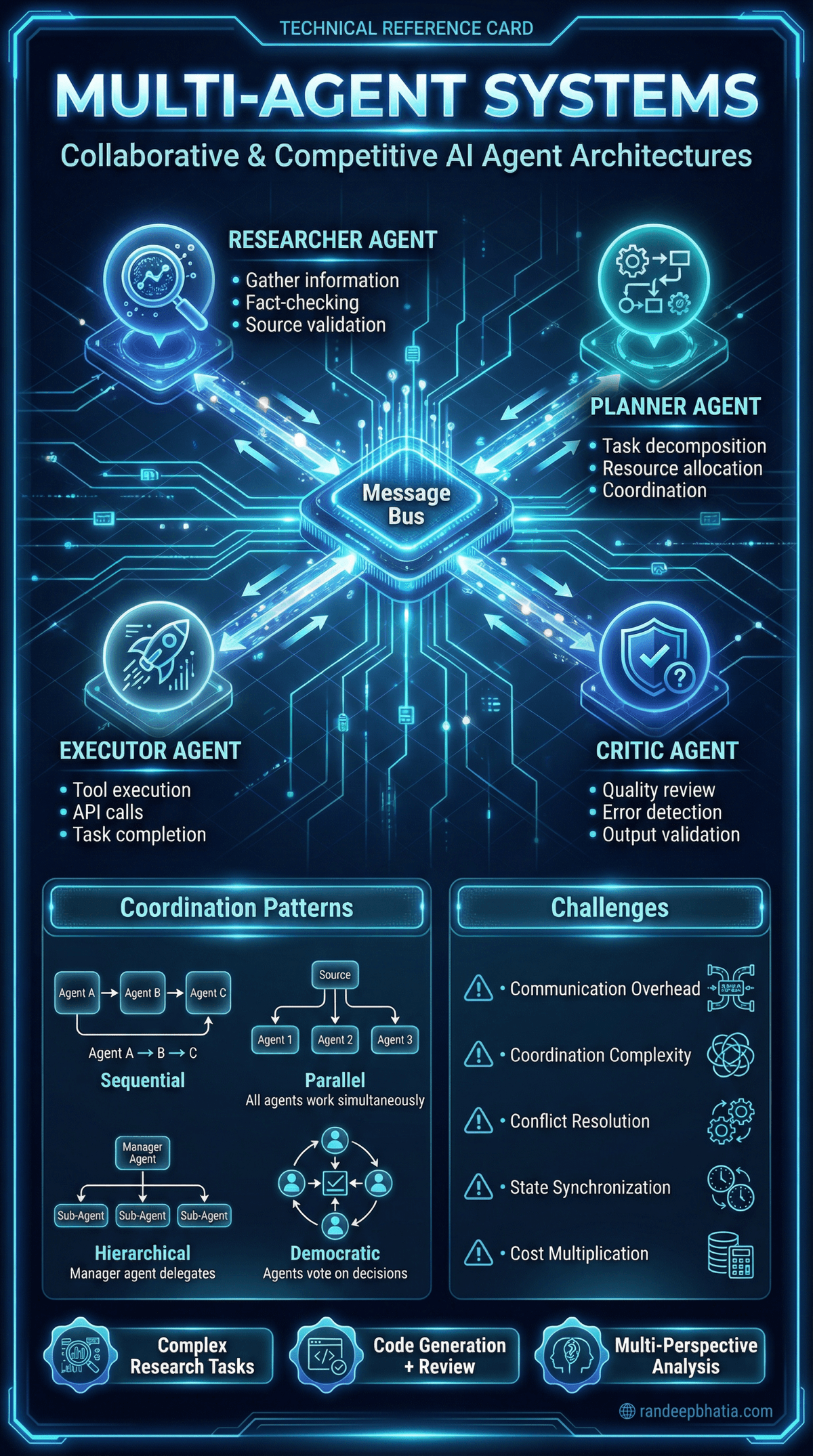
What is a Multi-Agent System
Executive Summary
Executive Summary
A multi-agent system (MAS) is an architecture where multiple autonomous AI agents collaborate, communicate, and coordinate to accomplish tasks that exceed the capabilities of any single agent.
Multi-agent systems decompose complex problems into specialized subtasks handled by purpose-built agents, enabling solutions that would be impossible or impractical for monolithic systems to achieve.
Effective MAS implementations require explicit coordination mechanisms, communication protocols, and conflict resolution strategies to prevent emergent failures and ensure coherent system behavior.
The decision to adopt a multi-agent architecture involves significant tradeoffs between capability expansion and operational complexity, with success depending heavily on clear agent boundaries and robust orchestration.
The Bottom Line
Multi-agent systems represent a fundamental architectural pattern for building AI applications that require diverse capabilities, parallel processing, or specialized expertise across different domains. Organizations should adopt MAS when task complexity genuinely exceeds single-agent capabilities, while recognizing that coordination overhead and debugging complexity scale non-linearly with agent count.
Definition
Definition
A multi-agent system (MAS) is a computational architecture comprising multiple autonomous agents that interact within a shared environment to achieve individual or collective goals through communication, coordination, and collaboration.
Each agent in a MAS operates with its own perception of the environment, decision-making capabilities, and action repertoire, while the system as a whole exhibits emergent behavior arising from agent interactions that cannot be predicted from individual agent specifications alone.
Extended Definition
Multi-agent systems extend beyond simple parallelization by introducing agents with distinct roles, knowledge bases, and behavioral policies that must negotiate, delegate, and synthesize their outputs to produce coherent results. In the context of modern AI and large language models, MAS architectures typically involve specialized LLM-powered agents handling distinct aspects of complex tasks—such as research, analysis, code generation, and validation—with an orchestration layer managing workflow, context sharing, and conflict resolution. The architectural paradigm draws from distributed systems theory, game theory, and organizational behavior, recognizing that effective multi-agent coordination requires explicit protocols for communication, shared state management, and consensus building. Unlike traditional distributed computing where nodes execute identical logic, MAS agents are heterogeneous by design, each contributing unique capabilities that complement rather than replicate other agents in the system.
Etymology & Origins
The term 'multi-agent system' emerged from distributed artificial intelligence (DAI) research in the 1980s, building on earlier work in distributed problem solving and parallel AI. The concept draws from multiple intellectual traditions: the 'agent' terminology derives from philosophical discussions of autonomous entities with beliefs, desires, and intentions (BDI architecture), while 'multi-agent' reflects the shift from centralized AI systems to distributed, cooperative problem-solving paradigms. The field gained formal recognition with the establishment of the International Conference on Multi-Agent Systems (ICMAS) in 1995 and the subsequent formation of the International Foundation for Autonomous Agents and Multiagent Systems (IFAAMAS). In contemporary usage, particularly within LLM-based systems, the term has evolved to encompass any architecture where multiple AI components with distinct roles collaborate on tasks.
Also Known As
Not To Be Confused With
Single agent with multiple tools
A single agent using multiple tools maintains centralized decision-making and context, whereas a multi-agent system distributes decision-making across autonomous entities with their own reasoning capabilities and potentially conflicting objectives.
Microservices architecture
Microservices are stateless, deterministic services with well-defined APIs, while agents in a MAS are autonomous entities with internal state, learning capabilities, and the ability to initiate actions based on their own goals rather than solely responding to requests.
Ensemble methods in machine learning
Ensemble methods combine multiple models through fixed aggregation rules (voting, averaging) without inter-model communication, whereas multi-agent systems involve dynamic interaction, negotiation, and adaptive coordination between agents.
Workflow orchestration
Traditional workflow orchestration follows predetermined paths with conditional branching, while multi-agent systems allow for emergent behavior, dynamic task allocation, and agent-initiated communication that can alter system behavior at runtime.
Parallel processing
Parallel processing distributes identical computations across resources for speed, whereas multi-agent systems distribute different types of reasoning and decision-making across specialized agents that must coordinate their heterogeneous outputs.
Chatbot with personas
A chatbot with multiple personas is a single system with different response styles, while a multi-agent system involves genuinely separate agents with distinct knowledge bases, reasoning processes, and the ability to disagree or negotiate with each other.
Conceptual Foundation
Core Principles
(8 principles)Mental Models
(6 models)The Orchestra Model
View the multi-agent system as an orchestra where each agent is a musician with a specific instrument (capability), the orchestrator is the conductor providing coordination and timing, and the score represents the shared protocol and goals. Individual excellence matters, but the quality of the performance depends on how well agents harmonize their contributions.
The Marketplace Model
Conceptualize the system as a marketplace where agents are vendors offering services, tasks are buyers seeking solutions, and coordination emerges through negotiation and contract formation rather than central planning. Agents compete and cooperate based on incentives and capabilities.
The Committee Model
Think of agents as committee members who must deliberate, present perspectives, and reach consensus on decisions. Each agent brings expertise from their domain, and the final output represents a synthesis of multiple viewpoints that has been vetted through structured discussion.
The Assembly Line Model
View the system as a manufacturing assembly line where each agent performs a specific transformation on the work product before passing it to the next agent. The focus is on well-defined handoffs, quality gates between stages, and optimizing the flow of work through the system.
The Ecosystem Model
Conceptualize agents as species in an ecosystem with various relationships: symbiotic (mutually beneficial), competitive (vying for resources), and predator-prey (one agent's output feeds another). The system evolves over time as agents adapt to each other and their environment.
The Diplomatic Corps Model
Think of agents as diplomats representing different stakeholders or domains, each with their own interests and constraints. Coordination requires negotiation, compromise, and formal protocols for communication. Conflicts are expected and must be resolved through established mechanisms.
Key Insights
(10 insights)The optimal number of agents is almost always fewer than initially assumed; each additional agent adds coordination complexity that scales super-linearly while capability gains diminish logarithmically.
Agent boundaries should align with natural task decomposition boundaries, not organizational structures or arbitrary technical divisions; misaligned boundaries create excessive inter-agent communication.
The most common failure mode in multi-agent systems is not agent failure but coordination failure—agents individually succeeding while the system collectively fails to produce coherent output.
Shared context and memory are more critical to MAS success than individual agent capabilities; a system of mediocre agents with excellent coordination often outperforms excellent agents with poor coordination.
Debugging multi-agent systems requires observability at three levels: individual agent behavior, inter-agent communication, and emergent system behavior—most teams only instrument the first.
The decision to use multiple agents should be driven by genuine capability requirements, not by the intuition that 'more agents means more capability'; single agents with good tools often outperform poorly coordinated multi-agent systems.
Agent communication protocols should be designed for the failure case first; assuming reliable, instantaneous communication leads to brittle systems that fail catastrophically under real-world conditions.
Human-in-the-loop oversight becomes more critical, not less, as agent count increases; the potential for emergent harmful behaviors scales with system complexity.
The most effective multi-agent systems often use a hybrid approach with both hierarchical control for critical decisions and peer-to-peer coordination for routine operations.
Cost efficiency in multi-agent systems requires careful attention to which agents invoke which other agents; a single poorly designed interaction pattern can dominate total system cost.
When to Use
When to Use
Ideal Scenarios
(12)Complex tasks requiring genuinely different types of expertise that cannot be effectively combined in a single prompt or agent, such as systems needing both deep technical analysis and creative content generation.
Workflows with natural parallelization opportunities where independent subtasks can be processed simultaneously by specialized agents, reducing total latency compared to sequential single-agent processing.
Problems requiring adversarial or dialectical reasoning where having separate agents argue different positions produces better outcomes than a single agent attempting to consider all perspectives.
Systems that must integrate with multiple external services or APIs where each integration has sufficient complexity to warrant a dedicated agent with specialized knowledge.
Applications requiring different levels of capability or cost optimization for different subtasks, allowing expensive high-capability agents to be used only where necessary while cheaper agents handle routine work.
Scenarios where task decomposition is uncertain at design time and the system must dynamically determine how to break down and allocate work based on runtime conditions.
Long-running processes that benefit from checkpointing and resumability, where agent boundaries provide natural points for saving state and recovering from failures.
Systems requiring audit trails and explainability where distinct agent responsibilities make it easier to trace how decisions were made and which component contributed what.
Applications where different subtasks have different latency requirements, allowing time-critical components to proceed while longer-running analyses complete asynchronously.
Domains where specialized fine-tuning or prompt engineering for subtasks yields significant improvements, making it worthwhile to maintain separate optimized agents rather than a single generalist.
Workflows requiring human approval at specific stages, where agent boundaries provide natural intervention points without disrupting the entire system.
Systems that must scale different capabilities independently, such as scaling research capacity without scaling code generation capacity.
Prerequisites
(8)Clear task decomposition with well-defined boundaries between subtasks that minimize the need for shared state and frequent synchronization between agents.
Sufficient task complexity to justify coordination overhead; the combined cost of multiple agents plus coordination must be less than the cost or impossibility of single-agent solutions.
Robust infrastructure for inter-agent communication including message queuing, state management, and failure handling capabilities.
Observability tooling capable of tracing requests across agent boundaries and correlating logs from multiple agents into coherent narratives.
Team expertise in distributed systems concepts including eventual consistency, failure modes, and debugging techniques for asynchronous systems.
Clear success criteria that can be evaluated at both the individual agent level and the system level, enabling identification of whether failures are agent-level or coordination-level.
Budget for increased operational complexity including monitoring, debugging, and maintenance of multiple agent configurations.
Tolerance for non-deterministic behavior and emergent outcomes that may require iterative refinement of agent interactions.
Signals You Need This
(10)Single-agent prompts have become unmanageably long, attempting to include instructions for multiple distinct capabilities that interfere with each other.
Task performance degrades when adding more capabilities to a single agent, suggesting that the agent is exceeding its effective context or instruction-following capacity.
Different parts of your workflow have dramatically different latency requirements that cannot be met with sequential single-agent processing.
You need to apply different safety constraints, access controls, or compliance requirements to different parts of the workflow.
Domain experts identify that your task naturally decomposes into subtasks requiring genuinely different expertise that would be diluted in a generalist approach.
You observe that humans solving the same problem naturally divide labor among specialists rather than having a single person attempt everything.
Single-agent solutions produce inconsistent quality because the agent must context-switch between very different types of reasoning within a single interaction.
You need to A/B test or gradually roll out improvements to specific capabilities without affecting the entire system.
Error analysis reveals that failures cluster in specific capability areas that could be isolated and improved independently.
Your application requires real-time responsiveness for some operations while tolerating higher latency for others, suggesting natural boundaries for agent separation.
Organizational Readiness
(7)Engineering team has experience with distributed systems, microservices, or similar architectures and understands the operational implications of distributed components.
Organization has established practices for monitoring and alerting on distributed systems, including distributed tracing and log aggregation.
Team has capacity for increased operational overhead including on-call responsibilities for a more complex system with more potential failure points.
Stakeholders understand and accept that multi-agent systems may exhibit emergent behaviors requiring ongoing tuning and that initial deployments may require iteration.
Budget allocation accounts for higher per-request costs during development and tuning phases before optimization efforts reduce coordination overhead.
Clear ownership model exists for different agents and the orchestration layer, preventing gaps in responsibility that lead to unaddressed issues.
Testing infrastructure supports integration testing across agent boundaries, not just unit testing of individual agents.
When NOT to Use
When NOT to Use
Anti-Patterns
(12)Creating multiple agents for tasks that a single well-prompted agent handles effectively, adding coordination complexity without meaningful capability gains.
Splitting agents along arbitrary boundaries that don't align with natural task decomposition, resulting in excessive inter-agent communication and shared state requirements.
Using multi-agent architecture primarily for perceived sophistication or to match competitor claims rather than to solve genuine capability limitations.
Implementing multi-agent systems without adequate observability, making it impossible to diagnose whether issues stem from individual agents or coordination failures.
Allowing agents to communicate through unstructured natural language without defined protocols, leading to miscommunication, ambiguity, and inconsistent behavior.
Creating circular dependencies between agents where Agent A needs output from Agent B which needs output from Agent A, causing deadlocks or infinite loops.
Designing agents with overlapping responsibilities without clear arbitration mechanisms, leading to conflicts, duplicated work, or inconsistent outputs.
Implementing synchronous blocking communication between all agents, negating the latency benefits of parallelization and creating bottlenecks.
Failing to implement timeout and fallback mechanisms, allowing single agent failures to block the entire system indefinitely.
Using multi-agent architecture for simple sequential workflows that would be more efficiently implemented as a single agent with multiple steps.
Creating agents that are too fine-grained, resulting in coordination overhead that exceeds the computational cost of the actual work.
Implementing multi-agent systems without clear escalation paths for conflicts or failures that cannot be resolved through automated coordination.
Red Flags
(10)The proposed agent boundaries require most agents to have access to most of the system context, indicating that decomposition doesn't reduce complexity.
Team cannot clearly articulate what each agent does that others cannot, suggesting artificial rather than capability-driven boundaries.
Initial prototypes show that coordination code is larger and more complex than the actual agent logic, indicating excessive overhead.
Debugging sessions consistently require examining multiple agents to understand single failures, suggesting boundaries are misaligned with failure modes.
Performance benchmarks show multi-agent implementation is slower than single-agent baseline for the same tasks, without compensating capability improvements.
The system requires extensive prompt engineering to prevent agents from duplicating each other's work or producing conflicting outputs.
Cost analysis reveals that inter-agent communication tokens exceed the tokens used for actual task completion.
Team members cannot explain the system's behavior without simulating the entire multi-agent interaction in their heads.
Most agent interactions follow a fixed sequence that could be implemented as a single agent with multiple steps.
The orchestration layer has become a de facto single agent that makes all meaningful decisions, with other agents serving as glorified function calls.
Better Alternatives
(8)Task requires multiple capabilities but they're used sequentially without parallel processing benefits
Single agent with structured output and multiple processing steps
Eliminates coordination overhead while maintaining capability through step-by-step processing; simpler to debug and optimize.
Different capabilities are needed but share extensive context that would need to be passed between agents
Single agent with tool use for specialized operations
Tools provide specialized capabilities without the overhead of full agent autonomy; context remains centralized and coherent.
Task parallelization is desired but subtasks are identical operations on different data
Single agent with parallel tool execution or batch processing
Parallel execution of identical operations doesn't require agent autonomy; simpler infrastructure with same latency benefits.
Multiple perspectives are needed for decision quality
Single agent with explicit multi-perspective prompting or chain-of-thought that considers alternatives
A well-prompted single agent can consider multiple perspectives without the overhead of separate agents; easier to ensure all perspectives are actually considered.
Different parts of the workflow have different cost profiles
Single orchestrator with model routing to different capability tiers
Model routing achieves cost optimization without full agent separation; maintains simpler architecture while optimizing spend.
System needs to handle diverse query types
Query classifier with specialized prompt templates rather than separate agents
Classification plus templating is simpler than full agent separation; reduces operational complexity while maintaining specialization benefits.
Workflow requires human approval at certain stages
Single agent with explicit checkpoints and human-in-the-loop integration
Checkpointing doesn't require agent boundaries; simpler state management and clearer human interaction points.
Task requires integration with multiple external APIs
Single agent with multiple tool integrations managed by a unified tool layer
API integrations are better modeled as tools than agents unless they require autonomous decision-making; reduces coordination complexity.
Common Mistakes
(10)Assuming that more agents automatically means better results, when coordination overhead often negates capability gains for insufficiently complex tasks.
Designing agent communication as an afterthought rather than a first-class architectural concern, leading to brittle and inefficient interaction patterns.
Failing to establish clear ownership and responsibility boundaries, resulting in gaps where no agent handles certain cases or conflicts where multiple agents claim authority.
Implementing agents with identical or highly overlapping capabilities, creating redundancy without the benefits of true specialization.
Using natural language for all inter-agent communication without structured schemas, leading to parsing errors, ambiguity, and inconsistent interpretation.
Neglecting to implement comprehensive logging and tracing, making it impossible to reconstruct what happened when issues occur in production.
Allowing unbounded agent-to-agent calls without cycle detection or depth limits, risking infinite loops and runaway costs.
Testing agents in isolation without integration testing, missing coordination failures that only manifest when agents interact.
Failing to implement graceful degradation, allowing single agent failures to cascade into complete system failures.
Over-engineering the initial implementation with complex coordination mechanisms before validating that multi-agent architecture is actually needed.
Core Taxonomy
Core Taxonomy
Primary Types
(8 types)A structured architecture where agents are organized in layers with supervisory agents directing subordinate agents, creating clear chains of command and escalation paths. Higher-level agents decompose tasks, delegate to specialists, and synthesize results.
Characteristics
- Clear authority structure with defined supervisor-subordinate relationships
- Top-down task decomposition and bottom-up result aggregation
- Centralized decision-making for cross-cutting concerns
- Explicit escalation paths for conflicts and exceptions
- Easier to reason about and debug due to structured flow
Use Cases
Tradeoffs
Provides clarity and control at the cost of flexibility; supervisor agents can become bottlenecks; may not leverage full parallelization potential; single points of failure at higher hierarchy levels.
Classification Dimensions
Communication Pattern
How agents exchange information, affecting latency characteristics, coupling, and failure handling. Synchronous communication is simpler but creates tight coupling; asynchronous enables parallelism but complicates state management.
State Management
How agent state is maintained and shared across the system. Stateless agents are simpler to scale but may require repeated context; shared state enables coordination but creates consistency challenges.
Agent Homogeneity
Whether agents in the system are identical or differentiated. Homogeneous systems are simpler to manage; heterogeneous systems can leverage specialization but require more complex coordination.
Coordination Mechanism
How agents coordinate their activities and resolve conflicts. Different mechanisms have different scalability, latency, and reliability characteristics.
Learning Capability
Whether and how agents adapt their behavior over time. Learning enables improvement but introduces non-determinism and potential instability.
Trust Model
Assumptions about agent reliability and honesty. Trust models affect what coordination mechanisms are appropriate and what verification is required.
Evolutionary Stages
Monolithic Single Agent
Initial deployment, 0-3 monthsAll capabilities in a single agent with a large prompt or fine-tuned model. Simple to deploy and debug but limited by context window, instruction-following capacity, and inability to parallelize.
Agent with Tools
Early optimization, 1-6 monthsSingle agent augmented with tool calling for specialized operations. Maintains centralized control while extending capabilities. First step toward decomposition without full multi-agent complexity.
Simple Multi-Agent Pipeline
Capability expansion, 3-12 monthsTwo to four agents in a sequential pipeline with clear handoffs. Introduces agent boundaries and inter-agent communication but maintains predictable flow. Often the right stopping point for many applications.
Orchestrated Multi-Agent System
Production maturity, 6-18 monthsCentral orchestrator managing multiple specialized agents with conditional routing and parallel execution. Enables complex workflows while maintaining oversight. Requires significant operational investment.
Adaptive Multi-Agent System
Advanced optimization, 12-36 monthsDynamic agent composition with runtime adaptation, learning from interactions, and emergent coordination patterns. Maximum capability but highest complexity. Requires sophisticated monitoring and intervention capabilities.
Architecture Patterns
(8 patterns)Supervisor-Worker Pattern
A hierarchical pattern where a supervisor agent receives tasks, decomposes them into subtasks, delegates to specialized worker agents, and synthesizes their outputs into a coherent response. The supervisor maintains overall context and makes routing decisions.
Components
- Supervisor agent with task decomposition and synthesis capabilities
- Multiple specialized worker agents
- Task queue for work distribution
- Result aggregation layer
- Shared context store accessible to supervisor
Data Flow
User request → Supervisor (decomposition) → Task queue → Worker agents (parallel execution) → Results → Supervisor (synthesis) → Response
Best For
- Complex tasks requiring multiple types of expertise
- Workflows with clear decomposition into independent subtasks
- Systems requiring centralized quality control
- Applications needing audit trails of decision-making
Limitations
- Supervisor is single point of failure and potential bottleneck
- Decomposition quality depends entirely on supervisor capability
- May not efficiently handle tasks requiring iterative agent collaboration
- Context passing to workers can be expensive
Scaling Characteristics
Workers scale horizontally; supervisor can become bottleneck at high throughput. Consider supervisor pooling or hierarchical supervisors for scale. Worker specialization enables independent scaling of different capabilities.
Integration Points
Orchestration Layer
Coordinates agent interactions, manages workflow state, handles routing decisions, and provides the control plane for the multi-agent system.
The orchestration layer is often the most critical component and potential single point of failure. Consider redundancy, state persistence, and graceful degradation. Keep orchestration logic simple—complex orchestration suggests agent boundaries may be wrong.
Message Bus
Provides reliable, potentially asynchronous communication between agents, decoupling senders from receivers and enabling various communication patterns.
Message bus choice significantly impacts system characteristics. Consider message ordering guarantees, delivery semantics (at-least-once, exactly-once), and latency requirements. Over-engineering the message bus is a common mistake for systems that don't need its full capabilities.
Shared Memory/Context Store
Maintains context and state that must be accessible to multiple agents, enabling coordination without direct communication and providing persistence across agent invocations.
Shared state is both enabling and dangerous—it allows coordination but creates coupling and consistency challenges. Minimize shared state; prefer explicit message passing where possible. Consider consistency requirements carefully—strong consistency has performance costs.
Agent Runtime
Provides the execution environment for agents, handling LLM API calls, tool execution, context management, and resource allocation for individual agents.
Agent runtime should provide isolation between agents while enabling efficient resource sharing. Consider multi-tenancy requirements, security boundaries, and resource fairness. Standardize runtime interface to enable agent portability.
Observability Stack
Provides visibility into system behavior through logging, metrics, and tracing, enabling debugging, performance optimization, and anomaly detection across the multi-agent system.
Observability is more critical in multi-agent systems than single-agent systems due to emergent behavior and distributed failures. Invest heavily in tracing that follows requests across agent boundaries. Ensure logs can be correlated into coherent narratives.
Human-in-the-Loop Interface
Enables human oversight, intervention, and feedback at critical points in the multi-agent workflow, providing guardrails and quality assurance.
Human-in-the-loop is often essential for production multi-agent systems but must be designed carefully to avoid becoming a bottleneck. Define clear criteria for when human involvement is required. Ensure humans have sufficient context to make informed decisions.
External Service Gateway
Manages connections to external APIs and services that agents may need to access, providing authentication, rate limiting, and failure handling.
External service failures are a common cause of multi-agent system failures. Implement robust retry logic, circuit breakers, and fallback strategies. Consider the blast radius of external service outages on your agent system.
Security and Access Control
Enforces security policies including authentication, authorization, and data protection across the multi-agent system.
Security in multi-agent systems must consider both external threats and inter-agent trust. Implement least-privilege access for agents. Consider prompt injection risks when agents process untrusted input. Ensure sensitive data doesn't leak through agent communication.
Decision Framework
Decision Framework
Multi-agent architecture may be appropriate; continue evaluation.
Consider single agent with tools or structured prompting; multi-agent likely adds unnecessary complexity.
Be honest about whether expertise is truly different or just different aspects of the same domain. A single well-prompted agent often handles more than expected.
Technical Deep Dive
Technical Deep Dive
Overview
A multi-agent system operates through the coordinated interaction of autonomous agents, each executing its own reasoning process while communicating with other agents to achieve collective goals. The system begins when a task enters through an entry point—typically an orchestrator or router—which determines how to decompose or route the task based on its characteristics and the capabilities of available agents. Each agent in the system maintains its own context, which may include a system prompt defining its role and capabilities, relevant memories or knowledge, and any tools it can invoke. When an agent receives a task or message, it processes the input through its reasoning engine (typically an LLM), potentially invoking tools or sub-agents, and produces an output that may be a final result, a message to another agent, or a request for additional information. Coordination between agents occurs through explicit communication channels—message passing, shared state, or direct invocation—governed by protocols that define message formats, sequencing, and error handling. The orchestration layer manages the overall workflow, tracking task state, handling failures, and ensuring that agent outputs are properly synthesized into coherent system outputs. The emergent behavior of the system arises from the combination of individual agent behaviors and their interactions. While each agent follows its own logic, the system as a whole can exhibit capabilities and behaviors that weren't explicitly programmed into any single agent, making comprehensive testing and monitoring essential for production deployments.
Step-by-Step Process
The system receives a task through its entry point, which may be an API endpoint, message queue, or user interface. The entry point performs initial validation, authentication, and logging before passing the task to the orchestration layer. Metadata such as request ID, timestamp, and user context is attached for tracing.
Insufficient validation at entry point allows malformed or malicious inputs to propagate through the system. Missing correlation IDs make debugging impossible. Not capturing initial context loses information needed for later debugging.
Under The Hood
At the implementation level, multi-agent systems rely on several key technical components working in concert. The agent runtime provides the execution environment for each agent, managing LLM API calls, tool execution, and resource allocation. Modern implementations typically use async/await patterns to handle the inherently concurrent nature of multi-agent execution, allowing multiple agents to process in parallel without blocking threads. Inter-agent communication is typically implemented through one of several mechanisms. Direct invocation treats agents as callable functions, simple but creating tight coupling. Message queues (Redis, RabbitMQ, Kafka) provide decoupling and persistence but add latency and operational complexity. Shared state stores (Redis, databases) enable implicit coordination through data but require careful consistency management. The choice of communication mechanism significantly impacts system characteristics including latency, reliability, and debugging complexity. State management in multi-agent systems presents unique challenges. Each agent may maintain local state (conversation history, working memory), while the system maintains global state (workflow progress, shared context). Implementations must carefully manage state lifecycle, ensuring that state is available when needed, consistent across agents when required, and cleaned up appropriately. Many systems use a combination of in-memory state for performance and persistent storage for durability. The orchestration layer—whether implemented as a dedicated orchestrator agent, a state machine, or a workflow engine—manages the overall flow of execution. Modern frameworks like LangGraph represent workflows as graphs with nodes (agents or functions) and edges (transitions), enabling complex conditional and parallel execution patterns. The orchestrator maintains workflow state, handles branching and merging, and manages error recovery. Observability implementation requires instrumentation at multiple levels. Distributed tracing (OpenTelemetry, Jaeger) tracks requests across agent boundaries, creating spans for each agent invocation. Structured logging captures agent inputs, outputs, and intermediate reasoning. Metrics collection tracks latency, token usage, and quality indicators. The challenge is correlating information across agents into coherent narratives that enable debugging of emergent behaviors. Error handling in multi-agent systems must address failures at multiple levels: individual LLM calls may fail or timeout, tools may return errors, agents may produce invalid outputs, and coordination may deadlock. Robust implementations use circuit breakers to prevent cascade failures, retry logic with exponential backoff for transient errors, fallback strategies for graceful degradation, and timeout enforcement at every level. The key insight is that partial failures are normal in multi-agent systems, and the system must be designed to continue functioning with reduced capability rather than failing completely.
Failure Modes
Failure Modes
Centralized orchestrator crashes or becomes unresponsive, halting all task processing since no agent can receive tasks or report results.
- All requests timeout or fail
- Agent queues fill up with unprocessed tasks
- No new workflows initiated
- Health checks on orchestrator fail
Complete system outage; no tasks processed until orchestrator recovers
Implement orchestrator redundancy with leader election. Keep orchestrator logic simple. Use stateless orchestrator design with external state store.
Automatic failover to standby orchestrator. Circuit breaker to fail fast. Queue persistence to prevent task loss during outage.
Operational Considerations
Key Metrics (15)
Total time from request receipt to response delivery, measuring user-perceived performance across the entire multi-agent workflow.
Dashboard Panels
Alerting Strategy
Implement tiered alerting with severity levels based on user impact. Critical alerts (paging) for system-wide outages, sustained high error rates, or security incidents. Warning alerts (ticket) for degraded performance, elevated error rates, or resource pressure. Info alerts (log) for anomalies worth investigating but not immediately actionable. Use alert aggregation to prevent alert storms during cascading failures. Implement alert correlation to identify root causes across multiple symptoms. Define clear runbooks for each alert type with escalation procedures.
Cost Analysis
Cost Analysis
Cost Drivers
(10)LLM API Token Usage
Typically 60-80% of total cost; scales with request volume, context size, and agent count
Optimize prompts for conciseness. Implement context summarization. Cache repeated queries. Use cheaper models for simple tasks. Batch similar requests.
Agent Invocation Count
Each additional agent invocation multiplies LLM costs; coordination adds overhead
Minimize agent count to necessary specialization. Combine agents where boundaries are artificial. Implement early termination for simple requests.
Context Passing Overhead
Repeated context in each agent's prompt multiplies token usage
Implement context summarization between agents. Pass only relevant context. Use hierarchical context with detail levels. Cache common context elements.
Retry and Error Handling
Failed attempts still incur costs; retries multiply per-request costs
Improve first-attempt success rate. Implement smart retry with backoff. Fail fast for unrecoverable errors. Cache successful results.
Infrastructure Costs
Compute, storage, networking for orchestration and agent runtime; typically 10-20% of total
Right-size infrastructure. Use spot/preemptible instances where appropriate. Optimize state storage. Implement efficient queuing.
External API Costs
Third-party services (search, databases, specialized APIs) add per-call costs
Cache external API results. Batch requests where possible. Negotiate volume pricing. Evaluate build vs. buy for frequent operations.
Human-in-the-Loop Costs
Human review and intervention has high per-instance cost; scales with escalation rate
Reduce escalation rate through agent improvement. Optimize human review workflows. Implement tiered review for different confidence levels.
Observability and Logging
Log storage, tracing infrastructure, monitoring tools; typically 5-10% of total
Implement log sampling for high-volume events. Set appropriate retention periods. Use tiered storage. Aggregate metrics efficiently.
Development and Maintenance
Engineering time for agent development, prompt tuning, and system maintenance
Invest in tooling for efficient development. Implement automated testing. Create reusable agent templates. Document patterns and anti-patterns.
Model Selection
Different models have 10-100x cost differences; capability requirements drive selection
Use capability-appropriate models. Implement model routing based on task complexity. Evaluate fine-tuned smaller models for specific tasks.
Cost Models
Per-Request Cost Model
Cost = Σ(agents) × [input_tokens × input_price + output_tokens × output_price] + infrastructure_overhead + external_api_costsA 5-agent workflow with average 2000 input tokens and 500 output tokens per agent using GPT-4: 5 × [(2000 × $0.03/1K) + (500 × $0.06/1K)] = 5 × [$0.06 + $0.03] = $0.45 per request in LLM costs alone
Monthly Operating Cost Model
Monthly_Cost = (requests_per_month × avg_cost_per_request) + fixed_infrastructure + human_review_costs + development_allocation100K requests/month × $0.50 avg + $2000 infrastructure + 40 hours × $75/hr human review + $10000 dev allocation = $50K + $2K + $3K + $10K = $65K/month
Cost per Capability Model
Capability_Cost = (dedicated_agent_costs + shared_overhead_allocation) / capability_usage_volumeResearch capability: $5000 agent costs + $1000 overhead allocation / 10000 research tasks = $0.60 per research task
ROI Model
ROI = (value_generated - total_cost) / total_cost × 100%System generates $200K value/month, costs $65K to operate, $300K development investment. Year 1 ROI: ($2.4M - $780K - $300K) / ($780K + $300K) = 122%
Optimization Strategies
- 1Implement intelligent routing to use cheaper models for simpler tasks, reserving expensive models for complex reasoning
- 2Cache common queries and agent outputs to avoid redundant LLM calls for repeated patterns
- 3Optimize prompts for conciseness without sacrificing quality, reducing input token costs
- 4Implement context summarization to reduce token usage in multi-agent context passing
- 5Use batch processing for non-time-sensitive requests to improve efficiency and potentially access batch pricing
- 6Evaluate fine-tuned smaller models for high-volume specific tasks where they can match larger model quality
- 7Implement early termination for requests that can be satisfied without full agent pipeline
- 8Monitor and eliminate unnecessary agent invocations through workflow optimization
- 9Negotiate volume pricing with LLM providers based on usage commitments
- 10Implement request deduplication to avoid processing identical requests multiple times
- 11Use streaming responses to provide value before full completion, potentially allowing early termination
- 12Optimize retry strategies to minimize wasted spend on ultimately failing requests
Hidden Costs
- 💰Development time for debugging emergent behaviors that don't occur in single-agent systems
- 💰Increased testing complexity requiring integration tests across agent boundaries
- 💰Operational overhead for monitoring and maintaining multiple agent configurations
- 💰Context switching costs for engineers working across multiple agent codebases
- 💰Coordination overhead in team communication about multi-agent system behavior
- 💰Technical debt accumulation from rapid iteration on agent prompts and configurations
- 💰Opportunity cost of complexity preventing rapid feature development
- 💰Training costs for team members learning multi-agent system patterns
ROI Considerations
Return on investment for multi-agent systems should be evaluated against the specific problems they solve, not against single-agent alternatives in the abstract. The relevant comparison is whether the multi-agent approach delivers sufficient additional value to justify its additional costs. Value may come from capabilities that single agents cannot provide, quality improvements from specialization, latency reductions from parallelization, or operational benefits from modular architecture. ROI calculations should include both direct costs (LLM APIs, infrastructure, development) and indirect costs (operational complexity, debugging time, team cognitive load). Similarly, value calculations should include both direct value (revenue, cost savings) and indirect value (user satisfaction, competitive positioning, future optionality). Break-even analysis should consider the volume at which multi-agent benefits outweigh costs. Many multi-agent systems have higher fixed costs but better scaling characteristics, making them more economical at high volumes. Conversely, low-volume applications may never achieve positive ROI from multi-agent complexity. Consider the time dimension of ROI. Multi-agent systems often have higher initial costs during development and tuning but lower marginal costs at scale. The payback period depends on how quickly the system reaches efficient operation and the expected lifetime of the deployment.
Security Considerations
Threat Model
(10 threats)Prompt Injection via Inter-Agent Communication
Malicious content in one agent's output is interpreted as instructions by downstream agents, causing unintended behavior or data exfiltration.
Unauthorized actions, data leakage, system compromise, reputation damage
Sanitize inter-agent communication. Use structured data formats rather than free text. Implement output validation. Apply principle of least privilege to agent capabilities.
Agent Impersonation
Attacker injects messages appearing to come from legitimate agents, manipulating system behavior or extracting information.
Unauthorized access, data manipulation, system compromise
Implement agent authentication. Sign inter-agent messages. Validate message sources. Use secure communication channels.
Data Exfiltration Through Agent Outputs
Agents inadvertently or maliciously include sensitive data in outputs that are logged, cached, or transmitted to unauthorized parties.
Data breach, compliance violations, privacy violations
Implement output filtering for sensitive data. Classify data and enforce handling rules. Audit agent outputs. Minimize data exposure in logs.
Denial of Service via Agent Loops
Crafted inputs cause agents to enter infinite loops or excessive recursion, consuming resources and blocking legitimate requests.
Service unavailability, resource exhaustion, cost explosion
Implement depth limits and timeouts. Detect and break loops. Rate limit per-user requests. Monitor for anomalous patterns.
Privilege Escalation Through Agent Chaining
Attacker exploits trust relationships between agents to access capabilities or data not directly available to them.
Unauthorized access, data breach, system compromise
Implement capability-based access control. Validate authorization at each agent. Don't inherit permissions through agent chains. Audit privilege usage.
Model Extraction via Agent Probing
Systematic querying of agents to extract proprietary prompts, fine-tuning data, or system architecture information.
Intellectual property theft, competitive disadvantage, security vulnerability exposure
Rate limit queries. Detect probing patterns. Avoid exposing system details in responses. Implement query anomaly detection.
Supply Chain Compromise
Malicious code or prompts introduced through compromised dependencies, frameworks, or agent templates.
System compromise, data breach, backdoor access
Audit dependencies. Use verified sources. Implement code review for agent configurations. Monitor for unexpected behavior.
Insider Threat via Agent Configuration
Malicious insider modifies agent prompts or configurations to introduce backdoors or exfiltrate data.
Data breach, system compromise, sabotage
Implement access controls on configurations. Audit configuration changes. Use version control with review requirements. Monitor for unauthorized changes.
Cross-Tenant Data Leakage
In multi-tenant deployments, data from one tenant leaks to another through shared agents, caches, or state.
Data breach, privacy violations, compliance failures
Implement strict tenant isolation. Separate state per tenant. Audit cross-tenant boundaries. Test isolation regularly.
External Service Compromise
Compromised external services (APIs, databases) that agents interact with are used to attack the multi-agent system.
Data breach, system compromise, malicious output injection
Validate external service responses. Implement circuit breakers. Use least privilege for external access. Monitor external service behavior.
Security Best Practices
- ✓Implement defense in depth with security controls at multiple layers (network, application, agent, data)
- ✓Apply principle of least privilege to all agents, granting only capabilities necessary for their function
- ✓Use structured, typed inter-agent communication rather than free-form text to prevent injection
- ✓Implement comprehensive logging and auditing of all agent actions and inter-agent communication
- ✓Encrypt sensitive data at rest and in transit, including inter-agent messages
- ✓Implement rate limiting and anomaly detection to identify and block attack patterns
- ✓Regularly audit agent configurations and prompts for security vulnerabilities
- ✓Use secure credential management; never embed secrets in prompts or configurations
- ✓Implement input validation at system entry points and between agents
- ✓Conduct regular security assessments including penetration testing of multi-agent workflows
- ✓Maintain incident response procedures specific to multi-agent system threats
- ✓Implement secure development practices for agent code and configurations
- ✓Use network segmentation to limit blast radius of compromises
- ✓Implement human oversight for high-risk operations
- ✓Maintain security awareness training for team members working with multi-agent systems
Data Protection
- 🔒Classify data by sensitivity and implement appropriate handling rules for each classification
- 🔒Implement data masking or tokenization for sensitive data passed between agents
- 🔒Minimize data retention in agent memory and shared state; implement TTLs
- 🔒Encrypt all data at rest including agent state, logs, and cached outputs
- 🔒Use TLS for all inter-agent communication and external API calls
- 🔒Implement access controls ensuring agents only access data necessary for their function
- 🔒Audit data access patterns and alert on anomalies
- 🔒Implement data loss prevention (DLP) controls on agent outputs
- 🔒Ensure data residency requirements are met for all agent processing and storage
- 🔒Implement secure data deletion procedures that cover all agent state and logs
Compliance Implications
GDPR (General Data Protection Regulation)
Data minimization, purpose limitation, right to explanation, data subject rights
Minimize personal data in agent context. Implement data retention limits. Provide audit trails for automated decisions. Enable data deletion across all agents and state stores.
HIPAA (Health Insurance Portability and Accountability Act)
Protected health information (PHI) safeguards, access controls, audit trails
Encrypt PHI in transit and at rest. Implement strict access controls on agents handling PHI. Maintain comprehensive audit logs. Ensure BAAs with LLM providers.
SOC 2
Security, availability, processing integrity, confidentiality, privacy controls
Document multi-agent system controls. Implement monitoring and alerting. Maintain change management procedures. Conduct regular audits of agent configurations.
PCI DSS (Payment Card Industry Data Security Standard)
Cardholder data protection, access control, monitoring, security testing
Isolate agents handling payment data. Implement strong access controls. Log all access to cardholder data. Conduct regular security assessments.
AI Act (EU Artificial Intelligence Act)
Risk assessment, transparency, human oversight for high-risk AI systems
Document multi-agent system risk assessment. Implement explainability for agent decisions. Ensure human oversight mechanisms. Maintain technical documentation.
CCPA (California Consumer Privacy Act)
Consumer rights to know, delete, opt-out; data protection
Track personal information across agents. Implement deletion capabilities. Provide transparency about AI processing. Honor opt-out requests.
Financial Services Regulations (various)
Model risk management, explainability, audit trails
Document agent models and their interactions. Implement comprehensive logging. Maintain model inventory. Conduct regular model validation.
Sector-Specific AI Guidelines
Varies by jurisdiction and sector; generally transparency, fairness, accountability
Stay current with evolving AI regulations. Implement flexible compliance controls. Document AI system behavior. Maintain human oversight capabilities.
Scaling Guide
Scaling Guide
Scaling Dimensions
Request Throughput
Horizontal scaling of agent instances; load balancing across instances; queue-based decoupling for burst handling
Limited by orchestrator capacity, shared state throughput, and LLM API rate limits
Ensure stateless agent design for horizontal scaling. Implement proper load balancing. Monitor queue depths for backpressure signals.
Agent Count
Modular agent deployment; service mesh for agent discovery; hierarchical organization for management
Coordination overhead increases super-linearly; practical limit typically 20-50 agents for human comprehension
Each new agent adds coordination complexity. Ensure clear boundaries and minimal coupling. Consider consolidation before adding agents.
Context Size
Context summarization; hierarchical context; retrieval-augmented context; context caching
Model context window limits; cost scales with context size; latency increases with context
Implement aggressive context management early. Design for context efficiency from the start.
Workflow Complexity
Hierarchical decomposition; sub-workflow encapsulation; dynamic workflow composition
Human comprehension of complex workflows; testing complexity; debugging difficulty
Keep individual workflows simple. Use composition for complexity. Document workflow patterns.
Geographic Distribution
Regional deployment; edge processing for latency-sensitive operations; data residency compliance
Cross-region latency; data sovereignty requirements; operational complexity
Design for regional independence where possible. Implement proper data handling for cross-region flows.
Concurrent Users
Session isolation; user-level rate limiting; priority queuing for different user tiers
State management for many concurrent sessions; fair resource allocation
Implement proper session isolation. Design for graceful degradation under load.
Data Volume
Streaming processing; chunked handling; distributed storage; archival strategies
Storage costs; processing latency for large data; memory constraints
Design for streaming from the start. Implement efficient data handling patterns.
Model Diversity
Model abstraction layer; capability-based routing; provider redundancy
Integration complexity; inconsistent behavior across models; testing burden
Abstract model details from agent logic. Implement proper fallback strategies.
Capacity Planning
Required_Capacity = (Peak_RPS × Avg_Agents_Per_Request × Avg_Processing_Time) × Safety_Margin + Redundancy_BufferTypically 1.5-2x expected peak load; higher for unpredictable workloads or strict SLAs. Include headroom for operational tasks (deployments, maintenance) that temporarily reduce capacity.
Scaling Milestones
- Establishing baseline metrics
- Validating multi-agent value proposition
- Initial prompt and workflow optimization
Single instance deployment acceptable. Focus on functionality over scalability. Manual monitoring sufficient.
- Reliability requirements increase
- Cost optimization becomes relevant
- Monitoring and alerting needed
Implement basic redundancy. Add structured logging and monitoring. Establish cost tracking. Implement basic caching.
- Performance optimization critical
- Operational complexity increases
- Team scaling for support
Horizontal scaling of agents. Implement proper load balancing. Add distributed tracing. Optimize hot paths. Consider model routing for cost.
- Infrastructure costs significant
- Coordination overhead visible
- Debugging complexity high
Implement caching aggressively. Optimize agent boundaries. Add request prioritization. Consider regional deployment. Implement advanced observability.
- Every inefficiency is expensive
- Availability requirements stringent
- Organizational complexity
Full horizontal scaling. Multi-region deployment. Advanced traffic management. Dedicated teams per subsystem. Continuous optimization programs.
Benchmarks
Benchmarks
Industry Benchmarks
| Metric | P50 | P95 | P99 | World Class |
|---|---|---|---|---|
| End-to-End Latency | 3-8 seconds | 15-30 seconds | 30-60 seconds | p50 < 3s, p95 < 10s |
| Request Success Rate | 95% | 98% | 99% | > 99.5% |
| Cost per Request | $0.10-0.50 | $0.50-2.00 | $2.00-5.00 | < $0.10 for routine, < $1.00 for complex |
| Agent Invocations per Request | 2-4 | 5-8 | 10-15 | Minimal necessary for task |
| Coordination Overhead | 15-25% | 25-35% | 35-50% | < 15% |
| Human Escalation Rate | 5-10% | 10-20% | 20-30% | < 5% |
| First-Attempt Success Rate | 80-90% | 90-95% | 95-98% | > 95% |
| Context Efficiency (useful tokens / total tokens) | 40-60% | 60-75% | 75-85% | > 75% |
| System Availability | 99.0% | 99.5% | 99.9% | > 99.9% |
| Mean Time to Recovery | 15-30 minutes | 5-15 minutes | < 5 minutes | < 2 minutes |
| Output Quality Score (task-specific) | 70-80% | 80-90% | 90-95% | > 90% |
| Throughput (requests/minute) | 10-50 | 50-200 | 200-1000 | Scales with demand |
Comparison Matrix
| Approach | Latency | Cost | Capability | Complexity | Scalability | Debuggability |
|---|---|---|---|---|---|---|
| Single Agent | Low | Low | Limited | Low | High | High |
| Agent + Tools | Low-Medium | Low-Medium | Medium | Low-Medium | High | High |
| Simple Pipeline (2-3 agents) | Medium | Medium | Medium-High | Medium | High | Medium |
| Orchestrated Multi-Agent | Medium-High | Medium-High | High | High | Medium-High | Medium |
| Peer-to-Peer Multi-Agent | Variable | High | High | Very High | High | Low |
| Adaptive/Learning MAS | Variable | Very High | Very High | Very High | Medium | Very Low |
Performance Tiers
Simple multi-agent workflows, limited parallelization, basic error handling
p95 latency < 60s, success rate > 90%, cost < $1/request
Optimized workflows, good parallelization, robust error handling, basic caching
p95 latency < 30s, success rate > 95%, cost < $0.50/request
Highly optimized, intelligent routing, comprehensive caching, graceful degradation
p95 latency < 15s, success rate > 98%, cost < $0.25/request
State-of-the-art optimization, adaptive systems, predictive scaling, continuous improvement
p95 latency < 10s, success rate > 99%, cost optimized per task type
Real World Examples
Real World Examples
Real-World Scenarios
(8 examples)Enterprise Document Processing Pipeline
Large financial services firm processing thousands of complex documents daily, requiring extraction, classification, validation, and integration with downstream systems.
Implemented 6-agent pipeline: Document Classifier → Content Extractor → Data Validator → Compliance Checker → Format Transformer → System Integrator. Each agent specialized for its stage with domain-specific prompts and tools.
Reduced document processing time from 2 hours (manual) to 5 minutes (automated). Achieved 94% accuracy on first pass, with human review for flagged items. Cost reduced by 70% compared to manual processing.
- 💡Stage-specific agents outperformed single generalist agent significantly
- 💡Quality gates between stages caught errors early, reducing rework
- 💡Human review for edge cases was essential for maintaining accuracy
- 💡Parallel processing of independent document sections improved throughput
Customer Support Automation
SaaS company receiving 10,000+ support tickets daily across multiple product lines, with varying complexity from simple FAQ to complex technical issues.
Router agent classifies tickets and routes to specialized agents: FAQ Agent, Technical Troubleshooter, Account Specialist, Escalation Handler. Supervisor agent monitors quality and handles cross-domain issues.
Automated resolution of 60% of tickets without human intervention. Average response time reduced from 4 hours to 5 minutes for automated responses. Customer satisfaction maintained at 4.2/5.
- 💡Accurate classification was critical—misrouted tickets had poor outcomes
- 💡Escalation paths to humans essential for complex or sensitive issues
- 💡Specialized agents significantly outperformed generalist for domain-specific queries
- 💡Continuous learning from human resolutions improved automated handling over time
Code Generation and Review System
Development team seeking to accelerate code generation while maintaining quality standards, particularly for boilerplate and well-defined components.
Three-agent system: Planner (decomposes requirements into implementation plan), Coder (generates code following plan), Reviewer (validates code against requirements and standards). Iterative refinement based on review feedback.
Reduced time for standard component generation by 60%. Code quality metrics (test coverage, lint scores) matched human-written code. Developer satisfaction high for routine tasks, lower for complex logic.
- 💡Separation of planning and coding improved code structure
- 💡Automated review caught many issues but missed subtle logic errors
- 💡Human review still necessary for security-critical or complex components
- 💡Clear requirements were essential—ambiguous requirements produced poor results
Research and Analysis Platform
Consulting firm needing to rapidly synthesize information from multiple sources for client deliverables, including market research, competitive analysis, and trend identification.
Parallel research agents (Web Researcher, Document Analyst, Data Analyst) gather information simultaneously. Synthesis agent combines findings. Quality agent validates claims and identifies gaps. Final agent formats deliverable.
Research time reduced from 2 weeks to 2 days for standard analyses. Quality comparable to junior analyst work. Senior analysts focused on insight generation rather than information gathering.
- 💡Parallel research dramatically reduced total time
- 💡Source attribution essential for credibility
- 💡Synthesis was the hardest problem—required significant prompt engineering
- 💡Human oversight necessary for strategic recommendations
Multi-Modal Content Creation
Marketing team producing content across multiple formats (blog posts, social media, email campaigns) from single briefs, requiring consistency while adapting to format requirements.
Content Strategist agent creates content plan from brief. Specialized agents (Blog Writer, Social Media Creator, Email Copywriter) generate format-specific content. Brand Consistency agent ensures alignment. Editor agent refines all outputs.
Content production increased 4x with same team size. Brand consistency improved (measured by style guide compliance). Time from brief to published content reduced from 1 week to 1 day.
- 💡Format-specific agents produced better results than single agent adapting
- 💡Brand consistency agent was essential for maintaining voice across formats
- 💡Human creative direction still necessary for campaign strategy
- 💡Feedback loops from performance data improved content quality over time
Compliance Monitoring System
Healthcare organization needing continuous monitoring of communications and documentation for regulatory compliance, with strict accuracy requirements.
Monitoring agents scan communications in real-time. Classification agent identifies potential issues. Analysis agent evaluates severity and context. Recommendation agent suggests remediation. All flagged items reviewed by compliance officers.
Compliance issue detection improved by 40%. False positive rate acceptable (15%) given high stakes. Time to identify issues reduced from weeks to hours. Audit preparation time reduced by 60%.
- 💡High recall more important than precision for compliance—false negatives costly
- 💡Context analysis essential to avoid flagging benign communications
- 💡Human review non-negotiable for regulatory compliance
- 💡Comprehensive audit trails essential for demonstrating compliance process
Intelligent Tutoring System
EdTech platform providing personalized learning experiences, needing to assess student understanding, adapt content, and provide feedback across multiple subjects.
Assessment agent evaluates student responses. Curriculum agent selects appropriate next content. Explanation agent provides personalized explanations. Encouragement agent maintains engagement. Supervisor tracks overall progress.
Student engagement increased 35%. Learning outcomes improved 20% compared to static content. Personalization praised by students and teachers. Reduced teacher workload for routine feedback.
- 💡Personalization significantly improved engagement and outcomes
- 💡Balance between challenge and support was critical
- 💡Teacher oversight essential for identifying struggling students
- 💡Different subjects required different agent configurations
Automated Trading Analysis
Investment firm seeking to augment analyst capabilities with AI-powered research and analysis, while maintaining human decision-making for trades.
Market Monitor agents track various data sources. Analysis agents (Technical, Fundamental, Sentiment) provide specialized perspectives. Synthesis agent combines analyses. Risk agent evaluates potential downsides. All recommendations reviewed by human analysts.
Research coverage expanded 3x. Time to initial analysis reduced from hours to minutes. Analyst productivity increased significantly. No autonomous trading—all decisions human-made.
- 💡Multiple analytical perspectives improved decision quality
- 💡Speed advantage significant in fast-moving markets
- 💡Human judgment essential for final decisions
- 💡Transparency in agent reasoning built analyst trust
Industry Applications
Financial Services
Fraud detection, document processing, customer service, compliance monitoring, trading analysis
Strict regulatory requirements, audit trail requirements, low tolerance for errors, high security standards, need for explainability
Healthcare
Clinical documentation, patient communication, research synthesis, administrative automation, diagnostic support
HIPAA compliance, patient safety paramount, need for human oversight on clinical decisions, integration with EHR systems
Legal
Document review, contract analysis, legal research, case preparation, compliance checking
Confidentiality requirements, need for citation and sourcing, human review for legal advice, jurisdiction-specific knowledge
Manufacturing
Quality control, supply chain optimization, maintenance prediction, process automation, documentation
Integration with industrial systems, real-time requirements, safety considerations, domain-specific knowledge
Retail/E-commerce
Customer service, product recommendations, inventory management, content generation, fraud prevention
High volume requirements, personalization needs, integration with commerce platforms, seasonal scaling
Media/Entertainment
Content creation, personalization, moderation, audience analysis, production assistance
Creative quality requirements, brand consistency, content moderation challenges, rights management
Education
Personalized tutoring, assessment, content adaptation, administrative automation, research assistance
Pedagogical effectiveness, student privacy, accessibility requirements, integration with LMS
Government
Citizen services, document processing, policy analysis, compliance monitoring, translation services
Accessibility requirements, transparency needs, security clearances, procurement constraints
Technology
Code generation, documentation, testing, DevOps automation, technical support
Integration with development tools, code quality requirements, security considerations, developer experience
Professional Services
Research and analysis, document generation, client communication, knowledge management, project coordination
Client confidentiality, quality standards, billable time tracking, expertise demonstration
Frequently Asked Questions
(20 questions)Architecture
The optimal number of agents is the minimum required to achieve your capability goals. Start with the fewest agents possible and add more only when you can demonstrate that additional agents provide value exceeding their coordination overhead. Most production systems have 3-8 agents; systems with more than 15-20 agents become difficult to understand and debug. Each agent should have a clear, distinct responsibility that justifies its existence.
Coordination
Implementation
Operations
Reliability
Cost
Testing
Security
Quality
Advanced
Performance
Risk
Glossary
Glossary
Glossary
(30 terms)Agent
An autonomous computational entity with its own perception, reasoning, and action capabilities that operates within a multi-agent system to achieve individual or collective goals.
Context: In LLM-based systems, an agent typically consists of a language model, a prompt defining its role, and potentially tools it can invoke.
Agent Autonomy
The degree to which an agent can operate independently, making decisions and taking actions without requiring approval or direction from other agents or central control.
Context: Higher autonomy enables flexibility but increases coordination challenges and potential for unexpected behaviors.
Agent Communication Protocol
The rules and formats governing how agents exchange information, including message structure, delivery semantics, and error handling.
Context: Well-designed protocols prevent miscommunication; poorly designed protocols lead to brittle systems.
Agent Lifecycle
The stages an agent goes through from initialization to termination, including startup, active processing, idle, and shutdown.
Context: Proper lifecycle management prevents resource leaks and ensures clean system behavior.
Agent Memory
Mechanisms for agents to retain and recall information across interactions, including conversation history, learned facts, and user preferences.
Context: Enables continuity and personalization but adds complexity and storage requirements.
Agent Registry
A catalog of available agents with their capabilities, interfaces, and status, enabling dynamic agent discovery and routing.
Context: Supports flexible agent composition and load balancing.
Blackboard Architecture
A coordination pattern where agents communicate through a shared knowledge structure rather than direct messaging.
Context: Enables loose coupling and opportunistic contribution but can have consistency and contention challenges.
Capability Matching
The process of matching tasks to agents based on required and available capabilities.
Context: Accuracy of matching affects system effectiveness; can be explicit or learned.
Cascade Failure
A failure that propagates from one component to others, potentially causing system-wide outage from a localized issue.
Context: A major risk in multi-agent systems; prevented through circuit breakers and isolation.
Circuit Breaker
A pattern that prevents cascade failures by stopping requests to a failing component and providing fallback behavior.
Context: Essential for resilience in multi-agent systems where one agent's failure could affect others.
Consensus
Agreement among multiple agents on a decision or output, achieved through voting, averaging, or other aggregation mechanisms.
Context: Used to improve decision quality through multiple perspectives; requires mechanism design to be effective.
Context Window
The maximum amount of text (measured in tokens) that a language model can process in a single interaction.
Context: Limits how much context can be passed to each agent; requires context management strategies in multi-agent systems.
Contract Net Protocol
A coordination protocol where tasks are announced and agents bid based on their capabilities, with the best bid selected.
Context: Enables dynamic task allocation in heterogeneous agent systems.
Coordination Overhead
The additional time, resources, and complexity required for agents to work together effectively, beyond what each agent would need operating independently.
Context: A key factor in deciding whether multi-agent architecture is appropriate; must be outweighed by capability benefits.
Distributed Tracing
A method for tracking requests as they flow through distributed systems, enabling debugging and performance analysis.
Context: Critical for understanding multi-agent system behavior; should be implemented from the start.
Emergent Behavior
System-level behaviors that arise from agent interactions but were not explicitly programmed into any individual agent.
Context: Can be beneficial (swarm intelligence) or problematic (unexpected failures); requires system-level testing to identify.
Graceful Degradation
The ability of a system to continue operating with reduced functionality when components fail, rather than failing completely.
Context: Essential for production multi-agent systems; requires explicit design of fallback behaviors.
Human-in-the-Loop (HITL)
System design that includes human oversight, approval, or intervention at specified points in automated workflows.
Context: Essential for high-stakes decisions; must be designed to provide humans with sufficient context.
Message Queue
A component that stores messages between senders and receivers, enabling asynchronous communication and load buffering.
Context: Provides decoupling and resilience but adds latency and operational complexity.
Orchestrator
A component that coordinates the activities of multiple agents, managing task decomposition, routing, sequencing, and result aggregation.
Context: May be implemented as a dedicated agent, a state machine, or a workflow engine depending on system requirements.
Prompt Injection
An attack where malicious input causes a language model to ignore its instructions and follow attacker-specified commands.
Context: Particularly dangerous in multi-agent systems where injection in one agent can propagate to others.
Reflection Pattern
A multi-agent pattern where a critic agent evaluates and provides feedback on a primary agent's output, enabling iterative improvement.
Context: Improves output quality at the cost of additional latency and token usage.
Routing
The process of directing tasks or messages to appropriate agents based on task characteristics, agent capabilities, or other criteria.
Context: Routing accuracy significantly impacts system effectiveness; can be rule-based or learned.
Supervisor Agent
An agent in a hierarchical system that manages other agents, assigning tasks, monitoring progress, and synthesizing results.
Context: Provides centralized control and quality assurance but can become a bottleneck or single point of failure.
Swarm Intelligence
Collective behavior emerging from the interactions of many simple agents following local rules, producing intelligent global behavior.
Context: Enables scalable, resilient systems but with less predictable and controllable behavior.
Task Decomposition
The process of breaking a complex task into smaller subtasks that can be assigned to specialized agents.
Context: Quality of decomposition significantly impacts system effectiveness; should align with agent capabilities.
Token Budget
A limit on the number of tokens that can be used for a particular operation, agent, or request, used for cost control.
Context: Prevents runaway costs but must be set appropriately to avoid degrading output quality.
Tool Calling
The capability of an agent to invoke external functions or APIs to extend its capabilities beyond language generation.
Context: Enables agents to take actions in the world; requires careful security consideration.
Worker Agent
An agent that performs specific tasks as directed by a supervisor or orchestrator, typically specialized for particular types of work.
Context: Specialization enables deeper expertise but requires clear interfaces and coordination.
Workflow State
The current status of a multi-agent workflow, including completed steps, pending tasks, and intermediate results.
Context: Must be managed carefully for reliability; enables checkpoint/restart and debugging.
References & Resources
Academic Papers
- • Wooldridge, M. (2009). An Introduction to MultiAgent Systems. John Wiley & Sons. - Foundational textbook covering MAS theory and practice.
- • Jennings, N. R., Sycara, K., & Wooldridge, M. (1998). A Roadmap of Agent Research and Development. Autonomous Agents and Multi-Agent Systems. - Influential survey of agent research directions.
- • Smith, R. G. (1980). The Contract Net Protocol: High-Level Communication and Control in a Distributed Problem Solver. IEEE Transactions on Computers. - Original paper on contract net coordination.
- • Rao, A. S., & Georgeff, M. P. (1995). BDI Agents: From Theory to Practice. ICMAS. - Foundational work on belief-desire-intention agent architecture.
- • Stone, P., & Veloso, M. (2000). Multiagent Systems: A Survey from a Machine Learning Perspective. Autonomous Robots. - Survey connecting MAS and machine learning.
- • Shoham, Y., & Leyton-Brown, K. (2008). Multiagent Systems: Algorithmic, Game-Theoretic, and Logical Foundations. Cambridge University Press. - Comprehensive treatment of MAS foundations.
- • Dorri, A., Kanhere, S. S., & Jurdak, R. (2018). Multi-Agent Systems: A Survey. IEEE Access. - Recent survey covering modern MAS developments.
- • Park, J. S., et al. (2023). Generative Agents: Interactive Simulacra of Human Behavior. UIST. - Influential work on LLM-based agent simulation.
Industry Standards
- • FIPA (Foundation for Intelligent Physical Agents) Standards - Agent communication language and interaction protocols
- • IEEE Standards for Agent-Based Systems - Engineering standards for agent system development
- • OMG Agent Metamodel and Profile - UML-based modeling standards for agent systems
- • W3C Web of Things - Standards relevant to agent interaction with IoT systems
- • OpenAI Function Calling Specification - De facto standard for LLM tool use
- • LangChain Expression Language (LCEL) - Emerging standard for LLM chain composition
Resources
- • LangChain Documentation (langchain.com) - Comprehensive guides for building LLM applications including multi-agent systems
- • LangGraph Documentation - Specific guidance on graph-based multi-agent orchestration
- • AutoGen Documentation (Microsoft) - Framework documentation for conversational multi-agent systems
- • CrewAI Documentation - Role-based multi-agent framework documentation
- • Anthropic's Constitutional AI Research - Relevant to agent safety and alignment
- • OpenAI Cookbook - Practical examples including multi-agent patterns
- • Hugging Face Multi-Agent Documentation - Resources for open-source multi-agent implementations
- • AWS Multi-Agent Orchestrator - Enterprise patterns for agent orchestration
Continue Learning
Related concepts to deepen your understanding
Last updated: 2026-01-04 • Version: v1.0 • Status: citation-safe-reference
Keywords: multi-agent, agent orchestration, agent coordination, MAS