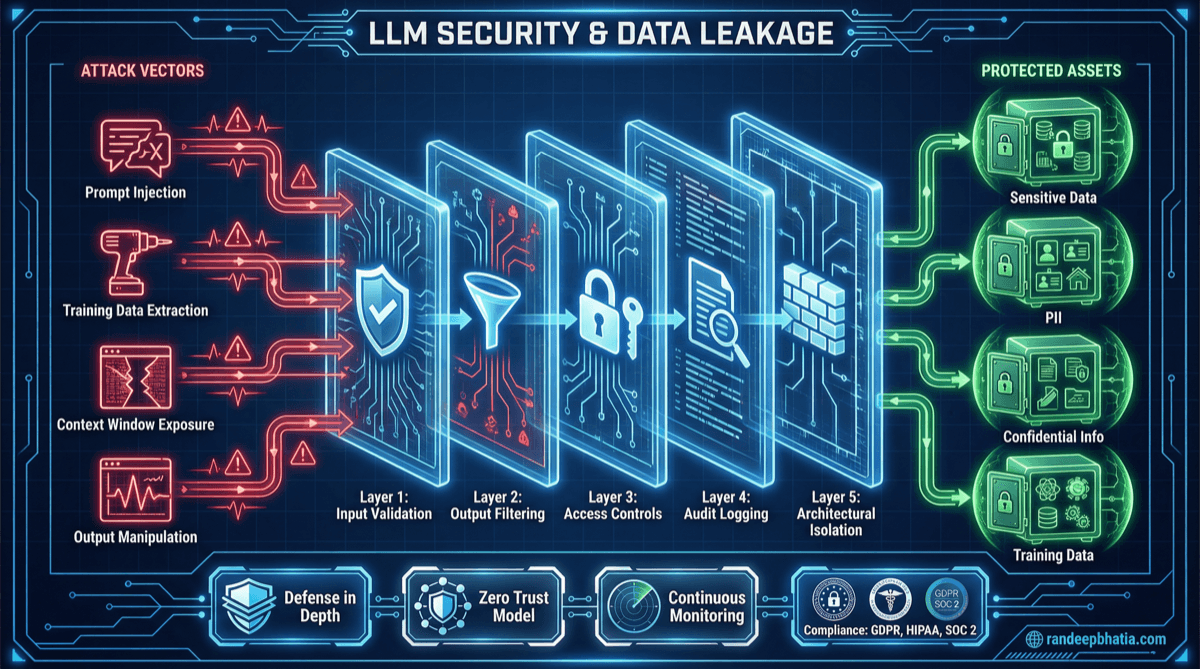
LLM Security and Data Leakage Risks
Executive Summary
Executive Summary
LLM security encompasses the comprehensive set of practices, controls, and architectures designed to prevent unauthorized data exposure, prompt manipulation attacks, and confidential information leakage in large language model deployments.
Data leakage in LLMs occurs through multiple vectors including prompt injection, training data extraction, context window exposure, and output manipulation, requiring defense-in-depth strategies that address each attack surface independently.
Effective LLM security requires a layered approach combining input validation, output filtering, access controls, audit logging, and architectural isolation to prevent both intentional attacks and accidental data exposure.
Compliance requirements under GDPR, HIPAA, SOC 2, and industry-specific regulations mandate specific technical controls for LLM deployments handling sensitive data, with significant legal and financial consequences for failures.
The Bottom Line
Organizations deploying LLMs in production must implement comprehensive security controls across the entire data flow from input to output, treating the model as an untrusted component that can be manipulated to expose sensitive information. Failure to address LLM security risks exposes organizations to data breaches, regulatory penalties, reputational damage, and potential legal liability from customers and partners whose data may be compromised.
Definition
Definition
LLM security and data leakage risks refer to the comprehensive threat landscape and corresponding protective measures associated with deploying large language models in environments where sensitive, confidential, or regulated data may be processed, stored, or inadvertently exposed through model interactions.
These risks encompass both intentional adversarial attacks designed to extract protected information or manipulate model behavior, and unintentional data exposure through architectural weaknesses, improper configuration, or insufficient access controls in LLM-powered systems.
Extended Definition
The security challenges unique to LLMs stem from their fundamental architecture as statistical pattern-matching systems trained on vast datasets, which creates inherent risks around memorization of training data, susceptibility to adversarial inputs, and difficulty in controlling output content. Unlike traditional software systems with deterministic behavior, LLMs exhibit emergent capabilities and failure modes that can bypass conventional security controls, requiring specialized defensive techniques. Data leakage specifically refers to the unauthorized disclosure of information through LLM interactions, whether through direct extraction of training data, exposure of context window contents, inference of sensitive patterns, or manipulation of the model to reveal protected information. The attack surface extends across the entire LLM pipeline including data ingestion, training, fine-tuning, inference, and output delivery, with each stage presenting distinct vulnerability profiles.
Etymology & Origins
The term 'LLM security' emerged in 2022-2023 as large language models transitioned from research artifacts to production systems, combining established information security concepts with novel challenges specific to generative AI. 'Data leakage' in the ML context originally referred to training data contaminating test sets, but expanded to encompass any unauthorized information disclosure through model interactions. The concept of 'prompt injection' was coined by security researchers in 2022, drawing parallels to SQL injection attacks from traditional application security.
Also Known As
Not To Be Confused With
AI Safety
AI safety focuses on ensuring AI systems behave as intended and avoid harmful outcomes at a societal level, including alignment problems and existential risks, while LLM security specifically addresses protecting data and systems from unauthorized access and manipulation in deployed applications.
Model Robustness
Model robustness refers to maintaining consistent performance under distribution shift or noisy inputs, whereas LLM security addresses intentional adversarial attacks and data protection requirements rather than natural performance degradation.
Privacy-Preserving ML
Privacy-preserving ML encompasses techniques like differential privacy and federated learning applied during training, while LLM security focuses on protecting deployed models and their interactions from attacks and data exposure.
Content Moderation
Content moderation filters harmful or inappropriate outputs based on policy, while LLM security prevents unauthorized data access and system manipulation regardless of content appropriateness.
Model Governance
Model governance addresses organizational policies, documentation, and lifecycle management of ML models, whereas LLM security specifically focuses on technical controls preventing attacks and data leakage.
Adversarial ML
Adversarial ML is a research field studying model vulnerabilities to crafted inputs, while LLM security is the practical discipline of implementing defenses against these and other threats in production systems.
Conceptual Foundation
Core Principles
(8 principles)Mental Models
(6 models)The Confused Deputy
LLMs can be manipulated into performing actions or revealing information on behalf of attackers by exploiting the model's inability to distinguish between legitimate instructions and malicious prompts embedded in user input, similar to how a confused deputy might be tricked into using their authority inappropriately.
The Leaky Abstraction
LLMs present a conversational interface that abstracts away their underlying statistical nature, but this abstraction leaks in ways that expose training data, reveal system prompts, or enable manipulation through carefully crafted inputs that exploit the model's actual behavior rather than its intended interface.
The Amplification Attack
Small amounts of sensitive information in LLM contexts can be amplified through repeated queries, inference chains, or combination with other data sources to reveal significantly more than any single interaction would expose.
The Trust Boundary Crossing
Data flowing through LLM systems crosses multiple trust boundaries between users, applications, models, and data stores, with each crossing representing a potential point of unauthorized access or data leakage.
The Probabilistic Firewall
Unlike deterministic security controls, LLM-based defenses operate probabilistically and may fail unpredictably, requiring redundant controls and continuous validation rather than reliance on any single LLM-based security mechanism.
The Context Window as Attack Surface
Everything in an LLM's context window becomes part of its operational knowledge and can potentially influence outputs or be extracted through clever prompting, making context management a critical security concern.
Key Insights
(10 insights)LLMs cannot reliably distinguish between instructions from system prompts and instructions embedded in user input, making prompt injection a fundamental vulnerability that cannot be fully eliminated through prompt engineering alone.
Training data memorization is an inherent property of large language models, meaning any sensitive data used in training may be extractable through targeted prompting regardless of post-training safety measures.
The effectiveness of output filtering decreases as attack sophistication increases, with determined attackers able to encode sensitive information in ways that bypass content-based filters.
Multi-turn conversations create cumulative context that can be exploited to gradually extract information that would be protected in single-turn interactions.
RAG systems introduce additional attack surfaces where document retrieval can be manipulated to inject malicious content or extract information about the underlying knowledge base.
Fine-tuned models inherit vulnerabilities from their base models while potentially introducing new attack vectors through the fine-tuning data and process.
LLM security controls must be evaluated against adaptive adversaries who will modify their attacks based on observed defenses, not just against known attack patterns.
The same capabilities that make LLMs useful for legitimate purposes also make them effective tools for attackers, creating an asymmetric security challenge.
Compliance requirements for LLM deployments often exceed those for traditional software systems due to the unpredictable nature of model outputs and the difficulty of proving negative claims about data handling.
Security testing of LLMs requires specialized techniques beyond traditional penetration testing, including adversarial prompt generation, extraction attacks, and behavioral analysis.
When to Use
When to Use
Ideal Scenarios
(12)Enterprise deployments processing customer data, employee information, or business-sensitive content where regulatory compliance and data protection are mandatory requirements.
Healthcare applications handling protected health information (PHI) where HIPAA compliance requires specific technical safeguards against unauthorized disclosure.
Financial services implementations processing personally identifiable information (PII), account data, or transaction details subject to PCI-DSS, SOX, or banking regulations.
Government and defense applications handling classified or controlled unclassified information (CUI) with strict access control and audit requirements.
Legal technology applications processing privileged communications, case details, or confidential client information protected by attorney-client privilege.
Human resources systems handling employee records, performance data, compensation information, or other sensitive personnel data.
Customer service applications with access to account information, purchase history, or support tickets containing personal details.
Research and development environments where proprietary algorithms, trade secrets, or competitive intelligence could be exposed through LLM interactions.
Multi-tenant SaaS platforms where data isolation between customers is critical to prevent cross-tenant information leakage.
Educational platforms handling student records, assessment data, or other information protected under FERPA or similar regulations.
Any production LLM deployment where the cost of a data breach exceeds the cost of implementing comprehensive security controls.
Systems integrating LLMs with access to internal APIs, databases, or services where compromised model behavior could enable broader system access.
Prerequisites
(8)Complete inventory of data types processed by the LLM system with explicit sensitivity classifications and handling requirements for each category.
Defined threat model identifying relevant adversaries, their capabilities, motivations, and potential attack vectors specific to the deployment context.
Established security baseline including network segmentation, access controls, and monitoring infrastructure upon which LLM-specific controls can be built.
Clear understanding of regulatory requirements applicable to the data and use case, including specific technical controls mandated by relevant frameworks.
Organizational commitment to ongoing security investment including regular assessments, control updates, and incident response capabilities.
Technical capability to implement and maintain security controls including input validation, output filtering, logging, and monitoring systems.
Defined acceptable risk thresholds and escalation procedures for security incidents involving LLM systems.
Integration with existing security operations including SIEM, incident response, and vulnerability management processes.
Signals You Need This
(10)LLM system has access to databases, APIs, or services containing sensitive information that could be exposed through model interactions.
Users can provide arbitrary text input that is processed by the LLM without comprehensive validation and sanitization.
System prompts contain confidential information, API keys, or instructions that should not be disclosed to users.
Multiple users or tenants share the same LLM infrastructure with potential for cross-contamination of data or context.
LLM outputs are displayed to users without filtering for potentially sensitive information that may have leaked into responses.
Fine-tuning or RAG systems incorporate proprietary data that could be extracted through targeted prompting.
Compliance audits or security assessments have identified gaps in LLM-specific security controls.
Incident reports indicate attempted or successful prompt injection attacks against the system.
Business stakeholders have expressed concerns about data protection or competitive intelligence exposure through LLM systems.
The organization handles data subject to breach notification requirements where LLM-related exposure would trigger reporting obligations.
Organizational Readiness
(7)Security team has or can acquire expertise in LLM-specific vulnerabilities and defensive techniques beyond traditional application security.
Development teams understand secure coding practices for LLM applications including input validation, output handling, and context management.
Executive sponsorship exists for security investments that may impact LLM functionality, performance, or user experience.
Incident response procedures include specific playbooks for LLM-related security events including data leakage and prompt injection.
Budget allocation covers ongoing security operations including monitoring, assessment, and control maintenance for LLM systems.
Legal and compliance teams understand LLM-specific risks and can provide guidance on regulatory requirements and liability exposure.
Vendor management processes include security assessment criteria for third-party LLM providers and APIs.
When NOT to Use
When NOT to Use
Anti-Patterns
(12)Implementing security theater controls that provide compliance checkbox satisfaction without meaningful protection against actual threats.
Relying solely on LLM-based content filtering to prevent data leakage without deterministic validation and sanitization controls.
Assuming that prompt engineering alone can prevent prompt injection attacks without implementing architectural defenses.
Treating LLM security as a one-time implementation rather than an ongoing program requiring continuous assessment and adaptation.
Implementing overly restrictive controls that render the LLM system unusable for its intended purpose, leading to workarounds that bypass security.
Copying security configurations from other deployments without adapting them to the specific threat model and data sensitivity of the current system.
Delaying security implementation until after production deployment with plans to add controls later that never materialize.
Assuming that API provider security controls are sufficient without implementing application-layer defenses for your specific use case.
Treating all data equally rather than implementing risk-proportionate controls based on actual sensitivity classifications.
Implementing security controls without corresponding monitoring and alerting that would detect when controls fail or are bypassed.
Relying on user training to prevent security incidents rather than implementing technical controls that enforce secure behavior.
Assuming that internal users are trusted and only implementing security controls for external-facing LLM applications.
Red Flags
(10)Security requirements are being defined by the same team responsible for feature delivery without independent security review.
No budget or timeline has been allocated for security testing, assessment, or ongoing monitoring of LLM systems.
The organization lacks incident response capabilities specific to LLM-related security events.
Security controls are being evaluated solely based on their impact on user experience or system performance without considering risk reduction.
Compliance is being treated as the ceiling for security investment rather than the floor.
Third-party LLM providers have not been assessed for security practices and data handling procedures.
No logging or monitoring infrastructure exists to detect security incidents or support forensic analysis.
Security decisions are being made without input from legal, compliance, or risk management stakeholders.
The threat model has not been updated since initial deployment despite changes in system capabilities or data access.
Security testing consists only of automated scanning without manual assessment by security professionals with LLM expertise.
Better Alternatives
(8)Processing highly sensitive data where any leakage would be catastrophic
Air-gapped or on-premises LLM deployment with no external connectivity
Eliminates network-based attack vectors and data exfiltration paths, though requires significant infrastructure investment and limits model capabilities.
Use case requires only structured data extraction without generative capabilities
Traditional NLP models or rule-based extraction systems
Deterministic systems have predictable behavior without the emergent vulnerabilities of generative LLMs, reducing attack surface significantly.
Security requirements exceed available budget or expertise
Defer LLM deployment until adequate resources are available
Deploying insecure LLM systems creates liability and breach risk that may exceed the business value of the application.
Data sensitivity varies significantly across use cases
Separate LLM deployments with different security profiles for different data sensitivity levels
Allows appropriate security investment proportionate to risk rather than applying maximum controls to all use cases or minimum controls to sensitive data.
Primary concern is preventing specific known attack patterns
Targeted controls for specific threats rather than comprehensive security program
May be appropriate for limited deployments with well-understood threat models, though creates risk of missing novel attack vectors.
Organization lacks internal security expertise for LLM systems
Managed LLM security services from specialized providers
Transfers security operations to organizations with specialized expertise, though requires careful vendor assessment and ongoing oversight.
Regulatory requirements prohibit cloud-based processing of certain data types
Smaller on-premises models with reduced capabilities but full data control
Trades model capability for data sovereignty and regulatory compliance, appropriate when compliance is non-negotiable.
Use case involves only public information without sensitive data
Reduced security controls focused on availability and integrity rather than confidentiality
Security investment should be proportionate to actual risk, and public data applications may not require comprehensive data protection controls.
Common Mistakes
(10)Assuming that because an LLM provider is reputable, their security controls are sufficient for your specific compliance and risk requirements.
Implementing input validation only at the API layer without considering prompt injection through RAG documents, tool outputs, or other indirect input channels.
Treating system prompts as secure secrets when they can often be extracted through various prompting techniques.
Failing to consider the cumulative information leakage across multiple interactions within a session or across sessions for the same user.
Implementing output filtering that can be bypassed by encoding sensitive information in non-obvious formats such as base64, pig latin, or structured data.
Assuming that fine-tuning on safe data makes a model safe without considering inherited vulnerabilities from the base model.
Neglecting to secure the entire LLM pipeline including data ingestion, preprocessing, and post-processing stages.
Implementing security controls that significantly degrade user experience, leading to pressure to disable or weaken protections.
Failing to establish baseline behavior metrics that would enable detection of anomalous activity indicating potential attacks.
Treating LLM security as purely a technical problem without addressing organizational policies, training, and governance.
Core Taxonomy
Core Taxonomy
Primary Types
(8 types)Attacks that manipulate LLM behavior by embedding malicious instructions in user input, exploiting the model's inability to distinguish between legitimate system instructions and attacker-controlled content.
Characteristics
- Exploits fundamental LLM architecture limitations
- Can bypass authentication and authorization controls
- Effectiveness varies with model and prompt design
- Difficult to fully prevent through filtering alone
- Can be direct (user input) or indirect (injected through retrieved content)
Use Cases
Tradeoffs
Comprehensive input validation reduces attack success but may also filter legitimate inputs; architectural isolation provides stronger protection but increases system complexity and latency.
Classification Dimensions
Attack Vector
Classification based on the pathway through which attacks are delivered to the LLM system.
Data Sensitivity Level
Classification based on the sensitivity and regulatory status of data at risk of exposure.
Attack Sophistication
Classification based on the capability and resources of potential attackers.
Impact Type
Classification based on the type of harm resulting from successful attacks.
Detection Difficulty
Classification based on how challenging it is to identify attacks or data leakage.
Remediation Complexity
Classification based on the effort required to address identified vulnerabilities.
Evolutionary Stages
Ad-hoc Security
Initial deployment through first 3-6 monthsNo formal LLM security program; reactive response to incidents; reliance on provider defaults; minimal monitoring or logging; security considered only when problems occur.
Basic Controls
6-12 months post-deploymentInput validation implemented; basic output filtering; access controls established; logging enabled; some security testing performed; documented security policies.
Systematic Security
12-24 months post-deploymentComprehensive threat model; defense-in-depth architecture; continuous monitoring and alerting; regular security assessments; incident response procedures; compliance verification.
Advanced Security
24-36 months post-deploymentProactive threat hunting; automated security testing in CI/CD; real-time anomaly detection; red team exercises; security metrics and KPIs; continuous improvement program.
Security Excellence
36+ months with dedicated investmentIndustry-leading practices; contribution to security research; zero-trust architecture; AI-powered security automation; minimal attack surface; rapid incident response; security as competitive advantage.
Architecture Patterns
(7 patterns)Gateway-Based Security Architecture
All LLM interactions pass through a dedicated security gateway that performs input validation, output filtering, logging, and policy enforcement before requests reach the model and before responses reach users.
Components
- API gateway with LLM-specific security plugins
- Input validation and sanitization engine
- Output filtering and redaction service
- Policy decision point for access control
- Audit logging and monitoring infrastructure
- Rate limiting and quota management
Data Flow
User requests enter the gateway, undergo input validation and policy checks, are forwarded to the LLM if approved, responses pass through output filtering and logging, and sanitized responses are returned to users.
Best For
- Enterprise deployments with multiple LLM applications
- Environments requiring centralized policy enforcement
- Organizations with existing API gateway infrastructure
- Deployments requiring comprehensive audit trails
Limitations
- Adds latency to all LLM interactions
- Gateway becomes single point of failure without redundancy
- Complex policy rules may be difficult to maintain
- May not catch all attack vectors that bypass gateway logic
Scaling Characteristics
Gateway can be horizontally scaled independently of LLM infrastructure; caching at gateway layer reduces LLM load; distributed deployment supports geographic distribution.
Integration Points
Identity and Access Management (IAM)
Provides authentication of users and services, authorization decisions, and identity context for LLM interactions.
IAM must support fine-grained permissions for LLM operations; service accounts for LLM components require careful privilege management; identity context should be included in audit logs.
Security Information and Event Management (SIEM)
Aggregates security events from LLM systems, correlates with other security data, and enables detection of attacks and incidents.
LLM-specific log formats may require custom parsing; high volume of LLM interactions can strain SIEM capacity; correlation rules must be developed for LLM attack patterns.
Data Loss Prevention (DLP)
Detects and prevents sensitive data from being included in LLM inputs or outputs through pattern matching and classification.
DLP must handle conversational context; false positive rates may be high for natural language; integration latency impacts user experience.
Key Management System (KMS)
Manages cryptographic keys for encrypting sensitive data, API credentials, and secure communications in LLM systems.
Key rotation must not disrupt LLM operations; access to keys must be tightly controlled; hardware security modules may be required for high-security deployments.
Vulnerability Management
Identifies and tracks security vulnerabilities in LLM systems, dependencies, and infrastructure.
Traditional vulnerability scanners may not detect LLM-specific vulnerabilities; custom assessment tools may be required; model vulnerabilities require specialized evaluation.
Incident Response Platform
Orchestrates response to security incidents involving LLM systems, including containment, investigation, and remediation.
LLM incidents may require specialized investigation techniques; playbooks must address LLM-specific scenarios; evidence preservation must include conversation logs and model state.
API Gateway
Provides centralized entry point for LLM APIs with rate limiting, authentication, and basic security controls.
Gateway must handle streaming responses for LLM outputs; latency sensitivity requires efficient processing; custom plugins may be needed for LLM-specific security.
Secrets Management
Securely stores and provides access to API keys, credentials, and other secrets used by LLM systems.
LLM systems should not have direct access to secrets that could be extracted through prompting; secrets should be injected at runtime rather than stored in prompts or configuration.
Decision Framework
Decision Framework
Implement comprehensive PII protection controls including input sanitization, output filtering, data minimization, and compliance-specific safeguards.
Proceed to evaluate other data sensitivity categories; PII-specific controls may not be required but general security controls still apply.
PII includes direct identifiers (names, SSN) and indirect identifiers that could be combined to identify individuals; consider both user-provided data and data accessible through integrations.
Technical Deep Dive
Technical Deep Dive
Overview
LLM security operates across multiple layers of the system architecture, implementing controls at each stage where data enters, is processed by, or exits the language model. The fundamental challenge stems from the LLM's architecture as a next-token prediction system that cannot inherently distinguish between legitimate instructions and malicious inputs, requiring external security mechanisms to enforce access controls and prevent data leakage. Input security begins with validation and sanitization of all data entering the LLM context, including user prompts, system instructions, retrieved documents, and tool outputs. This layer applies pattern matching, content classification, and structural validation to identify and neutralize potential attacks before they reach the model. The goal is to ensure that only safe, authorized content influences model behavior. The model execution layer implements isolation and access controls that limit what the LLM can access and what actions it can perform. This includes sandboxed execution environments, restricted tool permissions, and data access controls that prevent the model from reaching sensitive information beyond its operational requirements. Even if an attacker successfully injects malicious instructions, execution-layer controls limit the potential damage. Output security applies filtering and redaction to model responses before they reach users, detecting and removing sensitive information that may have leaked into outputs. This layer uses pattern matching for known sensitive data formats, content classification for contextual sensitivity, and comparison against known sensitive values to prevent unauthorized disclosure. The combination of input, execution, and output controls creates defense-in-depth that can contain failures at any single layer.
Step-by-Step Process
Incoming requests are received by the API gateway or security proxy, which performs initial validation including authentication verification, rate limit checking, request format validation, and basic input sanitization. This layer blocks obviously malformed requests and enforces access controls before any LLM processing occurs.
Gateway validation may be bypassed if requests reach the LLM through alternative paths; ensure all entry points are protected. Rate limiting must account for distributed attacks across multiple source IPs.
Under The Hood
At the technical level, LLM security controls operate through a combination of deterministic rule-based systems and probabilistic machine learning classifiers. Input validation typically employs regular expressions and pattern matching to identify known attack signatures, combined with ML-based classifiers trained on adversarial prompt datasets to detect novel attack variations. These systems must balance sensitivity (catching attacks) with specificity (avoiding false positives on legitimate inputs). Prompt injection defenses rely on architectural separation between system instructions and user input, often implemented through special delimiter tokens, instruction hierarchies, or separate processing channels. However, the fundamental limitation is that LLMs process all context tokens through the same attention mechanisms, making true separation impossible at the model level. Defenses therefore focus on making injection more difficult and detectable rather than impossible. Output filtering operates through multiple detection mechanisms including regex patterns for structured sensitive data (SSN, credit card numbers, etc.), named entity recognition for PII, semantic similarity matching against known sensitive content, and classification models trained to identify confidential information. The challenge is that sensitive information can be expressed in countless ways, and determined attackers can encode data to evade detection. Monitoring and anomaly detection systems analyze interaction patterns to identify potential attacks or data leakage. This includes statistical analysis of query patterns (unusual volume, timing, or content), behavioral analysis comparing interactions to baseline patterns, and correlation of events across multiple interactions to detect gradual extraction attacks. Machine learning models trained on normal interaction patterns can flag anomalies for investigation. The security architecture must also address the challenge of context window management, where information from previous interactions, retrieved documents, and tool outputs all become part of the model's operational context. Each piece of context represents a potential source of sensitive data leakage or attack vector. Secure context management requires careful control over what enters the context, how long it persists, and how it influences model outputs.
Failure Modes
Failure Modes
Novel injection technique evades all detection mechanisms, allowing attacker to fully control model behavior and access all available data and tools.
- Unexpected model outputs not matching intended behavior
- Tool calls to unauthorized resources
- Extraction of system prompt contents
- Model ignoring safety guidelines
Full compromise of LLM capabilities, potential data exfiltration, unauthorized actions through connected systems, complete loss of trust in system outputs.
Defense-in-depth with multiple independent detection mechanisms, architectural isolation limiting blast radius, continuous red team testing against novel techniques.
Immediate session termination, alert security team, forensic analysis of attack vector, emergency patching of detection rules, communication to affected users.
Operational Considerations
Key Metrics (15)
Percentage of requests flagged as potential prompt injection attempts by detection systems.
Dashboard Panels
Alerting Strategy
Implement tiered alerting with critical alerts for potential active attacks or data breaches requiring immediate response, high alerts for security anomalies requiring investigation within hours, medium alerts for trends requiring attention within days, and low alerts for informational events. Use alert correlation to reduce noise and identify related events. Implement escalation paths for unacknowledged alerts. Maintain on-call rotation for security response. Regular alert tuning to minimize false positives while maintaining detection capability.
Cost Analysis
Cost Analysis
Cost Drivers
(10)Security Infrastructure Compute
Processing overhead for input validation, output filtering, and real-time analysis adds 10-30% to base compute costs.
Optimize security processing efficiency, implement caching for repeated checks, use tiered security based on risk level.
Logging and Storage
Comprehensive audit logging can generate 10-100x the data volume of application logs, with associated storage and processing costs.
Implement log tiering with hot/warm/cold storage, use sampling for low-risk events, compress and deduplicate logs.
Security Tool Licensing
Enterprise security tools (SIEM, DLP, WAF) often have per-user or per-volume licensing that scales with LLM usage.
Negotiate volume discounts, evaluate open-source alternatives, consolidate tools where possible.
Security Personnel
Specialized LLM security expertise commands premium salaries; 24/7 coverage requires multiple FTEs.
Automate routine tasks, use managed security services for coverage, invest in training existing staff.
Compliance and Audit
Regular compliance assessments, penetration testing, and audit activities have direct costs plus internal resource requirements.
Maintain continuous compliance to reduce audit preparation, automate evidence collection, use efficient audit frameworks.
Incident Response
Security incidents have direct costs (investigation, remediation) plus indirect costs (downtime, reputation).
Invest in prevention to reduce incident frequency, maintain response readiness to minimize impact, carry appropriate insurance.
Security Testing
Regular penetration testing, red team exercises, and security assessments require specialized expertise.
Build internal testing capability, use bug bounty programs, prioritize testing based on risk.
Encryption and Key Management
Hardware security modules and key management services have significant licensing and operational costs.
Right-size HSM capacity, use cloud KMS where appropriate, implement efficient key hierarchies.
Network Security
Network segmentation, firewalls, and traffic inspection add infrastructure and operational costs.
Use software-defined networking, consolidate security functions, optimize traffic inspection rules.
Training and Awareness
Ongoing security training for development and operations teams requires time and resources.
Integrate security into existing training, use efficient delivery methods, focus on role-specific content.
Cost Models
Per-Request Security Cost
Security Cost = (Compute Cost × Security Overhead Factor) + (Log Storage Cost × Log Volume Factor) + (Tool Cost / Request Volume)For 1M requests/month with $0.001 base compute, 1.2x security overhead, $0.02/GB storage, 1KB logs/request, and $5000/month tools: ($0.001 × 1.2 × 1M) + ($0.02 × 1GB) + $5000 = $6,220/month
Security Program TCO
Annual TCO = Personnel Costs + Tool Licensing + Infrastructure + Compliance + Incident Costs + Training2 FTEs at $150K, $100K tools, $50K infrastructure, $30K compliance, $20K expected incidents, $10K training = $510K annual TCO
Risk-Adjusted Security Investment
Optimal Investment = Σ(Risk Probability × Impact) × Risk Reduction FactorIf data breach has 5% annual probability and $10M impact, and security controls reduce probability to 1%, investment up to $400K (4% × $10M) is justified.
Security Latency Cost
Latency Cost = Added Latency × Requests × User Value × Conversion Impact100ms added latency × 1M requests × $0.10 value × 0.1% conversion impact per 100ms = $1,000 monthly latency cost
Optimization Strategies
- 1Implement risk-based security tiers with higher controls for sensitive operations and lighter controls for low-risk interactions
- 2Use caching for repeated security checks on identical or similar inputs
- 3Optimize ML-based detection models for inference efficiency without sacrificing accuracy
- 4Implement log sampling for high-volume, low-risk events while maintaining full logging for security-critical events
- 5Consolidate security tools to reduce licensing costs and operational complexity
- 6Automate routine security operations to reduce personnel costs
- 7Use cloud-native security services that scale with usage rather than fixed-cost solutions
- 8Implement efficient data retention policies that meet compliance requirements without excessive storage
- 9Negotiate volume discounts with security vendors based on scale
- 10Build internal security expertise to reduce reliance on expensive external consultants
- 11Use open-source security tools where they meet requirements
- 12Implement shift-left security to catch issues earlier when they are cheaper to fix
Hidden Costs
- 💰Developer productivity impact from security requirements and reviews
- 💰User experience degradation from security friction
- 💰Opportunity cost of security-driven feature limitations
- 💰Technical debt from security workarounds and quick fixes
- 💰Vendor lock-in from security tool integrations
- 💰Knowledge loss when security personnel leave
- 💰Integration costs when security tools don't work together
- 💰False positive investigation time consuming security resources
ROI Considerations
Security investment ROI is challenging to measure directly since the primary benefit is avoiding negative outcomes. However, organizations can quantify ROI through several approaches: comparing actual incident costs before and after security improvements, measuring compliance penalty avoidance, calculating insurance premium reductions from improved security posture, and assessing competitive advantage from security certifications. The most significant ROI often comes from preventing a single major breach, which can easily justify years of security investment. Organizations should also consider the enabling value of security - the ability to handle sensitive data and serve security-conscious customers that would not be possible without adequate controls. Finally, security investments that improve operational efficiency (automation, better tooling) can provide direct cost savings alongside risk reduction.
Security Considerations
Threat Model
(10 threats)External Attacker - Prompt Injection
Malicious prompts submitted through user interfaces or APIs designed to manipulate model behavior, extract data, or bypass controls.
Unauthorized data access, system prompt extraction, safety bypass, potential access to connected systems through tool manipulation.
Multi-layer input validation, instruction hierarchy enforcement, output monitoring, architectural isolation of sensitive capabilities.
External Attacker - Training Data Extraction
Systematic querying designed to extract memorized content from model training data.
Exposure of confidential training data, privacy violations, intellectual property theft.
Output monitoring for memorization patterns, rate limiting extraction-pattern queries, differential privacy in training.
Insider Threat - Privileged Access Abuse
Authorized users or administrators misusing their access to extract data or modify security controls.
Data exfiltration, security control bypass, audit log manipulation, backdoor installation.
Least privilege access, separation of duties, comprehensive audit logging, behavioral monitoring for privileged users.
Insider Threat - Data Exfiltration
Employees using LLM systems to extract and exfiltrate sensitive organizational data.
Intellectual property theft, competitive intelligence loss, privacy violations.
DLP integration, output monitoring, access controls limiting data exposure, user activity monitoring.
Supply Chain - Model Poisoning
Compromise of model training pipeline or weights to introduce backdoors or vulnerabilities.
Targeted attacks through triggered behaviors, data exfiltration, misinformation generation.
Model provenance verification, behavioral testing, secure model storage and distribution.
Supply Chain - Dependency Compromise
Malicious code introduced through compromised libraries, frameworks, or tools used in LLM systems.
Arbitrary code execution, data access, security control bypass.
Dependency scanning, software composition analysis, secure development practices, vendor security assessment.
Infrastructure - Cloud Provider Compromise
Attack on cloud infrastructure hosting LLM systems, potentially by nation-state actors.
Complete system compromise, data exposure, service disruption.
Multi-cloud strategy, encryption of data at rest and in transit, secure enclave usage for sensitive workloads.
Application - API Abuse
Exploitation of API vulnerabilities or misconfigurations to bypass security controls.
Unauthorized access, rate limit bypass, data exposure through API responses.
API security testing, rate limiting, authentication enforcement, input validation at API layer.
Social Engineering - Operator Manipulation
Attackers manipulating system operators to weaken security controls or provide access.
Security control bypass, credential theft, unauthorized access.
Security awareness training, verification procedures, separation of duties, change management controls.
Physical - Hardware Compromise
Physical access to hardware hosting LLM systems to extract data or install malicious components.
Encryption key extraction, data theft, persistent backdoors.
Physical security controls, hardware security modules, tamper detection, secure disposal procedures.
Security Best Practices
- ✓Implement defense-in-depth with multiple independent security layers
- ✓Apply least privilege access to all LLM system components and integrations
- ✓Validate and sanitize all inputs before LLM processing
- ✓Filter and monitor all outputs for sensitive data leakage
- ✓Encrypt data at rest and in transit throughout the LLM pipeline
- ✓Implement comprehensive audit logging with integrity protection
- ✓Use strong authentication and session management
- ✓Isolate LLM execution environments from sensitive systems
- ✓Regularly test security controls through penetration testing and red team exercises
- ✓Monitor for anomalous behavior indicating attacks or compromise
- ✓Maintain incident response procedures specific to LLM security events
- ✓Keep all components updated with security patches
- ✓Assess and monitor third-party provider security practices
- ✓Implement secure development practices for LLM applications
- ✓Conduct regular security training for development and operations teams
Data Protection
- 🔒Classify all data processed by LLM systems according to sensitivity levels
- 🔒Implement data minimization to limit sensitive data in LLM contexts
- 🔒Use tokenization or pseudonymization for sensitive data where possible
- 🔒Encrypt sensitive data at rest using strong encryption algorithms
- 🔒Encrypt data in transit using TLS 1.3 or equivalent
- 🔒Implement access controls limiting data access to authorized users and systems
- 🔒Maintain data lineage tracking through LLM processing pipelines
- 🔒Implement data retention policies with secure deletion capabilities
- 🔒Use data loss prevention tools to detect and prevent unauthorized data exposure
- 🔒Implement secure data handling procedures for LLM training and fine-tuning
Compliance Implications
GDPR (General Data Protection Regulation)
Lawful basis for processing, data minimization, right to erasure, data protection by design, breach notification within 72 hours.
Implement consent management, minimize PII in LLM contexts, enable data deletion capabilities, build privacy into architecture, establish breach detection and notification procedures.
HIPAA (Health Insurance Portability and Accountability Act)
Administrative, physical, and technical safeguards for PHI; Business Associate Agreements; breach notification.
Implement access controls, audit logging, encryption for PHI; execute BAAs with LLM providers; establish breach procedures; conduct regular risk assessments.
PCI-DSS (Payment Card Industry Data Security Standard)
Protect cardholder data, maintain secure network, implement access control, monitor and test networks, maintain security policy.
Isolate cardholder data from LLM systems, implement network segmentation, restrict access to payment data, comprehensive logging and monitoring, documented security policies.
SOC 2 (Service Organization Control 2)
Controls for security, availability, processing integrity, confidentiality, and privacy based on Trust Services Criteria.
Document and implement controls across all criteria, maintain evidence of control operation, conduct regular assessments, remediate identified gaps.
CCPA/CPRA (California Consumer Privacy Act/Rights Act)
Consumer rights to know, delete, and opt-out; restrictions on selling personal information; data minimization.
Implement data inventory, enable consumer rights requests, restrict data sharing, minimize personal information collection and retention.
AI Act (EU Artificial Intelligence Act)
Risk-based requirements for AI systems including transparency, human oversight, accuracy, and security.
Classify AI system risk level, implement required controls for risk category, maintain documentation, enable human oversight capabilities.
NIST AI RMF (AI Risk Management Framework)
Framework for managing AI risks across governance, mapping, measuring, and managing functions.
Establish AI governance, identify and document AI risks, implement risk measurement, deploy risk management controls.
FedRAMP (Federal Risk and Authorization Management Program)
Security requirements for cloud services used by federal agencies based on NIST 800-53 controls.
Implement required security controls for authorization level, maintain continuous monitoring, undergo regular assessments.
Scaling Guide
Scaling Guide
Scaling Dimensions
Request Volume
Horizontal scaling of security processing components with load balancing; implement caching for repeated security checks; use async processing for non-blocking operations.
Security processing throughput must match or exceed LLM inference capacity; bottlenecks in security pipeline will limit overall system throughput.
Ensure security controls scale linearly with load; avoid single points of failure; maintain consistent security posture under load.
User Base
Scale identity and access management infrastructure; implement efficient session management; use distributed rate limiting.
IAM systems may have user count limits; session storage must scale with concurrent users; rate limiting state must be synchronized across instances.
User growth may require IAM architecture changes; plan for authentication surge during peak periods.
Data Volume
Implement tiered storage for audit logs; use efficient indexing for security event search; scale DLP and classification systems.
Storage costs grow with data volume; query performance may degrade with large datasets; retention requirements may mandate long-term storage.
Plan storage capacity well in advance; implement data lifecycle management; consider compliance requirements for data retention.
Geographic Distribution
Deploy security controls in each region; implement global policy management with local enforcement; ensure data residency compliance.
Cross-region latency for centralized services; data sovereignty requirements may restrict data movement; consistency challenges for distributed state.
Design for regional autonomy with global visibility; plan for regulatory differences across regions.
Tenant Count (Multi-tenant)
Implement efficient tenant isolation; scale tenant-specific security configurations; use shared infrastructure with logical separation.
Tenant isolation overhead may limit density; per-tenant customization increases complexity; noisy neighbor issues may affect security processing.
Balance isolation strength with efficiency; plan for tenant onboarding automation; implement tenant-specific monitoring.
Integration Complexity
Standardize security interfaces; implement API gateways for integration management; use event-driven architecture for loose coupling.
Integration points multiply attack surface; each integration requires security assessment; coordination complexity grows with integrations.
Maintain integration inventory; implement consistent security controls across integrations; plan for integration lifecycle management.
Security Rule Complexity
Optimize rule evaluation engines; implement rule caching; use efficient data structures for pattern matching.
Rule evaluation time grows with rule count; complex rules may have performance impact; rule conflicts become harder to manage.
Regularly review and optimize rule sets; implement rule testing and validation; monitor rule evaluation performance.
Monitoring and Analytics
Scale SIEM and analytics infrastructure; implement streaming analytics for real-time detection; use sampling for high-volume metrics.
Analytics processing must keep pace with event volume; storage for analytics data can be substantial; query performance may degrade at scale.
Plan analytics capacity based on growth projections; implement tiered analytics with different latency requirements.
Capacity Planning
Required Capacity = (Peak Requests × Security Overhead × Safety Margin) + (Log Volume × Retention Period) + (Concurrent Sessions × Session Size) + Incident Response ReserveMaintain 30-50% headroom above projected peak load for security infrastructure to ensure security controls do not become bottlenecks during traffic spikes and to provide capacity for incident response activities.
Scaling Milestones
- Establishing baseline security controls
- Implementing basic monitoring
- Setting up audit logging
Single-instance security components acceptable; basic logging to file or simple database; manual security review processes.
- Scaling authentication infrastructure
- Managing growing log volumes
- Implementing automated alerting
Introduce load balancing for security services; implement centralized logging; add automated security monitoring.
- Security processing becoming latency-sensitive
- Log storage costs increasing
- Need for 24/7 security coverage
Horizontal scaling of security components; implement log tiering and retention policies; establish security operations team or managed service.
- Distributed security state management
- Real-time anomaly detection at scale
- Multi-region deployment requirements
Distributed security architecture; streaming analytics for real-time detection; regional security infrastructure with global coordination.
- Security infrastructure as significant cost center
- Sophisticated threat actors targeting platform
- Complex compliance across jurisdictions
Dedicated security infrastructure team; advanced threat detection and response; automated security operations; comprehensive compliance automation.
Benchmarks
Benchmarks
Industry Benchmarks
| Metric | P50 | P95 | P99 | World Class |
|---|---|---|---|---|
| Prompt Injection Detection Rate | 85% | 95% | 98% | >99% with <1% false positive rate |
| PII Detection Accuracy | 90% | 97% | 99% | >99.5% with context-aware detection |
| Security Processing Latency | 100ms | 50ms | 25ms | <10ms with full security stack |
| Time to Detect Security Incident | 24 hours | 4 hours | 1 hour | <15 minutes for critical incidents |
| Time to Respond to Security Incident | 4 hours | 1 hour | 30 minutes | <15 minutes for critical incidents |
| Audit Log Completeness | 95% | 99% | 99.9% | 100% with integrity verification |
| Security Control Availability | 99% | 99.9% | 99.99% | 99.999% with graceful degradation |
| False Positive Rate (Input Filtering) | 5% | 2% | 0.5% | <0.1% with ML-based detection |
| Compliance Audit Pass Rate | 80% | 95% | 99% | 100% with continuous compliance |
| Security Training Completion | 70% | 90% | 98% | 100% with regular refresher |
| Vulnerability Remediation Time (Critical) | 30 days | 7 days | 24 hours | <4 hours for critical vulnerabilities |
| Security Assessment Frequency | Annual | Quarterly | Monthly | Continuous with automated testing |
Comparison Matrix
| Capability | No Security | Basic Security | Standard Security | Advanced Security | Enterprise Security |
|---|---|---|---|---|---|
| Input Validation | None | Basic sanitization | Pattern-based detection | ML-based detection | Multi-layer with behavioral analysis |
| Output Filtering | None | Keyword blocking | Pattern matching | Semantic analysis | Context-aware with DLP integration |
| Access Control | None | Basic authentication | Role-based access | Attribute-based access | Zero-trust with continuous verification |
| Audit Logging | None | Basic request logging | Comprehensive logging | Structured logging with correlation | Immutable logging with integrity verification |
| Monitoring | None | Basic metrics | Security dashboards | Real-time alerting | AI-powered anomaly detection |
| Incident Response | None | Ad-hoc response | Documented procedures | Automated response | 24/7 SOC with playbook automation |
| Compliance | None | Basic documentation | Periodic audits | Continuous compliance | Automated compliance with evidence |
| Data Protection | None | Basic encryption | Encryption at rest and transit | Tokenization and masking | HSM-backed with data classification |
Performance Tiers
Minimal security controls for development environments; focus on functionality over security; acceptable for non-production use only.
Basic input validation, development logging, no SLA requirements
Foundational security controls for low-risk production deployments; suitable for public information or internal tools without sensitive data.
Input validation, basic output filtering, authentication, standard logging, 99% availability
Comprehensive security controls for typical production deployments; suitable for business data with moderate sensitivity.
Multi-layer security, comprehensive logging, monitoring and alerting, 99.9% availability, <100ms security latency
Advanced security controls for sensitive data and regulated environments; suitable for PII, financial data, or compliance-driven deployments.
Defense-in-depth, real-time monitoring, rapid incident response, 99.99% availability, <50ms security latency, compliance certification
Highest security controls for critical or classified data; suitable for government, defense, or highest-sensitivity commercial applications.
Zero-trust architecture, continuous verification, 24/7 SOC, 99.999% availability, hardware security, air-gap capability
Real World Examples
Real World Examples
Real-World Scenarios
(6 examples)Enterprise Customer Service Chatbot
Large financial services company deploying LLM-powered chatbot for customer service with access to account information, transaction history, and customer PII.
Implemented data segregation architecture with PII tokenization, comprehensive input validation with prompt injection detection, output filtering with DLP integration, role-based access control tied to customer authentication, and real-time monitoring with anomaly detection.
Successfully deployed chatbot handling 100K+ daily interactions with zero data breaches in first year of operation. Security controls added 80ms average latency but were accepted given risk profile.
- 💡PII tokenization significantly reduced data leakage risk without impacting chatbot effectiveness
- 💡Initial prompt injection detection had high false positive rate requiring tuning
- 💡Customer authentication integration was more complex than anticipated
- 💡Real-time monitoring caught several attempted attacks that were blocked
Healthcare Clinical Decision Support
Hospital system implementing LLM for clinical decision support with access to patient records, lab results, and medical imaging reports.
Deployed in isolated HIPAA-compliant environment with strict access controls, comprehensive audit logging, data minimization limiting PHI exposure, clinician authentication with role-based access, and integration with existing EHR security controls.
Achieved HIPAA compliance certification. System supports 500+ clinicians with appropriate access controls. Audit logs enabled compliance verification and incident investigation.
- 💡HIPAA compliance required more extensive logging than initially planned
- 💡Clinician workflow integration was critical for adoption
- 💡Data minimization required careful balance with clinical utility
- 💡Regular security assessments identified gaps before they became issues
Multi-Tenant SaaS Platform
B2B SaaS company adding LLM capabilities to existing platform serving hundreds of enterprise customers with strict data isolation requirements.
Implemented tenant isolation at infrastructure level with separate model contexts, per-tenant encryption keys, cross-tenant monitoring, and tenant-specific security configurations based on customer requirements.
Successfully onboarded 200+ enterprise customers with varying security requirements. No cross-tenant data leakage incidents. Passed customer security assessments.
- 💡Tenant isolation complexity was underestimated initially
- 💡Per-tenant security configuration added significant operational overhead
- 💡Customer security requirements varied widely requiring flexible controls
- 💡Automated tenant onboarding with security configuration was essential
Internal Code Assistant
Technology company deploying LLM coding assistant for developers with access to proprietary codebase and internal documentation.
Implemented repository-level access controls, secret scanning in inputs and outputs, code review integration, audit logging of all code-related queries, and monitoring for potential IP exfiltration.
Deployed to 1000+ developers with appropriate access controls. Secret scanning prevented several accidental credential exposures. No intellectual property leakage incidents.
- 💡Developers initially resistant to security controls impacting productivity
- 💡Secret scanning false positives required careful tuning
- 💡Access control integration with existing code repository permissions was complex
- 💡Monitoring revealed unexpected usage patterns requiring policy updates
Legal Document Analysis
Law firm implementing LLM for document review and analysis with access to privileged client communications and case materials.
Deployed with matter-level isolation, privilege tagging and protection, comprehensive audit trails for discovery compliance, attorney supervision requirements, and strict access controls based on matter assignment.
Successfully used for document review on major litigation matters. Audit trails satisfied court requirements. No privilege breaches.
- 💡Legal privilege requirements added unique security considerations
- 💡Attorney supervision integration required workflow changes
- 💡Audit trail requirements were more extensive than typical deployments
- 💡Matter isolation prevented cross-contamination of case information
Government Agency Deployment
Federal agency deploying LLM for internal knowledge management with access to controlled unclassified information (CUI).
Implemented FedRAMP-compliant controls, CUI handling procedures, comprehensive access controls with clearance verification, air-gapped deployment option for sensitive operations, and extensive audit logging for compliance.
Achieved FedRAMP authorization. Successfully deployed to authorized users with appropriate security controls. Passed multiple security assessments.
- 💡FedRAMP compliance required extensive documentation
- 💡CUI handling added complexity beyond typical PII protection
- 💡Air-gapped deployment limited model capabilities but was required for some use cases
- 💡Continuous monitoring requirements were more extensive than commercial deployments
Industry Applications
Financial Services
Customer service, fraud detection, document processing, compliance monitoring
PCI-DSS compliance for payment data, SOX requirements for financial reporting, strict data retention requirements, regulatory examination readiness.
Healthcare
Clinical decision support, patient communication, medical coding, research assistance
HIPAA compliance for PHI, FDA considerations for clinical use, patient consent requirements, integration with EHR systems.
Legal
Document review, legal research, contract analysis, case summarization
Attorney-client privilege protection, conflict checking, court admissibility of AI-assisted work, ethical obligations.
Government
Citizen services, policy analysis, document processing, internal knowledge management
FedRAMP compliance, CUI handling, clearance requirements, FOIA implications, accessibility requirements.
Education
Student support, content creation, assessment assistance, administrative automation
FERPA compliance for student records, academic integrity concerns, age-appropriate content, accessibility requirements.
Retail/E-commerce
Customer service, product recommendations, content generation, inventory management
PCI-DSS for payment data, CCPA/GDPR for customer data, brand safety in generated content, scalability for peak periods.
Manufacturing
Technical documentation, quality control, supply chain optimization, maintenance support
Trade secret protection, safety-critical applications, integration with OT systems, supplier data handling.
Insurance
Claims processing, underwriting support, customer service, fraud detection
State insurance regulations, claims data protection, actuarial accuracy requirements, fair lending compliance.
Telecommunications
Customer support, network optimization, service provisioning, billing assistance
CPNI protection, FCC compliance, high-volume scalability, integration with BSS/OSS systems.
Media/Entertainment
Content creation, personalization, moderation, rights management
Copyright and IP protection, content moderation requirements, brand safety, creative attribution.
Frequently Asked Questions
(20 questions)Technical
No, prompt injection cannot be completely prevented due to the fundamental architecture of LLMs, which process all input tokens through the same attention mechanisms without inherent ability to distinguish instructions from data. However, the risk can be significantly reduced through defense-in-depth strategies including input validation, instruction hierarchy enforcement, output filtering, and architectural isolation. The goal is to make attacks difficult, detectable, and limited in impact rather than impossible.
Performance
Data Protection
Compliance
Architecture
Operations
Detection
Cost
Vendor
Metrics
Design
Glossary
Glossary
Glossary
(30 terms)Adversarial Prompt
Carefully crafted input designed to cause unintended LLM behavior, bypass controls, or extract information.
Context: Includes prompt injection, jailbreaking, and extraction attacks.
Audit Trail
Chronological record of system activities enabling reconstruction of events for security analysis and compliance.
Context: Essential for incident investigation and regulatory compliance.
Blast Radius
The scope of impact from a security incident, including affected systems, data, and users.
Context: Security architecture should minimize blast radius through isolation and segmentation.
Canary Token
Unique identifiable value embedded in sensitive data that triggers alerts when accessed or exposed.
Context: Used to detect data leakage even when content is transformed.
Compliance Framework
Structured set of guidelines and controls for meeting regulatory or industry security requirements.
Context: GDPR, HIPAA, PCI-DSS, SOC 2 are common frameworks affecting LLM deployments.
Context Window
The maximum amount of text (measured in tokens) that an LLM can process in a single interaction, including system prompts, conversation history, and user input.
Context: Security-relevant as all context content can potentially influence outputs or be extracted.
Data Leakage
Unauthorized disclosure of sensitive information through LLM interactions, whether through direct extraction, inference, or unintended inclusion in model outputs.
Context: Encompasses both intentional attacks and accidental exposure of protected data.
Defense in Depth
Security strategy implementing multiple independent layers of protection so that failure of any single control does not result in complete compromise.
Context: Essential for LLM security given probabilistic nature of many controls.
Differential Privacy
Mathematical framework providing provable privacy guarantees by adding calibrated noise to data or computations.
Context: Can be applied during LLM training to reduce memorization risks.
DLP (Data Loss Prevention)
Technologies and practices designed to detect and prevent unauthorized transmission of sensitive data.
Context: Often integrated with LLM output filtering for comprehensive data protection.
HSM (Hardware Security Module)
Physical device providing secure cryptographic key storage and operations with tamper protection.
Context: Used for highest-security key management in LLM deployments.
Instruction Hierarchy
Security technique establishing priority levels for different instruction sources to resist prompt injection.
Context: Attempts to ensure system instructions take precedence over user input.
Jailbreaking
Techniques to bypass LLM safety measures and content policies, typically to generate harmful, restricted, or policy-violating outputs.
Context: Constantly evolving attack category requiring ongoing defensive updates.
Model Inversion
Attack technique inferring information about training data by analyzing model outputs across many queries.
Context: Requires multiple queries and statistical analysis to extract information.
Output Filtering
Security control that analyzes and potentially modifies or blocks LLM outputs before delivery to users.
Context: Last line of defense against data leakage in model responses.
PII (Personally Identifiable Information)
Information that can be used to identify, contact, or locate an individual, subject to various privacy regulations.
Context: Common category of sensitive data requiring protection in LLM systems.
Prompt Injection
An attack technique where malicious instructions are embedded in user input to manipulate LLM behavior, bypass safety controls, or extract protected information.
Context: Primary attack vector against LLM systems, analogous to SQL injection in traditional applications.
RAG (Retrieval-Augmented Generation)
Architecture pattern where LLM responses are enhanced with content retrieved from external knowledge bases, introducing additional security considerations.
Context: Retrieved content may contain sensitive data or adversarial content.
Rate Limiting
Control restricting the frequency of requests from a source to prevent abuse and slow attacks.
Context: Basic but important control for limiting extraction and abuse attacks.
Red Team
Security testing approach where testers adopt attacker perspective to identify vulnerabilities through simulated attacks.
Context: Essential for validating LLM security controls against realistic threats.
Semantic Similarity
Measure of meaning similarity between texts, used in security for detecting paraphrased sensitive content.
Context: Enables detection of sensitive information even when exact patterns don't match.
SIEM (Security Information and Event Management)
Platform aggregating security events from multiple sources for correlation, analysis, and alerting.
Context: Central component of LLM security monitoring infrastructure.
Supply Chain Attack
Attack targeting upstream components (models, libraries, infrastructure) to compromise downstream systems.
Context: Significant concern for LLM deployments relying on third-party models and tools.
System Prompt
Instructions provided to the LLM to define its behavior, persona, and constraints, typically hidden from end users but potentially extractable.
Context: Should not contain truly sensitive information as extraction is possible.
TEE (Trusted Execution Environment)
Hardware-based isolated execution environment providing confidentiality and integrity guarantees.
Context: Enables secure LLM inference even in untrusted infrastructure.
Tenant Isolation
Security controls ensuring data and operations of different customers (tenants) in multi-tenant systems remain separated.
Context: Critical for SaaS LLM deployments serving multiple organizations.
Tokenization (Security)
Replacing sensitive data values with non-sensitive tokens that can be mapped back to original values only by authorized systems.
Context: Distinct from LLM tokenization; used for data protection in LLM contexts.
Tool Calling
LLM capability to invoke external functions or APIs, significantly expanding attack surface if not properly controlled.
Context: Requires strict access controls and parameter validation.
Training Data Extraction
Attack technique designed to recover content memorized by the LLM during training, potentially revealing sensitive information from training datasets.
Context: Exploits inherent memorization in large language models.
Zero Trust
Security model that requires verification of every access request regardless of source, assuming no implicit trust.
Context: Applicable to LLM security where all inputs and outputs should be validated.
References & Resources
Academic Papers
- • Extracting Training Data from Large Language Models (Carlini et al., 2021) - Foundational research on training data extraction attacks
- • Ignore This Title and HackAPrompt: Exposing Systemic Vulnerabilities of LLMs (Perez & Ribeiro, 2023) - Comprehensive prompt injection taxonomy
- • Universal and Transferable Adversarial Attacks on Aligned Language Models (Zou et al., 2023) - Research on adversarial suffix attacks
- • Scalable Extraction of Training Data from (Production) Language Models (Nasr et al., 2023) - Large-scale extraction attack research
- • Not What You've Signed Up For: Compromising Real-World LLM-Integrated Applications with Indirect Prompt Injection (Greshake et al., 2023) - Indirect injection attack research
- • Jailbroken: How Does LLM Safety Training Fail? (Wei et al., 2023) - Analysis of safety training limitations
- • Red Teaming Language Models with Language Models (Perez et al., 2022) - Automated red teaming approaches
- • Privacy Risks of General-Purpose Language Models (Pan et al., 2020) - Early research on LLM privacy risks
Industry Standards
- • OWASP Top 10 for LLM Applications - Industry standard vulnerability classification for LLM systems
- • NIST AI Risk Management Framework (AI RMF) - Federal framework for AI risk management
- • ISO/IEC 42001 - International standard for AI management systems
- • MITRE ATLAS (Adversarial Threat Landscape for AI Systems) - Threat matrix for AI/ML systems
- • Cloud Security Alliance AI Security Guidelines - Cloud-focused AI security guidance
- • IEEE P2863 - Recommended Practice for Organizational Governance of AI
Resources
- • NIST Artificial Intelligence Risk Management Framework documentation and implementation guides
- • Microsoft Responsible AI Standard and implementation guidance
- • Google Secure AI Framework (SAIF) documentation
- • Anthropic Constitutional AI and safety research publications
- • OpenAI Safety and security documentation
- • AWS Responsible AI documentation and best practices
- • Azure AI security and compliance documentation
- • LangChain Security Best Practices documentation
Continue Learning
Related concepts to deepen your understanding
Last updated: 2026-01-05 • Version: v1.0 • Status: citation-safe-reference
Keywords: LLM security, data leakage, prompt injection, PII protection