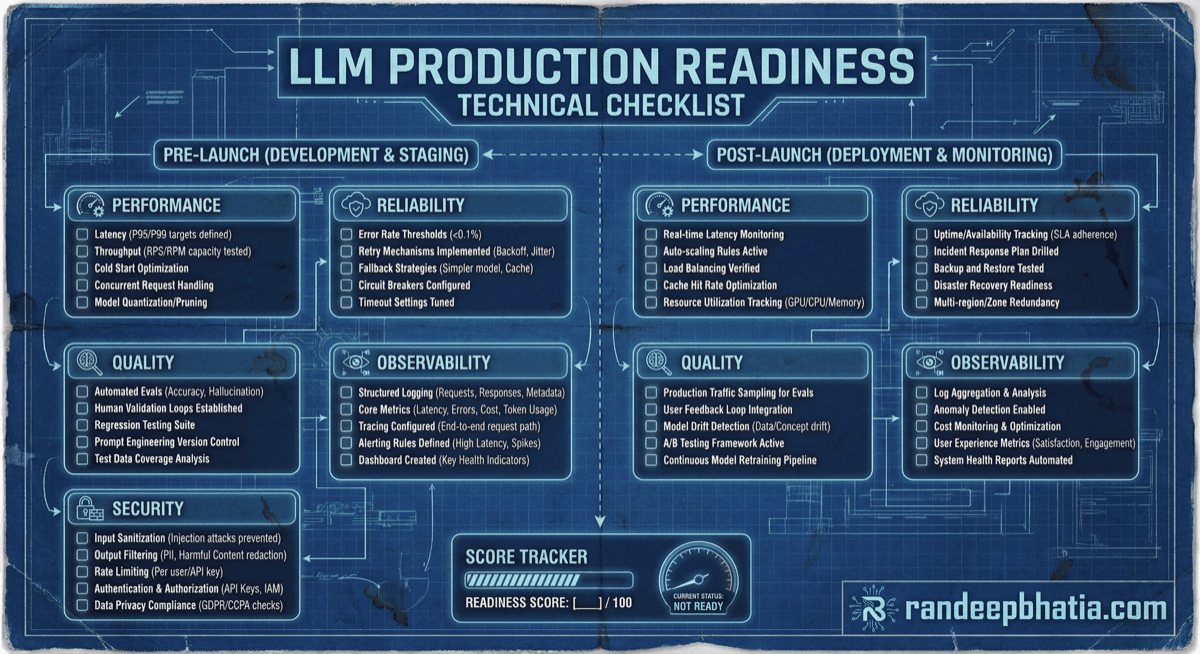
LLM Production Readiness Checklist

Checklistsâś“ citation-safe-referenceđź“– 45-60 minutesUpdated: 2026-01-05

Executive Summary

A systematic framework of validation criteria, operational requirements, and quality gates that must be satisfied before deploying a Large Language Model system to production environments.

1

Production readiness encompasses seven critical domains: functional validation, performance benchmarking, security hardening, observability infrastructure, operational procedures, cost governance, and compliance verification—each requiring explicit sign-off before deployment.

2

The checklist differentiates between blocking requirements that must be satisfied before any production traffic and non-blocking recommendations that should be addressed within defined timeframes post-launch.

3

Effective production readiness assessment requires collaboration across ML engineering, platform engineering, security, legal, and business stakeholders with clear ownership and accountability for each checklist item.

The Bottom Line

An LLM production readiness checklist transforms deployment from an ad-hoc event into a repeatable, auditable process that minimizes production incidents, ensures regulatory compliance, and establishes operational excellence from day one. Organizations that skip systematic readiness validation experience 3-5x higher incident rates in the first 90 days of production operation.

Definition

An LLM Production Readiness Checklist is a comprehensive validation framework that enumerates all technical, operational, security, and compliance requirements that must be verified before a Large Language Model system can serve production traffic.

The checklist serves as both a quality gate preventing premature deployment and a documentation artifact that demonstrates due diligence for stakeholders, auditors, and regulatory bodies.

Extended Definition

The production readiness checklist extends beyond traditional software deployment checklists to address LLM-specific concerns including prompt injection vulnerabilities, hallucination mitigation, content safety filtering, model versioning, inference cost management, and AI-specific regulatory requirements. It encompasses infrastructure readiness, model behavior validation, integration testing, security hardening, observability instrumentation, operational runbooks, disaster recovery procedures, and compliance documentation. The checklist is typically organized into mandatory blocking items that prevent deployment until resolved and recommended items that should be addressed within defined SLAs post-launch. Modern production readiness frameworks incorporate automated validation where possible while maintaining human review for subjective assessments like output quality and brand safety.

Etymology & Origins

The concept of production readiness checklists originated in aviation safety protocols and was adopted by software engineering through the Site Reliability Engineering (SRE) discipline pioneered at Google in the early 2000s. The term 'production readiness review' (PRR) became standard practice in cloud-native development, and the framework was extended to ML systems as MLOps matured around 2018-2020. LLM-specific production readiness checklists emerged in 2022-2023 as organizations discovered that traditional ML deployment criteria were insufficient for the unique challenges posed by generative AI systems.

Also Known As

Production Readiness Review (PRR)Go-Live ChecklistDeployment Validation FrameworkLaunch Readiness AssessmentProduction Certification ChecklistDeployment Gate CriteriaRelease Readiness ChecklistOperational Readiness Review

Not To Be Confused With

Model Evaluation

Model evaluation focuses on measuring model performance metrics like accuracy, perplexity, and benchmark scores, while production readiness encompasses the entire system including infrastructure, security, operations, and compliance—model quality is just one component of production readiness.

CI/CD Pipeline

CI/CD pipelines automate build, test, and deployment processes, but production readiness checklists validate that all prerequisites are met before the pipeline deploys to production—the checklist gates the pipeline, not replaces it.

Security Audit

Security audits are deep assessments of security posture typically performed by specialized teams, while production readiness checklists include security items as one domain among many—security audits may be a prerequisite for checklist completion.

Load Testing

Load testing validates system performance under stress, which is one item within a production readiness checklist—the checklist encompasses load testing results but also includes functional validation, security, compliance, and operational readiness.

Model Card

Model cards document model characteristics, limitations, and intended use cases for transparency purposes, while production readiness checklists validate operational deployment requirements—model cards may be a required artifact within the checklist.

SLA Definition

SLA definitions specify the service level commitments to users, while production readiness checklists validate that the system can actually meet those SLAs—the checklist verifies SLA achievability before making commitments.

Conceptual Foundation

Core Principles

(8 principles)

Mental Models

(6 models)

Swiss Cheese Model

Production incidents occur when holes in multiple defensive layers align, allowing failures to propagate through the system. Each checklist domain represents a layer of cheese, and comprehensive validation ensures holes do not align.

Pre-Flight Checklist

Aviation pre-flight checklists ensure every critical system is verified before takeoff, regardless of pilot experience or time pressure. Production readiness checklists serve the same function for software deployments.

Quality Gates

Production readiness represents a gate that must be passed before traffic flows to the system. The gate is binary—either all blocking requirements are met or deployment is blocked—eliminating partial compliance.

Risk Register

Each checklist item represents a risk that has been identified and mitigated. The checklist serves as a living risk register that documents known risks and their mitigations.

Technical Debt Ledger

Non-blocking checklist items that are deferred represent technical debt that must be tracked and repaid. The checklist serves as a ledger that ensures deferred items are not forgotten.

Minimum Viable Operations

Production readiness defines the minimum operational capabilities required to safely serve users, analogous to minimum viable product for features. Below this threshold, the system should not accept production traffic.

Key Insights

(10 insights)

Production readiness for LLM systems requires 2-3x more checklist items than traditional software due to unique concerns around model behavior, content safety, prompt security, and AI-specific regulations.

The most commonly skipped checklist items—observability instrumentation and operational runbooks—are also the items most correlated with extended incident duration and repeat incidents.

Organizations that implement automated checklist validation experience 60% fewer deployment rollbacks compared to those relying solely on manual review.

Security checklist items for LLM systems must address both traditional application security and novel attack vectors like prompt injection, jailbreaking, and training data extraction.

Cost governance checklist items are frequently overlooked but prevent the most common post-launch crisis: unexpected inference costs that exceed budget by 5-10x.

Compliance checklist items vary significantly by jurisdiction and use case, requiring legal review to ensure the checklist is complete for the specific deployment context.

Production readiness validation should include adversarial testing by red teams who attempt to elicit harmful outputs, not just functional testing with benign inputs.

The checklist should distinguish between items that can be validated in staging environments and those that require production-like conditions for accurate assessment.

Rollback procedures are the most critical operational checklist item because they determine recovery time when other checklist items prove insufficient.

Production readiness is a team sport requiring sign-off from ML engineering, platform engineering, security, legal, and business stakeholders—no single team can validate all items.

When to Use

Ideal Scenarios

(12)

Before deploying any LLM-powered feature to production environments where it will serve real users, regardless of whether the deployment is a new system or an update to an existing one.

When transitioning from prototype or proof-of-concept phase to production deployment, ensuring that shortcuts taken during experimentation are addressed before launch.

Before enabling a new use case or user segment for an existing LLM system, validating that the system is ready for the expanded scope.

After significant changes to the LLM system including model updates, prompt changes, infrastructure modifications, or dependency upgrades that may affect production behavior.

When onboarding a new team to operate an LLM system, using the checklist as a training tool and knowledge transfer mechanism.

During incident post-mortems to identify which checklist items were not adequately validated and contributed to the incident.

When preparing for compliance audits or security assessments, using the checklist as documentation of due diligence.

Before scaling an LLM system to handle significantly higher traffic volumes, validating that the system is ready for increased load.

When deploying LLM systems in regulated industries where formal validation documentation is required for compliance.

As part of vendor evaluation when assessing third-party LLM services, adapting the checklist to validate vendor capabilities.

When establishing organizational standards for LLM deployment, using the checklist as a template that teams customize for their specific systems.

Before announcing or marketing LLM-powered features externally, ensuring the system can handle the expected traffic and scrutiny.

Prerequisites

(8)
1

A functional LLM system that has completed development and initial testing, with all core features implemented and basic functionality verified.

2

Defined success criteria and SLAs that specify the performance, reliability, and quality targets the system must meet in production.

3

Staging or pre-production environment that mirrors production infrastructure and allows realistic validation of checklist items.

4

Identified stakeholders from all relevant domains (ML engineering, platform, security, legal, business) who can review and sign off on their respective checklist items.

5

Sufficient time allocated for checklist validation, typically 1-2 weeks for initial deployments and 2-5 days for updates to existing systems.

6

Access to production-like data and traffic patterns for realistic testing, either through traffic replay, synthetic generation, or shadow mode operation.

7

Documented architecture and design decisions that provide context for checklist reviewers to understand system behavior and constraints.

8

Established incident response procedures and on-call rotations that will support the system once it enters production.

Signals You Need This

(10)

Previous LLM deployments have experienced production incidents that could have been prevented by systematic validation.

Stakeholders are asking questions about system readiness that cannot be answered with confidence due to lack of systematic assessment.

The team is uncertain whether the system meets security, compliance, or performance requirements for production operation.

There is pressure to deploy quickly without clear criteria for what constitutes 'ready enough' for production.

Multiple teams are involved in the deployment and there is ambiguity about who is responsible for validating which requirements.

The system will handle sensitive data, high-value transactions, or safety-critical decisions that require rigorous validation.

Regulatory or compliance requirements mandate documented evidence of pre-deployment validation.

The organization is scaling LLM deployments and needs a repeatable process to ensure consistent quality across teams.

Post-deployment issues are consuming significant engineering time that could be prevented by better pre-deployment validation.

Stakeholders have low confidence in deployment decisions due to lack of visibility into system readiness.

Organizational Readiness

(7)

Executive sponsorship for production readiness processes that empowers teams to block deployments when requirements are not met.

Cross-functional collaboration culture where ML engineering, platform, security, and business teams work together on deployment decisions.

Tolerance for deployment delays when checklist items are not satisfied, rather than pressure to ship regardless of readiness.

Investment in tooling and automation to support efficient checklist validation without excessive manual overhead.

Clear ownership model that assigns accountability for each checklist domain to specific teams or individuals.

Incident response maturity that can handle production issues when they occur despite checklist validation.

Documentation culture that maintains up-to-date records of system architecture, operational procedures, and deployment history.

When NOT to Use

Anti-Patterns

(12)

Using the full production readiness checklist for internal tools or experiments that will never serve external users or handle sensitive data.

Applying the checklist as a bureaucratic gate that delays deployments without providing commensurate risk reduction.

Treating the checklist as a one-time event rather than a continuous process that must be maintained throughout the system lifecycle.

Using the checklist to shift blame rather than improve quality, focusing on who failed to check a box rather than how to prevent issues.

Applying a generic checklist without customization for the specific risk profile, use case, and regulatory context of the system.

Completing the checklist in isolation without engaging the stakeholders who have expertise in each domain.

Treating all checklist items as equally important rather than distinguishing between blocking requirements and recommendations.

Using the checklist as a substitute for good engineering practices rather than a complement to them.

Applying the checklist only to new deployments while ignoring updates to existing systems that may introduce new risks.

Completing the checklist mechanically without understanding the intent behind each item and whether it applies to the specific system.

Using an outdated checklist that does not reflect current best practices, regulatory requirements, or organizational standards.

Treating checklist completion as sufficient evidence of quality without actually validating that each item has been properly addressed.

Red Flags

(10)

The checklist is being completed hours before deployment with no time for remediation if issues are found.

A single person is completing the entire checklist without input from domain experts in security, compliance, or operations.

Checklist items are being marked complete without evidence or documentation of validation.

The same checklist is being used for all systems regardless of risk level, use case, or regulatory requirements.

Stakeholders are pressuring teams to mark items complete despite known deficiencies.

The checklist has not been updated in over a year despite significant changes in best practices and regulations.

Teams are treating checklist completion as a formality rather than a genuine quality gate.

There is no process for tracking and addressing non-blocking items that are deferred to post-launch.

The checklist does not include LLM-specific items and is simply a generic software deployment checklist.

Checklist validation is happening in environments that do not accurately represent production conditions.

Better Alternatives

(8)
1
When:

Deploying a prototype or proof-of-concept for internal evaluation only

Use Instead:

Lightweight validation checklist focused on basic functionality and data protection, without full production rigor

Why:

Full production readiness validation is disproportionate to the risk of internal prototypes and delays valuable learning from early experimentation.

2
When:

Making minor configuration changes to an existing production system

Use Instead:

Change management process with targeted validation of affected areas rather than full checklist re-validation

Why:

Minor changes do not require re-validating all checklist items, and targeted validation is more efficient while still managing risk.

3
When:

Deploying to a canary or shadow environment for limited testing

Use Instead:

Canary deployment checklist focused on observability and rollback rather than full production requirements

Why:

Canary deployments are designed to validate readiness with limited risk, and requiring full production readiness defeats the purpose of incremental validation.

4
When:

Urgent hotfix deployment to address a production incident

Use Instead:

Emergency change process with abbreviated validation and mandatory post-deployment review

Why:

Blocking urgent fixes on full checklist validation may extend incident duration, but abbreviated validation with follow-up ensures issues are addressed.

5
When:

Deploying a feature flag that is disabled by default

Use Instead:

Feature flag deployment checklist with full production readiness required before flag enablement

Why:

Deploying disabled code has lower risk than enabling features, and separating deployment from enablement allows parallel validation.

6
When:

Deploying to a development or staging environment

Use Instead:

Environment-specific checklist focused on functionality and integration rather than production operations

Why:

Non-production environments have different requirements and do not need full production readiness validation.

7
When:

Evaluating a third-party LLM API for potential use

Use Instead:

Vendor assessment checklist focused on capabilities, security, and compliance rather than deployment readiness

Why:

Vendor evaluation is a different activity than deployment readiness, though findings inform the eventual production checklist.

8
When:

Running A/B tests with a small percentage of traffic

Use Instead:

Experiment deployment checklist with focus on measurement validity and user safety rather than full operational readiness

Why:

A/B tests have limited blast radius and different success criteria than full production deployments.

Common Mistakes

(10)

Completing the checklist at the last minute without time to address issues, turning it into a documentation exercise rather than a quality gate.

Treating the checklist as comprehensive when it may not cover all risks specific to the system, use case, or regulatory context.

Assigning checklist completion to junior engineers without oversight from experienced practitioners who understand production risks.

Focusing on checklist completion percentage rather than the quality and thoroughness of validation for each item.

Skipping checklist items because they seem redundant with other validation activities without understanding their unique purpose.

Using the checklist only for initial deployment and not re-validating after significant changes to the system.

Treating all checklist items as binary pass/fail when some items require nuanced assessment of risk acceptance.

Completing the checklist in isolation without testing the system under realistic production conditions.

Assuming that passing the checklist guarantees production success rather than understanding it as risk reduction.

Not updating the checklist based on lessons learned from production incidents and near-misses.

Core Taxonomy

Primary Types

(8 types)

Validation that the LLM system correctly implements required functionality, produces appropriate outputs, and handles edge cases gracefully across all supported use cases and input variations.

Characteristics
  • End-to-end testing of all user journeys and interaction patterns
  • Edge case and boundary condition validation
  • Error handling and graceful degradation verification
  • Output quality assessment against defined criteria
  • Integration testing with all dependent systems
Use Cases
Validating that the system produces correct outputs for representative inputsEnsuring error messages are appropriate and actionableVerifying that all documented features work as specified
Tradeoffs

Comprehensive functional testing requires significant time and effort, but insufficient testing leads to user-facing bugs and trust erosion.

Classification Dimensions

Blocking vs Non-Blocking

Checklist items are classified by whether they prevent deployment or represent recommendations that can be deferred with documented risk acceptance.

Blocking (must be satisfied before deployment)Non-Blocking (should be addressed within defined SLA)

Validation Method

Checklist items are classified by the method used to validate them, informing tooling requirements and review processes.

Automated (validated by CI/CD pipeline)Manual (requires human review)Hybrid (automated check with human approval)

Ownership Domain

Checklist items are classified by the team responsible for validation, ensuring appropriate expertise is applied and accountability is clear.

ML EngineeringPlatform EngineeringSecurityLegal/ComplianceBusiness/Product

Validation Environment

Checklist items are classified by the environment required for accurate validation, informing testing infrastructure requirements.

Development (can validate locally)Staging (requires staging environment)Production-like (requires production-equivalent infrastructure)Production (can only validate in production)

Frequency

Checklist items are classified by how often they must be validated, distinguishing between initial setup and ongoing compliance.

One-time (validated once per system)Per-deployment (validated for each deployment)Continuous (validated ongoing in production)

Risk Level

Checklist items are classified by the severity of impact if the item is not properly validated, informing prioritization and rigor.

Critical (failure causes severe impact)High (failure causes significant impact)Medium (failure causes moderate impact)Low (failure causes minor impact)

Evolutionary Stages

1

Ad-Hoc

Early-stage organizations or teams deploying their first LLM system

No formal checklist exists; deployment decisions are made based on individual judgment and informal communication. Validation is inconsistent and undocumented.

2

Documented

3-6 months after initial LLM deployments, often following a production incident

A written checklist exists and is used for deployments, but validation is primarily manual and may not be consistently applied. Evidence of validation may be informal.

3

Standardized

6-12 months of LLM production experience with multiple deployments

The checklist is standardized across teams with clear ownership, blocking criteria, and formal sign-off processes. Some automation exists for validation.

4

Automated

12-24 months of LLM production experience with investment in tooling

Most checklist items are automatically validated through CI/CD integration, with human review focused on items requiring judgment. Validation is consistent and auditable.

5

Continuous

24+ months of LLM production experience with mature MLOps practices

Production readiness is continuously validated rather than point-in-time, with automated detection of compliance drift and proactive remediation. The checklist evolves based on production learnings.

Architecture Patterns

Architecture Patterns

(6 patterns)

Gated Deployment Pipeline

Production readiness checklist is integrated as a gate in the CI/CD pipeline that blocks deployment until all blocking items are validated, with automated checks where possible and manual approval workflows for human-reviewed items.

Components
  • CI/CD orchestration platform
  • Automated test suites for each checklist domain
  • Approval workflow system
  • Evidence collection and storage
  • Deployment gate logic
Data Flow

Code changes trigger pipeline -> automated checks execute -> results aggregated -> manual review items queued -> approvals collected -> gate evaluates all items -> deployment proceeds or blocks

Best For
  • Organizations with mature CI/CD practices
  • High-volume deployment environments
  • Regulated industries requiring audit trails
Limitations
  • Requires significant upfront investment in automation
  • Manual review items can become bottlenecks
  • May slow deployment velocity if not well-optimized
Scaling Characteristics

Scales horizontally with parallel test execution; bottleneck is typically manual review capacity

Integration Points

CI/CD Pipeline

Executes automated checklist validation and enforces deployment gates based on checklist status

Interfaces:
Pipeline stage definitionsTest execution frameworksApproval workflow APIsDeployment gate conditions

Pipeline integration should fail fast on blocking items while allowing parallel execution of independent checks to minimize validation time.

Model Registry

Tracks model versions and their associated production readiness status, preventing deployment of unvalidated models

Interfaces:
Model metadata APIsVersion taggingPromotion workflowsLineage tracking

Model registry should enforce that only models with complete checklist validation can be promoted to production-eligible status.

Observability Platform

Provides metrics, logs, and traces used to validate performance and operational readiness checklist items

Interfaces:
Metrics query APIsLog aggregationTrace analysisDashboard APIs

Observability integration should enable automated validation of monitoring coverage and alert configuration.

Security Scanning Tools

Executes security-related checklist validations including vulnerability scanning, secret detection, and penetration testing

Interfaces:
Scan execution APIsVulnerability databasesReport generationPolicy enforcement

Security tool integration should support both automated scanning and manual penetration testing workflows.

Compliance Management System

Tracks regulatory requirements and maps them to checklist items, ensuring compliance coverage

Interfaces:
Requirement databasesControl mappingEvidence collectionAudit reporting

Compliance integration should support multiple regulatory frameworks and enable evidence reuse across audits.

Cost Management Platform

Provides cost data and projections used to validate cost readiness checklist items

Interfaces:
Cost APIsBudget trackingForecasting modelsAlert configuration

Cost integration should enable validation of budget allocation and cost monitoring configuration before deployment.

Incident Management System

Validates operational readiness by confirming incident response procedures and on-call coverage

Interfaces:
On-call schedule APIsRunbook integrationEscalation policy verificationIncident history

Incident management integration should verify that the team is prepared to respond to production issues.

Documentation Platform

Stores and validates documentation-related checklist items including runbooks, architecture docs, and model cards

Interfaces:
Document APIsVersion trackingReview workflowsSearch and discovery

Documentation integration should validate that required documents exist, are current, and have been reviewed.

Decision Framework

âś“ If Yes

Apply full production readiness checklist for new systems

âś— If No

Apply change-appropriate subset of checklist for updates

Considerations

New systems require comprehensive validation while updates may only need validation of changed components and regression testing.

Technical Deep Dive

Overview

A production readiness checklist operates as a systematic validation framework that evaluates an LLM system across multiple dimensions before allowing deployment to production environments. The checklist defines specific criteria that must be met, methods for validating each criterion, evidence requirements for documentation, and ownership assignments for accountability. The validation process typically combines automated checks executed through CI/CD pipelines with manual reviews performed by domain experts, culminating in a formal sign-off that gates the deployment decision. The checklist is structured hierarchically with domains (functional, performance, security, etc.) containing categories, which contain individual checklist items. Each item specifies what must be validated, how to validate it, what evidence is required, who is responsible, and whether it is blocking or non-blocking. The validation process collects evidence for each item, evaluates whether the criterion is met, and aggregates results to determine overall readiness. Modern implementations treat the checklist as a living artifact that evolves based on production learnings, regulatory changes, and organizational maturity. The checklist is version-controlled and changes go through review processes to ensure updates are appropriate and communicated to stakeholders. Automation is progressively added to reduce manual burden and ensure consistent validation across deployments.

Step-by-Step Process

Create a new checklist instance for the specific deployment, selecting the appropriate checklist template based on system risk tier and characteristics. Populate system-specific information including system name, version, deployment target, and timeline.

⚠️ Pitfalls to Avoid

Using an outdated checklist template that does not reflect current requirements; selecting the wrong risk tier to reduce validation burden.

Under The Hood

The production readiness checklist operates on a principle of defense in depth, where multiple validation layers provide independent verification of system readiness. Each checklist domain addresses a different category of production risk, and comprehensive validation across all domains reduces the probability that any single failure mode will cause production incidents. The checklist structure reflects the understanding that production failures rarely have single causes—they typically result from the combination of multiple factors that individually might be acceptable but together create unacceptable risk. The validation process distinguishes between objective criteria that can be automatically verified and subjective criteria that require human judgment. Automated validation provides consistency and efficiency for objective criteria like performance benchmarks, security scan results, and configuration compliance. Human validation is reserved for criteria that require contextual judgment, such as output quality assessment, brand safety evaluation, and risk acceptance decisions. This hybrid approach balances thoroughness with practicality. Evidence collection serves multiple purposes beyond immediate deployment decisions. Evidence provides an audit trail that demonstrates due diligence for compliance purposes, enables post-incident analysis to understand what was validated before deployment, and supports organizational learning by documenting what worked and what did not. Evidence should be specific enough to demonstrate criterion satisfaction but not so voluminous that it becomes unmanageable. The blocking versus non-blocking classification reflects a pragmatic approach to deployment decisions. Some criteria are so critical that deployment without satisfaction would be irresponsible—these are blocking items. Other criteria are important but their absence does not create unacceptable immediate risk—these are non-blocking items that can be deferred with documented risk acceptance. The classification should be based on impact severity and likelihood, not on convenience or time pressure. Checklist evolution is essential for long-term effectiveness. Production incidents should trigger checklist review to identify whether new items should be added or existing items should be strengthened. Regulatory changes may introduce new compliance requirements. Organizational maturity may enable more sophisticated validation approaches. The checklist should be treated as a living document that improves over time based on experience and changing requirements.

Failure Modes

Root Cause

Organizational pressure to deploy quickly leads to skipping or rubber-stamping checklist items without genuine validation

Symptoms
  • Checklist completed in unrealistically short time
  • All items marked passed without evidence
  • Sign-offs obtained without review
  • Post-deployment incidents in areas that should have been caught
Impact

Production incidents that could have been prevented; erosion of checklist credibility; potential compliance violations

Prevention

Executive commitment to checklist discipline; automated enforcement of blocking items; separation of deployment authority from development

Mitigation

Post-incident review to identify bypass; reinforcement of checklist importance; process improvements to reduce legitimate time pressure

Operational Considerations

Key Metrics (15)

Percentage of deployments that complete the full checklist before deployment

Normal95-100%
AlertBelow 90%
ResponseInvestigate reasons for incomplete checklists; reinforce process; address systemic issues

Dashboard Panels

Checklist completion funnel showing items by statusDeployment timeline with checklist milestonesBlocking item failure trends over timeDeferred item backlog by age and systemAutomation coverage by checklist domainApprover response time distributionPost-deployment incident correlation with checklist itemsRisk acceptance trends by domainChecklist version history and adoptionCross-team coordination bottleneck analysis

Alerting Strategy

Implement tiered alerting with immediate alerts for checklist bypass attempts and critical compliance issues, daily summaries for deferred item SLA risks and approval delays, and weekly reports for trend analysis and process health metrics.

Cost Analysis

Cost Drivers

(10)

Validation infrastructure

Impact:

Staging environments, testing infrastructure, and security scanning tools require ongoing infrastructure costs

Optimization:

Share validation infrastructure across teams; use ephemeral environments; optimize resource utilization

Human review time

Impact:

Manual validation and approval processes consume engineering and specialist time

Optimization:

Maximize automation; streamline review processes; provide clear guidance to reduce review iterations

Tooling and platform costs

Impact:

Checklist management platforms, evidence storage, and integration tooling have licensing and operational costs

Optimization:

Evaluate build vs buy; consolidate tooling; negotiate volume pricing

Deployment delays

Impact:

Time spent on checklist validation delays feature delivery and may have opportunity costs

Optimization:

Shift validation left; parallelize validation; reduce blocking items where appropriate

Remediation effort

Impact:

Fixing issues identified during validation requires engineering time

Optimization:

Improve development quality to reduce failures; provide clear remediation guidance; automate common fixes

Evidence storage

Impact:

Long-term evidence retention for compliance requires storage costs

Optimization:

Implement tiered storage; archive old evidence; optimize evidence formats

Training and onboarding

Impact:

Training teams on checklist processes and tooling requires time investment

Optimization:

Create self-service documentation; automate onboarding; provide templates and examples

Compliance and audit support

Impact:

Responding to audits and maintaining compliance documentation requires ongoing effort

Optimization:

Automate compliance reporting; maintain audit-ready documentation; proactive compliance monitoring

Incident prevention value

Impact:

Prevented incidents have significant value in avoided costs, but this is difficult to measure directly

Optimization:

Track incidents that checklist prevented; calculate avoided costs; communicate value to stakeholders

Process overhead

Impact:

Coordination, communication, and administrative overhead for checklist processes

Optimization:

Streamline workflows; reduce unnecessary steps; automate coordination

Cost Models

Per-deployment cost

Infrastructure cost + (Human hours Ă— Hourly rate) + Tooling cost allocation + Remediation cost
Variables:
Infrastructure cost: staging environment, testing resourcesHuman hours: validation time, review time, approval timeHourly rate: blended rate for involved personnelTooling cost allocation: per-deployment share of platform costsRemediation cost: time to fix identified issues
Example:

A typical deployment might cost $2,000-5,000 in direct costs: $500 infrastructure, $1,500-3,500 human time (20-50 hours at $75/hour), $200 tooling, $300 remediation.

Annual program cost

Fixed costs + (Per-deployment cost Ă— Number of deployments) + Continuous costs
Variables:
Fixed costs: platform licensing, infrastructure baselinePer-deployment cost: as calculated aboveNumber of deployments: annual deployment volumeContinuous costs: monitoring, maintenance, updates
Example:

An organization with 100 deployments per year might spend $300,000-600,000 annually: $50,000 fixed costs, $200,000-500,000 per-deployment costs, $50,000 continuous costs.

Incident prevention ROI

(Prevented incidents Ă— Average incident cost) / Checklist program cost
Variables:
Prevented incidents: estimated based on historical data and industry benchmarksAverage incident cost: direct costs plus reputation, compliance, and opportunity costsChecklist program cost: annual program cost as calculated above
Example:

If checklist prevents 5 incidents per year with average cost of $100,000 each, and program costs $400,000, ROI is ($500,000 / $400,000) = 1.25x or 25% return.

Automation ROI

(Manual validation cost - Automated validation cost) Ă— Number of deployments / Automation investment
Variables:
Manual validation cost: human time for manual validationAutomated validation cost: infrastructure and maintenance for automationNumber of deployments: deployment volume over payback periodAutomation investment: development and setup costs
Example:

Automating a validation that takes 4 hours manually ($300) to 15 minutes automated ($25) saves $275 per deployment. With 100 deployments and $15,000 automation investment, payback is 55 deployments.

Optimization Strategies

  • 1Maximize automation coverage to reduce human review time, prioritizing high-frequency validation items
  • 2Implement risk-tiered checklists to avoid over-validating low-risk systems
  • 3Share validation infrastructure across teams to improve utilization
  • 4Use ephemeral environments that are created for validation and destroyed after
  • 5Shift validation left to catch issues earlier when they are cheaper to fix
  • 6Parallelize validation items to reduce wall-clock time without increasing cost
  • 7Provide clear guidance and templates to reduce review iterations
  • 8Implement self-service validation where teams can validate without specialist involvement
  • 9Archive historical evidence to cheaper storage tiers
  • 10Consolidate tooling to reduce licensing and integration costs
  • 11Train teams on efficient validation practices to reduce time per deployment
  • 12Implement continuous compliance to spread validation cost over time

Hidden Costs

  • đź’°Opportunity cost of delayed deployments while waiting for validation
  • đź’°Context switching cost when engineers move between development and validation
  • đź’°Coordination overhead for cross-team validation dependencies
  • đź’°Technical debt from deferred non-blocking items that accumulate
  • đź’°Morale impact if checklist is perceived as bureaucratic obstacle
  • đź’°Knowledge concentration risk if validation expertise is not distributed
  • đź’°Tool sprawl if multiple teams implement different validation approaches
  • đź’°Compliance risk if checklist does not cover all regulatory requirements

ROI Considerations

The ROI of production readiness checklists is primarily realized through incident prevention, which is inherently difficult to measure because prevented incidents are counterfactual. Organizations should track near-misses caught by checklists, incidents that occurred despite checklists (indicating gaps), and industry benchmarks for incident rates to estimate prevention value. Secondary ROI comes from compliance benefits including reduced audit findings, faster audit completion, and avoided regulatory penalties. Organizations in regulated industries may find compliance value exceeds incident prevention value. Tertiary ROI comes from operational efficiency improvements including faster incident resolution (due to better documentation), reduced on-call burden (due to more reliable systems), and improved team confidence (due to systematic validation). The investment in checklist automation typically has strong ROI for organizations with high deployment volume, as the per-deployment cost reduction compounds across many deployments. Organizations should prioritize automating the most time-consuming manual validations first.

Security Considerations

Threat Model

(10 threats)
1

Checklist bypass by malicious insider

Attack Vector

Insider with deployment access bypasses checklist to deploy malicious code

Impact

Malicious code in production; data breach; system compromise

Mitigation

Separation of duties; automated enforcement; audit logging; anomaly detection

2

Evidence tampering

Attack Vector

Attacker modifies validation evidence to make failed items appear passed

Impact

False confidence in validation; deployment of unvalidated system

Mitigation

Immutable evidence storage; cryptographic integrity verification; audit trails

3

Approval workflow compromise

Attack Vector

Attacker compromises approver account to provide unauthorized sign-offs

Impact

Unauthorized deployments; bypass of human review

Mitigation

Multi-factor authentication; approval anomaly detection; multiple approver requirements for high-risk deployments

4

Checklist template manipulation

Attack Vector

Attacker modifies checklist template to remove security items

Impact

Security validations not performed; vulnerabilities not detected

Mitigation

Template version control; change review process; template integrity monitoring

5

Validation tool compromise

Attack Vector

Attacker compromises automated validation tools to produce false positive results

Impact

Failed validations appear to pass; vulnerabilities not detected

Mitigation

Tool integrity verification; multiple validation sources; manual spot-checks

6

Sensitive data exposure in evidence

Attack Vector

Validation evidence contains sensitive data that is exposed through evidence storage

Impact

Data breach; privacy violation; compliance violation

Mitigation

Evidence sanitization; access controls; encryption; retention policies

7

Denial of service on validation infrastructure

Attack Vector

Attacker overwhelms validation infrastructure to prevent legitimate deployments

Impact

Deployment delays; pressure to bypass validation

Mitigation

Infrastructure resilience; rate limiting; capacity planning; bypass procedures for emergencies

8

Social engineering of approvers

Attack Vector

Attacker manipulates approvers into signing off on inadequate validation

Impact

Inadequate validation; deployment of vulnerable system

Mitigation

Approver training; clear approval criteria; escalation for unusual requests

9

Supply chain attack on validation dependencies

Attack Vector

Attacker compromises third-party tools or libraries used in validation

Impact

Compromised validation results; false confidence

Mitigation

Dependency scanning; vendor security assessment; multiple validation sources

10

Privilege escalation through checklist system

Attack Vector

Attacker exploits checklist system vulnerabilities to gain elevated privileges

Impact

Unauthorized access; system compromise

Mitigation

Security hardening; regular security assessments; principle of least privilege

Security Best Practices

  • âś“Implement separation of duties between development, validation, and deployment approval
  • âś“Use multi-factor authentication for all checklist system access
  • âś“Maintain immutable audit logs of all checklist actions
  • âś“Encrypt evidence at rest and in transit
  • âś“Implement role-based access control with principle of least privilege
  • âś“Require multiple approvers for high-risk deployments
  • âś“Conduct regular security assessments of checklist infrastructure
  • âś“Monitor for anomalous checklist activity patterns
  • âś“Implement integrity verification for checklist templates and validation tools
  • âś“Sanitize evidence to remove sensitive data before storage
  • âś“Establish secure backup and recovery procedures for checklist data
  • âś“Conduct security training for all checklist participants
  • âś“Implement secure integration patterns with external systems
  • âś“Regularly rotate credentials and access tokens
  • âś“Maintain incident response procedures for checklist security events

Data Protection

  • đź”’Classify checklist data by sensitivity and apply appropriate controls
  • đź”’Implement data minimization for evidence collection
  • đź”’Establish retention policies aligned with compliance requirements
  • đź”’Encrypt all checklist data at rest and in transit
  • đź”’Implement access logging for all data access
  • đź”’Sanitize evidence to remove PII and sensitive data where possible
  • đź”’Implement secure deletion procedures for expired data
  • đź”’Conduct regular data protection impact assessments
  • đź”’Establish data breach response procedures for checklist data
  • đź”’Implement cross-border data transfer controls where applicable

Compliance Implications

SOC 2

Requirement:

Change management controls and evidence of pre-deployment validation

Implementation:

Checklist provides documented evidence of validation with audit trail; map checklist items to SOC 2 controls

GDPR

Requirement:

Data protection impact assessment for AI systems processing personal data

Implementation:

Include DPIA completion as checklist item; validate data protection controls; document lawful basis

HIPAA

Requirement:

Security risk assessment and safeguards for protected health information

Implementation:

Include PHI-specific security items; validate encryption and access controls; document BAA compliance

PCI DSS

Requirement:

Change control procedures and security testing for cardholder data environments

Implementation:

Include PCI-specific security items; validate network segmentation; document penetration testing

EU AI Act

Requirement:

Risk assessment and conformity assessment for high-risk AI systems

Implementation:

Include AI-specific risk assessment items; validate human oversight; document transparency requirements

ISO 27001

Requirement:

Information security management system with change management controls

Implementation:

Map checklist to ISO 27001 controls; maintain evidence for certification audits

FedRAMP

Requirement:

Security assessment and authorization for federal cloud services

Implementation:

Include FedRAMP-specific security items; validate continuous monitoring; document authorization boundary

NIST AI RMF

Requirement:

AI risk management framework implementation

Implementation:

Map checklist items to NIST AI RMF functions; document risk management practices

Scaling Guide

Scaling Dimensions

Deployment volume

Strategy:

Increase automation coverage; parallelize validation; add reviewer capacity; implement self-service validation

Limits:

Manual review capacity becomes bottleneck above ~100 deployments per reviewer per month

Considerations:

High deployment volume requires investment in automation to maintain quality without excessive delay

Team count

Strategy:

Standardize checklist templates; implement federated validation; establish center of excellence; create self-service tooling

Limits:

Coordination overhead increases with team count; standardization becomes more valuable

Considerations:

Multiple teams require clear ownership boundaries and consistent standards

System complexity

Strategy:

Modular checklist design; specialized validation for complex components; increased automation for complex validations

Limits:

Very complex systems may require custom checklist items and specialized expertise

Considerations:

Complex systems benefit from decomposition into independently validatable components

Regulatory scope

Strategy:

Compliance mapping framework; regulation-specific checklist modules; automated compliance checking

Limits:

Each new regulation adds checklist items and review requirements

Considerations:

Multi-jurisdiction deployments require careful compliance mapping and potentially different checklists

Geographic distribution

Strategy:

Regional validation infrastructure; timezone-aware approval workflows; localized checklist items

Limits:

Global deployments require 24/7 approval coverage and region-specific validation

Considerations:

Distributed teams need clear handoff procedures and timezone-appropriate SLAs

Evidence volume

Strategy:

Tiered storage; automated archival; evidence summarization; efficient evidence formats

Limits:

Storage costs grow with evidence volume; retrieval performance may degrade

Considerations:

Long-term evidence retention requires scalable storage architecture

Integration count

Strategy:

Standardized integration patterns; API-first design; integration health monitoring

Limits:

Each integration adds maintenance burden and potential failure points

Considerations:

Integration complexity should be managed through abstraction and standardization

Checklist customization

Strategy:

Template inheritance; modular checklist design; governance for customization

Limits:

Excessive customization reduces standardization benefits and increases maintenance

Considerations:

Balance customization needs with standardization benefits through modular design

Capacity Planning

Key Factors:
Expected deployment volume per time periodAverage validation time per deploymentReviewer capacity and availabilityAutomation coverage percentageEvidence storage growth rateIntegration throughput requirements
Formula:Required reviewer capacity = (Deployments per month Ă— Manual review hours per deployment) / (Available hours per reviewer per month Ă— Reviewer efficiency factor)
Safety Margin:

Plan for 30-50% additional capacity to handle peak periods, unexpected complexity, and reviewer unavailability

Scaling Milestones

10 deployments per month
Challenges:
  • Establishing initial checklist and processes
  • Training team on validation procedures
  • Building basic automation
Architecture Changes:

Manual checklist with basic automation; single team ownership; simple evidence storage

50 deployments per month
Challenges:
  • Reviewer capacity constraints
  • Consistency across deployments
  • Evidence management overhead
Architecture Changes:

Increased automation; dedicated checklist tooling; standardized templates; multiple reviewers

200 deployments per month
Challenges:
  • Cross-team coordination
  • Checklist customization needs
  • Approval workflow bottlenecks
Architecture Changes:

Federated validation model; self-service tooling; automated approval workflows; modular checklists

500 deployments per month
Challenges:
  • Platform scalability
  • Global team coordination
  • Compliance at scale
Architecture Changes:

Dedicated platform team; regional validation infrastructure; automated compliance; advanced analytics

1000+ deployments per month
Challenges:
  • Enterprise-wide standardization
  • Continuous compliance
  • Cost optimization at scale
Architecture Changes:

Enterprise platform; continuous validation; ML-assisted review; comprehensive automation

Benchmarks

Industry Benchmarks

MetricP50P95P99 World Class
Checklist completion time (new system)3 days7 days14 days2 days with high automation
Checklist completion time (update)1 day3 days5 days4 hours with high automation
Automation coverage40%70%85%90%+ with continuous validation
Post-deployment incident rate15% of deployments5% of deployments2% of deploymentsLess than 1% of deployments
Blocking item first-pass rate70%85%95%90%+ with shift-left validation
Deferred item resolution time30 days14 days7 days7 days or less
Approver response time24 hours8 hours4 hours2 hours or less
Checklist bypass rate5%1%0.1%0% with automated enforcement
Evidence completeness80%95%99%100% with automated collection
Rollback rate10%3%1%Less than 1%
Mean time to detect post-deployment issues4 hours1 hour15 minutes5 minutes with comprehensive monitoring
Checklist items per deployment50 items100 items150 itemsAppropriate to risk level, not maximized

Comparison Matrix

ApproachImplementation EffortAutomation PotentialFlexibilityAudit ReadinessTeam AdoptionScalability
Manual checklist documentLowNoneHighLowMediumLow
Spreadsheet-based trackingLowLowHighMediumMediumLow
Issue tracker integrationMediumMediumMediumMediumHighMedium
Dedicated checklist platformHighHighMediumHighMediumHigh
CI/CD integrated validationHighVery HighLowHighHighVery High
Policy-as-code frameworkVery HighVery HighMediumVery HighLow initiallyVery High

Performance Tiers

Basic

Manual checklist with minimal automation; reactive validation; limited evidence collection

Target:

Checklist completion for all deployments; basic incident reduction

Standardized

Standardized checklist with some automation; proactive validation; systematic evidence collection

Target:

50% automation; 30% incident reduction; full audit trail

Optimized

Highly automated checklist; shift-left validation; comprehensive evidence; continuous improvement

Target:

75% automation; 50% incident reduction; sub-day completion time

World-class

Near-full automation; continuous validation; predictive risk assessment; self-improving checklist

Target:

90%+ automation; minimal incidents; real-time validation; ML-assisted review

Real World Examples

Real-World Scenarios

(6 examples)
1

E-commerce company deploying customer service chatbot

Context

Large e-commerce company deploying LLM-powered chatbot to handle customer inquiries, replacing significant portion of human support

Approach

Implemented comprehensive checklist covering functional validation (response accuracy, escalation handling), performance (latency under peak load), security (prompt injection, data leakage), content safety (brand voice, inappropriate content), and operational readiness (monitoring, runbooks, on-call). Required sign-off from ML engineering, security, legal, and customer experience teams.

Outcome

Checklist identified several issues before deployment including prompt injection vulnerability, inadequate escalation handling, and missing monitoring for customer satisfaction. Issues were resolved before launch, resulting in successful deployment with 95% customer satisfaction and no security incidents in first 6 months.

Lessons Learned
  • đź’ˇContent safety validation required extensive adversarial testing beyond standard test cases
  • đź’ˇEscalation to human agents was critical path that needed thorough validation
  • đź’ˇCustomer experience team provided valuable input on brand voice validation
  • đź’ˇCost monitoring was essential as usage exceeded initial projections by 3x
2

Healthcare startup deploying clinical decision support

Context

Healthcare startup deploying LLM to assist clinicians with differential diagnosis, operating in highly regulated environment

Approach

Extended standard checklist with healthcare-specific items including HIPAA compliance, clinical validation, explainability requirements, and human oversight mechanisms. Engaged clinical advisors for medical accuracy validation. Implemented extensive audit logging and model versioning.

Outcome

Checklist process took 3 months due to regulatory requirements but resulted in FDA-cleared deployment. No adverse events in first year of operation. Audit trail from checklist was essential for regulatory submissions.

Lessons Learned
  • đź’ˇRegulatory requirements significantly extended checklist scope and timeline
  • đź’ˇClinical validation required domain expertise not available internally
  • đź’ˇExplainability requirements drove significant architecture decisions
  • đź’ˇHuman oversight mechanisms were critical for regulatory approval
3

Financial services firm deploying fraud detection enhancement

Context

Large bank deploying LLM to enhance existing fraud detection system, requiring integration with legacy systems and compliance with financial regulations

Approach

Implemented checklist with emphasis on model fairness (bias detection), explainability (regulatory requirement for adverse actions), integration testing (legacy system compatibility), and operational resilience (fallback to existing system). Required sign-off from model risk management, compliance, and technology risk teams.

Outcome

Checklist identified bias issues in model that would have caused regulatory problems. Integration testing revealed performance issues with legacy systems. Deployment was delayed by 6 weeks for remediation but launched successfully with improved fraud detection and no compliance issues.

Lessons Learned
  • đź’ˇModel fairness validation was more complex than anticipated
  • đź’ˇLegacy system integration required extensive testing
  • đź’ˇModel risk management team had specific requirements not in initial checklist
  • đź’ˇFallback mechanisms were essential for production resilience
4

Media company deploying content recommendation system

Context

Streaming media company deploying LLM-powered content recommendation to improve user engagement

Approach

Implemented checklist focused on recommendation quality (relevance, diversity), performance (latency impact on user experience), A/B testing infrastructure, and content safety (age-appropriate recommendations). Included business metrics validation and rollback procedures.

Outcome

Checklist caught performance issues that would have degraded user experience. A/B testing validation ensured accurate measurement of business impact. Successful deployment with 15% improvement in engagement metrics.

Lessons Learned
  • đź’ˇPerformance requirements were stricter than typical due to user experience impact
  • đź’ˇA/B testing infrastructure validation was essential for measuring success
  • đź’ˇContent safety for recommendations had different requirements than content generation
  • đź’ˇBusiness metrics alignment was critical for stakeholder buy-in
5

Enterprise software company deploying code assistant

Context

Enterprise software company deploying LLM-powered code assistant for internal developers

Approach

Implemented checklist with emphasis on code security (no secrets in suggestions), intellectual property protection (no proprietary code leakage), developer productivity metrics, and integration with development tools. Required security and legal sign-off.

Outcome

Checklist identified IP leakage risk that required additional filtering. Security review found potential for secrets exposure in code suggestions. Deployment proceeded after mitigations with positive developer feedback.

Lessons Learned
  • đź’ˇIP protection required careful consideration of training data and outputs
  • đź’ˇCode security validation needed specialized tooling
  • đź’ˇDeveloper experience validation was important for adoption
  • đź’ˇIntegration with existing tools was critical for workflow
6

Government agency deploying citizen services chatbot

Context

Government agency deploying LLM chatbot to assist citizens with service inquiries, requiring accessibility and equity considerations

Approach

Implemented checklist with emphasis on accessibility (screen reader compatibility, plain language), equity (bias in responses, language support), security (citizen data protection), and compliance (government regulations, records retention). Required extensive stakeholder review.

Outcome

Checklist identified accessibility issues and language bias that were remediated before launch. Compliance review ensured records retention requirements were met. Successful deployment serving diverse citizen population.

Lessons Learned
  • đź’ˇAccessibility requirements drove significant UX decisions
  • đź’ˇEquity validation required diverse testing population
  • đź’ˇGovernment compliance requirements were extensive and specific
  • đź’ˇStakeholder review process was longer than private sector

Industry Applications

Healthcare

Clinical decision support, patient communication, medical documentation

Key Considerations:

HIPAA compliance, clinical validation, FDA requirements for medical devices, patient safety, explainability for clinical decisions, integration with EHR systems

Financial Services

Fraud detection, customer service, investment advice, underwriting

Key Considerations:

Model risk management, fair lending compliance, explainability for adverse actions, regulatory reporting, data privacy, systemic risk considerations

E-commerce

Customer service, product recommendations, search, content generation

Key Considerations:

Brand safety, customer experience, scalability for peak traffic, personalization privacy, competitive intelligence protection

Manufacturing

Quality control, predictive maintenance, supply chain optimization

Key Considerations:

Safety-critical systems, integration with OT systems, real-time performance, edge deployment, reliability requirements

Education

Tutoring, content creation, assessment, accessibility

Key Considerations:

Age-appropriate content, educational efficacy, accessibility requirements, student data privacy, equity in access

Legal

Document review, contract analysis, legal research, drafting assistance

Key Considerations:

Confidentiality, accuracy requirements, professional responsibility, privilege protection, citation verification

Media and Entertainment

Content recommendation, content creation, moderation, personalization

Key Considerations:

Content safety, copyright considerations, user engagement metrics, platform integrity, creator rights

Government

Citizen services, document processing, policy analysis, accessibility

Key Considerations:

Accessibility requirements, equity considerations, transparency, records retention, security clearance, procurement regulations

Telecommunications

Customer service, network optimization, fraud detection, billing

Key Considerations:

High availability requirements, real-time performance, regulatory compliance, customer data protection, integration with legacy systems

Insurance

Claims processing, underwriting, customer service, fraud detection

Key Considerations:

Actuarial accuracy, regulatory compliance, fair treatment, explainability for decisions, data privacy

Frequently Asked Questions

Frequently Asked Questions

(20 questions)

Process

For new LLM systems, expect 1-2 weeks for comprehensive validation with high automation, or 2-4 weeks with significant manual review. Updates to existing systems typically take 1-3 days. The timeline depends on checklist comprehensiveness, automation coverage, and reviewer availability. Rushing validation to meet deadlines is a common source of production incidents.

Technical

Security

Compliance

Governance

Metrics

Culture

Operations

Cost

Glossary

Glossary

(29 terms)
B

Blast Radius

The scope of impact when a failure occurs, including affected users, systems, data, and business functions.

Context: Used to assess risk and prioritize checklist items based on potential impact.

Blocking Item

A checklist item that must be satisfied before deployment can proceed; failure of a blocking item prevents deployment until remediated or explicitly waived by appropriate authority.

Context: Used to distinguish critical requirements from recommendations in production readiness checklists.

C

Canary Deployment

Deployment strategy where changes are rolled out to a small subset of users or traffic before full deployment, enabling validation with limited blast radius.

Context: Deployment technique that complements but does not replace production readiness validation.

Circuit Breaker

Pattern that prevents cascade failures by stopping requests to a failing service, allowing it to recover.

Context: Resilience pattern that should be validated as part of operational readiness.

Compensating Control

Alternative measure that provides equivalent risk reduction when a primary control cannot be implemented.

Context: Used when a checklist item cannot be satisfied directly but risk can be mitigated through other means.

Compliance Drift

Gradual deviation from compliance requirements over time due to system changes, configuration updates, or evolving requirements.

Context: Risk that production readiness validation becomes invalid after deployment, requiring continuous monitoring.

Content Safety

Measures to prevent LLM systems from generating harmful, offensive, biased, or inappropriate content, including filtering, moderation, and output validation.

Context: Critical validation domain for any LLM system that generates user-facing content.

D

Deployment Gate

A control point in the deployment process that blocks progression until specified criteria are met, typically implemented through CI/CD pipeline integration.

Context: Gates enforce checklist completion before deployment can proceed.

E

Evidence

Documentation that demonstrates a checklist item has been validated, including test results, screenshots, logs, attestations, and other artifacts.

Context: Evidence provides audit trail and enables verification of checklist completion.

Evidence Freshness

The recency of validation evidence relative to the deployment, ensuring evidence reflects current system state.

Context: Stale evidence may not accurately represent system readiness; freshness requirements prevent this.

F

Federated Validation

Validation approach where different teams validate their respective domains, with results aggregated for overall readiness determination.

Context: Organizational pattern for scaling production readiness across large organizations.

H

Hallucination

LLM behavior where the model generates plausible-sounding but factually incorrect or fabricated information, presenting it with apparent confidence.

Context: LLM-specific quality concern that affects output reliability and must be assessed during validation.

I

Inference Cost

The computational cost of running LLM inference, typically measured in tokens processed or API calls, which can be significant for production systems.

Context: LLM-specific cost consideration that must be validated and monitored for production readiness.

J

Jailbreak

Technique for bypassing LLM safety measures to elicit outputs the model was designed to refuse, often through creative prompting.

Context: Security and safety concern that must be tested during production readiness validation.

M

Model Card

Documentation that describes a machine learning model's intended use, limitations, performance characteristics, and ethical considerations, providing transparency for users and stakeholders.

Context: Often required as part of production readiness documentation for LLM systems.

Model Versioning

Practice of tracking and managing different versions of ML models, enabling reproducibility, rollback, and audit.

Context: Essential for production LLM systems to enable rollback and understand behavior changes.

N

Non-Blocking Item

A checklist item that is important but whose absence does not prevent deployment; non-blocking items are typically deferred with documented risk acceptance and SLAs for remediation.

Context: Allows deployment to proceed while tracking items that should be addressed post-launch.

O

Observability

The ability to understand system behavior through external outputs including metrics, logs, and traces.

Context: Critical capability for production operation that must be validated before deployment.

P

Production Readiness Review (PRR)

Formal review process where stakeholders assess system readiness for production deployment, typically using a checklist as the framework.

Context: The meeting or process where checklist status is reviewed and deployment decision is made.

Prompt Injection

An attack technique where malicious input is crafted to manipulate LLM behavior, potentially causing the model to ignore instructions, reveal sensitive information, or produce harmful outputs.

Context: LLM-specific security concern that must be validated before production deployment.

R

Red Team

Security testing approach where a team attempts to find vulnerabilities and exploit weaknesses, simulating real-world attackers.

Context: Valuable validation technique for security and content safety checklist items.

Risk Acceptance

Formal acknowledgment by appropriate authority that a risk is understood and accepted, typically documented with rationale, conditions, and timeline for remediation.

Context: Used when non-blocking items are deferred or when blocking items are waived under exceptional circumstances.

Rollback

The process of reverting a deployment to a previous known-good state, typically used when issues are discovered after deployment.

Context: Critical operational capability that must be validated as part of production readiness.

Runbook

Documented procedures for operating a system, including routine operations, troubleshooting guides, and incident response procedures.

Context: Essential operational readiness artifact that must be validated before production deployment.

S

Shadow Mode

Deployment approach where a new system processes production traffic but does not serve responses to users, enabling validation without user impact.

Context: Technique for validating production readiness with real traffic before full deployment.

Shift Left

Practice of moving validation activities earlier in the development lifecycle, enabling earlier detection of issues when they are cheaper to fix.

Context: Strategy for improving checklist efficiency by validating items progressively rather than all at deployment time.

Sign-off

Formal approval from a designated authority indicating that checklist items within their domain have been validated and meet requirements.

Context: Sign-offs create accountability and ensure appropriate expertise reviews each domain.

SLA (Service Level Agreement)

Commitment to specific service quality levels, typically including availability, latency, and error rate targets.

Context: Production readiness validation must confirm the system can meet committed SLAs.

T

Technical Debt

Accumulated shortcuts and deferred work that will require future effort to address, often tracked through non-blocking checklist items.

Context: Deferred checklist items represent technical debt that should be tracked and addressed.

References & Resources

Academic Papers

  • • Sculley, D., et al. 'Hidden Technical Debt in Machine Learning Systems.' NeurIPS 2015 - Foundational paper on ML systems technical debt
  • • Amershi, S., et al. 'Software Engineering for Machine Learning: A Case Study.' ICSE 2019 - Microsoft's ML engineering practices
  • • Breck, E., et al. 'The ML Test Score: A Rubric for ML Production Readiness and Technical Debt Reduction.' IEEE BigData 2017
  • • Paleyes, A., et al. 'Challenges in Deploying Machine Learning: A Survey of Case Studies.' NeurIPS 2020 Workshop
  • • Perez, F., and Ribeiro, I. 'Ignore This Title and HackAPrompt: Exposing Systemic Vulnerabilities of LLMs.' EMNLP 2023
  • • Weidinger, L., et al. 'Ethical and Social Risks of Harm from Language Models.' arXiv 2021 - DeepMind's analysis of LLM risks
  • • Bommasani, R., et al. 'On the Opportunities and Risks of Foundation Models.' Stanford HAI 2021
  • • Liang, P., et al. 'Holistic Evaluation of Language Models.' arXiv 2022 - Stanford HELM benchmark

Industry Standards

  • • NIST AI Risk Management Framework (AI RMF) - Framework for managing AI system risks
  • • ISO/IEC 42001:2023 - AI Management System standard
  • • EU AI Act - European regulation for AI systems
  • • IEEE 7000-2021 - Model Process for Addressing Ethical Concerns During System Design
  • • OWASP Top 10 for LLM Applications - Security risks specific to LLM systems
  • • MLOps Maturity Model - Framework for assessing ML operations maturity

Resources

  • • Google SRE Book - Site Reliability Engineering practices including production readiness
  • • Microsoft Responsible AI Standard - Framework for responsible AI development
  • • Anthropic's Constitutional AI documentation - Approach to AI safety
  • • OpenAI's Model Spec - Guidelines for model behavior
  • • AWS Well-Architected Framework for ML - Cloud provider best practices
  • • Google's ML Best Practices - Production ML guidance
  • • Hugging Face's Model Cards documentation - Model documentation standards
  • • Partnership on AI's guidelines - Multi-stakeholder AI guidance

Last updated: 2026-01-05 • Version: v1.0 • Status: citation-safe-reference

Keywords: production checklist, LLM deployment, readiness assessment, go-live checklist