Network15%
Compute60%
Stream25%

What is LLM Latency

Canonical Definitionscitation-safe-reference📖 45 minutesUpdated: 2026-01-05

Executive Summary

LLM latency is the time elapsed between submitting a prompt to a large language model and receiving the complete or partial response, encompassing all processing stages from input tokenization through token generation.

1

LLM latency comprises two distinct phases: prefill latency (processing the input prompt) and decode latency (generating output tokens autoregressively), each with different computational characteristics and optimization strategies.

2

Time to First Token (TTFT) is the critical user-facing metric for interactive applications, representing the delay before any response begins streaming, while Time Per Output Token (TPOT) determines the perceived generation speed.

3

Latency optimization requires balancing multiple factors including model size, hardware utilization, batching strategies, and caching mechanisms, with tradeoffs against throughput, cost, and output quality.

The Bottom Line

LLM latency directly determines user experience quality and system feasibility for real-time applications, making it the primary constraint for interactive AI systems. Understanding and optimizing the distinct components of latency—prefill, decode, network, and infrastructure overhead—is essential for deploying production LLM applications that meet user expectations and business requirements.

Definition

LLM latency refers to the total time duration required for a large language model to process an input prompt and generate a response, measured from the moment a request is initiated until the response is fully received by the client.

This metric encompasses multiple sequential and parallel processing stages including network transmission, input tokenization, prefill computation, autoregressive token generation, detokenization, and response delivery, each contributing to the overall response time experienced by end users.

Extended Definition

LLM latency is fundamentally determined by the autoregressive nature of transformer-based language models, which generate tokens sequentially where each new token depends on all previously generated tokens. The latency profile consists of two primary computational phases: the prefill phase, where the model processes the entire input prompt in parallel to build the key-value cache, and the decode phase, where tokens are generated one at a time using the cached representations. Unlike traditional software latency which often scales linearly with input size, LLM latency exhibits complex scaling behavior where prefill latency grows with input length while decode latency grows with output length, creating distinct optimization challenges for different use cases. Modern LLM deployments further complicate latency measurement through techniques like speculative decoding, continuous batching, and distributed inference, which can significantly alter the relationship between computational resources and observed latency.

Etymology & Origins

The term 'latency' derives from the Latin 'latens' meaning 'lying hidden' or 'concealed,' originally used in medical contexts to describe the delay between exposure and symptom manifestation. In computing, latency emerged as a fundamental metric in the 1960s with time-sharing systems, referring to delays in system response. The application to LLMs specifically gained prominence with the release of GPT-3 in 2020, when the practical deployment of large transformer models necessitated precise terminology to distinguish between different delay components in the inference pipeline. The compound term 'LLM latency' became standardized in industry discourse around 2022-2023 as organizations began deploying these models in production environments where response time directly impacted user experience and system viability.

Also Known As

inference latencymodel response timegeneration latencyend-to-end latencyrequest latencycompletion timeresponse delayinference time

Not To Be Confused With

LLM throughput

Throughput measures the number of tokens or requests processed per unit time across all concurrent requests, representing system capacity, while latency measures the time for a single request to complete. High throughput systems may have higher individual request latency due to batching, and optimizing for one often involves tradeoffs with the other.

Training time

Training time refers to the duration required to train or fine-tune a model on a dataset, which can span hours to months and involves gradient computation and weight updates. Inference latency occurs during model usage after training is complete and involves only forward passes through the network without weight modifications.

Network latency

Network latency specifically refers to the time for data to travel between client and server over the network infrastructure, which is only one component of total LLM latency. LLM latency includes network latency plus all computational processing time, tokenization, and response formatting.

Cold start latency

Cold start latency refers specifically to the additional delay incurred when a model must be loaded into memory or a new inference instance must be initialized, representing a one-time or infrequent overhead. Regular inference latency assumes the model is already loaded and warm, measuring only the per-request processing time.

Queue wait time

Queue wait time is the duration a request spends waiting in a queue before processing begins, which varies based on system load and is separate from actual inference computation. While queue time contributes to user-perceived latency, it is architecturally distinct from the computational latency of model inference itself.

Token latency

Token latency typically refers to the time to generate a single token during the decode phase (also called inter-token latency or time per output token), which is one component of total latency. Total LLM latency includes prefill time, all token generation times, and overhead, making it a broader metric than per-token measurements.

Conceptual Foundation

Core Principles

(8 principles)

Mental Models

(6 models)

Pipeline Processing Model

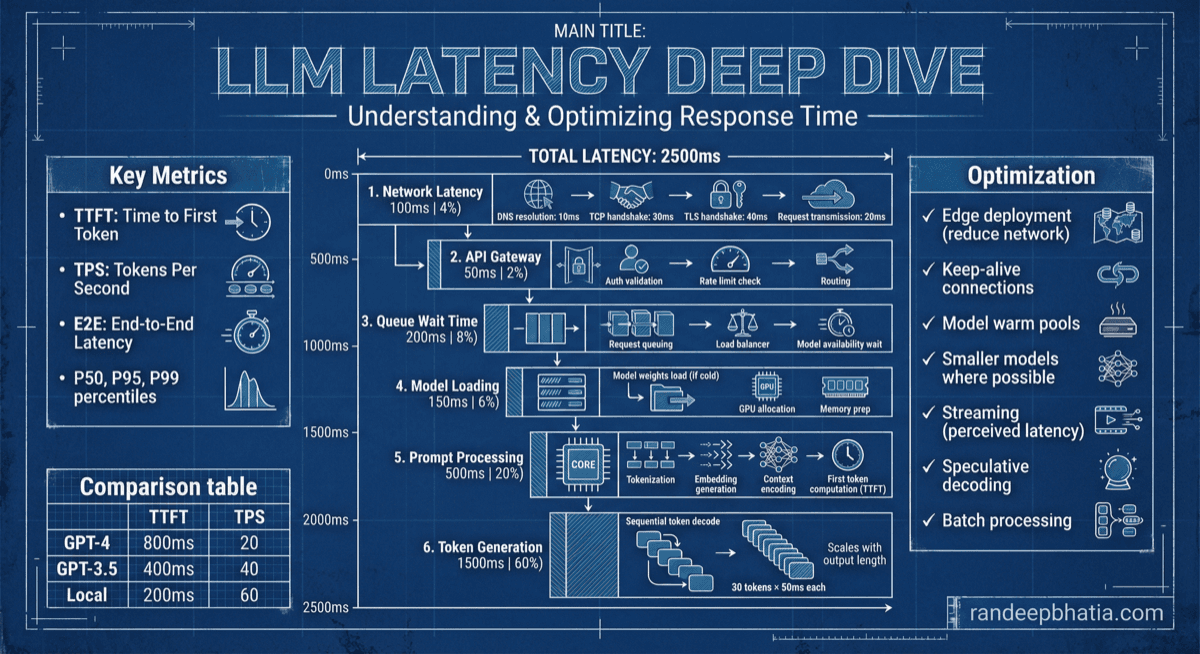
Visualize LLM inference as a multi-stage pipeline where each stage has different characteristics: tokenization (fast, CPU-bound), prefill (compute-intensive, parallelizable), decode (memory-bound, sequential), and detokenization (fast, CPU-bound). The total latency is the sum of all stage latencies, but the bottleneck stage determines optimization priority.

Water Flow Analogy

Think of LLM inference like water flowing through pipes of varying widths. The prefill phase is like a wide pipe that can handle large volumes quickly (parallel processing), while the decode phase is like a narrow pipe that restricts flow regardless of pressure (sequential generation). Batching is like combining multiple streams to better fill the pipes.

Two-Phase Computation Model

Conceptualize LLM inference as two distinct computational regimes: Phase 1 (prefill) where the system is compute-bound and benefits from parallelism, and Phase 2 (decode) where the system is memory-bound and benefits from bandwidth optimization. Different hardware and software optimizations apply to each phase.

Amortization Framework

View latency optimization through the lens of amortization: spreading fixed costs across multiple operations. Batching amortizes memory access across requests, speculative decoding amortizes verification across multiple candidate tokens, and caching amortizes computation across repeated patterns.

Latency Budget Allocation

Treat total acceptable latency as a budget to be allocated across components: network (typically 10-50ms), queue wait (variable), prefill (scales with input), decode (scales with output), and overhead (fixed). Each component has minimum values and different scaling characteristics.

Streaming Perception Model

Recognize that user-perceived latency differs from total latency when streaming is employed. Users experience TTFT as the initial wait, then perceive generation speed through token arrival rate. A system with higher total latency but lower TTFT and smooth streaming may feel faster than one with lower total latency but no streaming.

Key Insights

(10 insights)

Time to First Token (TTFT) is often more important than total latency for user experience, as users can begin reading while generation continues, making streaming essential for interactive applications even when total generation time remains unchanged.

The decode phase typically accounts for 70-90% of total latency for responses longer than a few sentences, making decode optimization the highest-impact area for most applications despite prefill receiving more attention in benchmarks.

Batching improves throughput but increases latency for individual requests; continuous batching techniques can partially mitigate this tradeoff by allowing requests to join and leave batches dynamically rather than waiting for batch completion.

KV cache memory consumption often becomes the limiting factor before compute capacity, particularly for long-context applications, making cache management strategies critical for production deployments.

Speculative decoding can reduce latency by 2-3x for appropriate workloads by using a smaller draft model to propose multiple tokens that the main model verifies in parallel, effectively trading compute for latency.

Quantization from FP16 to INT8 typically provides 1.5-2x latency improvement with less than 1% quality degradation for most tasks, making it one of the highest-ROI optimization techniques available.

Network latency between client and inference server often exceeds model inference time for small requests, making geographic distribution and edge deployment critical for latency-sensitive applications.

The relationship between model size and latency is not linear; architectural choices like attention mechanism variants, layer count versus width, and activation functions significantly impact latency independent of parameter count.

Cold start latency for loading large models can exceed 30 seconds, making warm instance pools and predictive scaling essential for maintaining latency SLOs during traffic spikes.

Prompt caching and prefix sharing can dramatically reduce prefill latency for applications with common prompt prefixes, but require careful cache management to balance memory usage against hit rates.

When to Use

Ideal Scenarios

(12)

Real-time conversational AI applications where users expect immediate responses, such as customer service chatbots, virtual assistants, and interactive tutoring systems, require careful latency optimization to maintain natural conversation flow.

Code completion and IDE integrations where developers expect suggestions within 100-200ms to maintain typing flow, making latency the primary constraint that determines feature viability.

Live translation and transcription services where output must keep pace with input speech, requiring consistent low-latency generation to avoid growing delays.

Gaming and interactive entertainment applications where AI-generated content must respond to player actions without breaking immersion, typically requiring sub-second response times.

Search and retrieval augmented generation systems where users expect results comparable to traditional search latency, generally under 2-3 seconds for complete responses.

Voice-based AI assistants where total round-trip time including speech recognition and synthesis must feel conversational, requiring LLM latency under 500ms to achieve natural interaction.

Real-time content moderation where decisions must be made before content is displayed, requiring latency low enough to not introduce perceptible delays in content delivery.

Agentic AI systems where multiple LLM calls occur sequentially within a single user request, making per-call latency critical to overall system responsiveness.

Mobile applications where users have lower tolerance for delays and may have variable network conditions, requiring optimized latency to maintain engagement.

Financial and trading applications where AI-assisted decisions must be made within strict time windows, making latency a hard constraint rather than a preference.

Healthcare triage and clinical decision support where timely AI assistance can impact patient outcomes, requiring reliable low-latency responses.

Accessibility applications like real-time captioning or text-to-speech for visually impaired users where delays significantly impact usability.

Prerequisites

(8)
1

Clear definition of latency requirements including target percentiles (p50, p95, p99) and maximum acceptable latency, as optimization strategies differ significantly based on these targets.

2

Understanding of the input and output length distributions for the target use case, as latency scales differently with input length (prefill) versus output length (decode).

3

Baseline measurements of current latency broken down by component (network, queue, prefill, decode, overhead) to identify optimization opportunities.

4

Hardware capacity assessment including GPU memory, compute capability, and memory bandwidth to understand physical constraints on achievable latency.

5

Traffic pattern analysis including peak load, request distribution over time, and concurrency requirements to design appropriate scaling strategies.

6

Quality requirements and acceptable tradeoffs, as many latency optimizations (quantization, smaller models, output length limits) may impact output quality.

7

Budget constraints for infrastructure, as achieving very low latency often requires dedicated resources, premium hardware, or edge deployment.

8

Integration architecture understanding including all systems in the request path that contribute to total latency.

Signals You Need This

(10)

Users are abandoning conversations or interactions before receiving responses, indicating latency exceeds their patience threshold.

User feedback or surveys indicate frustration with response times or perception that the system is slow or unresponsive.

A/B tests show that faster response times correlate with improved user engagement, conversion, or satisfaction metrics.

Competitive analysis reveals that alternative products offer significantly faster response times for similar functionality.

Sequential LLM calls in agentic workflows are causing total request times to exceed acceptable limits.

Real-time use cases like voice assistants or live translation are experiencing perceptible delays that break the user experience.

Timeout errors are occurring because responses are not completing within configured limits.

Infrastructure costs are high because over-provisioning is required to meet latency targets with current architecture.

Latency variability (high p99/p50 ratio) is causing inconsistent user experience even when median latency is acceptable.

Business requirements specify latency SLAs that current implementation cannot reliably meet.

Organizational Readiness

(7)

Engineering team has expertise in ML infrastructure, GPU optimization, and distributed systems required to implement and maintain latency optimizations.

Observability infrastructure is in place to measure latency at component level, track percentiles over time, and alert on regressions.

Deployment pipeline supports rapid iteration on inference configurations, model versions, and optimization techniques.

Cost tracking and attribution systems can measure the infrastructure cost impact of latency optimization decisions.

Product and engineering alignment on latency targets, acceptable quality tradeoffs, and prioritization of latency work.

Access to appropriate hardware (modern GPUs with sufficient memory and bandwidth) or cloud infrastructure with suitable instance types.

Capacity for ongoing maintenance as models, frameworks, and best practices evolve rapidly in the LLM space.

When NOT to Use

Anti-Patterns

(12)

Optimizing latency before establishing that latency is actually the bottleneck for user experience or business outcomes, as premature optimization wastes resources and may introduce unnecessary complexity.

Pursuing extremely low latency at the cost of output quality when the use case would be better served by higher quality responses with acceptable latency.

Over-engineering latency optimization for batch processing workloads where throughput and cost efficiency matter more than individual request latency.

Implementing complex latency optimizations before simpler approaches (model selection, basic infrastructure tuning) have been exhausted.

Optimizing for average latency while ignoring tail latency (p99) in applications where consistency matters more than typical performance.

Reducing latency by limiting output length in applications where complete, thorough responses are more valuable than fast partial responses.

Deploying to edge locations for latency reduction when the user base is geographically concentrated and a single region would suffice.

Using smaller models solely for latency when the quality degradation makes the output unsuitable for the use case.

Implementing speculative decoding or other complex techniques for workloads where simpler optimizations would achieve required targets.

Sacrificing reliability or availability for latency, such as removing redundancy or failover mechanisms to reduce overhead.

Optimizing inference latency while ignoring other latency sources (network, preprocessing, postprocessing) that dominate total user-perceived latency.

Pursuing latency optimization in isolation without considering the cost implications and whether the investment is justified by business value.

Red Flags

(10)

Latency targets are set arbitrarily without user research or business justification to validate that achieving them will improve outcomes.

Optimization efforts focus on metrics that don't align with user experience, such as optimizing decode speed when TTFT is the actual pain point.

Quality degradation from latency optimizations is not being measured or is being ignored in favor of hitting latency numbers.

Infrastructure costs are increasing faster than the business value delivered by latency improvements.

The team is implementing cutting-edge optimization techniques without first mastering fundamentals like proper batching and caching.

Latency improvements in benchmarks don't translate to production improvements due to different traffic patterns or configurations.

Optimization work is creating technical debt through complex, hard-to-maintain custom solutions.

Different teams are optimizing different parts of the latency pipeline without coordination, leading to suboptimal global outcomes.

Latency SLOs are being met by rejecting or timing out requests rather than actually improving performance.

The focus on latency is causing neglect of other important system properties like reliability, security, or cost efficiency.

Better Alternatives

(8)
1
When:

Batch processing of documents or data where results are not needed in real-time

Use Instead:

Optimize for throughput and cost efficiency rather than latency, using larger batch sizes and potentially spot/preemptible instances

Why:

Batch workloads benefit more from high throughput and low cost per token than from low individual request latency, and optimizing for latency in this context wastes resources.

2
When:

Applications where response quality is paramount and users will wait for better results

Use Instead:

Focus on output quality optimization, potentially using larger models or longer generation with chain-of-thought reasoning

Why:

Some applications like legal analysis, medical diagnosis support, or complex research benefit more from thorough, high-quality responses than from speed.

3
When:

Early-stage products where product-market fit is not yet established

Use Instead:

Use managed API services and focus engineering effort on product features rather than infrastructure optimization

Why:

Premature optimization of latency delays learning about what users actually need and may optimize for requirements that change as the product evolves.

4
When:

Internal tools with captive users who will tolerate longer response times

Use Instead:

Invest in UX improvements like progress indicators, partial results, and background processing rather than raw latency reduction

Why:

Internal users often accept longer waits if the interface communicates progress and allows them to continue other work, making UX investment more impactful than latency optimization.

5
When:

Applications where the LLM is one component of a longer workflow

Use Instead:

Optimize the end-to-end workflow, potentially parallelizing LLM calls with other operations or restructuring the pipeline

Why:

Reducing LLM latency may have minimal impact if other workflow components dominate total time, making workflow optimization more effective.

6
When:

Cost-constrained environments where infrastructure budget is limited

Use Instead:

Accept higher latency with smaller infrastructure footprint, using techniques like request queuing and user expectations management

Why:

Achieving very low latency requires significant infrastructure investment that may not be justified by the business value in cost-sensitive contexts.

7
When:

Applications with highly variable request complexity

Use Instead:

Implement tiered service levels with different latency targets for different request types

Why:

Attempting to meet aggressive latency targets for all requests may require over-provisioning, while tiered approaches can optimize cost while meeting expectations for each request type.

8
When:

Use cases where users initiate requests and then context-switch to other tasks

Use Instead:

Implement asynchronous processing with notifications when results are ready

Why:

If users don't wait for responses anyway, investing in latency reduction provides no user experience benefit and wastes resources.

Common Mistakes

(10)

Measuring latency only at the inference server without accounting for network latency, load balancer overhead, and client-side processing that users actually experience.

Optimizing for mean latency while ignoring variance, leading to inconsistent user experience where some requests are fast but others are unacceptably slow.

Implementing streaming without measuring TTFT separately, missing opportunities to optimize the metric that most impacts perceived responsiveness.

Using synthetic benchmarks with unrealistic input/output distributions that don't reflect production traffic patterns.

Neglecting cold start latency in serverless or auto-scaling deployments, causing latency spikes during traffic increases.

Over-batching requests to improve throughput without considering the latency impact on individual requests in the batch.

Implementing KV cache without proper memory management, leading to out-of-memory errors or cache thrashing under load.

Applying quantization uniformly without evaluating quality impact on specific use cases that may be more sensitive to precision loss.

Focusing on model inference optimization while ignoring preprocessing steps like retrieval or prompt construction that may dominate latency.

Setting latency SLOs without understanding the distribution of input and output lengths, leading to targets that are achievable for some requests but not others.

Core Taxonomy

Primary Types

(8 types)

The duration from request initiation until the first token of the response is generated and available, encompassing network latency, queue wait time, tokenization, and the complete prefill phase of inference.

Characteristics
  • Dominated by prefill computation for long prompts
  • Includes all request overhead and preprocessing
  • Critical metric for streaming applications
  • Scales primarily with input prompt length
  • Independent of output length
Use Cases
Interactive chatbots where users expect immediate acknowledgmentCode completion where suggestions must appear during typing pausesVoice assistants where silence indicates system failure
Tradeoffs

Optimizing TTFT may require smaller batch sizes or dedicated prefill resources, potentially reducing throughput. Techniques like prompt caching improve TTFT but require memory investment.

Classification Dimensions

Measurement Perspective

Latency can be measured at different points in the request path, each providing different insights. Client-side measurement captures the full user experience, while server-side measurement isolates inference performance from network effects.

Client-side latency (user-perceived)Server-side latency (inference time)Component latency (individual stage)System latency (including infrastructure)

Statistical Aggregation

Different statistical measures of latency distribution provide different insights. Mean can be skewed by outliers, median represents typical experience, and tail latencies indicate worst-case scenarios that affect a percentage of users.

Mean/average latencyMedian (p50) latencyTail latency (p95, p99, p99.9)Maximum latencyLatency variance/jitter

Request Characteristics

Latency behavior varies significantly based on request characteristics. Systems may have different performance profiles for different request types, requiring separate measurement and optimization.

Short prompt latencyLong prompt latencyShort output latencyLong output latencyStreaming vs non-streaming

System State

System state significantly affects latency. Production systems must account for all states and ensure acceptable performance not just in ideal conditions but during cold starts, high load, and recovery scenarios.

Warm latency (steady state)Cold start latency (initialization)Degraded latency (under load)Recovery latency (after failure)

Optimization Target

Systems can be optimized for different objectives that trade off against each other. The optimization target should align with business requirements and user needs.

Latency-optimized (minimize delay)Throughput-optimized (maximize tokens/second)Cost-optimized (minimize $/token)Balanced (multi-objective)

Deployment Model

Deployment model affects latency characteristics. Dedicated instances provide consistent latency, shared infrastructure has more variance, serverless adds cold start risk, and edge reduces network latency.

Dedicated instance latencyShared/multi-tenant latencyServerless latencyEdge deployment latency

Evolutionary Stages

1

Prototype/Development

0-3 months from project start

Latency is not optimized; using default configurations and potentially CPU inference. Focus is on functionality rather than performance. Latency may be seconds to tens of seconds.

2

Initial Production

3-6 months from project start

Basic GPU deployment with standard configurations. Some attention to latency but limited optimization. Typical latency 1-5 seconds for standard requests. Monitoring established but not comprehensive.

3

Optimized Production

6-12 months from project start

Systematic latency optimization including quantization, batching tuning, and caching. Latency targets defined and monitored. Typical latency 200ms-2s depending on use case. Trade-offs consciously managed.

4

Advanced Optimization

12-24 months from project start

Sophisticated techniques including speculative decoding, custom kernels, and advanced caching. Sub-second latency for most requests. Continuous optimization based on production data. Hardware-specific tuning.

5

World-Class Performance

24+ months with dedicated team

State-of-the-art latency through custom infrastructure, specialized hardware, and cutting-edge techniques. TTFT under 100ms, TPOT competitive with human reading speed. Continuous research and development investment.

Architecture Patterns

Architecture Patterns

(8 patterns)

Single-Instance Serving

A single GPU or multi-GPU server handles all inference requests, with requests processed sequentially or in small batches. This is the simplest deployment pattern, suitable for low-traffic applications or development environments.

Components
  • Inference server (vLLM, TGI, or similar)
  • Model weights loaded in GPU memory
  • Request queue
  • Basic load balancing (optional)
Data Flow

Client request → Load balancer → Inference server → Tokenization → Prefill → Decode → Detokenization → Response

Best For
  • Development and testing
  • Low-traffic applications
  • Cost-sensitive deployments
  • Simple operational requirements
Limitations
  • No horizontal scaling
  • Single point of failure
  • Limited throughput
  • Cold start affects all traffic during restarts
Scaling Characteristics

Vertical scaling only; limited by single server capacity. Latency consistent but throughput capped. No redundancy without additional instances.

Integration Points

Load Balancer

Distributes incoming requests across inference servers, performs health checks, and manages connection pooling to reduce per-request overhead.

Interfaces:
HTTP/HTTPS endpointsgRPC endpointsWebSocket for streamingHealth check endpoints

Load balancer configuration significantly impacts latency. Connection reuse, keep-alive settings, and routing algorithms affect per-request overhead. Geographic load balancing can reduce network latency.

Request Queue

Buffers incoming requests when inference capacity is saturated, implements priority ordering, and manages request timeouts.

Interfaces:
Enqueue/dequeue operationsPriority levelsTimeout configurationQueue depth metrics

Queue design directly impacts latency variance. FIFO queuing is simple but doesn't account for request urgency. Priority queuing can reduce latency for important requests but may starve others.

Tokenizer Service

Converts text input to token IDs for model input and token IDs back to text for output, typically running on CPU.

Interfaces:
Encode (text → tokens)Decode (tokens → text)Batch operationsVocabulary access

Tokenization is typically fast but can become a bottleneck at high throughput. Pre-tokenization and caching can reduce overhead. Streaming detokenization enables faster TTFT.

KV Cache Manager

Allocates, manages, and evicts key-value caches used during inference, critical for memory efficiency and supporting long contexts.

Interfaces:
Cache allocationCache accessEviction policiesMemory pressure signals

KV cache management directly impacts both latency and capacity. Paged attention and similar techniques improve memory efficiency. Cache eviction under pressure can cause latency spikes.

Metrics and Monitoring

Collects latency measurements at various points, aggregates statistics, and provides visibility into system performance.

Interfaces:
Metric emissionAggregation queriesAlerting rulesDashboard APIs

Comprehensive monitoring is essential for latency optimization. Measure at multiple points to identify bottlenecks. High-cardinality metrics enable detailed analysis but increase storage costs.

Auto-scaler

Adjusts inference capacity based on demand, adding or removing instances to maintain latency targets while optimizing cost.

Interfaces:
Scaling metrics inputScale up/down actionsCooldown configurationCapacity limits

Auto-scaling must balance responsiveness against stability. Aggressive scaling reduces latency during spikes but increases cost and cold start frequency. Predictive scaling can pre-warm capacity.

Model Registry

Stores and serves model artifacts, manages versions, and provides metadata for model loading and configuration.

Interfaces:
Model downloadVersion managementMetadata queriesArtifact validation

Model loading time affects cold start latency. Local caching, optimized formats (safetensors), and pre-loading strategies can reduce loading time.

Streaming Gateway

Manages streaming connections for token-by-token delivery, handling connection lifecycle and backpressure.

Interfaces:
Server-Sent Events (SSE)WebSocket connectionsChunked HTTP responsesConnection management

Streaming is essential for good user experience with LLMs. Gateway must efficiently handle many concurrent long-lived connections. Buffering and batching of token delivery affects perceived smoothness.

Decision Framework

✓ If Yes

Prioritize latency optimization, especially TTFT. Consider streaming, smaller models, and dedicated resources.

✗ If No

Prioritize throughput and cost efficiency. Use larger batches, spot instances, and optimize for tokens per dollar.

Considerations

Interactive applications have different latency requirements than batch processing. User patience varies by context—chat expects faster responses than document analysis.

Technical Deep Dive

Overview

LLM inference latency arises from the fundamental architecture of transformer-based language models, which process input through multiple attention layers and generate output tokens autoregressively. The inference process consists of two distinct computational phases with different performance characteristics: the prefill phase processes the entire input prompt in parallel to build internal representations, while the decode phase generates output tokens one at a time, each depending on all previous tokens. During prefill, the model performs a forward pass through all transformer layers for every input token simultaneously. This phase is compute-bound, meaning the GPU's arithmetic units are the bottleneck, and performance scales with available compute resources. The primary output of prefill is the key-value (KV) cache, which stores intermediate attention computations that will be reused during decode. The decode phase generates tokens sequentially, with each new token requiring a forward pass that attends to all previous tokens via the KV cache. This phase is memory-bandwidth-bound because the model must read all parameters and cache entries from GPU memory for each token while performing relatively little computation per byte transferred. Modern GPUs have compute capabilities that far exceed what can be utilized during single-token generation. Total latency is the sum of prefill time (proportional to input length) and decode time (proportional to output length), plus overhead from tokenization, network transfer, and system processing. Understanding this decomposition is essential for effective optimization, as different techniques target different phases.

Step-by-Step Process

The inference server receives the HTTP/gRPC request containing the prompt and generation parameters. The request is validated for format, authentication, and rate limits. This step includes TLS termination, request parsing, and initial logging.

⚠️ Pitfalls to Avoid

Large request payloads increase parsing time. Missing connection pooling causes repeated TLS handshake overhead. Synchronous validation can block request processing.

Under The Hood

The transformer architecture underlying LLMs creates specific computational patterns that determine latency characteristics. Each transformer layer consists of multi-head self-attention followed by a feed-forward network. During attention, the model computes query, key, and value projections for each token, then calculates attention weights between all token pairs, and finally produces weighted combinations of values. This attention mechanism has O(n²) complexity in sequence length for standard implementations, though optimized kernels like FlashAttention reduce memory requirements while maintaining the same computational complexity. The key-value cache is the critical data structure for efficient autoregressive generation. During prefill, the model computes and stores key and value projections for all input tokens across all layers. During decode, only the new token's query is computed, which attends to the cached keys and values. This avoids recomputing representations for previous tokens but requires storing and accessing large amounts of data. For a 70B parameter model with 80 layers and 8K context, the KV cache can exceed 10GB per request. Memory bandwidth is the fundamental bottleneck during decode. A 70B parameter model requires reading approximately 140GB of weights (in FP16) for each generated token, plus the KV cache. Even with 2TB/s memory bandwidth (high-end GPU), this limits generation to roughly 14 tokens per second for a single request. Batching multiple requests together amortizes this memory access, as the same weights serve multiple requests, but increases individual request latency due to synchronization. Quantization reduces memory bandwidth requirements by using lower precision representations. INT8 quantization halves the memory footprint, potentially doubling decode throughput. INT4 quantization quarters the footprint but may impact quality. The effectiveness of quantization depends on the specific model architecture and the sensitivity of the target task to precision loss. Speculative decoding addresses the sequential bottleneck by using a smaller draft model to propose multiple tokens that the main model verifies in parallel. If the draft model's predictions match what the main model would have generated, multiple tokens are accepted in a single main model forward pass. This trades additional compute (running both models) for reduced latency, with effectiveness depending on the draft model's accuracy for the specific content being generated.

Failure Modes

Root Cause

KV cache growth exceeds available GPU memory due to long sequences, large batches, or memory fragmentation. Can also occur during prefill for very long prompts.

Symptoms
  • CUDA out of memory errors in logs
  • Request failures with memory-related error codes
  • Sudden latency spikes before failure
  • Reduced batch sizes in continuous batching
Impact

Request failure, potential server crash, loss of in-progress generations for all requests in batch. May require server restart to recover.

Prevention

Implement memory limits per request, use paged attention for efficient allocation, monitor memory usage proactively, set maximum sequence lengths conservatively.

Mitigation

Graceful degradation by rejecting new requests, implement request-level memory budgets, use memory-efficient attention implementations, auto-restart with reduced batch size.

Operational Considerations

Key Metrics (15)

Duration from request receipt to first token generation, measuring prefill performance and queue wait time.

Normal100-500ms for interactive applications, 500ms-2s for standard applications
Alertp95 > 2x target, p99 > 3x target, or sustained p50 above target
ResponseInvestigate queue depth, prefill performance, and cold start frequency. Scale up if load-related.

Dashboard Panels

Latency percentiles over time (p50, p95, p99) with SLO linesTTFT vs TPOT breakdown showing prefill and decode contributionsQueue depth and wait time trendsGPU memory and compute utilization per instanceRequest rate and error rate with error categorizationThroughput (tokens/second) with capacity baselineCold start events timelineLatency by request characteristics (input length, output length)Geographic latency distribution (if multi-region)Batch size and efficiency metrics

Alerting Strategy

Implement tiered alerting with different severity levels: informational alerts for metric changes that may indicate developing issues, warning alerts for threshold breaches that require investigation, and critical alerts for conditions requiring immediate response. Use anomaly detection for metrics without fixed thresholds. Implement alert correlation to reduce noise and identify root causes. Ensure on-call rotation has runbooks for each alert type. Set up escalation paths for unresolved issues.

Cost Analysis

Cost Drivers

(10)

GPU Instance Hours

Impact:

Primary cost driver; GPU instances cost $1-30+/hour depending on type. Latency requirements determine minimum instance count and type.

Optimization:

Right-size instances for workload, use spot instances for non-critical traffic, implement efficient batching to maximize utilization.

Over-provisioning for Latency SLOs

Impact:

Meeting strict latency targets requires capacity headroom, reducing utilization and increasing cost per request.

Optimization:

Set realistic SLOs based on user needs, implement tiered service levels, use auto-scaling with appropriate response time.

Cold Start Mitigation

Impact:

Maintaining warm instances for fast response increases baseline cost even during low traffic.

Optimization:

Balance warm pool size against cold start tolerance, implement predictive scaling, use smaller models for faster loading.

Memory for KV Cache

Impact:

Long context and large batches require more GPU memory, potentially requiring larger/more instances.

Optimization:

Implement KV cache compression, use paged attention, limit context length where acceptable, optimize cache eviction.

Network Transfer

Impact:

Data transfer costs for requests/responses, especially for streaming and multi-region deployments.

Optimization:

Compress responses where possible, use efficient serialization, minimize unnecessary data transfer.

Multi-Region Deployment

Impact:

Deploying to multiple regions for latency reduction multiplies infrastructure costs.

Optimization:

Deploy only to regions with significant user populations, use edge caching for static components, implement intelligent routing.

Speculative Decoding Compute

Impact:

Running draft model adds compute overhead, increasing cost even when reducing latency.

Optimization:

Enable speculation only for workloads where it's effective, use efficient draft models, disable when acceptance rate is low.

Monitoring and Observability

Impact:

High-cardinality metrics, distributed tracing, and log storage add operational costs.

Optimization:

Sample traces appropriately, aggregate metrics where possible, implement log retention policies.

Model Storage and Loading

Impact:

Storing model artifacts and fast storage for quick loading adds storage costs.

Optimization:

Use efficient model formats, implement model caching, share storage across instances where possible.

Engineering Time

Impact:

Latency optimization requires significant engineering investment for implementation and maintenance.

Optimization:

Prioritize high-impact optimizations, use managed services where appropriate, build reusable optimization infrastructure.

Cost Models

Cost Per Request

(Instance_Cost_Per_Hour / Requests_Per_Hour) + Network_Cost_Per_Request + Overhead
Variables:
Instance cost varies by GPU type ($1-30/hour)Requests per hour depends on latency and batch efficiencyNetwork cost typically $0.01-0.10 per GBOverhead includes monitoring, storage, etc.
Example:

A100 at $3/hour serving 1000 requests/hour = $0.003/request base cost, plus ~$0.0001 network = ~$0.0031/request

Cost Per Token

Instance_Cost_Per_Hour / Tokens_Per_Hour
Variables:
Instance cost varies by GPU typeTokens per hour = throughput × 3600Throughput depends on model, hardware, and optimization
Example:

A100 at $3/hour generating 10,000 tokens/hour = $0.0003/token, competitive with API pricing for high utilization

Latency-Adjusted Cost

Base_Cost × (1 + Latency_Premium_Factor)
Variables:
Base cost from standard deploymentLatency premium factor increases with stricter requirementsFactor of 1.5-3x typical for aggressive latency targets
Example:

Base cost $0.003/request with 2x latency premium for sub-200ms TTFT = $0.006/request

Total Cost of Ownership

Infrastructure_Cost + Engineering_Cost + Operational_Cost + Opportunity_Cost
Variables:
Infrastructure: compute, storage, networkEngineering: development, optimization, maintenanceOperational: monitoring, on-call, incident responseOpportunity: cost of not meeting latency requirements
Example:

Monthly: $10K infrastructure + $20K engineering (amortized) + $5K operational = $35K TCO for latency-optimized deployment

Optimization Strategies

  • 1Implement efficient batching to maximize GPU utilization without exceeding latency targets
  • 2Use quantization (INT8/INT4) to reduce memory requirements and increase throughput
  • 3Deploy spot instances for non-latency-critical traffic with appropriate fallback
  • 4Implement auto-scaling that responds appropriately to demand without over-provisioning
  • 5Use smaller models where quality requirements allow
  • 6Implement caching for repeated or similar requests
  • 7Optimize prompt length to reduce prefill cost
  • 8Use tiered service levels with different latency/cost tradeoffs
  • 9Consolidate low-traffic workloads onto shared infrastructure
  • 10Negotiate reserved capacity pricing for predictable baseline load
  • 11Monitor and eliminate waste from failed requests, retries, and orphaned resources
  • 12Evaluate managed API services vs self-hosted based on volume and requirements

Hidden Costs

  • 💰Engineering time for optimization implementation and maintenance
  • 💰Debugging and incident response for latency issues
  • 💰Quality degradation from aggressive optimization requiring rework
  • 💰User churn from poor latency experience (opportunity cost)
  • 💰Technical debt from complex optimization implementations
  • 💰Training and knowledge transfer for specialized infrastructure
  • 💰Vendor lock-in from platform-specific optimizations
  • 💰Compliance and security overhead for latency-sensitive data handling

ROI Considerations

The return on investment for latency optimization depends heavily on the application context and user sensitivity to delays. For interactive applications like chatbots and code completion, studies consistently show that latency improvements drive measurable improvements in user engagement, satisfaction, and conversion. A common finding is that each 100ms of latency reduction can improve conversion rates by 1-2% for e-commerce and similar applications. However, the marginal value of latency improvement decreases as latency gets lower. Reducing latency from 5 seconds to 2 seconds typically has much higher ROI than reducing from 500ms to 200ms. Organizations should establish the latency threshold where user experience becomes 'good enough' and avoid over-investing beyond that point. For batch processing and non-interactive applications, latency optimization often has negative ROI compared to throughput and cost optimization. The key is matching optimization strategy to actual business requirements rather than pursuing low latency as an end in itself. When evaluating ROI, consider both direct benefits (user metrics, conversion) and indirect benefits (competitive positioning, platform capabilities, developer productivity). Also account for the ongoing cost of maintaining optimized infrastructure, which can be significant for complex deployments.

Security Considerations

Threat Model

(10 threats)
1

Denial of Service via Long Prompts

Attack Vector

Attacker submits extremely long prompts to consume GPU memory and compute, degrading service for other users.

Impact

Service degradation or outage, increased costs, poor experience for legitimate users.

Mitigation

Implement strict input length limits, rate limiting per user, request cost estimation and rejection, fair scheduling.

2

Timing Side-Channel Attacks

Attack Vector

Attacker analyzes latency patterns to infer information about model internals, other users' requests, or system state.

Impact

Information leakage, potential model extraction, privacy violations.

Mitigation

Add noise to response timing, implement consistent-time operations where feasible, isolate user requests.

3

Resource Exhaustion via Output Length

Attack Vector

Crafted prompts that cause extremely long outputs, consuming resources and potentially causing timeouts or OOM.

Impact

Resource exhaustion, service degradation, increased costs.

Mitigation

Enforce output length limits, implement token budgets per request, monitor for anomalous output patterns.

4

Prompt Injection Affecting Latency

Attack Vector

Malicious prompts designed to cause slow processing, infinite loops, or resource-intensive operations.

Impact

Service degradation, resource exhaustion, potential system instability.

Mitigation

Input validation, timeout enforcement, sandboxed execution, monitoring for anomalous processing patterns.

5

Cache Poisoning

Attack Vector

Attacker manipulates cached prefixes or responses to serve incorrect content to other users.

Impact

Incorrect outputs served to users, potential for spreading misinformation or malicious content.

Mitigation

User-isolated caching, cache integrity verification, careful cache key design, cache invalidation capabilities.

6

Model Extraction via Latency Analysis

Attack Vector

Systematic queries with latency measurement to infer model architecture, size, or parameters.

Impact

Intellectual property theft, competitive disadvantage, potential for creating adversarial attacks.

Mitigation

Rate limiting, query pattern detection, latency noise injection, monitoring for extraction attempts.

7

Data Leakage via Shared Infrastructure

Attack Vector

In multi-tenant deployments, information leakage between users through shared memory, caches, or timing.

Impact

Privacy violations, data breach, compliance failures.

Mitigation

Memory isolation between requests, dedicated instances for sensitive workloads, cache isolation, security audits.

8

Supply Chain Attacks on Optimization Libraries

Attack Vector

Compromised optimization libraries (CUDA kernels, inference frameworks) introduce vulnerabilities.

Impact

System compromise, data theft, service manipulation.

Mitigation

Verify library integrity, use trusted sources, security scanning, regular updates, vulnerability monitoring.

9

Insider Threat via Latency Manipulation

Attack Vector

Malicious insider modifies latency configurations to degrade service or create advantages for specific users.

Impact

Service degradation, unfair treatment of users, potential for extortion.

Mitigation

Access controls, configuration audit logging, change approval processes, anomaly detection.

10

Network Interception of Streaming Responses

Attack Vector

Attacker intercepts streaming responses to access content before user, potentially for competitive advantage or data theft.

Impact

Data theft, privacy violations, potential for response manipulation.

Mitigation

TLS encryption, certificate pinning, integrity verification, secure streaming protocols.

Security Best Practices

  • Implement strict input validation including length limits, character filtering, and format verification
  • Enforce output length limits and token budgets per request
  • Use TLS for all communications including internal service-to-service
  • Implement rate limiting at multiple levels (user, IP, API key)
  • Isolate user requests to prevent cross-user information leakage
  • Audit and monitor access to inference infrastructure
  • Keep inference frameworks and dependencies updated for security patches
  • Implement request authentication and authorization
  • Use secure configuration management for latency-related settings
  • Monitor for anomalous request patterns that may indicate attacks
  • Implement graceful degradation that doesn't expose system internals
  • Use dedicated instances for sensitive workloads requiring isolation
  • Implement logging that captures security-relevant events without exposing sensitive data
  • Conduct regular security assessments of inference infrastructure
  • Have incident response procedures for security events affecting latency systems

Data Protection

  • 🔒Encrypt all data in transit using TLS 1.3 or later
  • 🔒Encrypt sensitive data at rest including cached content
  • 🔒Implement data isolation between users in multi-tenant deployments
  • 🔒Minimize data retention in caches and logs
  • 🔒Implement secure deletion procedures for cached data
  • 🔒Use tokenization or anonymization where possible
  • 🔒Audit data access and processing activities
  • 🔒Implement data loss prevention controls
  • 🔒Ensure backup and recovery procedures protect data
  • 🔒Document data flows through latency optimization components

Compliance Implications

GDPR

Requirement:

Personal data processing must be secure, with appropriate technical measures including for AI systems processing personal data.

Implementation:

Ensure latency optimization doesn't compromise data protection. Implement data isolation, encryption, and access controls. Document processing activities including inference.

HIPAA

Requirement:

Protected health information must be secured with appropriate safeguards in AI systems used in healthcare.

Implementation:

Use dedicated, isolated infrastructure for PHI processing. Implement audit logging, access controls, and encryption. Ensure latency optimizations don't create security gaps.

SOC 2

Requirement:

Systems must meet trust service criteria including security, availability, and confidentiality.

Implementation:

Document latency-related controls, implement monitoring and alerting, maintain availability SLOs, protect confidential data in inference pipeline.

PCI DSS

Requirement:

Cardholder data must be protected with specific technical controls.

Implementation:

Isolate inference systems processing payment data, implement network segmentation, encrypt data in transit and at rest, maintain access controls.

AI Act (EU)

Requirement:

High-risk AI systems must meet requirements for robustness, accuracy, and security.

Implementation:

Document latency characteristics and their impact on system behavior, implement monitoring for performance degradation, ensure latency doesn't compromise safety requirements.

CCPA

Requirement:

California consumers have rights regarding their personal information including in AI systems.

Implementation:

Implement data handling procedures that respect consumer rights, ensure latency optimization doesn't compromise data deletion or access capabilities.

FedRAMP

Requirement:

Cloud services for federal agencies must meet security requirements.

Implementation:

Use FedRAMP-authorized infrastructure, implement required security controls, document system architecture including latency components.

NIST AI RMF

Requirement:

AI systems should be managed for risks including performance and security.

Implementation:

Incorporate latency considerations into AI risk management, document performance characteristics, implement monitoring and response procedures.

Scaling Guide

Scaling Dimensions

Horizontal (Instance Count)

Strategy:

Add more inference server instances behind load balancer to increase total throughput while maintaining per-request latency.

Limits:

Limited by load balancer capacity, coordination overhead, and cost. Each instance has fixed latency floor.

Considerations:

Ensure even load distribution, handle cold starts during scale-up, implement health checks for automatic failover.

Vertical (Instance Size)

Strategy:

Use larger GPU instances with more memory and compute to handle larger batches or longer sequences.

Limits:

Limited by available instance types, diminishing returns for memory-bound decode phase.

Considerations:

Larger instances have higher per-hour cost but may be more efficient for specific workloads. Evaluate cost per token.

Model Parallelism

Strategy:

Distribute model across multiple GPUs to serve larger models or reduce per-GPU memory pressure.

Limits:

Communication overhead increases latency, especially for tensor parallelism. Requires high-bandwidth interconnect.

Considerations:

Use NVLink or InfiniBand for low-latency communication. Pipeline parallelism has different tradeoffs than tensor parallelism.

Geographic Distribution

Strategy:

Deploy inference servers in multiple regions to reduce network latency for geographically distributed users.

Limits:

Multiplies infrastructure cost and operational complexity. Requires global load balancing.

Considerations:

Deploy in regions with significant user populations. Implement consistent model versions across regions.

Batch Size

Strategy:

Increase batch size to improve throughput and GPU utilization, trading individual request latency.

Limits:

Limited by GPU memory, latency requirements, and request arrival patterns.

Considerations:

Use continuous batching to dynamically adjust. Monitor latency impact of batch size changes.

Cache Capacity

Strategy:

Increase prefix cache size to improve hit rates and reduce prefill latency for repeated patterns.

Limits:

Limited by available memory, diminishing returns as cache grows.

Considerations:

Monitor cache hit rates to validate investment. Implement intelligent eviction policies.

Request Routing Intelligence

Strategy:

Implement smart routing to direct requests to optimal servers based on request characteristics, server load, and capabilities.

Limits:

Routing logic adds latency, complexity in maintaining routing rules.

Considerations:

Route long-context requests to high-memory servers, latency-sensitive requests to less loaded servers.

Tiered Service Levels

Strategy:

Implement different service tiers with different latency guarantees and resource allocations.

Limits:

Complexity in managing multiple tiers, potential for tier confusion.

Considerations:

Clearly define tier characteristics, implement appropriate isolation, price tiers based on cost to serve.

Capacity Planning

Key Factors:
Peak request rate (requests per second)Request characteristics distribution (input length, output length)Latency SLOs (TTFT, end-to-end, percentiles)Acceptable error rate and timeout rateTraffic patterns (daily/weekly cycles, growth rate)Cold start tolerance and warm pool requirementsGeographic distribution of usersBudget constraints
Formula:Required_Instances = (Peak_RPS × Avg_Latency_Seconds) / (Batch_Size × (1 - Safety_Margin)) × (1 + Cold_Start_Buffer)
Safety Margin:

Typically 20-40% headroom above calculated capacity to handle variance, provide latency buffer, and allow for instance failures without service degradation.

Scaling Milestones

10 concurrent users
Challenges:
  • Basic infrastructure setup
  • Initial latency baseline establishment
  • Monitoring implementation
Architecture Changes:

Single GPU instance sufficient. Focus on basic optimization and measurement. Establish baseline metrics.

100 concurrent users
Challenges:
  • Batching efficiency becomes important
  • Queue management needed
  • Auto-scaling introduction
Architecture Changes:

Multiple instances with load balancer. Implement continuous batching. Basic auto-scaling based on load.

1,000 concurrent users
Challenges:
  • Latency consistency at scale
  • Cost optimization pressure
  • Operational complexity
Architecture Changes:

Sophisticated batching and scheduling. Implement caching strategies. Multi-tier architecture consideration.

10,000 concurrent users
Challenges:
  • Geographic latency requirements
  • Complex traffic patterns
  • Cost at scale
Architecture Changes:

Multi-region deployment. Advanced routing and load balancing. Tiered service levels. Significant optimization investment.

100,000 concurrent users
Challenges:
  • Global infrastructure management
  • Extreme cost optimization
  • Reliability at scale
Architecture Changes:

Global edge deployment. Custom optimization infrastructure. Dedicated capacity planning team. Advanced traffic management.

1,000,000+ concurrent users
Challenges:
  • Industry-leading efficiency required
  • Custom hardware consideration
  • Organization-wide infrastructure
Architecture Changes:

Custom inference infrastructure. Potential custom silicon. Dedicated teams for each component. Industry-leading optimization.

Benchmarks

Industry Benchmarks

MetricP50P95P99 World Class
Time to First Token (TTFT)150-300ms300-600ms500ms-1s<100ms p95
Time Per Output Token (TPOT)20-40ms40-80ms60-120ms<20ms p95
End-to-End Latency (100 token output)2-4s4-8s6-12s<2s p95
Cold Start Time15-30s30-60s45-90s<10s p95
Throughput (tokens/second/GPU)500-1000300-600200-400>2000
Queue Wait Time<50ms100-500ms500ms-2s<20ms p95
Speculative Decoding Acceptance Rate60-70%40-50%30-40%>80%
Cache Hit Rate (prefix caching)40-60%20-40%10-20%>70%
GPU Utilization (decode phase)30-50%20-40%15-30%>60% with batching
Error Rate<0.1%0.1-0.5%0.5-1%<0.01%
Latency Variance (p99/p50 ratio)2-3x3-5x5-10x<2x
Network Latency Contribution10-30%20-40%30-50%<10%

Comparison Matrix

ApproachTTFT ImpactTPOT ImpactThroughput ImpactCost ImpactComplexityQuality Impact
Baseline (no optimization)1x (baseline)1x (baseline)1x (baseline)1x (baseline)LowNone
INT8 Quantization0.7-0.8x0.5-0.7x1.5-2x0.5-0.7xLowMinimal (<1%)
INT4 Quantization0.5-0.6x0.3-0.5x2-3x0.3-0.5xMediumModerate (1-5%)
Continuous Batching1-1.2x0.8-1x2-4x0.3-0.5xMediumNone
Speculative Decoding1x0.3-0.5x0.8-1x1.2-1.5xHighNone
Prefix Caching0.2-0.5x (hits)1x1.2-1.5x0.8-0.9xMediumNone
Flash Attention0.7-0.9x0.9-1x1.2-1.5x0.8-0.9xLowNone
Tensor Parallelism (2 GPU)0.6-0.8x0.7-0.9x1.5-1.8x1.8-2xHighNone
Smaller Model0.3-0.5x0.3-0.5x2-4x0.3-0.5xLowVariable (task-dependent)
Edge Deployment0.5-0.8x (network)1x1x1.5-3xVery HighNone

Performance Tiers

Basic

Default configuration, minimal optimization. Suitable for development and low-traffic production.

Target:

TTFT: 500ms-2s, TPOT: 50-100ms, Throughput: 100-500 tokens/s/GPU

Optimized

Standard optimizations applied (quantization, batching, flash attention). Suitable for most production workloads.

Target:

TTFT: 200-500ms, TPOT: 30-50ms, Throughput: 500-1500 tokens/s/GPU

High Performance

Advanced optimizations (speculative decoding, caching, tuned infrastructure). For latency-sensitive applications.

Target:

TTFT: 100-200ms, TPOT: 20-30ms, Throughput: 1000-2500 tokens/s/GPU

Ultra Low Latency

Maximum optimization with dedicated resources. For real-time applications with strict requirements.

Target:

TTFT: <100ms, TPOT: <20ms, Throughput: variable (latency prioritized)

Cost Optimized

Throughput and cost prioritized over latency. For batch processing and cost-sensitive workloads.

Target:

TTFT: 1-5s acceptable, TPOT: 50-100ms, Throughput: >2000 tokens/s/GPU

Real World Examples

Real-World Scenarios

(8 examples)
1

Customer Service Chatbot for E-commerce

Context

Large e-commerce platform handling 10,000+ concurrent chat sessions, requiring responsive interaction to maintain customer engagement and conversion rates.

Approach

Deployed 7B parameter model with INT8 quantization on A100 GPUs. Implemented streaming with aggressive TTFT optimization through prefix caching for common greeting and context patterns. Used continuous batching with latency-aware scheduling to prioritize interactive sessions.

Outcome

Achieved 180ms p95 TTFT and 35ms TPOT, enabling natural conversational flow. Customer satisfaction scores improved 15% compared to previous slower system. Conversion rate for chat-assisted purchases increased 8%.

Lessons Learned
  • 💡TTFT matters more than total latency for chat—users tolerate slower generation if response starts quickly
  • 💡Prefix caching provided 40% TTFT reduction for 60% of requests due to common conversation starters
  • 💡Streaming is essential—even fast total latency feels slow without progressive display
  • 💡Quality of smaller quantized model was sufficient for customer service use case
2

Code Completion in Cloud IDE

Context

Cloud-based IDE serving developers who expect instant code suggestions, competing with local completion tools that have near-zero latency.

Approach

Deployed specialized code model at edge locations close to major developer populations. Implemented aggressive caching of common code patterns and project-specific context. Used speculative decoding with small draft model trained on code.

Outcome

Achieved 80ms p95 TTFT for cached patterns, 150ms for novel completions. Developer adoption increased significantly when latency dropped below 200ms threshold. Completion acceptance rate improved 25%.

Lessons Learned
  • 💡200ms is the threshold where developers perceive completion as 'instant'—above this, they continue typing
  • 💡Code is highly predictable, making speculative decoding very effective (75% acceptance rate)
  • 💡Edge deployment was essential—network latency alone exceeded latency budget for distant users
  • 💡Project-specific caching dramatically improved both latency and relevance
3

Voice Assistant Backend

Context

Voice-activated assistant where total round-trip time (speech recognition + LLM + speech synthesis) must feel conversational, with LLM latency budget of 500ms.

Approach

Optimized for minimum TTFT to start speech synthesis early. Used streaming to begin synthesis before LLM completion. Implemented warm instance pool to eliminate cold starts. Deployed 13B model with INT8 quantization.

Outcome

Achieved 250ms p95 TTFT, allowing speech synthesis to begin while LLM continues generating. Total perceived latency (user speech end to assistant speech start) reduced to 800ms, approaching natural conversation pace.

Lessons Learned
  • 💡Voice interaction has stricter latency requirements than text—silence is perceived as failure
  • 💡Streaming to speech synthesis is critical—can hide significant LLM latency
  • 💡Cold starts are unacceptable for voice—must maintain warm capacity
  • 💡Smaller model with good optimization beats larger model with poor optimization for this use case
4

Document Analysis Platform

Context

Enterprise platform for analyzing legal and financial documents, where users submit documents and wait for comprehensive analysis. Latency less critical than quality, but still important for user experience.

Approach

Used 70B model for quality, with tensor parallelism across 4 GPUs. Implemented chunked processing for long documents with progress indication. Optimized for throughput with larger batches, accepting higher individual latency.

Outcome

Achieved 5-15 second response times for typical documents, with real-time progress updates. User satisfaction high due to quality of analysis. Cost per document analysis optimized through efficient batching.

Lessons Learned
  • 💡Progress indication transforms waiting experience—users accept longer waits with visibility
  • 💡Quality requirements justified larger model despite latency cost
  • 💡Throughput optimization reduced cost significantly without impacting user experience
  • 💡Chunked processing with streaming progress was key UX improvement
5

Real-time Translation Service

Context

Live translation for video conferencing where translated captions must keep pace with speech, requiring consistent low latency with minimal variance.

Approach

Deployed specialized translation model optimized for streaming. Implemented sentence-level batching to balance latency and efficiency. Used dedicated GPU instances to ensure consistent performance. Aggressive timeout management to prevent caption lag.

Outcome

Achieved 300ms p95 latency from speech segment to translated caption, with p99/p50 ratio of 1.5x ensuring consistency. Caption lag rarely exceeded 1 second even during complex speech.

Lessons Learned
  • 💡Consistency (low variance) matters as much as average latency for real-time applications
  • 💡Dedicated resources necessary to guarantee performance—shared infrastructure too variable
  • 💡Sentence-level processing better than word-level for translation quality and efficiency
  • 💡Timeout and fallback strategies essential for maintaining real-time guarantees
6

Multi-Agent Research Assistant

Context

Research platform using multiple LLM agents for complex queries, where sequential agent calls compound latency. Users expect comprehensive answers within 30 seconds.

Approach

Parallelized independent agent calls where possible. Used smaller, faster models for routing and simple subtasks. Implemented caching for repeated tool calls and common patterns. Streamed partial results as agents completed.

Outcome

Reduced average query time from 45 seconds to 18 seconds through parallelization and optimization. User engagement improved significantly with progressive result display.

Lessons Learned
  • 💡Agent orchestration design has massive latency impact—parallelization is critical
  • 💡Different agents can use different models based on task complexity
  • 💡Streaming partial results keeps users engaged during long operations
  • 💡Caching tool results provides significant latency reduction for repeated patterns
7

Mobile App with Offline Fallback

Context

Mobile application requiring AI features with variable connectivity, needing both cloud quality and offline capability.

Approach

Implemented tiered architecture: small on-device model for simple queries and offline, cloud model for complex queries. Intelligent routing based on query complexity and connectivity. Optimized cloud path for mobile network latency.

Outcome

On-device responses in <100ms, cloud responses in 500ms-2s depending on connectivity. Seamless fallback maintained functionality in poor connectivity. User satisfaction high due to consistent availability.

Lessons Learned
  • 💡On-device models enable use cases impossible with cloud-only architecture
  • 💡Query routing complexity is justified by user experience improvement
  • 💡Mobile networks add significant latency variance—must design for worst case
  • 💡Graceful degradation more important than optimal performance
8

High-Volume API Service

Context

API service handling 100K+ requests per hour with diverse latency requirements from different customers, from real-time to batch.

Approach

Implemented tiered service levels with different latency SLOs and pricing. Used priority queuing to ensure premium tier meets SLOs. Continuous batching with latency-aware scheduling. Auto-scaling based on queue depth and latency metrics.

Outcome

Premium tier achieved 200ms p95 TTFT, standard tier 500ms, batch tier optimized for cost. Overall system efficiency improved 40% through intelligent scheduling. Customer satisfaction improved across all tiers.

Lessons Learned
  • 💡One-size-fits-all latency targets waste resources—tiered approach more efficient
  • 💡Priority queuing essential for multi-tier SLOs on shared infrastructure
  • 💡Latency-aware scheduling significantly improves premium tier performance
  • 💡Clear tier definitions and pricing align customer expectations with service delivery

Industry Applications

Healthcare

Clinical decision support systems providing real-time recommendations during patient consultations.

Key Considerations:

Latency must be low enough to not disrupt clinical workflow (typically <3 seconds). Must balance speed with accuracy given patient safety implications. HIPAA compliance requires secure, isolated infrastructure. May need on-premise deployment for data residency.

Financial Services

Real-time fraud detection and transaction analysis using LLMs for complex pattern recognition.

Key Considerations:

Extremely low latency required for transaction processing (often <100ms). High reliability requirements—latency spikes can cause transaction failures. Regulatory requirements for audit trails and explainability. Cost sensitivity at high transaction volumes.

E-commerce

Product recommendations, search enhancement, and customer service automation.

Key Considerations:

Latency directly impacts conversion rates—every 100ms matters. High traffic variability requires robust auto-scaling. Personalization requires balancing latency with context processing. Cost per interaction must align with transaction value.

Gaming

AI-driven NPCs, dynamic content generation, and player assistance.

Key Considerations:

Latency requirements vary by game type—real-time games need <100ms, turn-based can tolerate more. Must not impact frame rate or game performance. Creative content generation may prioritize quality over speed. Edge deployment may be necessary for multiplayer.

Education

Intelligent tutoring systems, automated grading, and personalized learning assistance.

Key Considerations:

Interactive tutoring requires conversational latency (<1s TTFT). Batch grading can optimize for throughput. Student engagement correlates with responsiveness. Accessibility requirements may affect latency budgets.

Media and Entertainment

Content generation, personalization, and interactive storytelling.

Key Considerations:

Creative applications may prioritize quality over latency. Interactive experiences need real-time response. High-volume content generation benefits from throughput optimization. Streaming content requires consistent generation speed.

Legal

Document analysis, contract review, and legal research assistance.

Key Considerations:

Quality and accuracy paramount—latency secondary. Long document processing requires chunking strategies. Confidentiality requirements may mandate on-premise deployment. User expectations allow for longer processing times.

Manufacturing

Quality control analysis, maintenance prediction, and process optimization.

Key Considerations:

Real-time quality control needs low latency for production line integration. Predictive maintenance can be batch processed. Edge deployment may be necessary for factory floor. Integration with industrial systems adds latency considerations.

Telecommunications

Customer service automation, network optimization, and service personalization.

Key Considerations:

High volume requires efficient scaling. Customer service latency impacts satisfaction scores. Network optimization may need real-time response. Integration with existing systems adds complexity.

Government

Citizen services, document processing, and information retrieval.

Key Considerations:

Accessibility requirements affect design. Security and compliance requirements may limit optimization options. Budget constraints require cost efficiency. Public-facing services need consistent performance.

Frequently Asked Questions

Frequently Asked Questions

(20 questions)

Requirements

For interactive chatbots, good latency typically means Time to First Token (TTFT) under 500ms at p95, with streaming enabled so users see progressive response generation. Users generally perceive responses starting within 300ms as 'instant.' Total end-to-end latency depends on response length but should feel conversational—typically under 5 seconds for complete responses. The key insight is that TTFT matters more than total latency when streaming is implemented, as users can begin reading while generation continues.

Troubleshooting

Technical

Definitions

Optimization

Operations

Infrastructure

Architecture

Measurement

Benchmarks

Glossary

Glossary

(30 terms)
A

Attention Mechanism

The core operation in transformers that computes relationships between all tokens in a sequence, enabling context-aware processing.

Context: Attention has O(n²) complexity in sequence length, making it a key optimization target for long contexts.

Autoregressive Generation

The process of generating text one token at a time, where each new token depends on all previously generated tokens, creating inherent sequential dependencies.

Context: Autoregressive generation is the fundamental reason LLM decode latency cannot be fully parallelized.

B

Batch Size

The number of requests processed together in a single inference operation, affecting both throughput and individual request latency.

Context: Larger batches improve throughput but increase latency; continuous batching helps optimize this tradeoff.

C

Cold Start

The delay incurred when a model must be loaded into GPU memory or a new inference instance must be initialized, typically occurring after idle periods or during scale-up.

Context: Cold start latency can exceed 30 seconds for large models and is a key consideration for auto-scaling.

Context Window

The maximum number of tokens (input plus output) that a model can process in a single inference, determining maximum prompt and response length.

Context: Longer context windows enable more capability but increase memory requirements and may impact latency.

Continuous Batching

A scheduling technique that dynamically adjusts batch composition at each decode iteration, allowing requests to join and leave batches without waiting for batch completion.

Context: Continuous batching improves the latency-throughput tradeoff compared to static batching.

D

Decode Phase

The phase of LLM inference where output tokens are generated autoregressively one at a time, each requiring a forward pass through the model using the KV cache.

Context: Decode is memory-bandwidth-bound and benefits from quantization, batching, and speculative decoding.

Draft Model

A smaller, faster model used in speculative decoding to propose candidate tokens that are verified by the main target model.

Context: Draft model quality and speed determine speculative decoding effectiveness.

E

End-to-End Latency

The total time from request submission to complete response receipt, including all network, processing, and generation time.

Context: End-to-end latency is the ultimate user experience metric but may be less relevant when streaming.

F

Flash Attention

An optimized attention algorithm that reduces memory usage from O(n²) to O(n) by tiling computation and avoiding materialization of the full attention matrix.

Context: Flash attention enables longer sequences and larger batches within memory constraints.

Forward Pass

A single computation through the neural network from input to output, required for each generated token during autoregressive inference.

Context: Each forward pass during decode generates one token, making the number of passes equal to output length.

G

GPU Utilization

The percentage of GPU compute or memory bandwidth capacity being used during inference, indicating efficiency of resource usage.

Context: Low compute utilization during decode is normal due to memory bandwidth bottleneck; focus on bandwidth utilization.

I

Inference Server

Software that hosts LLM models and handles inference requests, implementing optimizations like batching, caching, and streaming (e.g., vLLM, TGI, TensorRT-LLM).

Context: Choice of inference server significantly impacts achievable latency and operational complexity.

K

Key-Value (KV) Cache

A data structure storing the key and value projections computed during inference, allowing efficient attention computation without reprocessing previous tokens.

Context: KV cache management is critical for memory efficiency and affects both latency and maximum batch size.

L

Latency Percentile

A statistical measure indicating the latency below which a given percentage of requests complete (e.g., p95 = 95th percentile).

Context: Percentiles provide better insight into user experience than averages, which can hide tail latency issues.

M

Memory Bandwidth

The rate at which data can be transferred between GPU memory and processing units, measured in GB/s or TB/s, which is the primary bottleneck during LLM decode.

Context: Modern GPUs like H100 offer 3+ TB/s bandwidth, but decode is still memory-bandwidth-limited.

P

Paged Attention

A memory management technique that allocates KV cache in non-contiguous blocks, similar to virtual memory, enabling efficient memory utilization and sharing.

Context: Paged attention, used in vLLM, significantly improves memory efficiency for variable-length sequences.

Prefill Phase

The initial phase of LLM inference where the model processes the entire input prompt in parallel to build the key-value cache, characterized by compute-bound operations.

Context: Prefill latency scales with input length and benefits from compute optimization and parallelism.

Prefix Caching

A technique that stores pre-computed KV cache for common prompt prefixes, allowing requests with matching prefixes to skip prefill computation for the cached portion.

Context: Prefix caching dramatically reduces TTFT for applications with repeated prompt patterns.

Q

Quantization

The process of reducing numerical precision of model weights and activations (e.g., from FP16 to INT8 or INT4) to decrease memory footprint and improve inference speed.

Context: Quantization is one of the most effective latency optimizations, with tradeoffs in output quality.

Queue Depth

The number of requests waiting for inference resources, indicating system load and contributing to request latency through wait time.

Context: Queue depth is a leading indicator of latency problems and should be monitored for capacity planning.

S

SLO (Service Level Objective)

A target value or range for a service metric like latency, defining the expected performance level (e.g., p95 TTFT < 500ms).

Context: SLOs guide optimization priorities and capacity planning, and may be contractually binding as SLAs.

Speculative Decoding

An optimization technique using a smaller draft model to propose multiple tokens that are verified in parallel by the main model, accepting all tokens up to the first mismatch.

Context: Speculative decoding trades compute for latency and is most effective for predictable content.

Streaming

The technique of delivering generated tokens to the client as they are produced rather than waiting for complete response generation.

Context: Streaming dramatically improves perceived latency by allowing users to begin reading immediately.

T

Tail Latency

The latency experienced by the slowest requests, typically measured as p95, p99, or p99.9 percentiles, representing worst-case user experience.

Context: Tail latency often matters more than average latency for user experience and SLO compliance.

Tensor Parallelism

A model parallelism strategy that splits individual layers across multiple GPUs by partitioning weight matrices, enabling serving of models larger than single GPU memory.

Context: Tensor parallelism reduces per-GPU memory and compute requirements but adds communication overhead.

Throughput

The total number of tokens generated per unit time across all requests, measuring system capacity rather than individual request speed.

Context: Throughput and latency are often in tension—optimizing one may degrade the other.

Time Per Output Token (TPOT)

The average time required to generate each token after the first during the autoregressive decode phase, representing the sustained generation speed.

Context: TPOT determines how fast text appears during streaming and is the primary metric for decode phase optimization.

Time to First Token (TTFT)

The duration from when a request is submitted until the first token of the response is generated and available, encompassing all preprocessing, queue wait time, and the prefill phase of inference.

Context: TTFT is the primary latency metric for streaming applications and determines initial perceived responsiveness.

Tokenization

The process of converting text into token IDs that the model can process, and converting generated token IDs back to text.

Context: Tokenization is typically fast but can become a bottleneck at very high throughput.

References & Resources

Academic Papers

  • Attention Is All You Need (Vaswani et al., 2017) - Foundation of transformer architecture
  • FlashAttention: Fast and Memory-Efficient Exact Attention (Dao et al., 2022) - Key optimization for attention computation
  • Fast Inference from Transformers via Speculative Decoding (Leviathan et al., 2023) - Speculative decoding technique
  • Efficient Memory Management for Large Language Model Serving with PagedAttention (Kwon et al., 2023) - vLLM and paged attention
  • LLM.int8(): 8-bit Matrix Multiplication for Transformers at Scale (Dettmers et al., 2022) - Quantization for inference
  • GPTQ: Accurate Post-Training Quantization for Generative Pre-trained Transformers (Frantar et al., 2023) - Advanced quantization
  • Orca: A Distributed Serving System for Transformer-Based Generative Models (Yu et al., 2022) - Continuous batching
  • Efficiently Scaling Transformer Inference (Pope et al., 2022) - Google's analysis of inference scaling

Industry Standards

  • MLPerf Inference Benchmark - Industry standard for ML inference performance measurement
  • OpenAI API Documentation - De facto standard for LLM API design and metrics
  • NVIDIA TensorRT-LLM Documentation - Reference for optimized LLM inference
  • Hugging Face Text Generation Inference (TGI) - Open source inference server standard
  • vLLM Documentation - Reference implementation for paged attention and continuous batching
  • Cloud Provider ML Inference Best Practices (AWS, GCP, Azure) - Production deployment guidelines

Resources

  • Anyscale Blog: LLM Inference Performance Engineering
  • NVIDIA Developer Blog: Optimizing LLM Inference
  • Hugging Face Blog: Text Generation Inference Deep Dive
  • Google Cloud Architecture: Serving LLMs at Scale
  • AWS Machine Learning Blog: Optimizing Inference Latency
  • Microsoft Research: Efficient Transformer Inference
  • Anthropic Research: Constitutional AI and Inference
  • Meta AI Research: LLaMA Inference Optimization

Last updated: 2026-01-05 Version: v1.0 Status: citation-safe-reference

Keywords: LLM latency, inference latency, time to first token, TTFT