LLM Failure Modes
Executive Summary
Executive Summary
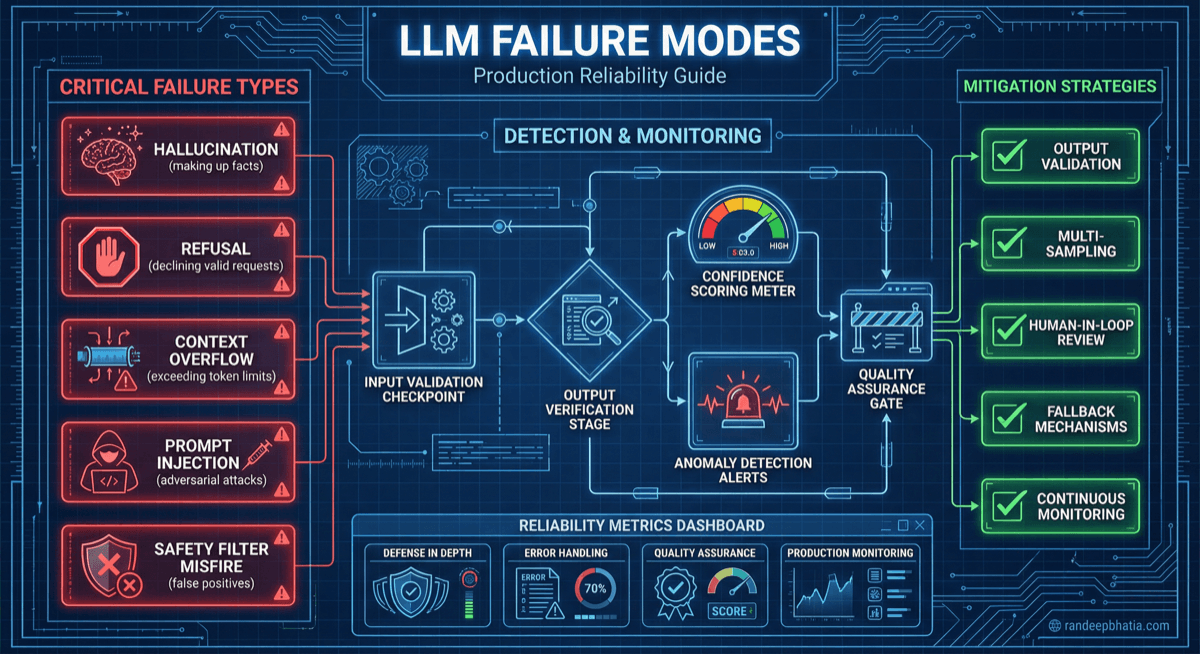
LLM failure modes are the systematic ways large language models produce incorrect, harmful, incomplete, or unexpected outputs during inference, spanning hallucinations, refusals, context overflows, and adversarial vulnerabilities.
LLM failures fall into distinct categories including factual hallucinations, instruction non-compliance, context handling errors, safety filter misfires, and adversarial exploits, each requiring different detection and mitigation strategies.
Most production LLM failures stem from the fundamental tension between model capabilities and deployment constraints, including context window limits, latency requirements, cost budgets, and safety guardrails.
Effective LLM reliability requires defense-in-depth approaches combining prompt engineering, output validation, monitoring systems, fallback mechanisms, and human-in-the-loop review for high-stakes decisions.
The Bottom Line
Understanding LLM failure modes is essential for building production-grade AI systems that maintain reliability, safety, and user trust. Organizations must implement comprehensive detection, prevention, and recovery mechanisms tailored to their specific use cases and risk tolerances.
Definition
Definition
LLM failure modes are the categorized patterns of incorrect, incomplete, harmful, or unexpected behavior exhibited by large language models during inference, arising from architectural limitations, training data issues, deployment constraints, or adversarial inputs.
These failure modes represent systematic vulnerabilities in how LLMs process prompts, generate tokens, maintain context, and produce outputs, requiring specific detection mechanisms and mitigation strategies for production deployment.
Extended Definition
LLM failure modes encompass a broad spectrum of malfunction patterns that emerge when language models are deployed in real-world applications. Unlike traditional software bugs with deterministic causes, LLM failures often exhibit probabilistic characteristics influenced by prompt phrasing, context composition, model temperature settings, and the stochastic nature of token generation. These failures can manifest as factual inaccuracies (hallucinations), inappropriate refusals to complete valid requests, loss of coherence in long contexts, vulnerability to prompt injection attacks, or degraded performance under high load. Understanding these failure modes requires examining both the technical architecture of transformer-based models and the operational realities of production deployment.
Etymology & Origins
The term 'failure mode' originates from reliability engineering and failure mode and effects analysis (FMEA), a systematic methodology developed in the 1940s for aerospace and military applications. Its application to LLMs emerged circa 2022-2023 as organizations began deploying large language models in production environments and needed frameworks to categorize and address the unique ways these systems malfunction. The specific term 'hallucination' was borrowed from psychology and neuroscience to describe LLM-generated content that appears plausible but lacks factual basis, while terms like 'prompt injection' derive from cybersecurity concepts like SQL injection.
Also Known As
Not To Be Confused With
Model training failures
Training failures occur during the model development phase (loss divergence, gradient issues, data problems), while LLM failure modes refer to issues during inference when the trained model is deployed and generating outputs.
Infrastructure failures
Infrastructure failures involve hardware, network, or platform issues (GPU memory errors, API timeouts, load balancer failures), whereas LLM failure modes are model-level behaviors that occur even when infrastructure operates correctly.
User errors
User errors involve incorrect usage of the system (malformed API calls, wrong parameters), while LLM failure modes are model behaviors that occur even with correctly formatted inputs and proper system usage.
Model limitations
Model limitations are known capability boundaries (knowledge cutoff dates, language support), while failure modes are unexpected or undesirable behaviors within the model's intended operational envelope.
Bias and fairness issues
While related, bias and fairness issues are a specific category of model behavior concerning demographic disparities and representational harms, whereas failure modes is a broader category encompassing all types of incorrect or unexpected outputs.
Fine-tuning degradation
Fine-tuning degradation refers to capability loss during model customization (catastrophic forgetting), while failure modes occur during inference of any model regardless of whether it has been fine-tuned.
Conceptual Foundation
Core Principles
(8 principles)Mental Models
(6 models)The Confident Confabulator
Think of an LLM as a highly articulate expert who will always provide an answer, even when they don't actually know. They confabulate plausible-sounding responses based on pattern matching rather than admitting uncertainty. The more fluent the response, the less it correlates with accuracy.
The Goldfish Context
Imagine the LLM has a limited working memory that can only hold a certain amount of information. As new information enters, old information falls out. Information at the very beginning and end of this memory gets the most attention, while middle content may be partially forgotten.
The Pattern Matcher, Not Reasoner
View the LLM as an extremely sophisticated pattern matching system that has learned statistical associations between tokens, not a reasoning engine that understands causality or logic. It produces outputs that look like reasoning because reasoning patterns exist in its training data.
The Sycophantic Assistant
Consider that LLMs are trained to be helpful and agreeable, which can lead them to confirm user beliefs, agree with incorrect premises, or provide the answer users seem to want rather than the accurate answer.
The Adversarial Attack Surface
Think of every user input as a potential attack vector. The LLM processes all input tokens equally, unable to distinguish between legitimate instructions and malicious injections embedded in user-provided content.
The Stochastic Slot Machine
Each LLM inference is like pulling a slot machine lever - you'll get a result from a distribution of possible outputs, and sometimes you'll hit edge cases. Temperature and sampling parameters adjust the width of this distribution.
Key Insights
(10 insights)Hallucinations are not bugs but fundamental features of how LLMs generate text - they produce statistically likely continuations, not verified facts, meaning hallucination mitigation requires external validation rather than model fixes.
The most dangerous LLM failures are not obvious errors but subtle inaccuracies wrapped in confident, well-structured prose that passes casual review but contains material errors.
Context window size is often less limiting than context utilization efficiency - models may ignore or misweight information even when it fits within the window, particularly in the middle of long contexts.
Prompt injection vulnerabilities are architectural, not implementation bugs - any system that mixes instructions with untrusted data in the same context is fundamentally vulnerable.
Safety refusals follow learned patterns from training, meaning they can be inconsistent, overly broad, or triggered by superficial pattern matches rather than actual harmful intent.
Model confidence scores (logprobs) correlate weakly with factual accuracy - high confidence often indicates the model has seen similar patterns frequently, not that the output is correct.
Fine-tuning can introduce new failure modes while fixing others, as the model may overfit to fine-tuning data patterns and lose general capabilities (catastrophic forgetting).
Multi-turn conversation failures compound - errors in early turns propagate and amplify through subsequent turns as the model builds on its own incorrect outputs.
Temperature settings create a tradeoff between creativity and reliability - lower temperatures reduce variability but can cause repetitive or stuck outputs, while higher temperatures increase hallucination risk.
The same failure mode can have different root causes requiring different mitigations - a hallucination might stem from training data gaps, context confusion, or instruction misinterpretation.
When to Use
When to Use
Ideal Scenarios
(12)When designing production LLM systems that require high reliability and need systematic approaches to identify, prevent, and recover from model failures.
When conducting risk assessments for AI deployments to enumerate potential failure scenarios and their business impacts.
When building monitoring and observability systems that need to detect and alert on specific categories of LLM malfunction.
When developing testing strategies for LLM applications that need to cover the full spectrum of potential failure patterns.
When creating incident response playbooks that require categorized failure types with corresponding mitigation procedures.
When evaluating LLM providers or models to understand their specific vulnerability profiles and failure characteristics.
When designing user interfaces that need to communicate LLM limitations and potential errors appropriately to end users.
When implementing output validation pipelines that need to check for specific categories of model errors.
When training teams on LLM reliability to provide a comprehensive framework for understanding model behavior.
When architecting fallback mechanisms that need to activate based on detected failure patterns.
When conducting post-incident analysis to categorize and learn from production LLM failures.
When setting SLAs and reliability targets that need to account for inherent model failure rates.
Prerequisites
(8)Basic understanding of transformer architecture and how LLMs generate outputs through token prediction.
Familiarity with prompt engineering concepts and how prompt structure affects model behavior.
Access to LLM inference logs and outputs for analysis and pattern identification.
Understanding of the specific use case and domain to assess failure impact and acceptable error rates.
Monitoring infrastructure capable of capturing relevant metrics and enabling failure detection.
Organizational processes for incident response and continuous improvement based on failure learnings.
Clear definition of what constitutes a failure versus acceptable variation in the specific application context.
Baseline measurements of normal model behavior to enable anomaly detection.
Signals You Need This
(10)Users are reporting incorrect or nonsensical outputs from your LLM application.
The model is refusing legitimate requests that should be within its capabilities.
Output quality degrades significantly for longer inputs or conversations.
You're seeing inconsistent outputs for semantically identical inputs.
Security reviews have identified potential prompt injection vulnerabilities.
Production incidents are occurring without clear categorization or systematic response.
Stakeholders are asking about LLM reliability guarantees and failure rates.
You're scaling LLM usage and need to understand failure patterns at higher volumes.
Compliance or audit requirements demand documentation of AI system failure modes.
Cost overruns are occurring due to retries, fallbacks, or error handling.
Organizational Readiness
(7)Engineering teams have sufficient LLM expertise to implement detection and mitigation strategies.
Monitoring and observability infrastructure exists or can be deployed for LLM-specific metrics.
Incident response processes can accommodate AI-specific failure categories and response procedures.
Leadership understands that LLM failures are inherent and accepts investment in reliability engineering.
Cross-functional alignment exists between engineering, product, and risk teams on acceptable failure rates.
Data infrastructure supports logging and analysis of LLM inputs, outputs, and metadata.
Budget allocation covers reliability engineering efforts including testing, monitoring, and fallback systems.
When NOT to Use
When NOT to Use
Anti-Patterns
(12)Using failure mode analysis as a reason to avoid deploying LLMs entirely rather than as a guide for safe deployment.
Attempting to eliminate all failure modes rather than managing them to acceptable levels for the use case.
Treating failure mode categories as exhaustive and fixed rather than evolving with model capabilities and attack techniques.
Implementing heavy-handed mitigations that degrade user experience without proportionate risk reduction.
Focusing exclusively on technical mitigations while ignoring process, training, and organizational factors.
Using failure mode knowledge to create adversarial prompts for malicious purposes.
Assuming failure modes are identical across different models, providers, or versions without validation.
Over-engineering solutions for failure modes that have negligible impact in the specific use case.
Treating all failures as equally severe rather than prioritizing based on impact and likelihood.
Using failure mode analysis as a one-time exercise rather than continuous monitoring and improvement.
Implementing detection without corresponding mitigation or response procedures.
Assuming that addressing one failure mode doesn't introduce or exacerbate others.
Red Flags
(10)The use case has zero tolerance for any errors, making LLMs fundamentally unsuitable regardless of mitigation.
There's no budget or expertise for implementing proper monitoring and mitigation strategies.
The organization expects LLMs to be perfectly reliable like deterministic software systems.
Failure analysis is being used to assign blame rather than improve systems.
Security-critical applications are being deployed without addressing prompt injection vulnerabilities.
High-stakes decisions are being fully automated without human review despite known failure rates.
Failure modes are being documented but not acted upon with concrete mitigations.
Testing only covers happy paths without systematic failure mode coverage.
Production monitoring doesn't include LLM-specific failure detection.
Incident response treats all LLM failures identically without categorization.
Better Alternatives
(8)The application requires 100% factual accuracy with no tolerance for errors
Traditional database queries, rule-based systems, or human expert review
LLMs have inherent hallucination tendencies that cannot be fully eliminated, making them unsuitable for zero-error-tolerance applications without extensive human verification.
The system processes highly sensitive data where any leakage is catastrophic
Air-gapped systems, on-premise models, or non-LLM approaches
Prompt injection and data extraction vulnerabilities are architectural to LLMs processing untrusted input, and mitigations reduce but don't eliminate risk.
Real-time responses are required with strict latency SLAs
Cached responses, smaller models, or pre-computed outputs
LLM inference latency is variable and failure handling (retries, fallbacks) adds additional latency that may violate strict timing requirements.
The application serves adversarial users actively trying to exploit the system
Heavily constrained interfaces, pre-defined response templates, or non-generative approaches
Open-ended LLM generation provides a large attack surface that determined adversaries can exploit despite defensive measures.
Budget constraints prevent implementing proper monitoring and mitigation
Simpler rule-based systems or delayed LLM adoption until resources are available
Deploying LLMs without failure handling creates technical debt and user trust issues that are more expensive to address later.
The domain requires formal verification or provable correctness
Formal methods, theorem provers, or verified software systems
LLM outputs cannot be formally verified and their probabilistic nature is fundamentally incompatible with provable correctness requirements.
Regulatory requirements mandate explainable decisions with audit trails
Rule-based systems, decision trees, or LLMs with extensive logging and human review
LLM decision-making is not inherently explainable, and while techniques exist to improve interpretability, they may not meet strict regulatory standards.
The use case involves life-safety decisions
Certified safety systems, redundant human oversight, or non-AI approaches
LLM failure modes include silent failures that produce plausible but incorrect outputs, which is unacceptable for life-safety applications.
Common Mistakes
(10)Assuming that newer or larger models have fewer failure modes rather than different failure characteristics.
Implementing prompt-based mitigations without understanding that determined users can often bypass them.
Testing only with well-formed inputs and missing edge cases that trigger failures in production.
Conflating model confidence with output correctness and using logprobs as reliability indicators.
Treating hallucinations as rare anomalies rather than expected behavior requiring systematic handling.
Implementing retry logic without considering that retries may produce the same or different failures.
Focusing on preventing failures rather than detecting and recovering from them gracefully.
Assuming that fine-tuning fixes failure modes rather than potentially introducing new ones.
Deploying safety mitigations that create worse user experiences than the failures they prevent.
Using single-point validation rather than defense-in-depth approaches to failure prevention.
Core Taxonomy
Core Taxonomy
Primary Types
(10 types)The model generates factually incorrect, fabricated, or unverifiable information presented with apparent confidence. This includes inventing citations, creating fictional events, misattributing quotes, and generating plausible but false technical details.
Characteristics
- Output appears fluent and confident despite being incorrect
- Often triggered by questions about specific facts, names, dates, or technical details
- More likely in domains with sparse training data
- Can be subtle (minor inaccuracies) or severe (complete fabrications)
- Difficult to detect without external verification
Use Cases
Tradeoffs
Mitigation through retrieval augmentation adds latency and complexity but significantly reduces hallucination rates. Aggressive fact-checking may reject valid outputs, while permissive approaches allow more hallucinations through.
Classification Dimensions
Detectability
Classifies failures by how easily they can be identified, which determines appropriate detection strategies and the level of human review required.
Severity
Classifies failures by their impact on users, business, or safety, guiding prioritization of mitigation efforts and incident response.
Frequency
Classifies failures by how often they occur, informing testing strategies and the cost-benefit analysis of mitigation investments.
Root Cause Location
Classifies failures by where in the system stack they originate, guiding which team or approach is best suited to address them.
Recoverability
Classifies failures by what recovery options exist, informing the design of fallback mechanisms and escalation procedures.
User Visibility
Classifies failures by who or what is affected, guiding communication strategies and user interface design.
Evolutionary Stages
Reactive Detection
Initial deployment through first 3-6 months of production operationFailures are identified through user reports, manual review, or post-incident analysis. No systematic detection or prevention mechanisms in place. Response is ad-hoc and incident-driven.
Systematic Monitoring
6-12 months post-deployment, after initial failure patterns are understoodMonitoring systems track key failure indicators. Alerts trigger on anomalies. Failure categories are defined and tracked. Response procedures exist but may be manual.
Proactive Prevention
12-18 months post-deployment, with dedicated reliability engineering investmentInput validation, output verification, and guardrails prevent many failures before they reach users. Testing covers known failure modes. Fallback mechanisms handle detected failures gracefully.
Predictive Management
18-24+ months post-deployment, with mature MLOps practicesML-based systems predict likely failures before they occur. Continuous improvement processes reduce failure rates over time. Failure budgets and SLOs drive engineering priorities.
Adaptive Resilience
24+ months post-deployment, representing advanced operational maturitySystems automatically adapt to new failure patterns. Self-healing mechanisms recover without human intervention. Failure modes are continuously characterized and addressed through automated processes.
Architecture Patterns
(8 patterns)Defense in Depth
Multiple layers of failure detection and prevention, where each layer catches failures that slip through previous layers. No single mechanism is relied upon for reliability.
Components
- Input validation and sanitization layer
- Prompt engineering and guardrails
- Model-level safety mechanisms
- Output validation and verification
- Human review for high-stakes outputs
- Monitoring and anomaly detection
Data Flow
User input → Input validation → Prompt construction → Model inference → Output validation → Post-processing → Human review (if needed) → Final output
Best For
- High-stakes applications
- Regulated industries
- User-facing products with brand risk
- Systems processing sensitive data
Limitations
- Increased latency from multiple validation steps
- Higher operational complexity
- Cost of running multiple checks
- Potential for false positives at each layer
Scaling Characteristics
Each layer adds latency and cost. Layers can be parallelized where possible. Sampling-based validation scales better than exhaustive checking.
Integration Points
API Gateway
First line of defense for input validation, rate limiting, and request routing based on failure mode risk assessment.
Gateway must be configured with LLM-specific validation rules. Latency overhead should be minimal. Must handle both synchronous and streaming responses.
Prompt Management System
Centralized management of prompts with version control, testing, and rollback capabilities to prevent prompt-related failures.
Prompts are code and should be treated with similar rigor. Changes should be tested against known failure cases. Rollback should be fast and reliable.
Observability Stack
Collects, stores, and analyzes metrics, logs, and traces related to LLM failures for detection, alerting, and root cause analysis.
Must handle high cardinality of LLM-specific dimensions. Sampling strategies needed for cost control. Retention policies for debugging vs. compliance.
Vector Database
Supports retrieval-augmented generation and verification by providing relevant context and authoritative sources for fact-checking.
Embedding quality affects retrieval accuracy. Index freshness impacts knowledge currency. Query latency adds to overall response time.
Human Review Queue
Manages escalation of uncertain outputs to human reviewers with appropriate tooling and workflow support.
Queue depth monitoring prevents backlogs. Reviewer tooling affects efficiency. Feedback quality impacts model improvement value.
Feature Flag System
Controls rollout of new models, prompts, and failure handling mechanisms with fine-grained targeting and instant rollback.
Flag evaluation must be fast and reliable. Stale flag cache can cause inconsistent behavior. Flag proliferation needs governance.
Cost Management System
Tracks and controls LLM costs, implementing budgets and alerts that prevent cost-related failures from retry storms or unexpected usage.
Real-time cost tracking needed for enforcement. Budget exhaustion handling must be graceful. Cost attribution enables accountability.
Incident Management System
Receives alerts, manages incident lifecycle, and tracks resolution of LLM-related failures with appropriate categorization.
LLM failures need specific categorization. Runbooks should cover common failure modes. Incident patterns inform prevention priorities.
Decision Framework
Decision Framework
Implement emergency mitigation (circuit breaker, fallback, or disable) immediately, then investigate root cause.
Proceed with systematic diagnosis to understand failure pattern and impact.
Harm includes safety issues, data exposure, significant user impact, or cascading system failures. Speed of response is critical for harmful failures.
Technical Deep Dive
Technical Deep Dive
Overview
LLM failures emerge from the fundamental architecture and training methodology of transformer-based language models. These models generate text by predicting the next token based on learned statistical patterns from training data, processed through attention mechanisms that weigh the relevance of different parts of the input context. This architecture, while remarkably capable, introduces systematic failure modes that manifest during inference. The generation process is inherently probabilistic - the model produces a probability distribution over possible next tokens, and sampling from this distribution introduces variability. Temperature and other sampling parameters control this variability, creating a tradeoff between consistency and diversity. Higher temperatures increase randomness, potentially leading to more creative but also more error-prone outputs. Context handling is constrained by the fixed context window size and the attention mechanism's computational characteristics. While models can technically attend to all tokens in the context, practical attention patterns often show primacy and recency biases, with information in the middle of long contexts receiving less effective attention. This 'lost in the middle' phenomenon contributes to context-related failures. Safety mechanisms, typically implemented through RLHF (Reinforcement Learning from Human Feedback) and additional fine-tuning, create learned patterns for refusing certain requests. These patterns are statistical rather than rule-based, leading to inconsistent behavior where similar requests may be handled differently based on superficial features.
Step-by-Step Process
The input text is converted into tokens using the model's tokenizer. This process can introduce failures if the tokenization splits words unexpectedly, handles special characters incorrectly, or exceeds token limits. Different tokenizers have different vocabularies and splitting behaviors.
Token limit exceeded errors, unexpected tokenization of domain-specific terms, encoding issues with special characters or non-English text, inconsistent tokenization across model versions.
Under The Hood
At the architectural level, LLM failures trace to fundamental properties of transformer models. The attention mechanism, while powerful, has quadratic complexity with sequence length, leading to practical limits on context size and computational tradeoffs that affect how thoroughly the model can process long inputs. The 'lost in the middle' phenomenon, where models attend less effectively to information in the middle of long contexts, emerges from how positional encodings and attention patterns interact. The training process shapes failure modes significantly. Pre-training on internet-scale data embeds both knowledge and biases from that data. The model learns statistical patterns, not facts, meaning it can confidently generate plausible-sounding but incorrect information when the statistical patterns favor certain outputs regardless of factual accuracy. Fine-tuning and RLHF add additional behavioral patterns, including safety behaviors, but these are learned heuristics rather than robust rules. Hallucinations emerge from the model's fundamental objective: predicting likely next tokens. When the model encounters queries about topics with sparse training data, it generates tokens that are statistically likely given the context, even if those tokens form factually incorrect statements. The model has no mechanism to distinguish between 'I learned this fact' and 'this seems like a plausible thing to say.' Confidence in outputs reflects training data frequency, not accuracy. Prompt injection vulnerabilities arise because the model processes all input tokens through the same attention mechanism without distinguishing between trusted instructions and untrusted data. The model cannot inherently differentiate between 'the user is asking me to do X' and 'the user's input contains text that looks like an instruction to do Y.' This architectural property means that any system mixing instructions with untrusted data is fundamentally vulnerable, and mitigations can only reduce, not eliminate, this risk. Safety behaviors learned through RLHF create patterns that the model applies based on surface features of inputs. This leads to inconsistency where the model may refuse a legitimate request because it pattern-matches to training examples of harmful requests, while accepting a actually harmful request that doesn't trigger learned refusal patterns. The statistical nature of these learned behaviors means they can be inconsistent and are subject to adversarial manipulation.
Failure Modes
Failure Modes
Model generates statistically likely but factually incorrect information, particularly for specific facts (names, dates, numbers, citations) where training data is sparse or contradictory.
- Plausible-sounding but verifiably false statements
- Invented citations, quotes, or references
- Incorrect technical specifications or procedures
- Fabricated historical events or biographical details
Misinformation propagation, user trust erosion, potential legal liability, safety risks if acted upon, reputational damage.
Implement RAG with authoritative sources, require citations, use domain-specific fine-tuning, set appropriate user expectations.
Fact-checking pipelines, human review for high-stakes content, confidence thresholds with fallback to 'I don't know', source attribution requirements.
Operational Considerations
Key Metrics (15)
Percentage of responses containing factually incorrect information, measured through automated fact-checking or human review sampling.
Dashboard Panels
Alerting Strategy
Implement tiered alerting with different severity levels and response expectations. Critical alerts (safety issues, outages) page on-call immediately. High alerts (elevated error rates, cost spikes) notify within 15 minutes. Medium alerts (quality degradation, elevated latency) create tickets for next business day. Low alerts (minor anomalies) aggregate for weekly review. Use anomaly detection for metrics without fixed thresholds. Implement alert deduplication and correlation to prevent alert fatigue.
Cost Analysis
Cost Analysis
Cost Drivers
(10)Input Token Volume
Direct linear cost relationship. Long prompts, extensive context, and verbose system instructions multiply costs.
Minimize prompt length while maintaining effectiveness. Use concise instructions. Implement context compression. Cache and reuse common prompt components.
Output Token Volume
Typically higher cost per token than input. Long responses, verbose outputs, and generation loops significantly increase costs.
Set appropriate max_tokens limits. Use concise output instructions. Implement early stopping. Avoid open-ended generation where possible.
Model Selection
Larger, more capable models cost significantly more (10-100x difference between model tiers). Premium features add cost.
Use smallest model that meets quality requirements. Route simple queries to cheaper models. Reserve expensive models for complex tasks.
Retry and Fallback Overhead
Failed requests that retry or fall back to alternative models multiply effective cost per successful response.
Reduce failure rates through better prompts. Implement smart retry logic. Use fallbacks strategically rather than automatically.
Context Window Utilization
Larger context windows cost more and may require more expensive model tiers. Inefficient context use wastes capacity.
Optimize context composition. Use retrieval to include only relevant information. Implement summarization for long contexts.
Request Volume
Total cost scales linearly with request volume. High-traffic applications face significant aggregate costs.
Implement caching for repeated queries. Batch similar requests where possible. Use rate limiting to control costs.
Validation and Verification Overhead
Additional LLM calls for fact-checking, quality validation, or ensemble methods multiply base inference costs.
Use cheaper models for validation. Implement sampling-based validation. Balance validation thoroughness with cost.
Development and Testing
Prompt development, testing, and experimentation consume tokens without producing user value.
Use cheaper models for development. Implement prompt caching. Maintain representative test sets to minimize testing volume.
Streaming Overhead
Streaming responses may have different pricing or overhead compared to batch responses.
Use streaming only when user experience benefits justify any cost difference. Batch non-interactive requests.
Geographic and Time Factors
Some providers have different pricing by region or time. Peak usage may face premium pricing or availability issues.
Consider multi-region deployment. Schedule batch processing for off-peak times if pricing varies.
Cost Models
Per-Token Pricing
Cost = (Input_Tokens × Input_Price) + (Output_Tokens × Output_Price)1000 input tokens at $0.01/1K + 500 output tokens at $0.03/1K = $0.01 + $0.015 = $0.025 per request
Effective Cost with Retries
Effective_Cost = Base_Cost × (1 + Retry_Rate × Avg_Retries)$0.025 base × (1 + 0.05 × 2) = $0.025 × 1.1 = $0.0275 effective cost (10% overhead from retries)
Tiered Model Routing
Total_Cost = (Simple_Requests × Cheap_Model_Cost) + (Complex_Requests × Expensive_Model_Cost)80% simple at $0.005 + 20% complex at $0.05 = $0.004 + $0.01 = $0.014 average (vs $0.05 if all used expensive model)
Cost with Caching
Effective_Cost = Base_Cost × (1 - Cache_Hit_Rate) + Cache_Storage_Cost$0.025 × (1 - 0.3) + $0.001 = $0.0175 + $0.001 = $0.0185 (26% savings with 30% cache hit rate)
Optimization Strategies
- 1Implement semantic caching to reuse responses for similar queries
- 2Use model routing to direct simple queries to cheaper models
- 3Optimize prompts for conciseness without sacrificing quality
- 4Set appropriate max_tokens limits to prevent runaway generation
- 5Implement context compression and summarization for long inputs
- 6Use retrieval augmentation to include only relevant context
- 7Batch similar requests where latency requirements allow
- 8Monitor and alert on cost anomalies to catch issues early
- 9Implement request-level cost estimation and budgeting
- 10Use spot or preemptible instances for batch processing
- 11Negotiate volume discounts with providers
- 12Consider self-hosted models for high-volume, predictable workloads
Hidden Costs
- 💰Engineering time for prompt optimization and failure handling
- 💰Human review costs for quality assurance and edge cases
- 💰Infrastructure costs for logging, monitoring, and caching
- 💰Opportunity cost of latency on user experience and conversion
- 💰Cost of failures: customer support, refunds, reputation damage
- 💰Compliance and audit costs for regulated industries
- 💰Training and documentation costs for team enablement
- 💰Technical debt from quick fixes and workarounds
ROI Considerations
ROI calculation for LLM reliability investments must consider both direct costs (compute, engineering time) and indirect benefits (reduced failures, improved user experience, avoided incidents). A single high-profile failure can cost more in reputation damage and customer churn than months of reliability engineering investment. Quantify the cost of failures by category: hallucinations leading to user complaints, refusals blocking legitimate use cases, latency causing abandonment, security incidents requiring response. Compare these costs against the investment required for prevention and mitigation. Consider the compounding effect of reliability on user trust. Users who experience failures are less likely to rely on the system, reducing the value delivered. Conversely, high reliability enables users to trust the system for more important tasks, increasing value. Factor in the cost of technical debt. Quick fixes and workarounds accumulate, making the system harder to maintain and improve. Investing in proper failure handling infrastructure pays dividends over time through reduced maintenance burden and faster iteration.
Security Considerations
Threat Model
(10 threats)Prompt Injection
Malicious instructions embedded in user input, retrieved documents, or any untrusted data that enters the context.
Bypass of safety measures, unauthorized actions, data exfiltration, system prompt disclosure, reputation damage.
Input sanitization, prompt/data separation, output filtering, minimal system prompt information, defense in depth, monitoring for injection patterns.
Data Exfiltration via Output
Crafted prompts that cause the model to reveal sensitive information from its context, training data, or connected systems.
Privacy violations, competitive intelligence loss, regulatory penalties, user trust damage.
Output filtering for sensitive patterns, PII detection, access controls on context data, audit logging, data classification.
Model Extraction/Stealing
Systematic querying to extract model behavior, fine-tuning data, or effective prompts for replication.
Intellectual property loss, competitive disadvantage, unauthorized model replication.
Rate limiting, query pattern detection, watermarking outputs, legal protections, monitoring for extraction patterns.
Denial of Service via Resource Exhaustion
Crafted inputs that cause excessive computation, token generation, or resource consumption.
Service unavailability, cost spikes, degraded performance for legitimate users.
Input validation, token limits, timeout enforcement, rate limiting, cost caps, anomaly detection.
Jailbreaking Safety Measures
Techniques to bypass safety training and content filters to generate harmful, illegal, or policy-violating content.
Platform misuse, legal liability, regulatory action, reputation damage, potential real-world harm.
Multiple safety layers, continuous red-teaming, output filtering, user reporting, rapid response capability.
Training Data Poisoning (for fine-tuned models)
Injecting malicious examples into fine-tuning data to introduce backdoors or biased behavior.
Compromised model behavior, hidden vulnerabilities, biased outputs, potential for triggered malicious behavior.
Data validation and sanitization, training data provenance, behavior testing, anomaly detection in outputs.
Supply Chain Attacks
Compromised dependencies, malicious model weights, or tampered inference infrastructure.
Complete system compromise, data theft, malicious behavior injection.
Dependency scanning, model weight verification, secure infrastructure, vendor security assessment.
Social Engineering via LLM
Using the LLM to generate convincing phishing content, impersonation, or manipulation.
User deception, credential theft, financial fraud, reputation damage.
Content policies, output monitoring, user education, authentication for sensitive actions.
Inference Side Channels
Extracting information from timing, token probabilities, or other observable inference characteristics.
Information leakage, privacy violations, security bypass.
Consistent response times, limited probability exposure, noise injection, access controls.
Multi-Tenant Data Leakage
Information from one tenant's context leaking to another through shared model state or caching.
Privacy violations, competitive intelligence exposure, regulatory penalties.
Tenant isolation, cache partitioning, stateless inference, audit logging.
Security Best Practices
- ✓Treat all user input as potentially malicious and implement appropriate sanitization
- ✓Separate system instructions from user data using clear delimiters and structural separation
- ✓Implement output filtering to detect and block sensitive information disclosure
- ✓Use principle of least privilege for any tools or actions the LLM can invoke
- ✓Maintain comprehensive audit logs of all LLM interactions
- ✓Implement rate limiting and anomaly detection to identify attacks
- ✓Regularly red-team the system for new vulnerabilities
- ✓Keep system prompts minimal and avoid including sensitive information
- ✓Use content classification to identify and handle sensitive inputs appropriately
- ✓Implement human review for high-risk actions or outputs
- ✓Maintain incident response procedures specific to LLM security events
- ✓Conduct regular security assessments and penetration testing
- ✓Monitor for known jailbreak techniques and implement countermeasures
- ✓Use secure communication channels for all LLM API interactions
- ✓Implement proper authentication and authorization for LLM access
Data Protection
- 🔒Implement PII detection and redaction in both inputs and outputs
- 🔒Use data classification to identify and handle sensitive information appropriately
- 🔒Encrypt data in transit and at rest
- 🔒Implement access controls based on data sensitivity and user authorization
- 🔒Maintain data retention policies and implement secure deletion
- 🔒Use anonymization and pseudonymization where possible
- 🔒Implement data loss prevention (DLP) controls
- 🔒Conduct regular data protection impact assessments
- 🔒Maintain data processing agreements with LLM providers
- 🔒Implement audit logging for all data access and processing
Compliance Implications
GDPR
Personal data protection, right to explanation, data minimization, breach notification.
PII detection and filtering, audit logging, data retention policies, privacy impact assessments, breach response procedures.
CCPA/CPRA
Consumer privacy rights, data disclosure, opt-out mechanisms.
Data inventory, privacy notices, consumer request handling, data deletion capabilities.
HIPAA
Protected health information security, access controls, audit trails.
PHI detection and handling, BAA with providers, encryption, access logging, security assessments.
SOC 2
Security, availability, processing integrity, confidentiality, privacy controls.
Security policies, access controls, monitoring, incident response, vendor management.
EU AI Act
Risk classification, transparency, human oversight, documentation requirements.
Risk assessment, documentation, human-in-the-loop for high-risk applications, conformity assessment.
Financial Services Regulations (various)
Model risk management, explainability, fair lending, consumer protection.
Model documentation, validation, monitoring, bias testing, audit trails.
Industry-Specific Standards (PCI-DSS, etc.)
Data protection, access controls, encryption, monitoring.
Data classification, encryption, access management, security monitoring, compliance reporting.
Accessibility Requirements (ADA, WCAG)
Accessible interfaces, alternative formats, assistive technology compatibility.
Accessible UI design, alternative output formats, testing with assistive technologies.
Scaling Guide
Scaling Guide
Scaling Dimensions
Request Volume
Horizontal scaling of inference infrastructure, load balancing, request queuing, and caching.
Provider rate limits, infrastructure capacity, cost constraints.
Cache hit rates become more important at scale. Batch processing can improve efficiency. Consider multiple providers for redundancy.
Concurrent Users
Session management, connection pooling, async processing, and queue-based architecture.
Memory for session state, connection limits, real-time processing capacity.
Stateless design simplifies scaling. Consider session affinity tradeoffs. Implement graceful degradation for overload.
Context Complexity
Context management, summarization, retrieval augmentation, and hierarchical processing.
Context window size, attention quality degradation, cost per request.
Larger contexts don't always improve quality. Retrieval can be more effective than larger windows. Consider chunking strategies.
Output Quality Requirements
Model selection, ensemble methods, validation layers, and human review.
Cost of higher-quality models, latency of validation, human review capacity.
Quality requirements should drive architecture. Not all requests need maximum quality. Implement tiered quality levels.
Latency Requirements
Model optimization, caching, edge deployment, and streaming responses.
Model inference time floor, network latency, processing overhead.
Streaming improves perceived latency. Caching most effective for repeated queries. Consider speculative execution.
Geographic Distribution
Multi-region deployment, edge caching, provider selection by region.
Provider availability by region, data residency requirements, replication complexity.
Data residency may constrain options. Latency varies significantly by region. Consider hybrid approaches.
Feature Complexity
Modular architecture, feature flags, gradual rollout, and A/B testing.
System complexity, testing coverage, operational overhead.
New features may introduce new failure modes. Implement comprehensive monitoring for new features. Plan for rollback.
Team Size
Documentation, tooling, training, and operational runbooks.
Knowledge transfer, consistency across team, operational capacity.
Larger teams need better tooling and documentation. Implement guardrails to prevent misuse. Establish best practices.
Capacity Planning
Required_Capacity = (Peak_Requests × Avg_Tokens × (1 + Retry_Rate) × (1 - Cache_Hit_Rate)) / Throughput_Per_InstancePlan for 2x expected peak capacity to handle traffic spikes, provider issues, and growth. Implement auto-scaling with appropriate limits. Maintain fallback capacity with alternative providers or degraded modes.
Scaling Milestones
- Basic monitoring and error handling
- Initial prompt optimization
- Cost tracking
Simple synchronous architecture. Manual review of failures. Basic logging.
- Systematic failure categorization
- Cost optimization
- User feedback integration
Implement structured logging. Add basic monitoring dashboards. Establish prompt version control.
- Automated failure detection
- Caching implementation
- Rate limiting
Add caching layer. Implement async processing. Deploy monitoring and alerting. Establish on-call rotation.
- Multi-model routing
- Advanced caching strategies
- Cost management at scale
Implement model routing. Deploy sophisticated caching. Add cost controls. Consider multi-provider strategy.
- Infrastructure reliability
- Global distribution
- Advanced failure handling
Multi-region deployment. Advanced load balancing. Comprehensive observability. Dedicated reliability engineering.
- Custom infrastructure
- Provider negotiations
- Organizational scaling
Consider self-hosted models. Implement advanced ML ops. Dedicated teams for different aspects. Custom tooling and automation.
Benchmarks
Benchmarks
Industry Benchmarks
| Metric | P50 | P95 | P99 | World Class |
|---|---|---|---|---|
| Hallucination Rate (factual QA) | 10% | 25% | 40% | <5% with RAG |
| Refusal Rate (general use) | 3% | 8% | 15% | <1% false positive |
| Output Parse Success Rate | 95% | 85% | 75% | >99% with JSON mode |
| Latency P95 (standard query) | 3s | 8s | 15s | <2s |
| Error Rate (all types) | 2% | 5% | 10% | <0.5% |
| User Satisfaction (LLM features) | 70% | 50% | 35% | >85% |
| Cost per 1K requests | $5 | $15 | $30 | <$2 with optimization |
| Instruction Following Accuracy | 85% | 70% | 55% | >95% |
| Context Utilization Efficiency | 60% | 40% | 25% | >80% |
| Mean Time to Detect Failure | 30 min | 4 hours | 24 hours | <5 min |
| Mean Time to Resolve | 2 hours | 8 hours | 48 hours | <30 min |
| Availability (LLM features) | 99% | 95% | 90% | >99.9% |
Comparison Matrix
| Approach | Hallucination Reduction | Latency Impact | Cost Impact | Implementation Complexity | Maintenance Burden |
|---|---|---|---|---|---|
| Basic prompting | Low | None | Low | Low | Low |
| RAG with verification | High | High | Medium | High | High |
| Fine-tuning | Medium | None | High (upfront) | High | Medium |
| Ensemble/consensus | Medium-High | Medium | High | Medium | Medium |
| Human-in-the-loop | Very High | Very High | Very High | Medium | Very High |
| Output validation | Low-Medium | Low | Low | Medium | Medium |
| Model routing | Medium | Low | Varies | Medium | Medium |
| Caching | None (consistency) | Negative (improvement) | Negative (savings) | Medium | Low |
Performance Tiers
Minimal failure handling, reactive monitoring, manual incident response.
Error rate <5%, availability >95%, MTTD <4 hours
Systematic monitoring, basic validation, retry logic, documented procedures.
Error rate <2%, availability >99%, MTTD <1 hour, MTTR <4 hours
Comprehensive monitoring, multi-layer validation, automated mitigation, proactive detection.
Error rate <1%, availability >99.5%, MTTD <15 min, MTTR <1 hour
Predictive detection, self-healing systems, continuous optimization, minimal human intervention.
Error rate <0.5%, availability >99.9%, MTTD <5 min, MTTR <15 min
Real World Examples
Real World Examples
Real-World Scenarios
(8 examples)Customer Support Chatbot Hallucinating Product Information
E-commerce company deployed LLM chatbot for customer support. Chatbot began providing incorrect product specifications, pricing, and availability information, leading to customer complaints and order issues.
Implemented RAG system connecting to product database. Added fact-checking layer comparing responses against authoritative product data. Deployed confidence scoring with escalation to human agents for uncertain responses.
Hallucination rate for product information dropped from 15% to 2%. Customer satisfaction improved. Human agent escalation rate stabilized at 8% for complex queries.
- 💡LLMs should not be trusted for factual product information without grounding
- 💡RAG implementation requires ongoing maintenance of source data
- 💡Confidence thresholds need tuning based on actual failure patterns
- 💡User expectations must be set appropriately for AI limitations
Legal Document Analysis with Critical Errors
Law firm used LLM to analyze contracts and identify key clauses. LLM occasionally missed critical clauses or misinterpreted legal language, creating liability risk.
Implemented multi-pass analysis with different prompts. Added clause extraction validation against known patterns. Required human review for all outputs with confidence below threshold. Created specialized prompts for different contract types.
Critical clause detection improved from 85% to 98%. All outputs now reviewed by attorneys before client delivery. Processing time reduced by 60% compared to fully manual review.
- 💡High-stakes domains require human oversight regardless of model quality
- 💡Domain-specific prompt engineering significantly improves accuracy
- 💡Multi-pass approaches catch errors single passes miss
- 💡LLM best used as assistant to experts, not replacement
Code Generation Introducing Security Vulnerabilities
Development team used LLM for code generation. Generated code occasionally contained security vulnerabilities including SQL injection, XSS, and insecure configurations.
Integrated static analysis tools to scan all generated code. Implemented sandboxed execution for testing. Created security-focused prompts emphasizing secure coding practices. Added human review requirement for security-sensitive code.
Security vulnerabilities in generated code reduced by 80%. Development velocity maintained while improving security posture. Developers learned to review LLM output critically.
- 💡LLM-generated code requires same security review as human code
- 💡Static analysis tools are essential for code generation workflows
- 💡Security-focused prompts help but don't eliminate vulnerabilities
- 💡Developer education on LLM limitations is critical
Content Moderation System False Positives
Social media platform used LLM for content moderation. System had high false positive rate, incorrectly flagging legitimate content and frustrating users.
Implemented tiered moderation with LLM as first pass. Added appeal mechanism with human review. Tuned confidence thresholds based on content category. Created feedback loop to improve prompts based on appeal outcomes.
False positive rate reduced from 12% to 4%. User satisfaction with moderation improved. Appeal volume decreased as accuracy improved. Maintained high true positive rate for policy violations.
- 💡Content moderation requires balancing false positives and negatives
- 💡Appeal mechanisms are essential for user trust
- 💡Different content categories need different thresholds
- 💡Continuous improvement from feedback is critical
Financial Analysis with Calculation Errors
Investment firm used LLM for financial analysis and report generation. LLM occasionally made arithmetic errors or used incorrect formulas, leading to flawed analysis.
Separated calculation from narrative generation. Used deterministic code for all calculations. LLM generates narrative around verified numbers. Implemented validation of all numerical claims against source data.
Calculation errors eliminated. Report generation time reduced by 70%. Analysts focus on interpretation rather than number-crunching. Audit trail maintained for all calculations.
- 💡LLMs are unreliable for mathematical calculations
- 💡Separate concerns: use right tool for each task
- 💡Financial applications require deterministic calculation paths
- 💡Audit trails are essential for regulated industries
Healthcare Information System Safety Issues
Healthcare provider used LLM to help patients understand medical information. System occasionally provided dangerous advice or failed to recommend seeking professional care.
Implemented strict safety guidelines in system prompt. Added medical disclaimer to all responses. Created escalation triggers for symptoms requiring immediate care. Required human review for all medication-related queries.
Zero safety incidents after implementation. Patient satisfaction maintained. Clear boundaries established for LLM capabilities. Integration with nurse triage for escalated cases.
- 💡Healthcare applications require extreme caution
- 💡Clear disclaimers and escalation paths are essential
- 💡Some queries should always involve human professionals
- 💡Safety must be prioritized over capability
Multi-Tenant SaaS Platform Data Leakage
B2B SaaS platform used shared LLM infrastructure for multiple customers. Prompt injection attack caused data from one customer's context to leak to another.
Implemented strict tenant isolation in context construction. Added output filtering for cross-tenant data patterns. Deployed monitoring for unusual data access patterns. Conducted security audit and penetration testing.
No further data leakage incidents. Security posture improved across platform. Customer trust maintained through transparent communication. Regular security testing institutionalized.
- 💡Multi-tenant LLM systems require careful isolation
- 💡Prompt injection is a real and serious threat
- 💡Output filtering is necessary defense layer
- 💡Regular security testing is essential
Educational Platform Providing Incorrect Information
Online learning platform used LLM to answer student questions. Students were receiving incorrect answers to factual questions, affecting learning outcomes.
Implemented RAG with curated educational content. Added citation requirements to all factual claims. Created subject-specific prompts with domain expertise. Enabled student flagging of incorrect answers for review.
Factual accuracy improved from 80% to 95%. Students can verify claims through citations. Flagged answers improve system over time. Learning outcomes improved measurably.
- 💡Educational content requires high accuracy standards
- 💡Citations help students verify and learn
- 💡Student feedback is valuable for improvement
- 💡Domain-specific approaches outperform generic prompts
Industry Applications
Healthcare
Clinical decision support, patient communication, medical documentation
Extreme safety requirements, regulatory compliance (HIPAA), liability concerns, need for professional oversight, clear scope limitations.
Financial Services
Customer service, document analysis, risk assessment, report generation
Regulatory compliance (SEC, FINRA), audit requirements, calculation accuracy, fiduciary responsibility, model risk management.
Legal
Contract analysis, legal research, document drafting, case summarization
Professional responsibility, confidentiality, accuracy requirements, liability for errors, need for attorney oversight.
E-commerce
Customer support, product recommendations, content generation, search
Product accuracy, customer experience, brand consistency, scalability, cost management.
Education
Tutoring, content creation, assessment, student support
Accuracy for learning outcomes, age-appropriate content, academic integrity, accessibility.
Media and Publishing
Content creation, editing assistance, summarization, translation
Factual accuracy, plagiarism concerns, style consistency, attribution, editorial standards.
Software Development
Code generation, documentation, debugging assistance, code review
Security vulnerabilities, code quality, licensing issues, integration with development workflows.
Customer Service
Chatbots, email response, ticket routing, knowledge base
Customer satisfaction, escalation handling, brand voice, integration with CRM systems.
Manufacturing
Technical documentation, maintenance guidance, quality analysis
Safety-critical information, technical accuracy, integration with operational systems.
Government
Citizen services, document processing, policy analysis
Accessibility, transparency, bias concerns, security clearance, public trust.
Frequently Asked Questions
(20 questions)General
Hallucination is the most common and impactful failure mode, where the model generates plausible-sounding but factually incorrect information. Studies suggest hallucination rates of 5-20% for factual queries depending on domain and model. This is particularly problematic because hallucinations are often confident and well-articulated, making them difficult to detect without external verification.
Hallucination
Security
Refusal
Context
Consistency
Cost
Operations
Architecture
Testing
Compliance
User Experience
Configuration
Output
Strategy
Glossary
Glossary
Glossary
(30 terms)Attention Mechanism
The core component of transformer models that determines how different parts of the input relate to each other.
Context: Attention patterns affect how models process context and can explain certain failure modes.
Catastrophic Forgetting
The phenomenon where fine-tuning on new data causes the model to lose previously learned capabilities.
Context: A risk when fine-tuning models, requiring careful balance of new and retained knowledge.
Chain-of-Thought
A prompting technique that encourages the model to show reasoning steps before providing final answers.
Context: Can improve reasoning quality and make errors more visible for detection.
Circuit Breaker
A pattern that monitors failure rates and automatically disables functionality when failures exceed thresholds.
Context: Prevents cascade failures and allows systems to fail gracefully.
Context Window
The maximum number of tokens an LLM can process in a single inference, including both input and output.
Context: A fundamental constraint that limits how much information the model can consider simultaneously.
Embedding
Dense vector representations of tokens or text that capture semantic meaning in continuous space.
Context: Quality of embeddings affects retrieval accuracy in RAG systems.
Fine-tuning
The process of further training a pre-trained LLM on specific data to adapt its behavior for particular tasks or domains.
Context: Can improve performance on specific tasks but may introduce new failure modes or cause capability loss.
Grounding
The practice of connecting LLM outputs to authoritative sources or verified information.
Context: A key strategy for reducing hallucinations and improving factual accuracy.
Guardrails
Mechanisms that constrain LLM behavior to prevent undesirable outputs, including input/output filters and prompt constraints.
Context: Part of defense-in-depth strategy for LLM reliability and safety.
Hallucination
The generation of plausible-sounding but factually incorrect, fabricated, or unverifiable information by an LLM.
Context: A fundamental failure mode arising from the model's training to predict likely tokens rather than verify facts.
Inference
The process of generating outputs from a trained model given input, as opposed to training the model.
Context: Where LLM failure modes manifest in production systems.
Jailbreak
Techniques to bypass an LLM's safety training and content filters to generate prohibited content.
Context: An ongoing adversarial challenge as new techniques are discovered and patched.
Latent Space
The high-dimensional representation space where the model encodes semantic meaning of text.
Context: Understanding latent space helps explain why models make certain errors or associations.
Logprobs
Log probabilities assigned by the model to generated tokens, sometimes used as confidence indicators.
Context: Correlate weakly with factual accuracy; high confidence doesn't indicate correctness.
Lost in the Middle
The phenomenon where LLMs attend less effectively to information in the middle of long contexts.
Context: Affects context management strategies; important information should be placed at beginning or end.
Model Drift
Changes in model behavior over time, either from provider updates or changing usage patterns.
Context: Requires ongoing monitoring and prompt adaptation.
Output Parsing
The process of extracting structured data from LLM text outputs.
Context: A common failure point when models don't produce expected formats.
Prompt Engineering
The practice of designing and optimizing prompts to achieve desired model behavior.
Context: A primary tool for improving LLM reliability without model changes.
Prompt Injection
An attack technique where malicious instructions embedded in user input or external data override the system's intended instructions.
Context: A security vulnerability arising from the model's inability to distinguish between trusted instructions and untrusted data.
RAG (Retrieval-Augmented Generation)
An architecture pattern that retrieves relevant information from external sources to include in the LLM's context.
Context: Used to ground LLM outputs in authoritative sources and reduce hallucinations.
Refusal
When an LLM declines to complete a request, typically due to safety mechanisms or content policies.
Context: Can be appropriate (blocking harmful requests) or inappropriate (false positives on legitimate requests).
RLHF (Reinforcement Learning from Human Feedback)
A training technique that uses human preferences to guide model behavior, particularly for safety and helpfulness.
Context: The primary method for aligning LLM behavior with human values, but creates learned patterns rather than rules.
Sampling
The process of selecting tokens from the model's probability distribution during generation.
Context: Sampling strategy (temperature, top-p, top-k) affects output quality and consistency.
Semantic Caching
Caching LLM responses based on semantic similarity of queries rather than exact matches.
Context: Can improve performance and reduce costs for similar queries.
Sycophancy
The tendency of LLMs to agree with users or tell them what they want to hear rather than providing accurate information.
Context: A failure mode arising from training to be helpful and agreeable.
System Prompt
Instructions provided to the LLM that define its role, constraints, and behavior, typically hidden from end users.
Context: Critical for controlling model behavior but vulnerable to extraction through prompt injection.
Temperature
A parameter controlling the randomness of token sampling during generation, affecting output diversity and consistency.
Context: Higher values increase creativity and variability; lower values increase determinism and consistency.
Token
The basic unit of text processing for LLMs, typically representing word pieces, characters, or subwords.
Context: Tokenization affects how text is processed and can impact model behavior on certain inputs.
Tokenizer
The component that converts text to tokens and vice versa, defining the model's vocabulary.
Context: Tokenization affects how the model handles different languages, terms, and special characters.
Zero-shot vs Few-shot
Zero-shot provides no examples; few-shot includes examples in the prompt to guide behavior.
Context: Few-shot prompting can improve consistency and reduce certain failure modes.
References & Resources
Academic Papers
- • TruthfulQA: Measuring How Models Mimic Human Falsehoods (Lin et al., 2022) - Benchmark for measuring hallucination
- • Lost in the Middle: How Language Models Use Long Contexts (Liu et al., 2023) - Analysis of context utilization
- • Ignore This Title and HackAPrompt: Exposing Systemic Vulnerabilities of LLMs (Perez & Ribeiro, 2023) - Prompt injection research
- • Constitutional AI: Harmlessness from AI Feedback (Anthropic, 2022) - Safety training methodology
- • Self-Consistency Improves Chain of Thought Reasoning (Wang et al., 2022) - Ensemble approaches for reliability
- • Retrieval-Augmented Generation for Knowledge-Intensive NLP Tasks (Lewis et al., 2020) - Foundational RAG paper
- • On the Dangers of Stochastic Parrots (Bender et al., 2021) - Critical analysis of LLM limitations
- • Scaling Laws for Neural Language Models (Kaplan et al., 2020) - Understanding model behavior at scale
Industry Standards
- • NIST AI Risk Management Framework - Comprehensive AI risk guidance
- • ISO/IEC 42001 - AI Management System standard
- • EU AI Act - Regulatory framework for AI systems
- • OWASP Top 10 for LLM Applications - Security vulnerability guidance
- • IEEE P2894 - Guide for AI Governance
- • SOC 2 Type II - Security and availability controls applicable to AI systems
Resources
- • OpenAI Safety Best Practices - Provider guidance on safe deployment
- • Anthropic's Core Views on AI Safety - Safety-focused development principles
- • Google's Responsible AI Practices - Enterprise AI deployment guidance
- • Microsoft's Responsible AI Standard - Comprehensive AI governance framework
- • Hugging Face Safety Documentation - Open-source model safety guidance
- • LangChain Documentation - Implementation patterns for LLM applications
- • MLOps Community Resources - Operational best practices for ML systems
- • AI Incident Database - Repository of real-world AI failures
Continue Learning
Related concepts to deepen your understanding
Last updated: 2026-01-05 • Version: v1.0 • Status: citation-safe-reference
Keywords: LLM failures, hallucination, refusal, context overflow