$$$$

LLM Cost Drivers

Technical Reference Tablescitation-safe-reference📖 45-60 minutesUpdated: 2026-01-05

Executive Summary

LLM cost drivers are the technical, operational, and architectural factors that determine the total expense of deploying, running, and scaling large language model inference in production systems.

1

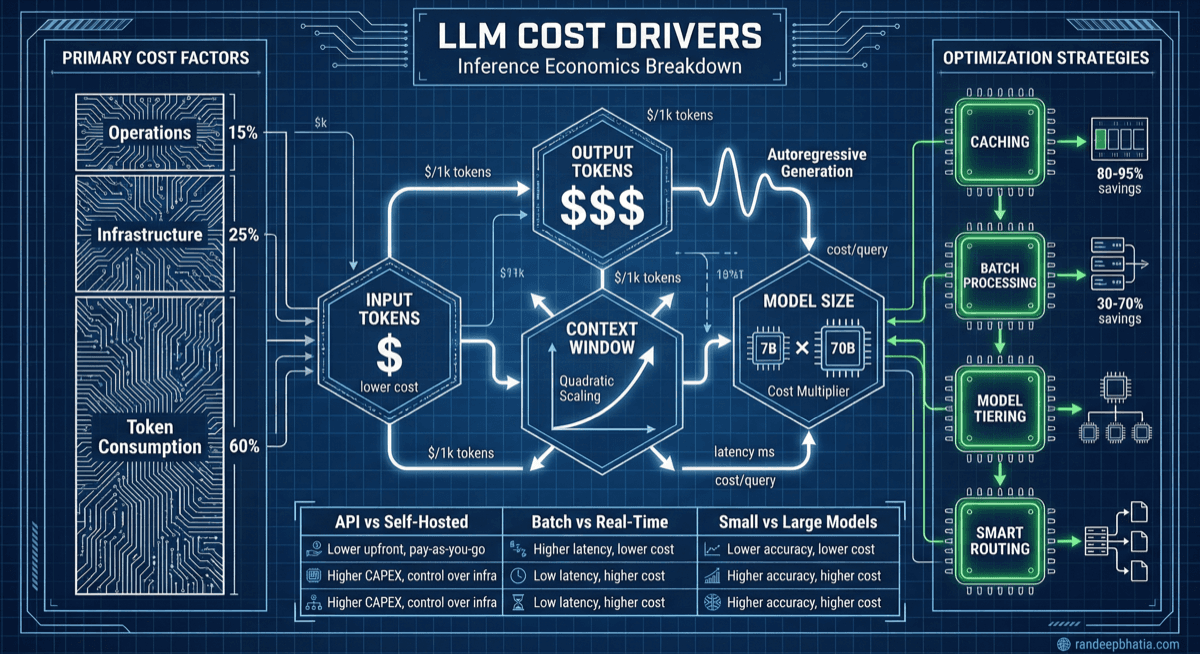
Token consumption (both input and output) represents the primary variable cost in LLM operations, with output tokens typically costing 2-4x more than input tokens due to the autoregressive generation process requiring sequential GPU compute.

2

Infrastructure choices between managed API services, self-hosted open-source models, and hybrid architectures create fundamentally different cost structures with tradeoffs between capital expenditure, operational complexity, and per-query marginal costs.

3

Context window utilization, model selection, caching strategies, and request batching can reduce LLM costs by 60-90% without degrading output quality when properly optimized for specific use case patterns.

The Bottom Line

Understanding LLM cost drivers enables organizations to make informed architectural decisions that balance quality, latency, and expense. Effective cost management requires treating inference economics as a first-class engineering concern rather than an afterthought, with continuous monitoring and optimization across the entire request lifecycle.

Definition

LLM cost drivers are the quantifiable factors that contribute to the total cost of ownership for large language model inference, encompassing compute resources, API consumption, infrastructure overhead, and operational expenses.

These drivers span multiple dimensions including per-token pricing for API-based services, GPU compute hours for self-hosted deployments, memory bandwidth utilization, storage costs for model weights and caches, and the human operational costs of maintaining production LLM systems.

Extended Definition

LLM cost drivers operate across three primary layers: the inference layer where compute costs scale with model size, sequence length, and batch size; the infrastructure layer where costs depend on hosting choices, redundancy requirements, and geographic distribution; and the operational layer where costs emerge from monitoring, debugging, prompt engineering, and quality assurance. The interplay between these layers creates complex cost dynamics where optimizing one dimension may increase costs in another. For example, aggressive caching reduces inference costs but increases storage and cache invalidation complexity. Understanding these relationships is essential for building cost-effective LLM applications that can scale sustainably. The economics of LLM inference differ fundamentally from traditional software where marginal costs approach zero at scale; instead, LLM costs scale roughly linearly with usage, making cost optimization a continuous engineering discipline rather than a one-time infrastructure decision.

Etymology & Origins

The term 'LLM cost drivers' emerged from the intersection of cloud economics terminology and machine learning operations (MLOps) practices around 2022-2023, as organizations began deploying large language models at scale and required frameworks for understanding and managing inference expenses. The concept draws from traditional IT cost driver analysis while incorporating ML-specific factors like token consumption, model parameter counts, and GPU utilization patterns that have no direct analogue in conventional software systems.

Also Known As

Inference economicsLLM operational costsToken economicsModel serving costsAI infrastructure expensesGenerative AI cost factorsLLM TCO componentsInference cost structure

Not To Be Confused With

Training costs

Training costs refer to the one-time or periodic expense of creating or fine-tuning model weights, which can reach millions of dollars for frontier models, while inference cost drivers focus on the ongoing per-request expenses of using trained models in production.

API rate limits

Rate limits constrain throughput capacity and may indirectly affect costs through architectural decisions, but they are access controls rather than direct cost drivers; high rate limits do not inherently mean high costs if requests are not made.

Model quality metrics

Quality metrics like perplexity, accuracy, or human preference scores measure model output effectiveness, while cost drivers measure resource consumption; a more expensive model is not necessarily higher quality, and cost optimization should not be conflated with quality degradation.

Latency requirements

Latency is a performance constraint that influences architectural choices and indirectly affects costs, but it is not itself a cost driver; meeting strict latency requirements often increases costs through over-provisioning or premium infrastructure tiers.

Token limits

Token limits define maximum context window sizes as technical constraints, while token costs are the actual expenses incurred per token processed; staying within limits does not minimize costs, and different positions within limits have different cost implications.

Model parameters

Parameter count describes model size and capability, while cost drivers describe the economic factors of using that model; larger models have higher per-token costs, but parameter count alone does not determine total cost without considering usage patterns.

Conceptual Foundation

Core Principles

(8 principles)

Mental Models

(6 models)

The Metered Utility Model

Think of LLM inference like electricity or water utilities where you pay for exactly what you consume, with different rates for different service tiers (peak vs off-peak, premium vs standard). Just as you would not leave lights on unnecessarily, you should not generate unnecessary tokens.

The Restaurant Kitchen Model

Consider LLM inference like a restaurant kitchen where input tokens are ingredients (relatively cheap), output tokens are prepared dishes (expensive due to chef labor), and context window is counter space (limited and costly to expand). Batch orders are more efficient than individual orders.

The Shipping Container Model

View request batching like shipping containers where sending one item in a container is wasteful, but filling the container amortizes shipping costs across all items. The tradeoff is waiting to fill the container (latency) versus shipping immediately (cost).

The Tiered Service Model

Think of model selection like choosing between economy, business, and first-class airline tickets where all get you to the destination, but with different comfort levels and prices. Not every trip requires first class, and using economy for short trips is often optimal.

The Memory Palace Model

Consider context windows like a memory palace where you can only hold so much information at once, and adding more requires either expanding the palace (expensive) or being selective about what to remember (requires engineering effort).

The Investment Portfolio Model

View infrastructure decisions like investment portfolios where API services are like bonds (predictable, lower risk, moderate returns), self-hosting is like stocks (higher potential returns but more risk and effort), and hybrid approaches provide diversification.

Key Insights

(10 insights)

Output token costs dominate total inference costs for most applications because generation is sequential while input processing is parallel, making response length optimization more impactful than prompt length optimization.

The cheapest token is the one you never generate; semantic caching, response reuse, and early termination strategies often provide 10x better ROI than infrastructure optimization.

Model routing based on query complexity can reduce costs by 40-60% by directing simple queries to smaller, cheaper models while reserving expensive models for complex reasoning tasks.

GPU memory bandwidth, not compute capacity, is often the true bottleneck for LLM inference, meaning memory-optimized instances may provide better cost-performance than compute-optimized ones.

Prompt caching and KV cache reuse can reduce costs by 50-80% for applications with repetitive system prompts or conversation prefixes, but require careful cache key design.

Self-hosted open-source models become cost-competitive with API services at approximately 1-10 million tokens per day, depending on model size and infrastructure choices.

Embedding generation costs are typically 10-100x lower than text generation costs, making RAG architectures significantly more cost-effective than pure generation for knowledge-intensive tasks.

Streaming responses do not reduce costs but can improve perceived latency and enable early termination, which indirectly reduces costs if users frequently stop generation early.

Fine-tuned smaller models can match larger model quality for specific tasks at 5-10x lower inference costs, but require upfront training investment and ongoing maintenance.

Geographic pricing variations between cloud regions can create 20-40% cost differences for identical workloads, making region selection a meaningful optimization lever.

When to Use

Ideal Scenarios

(12)

When building production LLM applications that will process more than 100,000 tokens per day, where cost optimization directly impacts unit economics and business viability.

When designing system architecture for LLM-powered features and needing to make informed decisions about model selection, hosting strategy, and request patterns.

When conducting capacity planning for LLM infrastructure to forecast budgets, provision resources, and set usage quotas across teams or applications.

When optimizing existing LLM applications that have exceeded budget expectations or need to scale without proportional cost increases.

When evaluating build-versus-buy decisions for LLM infrastructure, comparing managed API services against self-hosted open-source alternatives.

When implementing cost allocation and chargeback systems to attribute LLM expenses to specific teams, projects, or customers in multi-tenant environments.

When designing pricing models for LLM-powered products where inference costs must be recovered through customer pricing without eroding margins.

When performing due diligence on AI startups or products to assess the sustainability and scalability of their LLM cost structures.

When negotiating enterprise contracts with LLM API providers to understand which pricing dimensions offer the most leverage for volume discounts.

When implementing FinOps practices for AI workloads to bring the same cost visibility and optimization discipline applied to cloud infrastructure to LLM operations.

When building internal platforms or abstractions over LLM services that need to provide cost transparency and optimization capabilities to internal users.

When conducting post-mortems on LLM cost overruns to identify root causes and implement preventive measures for future deployments.

Prerequisites

(8)
1

Basic understanding of transformer architecture and how attention mechanisms process sequences, including the distinction between prefill and decode phases.

2

Familiarity with tokenization concepts including how text is converted to tokens, typical token-to-word ratios, and how different models use different tokenizers.

3

Knowledge of cloud computing cost models including on-demand versus reserved pricing, spot instances, and the relationship between compute, memory, and storage costs.

4

Understanding of the difference between training and inference in machine learning, and why inference costs are ongoing while training costs are typically one-time.

5

Access to usage metrics and billing data for current LLM deployments, or realistic estimates for planned deployments based on expected usage patterns.

6

Clarity on quality requirements and acceptable tradeoffs, since cost optimization often involves quality-cost tradeoffs that require business input.

7

Understanding of latency requirements and user experience constraints, as many cost optimizations increase latency and may not be acceptable for all use cases.

8

Familiarity with the LLM provider landscape including major API providers, open-source model options, and the general capability-cost tradeoffs between them.

Signals You Need This

(10)

LLM API bills are growing faster than user growth or revenue, indicating inefficient usage patterns or architectural issues that will become unsustainable.

Cost per user or cost per transaction metrics are higher than industry benchmarks or competitive products, threatening unit economics.

Teams are avoiding LLM features due to cost concerns, indicating that cost uncertainty is limiting innovation and product development.

There is no visibility into which features, users, or teams are driving LLM costs, making optimization impossible and creating accountability gaps.

Cost spikes occur unpredictably without clear correlation to business metrics, suggesting uncontrolled usage patterns or missing safeguards.

The organization is considering switching LLM providers primarily for cost reasons without understanding the true cost drivers that may persist across providers.

Self-hosting is being considered without clear analysis of the crossover point where it becomes economically advantageous over API services.

Prompt engineering efforts focus solely on quality without considering the cost implications of prompt length and expected output length.

Caching strategies are absent or ineffective, with high cache miss rates or no caching at all for repetitive queries.

Model selection is uniform across all use cases, using the most capable (and expensive) model even for simple tasks that smaller models could handle.

Organizational Readiness

(7)

Engineering teams have instrumentation capabilities to measure token usage, latency, and costs at the request level with attribution to features and users.

Product and engineering leadership understand that LLM costs scale with usage and have aligned expectations about cost-quality tradeoffs.

Budget ownership is clearly defined with accountability for LLM costs assigned to specific teams or cost centers.

There is organizational appetite for optimization work that may require refactoring prompts, implementing caching, or changing model selection logic.

Cross-functional collaboration between engineering, product, and finance is possible for decisions that involve cost-quality-latency tradeoffs.

The organization has or can develop expertise in LLM operations, including prompt engineering, model evaluation, and infrastructure management.

There is tolerance for experimentation and iteration, as cost optimization often requires testing multiple approaches to find optimal configurations.

When NOT to Use

Anti-Patterns

(12)

Optimizing costs before validating product-market fit, when the priority should be learning and iteration rather than efficiency, and premature optimization may constrain necessary experimentation.

Applying uniform cost optimization across all use cases without considering that different features have different value densities and cost tolerances.

Reducing costs by degrading quality below acceptable thresholds, which may save money short-term but damages user experience and product value.

Over-engineering cost optimization infrastructure for low-volume applications where the engineering cost exceeds potential savings.

Choosing models solely based on cost without considering capability requirements, leading to poor user experiences or failed use cases.

Implementing complex caching systems for highly dynamic content where cache hit rates will be too low to justify the complexity.

Batching requests in latency-sensitive applications where the batching delay degrades user experience more than the cost savings justify.

Self-hosting to save costs without accounting for the full operational burden including on-call, security patching, and infrastructure management.

Optimizing individual components in isolation without considering system-level effects, such as reducing prompt length in ways that increase output length.

Treating cost optimization as a one-time project rather than an ongoing operational discipline that requires continuous monitoring and adjustment.

Applying cost constraints that prevent necessary quality improvements or feature development, treating cost as the primary constraint rather than one of several.

Ignoring the cost of engineering time spent on optimization, which may exceed the infrastructure cost savings for small-scale applications.

Red Flags

(10)

Cost optimization efforts are driven by arbitrary budget targets rather than analysis of value delivered per dollar spent.

Quality metrics are not being tracked alongside cost metrics, making it impossible to detect quality degradation from optimization efforts.

Optimization decisions are made without A/B testing or controlled experiments to validate that quality is maintained.

The organization lacks visibility into current costs and usage patterns, making optimization efforts speculative rather than data-driven.

Cost reduction is positioned as purely an engineering problem without product involvement in quality-cost tradeoff decisions.

There is pressure to reduce costs immediately without time for proper analysis and gradual optimization.

Optimization efforts focus on the largest cost categories without considering which categories offer the best optimization ROI.

The team lacks expertise in LLM operations and is making optimization decisions based on assumptions rather than measured data.

Cost optimization is being used as justification for technical decisions that have other motivations.

There is no baseline measurement of current costs against which to measure optimization progress.

Better Alternatives

(8)
1
When:

Early-stage product development with uncertain requirements

Use Instead:

Focus on rapid iteration and learning using managed API services with usage caps rather than optimizing costs

Why:

Premature optimization constrains experimentation, and the cost of delayed learning exceeds the cost of inefficient API usage during validation phases.

2
When:

Low-volume applications processing fewer than 10,000 tokens per day

Use Instead:

Accept higher per-token costs from managed APIs and focus engineering effort on product features

Why:

The absolute cost savings from optimization are too small to justify engineering investment, and managed services reduce operational burden.

3
When:

Applications where quality is the primary differentiator

Use Instead:

Invest in quality improvements and prompt engineering rather than cost reduction

Why:

For premium products, the value of quality improvements typically exceeds the value of cost savings, and cost pressure may compromise differentiation.

4
When:

Teams without LLM operations expertise

Use Instead:

Use managed services with built-in optimization features rather than building custom optimization infrastructure

Why:

The learning curve and operational risk of custom optimization often exceeds the cost savings, especially for teams new to LLM operations.

5
When:

Highly variable or unpredictable workloads

Use Instead:

Use pay-per-use API services rather than provisioned infrastructure

Why:

The cost of over-provisioning for peak loads or under-provisioning during spikes often exceeds the premium for on-demand pricing.

6
When:

Applications requiring cutting-edge model capabilities

Use Instead:

Accept higher costs for frontier models rather than compromising on capability

Why:

For use cases that require the latest capabilities, the cost of using inferior models (in terms of failed use cases or poor experiences) exceeds the cost premium.

7
When:

Short-term projects or experiments

Use Instead:

Use simple, unoptimized implementations with hard spending caps

Why:

The investment in optimization infrastructure will not be amortized over enough usage to justify the effort.

8
When:

Compliance-sensitive applications with strict data residency requirements

Use Instead:

Prioritize compliance over cost optimization when they conflict

Why:

The cost of compliance violations far exceeds any savings from cost-optimized but non-compliant architectures.

Common Mistakes

(10)

Focusing on input token optimization when output tokens are the dominant cost driver, achieving minimal savings while adding prompt complexity.

Implementing aggressive caching without proper cache invalidation, leading to stale responses that degrade user experience.

Switching to smaller models without proper evaluation, resulting in quality degradation that increases downstream costs through user complaints and manual intervention.

Over-batching requests to maximize efficiency, creating unacceptable latency for users and degrading real-time experiences.

Ignoring the operational costs of self-hosting when comparing against API pricing, leading to underestimated total cost of ownership.

Optimizing for average case costs without considering tail cases, leading to cost spikes from edge cases that exceed typical usage.

Implementing cost controls that block legitimate high-value usage, such as hard limits that prevent important but expensive queries.

Treating all tokens as equal when different use cases have different value densities and should have different cost tolerances.

Optimizing prompts for brevity in ways that reduce output quality, trading visible cost savings for hidden quality costs.

Failing to account for the cost of failed requests and retries when calculating effective per-request costs.

Core Taxonomy

Primary Types

(8 types)

The direct costs of GPU or TPU compute resources required to execute model inference, including both the prefill phase (processing input tokens) and the decode phase (generating output tokens). These costs scale with model size, sequence length, and request volume.

Characteristics
  • Scales linearly with token count for fixed model size
  • Scales roughly linearly with model parameter count
  • Decode phase costs 10-100x more per token than prefill due to sequential processing
  • Can be reduced through batching, quantization, and hardware optimization
  • Represents 60-80% of total inference costs for most deployments
Use Cases
Real-time inference for user-facing applicationsBatch processing for offline analysisEmbedding generation for search and retrievalFine-tuning inference for specialized tasks
Tradeoffs

Higher compute investment enables larger models with better quality but increases per-token costs; optimization techniques like quantization reduce compute needs but may impact quality.

Classification Dimensions

Cost Variability

Costs can be classified by how they scale with usage, which affects budgeting, forecasting, and optimization strategies. Fixed costs favor high utilization while variable costs favor efficiency.

Fixed costs (infrastructure, licenses)Variable costs (per-token, per-request)Step-function costs (capacity tiers)Hidden costs (operational, opportunity)

Cost Attribution

Costs can be classified by how easily they can be attributed to specific users, features, or requests, which affects chargeback models and optimization targeting.

Direct costs (clearly attributable to specific usage)Shared costs (infrastructure shared across workloads)Overhead costs (management, monitoring)Opportunity costs (foregone alternatives)

Cost Controllability

Costs can be classified by the degree of control the organization has over them, which affects where optimization efforts should focus.

Controllable costs (can be directly optimized)Influenceable costs (can be indirectly reduced)Committed costs (locked in by prior decisions)External costs (determined by providers)

Cost Timing

Costs can be classified by when they are incurred relative to the value they provide, which affects cash flow planning and investment decisions.

Upfront costs (paid before usage)Ongoing costs (paid during usage)Deferred costs (paid after usage)Sunk costs (already paid, not recoverable)

Cost Visibility

Costs can be classified by how easily they are observed and measured, which affects whether they are considered in optimization decisions.

Visible costs (appear on invoices)Hidden costs (not directly billed)Opportunity costs (value of alternatives)Technical debt costs (future remediation)

Cost Optimization Potential

Costs can be classified by the return on investment from optimization efforts, which helps prioritize where to focus limited engineering resources.

High leverage (small changes, large savings)Medium leverage (moderate effort, moderate savings)Low leverage (significant effort, small savings)Negative leverage (optimization costs exceed savings)

Evolutionary Stages

1

Ad-hoc Usage

0-3 months from initial LLM adoption

No cost tracking or optimization, direct API calls without abstraction, costs treated as R&D expense, no usage policies or limits. Typical of early experimentation and proof-of-concept phases.

2

Cost Awareness

3-6 months from initial adoption

Basic usage monitoring implemented, costs tracked at aggregate level, initial budgets established, awareness of cost drivers but limited optimization. Teams begin to consider costs in design decisions.

3

Active Optimization

6-12 months from initial adoption

Systematic cost optimization efforts, caching and batching implemented, model routing based on task complexity, cost attribution to teams or features, regular cost reviews and optimization sprints.

4

Cost Engineering

12-24 months from initial adoption

Cost optimization embedded in development processes, automated cost testing in CI/CD, real-time cost monitoring and alerting, sophisticated model routing and caching, cost-aware architecture decisions.

5

FinOps Maturity

24+ months from initial adoption

Full cost visibility and attribution, predictive cost modeling, automated optimization, cost-quality tradeoff frameworks, continuous improvement culture, cost efficiency as competitive advantage.

Architecture Patterns

Architecture Patterns

(8 patterns)

Tiered Model Routing

Route requests to different models based on task complexity, with simpler queries handled by smaller, cheaper models and complex queries routed to larger, more capable models. Classification can be rule-based, ML-based, or use a small model to assess complexity.

Components
  • Request classifier (rule-based or ML)
  • Model registry with capability and cost metadata
  • Routing logic with fallback handling
  • Quality monitoring to validate routing decisions
  • Feedback loop to improve classification
Data Flow

Request arrives → Classifier assesses complexity → Router selects appropriate model → Model processes request → Quality monitor validates output → Feedback updates classifier

Best For
  • Applications with diverse query complexity
  • High-volume systems where cost optimization is critical
  • Products with clear quality tiers (free vs premium)
  • Workloads with predictable complexity patterns
Limitations
  • Classification errors can degrade quality or waste costs
  • Requires ongoing tuning as usage patterns change
  • Adds latency for classification step
  • Complex to implement quality-preserving fallbacks
Scaling Characteristics

Scales horizontally by adding model instances; classification overhead is minimal; main scaling challenge is maintaining quality consistency across model tiers

Integration Points

API Gateway

Central point for request routing, rate limiting, authentication, and cost tracking for all LLM requests

Interfaces:
REST/GraphQL API for client requestsMetrics export for monitoring systemsConfiguration API for routing rulesWebhook for cost alerts

Gateway adds latency but provides essential control and visibility; should be highly available and low-latency; consider edge deployment for global applications

Cost Attribution Service

Track and attribute LLM costs to specific users, features, teams, or cost centers for chargeback and optimization targeting

Interfaces:
Event ingestion from inference servicesQuery API for cost reportsIntegration with billing systemsExport to data warehouses

Attribution granularity affects storage costs; real-time attribution enables immediate feedback; historical data enables trend analysis

Model Registry

Maintain metadata about available models including capabilities, costs, latency characteristics, and routing rules

Interfaces:
CRUD API for model metadataQuery API for model selectionIntegration with deployment systemsVersion management

Registry should be highly available as it is on the critical path; caching reduces lookup latency; versioning enables gradual rollouts

Caching Infrastructure

Store and retrieve cached responses, embeddings, and intermediate results to reduce redundant inference

Interfaces:
Key-value store for exact matchesVector store for semantic similarityTTL and invalidation APIsCache statistics for monitoring

Cache size and TTL affect hit rates and storage costs; semantic caching requires embedding infrastructure; invalidation strategy affects freshness

Monitoring and Alerting

Track cost metrics, usage patterns, and anomalies to enable optimization and prevent cost overruns

Interfaces:
Metrics ingestion from all componentsDashboard APIs for visualizationAlert configuration and routingAnomaly detection integration

Real-time monitoring enables immediate response; historical analysis enables trend identification; alerting prevents cost surprises

Quality Evaluation Service

Assess output quality to ensure cost optimizations do not degrade user experience

Interfaces:
Evaluation API for automated checksHuman review workflow integrationA/B test result aggregationQuality metric dashboards

Evaluation costs must be factored into optimization ROI; automated evaluation enables continuous monitoring; human evaluation provides ground truth

Budget Management Service

Enforce spending limits, allocate budgets across teams, and provide forecasting for capacity planning

Interfaces:
Budget configuration APIReal-time spend trackingForecast generationLimit enforcement hooks

Hard limits may block legitimate usage; soft limits with alerts provide flexibility; forecasting accuracy depends on usage predictability

Prompt Management System

Version, optimize, and manage prompts to enable systematic prompt engineering and cost optimization

Interfaces:
Prompt CRUD and versioningA/B testing integrationCost and quality metrics per promptOptimization suggestions

Prompt changes can significantly affect costs; versioning enables rollback; metrics enable data-driven optimization

Decision Framework

✓ If Yes

Invest in systematic cost optimization infrastructure including monitoring, caching, and model routing

✗ If No

Focus on basic cost hygiene (usage monitoring, reasonable limits) and prioritize product development

Considerations

The threshold varies by organization size and growth rate; fast-growing applications may benefit from earlier optimization investment

Technical Deep Dive

Overview

LLM inference costs emerge from the computational requirements of transformer-based neural networks processing sequences of tokens. The fundamental operations are matrix multiplications between input activations and model weights, with costs scaling based on model size (parameter count), sequence length (context window utilization), and batch size (concurrent requests). Understanding these mechanics is essential for effective cost optimization. The inference process has two distinct phases with different cost characteristics. The prefill phase processes all input tokens in parallel, computing attention across the entire input sequence. The decode phase generates output tokens one at a time, with each token requiring attention over all previous tokens. This asymmetry explains why output tokens cost more than input tokens. Cost optimization operates at multiple levels: algorithmic optimizations reduce the fundamental compute required, system optimizations improve hardware utilization, and architectural optimizations reduce the number of inference calls needed. Effective cost management requires understanding and optimizing at all three levels. The economics of LLM inference differ fundamentally from traditional software. While conventional applications have near-zero marginal costs at scale, LLM inference has significant per-request costs that scale linearly with usage. This makes cost optimization a continuous engineering discipline rather than a one-time infrastructure decision.

Step-by-Step Process

The inference request arrives containing the prompt text, generation parameters (temperature, max_tokens, etc.), and metadata. The system validates the request, checks rate limits and quotas, and routes to the appropriate model endpoint. Preprocessing includes tokenization, which converts text to token IDs using the model's vocabulary.

⚠️ Pitfalls to Avoid

Tokenization overhead is often overlooked but can be significant for high-throughput systems. Different models use different tokenizers, so token counts vary between providers. Preprocessing latency adds to total response time.

Under The Hood

At the hardware level, LLM inference is dominated by matrix multiplication operations between input activations and model weight matrices. For a model with hidden dimension H and sequence length S, each transformer layer performs attention computations scaling as O(S²H) and feed-forward computations scaling as O(SH²). With L layers, total compute scales as O(L(S²H + SH²)). For typical models where H >> S, the feed-forward computation dominates, but for long sequences, attention becomes the bottleneck. GPU utilization during inference is often limited by memory bandwidth rather than compute capacity. Model weights must be loaded from GPU memory (HBM) to compute units for each forward pass. For a 70B parameter model in FP16, this requires loading 140GB of weights. With HBM bandwidth of ~2TB/s on modern GPUs, weight loading alone takes ~70ms, setting a floor on per-token latency regardless of compute speed. This memory-bound nature explains why techniques like quantization (reducing weight precision) and batching (amortizing weight loading across requests) are so effective. The KV cache is a critical optimization that avoids recomputing attention for previous tokens during decode. For each layer, the cache stores key and value vectors for all previous tokens, requiring O(LSH) memory. For long sequences and large batches, KV cache memory can exceed model weight memory, limiting batch sizes. Techniques like PagedAttention manage KV cache memory more efficiently by allocating non-contiguous blocks, similar to virtual memory in operating systems. Batching improves throughput by processing multiple requests simultaneously, amortizing the fixed cost of weight loading across requests. However, batching is constrained by memory (KV cache for all requests must fit in GPU memory) and heterogeneity (requests with different lengths require padding, wasting compute). Continuous batching allows new requests to join in-progress batches as slots become available, improving utilization compared to static batching. Quantization reduces model size and memory bandwidth requirements by using lower precision representations. INT8 quantization halves memory requirements compared to FP16, while INT4 quantization quarters them. The tradeoff is potential quality degradation, though modern quantization techniques like GPTQ and AWQ minimize quality loss. Quantization is particularly effective for memory-bound inference, where reduced memory bandwidth requirements directly translate to improved throughput.

Failure Modes

Root Cause

Missing or ineffective max_tokens limits allowing models to generate extremely long responses, combined with high request volumes

Symptoms
  • Sudden spike in API costs without corresponding traffic increase
  • Individual requests consuming 10-100x expected tokens
  • Billing alerts triggered unexpectedly
  • Slow response times as generation continues indefinitely
Impact

Direct financial impact from excessive token consumption; potential service degradation from resource exhaustion; budget overruns affecting other projects

Prevention

Implement hard max_tokens limits at multiple levels (application, API gateway, provider); set up cost alerting with low thresholds; review generation parameters in code reviews

Mitigation

Immediately reduce max_tokens limits; implement request-level cost caps; review and terminate long-running requests; analyze logs to identify problematic patterns

Operational Considerations

Key Metrics (15)

The effective cost for processing one million input tokens, accounting for all overhead and inefficiencies

Normal$0.50-$30 depending on model tier
Alert>20% above baseline for same model
ResponseInvestigate efficiency degradation; check for prompt bloat; review caching effectiveness

Dashboard Panels

Real-time cost accumulation with budget overlay and projectionToken consumption breakdown by input/output and model tierCache performance including hit rate, latency, and storage utilizationModel routing distribution with quality metrics per tierCost attribution by team, feature, and customerRequest volume and error rates over timeLatency distribution with P50, P95, P99 percentilesGPU utilization and memory usage for self-hosted infrastructureProvider health status and rate limit headroomCost efficiency trends (cost per request, cost per user)

Alerting Strategy

Implement tiered alerting with different severity levels and response expectations. Cost alerts should fire at 50%, 75%, and 90% of budget with escalating urgency. Efficiency alerts should detect degradation early through statistical anomaly detection rather than fixed thresholds. Combine leading indicators (cache hit rate, retry rate) with lagging indicators (total cost) for comprehensive coverage. Route alerts to appropriate teams based on the type of issue (infrastructure vs application vs cost management).

Cost Analysis

Cost Drivers

(10)

Output Token Volume

Impact:

Primary cost driver for most applications; output tokens cost 2-4x input tokens due to sequential generation; dominates total cost for generation-heavy use cases

Optimization:

Implement output length controls; use structured output formats; add explicit length guidance in prompts; implement early stopping; consider summarization for long outputs

Input Token Volume

Impact:

Secondary cost driver; scales with prompt length and context size; can dominate for RAG applications with large retrieved contexts

Optimization:

Compress prompts; summarize retrieved context; implement efficient retrieval to reduce context size; cache common prompt prefixes

Model Selection

Impact:

10-100x cost difference between model tiers; frontier models (GPT-4, Claude 3 Opus) cost significantly more than smaller models

Optimization:

Implement tiered routing based on query complexity; use smaller models for simple tasks; reserve expensive models for complex reasoning

Request Volume

Impact:

Linear scaling of costs with request count; high-traffic applications accumulate significant costs even with low per-request costs

Optimization:

Implement caching to reduce inference requests; batch similar requests; deduplicate redundant queries; implement rate limiting for non-critical paths

Context Window Utilization

Impact:

Longer contexts increase both input costs and attention computation costs; extended context models have premium pricing

Optimization:

Implement context management strategies; use summarization for long conversations; implement sliding window approaches; use RAG instead of long context

Cache Miss Rate

Impact:

Each cache miss requires full inference; low hit rates negate caching infrastructure investment

Optimization:

Optimize cache key design; tune similarity thresholds for semantic caching; extend TTLs for stable content; warm caches proactively

Retry and Error Rate

Impact:

Failed requests that are retried multiply effective costs; high error rates indicate wasted inference

Optimization:

Improve request quality to reduce errors; implement circuit breakers; use exponential backoff; address root causes of failures

Infrastructure Overhead

Impact:

Self-hosted deployments have fixed infrastructure costs regardless of utilization; underutilization increases effective per-request costs

Optimization:

Right-size infrastructure; improve utilization through batching; use spot instances; implement auto-scaling; consider hybrid approaches

Operational Overhead

Impact:

Engineering time for optimization, monitoring, and maintenance has real costs that should be factored into total cost of ownership

Optimization:

Automate routine optimization tasks; use managed services where operational cost exceeds infrastructure savings; invest in tooling

Geographic Distribution

Impact:

Different cloud regions have different pricing; data transfer between regions adds costs; compliance requirements may constrain options

Optimization:

Deploy in cost-effective regions where compliance allows; minimize cross-region data transfer; use edge caching for global applications

Cost Models

API Service Cost Model

Total Cost = (Input Tokens × Input Price per Token) + (Output Tokens × Output Price per Token)
Variables:
Input Tokens: Total tokens in promptsOutput Tokens: Total tokens generatedInput Price: Provider's per-token input rate (typically $X per 1M tokens)Output Price: Provider's per-token output rate (typically 2-4x input rate)
Example:

For GPT-4 Turbo at $10/1M input, $30/1M output: 1000 requests with average 500 input tokens and 200 output tokens = (500K × $0.00001) + (200K × $0.00003) = $5 + $6 = $11

Self-Hosted Cost Model

Total Cost = (GPU Hours × GPU Rate) + (Storage × Storage Rate) + (Network × Network Rate) + Operational Overhead
Variables:
GPU Hours: Total GPU compute timeGPU Rate: Hourly cost per GPU (varies by type and pricing model)Storage: Model weights and cache storageNetwork: Data transfer costsOperational Overhead: Engineering time, monitoring, etc.
Example:

For A100 GPU at $3/hour with 70% utilization serving 1M tokens/hour: Monthly cost = 720 hours × $3 = $2,160 for ~500M tokens = ~$4.30 per 1M tokens (before operational overhead)

Effective Cost with Caching

Effective Cost = Base Cost × (1 - Cache Hit Rate) + Cache Infrastructure Cost
Variables:
Base Cost: Cost without cachingCache Hit Rate: Percentage of requests served from cacheCache Infrastructure Cost: Storage, compute for cache lookups, embedding generation
Example:

With 60% cache hit rate on $10,000 monthly base cost and $500 cache infrastructure: Effective cost = $10,000 × 0.4 + $500 = $4,500 (55% savings)

Tiered Routing Cost Model

Total Cost = Σ(Traffic Share for Tier × Requests × Cost per Request for Tier)
Variables:
Traffic Share: Percentage of requests routed to each tierRequests: Total request volumeCost per Request: Average cost for requests in each tier
Example:

With 70% to small model ($0.001/req), 25% to medium ($0.01/req), 5% to large ($0.10/req) for 100K requests: Cost = 70K×$0.001 + 25K×$0.01 + 5K×$0.10 = $70 + $250 + $500 = $820 vs $10,000 if all large

Optimization Strategies

  • 1Implement semantic caching with embedding-based similarity search to serve repeated queries from cache
  • 2Use tiered model routing to match model capability to query complexity
  • 3Optimize prompts for conciseness without sacrificing quality
  • 4Implement output length controls through max_tokens and prompt guidance
  • 5Batch requests for throughput-optimized workloads to improve GPU utilization
  • 6Use prompt caching / KV cache reuse for shared prompt prefixes
  • 7Compress context through summarization and selective retrieval
  • 8Evaluate and deploy quantized models for cost-sensitive use cases
  • 9Implement request deduplication to avoid processing identical requests
  • 10Use structured output formats to reduce verbose natural language responses
  • 11Negotiate volume discounts with providers for committed usage
  • 12Implement hybrid self-hosted and API architecture for optimal cost at different scales
  • 13Use spot instances for batch workloads that can tolerate interruption
  • 14Implement early stopping for responses that complete before max_tokens
  • 15Monitor and optimize embedding generation costs for RAG applications

Hidden Costs

  • 💰Engineering time for prompt optimization and maintenance
  • 💰Quality assurance and evaluation infrastructure
  • 💰Monitoring and observability tooling
  • 💰On-call burden for production LLM systems
  • 💰Training and skill development for teams
  • 💰Opportunity cost of engineering resources spent on optimization
  • 💰Cost of failed requests and retries
  • 💰Cache infrastructure and storage costs
  • 💰Data transfer and network costs
  • 💰Compliance and security overhead

ROI Considerations

Return on investment for LLM cost optimization depends on current spend levels, expected growth, and engineering opportunity cost. Organizations spending less than $10,000 monthly on LLM inference should focus on basic cost hygiene and product development rather than sophisticated optimization. At $10,000-$100,000 monthly, systematic optimization can yield 30-50% savings, often justifying dedicated engineering investment. Above $100,000 monthly, comprehensive optimization programs including self-hosting evaluation, advanced caching, and model routing typically provide strong ROI. The ROI calculation should include both direct cost savings and indirect benefits such as improved scalability, better cost predictability, and reduced risk of cost overruns. However, it should also account for the opportunity cost of engineering time that could be spent on product features, as well as the ongoing maintenance burden of optimization infrastructure. Organizations should establish clear cost targets based on business value rather than arbitrary reduction goals. A feature that generates $1 of value per $0.10 of LLM cost has healthy unit economics even if the absolute cost seems high. Conversely, optimizing a feature with poor unit economics may be less valuable than reconsidering whether the feature should exist. Cost optimization should be treated as a continuous discipline rather than a one-time project. Usage patterns change, provider pricing evolves, and new optimization techniques emerge. Organizations that build cost awareness into their development culture and operational practices will maintain efficiency over time, while those that treat optimization as a periodic project will see efficiency degrade between optimization efforts.

Security Considerations

Threat Model

(10 threats)
1

Cost Denial of Service

Attack Vector

Attacker submits many expensive requests or crafts prompts that generate extremely long outputs to exhaust victim's budget

Impact

Budget exhaustion; service degradation for legitimate users; financial damage

Mitigation

Implement per-user rate limits; set hard budget caps; monitor for anomalous usage patterns; implement request cost estimation and rejection

2

Prompt Injection for Cost Amplification

Attack Vector

Malicious input causes model to generate excessive output, make many tool calls, or enter loops that consume resources

Impact

Cost amplification; resource exhaustion; potential service disruption

Mitigation

Input validation and sanitization; strict output limits; tool call depth limits; anomaly detection for unusual generation patterns

3

API Key Theft and Abuse

Attack Vector

Attacker obtains API keys through code exposure, phishing, or system compromise and uses them for unauthorized inference

Impact

Unauthorized costs charged to victim; potential data exposure; reputational damage

Mitigation

Secure key management; key rotation; usage monitoring and alerting; IP allowlisting; separate keys for different environments

4

Budget Manipulation

Attack Vector

Insider or compromised account modifies budget limits or cost attribution to hide unauthorized usage

Impact

Undetected cost overruns; incorrect cost attribution; potential fraud

Mitigation

Access controls on budget configuration; audit logging; separation of duties; regular reconciliation with provider bills

5

Cache Poisoning

Attack Vector

Attacker crafts inputs that cause incorrect or malicious responses to be cached and served to other users

Impact

Quality degradation; potential safety issues; trust erosion

Mitigation

Response validation before caching; cache isolation between users where appropriate; cache TTL limits; anomaly detection

6

Model Extraction via API

Attack Vector

Attacker makes many queries to extract model behavior, potentially to train competing models or find vulnerabilities

Impact

Intellectual property loss; cost of queries; potential vulnerability discovery

Mitigation

Rate limiting; query pattern monitoring; terms of service enforcement; response perturbation for sensitive models

7

Data Exfiltration via Prompts

Attack Vector

Malicious prompts attempt to extract sensitive information from model context or training data

Impact

Data breach; privacy violations; compliance issues

Mitigation

Input filtering; output scanning; context isolation; data minimization in prompts

8

Inference Infrastructure Compromise

Attack Vector

Attacker compromises self-hosted inference infrastructure to access model weights, user data, or compute resources

Impact

Data breach; model theft; resource hijacking; service disruption

Mitigation

Infrastructure security hardening; network segmentation; access controls; monitoring; incident response planning

9

Supply Chain Attack on Models

Attack Vector

Compromised model weights or serving infrastructure introduce backdoors or vulnerabilities

Impact

Compromised outputs; potential data exfiltration; trust erosion

Mitigation

Model provenance verification; integrity checking; trusted sources; security scanning

10

Cost Attribution Evasion

Attack Vector

User manipulates requests to avoid cost attribution or exceed quotas without detection

Impact

Incorrect cost allocation; quota bypass; unfair resource consumption

Mitigation

Robust attribution mechanisms; server-side enforcement; audit logging; anomaly detection

Security Best Practices

  • Implement defense in depth with multiple layers of cost controls (application, gateway, provider)
  • Use least privilege access for API keys and budget configuration
  • Rotate API keys regularly and immediately on suspected compromise
  • Monitor for anomalous usage patterns that may indicate abuse or compromise
  • Implement rate limiting at multiple levels (per user, per IP, per API key)
  • Set hard budget caps that cannot be exceeded regardless of usage
  • Validate and sanitize all inputs before sending to LLM APIs
  • Implement output scanning for sensitive information before returning to users
  • Use separate API keys and budgets for different environments (dev, staging, prod)
  • Audit log all cost-related configuration changes
  • Implement IP allowlisting for API access where feasible
  • Encrypt API keys at rest and in transit
  • Regular security reviews of cost management infrastructure
  • Incident response plan for cost-related security events
  • Employee training on secure handling of API credentials

Data Protection

  • 🔒Minimize sensitive data in prompts; use references or IDs instead of actual data where possible
  • 🔒Implement prompt and response logging policies that balance debugging needs with privacy
  • 🔒Use data masking or tokenization for sensitive fields before including in prompts
  • 🔒Implement retention policies for cached responses containing user data
  • 🔒Verify provider data handling practices and contractual commitments
  • 🔒Consider on-premises or private cloud deployment for highly sensitive data
  • 🔒Implement access controls on prompt and response logs
  • 🔒Regular audits of data handling practices
  • 🔒Employee training on data protection in LLM contexts
  • 🔒Incident response procedures for data exposure events

Compliance Implications

SOC 2

Requirement:

Controls over system availability, security, and confidentiality including cost management systems

Implementation:

Document cost controls; implement access management; maintain audit logs; regular control testing

GDPR

Requirement:

Data protection for personal data processed by LLMs; data minimization; purpose limitation

Implementation:

Minimize personal data in prompts; implement data retention policies; document processing purposes; enable data subject rights

HIPAA

Requirement:

Protection of protected health information (PHI) in healthcare applications

Implementation:

Use HIPAA-compliant providers; implement BAAs; encrypt PHI; audit access; minimize PHI in prompts

PCI DSS

Requirement:

Protection of payment card data; secure handling of cardholder information

Implementation:

Never include card data in prompts; use PCI-compliant infrastructure; implement access controls

Financial Services Regulations

Requirement:

Model risk management; explainability; audit trails for financial decisions

Implementation:

Document model selection rationale; maintain decision audit trails; implement model governance

AI-Specific Regulations (EU AI Act)

Requirement:

Transparency, accountability, and risk management for AI systems

Implementation:

Document AI system purposes; implement risk assessments; maintain transparency about AI use

Data Residency Requirements

Requirement:

Data must remain within specific geographic boundaries

Implementation:

Use region-specific deployments; verify provider data handling; implement data flow controls

Export Controls

Requirement:

Restrictions on AI technology transfer to certain countries or entities

Implementation:

Verify user locations; implement access controls; comply with export regulations

Scaling Guide

Scaling Dimensions

Request Volume

Strategy:

Scale horizontally by adding inference capacity; implement load balancing; use auto-scaling based on queue depth or latency

Limits:

Provider rate limits; infrastructure capacity; budget constraints

Considerations:

Cost scales linearly with volume; efficiency optimizations become more valuable at scale; consider batching for throughput

Token Throughput

Strategy:

Optimize tokens per second through batching, hardware upgrades, and model optimization; implement parallel processing

Limits:

GPU memory bandwidth; model size; batch size constraints

Considerations:

Throughput optimization often trades off with latency; different optimization strategies for prefill vs decode

Concurrent Users

Strategy:

Implement connection pooling; use async processing; scale inference capacity based on concurrent load

Limits:

Connection limits; memory for concurrent requests; provider concurrency limits

Considerations:

Concurrent users may have correlated request patterns; implement graceful degradation under load

Context Length

Strategy:

Use extended context models; implement context management strategies; optimize KV cache usage

Limits:

Model context limits; memory for KV cache; quadratic attention scaling

Considerations:

Longer contexts increase costs superlinearly; context management often more cost-effective than extended context models

Model Diversity

Strategy:

Implement model routing; maintain multiple model deployments; use model-specific optimization

Limits:

Operational complexity; infrastructure overhead; routing accuracy

Considerations:

More models increase flexibility but add operational burden; consolidate where possible

Geographic Distribution

Strategy:

Deploy in multiple regions; use edge caching; implement global load balancing

Limits:

Provider availability; data residency requirements; cost of multi-region deployment

Considerations:

Geographic distribution reduces latency but increases complexity and potentially cost

Feature Complexity

Strategy:

Implement feature-specific optimization; use appropriate models per feature; monitor per-feature costs

Limits:

Engineering capacity; optimization ROI; quality requirements

Considerations:

Different features have different cost-quality tradeoffs; optimize high-volume features first

Budget

Strategy:

Implement budget allocation and enforcement; prioritize high-value usage; optimize for ROI

Limits:

Organizational budget constraints; cost of optimization; quality requirements

Considerations:

Budget scaling requires both cost optimization and value demonstration

Capacity Planning

Key Factors:
Expected request volume growth rateAverage tokens per request (input and output)Peak to average traffic ratioCache hit rate expectationsModel tier distributionLatency requirementsBudget constraintsRedundancy requirements
Formula:Required Capacity = (Peak Requests per Second × Average Tokens per Request × (1 - Cache Hit Rate)) / Tokens per Second per Instance × Redundancy Factor
Safety Margin:

Maintain 30-50% headroom above expected peak load to handle traffic spikes, failed instances, and growth. For critical applications, maintain ability to scale 2-3x within minutes through auto-scaling or provider capacity.

Scaling Milestones

< 100K tokens/day
Challenges:
  • Limited data for optimization decisions
  • Cost not yet significant enough to justify optimization investment
  • Usage patterns still being established
Architecture Changes:

Use managed API services; implement basic monitoring; focus on product development rather than optimization

100K - 1M tokens/day
Challenges:
  • Costs becoming noticeable
  • Need for basic cost visibility
  • Initial optimization opportunities emerging
Architecture Changes:

Implement cost monitoring and attribution; add basic caching for repetitive queries; establish usage policies

1M - 10M tokens/day
Challenges:
  • Costs significant enough to require optimization
  • Need for systematic cost management
  • Provider rate limits may become relevant
Architecture Changes:

Implement semantic caching; add model routing for query complexity; establish budget controls; evaluate self-hosting economics

10M - 100M tokens/day
Challenges:
  • Costs are major expense category
  • Self-hosting becomes economically attractive
  • Need for sophisticated optimization
Architecture Changes:

Implement hybrid self-hosted and API architecture; deploy comprehensive caching; implement advanced routing; establish FinOps practices

100M - 1B tokens/day
Challenges:
  • Infrastructure complexity significant
  • Need for dedicated optimization team
  • Provider relationships become strategic
Architecture Changes:

Dedicated inference infrastructure; custom optimization tooling; multi-provider strategy; advanced batching and scheduling

> 1B tokens/day
Challenges:
  • Operating at scale of major providers
  • Custom hardware and optimization may be justified
  • Cost optimization is competitive advantage
Architecture Changes:

Custom inference infrastructure; potential custom hardware; dedicated optimization teams; strategic provider partnerships

Enterprise multi-tenant
Challenges:
  • Cost isolation between tenants
  • Fair resource allocation
  • Chargeback and billing complexity
Architecture Changes:

Tenant-aware cost attribution; quota management; usage-based billing integration; tenant isolation for caching

Benchmarks

Industry Benchmarks

MetricP50P95P99 World Class
Cost per 1M input tokens (GPT-4 class)$10-15$25-30$50+$5-8 (with optimization)
Cost per 1M output tokens (GPT-4 class)$30-45$60-90$120+$15-25 (with optimization)
Cost per 1M tokens (GPT-3.5 class)$0.50-1.00$1.50-2.00$3.00+$0.20-0.40 (with optimization)
Cache hit rate20-30%50-60%70-80%80-95% (for cacheable workloads)
Cost reduction from optimization20-30%40-50%60-70%70-90% (comprehensive optimization)
Input/output token ratio2:1 to 3:15:1 to 10:110:1+Varies by use case; optimize for value
Cost per customer interaction$0.01-0.05$0.10-0.25$0.50+$0.005-0.02
Self-hosted vs API cost ratio0.3-0.5x at scale0.5-0.7x0.8-1.0x (underutilized)0.2-0.3x (highly optimized)
GPU utilization (self-hosted)40-50%60-70%75-85%85-95%
Cost attribution coverage60-70%80-90%95%+99%+ with full granularity
Budget variance±20-30%±10-15%±5-10%±5% with accurate forecasting
Time to detect cost anomalyHours to daysMinutes to hoursSeconds to minutesReal-time with automated response

Comparison Matrix

Provider/ApproachInput Cost (per 1M)Output Cost (per 1M)LatencyQualityOperational BurdenBest For
OpenAI GPT-4 Turbo$10$30Low-MediumHighestMinimalComplex reasoning, quality-critical
OpenAI GPT-3.5 Turbo$0.50$1.50LowGoodMinimalHigh volume, simpler tasks
Anthropic Claude 3 Opus$15$75MediumHighestMinimalLong context, nuanced tasks
Anthropic Claude 3 Sonnet$3$15Low-MediumHighMinimalBalanced cost-quality
Anthropic Claude 3 Haiku$0.25$1.25Very LowGoodMinimalHigh volume, fast response
Google Gemini Pro$0.50$1.50LowGood-HighMinimalGoogle ecosystem integration
Self-hosted Llama 70B$2-5 effective$2-5 effectiveVariableGood-HighHighHigh volume, data privacy
Self-hosted Llama 7B$0.20-0.50 effective$0.20-0.50 effectiveLowModerateMediumSimple tasks, cost-sensitive
Self-hosted Mistral 7B$0.20-0.50 effective$0.20-0.50 effectiveLowGoodMediumBalanced open-source option
Hybrid (Self-hosted + API)VariableVariableVariableHighHighOptimized cost at scale

Performance Tiers

Cost-Optimized

Prioritizes cost efficiency over latency and sometimes quality; uses smallest viable models, aggressive caching, and batching

Target:

Cost per request minimized; latency acceptable for use case; quality meets minimum threshold

Balanced

Balances cost, latency, and quality; uses tiered routing and moderate caching; typical production configuration

Target:

Cost within budget; latency meets SLAs; quality satisfies users

Quality-Optimized

Prioritizes output quality; uses best available models; minimal optimization that might affect quality

Target:

Highest quality outputs; cost secondary concern; latency acceptable

Latency-Optimized

Prioritizes response speed; uses fast models, edge deployment, aggressive caching; may sacrifice cost efficiency

Target:

Minimum latency; quality maintained; cost acceptable for speed

Enterprise

Comprehensive optimization with full visibility, compliance, and control; sophisticated routing and caching; dedicated resources

Target:

All metrics optimized; full cost visibility; compliance requirements met

Real World Examples

Real-World Scenarios

(8 examples)
1

E-commerce Product Description Generation

Context

Large e-commerce platform generating product descriptions for millions of SKUs, with varying complexity from simple items to technical products

Approach

Implemented tiered model routing based on product category complexity, semantic caching for similar products, and batch processing for catalog updates. Used small models for simple products (clothing, accessories) and larger models for technical products (electronics, appliances).

Outcome

Reduced cost per description by 65% while maintaining quality. Cache hit rate of 40% for similar products. Processing time for full catalog reduced from days to hours.

Lessons Learned
  • 💡Product category is a strong signal for model selection
  • 💡Similar products often need similar descriptions, enabling high cache hit rates
  • 💡Batch processing is ideal for catalog-scale operations
  • 💡Quality validation is essential when using smaller models
2

Customer Support Chatbot at Scale

Context

Financial services company handling 100,000+ customer interactions daily, with strict quality requirements for financial advice accuracy

Approach

Implemented semantic caching for common questions (account balance, transaction history), tiered routing for query complexity, and human escalation for complex financial advice. Used small models for simple queries and GPT-4 for complex financial questions.

Outcome

70% of queries served from cache or small models. Cost per interaction reduced from $0.15 to $0.04. Customer satisfaction maintained. Compliance requirements met through careful prompt design and human oversight.

Lessons Learned
  • 💡Customer support has high query repetition, ideal for caching
  • 💡Compliance requirements constrain optimization options
  • 💡Human escalation is essential for high-stakes queries
  • 💡Cost per interaction is key metric for support economics
3

Code Review Assistant for Engineering Team

Context

Software company deploying AI code review for 500 engineers, analyzing pull requests for bugs, style issues, and security vulnerabilities

Approach

Used small specialized model for style and formatting issues, medium model for logic review, and large model for security analysis. Implemented caching for common code patterns and batch processing for large PRs.

Outcome

Cost per PR review reduced by 55%. Security issues caught earlier in development cycle. Developer adoption increased due to fast feedback on style issues.

Lessons Learned
  • 💡Different review types have different complexity requirements
  • 💡Fast feedback on simple issues improves developer experience
  • 💡Security analysis justifies higher model costs
  • 💡Caching common patterns reduces redundant analysis
4

Legal Document Analysis Platform

Context

Legal tech startup analyzing contracts for clause extraction, risk identification, and compliance checking, processing thousands of documents daily

Approach

Self-hosted open-source models for data privacy compliance. Implemented document chunking and summarization to manage context length. Used specialized fine-tuned models for clause extraction and general models for risk analysis.

Outcome

Achieved 80% cost reduction compared to API-only approach. Met data residency requirements. Processing capacity scaled to handle enterprise clients.

Lessons Learned
  • 💡Legal data privacy requirements often necessitate self-hosting
  • 💡Document chunking is essential for long legal documents
  • 💡Fine-tuned models can match larger models for specific tasks
  • 💡Self-hosting ROI is strong for high-volume, privacy-sensitive applications
5

Content Moderation at Social Media Scale

Context

Social media platform moderating millions of posts daily for policy violations, requiring near-real-time decisions

Approach

Used small, fast models for initial screening with high recall. Escalated borderline cases to larger models. Implemented aggressive caching for repeated content (reposts, viral content). Batch processing for historical content review.

Outcome

Cost per moderation decision reduced to $0.0001. Latency under 100ms for 95% of decisions. False positive rate maintained within acceptable bounds.

Lessons Learned
  • 💡Two-stage moderation balances speed and accuracy
  • 💡Viral content creates caching opportunities
  • 💡Latency is critical for user experience
  • 💡Cost per decision must be extremely low at social media scale
6

Enterprise Knowledge Base Q&A

Context

Large enterprise deploying internal Q&A system over company documentation, serving 50,000 employees with varying query complexity

Approach

Implemented RAG architecture with semantic search over documentation. Used embedding caching for documents and query patterns. Tiered routing based on query complexity assessment. Cached common questions and their answers.

Outcome

60% of queries served from cache. Cost per query reduced by 70%. Employee satisfaction improved due to accurate, fast answers. Reduced load on internal support teams.

Lessons Learned
  • 💡Enterprise Q&A has high repetition of common questions
  • 💡RAG is more cost-effective than stuffing context with all documents
  • 💡Embedding caching is essential for large document collections
  • 💡Query complexity varies widely in enterprise settings
7

Startup MVP with Uncertain Scale

Context

Early-stage startup building AI writing assistant, uncertain about product-market fit and usage patterns

Approach

Used managed API services exclusively to minimize operational burden. Implemented basic usage monitoring and hard spending caps. Focused engineering effort on product features rather than optimization.

Outcome

Launched quickly with minimal infrastructure investment. Spending caps prevented budget surprises. Gathered usage data to inform future optimization decisions.

Lessons Learned
  • 💡Early-stage products should prioritize speed over optimization
  • 💡Managed APIs reduce operational burden during validation
  • 💡Spending caps are essential for budget predictability
  • 💡Usage data from MVP informs future optimization strategy
8

Healthcare Clinical Decision Support

Context

Healthcare system deploying AI assistance for clinical decision support, with strict accuracy and compliance requirements

Approach

Used highest-quality models regardless of cost due to clinical accuracy requirements. Implemented comprehensive logging for audit trails. Self-hosted in HIPAA-compliant environment. Human physician review for all recommendations.

Outcome

Met clinical accuracy requirements. Achieved HIPAA compliance. Cost per consultation higher than other use cases but justified by clinical value.

Lessons Learned
  • 💡Healthcare applications prioritize accuracy over cost
  • 💡Compliance requirements constrain architecture choices
  • 💡Human oversight is non-negotiable for clinical decisions
  • 💡Cost optimization is secondary to patient safety

Industry Applications

Financial Services

Fraud detection, customer service, document analysis, risk assessment

Key Considerations:

Regulatory compliance requirements; audit trail needs; accuracy critical for financial decisions; data privacy for customer information

Healthcare

Clinical decision support, medical documentation, patient communication, research assistance

Key Considerations:

HIPAA compliance; clinical accuracy requirements; human oversight mandatory; liability considerations

E-commerce

Product descriptions, customer service, search enhancement, personalization

Key Considerations:

High volume with thin margins; quality affects conversion; seasonal demand spikes; multilingual requirements

Legal

Contract analysis, legal research, document review, compliance checking

Key Considerations:

Data confidentiality; accuracy for legal decisions; long document handling; specialized terminology

Education

Tutoring, content generation, assessment, accessibility

Key Considerations:

Age-appropriate content; educational accuracy; accessibility requirements; budget constraints in education sector

Media and Entertainment

Content generation, moderation, personalization, creative assistance

Key Considerations:

High volume content moderation; creative quality requirements; copyright considerations; real-time requirements

Manufacturing

Technical documentation, quality control, maintenance prediction, supply chain optimization

Key Considerations:

Technical accuracy; integration with industrial systems; multilingual documentation; safety-critical applications

Software Development

Code generation, review, documentation, testing

Key Considerations:

Code quality and security; integration with development tools; developer experience; intellectual property considerations

Customer Service

Chatbots, email response, ticket routing, knowledge base

Key Considerations:

Response time expectations; escalation handling; multilingual support; integration with CRM systems

Research and Academia

Literature review, hypothesis generation, data analysis, writing assistance

Key Considerations:

Citation accuracy; research integrity; budget constraints; specialized domain knowledge

Frequently Asked Questions

Frequently Asked Questions

(20 questions)

Fundamentals

Output tokens cost more because they must be generated sequentially in an autoregressive process where each token depends on all previous tokens. This sequential dependency prevents parallelization, making generation inherently more compute-intensive per token than input processing, which can be fully parallelized across the entire input sequence.

Infrastructure

Optimization

Planning

Strategy

Operations

Technical

Security

Architecture

Glossary

Glossary

(30 terms)
B

Batch Size

The number of requests processed simultaneously in a single inference pass, amortizing fixed costs across requests.

Context: Larger batches improve throughput but increase latency and memory usage.

C

Context Window

The maximum number of tokens a model can process in a single request, including both input and output. Ranges from 4K to 200K+ tokens depending on the model.

Context: Larger context windows enable more information but increase costs.

Continuous Batching

A batching strategy that allows new requests to join in-progress batches as slots become available.

Context: Continuous batching improves GPU utilization compared to static batching.

Cost Attribution

The process of assigning costs to specific users, teams, features, or cost centers for accountability and optimization.

Context: Effective attribution enables targeted optimization and chargeback models.

D

Decode Phase

The phase of inference where output tokens are generated one at a time, with each token depending on all previous tokens.

Context: Decode is memory-bandwidth bound and cannot be parallelized.

E

Embedding

A dense vector representation of text that captures semantic meaning, used for similarity search and retrieval.

Context: Embedding generation has its own costs, typically much lower than text generation.

F

Fine-tuning

Additional training of a base model on specific data to improve performance for particular tasks or domains.

Context: Fine-tuning has upfront costs but can reduce inference costs by enabling smaller models.

FinOps

Financial operations practices for managing cloud and infrastructure costs, increasingly applied to AI workloads.

Context: FinOps practices bring cost visibility and optimization discipline to LLM operations.

Flash Attention

An optimized attention implementation that reduces memory usage and improves speed through operation fusion and tiling.

Context: Flash Attention is a key optimization for efficient transformer inference.

G

GPU (Graphics Processing Unit)

Specialized hardware optimized for parallel computation, essential for efficient LLM inference.

Context: GPU costs are the primary infrastructure expense for self-hosted deployments.

H

HBM (High Bandwidth Memory)

High-speed memory used in modern GPUs, providing the bandwidth needed for efficient LLM inference.

Context: HBM bandwidth often bottlenecks inference more than compute capacity.

I

Inference

The process of using a trained model to generate outputs for new inputs, as opposed to training the model.

Context: Inference costs are ongoing and scale with usage, unlike one-time training costs.

Input Tokens

Tokens in the prompt sent to the model, including system prompts, user messages, and any context. Processed in parallel during the prefill phase.

Context: Input tokens are typically cheaper than output tokens due to parallel processing.

K

KV Cache

Key-Value cache storing intermediate attention computations from previous tokens, enabling efficient autoregressive generation without recomputation.

Context: KV cache memory often limits batch sizes for long sequences.

L

Latency

The time from request submission to response completion, including queue time, prefill, and decode phases.

Context: Latency requirements constrain many cost optimization options.

M

Model Routing

Directing requests to different models based on query characteristics, typically routing simple queries to smaller models.

Context: Effective routing can reduce costs by 40-60% for diverse query workloads.

O

Output Tokens

Tokens generated by the model in response to the prompt. Generated sequentially during the decode phase, making them more expensive than input tokens.

Context: Output token optimization often has higher impact than input token optimization.

P

PagedAttention

A memory management technique that allocates KV cache in non-contiguous blocks, improving memory utilization.

Context: PagedAttention enables higher batch sizes and longer sequences within memory limits.

Prefill Phase

The initial phase of inference where all input tokens are processed in parallel to compute attention and populate the KV cache.

Context: Prefill is compute-bound and benefits from parallelization.

Prompt Caching

Reusing KV cache entries for shared prompt prefixes across requests, avoiding redundant prefill computation.

Context: Prompt caching is highly effective for applications with common system prompts.

Q

Quantization

Reducing the precision of model weights (e.g., from FP16 to INT8 or INT4) to reduce memory usage and improve throughput.

Context: Quantization can significantly reduce costs with minimal quality impact.

R

RAG (Retrieval-Augmented Generation)

Architecture that retrieves relevant documents and includes them in the prompt context, rather than relying solely on model knowledge.

Context: RAG can be more cost-effective than using very long contexts or larger models.

S

Semantic Caching

Caching responses based on semantic similarity of queries rather than exact string matching, using embeddings for similarity search.

Context: Semantic caching extends cache benefits to paraphrased queries.

Speculative Decoding

Using a smaller model to generate draft tokens that are verified by a larger model, potentially reducing generation time.

Context: Speculative decoding can reduce latency and costs when draft acceptance is high.

Spot Instance

Cloud compute capacity available at discounted prices but subject to interruption when demand increases.

Context: Spot instances can reduce self-hosted costs by 60-90% for interruptible workloads.

T

TCO (Total Cost of Ownership)

The complete cost of a system including infrastructure, operations, maintenance, and opportunity costs.

Context: TCO analysis is essential for comparing self-hosted vs API approaches.

Throughput

The number of tokens or requests processed per unit time, typically measured in tokens per second.

Context: Throughput optimization often trades off with latency.

Time to First Token (TTFT)

The time from request submission to receiving the first output token, primarily determined by prefill time.

Context: TTFT is critical for perceived responsiveness in streaming applications.

Token

The fundamental unit of text processing in LLMs, typically representing 3-4 characters or about 0.75 words in English. Tokens are the basis for pricing and context limits.

Context: Understanding tokenization is essential for cost estimation and prompt optimization.

V

VRAM

Video RAM, the memory available on a GPU for storing model weights, KV cache, and activations.

Context: VRAM limits determine maximum model size and batch size for self-hosted deployments.

References & Resources

Academic Papers

  • Attention Is All You Need (Vaswani et al., 2017) - Foundation of transformer architecture
  • FlashAttention: Fast and Memory-Efficient Exact Attention (Dao et al., 2022) - Key optimization technique
  • Efficient Memory Management for Large Language Model Serving with PagedAttention (Kwon et al., 2023) - Memory optimization
  • Speculative Decoding (Leviathan et al., 2023) - Latency optimization technique
  • LLM.int8(): 8-bit Matrix Multiplication for Transformers at Scale (Dettmers et al., 2022) - Quantization methods
  • GPTQ: Accurate Post-Training Quantization for Generative Pre-trained Transformers (Frantar et al., 2023) - Advanced quantization
  • Scaling Laws for Neural Language Models (Kaplan et al., 2020) - Understanding model scaling economics
  • Training Compute-Optimal Large Language Models (Hoffmann et al., 2022) - Chinchilla scaling laws

Industry Standards

  • FinOps Framework (FinOps Foundation) - Cloud cost management practices
  • MLOps Maturity Model - Operational practices for ML systems
  • NIST AI Risk Management Framework - AI governance and risk management
  • ISO/IEC 42001 - AI management system standard
  • SOC 2 Type II - Security and availability controls
  • Cloud Security Alliance AI Security Guidelines

Resources

  • OpenAI API Documentation and Pricing - Authoritative source for OpenAI costs
  • Anthropic API Documentation - Claude pricing and capabilities
  • Google Cloud Vertex AI Documentation - Google AI platform costs
  • AWS Bedrock Documentation - AWS AI service pricing
  • Hugging Face Model Hub - Open source model information
  • vLLM Documentation - High-performance inference serving
  • TensorRT-LLM Documentation - NVIDIA inference optimization
  • Ray Serve Documentation - Scalable model serving

Last updated: 2026-01-05 Version: v1.0 Status: citation-safe-reference

Keywords: LLM costs, token pricing, cost factors, inference economics