VS
🎯

Context Windows vs External Memory

Comparisons & Decisionscitation-safe-reference📖 45-55 minutesUpdated: 2026-01-05

Executive Summary

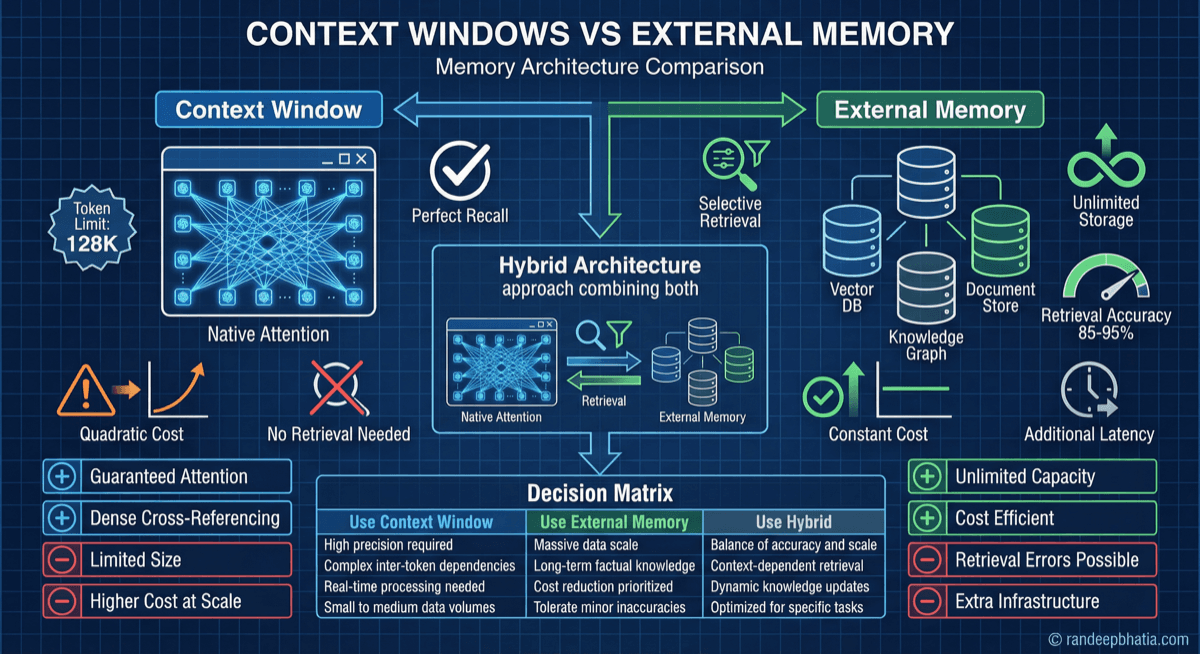
Context windows provide native in-model memory with guaranteed attention across all tokens, while external memory systems offer unlimited storage with selective retrieval at the cost of retrieval accuracy and latency.

1

Context windows offer perfect recall within their limits but scale quadratically in compute cost with length, making them ideal for tasks requiring dense cross-referencing but expensive for large knowledge bases.

2

External memory systems provide theoretically unlimited storage with constant-time retrieval but introduce retrieval accuracy risks, additional infrastructure complexity, and potential information loss during the retrieval process.

3

The optimal choice depends on the relationship density of your data, latency requirements, cost constraints, and whether your use case requires guaranteed attention across all information or can tolerate selective retrieval.

The Bottom Line

Context windows excel when all information must be jointly reasoned over and the data fits within token limits, while external memory is necessary when data exceeds context limits or when cost optimization is critical. Most production systems benefit from hybrid architectures that use external memory for broad knowledge and context windows for focused reasoning.

Definition

Context windows represent the fixed-size input buffer of transformer-based language models where all tokens receive mutual attention, enabling the model to reason jointly over the entire input during inference.

External memory systems are auxiliary storage and retrieval mechanisms that exist outside the model's native attention mechanism, allowing access to information beyond context window limits through retrieval operations that select relevant subsets of stored data.

Extended Definition

The context window is fundamentally constrained by the transformer architecture's attention mechanism, which computes pairwise relationships between all tokens, resulting in quadratic computational complexity with respect to sequence length. This architectural constraint creates a hard limit on how much information can be processed in a single forward pass, though this limit has expanded from 2,048 tokens in early models to 128,000+ tokens in modern architectures. External memory systems circumvent this limitation by storing information in separate data structures—typically vector databases, key-value stores, or graph databases—and retrieving relevant subsets at inference time. The retrieved information is then injected into the context window, creating a two-stage process where retrieval quality directly impacts the model's ability to reason over the relevant information.

Etymology & Origins

The term 'context window' emerged from the transformer architecture literature, where 'context' refers to the surrounding tokens that inform each position's representation, and 'window' denotes the fixed-size boundary of this attention scope. 'External memory' derives from computer architecture terminology, where memory hierarchies separate fast but limited primary storage from slower but larger secondary storage, adapted to neural network architectures through mechanisms like Neural Turing Machines and Memory Networks in the mid-2010s.

Also Known As

context lengthsequence lengthattention windowtoken limitmemory-augmented modelsretrieval-augmented generationknowledge retrievallong-term memory

Not To Be Confused With

Working memory

Working memory in cognitive science refers to temporary information storage during reasoning tasks, while context windows are the architectural input buffer of transformer models that persists only for a single inference pass.

Model parameters

Model parameters represent learned weights that encode general knowledge during training, while context windows contain dynamic input data provided at inference time that the model reasons over.

Fine-tuning

Fine-tuning permanently modifies model weights to incorporate new knowledge, while context windows and external memory provide information dynamically at inference time without changing the model.

Caching

KV caching optimizes repeated computations within a context window, while external memory refers to separate storage systems for information retrieval outside the model's attention mechanism.

Embedding storage

Embedding storage is one implementation of external memory focused on vector representations, while external memory broadly encompasses any retrieval mechanism including keyword search, graph traversal, and structured queries.

Prompt engineering

Prompt engineering optimizes how information is formatted within the context window, while the context window vs external memory decision determines what information can be included at all.

Conceptual Foundation

Core Principles

(7 principles)

Mental Models

(6 models)

Library vs Desk Analogy

The context window is like a desk where you can spread out documents and see everything simultaneously, enabling cross-referencing. External memory is like a library where you must retrieve specific books, but you have access to far more information than could fit on any desk.

RAM vs Disk Storage

Context windows function like RAM—fast, directly accessible, but limited in size. External memory functions like disk storage—larger capacity but requiring explicit retrieval operations with associated latency.

Spotlight vs Flashlight

The context window is a spotlight illuminating everything within its beam with equal intensity. External memory is a flashlight you must aim, potentially missing important areas but able to reach further into the darkness.

Open Book vs Closed Book Exam

Context windows provide an open-book exam where all reference material is available during reasoning. External memory provides a closed-book exam with the ability to request specific references, but you must know what to ask for.

Single Transaction vs Distributed Transaction

Context window processing is a single atomic operation with guaranteed consistency. External memory introduces distributed system concerns—retrieval and generation are separate operations that can fail independently.

Compilation vs Interpretation

Context windows 'compile' all information into a single reasoning pass. External memory 'interprets' queries dynamically, retrieving information as needed but with runtime overhead.

Key Insights

(10 insights)

The 'lost in the middle' phenomenon means that even within context windows, information in the middle of long contexts receives less attention than information at the beginning or end, partially negating the theoretical advantage of complete attention.

External memory retrieval quality is bounded by embedding model quality—if the embedding model cannot capture the semantic relationship between query and relevant documents, no amount of retrieval optimization will recover the information.

Hybrid architectures that use external memory for initial retrieval and context windows for focused reasoning often outperform pure approaches, combining broad knowledge access with deep reasoning capability.

The cost crossover point between context windows and external memory depends heavily on query volume—high-volume applications amortize external memory infrastructure costs, while low-volume applications may find context windows more economical.

Context window expansion through architectural innovations (sparse attention, linear attention) changes the tradeoff calculus, but fundamental quadratic scaling in dense attention remains for tasks requiring full cross-attention.

External memory systems can implement access control and audit logging at the retrieval layer, providing security and compliance capabilities that are difficult to achieve with context window approaches.

The choice between context windows and external memory often determines the debugging and interpretability story—context window inputs are fully observable, while retrieval decisions add an opaque intermediate step.

Multi-turn conversations create an implicit external memory requirement as conversation history grows beyond context limits, making external memory unavoidable for long-running agent interactions.

Retrieval-augmented generation (RAG) is not synonymous with external memory—RAG is one pattern for using external memory, but external memory can also include structured databases, APIs, and tool outputs.

The semantic gap between how information is stored and how it is queried is the fundamental challenge of external memory systems, requiring careful attention to chunking strategies, embedding alignment, and query reformulation.

When to Use

Ideal Scenarios

(12)

Document analysis tasks where the entire document fits within context limits and requires cross-referencing between sections, such as contract review, legal document analysis, or academic paper summarization.

Code review and refactoring tasks where understanding the relationships between multiple files, functions, and modules requires joint attention over the entire codebase context.

Multi-document synthesis tasks where a small number of documents must be compared, contrasted, and integrated into a coherent output.

Conversation continuity in customer service or support scenarios where the full conversation history must inform each response and fits within context limits.

Few-shot learning scenarios where example demonstrations must be jointly attended to for pattern extraction and application to new inputs.

Structured data analysis where tables, schemas, or configuration files must be fully visible to generate accurate queries or transformations.

Creative writing tasks where maintaining narrative consistency requires attention to all previously generated content.

Translation tasks where document-level context is essential for accurate terminology and style consistency.

Question-answering over large knowledge bases where relevant information is distributed across many documents and must be aggregated.

Enterprise search applications where users need to query organizational knowledge spanning thousands of documents.

Real-time information systems where knowledge must be updated frequently without model redeployment.

Personalization systems where user history and preferences must be maintained across sessions and may grow unboundedly.

Prerequisites

(8)
1

Clear understanding of the maximum information volume that must be processed per request, including worst-case scenarios.

2

Accurate token count estimates for typical inputs, accounting for tokenization overhead and formatting requirements.

3

Latency budget analysis that accounts for both context window processing time and potential retrieval overhead.

4

Cost modeling that considers both per-token inference costs and external memory infrastructure costs at projected query volumes.

5

Data classification to determine which information requires joint attention versus which can be selectively retrieved.

6

Evaluation metrics that can measure the impact of retrieval errors or context truncation on task performance.

7

Infrastructure capability assessment for deploying and maintaining external memory systems if required.

8

Understanding of data update frequency and whether real-time knowledge updates are required.

Signals You Need This

(10)

Users report that the system 'forgets' information from earlier in conversations or documents.

Task performance degrades significantly when input documents exceed a certain length.

Cost analysis reveals that context window token costs dominate the inference budget.

Latency requirements cannot be met with full context window processing of all relevant information.

Knowledge base size exceeds what can reasonably fit in context windows even with aggressive summarization.

Information freshness requirements demand updates more frequent than model redeployment cycles.

Different users or tenants require access to different subsets of a shared knowledge base.

Audit and compliance requirements demand logging of which specific information informed each response.

System must handle queries that could require information from any part of a large corpus.

Performance varies significantly based on where relevant information appears in the input sequence.

Organizational Readiness

(7)

Engineering team has experience with vector databases, embedding models, or information retrieval systems if external memory is required.

Infrastructure team can provision and maintain additional database systems with appropriate SLAs.

Data engineering capabilities exist to implement chunking, embedding, and indexing pipelines for external memory.

Monitoring and observability practices can extend to retrieval quality metrics and not just model performance.

Cost accounting can attribute expenses to both inference compute and retrieval infrastructure.

Security and compliance teams can evaluate data protection implications of external memory systems.

Product team understands the tradeoffs and can make informed decisions about acceptable retrieval accuracy levels.

When NOT to Use

Anti-Patterns

(12)

Using external memory for small, static knowledge bases that easily fit within context windows, adding unnecessary complexity and retrieval latency.

Relying solely on context windows for applications where information volume will grow unboundedly over time.

Implementing external memory without proper evaluation of retrieval quality, leading to silent failures when relevant information is not retrieved.

Using maximum context window sizes by default without analyzing whether the additional tokens provide value proportional to their cost.

Chunking documents arbitrarily without considering semantic boundaries, leading to fragmented context that harms both retrieval and reasoning.

Assuming that larger context windows eliminate the need for retrieval strategies—even 128K token windows cannot hold enterprise-scale knowledge bases.

Implementing hybrid architectures without clear criteria for what goes in context versus what goes in external memory.

Using external memory for information that requires dense cross-referencing, where retrieval selectivity will miss important relationships.

Ignoring the 'lost in the middle' phenomenon and assuming all context window positions are equally effective.

Treating retrieval as a solved problem and not investing in retrieval quality monitoring and improvement.

Using context windows for real-time data that changes faster than requests can be processed.

Implementing external memory without considering the cold start problem for new or rare queries.

Red Flags

(10)

Retrieval accuracy metrics are not being tracked or are consistently below 80% recall for relevant information.

Context window costs are growing faster than revenue or value delivered by the application.

Users frequently report that the system gives inconsistent answers to similar questions.

Latency SLAs are being missed due to either context processing time or retrieval overhead.

The system cannot answer questions about recently added information despite external memory updates.

Debugging production issues requires examining both model behavior and retrieval results, but tooling only supports one.

Different team members have conflicting mental models of how information flows through the system.

Cost optimization efforts focus only on model inference without considering retrieval infrastructure costs.

The chunking strategy was chosen arbitrarily and has never been evaluated for retrieval quality impact.

External memory queries return results but the model's answers don't reflect the retrieved information.

Better Alternatives

(8)
1
When:

Static knowledge base under 50,000 tokens with infrequent updates

Use Instead:

Full context window injection with intelligent ordering

Why:

Eliminates retrieval complexity and latency while guaranteeing all information is available for reasoning. The cost premium is justified by simplicity and reliability.

2
When:

Highly structured data with known query patterns

Use Instead:

Direct database queries with result injection into context

Why:

Structured queries provide deterministic retrieval without embedding approximation errors. SQL or GraphQL queries can precisely select relevant data.

3
When:

Real-time data requiring sub-second freshness

Use Instead:

API-based tool calling with live data fetching

Why:

External memory systems have indexing latency that prevents true real-time access. Direct API calls ensure data freshness at the cost of per-request latency.

4
When:

Multi-modal information including images, audio, and video

Use Instead:

Multi-modal models with native context handling

Why:

External memory for multi-modal data requires separate embedding spaces and retrieval strategies. Native multi-modal context avoids cross-modal retrieval complexity.

5
When:

Highly sensitive data with strict access control requirements

Use Instead:

Fine-tuned models with knowledge encoded in parameters

Why:

Fine-tuning eliminates runtime data exposure risks, though at the cost of update flexibility and potential for knowledge conflicts.

6
When:

Tasks requiring exact string matching or precise data lookup

Use Instead:

Traditional search indices with keyword matching

Why:

Semantic embedding retrieval can miss exact matches that keyword search finds reliably. Hybrid retrieval combining both approaches is often necessary.

7
When:

Low-volume applications with simple knowledge requirements

Use Instead:

Prompt templates with embedded knowledge

Why:

The infrastructure overhead of external memory systems is not justified for simple applications. Static prompt engineering may suffice.

8
When:

Applications requiring guaranteed deterministic responses

Use Instead:

Rule-based systems with LLM fallback

Why:

Neither context windows nor external memory guarantee deterministic outputs. Critical paths may require deterministic logic with LLM enhancement only for edge cases.

Common Mistakes

(10)

Assuming that retrieval-augmented generation automatically improves answer quality without measuring retrieval accuracy.

Using the same chunking strategy for all document types regardless of their structure and semantic boundaries.

Not implementing retrieval result ranking and blindly including all retrieved chunks in the context.

Ignoring the impact of retrieval latency on user experience and overall system performance.

Failing to version external memory indices, making it impossible to reproduce past system behavior.

Using embedding models trained on different domains than the target knowledge base.

Not implementing fallback strategies when retrieval returns no results or low-confidence results.

Assuming that more retrieved context is always better, when it can actually dilute relevant information.

Neglecting to update retrieval strategies as the knowledge base grows and query patterns evolve.

Treating context window size as the only factor in model selection, ignoring attention pattern quality and efficiency.

Core Taxonomy

Primary Types

(8 types)

The standard transformer context window where all tokens participate in full self-attention, providing complete bidirectional attention across the entire input sequence.

Characteristics
  • Quadratic computational complexity O(n²) with sequence length
  • Full attention between all token pairs
  • Fixed maximum length determined by model architecture
  • Linear memory scaling with sequence length for KV cache
Use Cases
Document analysis requiring cross-referencingCode understanding across multiple filesMulti-turn conversation with full history
Tradeoffs

Maximum reasoning capability over included content at highest computational cost. Best for tasks where all information genuinely requires joint attention.

Classification Dimensions

Retrieval Granularity

The unit of information retrieved from external memory, affecting both retrieval precision and context utilization efficiency. Finer granularity improves precision but increases retrieval complexity.

Document-levelPassage-levelSentence-levelToken-level

Update Frequency

How frequently external memory contents are updated, affecting data freshness guarantees and infrastructure complexity. Real-time updates require streaming architectures.

StaticPeriodic batchNear real-timeReal-time streaming

Retrieval Timing

When retrieval occurs relative to the generation process, affecting latency characteristics and the ability to refine retrieval based on generation progress.

Pre-retrievalQuery-time retrievalIterative retrievalPost-generation verification

Memory Persistence

The lifetime and scope of stored information, affecting personalization capabilities and storage requirements. Longer persistence enables learning but increases storage costs.

EphemeralSession-scopedUser-scopedGlobal persistent

Access Pattern

The ratio of read to write operations, affecting database selection and optimization strategies. Most RAG systems are read-heavy with periodic batch writes.

Read-heavyWrite-heavyBalanced read-writeAppend-only

Consistency Model

The guarantees provided about data consistency across retrieval operations, affecting system complexity and performance. Weaker consistency enables better performance.

Strong consistencyEventual consistencyRead-your-writesCausal consistency

Evolutionary Stages

1

Context-Only

Initial development phase, 0-3 months

All information provided directly in prompts with no external retrieval. Simple architecture but limited by context window size. Suitable for prototypes and simple applications.

2

Basic RAG

Early production phase, 3-6 months

Simple vector database retrieval with fixed chunking and top-k retrieval. First external memory implementation. Enables larger knowledge bases but with basic retrieval quality.

3

Advanced RAG

Production optimization phase, 6-12 months

Sophisticated chunking strategies, hybrid retrieval, reranking, and query reformulation. Improved retrieval accuracy through multiple techniques. Requires dedicated retrieval engineering.

4

Hybrid Memory Architecture

Mature production phase, 12-24 months

Multiple memory systems with intelligent routing between context windows, vector stores, structured databases, and caches. Optimized for different query types and data characteristics.

5

Adaptive Memory Systems

Advanced optimization phase, 24+ months

Self-optimizing memory architectures that learn retrieval patterns, automatically adjust chunking strategies, and balance between memory types based on observed performance.

Architecture Patterns

Architecture Patterns

(8 patterns)

Naive RAG

The simplest retrieval-augmented generation pattern where documents are chunked, embedded, stored in a vector database, and retrieved based on query similarity before being injected into the context window.

Components
  • Document chunker
  • Embedding model
  • Vector database
  • Retrieval service
  • Context assembler
  • Language model
Data Flow

Documents → Chunking → Embedding → Vector DB storage. Query → Embedding → Vector search → Top-k retrieval → Context assembly → LLM generation.

Best For
  • Quick prototypes
  • Simple knowledge bases
  • Low-stakes applications
  • Teams new to RAG
Limitations
  • Fixed chunking ignores semantic boundaries
  • No query reformulation
  • Single retrieval pass may miss relevant context
  • No result reranking
Scaling Characteristics

Scales horizontally through vector database sharding. Retrieval latency grows logarithmically with corpus size. Embedding computation can be parallelized.

Integration Points

Embedding Model

Converts text into dense vector representations for semantic similarity search in external memory systems.

Interfaces:
Text-to-embedding APIBatch embedding endpointStreaming embedding for large documents

Embedding model choice significantly impacts retrieval quality. Must be aligned between indexing and query time. Consider domain-specific fine-tuning for specialized knowledge bases.

Vector Database

Stores and indexes vector embeddings for efficient approximate nearest neighbor search.

Interfaces:
Insert/upsert vectorsSearch by vector similarityFiltered search with metadataBatch operations

Index type affects latency-accuracy tradeoff. Sharding strategy impacts query distribution. Consider hybrid search capabilities combining vector and keyword search.

Document Processor

Transforms raw documents into chunks suitable for embedding and retrieval.

Interfaces:
Document ingestion APIChunking configurationMetadata extractionFormat conversion

Chunking strategy significantly impacts retrieval quality. Consider semantic boundaries, overlap, and metadata preservation. Different document types may require different strategies.

Reranker

Rescores retrieved results based on query-document relevance to improve precision.

Interfaces:
Score query-document pairsBatch rerankingThreshold-based filtering

Cross-encoders provide better accuracy but higher latency. Consider lightweight rerankers for latency-sensitive applications. Reranker training data should match target domain.

Context Assembler

Combines retrieved information with system prompts and user queries into the final context window input.

Interfaces:
Context template renderingToken budget managementPriority-based truncation

Context ordering affects model attention. Implement clear separation between retrieved content and instructions. Handle token budget overflow gracefully.

Cache Layer

Stores frequently accessed retrieval results and pre-computed contexts for latency optimization.

Interfaces:
Cache lookupCache populationInvalidation triggersTTL management

Cache key design affects hit rate. Implement cache warming for predictable query patterns. Balance cache size against memory costs.

Monitoring Service

Tracks retrieval quality, latency, and system health metrics for operational visibility.

Interfaces:
Metric emissionLog aggregationAlert configurationDashboard integration

Retrieval quality metrics require ground truth or proxy measures. Implement sampling for high-volume systems. Correlate retrieval metrics with generation quality.

Access Control Layer

Enforces authorization policies on external memory access based on user identity and permissions.

Interfaces:
Permission check APIDocument-level ACLsQuery filtering by permissionsAudit logging

Access control must be enforced at retrieval time, not just at ingestion. Consider performance impact of permission checks. Implement audit trails for compliance.

Decision Framework

✓ If Yes

Context window approach is viable. Evaluate cost-benefit of full context vs selective retrieval.

✗ If No

External memory is required. Proceed to evaluate retrieval strategies.

Considerations

Account for worst-case input sizes, not just average cases. Include system prompts, few-shot examples, and output tokens in budget.

Technical Deep Dive

Overview

Context windows and external memory represent fundamentally different approaches to providing information to language models during inference. Context windows leverage the transformer's native attention mechanism, where every token in the input sequence can attend to every other token through learned attention patterns. This creates a dense web of information flow where the model can discover and reason over arbitrary relationships between any parts of the input. The computational cost of this approach scales quadratically with sequence length—doubling the context window quadruples the attention computation—which creates practical limits on context size despite architectural innovations. External memory systems decouple information storage from the model's attention mechanism. Information is stored in external data structures optimized for retrieval—typically vector databases using approximate nearest neighbor algorithms, but also including structured databases, graph stores, and hybrid systems. At inference time, a retrieval operation selects a subset of stored information based on relevance to the current query. This retrieved information is then injected into the context window, where the model can reason over it using standard attention. The key insight is that retrieval scales much better than attention: searching a billion-item database takes roughly the same time as searching a million-item database with proper indexing. The interaction between retrieval and generation creates a two-stage pipeline with distinct failure modes. Retrieval failures occur when relevant information exists in the external memory but is not retrieved—either due to embedding model limitations, query-document mismatch, or ranking errors. Generation failures occur when retrieved information is present in context but the model fails to use it correctly. Understanding this separation is crucial for debugging and optimization: retrieval metrics and generation metrics must be tracked independently to identify the source of quality issues. Hybrid architectures attempt to combine the strengths of both approaches. A common pattern maintains a 'core context' of essential information that is always included in the context window, supplemented by dynamically retrieved information based on the specific query. This ensures that critical context is never missed by retrieval while still enabling access to large knowledge bases. The challenge lies in managing the context budget—deciding how much space to allocate to core context versus retrieved content, and how to prioritize when retrieved content exceeds available space.

Step-by-Step Process

The incoming query is analyzed to determine information needs. This may include query expansion (adding synonyms or related terms), query decomposition (breaking complex queries into sub-queries), and intent classification (determining what type of information is needed). For context-window-only approaches, this step focuses on formatting the query appropriately within the prompt template.

⚠️ Pitfalls to Avoid

Over-expansion can retrieve irrelevant information. Under-expansion can miss relevant content with different terminology. Intent misclassification can route to wrong retrieval strategies.

Under The Hood

The transformer attention mechanism at the heart of context windows computes attention scores between all pairs of tokens in the sequence. For a sequence of length n, this requires O(n²) operations to compute the attention matrix, where each entry represents how much one token should attend to another. The attention scores are computed as softmax(QK^T/√d)V, where Q, K, and V are learned projections of the input embeddings. This quadratic scaling is the fundamental bottleneck that limits context window sizes—a 128K token context requires 16 billion attention computations per layer, compared to 4 million for a 2K token context. Modern architectures employ various optimizations to manage this complexity. Flash Attention reorganizes computation to maximize GPU memory bandwidth utilization, reducing wall-clock time without changing the fundamental complexity. Sparse attention patterns (like those in Longformer or BigBird) reduce complexity by attending only to local windows plus selected global tokens, achieving O(n) complexity at the cost of potentially missing long-range dependencies. Linear attention variants replace softmax attention with kernel approximations that enable O(n) complexity, though often with quality tradeoffs. External memory retrieval relies on approximate nearest neighbor (ANN) algorithms that trade exactness for speed. The most common approach uses hierarchical navigable small world (HNSW) graphs, which organize vectors in a multi-layer graph structure where higher layers contain fewer, more spread-out nodes. Search proceeds from top layers (coarse navigation) to bottom layers (fine-grained search), achieving O(log n) average complexity. Other approaches include inverted file indices (IVF) that partition the vector space into clusters, and product quantization (PQ) that compresses vectors for memory efficiency. The embedding models that power semantic retrieval are themselves transformers trained with contrastive objectives. They learn to map semantically similar texts to nearby points in embedding space while pushing dissimilar texts apart. The quality of retrieval is fundamentally bounded by the embedding model's ability to capture semantic relationships—if two texts are semantically related but the embedding model doesn't recognize this relationship, no amount of retrieval optimization will find the connection. This creates a ceiling effect where retrieval quality improvements require better embedding models, not just better retrieval algorithms. The interaction between retrieval and generation creates interesting dynamics. Retrieved content competes for the model's attention with other context elements. Research on 'lost in the middle' shows that information in the middle of long contexts receives less attention than information at the beginning or end, suggesting that retrieval result ordering matters significantly. Additionally, the model may not effectively use retrieved information if it contradicts the model's parametric knowledge or if the retrieval-generation interface is poorly designed. Understanding these dynamics is essential for optimizing hybrid systems.

Failure Modes

Root Cause

Relevant information exists in external memory but is not retrieved due to embedding model limitations, query-document semantic gap, or index corruption.

Symptoms
  • Model generates plausible but incorrect answers
  • Answers contradict information known to be in the knowledge base
  • Follow-up queries with different phrasing succeed where original failed
  • Retrieval logs show no relevant documents in top-k results
Impact

Users receive incorrect information with high confidence. Trust in system erodes. May cause downstream decision errors in critical applications.

Prevention

Implement hybrid retrieval combining semantic and keyword search. Use domain-adapted embedding models. Implement query expansion and reformulation. Monitor retrieval recall metrics.

Mitigation

Implement confidence scoring and fallback to broader search. Surface retrieval uncertainty to users. Provide 'I don't know' responses when retrieval confidence is low.

Operational Considerations

Key Metrics (15)

Median latency for external memory retrieval operations, including embedding generation, vector search, and result fetching.

Normal50-150ms for vector search, 100-300ms including embedding
Alert>500ms sustained for 5 minutes
ResponseInvestigate vector database performance, check embedding service health, review query patterns for complexity spikes.

Dashboard Panels

Retrieval latency distribution (p50, p95, p99) over time with breakdown by query typeRetrieval quality metrics (recall, precision, MRR) with trend lines and anomaly detectionContext utilization heatmap showing token budget allocation across request typesIndex freshness timeline showing lag between updates and availabilityCache performance metrics including hit rate, eviction rate, and memory utilizationError rate breakdown by error type (timeout, empty results, truncation, ACL failures)Vector database cluster health including node status, replication lag, and resource utilizationEmbedding service performance including latency, throughput, and error ratesEnd-to-end request flow showing latency contribution from each componentQuery pattern analysis showing top queries, failing queries, and query type distribution

Alerting Strategy

Implement tiered alerting with different severity levels: P1 for complete retrieval failures or security issues requiring immediate response, P2 for significant quality degradation or latency SLA violations requiring response within 1 hour, P3 for gradual degradation trends requiring investigation within 24 hours. Use anomaly detection for metrics with variable baselines. Implement alert correlation to avoid alert storms during cascading failures. Ensure on-call rotation has runbooks for each alert type.

Cost Analysis

Cost Drivers

(10)

Context Window Token Processing

Impact:

Per-token inference cost multiplied by context length. Quadratic attention cost means doubling context more than doubles compute cost. Dominates cost for context-heavy workloads.

Optimization:

Minimize context length through efficient retrieval. Use smaller models where quality permits. Implement context caching for repeated patterns. Consider sparse attention models for very long contexts.

Embedding Model Inference

Impact:

Cost per embedding generation for queries and documents. Scales with query volume and document ingestion rate. Can become significant for high-volume applications.

Optimization:

Cache embeddings for repeated queries. Batch embedding requests. Use efficient embedding models. Consider on-device embedding for latency-sensitive applications.

Vector Database Infrastructure

Impact:

Fixed infrastructure cost plus variable cost based on storage and query volume. Scales with corpus size and query throughput. Includes compute, storage, and memory costs.

Optimization:

Right-size infrastructure for actual load. Use tiered storage for less-accessed data. Implement query result caching. Consider managed services versus self-hosted based on scale.

Reranking Model Inference

Impact:

Cost per query-document pair scored. Scales with retrieval count and query volume. Cross-encoders are significantly more expensive than bi-encoders.

Optimization:

Reduce initial retrieval count to minimize reranking candidates. Cache reranking results for common queries. Use lightweight rerankers where quality permits. Implement conditional reranking.

Index Maintenance and Updates

Impact:

Compute cost for document processing, embedding, and indexing. Scales with document update frequency and corpus size. Includes both incremental updates and periodic rebuilds.

Optimization:

Batch document updates. Implement incremental indexing. Schedule rebuilds during off-peak hours. Optimize document processing pipeline.

Storage for Documents and Embeddings

Impact:

Storage cost scales linearly with corpus size. Embedding storage can exceed document storage for high-dimensional embeddings. Includes both primary and backup storage.

Optimization:

Compress embeddings where quality permits. Implement tiered storage. Remove stale documents. Use efficient storage formats.

Network Transfer

Impact:

Data transfer costs between components, especially in distributed architectures. Can be significant for large retrieved contexts or high query volumes.

Optimization:

Co-locate components where possible. Compress data in transit. Implement efficient serialization. Cache at network boundaries.

Monitoring and Observability

Impact:

Cost of metrics collection, log storage, and analysis tools. Scales with system complexity and data retention requirements.

Optimization:

Sample high-volume metrics. Implement log rotation and retention policies. Use efficient observability tools. Focus monitoring on actionable metrics.

Development and Maintenance

Impact:

Engineering time for system development, optimization, and maintenance. External memory systems require more engineering investment than context-only approaches.

Optimization:

Use managed services where appropriate. Invest in automation. Build reusable components. Document thoroughly to reduce maintenance burden.

Quality Assurance and Evaluation

Impact:

Cost of maintaining evaluation datasets, running quality assessments, and human evaluation. Essential for maintaining retrieval and generation quality.

Optimization:

Automate evaluation where possible. Use proxy metrics for continuous monitoring. Focus human evaluation on high-impact areas. Build reusable evaluation infrastructure.

Cost Models

Context Window Cost Model

Cost = (input_tokens + output_tokens) × price_per_token × requests_per_month
Variables:
input_tokens: Average tokens in context window including retrieved contentoutput_tokens: Average generated output lengthprice_per_token: Model-specific pricing (varies by provider and model)requests_per_month: Total query volume
Example:

For 10K tokens average context, 500 tokens output, $0.01/1K input tokens, $0.03/1K output tokens, 100K requests/month: (10 × $0.01 + 0.5 × $0.03) × 100K = $11,500/month

External Memory Infrastructure Cost Model

Cost = vector_db_cost + embedding_cost + storage_cost + compute_cost
Variables:
vector_db_cost: Database infrastructure (managed service or self-hosted)embedding_cost: Embedding model inference for queries and indexingstorage_cost: Document and embedding storagecompute_cost: Processing for indexing and retrieval
Example:

Managed vector DB: $500/month, Embedding API: $200/month (1M embeddings), Storage: $100/month (100GB), Compute: $300/month = $1,100/month infrastructure

Hybrid System Total Cost Model

Total = context_cost + infrastructure_cost + engineering_cost
Variables:
context_cost: Token-based inference costs (reduced by selective retrieval)infrastructure_cost: External memory system costsengineering_cost: Development and maintenance (often amortized)
Example:

With retrieval reducing average context from 10K to 3K tokens: Context savings of ~70% offset by infrastructure costs. Break-even depends on query volume.

Cost Per Query Comparison

CPQ_context = tokens × token_price; CPQ_retrieval = embedding_cost + search_cost + reduced_tokens × token_price
Variables:
tokens: Full context token counttoken_price: Per-token inference costembedding_cost: Query embedding generation costsearch_cost: Vector search cost (often negligible per query)reduced_tokens: Context tokens after selective retrieval
Example:

Full context: 10K tokens × $0.01/1K = $0.10/query. With retrieval: $0.001 embedding + $0.0001 search + 3K × $0.01/1K = $0.031/query. 69% savings per query.

Optimization Strategies

  • 1Implement aggressive caching for repeated queries and common retrieval patterns to reduce both embedding and inference costs
  • 2Use tiered retrieval with cheap initial filtering before expensive semantic search to reduce vector database load
  • 3Optimize chunk sizes to balance retrieval granularity against storage and embedding costs
  • 4Implement context budget management to avoid paying for unused context window capacity
  • 5Use smaller, efficient embedding models for initial retrieval with expensive models only for reranking
  • 6Batch embedding requests to maximize throughput and reduce per-request overhead
  • 7Implement query result caching with intelligent invalidation to serve repeated patterns from cache
  • 8Use spot instances or preemptible compute for batch indexing workloads
  • 9Implement progressive retrieval that stops early when sufficient relevant content is found
  • 10Optimize document preprocessing to reduce embedding and storage costs for redundant content
  • 11Use compression for stored embeddings where quality impact is acceptable
  • 12Implement request routing to direct simple queries to cheaper processing paths

Hidden Costs

  • 💰Re-indexing costs when embedding models are updated or chunking strategies change
  • 💰Quality degradation costs from suboptimal retrieval affecting user satisfaction and retention
  • 💰Engineering time for debugging retrieval issues that are harder to diagnose than context-only systems
  • 💰Compliance and audit costs for maintaining data lineage and access logs in external memory systems
  • 💰Cold start costs when cache is invalidated or system restarts require cache warming
  • 💰Opportunity costs from latency increases that affect user engagement
  • 💰Technical debt from quick fixes that accumulate in complex retrieval pipelines
  • 💰Training and onboarding costs for teams learning external memory system operations

ROI Considerations

The return on investment for external memory systems depends heavily on scale and use case characteristics. For small knowledge bases under 50K tokens, context-only approaches typically provide better ROI due to lower complexity and engineering costs. The crossover point where external memory becomes cost-effective typically occurs when the knowledge base exceeds context window limits or when query volume is high enough to amortize infrastructure costs. Quality improvements from external memory must be weighed against complexity costs. If retrieval accuracy is low, the system may perform worse than a well-designed context-only approach with summarization. Investment in retrieval quality (embedding models, reranking, hybrid search) is often necessary to realize the theoretical benefits of external memory. Long-term ROI considerations include scalability headroom, knowledge update flexibility, and operational maturity. External memory systems provide a path to scaling beyond context limits and enable real-time knowledge updates without model changes. However, they require ongoing operational investment that context-only approaches avoid. The decision should consider both current needs and projected growth. Starting with context-only approaches and migrating to external memory as scale demands is a valid strategy, but migration costs should be factored into the initial decision. Building external memory infrastructure before it's needed incurs costs without immediate benefit, while waiting too long creates technical debt and migration pressure.

Security Considerations

Threat Model

(10 threats)
1

Prompt Injection via Retrieved Content

Attack Vector

Malicious content stored in external memory contains instructions that override system prompts when retrieved and injected into context.

Impact

Model behavior manipulation, potential data exfiltration, bypassing safety controls, unauthorized actions in agentic systems.

Mitigation

Implement content sanitization before indexing. Use instruction hierarchy separating retrieved content from system instructions. Monitor outputs for injection indicators. Implement content reputation scoring.

2

Data Exfiltration through Retrieval

Attack Vector

Attacker crafts queries designed to retrieve and expose sensitive information from external memory that should not be accessible.

Impact

Unauthorized data access, privacy violations, compliance breaches, competitive intelligence leakage.

Mitigation

Implement robust access control at retrieval layer. Validate user permissions before returning results. Audit retrieval access patterns. Implement query analysis for exfiltration attempts.

3

Index Poisoning

Attack Vector

Attacker injects malicious documents into the knowledge base that will be retrieved for specific queries, manipulating system responses.

Impact

Misinformation delivery, reputation damage, manipulation of downstream decisions, persistent attack vector.

Mitigation

Implement content validation before indexing. Track document provenance. Implement anomaly detection for unusual indexing patterns. Enable rapid content removal capability.

4

Cross-Tenant Data Leakage

Attack Vector

Flaws in access control implementation allow queries from one tenant to retrieve documents belonging to another tenant.

Impact

Severe privacy violation, compliance failure, legal liability, customer trust destruction.

Mitigation

Implement defense-in-depth tenant isolation. Use separate indices per tenant where feasible. Extensive ACL testing. Regular security audits. Implement query result validation.

5

Embedding Model Extraction

Attack Vector

Attacker uses query-response patterns to extract information about the embedding model, enabling adversarial attacks on retrieval.

Impact

Enables more sophisticated attacks on retrieval system, potential intellectual property theft if custom models are used.

Mitigation

Rate limit queries. Add noise to similarity scores. Monitor for extraction patterns. Use ensemble of embedding models.

6

Denial of Service via Complex Queries

Attack Vector

Attacker submits queries designed to maximize retrieval computation, exhausting system resources.

Impact

Service degradation or outage, increased costs, impact on legitimate users.

Mitigation

Implement query complexity limits. Rate limiting per user. Resource quotas. Query timeout enforcement. Anomaly detection for unusual query patterns.

7

Stale Data Exploitation

Attack Vector

Attacker exploits known delays in index updates to manipulate responses based on outdated information.

Impact

Incorrect information delivery, potential for fraud in time-sensitive applications, trust erosion.

Mitigation

Minimize indexing latency. Display data timestamps. Implement freshness validation for critical data. Real-time verification for sensitive operations.

8

Inference of Private Information

Attack Vector

Attacker uses patterns in retrieval results to infer information about other users or documents they shouldn't access.

Impact

Privacy violation through side channels, potential for targeted attacks based on inferred information.

Mitigation

Implement differential privacy in retrieval. Avoid leaking result counts or scores. Audit for inference vulnerabilities. Minimize metadata exposure.

9

Model Confusion Attack

Attack Vector

Attacker crafts documents that are retrieved for many unrelated queries, polluting context across the system.

Impact

Widespread quality degradation, potential for subtle manipulation across many queries.

Mitigation

Monitor document retrieval frequency. Implement diversity requirements. Detect and quarantine over-retrieved documents. Regular retrieval quality audits.

10

Supply Chain Attack on Embedding Models

Attack Vector

Compromised embedding model produces embeddings that enable targeted retrieval manipulation.

Impact

Systematic retrieval failures or manipulations, difficult to detect, wide blast radius.

Mitigation

Verify embedding model integrity. Use models from trusted sources. Monitor for embedding anomalies. Implement embedding validation checks.

Security Best Practices

  • Implement defense-in-depth access control with checks at multiple layers (API, retrieval, document)
  • Sanitize all content before indexing to remove potential injection payloads
  • Use instruction hierarchy in prompts to clearly separate retrieved content from system instructions
  • Implement comprehensive audit logging for all retrieval operations
  • Encrypt data at rest and in transit for external memory systems
  • Regularly rotate credentials and API keys for external memory access
  • Implement rate limiting and quotas to prevent abuse
  • Monitor for anomalous query patterns that may indicate attacks
  • Validate retrieved content before injection into context
  • Implement content provenance tracking for accountability
  • Regular security assessments and penetration testing of retrieval systems
  • Implement circuit breakers to limit blast radius of security incidents
  • Use separate indices for different sensitivity levels
  • Implement data retention policies and secure deletion
  • Train development team on retrieval-specific security considerations

Data Protection

  • 🔒Encrypt all data at rest using industry-standard encryption (AES-256)
  • 🔒Encrypt all data in transit using TLS 1.3
  • 🔒Implement key management with regular rotation
  • 🔒Use separate encryption keys per tenant where required
  • 🔒Implement secure deletion that removes data from all indices and backups
  • 🔒Minimize data retention to what is necessary for functionality
  • 🔒Implement data classification to apply appropriate protections
  • 🔒Regular backup integrity verification
  • 🔒Implement access logging for all data operations
  • 🔒Use tokenization or pseudonymization for sensitive identifiers where possible

Compliance Implications

GDPR

Requirement:

Right to erasure, data minimization, purpose limitation, data subject access rights

Implementation:

Implement document deletion propagating to all indices. Track data lineage for access requests. Implement purpose-based access controls. Enable data export for subject access requests.

HIPAA

Requirement:

Protected health information safeguards, access controls, audit trails

Implementation:

Encrypt PHI in external memory. Implement role-based access control. Comprehensive audit logging. Business associate agreements with vector database providers.

SOC 2

Requirement:

Security, availability, processing integrity, confidentiality, privacy controls

Implementation:

Document security controls for external memory. Implement monitoring and alerting. Regular security assessments. Incident response procedures.

PCI DSS

Requirement:

Cardholder data protection, access control, monitoring

Implementation:

Never store cardholder data in external memory. Implement network segmentation. Comprehensive logging. Regular vulnerability assessments.

CCPA

Requirement:

Consumer data rights, disclosure requirements, opt-out mechanisms

Implementation:

Track personal information in external memory. Implement deletion capabilities. Enable data access requests. Document data practices.

AI Act (EU)

Requirement:

Transparency, human oversight, data governance for high-risk AI systems

Implementation:

Document retrieval system design. Implement explainability for retrieval decisions. Enable human review of retrieved content. Data quality monitoring.

Financial Services Regulations

Requirement:

Data retention, audit trails, model governance

Implementation:

Implement compliant data retention. Comprehensive audit logging. Version control for retrieval configurations. Regular model validation.

Industry-Specific Data Localization

Requirement:

Data residency requirements for certain jurisdictions

Implementation:

Deploy regional external memory instances. Implement data routing based on jurisdiction. Verify cloud provider compliance. Document data flows.

Scaling Guide

Scaling Dimensions

Query Volume

Strategy:

Horizontal scaling of retrieval infrastructure. Add vector database replicas for read scaling. Implement query result caching. Use load balancing across retrieval instances.

Limits:

Vector database query throughput limits. Embedding model inference capacity. Cache memory limits. Network bandwidth between components.

Considerations:

Monitor query latency distribution as volume increases. Implement backpressure mechanisms. Consider query routing based on complexity. Plan for burst capacity.

Corpus Size

Strategy:

Shard vector indices across multiple nodes. Implement tiered storage for less-accessed content. Use approximate search with tuned accuracy. Consider federated retrieval across indices.

Limits:

Single-node memory limits for HNSW indices. Index build time for large corpora. Query latency increases with corpus size. Storage costs scale linearly.

Considerations:

Plan sharding strategy before hitting limits. Monitor recall as corpus grows. Implement index maintenance windows. Consider corpus pruning for stale content.

Context Length

Strategy:

Use models with larger context windows. Implement context compression and summarization. Use sparse attention architectures. Optimize context assembly for efficiency.

Limits:

Model maximum context length. Quadratic attention cost. KV cache memory requirements. Latency increases with context length.

Considerations:

Evaluate quality impact of context compression. Monitor lost-in-the-middle effects. Consider chunked processing for very long contexts. Balance context length against cost.

Concurrent Users

Strategy:

Scale stateless components horizontally. Implement connection pooling for databases. Use async processing where possible. Implement request queuing with backpressure.

Limits:

Database connection limits. Memory per concurrent request. Network connection limits. Downstream service capacity.

Considerations:

Monitor per-user resource consumption. Implement fair queuing. Consider user-level rate limiting. Plan for peak concurrent usage.

Update Frequency

Strategy:

Implement streaming indexing pipelines. Use incremental index updates. Separate read and write paths. Implement change data capture for source systems.

Limits:

Index update throughput. Consistency lag between updates and availability. Write amplification in indices. Processing capacity for document changes.

Considerations:

Balance freshness against indexing cost. Implement update batching where latency permits. Monitor indexing lag. Plan for bulk update scenarios.

Geographic Distribution

Strategy:

Deploy regional retrieval infrastructure. Implement cross-region replication. Use CDN for static content. Route queries to nearest region.

Limits:

Cross-region replication latency. Data residency requirements. Consistency across regions. Operational complexity.

Considerations:

Evaluate latency requirements per region. Implement region-aware routing. Plan for regional failures. Consider data sovereignty requirements.

Multi-Tenancy

Strategy:

Implement tenant isolation at index level or through filtering. Use tenant-aware resource allocation. Implement per-tenant quotas. Consider dedicated infrastructure for large tenants.

Limits:

Overhead of per-tenant indices. Filter performance at scale. Resource contention between tenants. Operational complexity.

Considerations:

Balance isolation against efficiency. Implement noisy neighbor protection. Plan tenant onboarding and offboarding. Monitor per-tenant resource usage.

Model Complexity

Strategy:

Use model serving infrastructure with auto-scaling. Implement model caching. Consider model distillation for efficiency. Use batched inference.

Limits:

GPU memory for large models. Inference latency requirements. Model serving infrastructure costs. Batch size limits.

Considerations:

Evaluate quality-latency tradeoffs. Monitor model serving utilization. Plan for model updates. Consider multi-model architectures.

Capacity Planning

Key Factors:
Expected query volume with growth projectionsCorpus size and growth rateQuery latency SLA requirementsRetrieval accuracy requirementsUpdate frequency and freshness requirementsConcurrent user expectationsGeographic distribution needsBudget constraints
Formula:Required capacity = (peak_qps × latency_budget_factor) × (corpus_size / baseline_corpus) × safety_margin. Where latency_budget_factor accounts for SLA headroom and safety_margin typically 1.5-2x for growth.
Safety Margin:

Maintain 50-100% headroom above expected peak load. Higher margins for systems with unpredictable traffic patterns. Consider seasonal variations and growth trajectory. Plan for failure scenarios requiring capacity redistribution.

Scaling Milestones

Prototype (100 users, 10K documents)
Challenges:
  • Establishing baseline metrics
  • Validating retrieval quality
  • Initial chunking strategy
Architecture Changes:

Single-instance deployment acceptable. Focus on functionality over scale. Establish monitoring foundation.

Early Production (1K users, 100K documents)
Challenges:
  • First scaling bottlenecks
  • Retrieval latency optimization
  • Index update pipeline
Architecture Changes:

Introduce caching layer. Implement proper monitoring. Consider managed vector database. Establish SLAs.

Growth (10K users, 1M documents)
Challenges:
  • Index size management
  • Query volume handling
  • Operational complexity
Architecture Changes:

Horizontal scaling of retrieval. Implement sharding strategy. Add reranking layer. Enhance caching.

Scale (100K users, 10M documents)
Challenges:
  • Multi-region requirements
  • Complex access control
  • Cost optimization pressure
Architecture Changes:

Regional deployment. Federated retrieval. Advanced caching strategies. Tiered storage.

Enterprise (1M+ users, 100M+ documents)
Challenges:
  • Global distribution
  • Extreme reliability requirements
  • Complex multi-tenancy
Architecture Changes:

Global infrastructure. Dedicated tenant options. Advanced routing and load balancing. Comprehensive automation.

Benchmarks

Industry Benchmarks

MetricP50P95P99 World Class
Retrieval Latency (p50)50ms150ms300ms<30ms
Retrieval Latency (p99)200ms500ms1000ms<200ms
Retrieval Recall@100.700.850.92>0.95
End-to-End Latency (with generation)1.5s3s5s<1s
Context Utilization Efficiency60%80%90%>85%
Index Freshness Lag1 hour15 minutes5 minutes<1 minute
Cache Hit Rate30%60%80%>70%
Retrieval Empty Rate10%5%2%<1%
Reranking Improvement1.1x1.3x1.5x>1.4x
Cost per 1K Queries$5$2$0.50<$0.25
System Availability99%99.9%99.95%>99.99%
Query Throughput (QPS)100100010000>50000

Comparison Matrix

ApproachMax Knowledge SizeLatencyCost per QueryAccuracyComplexityUpdate Speed
Context Window Only128K tokensLowHighVery HighLowInstant
Basic RAGUnlimitedMediumMediumMediumMediumMinutes-Hours
Advanced RAG with RerankingUnlimitedMedium-HighMediumHighHighMinutes-Hours
Hybrid Context + RAGUnlimitedMediumMedium-HighHighHighMixed
Hierarchical MemoryUnlimitedVariableMediumHighVery HighVariable
Fine-Tuned ModelModel CapacityLowLowMedium-HighHigh (training)Days-Weeks
Tool-Augmented RetrievalUnlimitedHighHighVariableHighReal-time
Graph-Based MemoryUnlimitedMedium-HighMediumHigh for relationsVery HighMinutes

Performance Tiers

Basic

Simple RAG with default configurations. Suitable for prototypes and low-stakes applications.

Target:

Recall@10 >0.6, Latency <500ms, Availability >99%

Production

Optimized RAG with reranking and caching. Suitable for customer-facing applications.

Target:

Recall@10 >0.8, Latency <200ms, Availability >99.9%

Enterprise

Advanced hybrid architecture with comprehensive monitoring. Suitable for business-critical applications.

Target:

Recall@10 >0.9, Latency <100ms, Availability >99.95%

World-Class

State-of-the-art retrieval with continuous optimization. Suitable for competitive differentiation.

Target:

Recall@10 >0.95, Latency <50ms, Availability >99.99%

Real World Examples

Real-World Scenarios

(8 examples)
1

Enterprise Knowledge Base for Customer Support

Context

Large enterprise with 500K+ support documents, 10K daily support queries, strict SLA requirements, and multi-tenant architecture serving different product lines.

Approach

Implemented hybrid RAG with product-specific indices, reranking layer, and aggressive caching for common queries. Used hierarchical chunking respecting document structure. Implemented tenant isolation through filtered retrieval.

Outcome

Reduced average handle time by 35%. Achieved 85% retrieval recall. Maintained p95 latency under 2 seconds. Successfully isolated tenant data with zero cross-tenant leakage.

Lessons Learned
  • 💡Product-specific indices significantly improved relevance over single unified index
  • 💡Caching common queries reduced infrastructure costs by 40%
  • 💡Reranking was essential for quality but added 200ms latency
  • 💡Tenant isolation required careful index design from the start
2

Legal Document Analysis Platform

Context

Law firm analyzing contracts and legal documents, requiring high accuracy for clause identification, cross-referencing between documents, and audit trail for compliance.

Approach

Used large context windows (128K tokens) for individual document analysis. Implemented external memory for cross-document search and precedent lookup. Combined approaches based on task type.

Outcome

Achieved 95% accuracy on clause identification. Reduced document review time by 60%. Full audit trail for all retrieval and analysis operations.

Lessons Learned
  • 💡Legal documents required full context for accurate analysis - retrieval alone was insufficient
  • 💡Cross-document tasks benefited from external memory for precedent search
  • 💡Audit requirements drove significant infrastructure decisions
  • 💡Domain-specific embedding fine-tuning improved legal terminology retrieval
3

E-commerce Product Search and Recommendations

Context

Online retailer with 2M products, real-time inventory updates, personalization requirements, and high query volume (100K queries/hour peak).

Approach

Hybrid retrieval combining structured product database queries with semantic search for natural language queries. Real-time inventory filtering. User history in external memory for personalization.

Outcome

20% improvement in search relevance. Real-time inventory accuracy. Personalized results improved conversion by 15%.

Lessons Learned
  • 💡Structured queries essential for exact product attributes (size, color, price)
  • 💡Semantic search improved discovery for vague queries
  • 💡Real-time inventory required streaming updates to indices
  • 💡Personalization memory required careful privacy controls
4

Research Assistant for Scientific Literature

Context

Research institution with access to 10M+ scientific papers, complex multi-hop queries, need for citation accuracy, and diverse research domains.

Approach

Iterative retrieval for complex queries. Domain-specific embedding models. Citation graph integration for related paper discovery. Hierarchical summarization for large paper sets.

Outcome

Researchers reported 50% reduction in literature review time. High citation accuracy. Successful cross-domain discovery.

Lessons Learned
  • 💡Iterative retrieval essential for complex research questions
  • 💡Citation graphs provided valuable signal beyond semantic similarity
  • 💡Domain-specific embeddings significantly improved retrieval in specialized fields
  • 💡Summarization quality varied significantly across paper types
5

Conversational AI Agent with Long-Term Memory

Context

Personal assistant application requiring memory of user preferences, past conversations, and task context across sessions spanning months.

Approach

Hierarchical memory with working memory (current conversation), episodic memory (past interactions), and semantic memory (user preferences). Automatic consolidation and summarization.

Outcome

Users reported significantly improved personalization. Successful recall of past context. Manageable storage growth through summarization.

Lessons Learned
  • 💡Memory consolidation timing significantly affected user experience
  • 💡Summarization quality was critical for long-term memory usefulness
  • 💡Users valued consistency in personality and preferences over perfect recall
  • 💡Privacy controls for memory were essential for user trust
6

Code Repository Assistant

Context

Software company with 50M lines of code across 500 repositories, need for code search, documentation lookup, and codebase understanding.

Approach

Code-aware chunking respecting function and class boundaries. Hybrid retrieval combining code search with documentation. Repository-level context for architecture questions.

Outcome

Developers reported 40% faster code discovery. Improved onboarding for new team members. Accurate cross-repository search.

Lessons Learned
  • 💡Code chunking required language-specific parsing
  • 💡Documentation and code needed separate but linked indices
  • 💡Repository structure provided important context for retrieval
  • 💡Code embeddings required specialized models
7

Healthcare Clinical Decision Support

Context

Hospital system requiring access to clinical guidelines, drug interactions, patient history, with strict HIPAA compliance and real-time requirements.

Approach

Federated retrieval across clinical knowledge base and patient records. Strict access control with audit logging. Real-time drug interaction checking.

Outcome

Reduced adverse drug events by 25%. Improved guideline adherence. Full HIPAA compliance maintained.

Lessons Learned
  • 💡Access control complexity was significantly higher than anticipated
  • 💡Real-time requirements drove architecture decisions
  • 💡Clinical terminology required specialized handling
  • 💡Audit requirements added significant infrastructure overhead
8

Financial News Analysis Platform

Context

Investment firm requiring real-time news analysis, historical context, and entity-centric information retrieval across millions of news articles.

Approach

Streaming ingestion for real-time news. Entity extraction and linking for company-centric retrieval. Temporal awareness in retrieval ranking. Sentiment analysis integration.

Outcome

Sub-minute latency for breaking news. Accurate entity disambiguation. Historical context improved analysis quality.

Lessons Learned
  • 💡Real-time indexing required streaming architecture
  • 💡Entity disambiguation was critical for financial entities
  • 💡Temporal relevance needed explicit handling in ranking
  • 💡News source credibility affected retrieval weighting

Industry Applications

Healthcare

Clinical decision support systems combining patient records with medical knowledge bases for diagnosis assistance and treatment recommendations.

Key Considerations:

HIPAA compliance, real-time requirements, high accuracy needs, integration with EHR systems, audit trail requirements.

Legal

Contract analysis, legal research, and case law retrieval systems for law firms and corporate legal departments.

Key Considerations:

High accuracy requirements, citation accuracy, document confidentiality, cross-reference needs, audit trails.

Financial Services

Research analysis, regulatory compliance checking, and customer service automation for banks and investment firms.

Key Considerations:

Real-time data requirements, regulatory compliance, data security, audit requirements, high availability.

E-commerce

Product search, recommendation systems, and customer service chatbots for online retailers.

Key Considerations:

Real-time inventory, personalization, high query volume, conversion optimization, multi-language support.

Technology

Code search, documentation systems, and developer assistance tools for software companies.

Key Considerations:

Code-aware processing, repository scale, real-time updates, multi-language code support.

Education

Intelligent tutoring systems, research assistance, and content recommendation for educational institutions.

Key Considerations:

Pedagogical effectiveness, content accuracy, accessibility requirements, student privacy.

Manufacturing

Technical documentation retrieval, maintenance assistance, and quality control systems for manufacturers.

Key Considerations:

Technical accuracy, multi-modal content (diagrams, schematics), real-time requirements, safety criticality.

Government

Policy research, citizen services, and regulatory compliance systems for government agencies.

Key Considerations:

Security clearances, data sovereignty, accessibility requirements, audit trails, multi-language support.

Media and Entertainment

Content recommendation, archive search, and creative assistance tools for media companies.

Key Considerations:

Multi-modal content, copyright considerations, personalization, real-time recommendations.

Telecommunications

Customer service automation, technical support, and network documentation systems for telecom providers.

Key Considerations:

High volume, real-time requirements, technical complexity, multi-channel support.

Frequently Asked Questions

Frequently Asked Questions

(20 questions)

Decision Making

Use context windows when all required information fits within the model's limits and the task requires dense cross-referencing between information pieces. Context windows are ideal for document analysis, code review, and tasks where missing any information could significantly impact quality. They're also simpler to implement and debug, making them suitable for prototypes and applications where engineering resources are limited.

Cost

Evaluation

Technical

Operations

Security

Scaling

Migration

Architecture

Glossary

Glossary

(30 terms)
A

Approximate Nearest Neighbor (ANN)

Algorithms that find approximately nearest neighbors in high-dimensional spaces with sublinear complexity.

Context: ANN algorithms enable scalable semantic search by trading exactness for speed.

Attention Mechanism

The core computation in transformers that determines how tokens influence each other's representations.

Context: Understanding attention is essential for optimizing context window usage.

B

Bi-Encoder

A model that independently encodes query and document into vectors, enabling efficient similarity search.

Context: Bi-encoders enable scalable retrieval through pre-computed document embeddings.

C

Chunking

The process of dividing documents into smaller segments suitable for embedding and retrieval.

Context: Chunking strategy significantly impacts retrieval quality and should respect semantic boundaries.

Cold Start

The challenge of providing good results for new users, items, or query types with limited historical data.

Context: Cold start affects both retrieval quality and cache effectiveness for novel queries.

Context Budget

The allocation of available context window tokens across different content types (instructions, retrieved content, history).

Context: Effective context budget management is essential for maximizing context window utility.

Context Window

The fixed-size input buffer of a transformer model where all tokens receive mutual attention during inference.

Context: Context windows are measured in tokens and vary by model, from 2K tokens in early models to 128K+ in modern architectures.

Cross-Encoder

A model that processes query and document together to produce a relevance score, providing higher accuracy than bi-encoders.

Context: Cross-encoders are used for reranking due to their accuracy but are too slow for initial retrieval.

E

Embedding

A dense vector representation of text that captures semantic meaning, enabling similarity-based retrieval.

Context: Embedding quality directly impacts retrieval accuracy and is a key factor in external memory system design.

Embedding Drift

Changes in embedding space characteristics over time due to model updates or data distribution shifts.

Context: Embedding drift can degrade retrieval quality and may require re-indexing.

Episodic Memory

Memory organized around discrete events or episodes, enabling temporal and causal retrieval.

Context: Episodic memory is useful for conversational agents and applications with sequential experiences.

External Memory

Storage and retrieval systems outside the model's native attention mechanism that provide information through retrieval operations.

Context: External memory enables access to information beyond context window limits through selective retrieval.

H

Hierarchical Memory

Multi-tier memory architecture with different storage characteristics for different access patterns.

Context: Hierarchical memory mimics human memory consolidation for efficient long-term storage.

HNSW (Hierarchical Navigable Small World)

A graph-based algorithm for approximate nearest neighbor search that provides logarithmic query complexity.

Context: HNSW is the most common indexing algorithm in production vector databases.

Hybrid Retrieval

Combining multiple retrieval methods (e.g., semantic and keyword search) and fusing results.

Context: Hybrid retrieval often outperforms single-method approaches by capturing different relevance signals.

I

Index Freshness

The delay between when source data changes and when those changes are reflected in the retrieval index.

Context: Index freshness is critical for applications requiring up-to-date information.

K

KV Cache

Cache storing computed key and value tensors from previous tokens during autoregressive generation.

Context: KV cache size scales with context length and is a key memory constraint for long contexts.

L

Lost in the Middle

A phenomenon where information in the middle of long contexts receives less attention than information at boundaries.

Context: This effect impacts context window effectiveness and should inform context ordering strategies.

M

MRR (Mean Reciprocal Rank)

The average of reciprocal ranks of the first relevant result across queries.

Context: MRR is useful when the position of the first relevant result is important.

P

Precision@k

The proportion of top-k retrieval results that are relevant to the query.

Context: Precision@k measures retrieval accuracy and is important for context efficiency.

Prompt Injection

An attack where malicious input manipulates model behavior by overriding system instructions.

Context: External memory systems are vulnerable to prompt injection through retrieved content.

Q

Query Expansion

Augmenting the original query with synonyms, related terms, or reformulations to improve retrieval coverage.

Context: Query expansion can improve recall but may also introduce noise if not carefully tuned.

R

RAG (Retrieval-Augmented Generation)

A pattern that enhances language model generation by retrieving relevant information from external sources and including it in the context.

Context: RAG is the most common implementation pattern for external memory in LLM applications.

Recall@k

The proportion of relevant documents that appear in the top-k retrieval results.

Context: Recall@k is a key metric for evaluating retrieval coverage and completeness.

Reciprocal Rank Fusion (RRF)

An algorithm for combining rankings from multiple retrieval methods into a unified ranking.

Context: RRF is commonly used in hybrid retrieval to merge results from different sources.

Reranking

A second-stage retrieval process that rescores initial results using more sophisticated relevance models.

Context: Reranking improves precision but adds latency; typically uses cross-encoder models.

S

Semantic Gap

The difference between how information is stored/indexed and how users query for it.

Context: Bridging the semantic gap is a fundamental challenge in retrieval system design.

Sparse Attention

Attention patterns that attend to subsets of tokens rather than all tokens, reducing computational complexity.

Context: Sparse attention enables longer context windows at the cost of potentially missing some relationships.

T

Tenant Isolation

Ensuring that data and operations for one tenant cannot affect or access another tenant's resources.

Context: Tenant isolation is critical for multi-tenant external memory systems.

V

Vector Database

A database optimized for storing and searching dense vector embeddings using approximate nearest neighbor algorithms.

Context: Vector databases are the primary infrastructure for semantic retrieval in external memory systems.

References & Resources

Academic Papers

  • Attention Is All You Need (Vaswani et al., 2017) - Foundation of transformer architecture and attention mechanisms
  • Retrieval-Augmented Generation for Knowledge-Intensive NLP Tasks (Lewis et al., 2020) - Seminal RAG paper
  • Lost in the Middle: How Language Models Use Long Contexts (Liu et al., 2023) - Analysis of attention patterns in long contexts
  • Efficient Transformers: A Survey (Tay et al., 2022) - Comprehensive survey of efficient attention mechanisms
  • Dense Passage Retrieval for Open-Domain Question Answering (Karpukhin et al., 2020) - Foundation for dense retrieval
  • ColBERT: Efficient and Effective Passage Search via Contextualized Late Interaction (Khattab & Zaharia, 2020) - Efficient neural retrieval
  • Scaling Laws for Neural Language Models (Kaplan et al., 2020) - Understanding model scaling and context
  • REALM: Retrieval-Augmented Language Model Pre-Training (Guu et al., 2020) - Pre-training with retrieval

Industry Standards

  • OpenAI API Documentation - Context window specifications and best practices
  • Anthropic Claude Documentation - Long context handling guidelines
  • LangChain Documentation - RAG implementation patterns and best practices
  • LlamaIndex Documentation - Data framework for LLM applications
  • Pinecone Best Practices - Vector database operational guidance
  • Weaviate Documentation - Hybrid search implementation patterns

Resources

  • Pinecone Learning Center - Comprehensive vector database and retrieval education
  • Hugging Face Course on Retrieval - Practical retrieval implementation guidance
  • Google Cloud Architecture Center - Enterprise RAG patterns
  • AWS Machine Learning Blog - Production RAG implementations
  • Microsoft Semantic Kernel Documentation - Enterprise AI orchestration patterns
  • Cohere Documentation - Embedding and reranking best practices
  • Anthropic Research Blog - Long context research and findings
  • OpenAI Cookbook - Practical RAG implementation examples

Last updated: 2026-01-05 Version: v1.0 Status: citation-safe-reference

Keywords: context window, external memory, long context, memory management