Context Injection Strategies
Executive Summary
Executive Summary
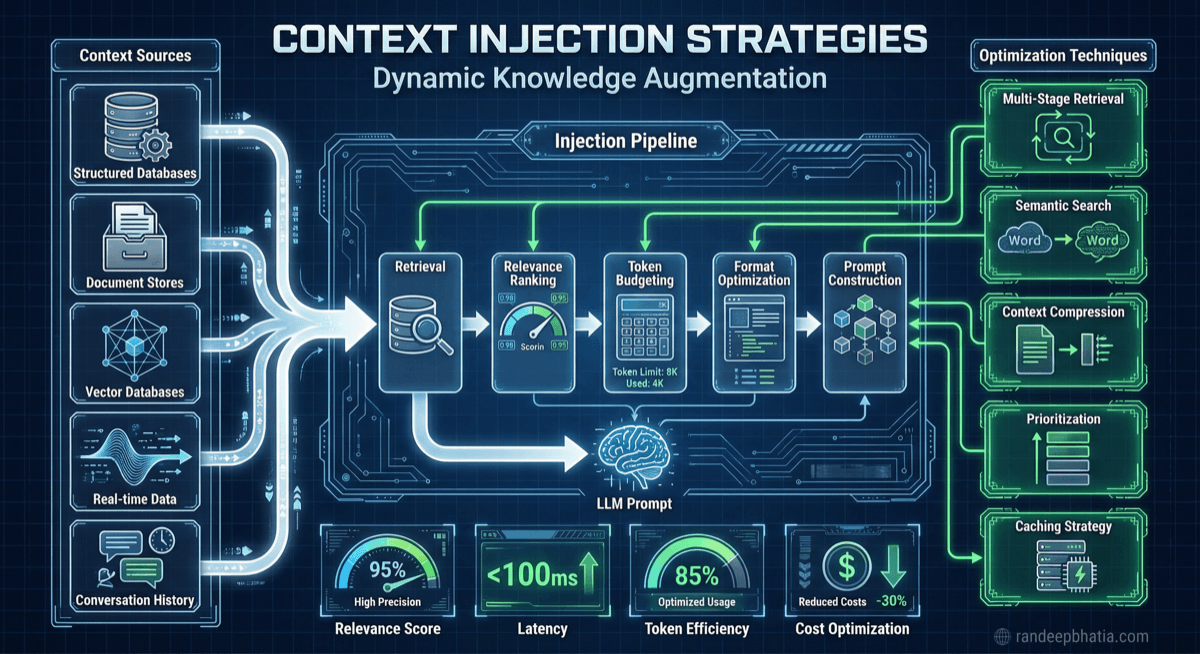
Context injection strategies are systematic approaches for selecting, formatting, and inserting relevant information into LLM prompts to improve response accuracy, relevance, and grounding in specific knowledge.
Context injection bridges the gap between an LLM's static training data and dynamic, task-specific information requirements by programmatically constructing prompts with relevant retrieved or computed context.
Effective context injection requires balancing multiple competing constraints including context window limits, retrieval latency, relevance scoring accuracy, and cost optimization across token consumption.
Production-grade context injection systems must handle failure modes gracefully, implement caching strategies, and maintain observability to ensure consistent response quality at scale.
The Bottom Line
Context injection is the foundational mechanism that transforms generic LLMs into specialized, knowledge-grounded systems capable of accurate domain-specific responses. Mastering context injection strategies is essential for any production AI system that must reason over proprietary data, maintain factual accuracy, or adapt to user-specific requirements.
Definition
Definition
Context injection is the process of programmatically inserting relevant information, documents, data, or instructions into the prompt sent to a large language model to augment its knowledge and guide its response generation.
This technique enables LLMs to access information beyond their training data cutoff, incorporate real-time data, leverage proprietary knowledge bases, and maintain conversation continuity across interactions.
Extended Definition
Context injection encompasses the entire pipeline from information retrieval through prompt construction, including source selection, relevance ranking, content transformation, token budgeting, and format optimization. The strategy employed depends on the nature of the context sources (structured databases, unstructured documents, conversation history, tool outputs), the constraints of the target model (context window size, attention patterns, instruction-following capabilities), and the requirements of the application (latency tolerance, accuracy requirements, cost constraints). Advanced context injection systems implement multi-stage retrieval, dynamic context prioritization, and adaptive compression to maximize the utility of limited context windows while minimizing irrelevant or redundant information that could dilute model attention or increase costs.
Etymology & Origins
The term 'context injection' emerged from the software engineering concept of dependency injection, where external dependencies are provided to a component rather than being created internally. In the LLM domain, this concept was adapted around 2022-2023 as practitioners developed systematic approaches to augmenting prompts with external information, particularly with the rise of retrieval-augmented generation (RAG) systems. The term gained widespread adoption as the AI engineering community recognized that prompt construction was a distinct engineering discipline requiring systematic approaches rather than ad-hoc string concatenation.
Also Known As
Not To Be Confused With
Fine-tuning
Fine-tuning modifies model weights through additional training, while context injection provides information at inference time without changing the model. Context injection is dynamic and immediate; fine-tuning is static and requires retraining.
Prompt engineering
Prompt engineering is the broader discipline of crafting effective prompts, while context injection specifically refers to the dynamic insertion of external information. Context injection is a technique within prompt engineering, not a synonym for it.
In-context learning
In-context learning refers to the model's ability to learn from examples provided in the prompt, while context injection is the mechanism of providing those examples or other information. In-context learning is a model capability; context injection is an engineering practice.
Embedding
Embeddings are vector representations of text used for similarity search and retrieval, while context injection is the process of using retrieved content in prompts. Embeddings enable context injection but are not the same thing.
RAG (Retrieval-Augmented Generation)
RAG is a specific architecture pattern that uses retrieval to augment generation, while context injection is the broader category of techniques for adding context to prompts. RAG is one implementation approach; context injection includes RAG and other methods.
System prompts
System prompts are static instructions that define model behavior, while context injection typically refers to dynamic, query-specific information. System prompts set the stage; context injection provides the specific knowledge needed for each request.
Conceptual Foundation
Core Principles
(8 principles)Mental Models
(6 models)The Briefing Document Model
Think of context injection as preparing a briefing document for an expert consultant. The consultant (LLM) has broad knowledge but needs specific information about your situation, relevant background, and key facts to provide useful advice. The quality of the briefing directly determines the quality of the consultation.
The Attention Budget Model
Visualize the model's attention as a limited resource that must be distributed across all tokens in the context. Each piece of injected context competes for attention with every other piece. Low-value context doesn't just waste tokens—it actively dilutes attention from high-value context.
The Search Results Page Model
Consider context injection like curating a search results page. Users don't want every possible result—they want the most relevant results, well-organized, with enough information to be useful but not so much that they're overwhelmed. Position and presentation matter as much as content.
The Working Memory Model
The context window functions like human working memory—limited capacity, subject to interference, with primacy and recency effects. Information at the beginning and end of context may receive more attention than information in the middle.
The Evidence-Based Reasoning Model
Frame context injection as providing evidence for the model to reason over. The model should be able to cite specific pieces of context to support its conclusions. If context can't serve as citable evidence, it may not belong in the prompt.
The Layered Context Model
Visualize context as layers with different persistence and scope: system-level context (always present), session-level context (conversation history), and query-level context (retrieved for specific questions). Each layer has different update frequencies and management requirements.
Key Insights
(10 insights)The optimal amount of context is often less than the maximum available—studies show that excessive context can degrade model performance even when all context is technically relevant.
Context position matters significantly: most models exhibit primacy bias (attending more to early context) and recency bias (attending more to recent context), with potential 'lost in the middle' effects for long contexts.
Retrieval relevance scores from embedding similarity often correlate poorly with actual usefulness for answering questions—semantic similarity is necessary but not sufficient for good context selection.
The same context formatted differently can produce dramatically different results; structured formats (JSON, markdown tables) often outperform unstructured prose for factual information.
Context injection latency often dominates end-to-end response time in production systems, making retrieval optimization as important as model selection.
Hybrid retrieval approaches combining keyword search with semantic search consistently outperform either approach alone across diverse query types.
Context compression techniques can reduce token usage by 50-70% with minimal impact on response quality when properly tuned, but naive compression often destroys critical information.
The effectiveness of context injection varies significantly across model families—strategies optimized for one model may underperform on others due to different training approaches and attention patterns.
Multi-hop reasoning over injected context remains challenging for current models; complex queries often require query decomposition and iterative context injection rather than single-shot retrieval.
User feedback signals (clicks, ratings, follow-up questions) provide the most reliable signal for context relevance but require infrastructure to capture and incorporate into retrieval systems.
When to Use
When to Use
Ideal Scenarios
(12)Building question-answering systems over proprietary document collections where the LLM lacks training data coverage of the specific domain or organization.
Creating customer support chatbots that need access to product documentation, FAQs, and historical ticket resolutions to provide accurate, consistent responses.
Developing code assistants that must reference project-specific codebases, internal libraries, or organizational coding standards not present in public training data.
Implementing conversational agents that maintain context across multi-turn interactions, requiring injection of conversation history and accumulated state.
Building research assistants that synthesize information from multiple sources, requiring retrieval from academic papers, internal reports, and structured databases.
Creating personalized recommendation systems where user preferences, history, and profile information must inform LLM-generated explanations or suggestions.
Developing compliance and legal assistants that must reference specific regulations, policies, and precedents when providing guidance.
Building real-time information systems that need to incorporate live data feeds, current events, or time-sensitive information into responses.
Creating enterprise search interfaces that use LLMs to synthesize and summarize results from multiple internal knowledge bases and document repositories.
Implementing agentic systems where tool outputs, intermediate results, and execution state must be injected as context for subsequent reasoning steps.
Building educational systems that adapt explanations based on student knowledge level, learning history, and curriculum requirements.
Developing healthcare assistants that must reference patient records, clinical guidelines, and drug interaction databases while maintaining accuracy requirements.
Prerequisites
(8)Access to relevant knowledge sources in a format suitable for retrieval (documents, databases, APIs) with appropriate permissions and data governance.
Infrastructure for storing and querying vector embeddings if using semantic retrieval, including vector database or search engine with embedding support.
Clear understanding of the types of queries the system will handle and the information needed to answer them accurately.
Sufficient context window size in the target LLM to accommodate both injected context and expected response length.
Mechanisms for measuring response quality to enable iterative improvement of context injection strategies.
Data preprocessing pipelines capable of chunking, cleaning, and preparing source documents for effective retrieval.
Latency budget that accommodates retrieval operations in addition to LLM inference time.
Token budget and cost model that accounts for increased prompt sizes due to context injection.
Signals You Need This
(10)LLM responses contain outdated information because the model's training data predates relevant events or updates.
Users report factual errors or hallucinations when asking about domain-specific topics not well-covered in general training data.
The same questions receive inconsistent answers across interactions because the model lacks grounding in authoritative sources.
Responses lack specificity or detail that exists in available documentation but isn't being surfaced to the model.
Users must manually copy-paste relevant information into prompts to get useful responses.
The application requires referencing proprietary information that cannot be included in model training for confidentiality reasons.
Response quality degrades significantly for topics outside the model's apparent knowledge strengths.
Users ask follow-up questions that require information from earlier in the conversation that the model has 'forgotten'.
The system needs to provide citations or sources for its claims to meet trust or compliance requirements.
Performance varies dramatically based on how users phrase questions, suggesting the model is guessing rather than retrieving.
Organizational Readiness
(7)Data governance policies that permit the use of organizational knowledge in LLM prompts, with clear guidelines on sensitive information handling.
Technical teams with experience in information retrieval, search systems, or recommendation engines who can design and optimize retrieval pipelines.
Infrastructure capabilities for hosting vector databases, embedding models, and retrieval services with appropriate scalability.
Established processes for maintaining and updating knowledge bases to ensure injected context remains accurate and current.
Monitoring and observability practices that can be extended to track context injection quality and impact on response quality.
Budget allocation for increased token consumption and potential additional infrastructure costs associated with retrieval systems.
Cross-functional alignment between teams owning knowledge sources and teams building AI applications to ensure data access and quality.
When NOT to Use
When NOT to Use
Anti-Patterns
(12)Injecting entire documents when only specific sections are relevant, wasting token budget and potentially confusing the model with irrelevant information.
Using context injection as a substitute for fine-tuning when the required knowledge is stable, frequently accessed, and would benefit from being internalized in model weights.
Retrieving context based solely on keyword matching without semantic understanding, leading to false positives and missed relevant content.
Injecting context without considering the model's existing knowledge, potentially creating conflicts between training data and injected information.
Treating all context sources as equally authoritative when some should take precedence over others in case of conflicts.
Injecting raw database records or API responses without transformation into natural language that the model can effectively process.
Using fixed context injection regardless of query type, when different queries require fundamentally different types of context.
Injecting sensitive information without appropriate access controls, potentially exposing confidential data through model responses.
Relying on context injection for real-time information when the retrieval pipeline has significant latency, leading to stale data.
Injecting context from untrusted sources without validation, potentially enabling prompt injection attacks or misinformation.
Over-engineering context injection for simple use cases where static prompts or basic templating would suffice.
Ignoring context window limits and truncating context arbitrarily rather than implementing intelligent prioritization.
Red Flags
(10)Retrieval latency exceeds acceptable response time budgets, indicating need for caching, index optimization, or architectural changes.
Context relevance scores are consistently low across queries, suggesting fundamental mismatch between retrieval strategy and query patterns.
Token costs are growing faster than usage, indicating inefficient context selection or lack of compression strategies.
Model responses frequently contradict injected context, suggesting formatting issues, context positioning problems, or model limitations.
Users report that responses ignore provided context and fall back to generic knowledge, indicating attention or instruction-following issues.
Retrieval returns empty or near-empty results for significant portions of queries, suggesting coverage gaps in knowledge bases.
Context injection adds significant complexity but measurable response quality improvements are minimal or inconsistent.
The same context produces different results across model versions or providers, indicating over-reliance on model-specific behaviors.
Debugging response issues requires extensive investigation to determine which context influenced the response.
Context sources are updated infrequently while the domain knowledge changes rapidly, leading to stale information.
Better Alternatives
(8)The required knowledge is stable, well-defined, and accessed in predictable patterns across most queries.
Fine-tuning or continued pre-training to internalize the knowledge in model weights.
Fine-tuning eliminates retrieval latency, reduces per-query costs, and can improve response consistency for frequently-needed knowledge.
Queries require simple lookups of structured data with exact matches rather than semantic understanding.
Direct database queries with results formatted into response templates.
Traditional database queries are faster, more reliable, and more cost-effective for structured data retrieval than semantic search.
The application requires guaranteed factual accuracy with no tolerance for approximation or interpretation.
Deterministic systems with LLM used only for natural language formatting of verified results.
LLMs cannot guarantee factual accuracy even with perfect context; critical applications need deterministic verification layers.
Context sources are extremely large and queries require reasoning over the entire corpus simultaneously.
Specialized summarization or aggregation pipelines that pre-process information before LLM interaction.
Context windows cannot accommodate entire large corpora; pre-processing can distill relevant patterns and aggregates.
Real-time requirements are extremely strict (sub-100ms) and retrieval latency is unavoidable.
Pre-computed responses or cached LLM outputs for common query patterns.
Retrieval adds irreducible latency; pre-computation trades freshness for speed when latency is critical.
The primary value is in the retrieval itself rather than LLM synthesis or generation.
Traditional search interfaces with optional LLM-powered summarization as a secondary feature.
If users primarily need to find documents rather than synthesize information, search UX may be more appropriate.
Knowledge sources are highly dynamic with updates every few seconds or minutes.
Streaming architectures with real-time data pipelines feeding directly into prompts.
Traditional retrieval systems may not keep pace with rapidly changing data; streaming architectures ensure freshness.
The application serves a small, well-defined set of query types with predictable information needs.
Template-based prompts with parameterized context slots filled through simple lookups.
Full retrieval infrastructure may be over-engineered when query patterns are predictable and limited.
Common Mistakes
(10)Assuming more context is always better, when excessive context can degrade model attention and response quality.
Optimizing retrieval for semantic similarity without validating that high-similarity results actually improve response quality.
Neglecting to test context injection with adversarial or edge-case queries that may retrieve irrelevant or misleading content.
Failing to implement proper chunking strategies, leading to context fragments that lack necessary surrounding information.
Ignoring the impact of context ordering on model attention, placing critical information in positions likely to be overlooked.
Not accounting for token overhead from context formatting, metadata, and delimiters when calculating token budgets.
Treating context injection as a one-time implementation rather than an iterative process requiring ongoing optimization.
Failing to establish baselines and metrics for context injection effectiveness, making improvement impossible to measure.
Over-relying on embedding similarity scores without incorporating other relevance signals like recency, authority, or user feedback.
Not implementing fallback strategies for retrieval failures, leading to degraded or failed responses when retrieval systems have issues.
Core Taxonomy
Core Taxonomy
Primary Types
(8 types)Context is dynamically retrieved from external knowledge bases using semantic search, keyword matching, or hybrid approaches based on the user query or conversation state.
Characteristics
- Query-dependent context selection
- Requires embedding infrastructure for semantic search
- Latency includes retrieval time
- Context varies per request
- Scales with knowledge base size
Use Cases
Tradeoffs
Provides highly relevant, query-specific context but adds retrieval latency and requires maintaining retrieval infrastructure. Quality depends heavily on retrieval accuracy.
Classification Dimensions
Retrieval Mechanism
The underlying mechanism used to identify and retrieve relevant context from available sources.
Context Scope
The scope at which context is defined and managed, affecting caching strategies and personalization capabilities.
Temporal Characteristics
How frequently the context sources change, impacting caching strategies and freshness requirements.
Context Format
The format in which context is presented to the model, affecting parsing and attention patterns.
Injection Timing
When in the request lifecycle context injection occurs, affecting latency and context relevance.
Compression Strategy
How context is compressed to fit within token budgets while preserving essential information.
Evolutionary Stages
Ad-hoc Injection
Initial prototypes and proof-of-concept implementations, typically 0-3 months into development.Context is manually assembled through string concatenation with minimal structure. No systematic retrieval, limited error handling, and inconsistent formatting across different parts of the application.
Structured Retrieval
Early production systems, typically 3-6 months into development with initial user feedback.Dedicated retrieval pipeline with vector search or keyword matching. Consistent chunking and formatting strategies. Basic relevance scoring and token budget management.
Optimized Pipeline
Mature production systems, typically 6-12 months with significant query volume and optimization iterations.Multi-stage retrieval with reranking. Hybrid search combining multiple retrieval mechanisms. Caching layers for common queries. Comprehensive monitoring and quality metrics.
Adaptive Systems
Advanced production systems, typically 12-24 months with dedicated ML engineering resources.Dynamic strategy selection based on query characteristics. Learning from user feedback to improve retrieval. Automated A/B testing of context strategies. Self-tuning relevance models.
Intelligent Orchestration
State-of-the-art systems, typically 24+ months with significant R&D investment.AI-driven context assembly that reasons about information needs. Multi-agent architectures for complex context gathering. Predictive context pre-fetching. Continuous learning and adaptation.
Architecture Patterns
(8 patterns)Simple RAG Pattern
The foundational retrieval-augmented generation pattern where user queries are embedded, matched against a vector store, and top-k results are injected into the prompt before LLM inference.
Components
- Embedding model for query encoding
- Vector database for document storage
- Retrieval service for similarity search
- Prompt template with context placeholder
- LLM for response generation
Data Flow
User query → Query embedding → Vector similarity search → Top-k retrieval → Context formatting → Prompt assembly → LLM inference → Response
Best For
- Document Q&A systems
- Knowledge base search
- FAQ automation
- Simple information retrieval tasks
Limitations
- Single retrieval pass may miss relevant context
- No query understanding or decomposition
- Limited handling of complex multi-hop questions
- Retrieval quality depends heavily on embedding model
Scaling Characteristics
Scales horizontally through vector database sharding and embedding service replication. Retrieval latency typically O(log n) with appropriate indexing. Token costs scale linearly with context size.
Integration Points
Vector Database
Stores document embeddings and provides similarity search capabilities for semantic retrieval of relevant context.
Choice of vector database impacts query latency, scaling characteristics, and available filtering options. Consider managed vs. self-hosted options based on operational capabilities.
Embedding Service
Converts text (queries and documents) into vector representations for semantic similarity matching.
Embedding model choice significantly impacts retrieval quality. Consider latency, cost, and whether to use hosted APIs or self-hosted models.
Document Processing Pipeline
Ingests, chunks, and prepares documents for storage in the retrieval system.
Chunking strategy critically impacts retrieval quality. Must handle various document formats and maintain consistency during updates.
Reranking Service
Reorders retrieved results based on more sophisticated relevance models, typically cross-encoders.
Adds latency but can significantly improve precision. Consider whether quality improvement justifies additional latency and cost.
LLM Gateway
Manages LLM API calls including prompt assembly, token counting, rate limiting, and response handling.
Should handle token budget enforcement, retries, and fallbacks. Consider multi-provider support for resilience.
Cache Layer
Stores frequently accessed context, embeddings, or complete responses to reduce latency and cost.
Cache key design is critical. Must balance hit rate against staleness risk. Consider multi-level caching strategies.
Observability Stack
Collects metrics, logs, and traces for monitoring context injection quality and debugging issues.
Must capture retrieval quality metrics, not just latency. Consider sampling strategies for high-volume systems.
Knowledge Base Management
Provides CRUD operations for managing the underlying knowledge sources that feed context injection.
Must maintain consistency between source documents and indexed representations. Consider incremental vs. full reindexing strategies.
Decision Framework
Decision Framework
Context injection is likely necessary. Proceed to determine the appropriate strategy.
Consider whether fine-tuning or prompt engineering alone might suffice before adding retrieval complexity.
Even if information exists in training data, context injection may improve accuracy and enable citation.
Technical Deep Dive
Technical Deep Dive
Overview
Context injection operates at the intersection of information retrieval and prompt engineering, transforming user queries into enriched prompts that provide LLMs with the specific knowledge needed to generate accurate, grounded responses. The process begins when a user query arrives, triggering a retrieval pipeline that identifies relevant information from configured knowledge sources. This retrieved content is then transformed, prioritized, and formatted before being assembled into a prompt template alongside the original query and any system instructions. The retrieval phase typically employs embedding-based semantic search, where both the query and stored documents are represented as high-dimensional vectors, enabling similarity-based matching that captures conceptual relationships beyond keyword overlap. Modern systems often combine this semantic retrieval with traditional lexical search methods like BM25 to handle both conceptual and exact-match query patterns effectively. Once candidate context is retrieved, it undergoes several transformation steps: relevance scoring to prioritize the most useful content, deduplication to remove redundant information, formatting to present content in a structure the LLM can effectively process, and token budgeting to ensure the assembled prompt fits within model context limits. The final prompt is then sent to the LLM, which generates a response informed by both its training knowledge and the injected context. Throughout this process, observability instrumentation captures metrics about retrieval quality, latency, and downstream response quality, enabling continuous optimization of the context injection pipeline.
Step-by-Step Process
The user query is received and preprocessed, which may include normalization, spell correction, query expansion, or classification to determine the appropriate retrieval strategy. Query preprocessing can significantly impact retrieval quality by ensuring the query is in optimal form for matching.
Over-aggressive preprocessing can alter query intent. Query expansion can introduce noise. Classification errors can route queries to wrong pipelines.
Under The Hood
At the core of context injection lies the embedding space, a high-dimensional vector representation where semantic similarity translates to geometric proximity. Modern embedding models like those from OpenAI, Cohere, or open-source alternatives like BGE and E5 are trained on massive text corpora to learn these representations. When a document is embedded, it's projected into this space based on its semantic content; when a query is embedded, it lands in the same space, and nearby documents are retrieved as relevant. Vector databases implement specialized index structures to enable efficient similarity search in high-dimensional spaces. Approximate Nearest Neighbor (ANN) algorithms like HNSW (Hierarchical Navigable Small World) or IVF (Inverted File Index) trade perfect accuracy for dramatic speed improvements, enabling sub-second search over millions of vectors. These indexes must be tuned for the specific tradeoff between recall (finding all relevant results) and latency (search speed). The attention mechanism in transformer-based LLMs determines how the model weighs different parts of the context when generating each token. Research has shown that attention is not uniformly distributed: tokens at the beginning and end of the context often receive more attention than those in the middle, a phenomenon known as the 'lost in the middle' effect. This has important implications for context ordering—critical information should be positioned strategically. Token budgeting involves precise counting of tokens according to the model's tokenizer, which varies between model families. A single word may be one token or several depending on the tokenizer's vocabulary. Context injection systems must account for this variability and include safety margins to prevent prompt truncation. Some systems implement dynamic token allocation that adjusts context volume based on query complexity or available budget. Reranking models, typically cross-encoders, operate differently from embedding-based retrieval. While embeddings encode query and document independently, cross-encoders process the query-document pair together, enabling richer interaction modeling. This joint processing is more computationally expensive but often yields significant precision improvements, particularly for nuanced relevance judgments. Caching strategies in context injection systems operate at multiple levels: embedding caches store computed vectors to avoid re-embedding unchanged content, retrieval caches store query-result mappings for repeated queries, and response caches store complete LLM outputs for identical prompts. Cache invalidation must be carefully managed to balance freshness against performance benefits.
Failure Modes
Failure Modes
Vector database outage, network partition, or service crash prevents retrieval of any context.
- Retrieval timeouts or connection errors
- Empty context in prompts
- Degraded response quality across all queries
- Error rates spike in monitoring
Complete loss of context-dependent functionality. Responses fall back to model's training knowledge only, which may be outdated or incorrect for domain-specific queries.
Implement redundant retrieval infrastructure with failover. Use managed services with SLAs. Implement health checks and circuit breakers.
Graceful degradation to cached results or static context. Clear user messaging about reduced functionality. Automatic failover to backup systems.
Operational Considerations
Key Metrics (15)
Median time from query receipt to context retrieval completion, measuring typical user experience.
Dashboard Panels
Alerting Strategy
Implement tiered alerting with different severity levels: P1 alerts for complete retrieval failures or security issues requiring immediate response; P2 alerts for significant quality degradation or latency increases requiring response within hours; P3 alerts for trend-based concerns requiring investigation within days. Use anomaly detection for metrics without clear thresholds. Implement alert aggregation to prevent alert fatigue during cascading failures.
Cost Analysis
Cost Analysis
Cost Drivers
(10)Embedding API Calls
Cost per embedding generation, typically $0.0001-0.001 per 1K tokens. Scales with query volume and document indexing frequency.
Implement embedding caching aggressively. Batch embedding requests. Consider self-hosted embedding models for high volume.
Vector Database Storage
Storage costs scale with document count and embedding dimensions. Typically $0.10-0.50 per GB per month for managed services.
Use appropriate embedding dimensions (smaller if quality permits). Implement document lifecycle policies. Archive or delete unused content.
Vector Database Queries
Query costs in managed services, typically $0.01-0.10 per 1K queries. Can dominate costs at high volume.
Implement query caching. Batch similar queries. Optimize index for query patterns.
LLM Token Consumption
Injected context directly increases prompt token costs. At $0.01-0.03 per 1K tokens, context injection can double or triple LLM costs.
Implement context compression. Optimize retrieval to minimize irrelevant content. Use token budgets aggressively.
Reranking Model Inference
Cross-encoder inference costs scale with candidate set size. Can add $0.001-0.01 per query.
Limit candidate set size. Use efficient reranking models. Skip reranking for high-confidence retrievals.
Compute for Self-Hosted Components
GPU costs for self-hosted embedding or reranking models. CPU costs for retrieval services.
Right-size instances. Implement autoscaling. Use spot instances where appropriate.
Network Transfer
Data transfer costs between components, especially across regions or cloud boundaries.
Co-locate components. Compress data in transit. Minimize cross-region traffic.
Indexing Pipeline Compute
Processing costs for document ingestion, chunking, and embedding generation during indexing.
Implement incremental indexing. Schedule bulk indexing during off-peak hours. Optimize chunking efficiency.
Observability and Logging
Log storage and analysis costs can be significant at high query volumes.
Implement log sampling. Use appropriate retention policies. Aggregate metrics rather than storing raw data.
Development and Maintenance
Engineering time for building, optimizing, and maintaining context injection systems.
Use managed services where appropriate. Invest in automation. Build reusable components.
Cost Models
Per-Query Cost Model
Cost per query = (embedding_cost) + (retrieval_cost) + (reranking_cost) + (context_tokens × token_price) + (response_tokens × token_price)Query with 2000 context tokens, 500 response tokens at $0.00003/token: $0.0001 + $0.00005 + $0.001 + (2000 × $0.00003) + (500 × $0.00003) = $0.076 per query
Monthly Infrastructure Cost Model
Monthly cost = (vector_db_storage × storage_price) + (vector_db_compute) + (embedding_service_cost) + (reranking_compute) + (observability_cost)100GB vectors at $0.25/GB + $500 compute + $200 embedding + $300 reranking + $100 observability = $1,125/month base infrastructure
Scaling Cost Model
Cost at scale = base_infrastructure + (queries_per_month × per_query_cost) + (documents × indexing_cost_per_doc)At 1M queries/month with $0.05 per query cost: $1,125 base + (1,000,000 × $0.05) = $51,125/month
ROI Calculation Model
ROI = (value_generated - total_cost) / total_cost × 100%If context injection improves conversion by 10% generating $100K additional revenue against $20K costs: ROI = ($100K - $20K) / $20K = 400%
Optimization Strategies
- 1Implement aggressive embedding caching to reduce redundant embedding API calls by 70-90%
- 2Use semantic caching for similar queries to serve cached results without full retrieval
- 3Implement tiered retrieval with fast/cheap first stage and expensive reranking only when needed
- 4Compress context using extractive summarization to reduce token consumption by 40-60%
- 5Batch embedding requests during indexing to reduce API call overhead
- 6Use smaller embedding models where quality permits (384 vs 1536 dimensions)
- 7Implement query classification to route simple queries to cheaper processing paths
- 8Set strict token budgets and enforce them to prevent runaway costs
- 9Use spot instances or preemptible VMs for batch processing workloads
- 10Implement request deduplication to avoid processing identical queries
- 11Consider self-hosted embedding models at scale (>100K queries/day)
- 12Negotiate volume pricing with API providers for predictable high-volume usage
Hidden Costs
- 💰Engineering time for initial implementation and ongoing optimization
- 💰Quality assurance and testing infrastructure for retrieval evaluation
- 💰Incident response and debugging time when retrieval issues occur
- 💰Training and documentation for teams working with context injection systems
- 💰Technical debt from quick implementations that require later refactoring
- 💰Opportunity cost of engineering resources allocated to context injection vs. other features
- 💰Compliance and security audit costs for systems handling sensitive data
- 💰Vendor lock-in costs if migrating between embedding or vector database providers
ROI Considerations
The ROI of context injection depends heavily on the application domain and baseline performance. For customer support applications, context injection typically reduces escalation rates by 20-40% and improves first-contact resolution, generating clear cost savings. For knowledge-intensive applications like legal or medical assistants, the accuracy improvements from context injection may be essential for product viability rather than incremental improvement. Measuring ROI requires establishing clear baselines before implementation and tracking relevant business metrics alongside technical metrics. Common value drivers include: reduced support costs, improved user satisfaction and retention, increased conversion rates, reduced time-to-answer for information retrieval tasks, and decreased error rates in AI-assisted decisions. The cost curve for context injection has significant economies of scale: fixed infrastructure costs are amortized over query volume, and optimization investments yield returns across all queries. Early-stage implementations may appear expensive on a per-query basis, but mature systems at scale can achieve very favorable unit economics. Consider the counterfactual: what is the cost of not implementing context injection? For many applications, the alternative is either manual information retrieval (expensive human time), inaccurate AI responses (user trust and potential liability), or inability to serve the use case at all. Context injection costs should be evaluated against these alternatives, not in isolation.
Security Considerations
Threat Model
(10 threats)Prompt Injection via Retrieved Content
Malicious content in knowledge base contains instructions that override system prompt when retrieved and injected.
Attacker can manipulate model behavior, extract sensitive information, bypass safety measures, or cause harmful outputs.
Sanitize content during indexing. Use clear delimiters between context and instructions. Implement output filtering. Consider instruction hierarchy in prompt design.
Data Exfiltration Through Retrieval
Crafted queries designed to retrieve and expose sensitive information from knowledge base.
Unauthorized access to confidential data, potential compliance violations, competitive intelligence leakage.
Implement retrieval-time access controls. Audit query patterns. Classify and protect sensitive content. Implement data loss prevention checks.
Knowledge Base Poisoning
Attacker gains ability to insert malicious content into knowledge base, which is then retrieved and trusted.
Misinformation propagation, prompt injection at scale, reputation damage, potential safety incidents.
Strict access controls on knowledge base updates. Content validation and review workflows. Anomaly detection on indexed content.
Inference Attacks on Embeddings
Attacker with access to embeddings attempts to reconstruct original content or identify sensitive documents.
Privacy violations, exposure of confidential information structure even without direct content access.
Protect embedding storage with appropriate access controls. Consider differential privacy for sensitive embeddings. Limit embedding API exposure.
Denial of Service via Complex Queries
Crafted queries designed to maximize retrieval computation, exhausting resources.
Service degradation or unavailability, increased costs, poor user experience.
Implement query complexity limits. Rate limiting per user/session. Resource quotas for retrieval operations. Query timeout enforcement.
Cross-Tenant Data Leakage
In multi-tenant systems, queries from one tenant retrieve content belonging to another.
Privacy violations, compliance failures, loss of customer trust, potential legal liability.
Strict tenant isolation in vector stores. Mandatory tenant filtering on all queries. Regular access control audits. Penetration testing.
Model Extraction via Retrieval Probing
Systematic queries to map knowledge base contents or understand retrieval behavior.
Intellectual property theft, competitive intelligence gathering, preparation for more targeted attacks.
Rate limiting and anomaly detection. Query logging and analysis. Limit result metadata exposure.
Supply Chain Attacks on Embedding Models
Compromised embedding models produce manipulated embeddings that affect retrieval behavior.
Systematic retrieval manipulation, potential backdoors in AI system behavior.
Use trusted embedding model sources. Verify model checksums. Monitor for unexpected retrieval behavior changes.
Session Hijacking for Context Access
Attacker gains access to user session and retrieves context intended for that user.
Exposure of user-specific context, conversation history, and personalization data.
Strong session management. Context encryption at rest. Session timeout policies. Anomaly detection for session behavior.
Logging and Observability Data Exposure
Logs containing queries, context, or responses are accessed by unauthorized parties.
Exposure of sensitive queries and responses, privacy violations, potential for further attacks.
Sanitize logs to remove sensitive content. Implement log access controls. Use appropriate retention policies. Encrypt logs at rest.
Security Best Practices
- ✓Implement defense in depth with multiple security layers throughout the context injection pipeline
- ✓Use clear, consistent delimiters between system instructions, context, and user input
- ✓Sanitize all content before indexing to remove potential injection payloads
- ✓Implement retrieval-time access controls that enforce user permissions on every query
- ✓Log all retrieval operations with sufficient detail for security audit and incident response
- ✓Encrypt embeddings and document content at rest and in transit
- ✓Implement rate limiting and anomaly detection to identify potential attacks
- ✓Regularly audit access controls and permissions on knowledge base content
- ✓Use separate indexes for different sensitivity levels of content
- ✓Implement output filtering to catch potential data leakage in responses
- ✓Conduct regular penetration testing of context injection systems
- ✓Maintain incident response procedures specific to context injection security events
- ✓Train development teams on prompt injection and context injection security risks
- ✓Implement content classification and handling procedures for sensitive information
- ✓Use principle of least privilege for all system components and API access
Data Protection
- 🔒Classify all knowledge base content by sensitivity level before indexing
- 🔒Implement encryption at rest for vector databases and document stores
- 🔒Use TLS for all data in transit between context injection components
- 🔒Implement key management procedures for encryption keys
- 🔒Maintain data inventory documenting what information is stored and processed
- 🔒Implement data retention policies with automated enforcement
- 🔒Enable audit logging for all data access and modifications
- 🔒Implement backup and recovery procedures with appropriate security
- 🔒Conduct regular data protection impact assessments
- 🔒Implement data masking or anonymization for sensitive content where appropriate
Compliance Implications
GDPR (General Data Protection Regulation)
Personal data in knowledge bases must be processed lawfully with appropriate consent. Data subjects have rights to access, rectification, and erasure.
Implement data subject access request handling for knowledge base content. Enable deletion propagation to vector indexes. Document lawful basis for processing. Implement data minimization in context injection.
CCPA (California Consumer Privacy Act)
California residents have rights to know what personal information is collected and to request deletion.
Maintain inventory of personal information in knowledge bases. Implement deletion workflows that include vector index updates. Provide disclosure of AI processing.
HIPAA (Health Insurance Portability and Accountability Act)
Protected Health Information (PHI) requires specific safeguards and access controls.
Implement strict access controls on PHI in knowledge bases. Ensure BAAs with all vendors. Audit logging for PHI access. Encryption requirements for PHI at rest and in transit.
SOC 2 Type II
Demonstrate security controls are operating effectively over time.
Document context injection security controls. Implement continuous monitoring. Maintain audit trails. Regular control testing and evidence collection.
PCI DSS (Payment Card Industry Data Security Standard)
Cardholder data requires specific protection measures.
Exclude cardholder data from knowledge bases or implement PCI-compliant storage. Network segmentation for systems handling card data. Regular vulnerability assessments.
AI-Specific Regulations (EU AI Act, etc.)
Emerging regulations require transparency, human oversight, and risk management for AI systems.
Document context injection as part of AI system documentation. Implement human oversight mechanisms. Conduct and document risk assessments. Maintain audit trails for AI decisions.
Industry-Specific Regulations (FINRA, FDA, etc.)
Sector-specific requirements for data handling, record-keeping, and system validation.
Consult sector-specific guidance. Implement required retention policies. Validate context injection systems per regulatory requirements.
Data Residency Requirements
Some jurisdictions require data to remain within geographic boundaries.
Deploy vector databases and knowledge bases in compliant regions. Implement data residency controls. Document data flows for compliance verification.
Scaling Guide
Scaling Guide
Scaling Dimensions
Query Volume
Horizontal scaling of retrieval services with load balancing. Implement caching layers. Consider read replicas for vector databases.
Limited by vector database query throughput and embedding service capacity. Caching effectiveness depends on query distribution.
Monitor cache hit rates. Plan for traffic spikes. Implement autoscaling based on query queue depth.
Knowledge Base Size
Shard vector indexes across multiple nodes. Implement hierarchical retrieval for very large collections. Consider index partitioning by domain or time.
Single-node vector databases typically handle 1-10M vectors. Sharding enables billions but adds complexity.
Plan sharding strategy early. Consider query routing complexity. Monitor per-shard performance.
Context Complexity
Implement tiered processing with simple queries handled quickly and complex queries routed to more sophisticated pipelines.
Complex multi-hop queries have inherent latency from multiple retrieval rounds.
Query classification accuracy impacts routing effectiveness. Set appropriate timeouts for complex queries.
Concurrent Users
Stateless retrieval services enable horizontal scaling. Session state managed externally. Connection pooling for database access.
Limited by downstream service capacity (embedding APIs, LLM APIs).
Implement graceful degradation under load. Queue management for burst traffic.
Geographic Distribution
Deploy retrieval infrastructure in multiple regions. Implement index replication. Use CDN for static context.
Cross-region replication adds latency and complexity. Consistency guarantees may be relaxed.
Data residency requirements may constrain options. Plan for regional failover.
Real-Time Requirements
Streaming architectures for real-time data. Event-driven index updates. In-memory caching for hot data.
True real-time requires significant infrastructure investment. Trade-offs between freshness and cost.
Define acceptable staleness. Implement freshness indicators in responses.
Multi-Tenancy
Tenant isolation through metadata filtering or separate indexes. Implement tenant-aware caching. Resource quotas per tenant.
Separate indexes provide strongest isolation but highest cost. Shared indexes require careful access control.
Noisy neighbor problems. Tenant-specific SLAs. Cost allocation.
Model Diversity
Support multiple embedding models and LLMs through abstraction layers. Implement model routing based on query characteristics.
Each model requires separate infrastructure. Embedding compatibility across models.
Standardize interfaces. Plan for model lifecycle management.
Capacity Planning
Required capacity = (peak_qps × processing_time_per_query × safety_margin) + (knowledge_base_size × storage_overhead) + (concurrent_connections × connection_overhead)Plan for 2-3x expected peak load to handle traffic spikes and provide headroom for growth. Implement autoscaling to handle unexpected demand while controlling costs.
Scaling Milestones
- Establishing baseline metrics
- Validating retrieval quality
- Iterating on chunking and prompts
Single-node setup acceptable. Focus on functionality over scalability. Use managed services for simplicity.
- Ensuring reliability
- Implementing monitoring
- Managing costs
Implement caching. Set up proper monitoring. Consider managed vector database. Implement basic autoscaling.
- Latency optimization
- Cost management at scale
- Handling diverse query patterns
Multi-tier caching. Query classification and routing. Consider self-hosted components for cost optimization. Implement comprehensive observability.
- Infrastructure complexity
- Team scaling
- Maintaining quality at volume
Distributed retrieval infrastructure. Dedicated teams for different components. Sophisticated caching and optimization. Consider multi-region deployment.
- Operational excellence
- Cost optimization critical
- Complex failure modes
Fully distributed architecture. Custom optimizations. Dedicated SRE practices. Advanced ML for retrieval optimization.
- Cutting-edge infrastructure
- Custom solutions required
- Organizational complexity
Custom-built components where needed. Research-level optimizations. Dedicated infrastructure teams. Global distribution.
- Tenant isolation
- Variable workloads
- Complex access control
Tenant-aware architecture throughout. Resource isolation and quotas. Sophisticated access control. Per-tenant monitoring and billing.
Benchmarks
Benchmarks
Industry Benchmarks
| Metric | P50 | P95 | P99 | World Class |
|---|---|---|---|---|
| Retrieval Latency (p50) | 50ms | 150ms | 300ms | <30ms |
| Retrieval Latency (p95) | 150ms | 400ms | 800ms | <100ms |
| End-to-End Latency (p50) | 800ms | 2000ms | 4000ms | <500ms |
| Retrieval Recall@10 | 70% | 85% | 92% | >95% |
| Retrieval Precision@10 | 60% | 80% | 90% | >85% |
| Context Relevance Score | 0.65 | 0.80 | 0.90 | >0.85 |
| Token Efficiency (useful tokens / total tokens) | 50% | 70% | 85% | >80% |
| Cache Hit Rate | 40% | 70% | 85% | >80% |
| Empty Result Rate | 15% | 8% | 3% | <2% |
| System Availability | 99.0% | 99.9% | 99.99% | >99.99% |
| Index Freshness (time to reflect updates) | 1 hour | 15 minutes | 5 minutes | <1 minute |
| Cost per 1000 Queries | $5.00 | $2.00 | $0.50 | <$0.25 |
Comparison Matrix
| Approach | Retrieval Quality | Latency | Cost | Complexity | Scalability | Best For |
|---|---|---|---|---|---|---|
| Simple RAG | Good | Low | Low | Low | High | Standard Q&A, getting started |
| Hybrid Retrieval | Very Good | Medium | Medium | Medium | High | Mixed query types, enterprise search |
| Multi-Stage + Reranking | Excellent | High | High | High | Medium | High-precision requirements |
| Query Decomposition | Excellent | Very High | Very High | Very High | Low | Complex multi-hop questions |
| Agentic Retrieval | Variable | Variable | Very High | Very High | Low | Open-ended research tasks |
| Cached Context | Good (for cached) | Very Low | Low | Medium | Very High | High-volume, repeated queries |
| Fine-tuned + RAG | Excellent | Medium | High (upfront) | High | High | Stable domain + dynamic updates |
| Structured Query + LLM | Excellent (for structured) | Low | Low | Medium | High | Database-backed applications |
Performance Tiers
Simple RAG implementation with single embedding model and vector database. Adequate for prototypes and low-stakes applications.
Retrieval latency <500ms, Recall@10 >60%, Availability >99%
Hybrid retrieval with caching, monitoring, and error handling. Suitable for customer-facing applications with moderate quality requirements.
Retrieval latency <200ms, Recall@10 >75%, Availability >99.9%
Multi-stage retrieval with reranking, sophisticated caching, and comprehensive observability. For applications where quality is critical.
Retrieval latency <150ms, Recall@10 >85%, Availability >99.95%
Full-featured implementation with multi-tenant support, advanced security, compliance features, and SLA guarantees.
Retrieval latency <100ms, Recall@10 >90%, Availability >99.99%
State-of-the-art implementation with custom optimizations, ML-driven retrieval improvement, and cutting-edge techniques.
Retrieval latency <50ms, Recall@10 >95%, Availability >99.999%
Real World Examples
Real World Examples
Real-World Scenarios
(8 examples)Enterprise Knowledge Base Assistant
Large technology company with 500,000+ internal documents across wikis, Confluence, SharePoint, and Slack. Employees spend significant time searching for information.
Implemented hybrid retrieval combining semantic search with metadata filtering (department, document type, recency). Multi-stage pipeline with BM25 first stage, embedding-based reranking, and cross-encoder final ranking. Conversation history maintained for follow-up questions.
Reduced average time to find information from 15 minutes to 2 minutes. 78% of queries answered without human escalation. Employee satisfaction with internal search improved from 2.8 to 4.2 (out of 5).
- 💡Document freshness signals were critical—employees needed recent information prioritized
- 💡Department-specific terminology required custom embedding fine-tuning
- 💡Access control integration was more complex than anticipated
- 💡Conversation history significantly improved follow-up question handling
Customer Support Chatbot
E-commerce company handling 50,000 support tickets monthly. Wanted to automate common questions while maintaining quality.
RAG system over product documentation, FAQ database, and historical ticket resolutions. Implemented confidence-based routing: high-confidence answers delivered directly, medium-confidence presented with human review option, low-confidence escalated to agents.
Automated 45% of incoming tickets. Average resolution time for automated tickets: 30 seconds vs. 8 minutes for human agents. Customer satisfaction maintained at 4.1/5 for automated responses.
- 💡Confidence calibration required extensive tuning with human evaluation
- 💡Product catalog changes required rapid reindexing—implemented real-time sync
- 💡Edge cases in returns/refunds needed special handling outside RAG
- 💡User feedback loop was essential for continuous improvement
Legal Document Analysis
Law firm needed to search across 2 million case documents and contracts to find relevant precedents and clauses.
Specialized legal embedding model fine-tuned on legal corpus. Hierarchical retrieval: document-level first, then section-level, then paragraph-level. Citation extraction and cross-referencing. Strict access controls based on matter assignment.
Research time reduced by 60%. Relevant precedent identification improved from 70% to 92% recall. Enabled junior associates to perform research previously requiring senior oversight.
- 💡Legal terminology required domain-specific embeddings—general models performed poorly
- 💡Document structure (sections, clauses) was critical for meaningful retrieval
- 💡Citation networks provided valuable relevance signals beyond semantic similarity
- 💡Audit trails were mandatory for compliance
Healthcare Clinical Decision Support
Hospital system implementing AI assistant for clinicians to query clinical guidelines, drug information, and research literature.
Extremely conservative approach with multiple validation layers. Retrieved content always displayed alongside AI synthesis. Confidence scores prominently shown. Human-in-the-loop for any treatment recommendations. Strict HIPAA compliance throughout.
Clinicians reported 40% time savings on information lookup. Zero adverse events attributed to system. Adoption reached 70% of target clinicians within 6 months.
- 💡Trust was paramount—transparency about sources and confidence was essential
- 💡Medical terminology standardization (SNOMED, ICD) improved retrieval significantly
- 💡Real-time drug interaction checking required structured data integration, not just RAG
- 💡Regulatory review added 3 months to timeline but was non-negotiable
Software Documentation Assistant
Developer tools company with extensive API documentation, tutorials, and community content. Developers struggled to find relevant information.
Code-aware retrieval using specialized code embedding model. Integrated with IDE for context-aware suggestions. Combined documentation, Stack Overflow-style Q&A, and GitHub issues. Version-aware retrieval to match user's software version.
Support ticket volume reduced by 35%. Developer satisfaction with documentation improved from 3.2 to 4.4. Average time to first successful API call reduced by 50%.
- 💡Code snippets required special handling—standard chunking broke code blocks
- 💡Version compatibility was critical—outdated examples caused significant frustration
- 💡IDE integration dramatically increased adoption over web interface
- 💡Community content quality varied—implemented quality scoring
Financial Research Platform
Investment firm needed to synthesize information from earnings calls, SEC filings, news, and internal research across thousands of companies.
Multi-source retrieval with source-specific processing pipelines. Temporal awareness for time-sensitive financial data. Entity resolution to link mentions across sources. Sentiment and fact extraction for structured querying.
Analysts reported 3x improvement in research throughput. Previously impossible cross-company analyses became routine. Competitive intelligence gathering time reduced by 70%.
- 💡Financial data freshness was critical—stale data could lead to poor decisions
- 💡Entity disambiguation (company names, ticker symbols) required significant effort
- 💡Combining structured (financials) and unstructured (narratives) data was powerful but complex
- 💡Compliance requirements for data sourcing added significant overhead
Educational Tutoring System
Online learning platform wanted to provide personalized tutoring that adapted to student knowledge level and learning style.
Student profile injection including knowledge state, learning history, and preferences. Curriculum-aware retrieval to ensure pedagogically appropriate content. Adaptive difficulty based on student performance. Socratic questioning patterns in prompts.
Student engagement increased by 45%. Learning outcome assessments improved by 25%. Tutor workload reduced by 40% as AI handled routine questions.
- 💡Student modeling was as important as content retrieval
- 💡Pedagogical sequencing required curriculum expertise, not just relevance
- 💡Motivation and encouragement patterns significantly impacted engagement
- 💡Parent/teacher visibility into AI interactions was important for trust
Manufacturing Quality Assistant
Manufacturing company needed to help quality engineers diagnose issues by searching equipment manuals, maintenance records, and historical defect reports.
Multimodal retrieval including text, diagrams, and sensor data. Equipment-specific context injection based on production line. Integration with real-time sensor feeds for current state awareness. Root cause analysis patterns in prompts.
Mean time to diagnose quality issues reduced from 4 hours to 45 minutes. Repeat defects reduced by 30% through better knowledge sharing. New engineer onboarding time reduced by 50%.
- 💡Equipment-specific context was essential—generic manufacturing knowledge was insufficient
- 💡Diagram and schematic retrieval required specialized processing
- 💡Tribal knowledge from experienced engineers needed explicit capture
- 💡Integration with operational systems provided valuable real-time context
Industry Applications
Healthcare
Clinical decision support systems that retrieve relevant guidelines, drug information, and research to assist clinician decision-making while maintaining strict accuracy and compliance requirements.
HIPAA compliance mandatory. Patient safety requires high precision. Must integrate with EHR systems. Requires extensive validation before deployment. Human oversight essential for treatment decisions.
Legal
Legal research assistants that search case law, statutes, and contracts to find relevant precedents and clauses, with citation tracking and jurisdiction awareness.
Jurisdiction-specific content critical. Citation accuracy must be perfect. Confidentiality requirements for client matters. Audit trails required. Domain-specific language models often necessary.
Financial Services
Investment research platforms that synthesize information from filings, earnings calls, news, and analyst reports to support investment decisions.
Data freshness critical for time-sensitive decisions. Regulatory compliance (SEC, FINRA) required. Source attribution important for audit. Must handle structured financial data alongside unstructured text.
Technology
Developer documentation assistants that help engineers find relevant API documentation, code examples, and troubleshooting information with version awareness.
Code-aware retrieval required. Version compatibility critical. Integration with development tools increases adoption. Community content quality varies.
Retail/E-commerce
Customer service automation that answers product questions, handles returns, and provides recommendations based on product catalog and customer history.
Product catalog changes require rapid updates. Personalization based on customer history. Integration with order management systems. Handling of edge cases (fraud, disputes) requires escalation.
Manufacturing
Equipment maintenance assistants that help technicians diagnose issues by searching manuals, maintenance records, and historical repair data.
Equipment-specific context essential. May require multimodal retrieval (diagrams, schematics). Integration with sensor data valuable. Tribal knowledge capture important.
Education
Adaptive tutoring systems that provide personalized learning support by retrieving appropriate educational content based on student level and learning objectives.
Student modeling as important as content retrieval. Pedagogical appropriateness required. Age-appropriate content filtering. Progress tracking and reporting for educators.
Government
Citizen service assistants that help residents navigate government services by searching regulations, forms, and procedural documentation.
Accessibility requirements (ADA compliance). Multi-language support often required. Accuracy critical for legal/regulatory information. Privacy requirements for citizen data.
Insurance
Claims processing assistants that retrieve relevant policy information, coverage details, and precedent claims to support adjusters in decision-making.
Policy-specific context essential. Regulatory compliance required. Fraud detection integration valuable. Audit trails for claims decisions mandatory.
Pharmaceutical
Drug information systems that retrieve clinical trial data, adverse event reports, and regulatory submissions to support research and compliance activities.
FDA/EMA compliance requirements. Data integrity critical. Version control for regulatory submissions. Integration with clinical trial management systems.
Frequently Asked Questions
(20 questions)Fundamentals
RAG (Retrieval-Augmented Generation) is a specific architecture pattern that uses retrieval to augment LLM generation. Context injection is the broader category of techniques for adding external information to prompts, which includes RAG but also encompasses static context injection, conversation history management, tool output injection, and other methods. RAG is one implementation of context injection focused on document retrieval.
Implementation
Architecture
Optimization
Technology Selection
Measurement
Security
Performance
Operations
Debugging
Glossary
Glossary
Glossary
(30 terms)Approximate Nearest Neighbor (ANN)
Algorithms that find vectors similar to a query vector without exhaustive search, trading perfect accuracy for dramatically improved speed. Common implementations include HNSW, IVF, and LSH.
Context: ANN algorithms enable sub-second retrieval over millions of vectors, making production-scale context injection feasible.
Bi-Encoder
An architecture that encodes queries and documents independently into vectors, enabling efficient similarity search but potentially missing query-document interactions.
Context: Bi-encoders enable fast initial retrieval but may be complemented by cross-encoders for reranking.
BM25
Best Matching 25, a probabilistic ranking function used for lexical retrieval that scores documents based on term frequency, inverse document frequency, and document length normalization.
Context: BM25 is often used alongside semantic search in hybrid retrieval systems to capture exact term matches that embedding similarity might miss.
Chunking
The process of splitting documents into smaller segments suitable for embedding and retrieval. Chunk size and strategy significantly impact retrieval quality.
Context: Effective chunking preserves semantic coherence while creating units small enough for precise retrieval.
Context Window
The maximum number of tokens an LLM can process in a single request, including both input (prompt + context) and output (response).
Context: Context window limits constrain how much information can be injected, requiring prioritization and potentially compression strategies.
Cross-Encoder
A neural network architecture that processes query-document pairs jointly, enabling more nuanced relevance judgments than independent encoding. Used for reranking.
Context: Cross-encoders provide higher-quality relevance scores but are too expensive for initial retrieval, making them suitable for reranking smaller candidate sets.
Dense Retrieval
Retrieval based on dense vector representations (embeddings) as opposed to sparse representations (term frequencies).
Context: Dense retrieval captures semantic similarity but may miss exact term matches that sparse retrieval handles well.
Embedding
A dense vector representation of text that captures semantic meaning in a high-dimensional space where similar concepts are positioned near each other.
Context: Embeddings enable semantic similarity search, the foundation of most modern context injection systems.
Few-Shot
Providing a small number of examples in the prompt to demonstrate desired behavior or format, leveraging in-context learning.
Context: Few-shot examples are a form of context injection that demonstrates rather than describes desired outputs.
Grounding
Connecting LLM responses to specific, verifiable sources of information to improve accuracy and enable citation.
Context: Context injection enables grounding by providing authoritative sources that the model can reference in responses.
Hallucination
LLM generation of plausible-sounding but factually incorrect or unsupported information.
Context: Context injection reduces hallucination by providing factual grounding, though it cannot eliminate it entirely.
HNSW (Hierarchical Navigable Small World)
A graph-based algorithm for approximate nearest neighbor search that provides excellent query performance with logarithmic time complexity.
Context: HNSW is the most common indexing algorithm in production vector databases due to its balance of speed and accuracy.
Hybrid Retrieval
Retrieval approaches that combine multiple methods (typically semantic and lexical) to improve recall and precision over single-method approaches.
Context: Hybrid retrieval addresses the limitations of pure semantic or pure lexical search by leveraging the strengths of both.
In-Context Learning
The ability of LLMs to learn from examples or information provided in the prompt without parameter updates, enabling task adaptation through context alone.
Context: Context injection leverages in-context learning to provide LLMs with task-specific knowledge at inference time.
Lost in the Middle
The phenomenon where LLMs pay less attention to information in the middle of long contexts compared to the beginning and end.
Context: This effect influences context positioning strategies, with critical information placed at strategic positions.
Maximal Marginal Relevance (MMR)
An algorithm that balances relevance and diversity in result selection by penalizing redundancy with already-selected items.
Context: MMR helps ensure retrieved context covers different aspects of a query rather than repeating similar information.
MRR (Mean Reciprocal Rank)
A metric that measures how highly the first relevant result is ranked, averaging the reciprocal of the rank across queries.
Context: MRR is particularly relevant when only the top result matters or when results are presented in ranked order.
Precision@k
The proportion of top-k retrieved results that are actually relevant, measuring retrieval accuracy.
Context: High precision ensures injected context is relevant, avoiding token waste and potential model confusion.
Prompt Injection
An attack where malicious content in user input or retrieved context contains instructions that override the system prompt or manipulate model behavior.
Context: Context injection systems must guard against prompt injection by sanitizing retrieved content and using clear delimiters.
Query Expansion
Techniques that augment the original query with related terms, synonyms, or reformulations to improve retrieval recall.
Context: Query expansion can help retrieve relevant content that doesn't match the exact query terms.
RAG (Retrieval-Augmented Generation)
An architecture pattern that enhances LLM generation by retrieving relevant documents and including them in the prompt, grounding responses in external knowledge.
Context: RAG is the most common context injection pattern, combining information retrieval with language model generation.
Recall@k
The proportion of relevant documents that appear in the top-k retrieved results, measuring retrieval completeness.
Context: High recall ensures relevant context isn't missed, though it must be balanced against precision.
Reciprocal Rank Fusion (RRF)
A simple but effective algorithm for combining ranked lists from multiple retrieval methods by summing reciprocal ranks.
Context: RRF is commonly used to fuse results from semantic and lexical retrieval in hybrid systems.
Reranking
A second-stage retrieval process that reorders initial retrieval results using a more sophisticated (and expensive) relevance model.
Context: Reranking improves precision by applying expensive models to a smaller candidate set identified by faster initial retrieval.
Semantic Search
Search based on meaning rather than exact keyword matching, typically implemented using embedding similarity in vector spaces.
Context: Semantic search enables retrieval of conceptually related content even when exact terms don't match.
Sparse Retrieval
Retrieval based on sparse vector representations like TF-IDF or BM25, where most dimensions are zero.
Context: Sparse retrieval excels at exact term matching and is often combined with dense retrieval in hybrid systems.
Token
The basic unit of text processing for LLMs, typically representing a word, subword, or character depending on the tokenizer. Token counts determine context window usage and costs.
Context: Context injection must carefully manage token budgets to maximize information within model limits.
Token Budget
The allocation of available context window tokens across different components: system prompt, injected context, conversation history, and response.
Context: Effective token budgeting ensures critical information fits within limits while leaving room for model response.
Vector Database
A database optimized for storing and querying high-dimensional vectors, enabling efficient similarity search for embedding-based retrieval.
Context: Vector databases are core infrastructure for context injection systems, providing fast similarity search at scale.
Zero-Shot
Model performance on tasks without any task-specific examples in the prompt, relying solely on instructions and general knowledge.
Context: Context injection can enhance zero-shot performance by providing relevant information without requiring few-shot examples.
References & Resources
Academic Papers
- • Lewis, P., et al. (2020). 'Retrieval-Augmented Generation for Knowledge-Intensive NLP Tasks.' NeurIPS 2020. - Foundational paper introducing the RAG architecture.
- • Karpukhin, V., et al. (2020). 'Dense Passage Retrieval for Open-Domain Question Answering.' EMNLP 2020. - Established dense retrieval as effective for QA.
- • Izacard, G., & Grave, E. (2021). 'Leveraging Passage Retrieval with Generative Models for Open Domain Question Answering.' EACL 2021. - Fusion-in-Decoder approach for multi-document reasoning.
- • Guu, K., et al. (2020). 'REALM: Retrieval-Augmented Language Model Pre-Training.' ICML 2020. - Pre-training with retrieval augmentation.
- • Liu, N.F., et al. (2023). 'Lost in the Middle: How Language Models Use Long Contexts.' arXiv. - Critical analysis of attention patterns in long contexts.
- • Shi, W., et al. (2023). 'REPLUG: Retrieval-Augmented Black-Box Language Models.' arXiv. - Retrieval augmentation for API-based models.
- • Asai, A., et al. (2023). 'Self-RAG: Learning to Retrieve, Generate, and Critique through Self-Reflection.' arXiv. - Adaptive retrieval with self-critique.
- • Borgeaud, S., et al. (2022). 'Improving Language Models by Retrieving from Trillions of Tokens.' ICML 2022. - Scaling retrieval to massive corpora.
Industry Standards
- • OpenAI Embeddings API Documentation - De facto standard for embedding generation in many applications.
- • LangChain Documentation - Widely-adopted framework for building context injection pipelines.
- • LlamaIndex Documentation - Comprehensive framework for data ingestion and retrieval.
- • Pinecone Best Practices - Production guidance from leading vector database provider.
- • Weaviate Documentation - Open-source vector database with extensive context injection guidance.
- • Anthropic Claude Documentation - Guidelines for effective context use with Claude models.
Resources
- • Pinecone Learning Center - Comprehensive tutorials on vector search and RAG implementation.
- • LangChain Blog - Regular updates on context injection patterns and best practices.
- • Hugging Face Documentation - Open-source models and tools for retrieval and embedding.
- • Google Cloud Vertex AI Search Documentation - Enterprise search and retrieval guidance.
- • AWS Bedrock Knowledge Bases Documentation - Managed RAG service documentation.
- • Microsoft Azure AI Search Documentation - Enterprise search capabilities for context injection.
- • Cohere Documentation - Embedding and reranking model guidance.
- • Anthropic Research Blog - Insights on effective prompting and context use.
Continue Learning
Related concepts to deepen your understanding
Last updated: 2026-01-05 • Version: v1.0 • Status: citation-safe-reference
Keywords: context injection, prompt engineering, context management, information retrieval