What is Context Engineering
Executive Summary
Executive Summary
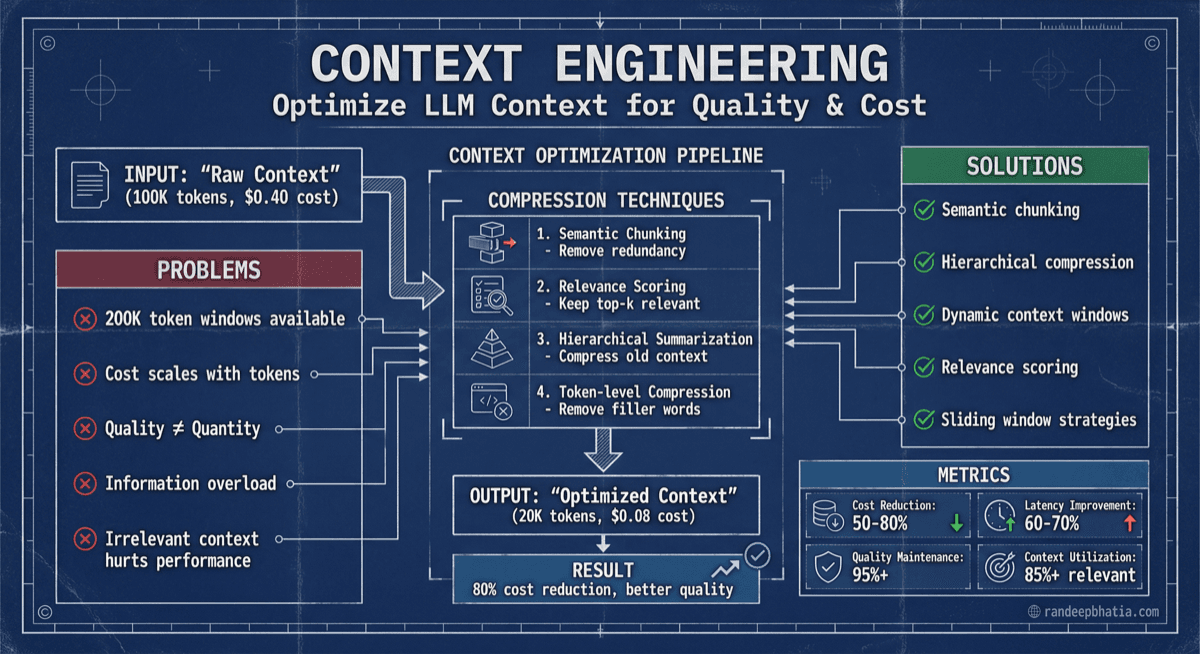
Context engineering is the systematic discipline of designing, assembling, and managing the information provided to large language models to optimize their outputs for specific tasks and constraints.
Context engineering extends beyond prompt engineering by treating context as a dynamic, composable system rather than static text, encompassing retrieval, filtering, prioritization, and lifecycle management of information fed to LLMs.
Effective context engineering directly impacts model accuracy, latency, cost, and reliability in production systems, making it a critical competency for AI-powered applications at scale.
The discipline requires understanding token economics, information density, temporal relevance, and the cognitive limitations of transformer architectures to maximize the utility of finite context windows.
The Bottom Line
Context engineering determines whether an LLM-powered system produces useful, accurate, and cost-effective outputs or fails unpredictably in production. Organizations that master context engineering achieve significantly better AI outcomes with lower inference costs and higher reliability.
Definition
Definition
Context engineering is the practice of systematically designing, selecting, organizing, and delivering relevant information to large language models within their context window constraints to achieve optimal task performance.
It encompasses the full lifecycle of context management including retrieval, filtering, ranking, compression, injection, and monitoring of information that shapes LLM behavior and outputs.
Extended Definition
Context engineering represents a paradigm shift from viewing prompts as static templates to treating context as a dynamic, orchestrated system. It involves building infrastructure that can retrieve relevant information from diverse sources, prioritize and filter that information based on task requirements, compress or summarize content to fit within token limits, and inject context in formats that maximize model comprehension. The discipline draws from information retrieval, data engineering, and cognitive science to create systems that consistently provide LLMs with the right information at the right time in the right format. Unlike prompt engineering which focuses on instruction crafting, context engineering addresses the entire information supply chain that feeds into model inference.
Etymology & Origins
The term 'context engineering' emerged in 2023-2024 as practitioners recognized that optimizing LLM performance required more than crafting better prompts. The term combines 'context' (from Latin contextus, meaning 'a joining together') referring to the surrounding information that gives meaning to text, with 'engineering' denoting the systematic, principled approach to building reliable systems. The discipline crystallized as organizations moved from prototype AI applications to production systems where context management became a critical bottleneck and differentiator.
Also Known As
Not To Be Confused With
Prompt engineering
Prompt engineering focuses on crafting instructions and examples within a prompt, while context engineering encompasses the broader system of retrieving, filtering, and managing all information provided to the model including dynamic data, retrieved documents, and conversation history.
Retrieval-Augmented Generation (RAG)
RAG is a specific technique for augmenting prompts with retrieved documents, whereas context engineering is the broader discipline that includes RAG as one component alongside context prioritization, compression, lifecycle management, and multi-source orchestration.
Fine-tuning
Fine-tuning modifies model weights to encode knowledge permanently, while context engineering provides information at inference time through the context window without changing the underlying model.
Knowledge management
Knowledge management is an organizational discipline for capturing and sharing human knowledge, while context engineering specifically addresses the technical challenge of providing relevant information to AI models at inference time.
Data engineering
Data engineering focuses on building pipelines for data storage, transformation, and analytics, while context engineering specifically addresses the real-time assembly and delivery of information to LLMs during inference.
Information retrieval
Information retrieval is the science of searching and ranking documents for human consumption, while context engineering adapts these techniques for LLM consumption with additional concerns like token limits, model comprehension, and output optimization.
Conceptual Foundation
Core Principles
(8 principles)Mental Models
(6 models)The Briefing Room Model
Think of context engineering like preparing a briefing for a highly capable but amnesiac expert. Each interaction starts fresh, so you must provide all relevant background, current situation, objectives, and constraints in a concise briefing that fits within a strict time limit. The expert can only act on what's in the briefing.
The Working Memory Model
Context window functions like human working memory with limited capacity. Just as humans can only hold 7±2 items in working memory, LLMs have finite context capacity. Overloading working memory degrades performance; strategic chunking and prioritization improves it.
The Supply Chain Model
Context engineering is an information supply chain delivering the right information to the right place at the right time. Like physical supply chains, it involves sourcing (retrieval), processing (filtering/compression), logistics (injection), and quality control (validation).
The Attention Budget Model
Every token in context competes for model attention. High-value information should be positioned and formatted to capture attention, while low-value information dilutes attention from what matters. Context engineering is attention budget allocation.
The Signal-to-Noise Model
Context has a signal-to-noise ratio where signal is task-relevant information and noise is everything else. Maximizing signal-to-noise ratio within token constraints is the core optimization problem of context engineering.
The Composable Layers Model
Effective context is built in composable layers: foundational instructions, domain knowledge, task-specific information, and dynamic runtime data. Each layer can be developed and optimized independently, then composed for specific use cases.
Key Insights
(10 insights)Context window utilization follows diminishing returns: the first 20% of relevant context often provides 80% of the value, making aggressive prioritization more valuable than comprehensive inclusion.
Position within context matters significantly due to attention patterns in transformer architectures; critical information should be placed at the beginning and end of context, not buried in the middle.
Context compression techniques (summarization, extraction) can often preserve task-relevant information while dramatically reducing token consumption, but compression quality varies by information type.
The optimal context strategy differs between model families and sizes; strategies optimized for GPT-4 may not transfer to Claude or open-source models without adaptation.
Conversation history management is often the largest source of context bloat in production systems; implementing intelligent history summarization and pruning is critical for long-running interactions.
Retrieved context quality depends heavily on query formulation; the same retrieval system produces dramatically different results based on how queries are constructed and expanded.
Context caching at the infrastructure level can reduce latency and costs by 50-90% for applications with repeated context patterns, but requires careful cache invalidation strategies.
Multi-turn interactions create context debt where each turn adds to context requirements; without active management, context windows fill within 5-10 turns in typical applications.
The relationship between context length and output quality is non-monotonic; there are sweet spots where adding more context improves quality, and regions where additional context degrades performance.
Context engineering failures often manifest as subtle quality degradation rather than obvious errors, making monitoring and evaluation systems essential for production reliability.
When to Use
When to Use
Ideal Scenarios
(12)Building production LLM applications where consistent, high-quality outputs are required across diverse inputs and edge cases that cannot be handled by static prompts alone.
Developing AI systems that must incorporate dynamic, real-time information such as current inventory, live pricing, recent events, or user-specific data that changes between requests.
Creating customer-facing AI assistants that need access to product catalogs, documentation, policies, and historical interaction data to provide accurate, personalized responses.
Implementing AI agents that must maintain coherent behavior across extended multi-turn conversations while managing growing context requirements efficiently.
Building enterprise AI applications that must integrate information from multiple internal systems (CRM, ERP, knowledge bases) to generate contextually appropriate outputs.
Developing code generation or analysis tools that need to understand project structure, coding standards, existing codebase patterns, and documentation to produce consistent, integrable code.
Creating analytical AI systems that must synthesize information from multiple documents, databases, or sources to generate comprehensive insights or recommendations.
Building AI systems with strict accuracy requirements where hallucination must be minimized through grounding in authoritative source documents.
Implementing AI applications with cost constraints where optimizing context usage directly reduces inference costs at scale.
Developing AI systems that must comply with data governance requirements, necessitating careful control over what information enters the context and how it's handled.
Creating personalized AI experiences that must adapt behavior based on user preferences, history, and profile information without fine-tuning separate models.
Building AI systems that operate across multiple domains or use cases where context requirements vary significantly and must be dynamically assembled.
Prerequisites
(8)Clear understanding of the target LLM's context window limits, tokenization behavior, and performance characteristics across different context lengths.
Defined use cases with understood information requirements, including what types of context are needed and where that information will be sourced.
Access to relevant data sources (databases, document stores, APIs) that will provide the dynamic context needed for the application.
Infrastructure for storing and retrieving context components, including vector databases for semantic search if RAG patterns are used.
Monitoring and logging capabilities to track context composition, token usage, and output quality for optimization and debugging.
Evaluation frameworks to measure how context changes impact output quality, enabling data-driven context optimization.
Understanding of the cost structure for the target LLM, including how context length affects pricing and latency.
Team expertise in both the domain (to understand what context is relevant) and LLM behavior (to understand how context affects outputs).
Signals You Need This
(10)LLM outputs are inconsistent or unpredictable across similar inputs, suggesting the model lacks necessary context to produce stable responses.
Users report that the AI 'doesn't remember' relevant information from earlier in conversations or from their history with the system.
Model outputs contain hallucinations or factual errors that could be prevented by providing accurate source information in context.
Inference costs are growing faster than usage due to inefficient context utilization or unnecessary context inclusion.
Response latency is increasing as context grows, impacting user experience or system throughput.
The same prompt template produces good results for some inputs but fails for others, indicating context-dependent behavior.
AI system performance degrades over time as conversation history accumulates without management.
Users must repeatedly provide the same information because the system doesn't effectively utilize available context.
Model outputs don't reflect recent changes to products, policies, or data that should influence responses.
Quality varies significantly between simple queries (which work well) and complex queries (which fail), suggesting context assembly issues.
Organizational Readiness
(7)Engineering team has experience with LLM APIs and understands basic concepts like tokenization, context windows, and prompt structure.
Organization has identified and documented the information sources that should inform AI outputs, with clear data ownership and access patterns.
Infrastructure exists or can be built for real-time data retrieval with latency appropriate for synchronous AI interactions.
Product and engineering alignment exists on quality standards and acceptable tradeoffs between context comprehensiveness and cost/latency.
Monitoring and observability practices are mature enough to extend to AI-specific metrics including context utilization and quality.
Data governance frameworks can accommodate the flow of potentially sensitive information through context engineering pipelines.
Team capacity exists for ongoing context optimization, as context engineering is not a one-time setup but requires continuous refinement.
When NOT to Use
When NOT to Use
Anti-Patterns
(12)Using context engineering complexity when simple, static prompts with few-shot examples adequately solve the problem with acceptable quality and cost.
Building elaborate context retrieval systems before validating that the base model can perform the task well when given perfect context manually.
Implementing dynamic context for information that rarely changes and could be included in static system prompts or addressed through fine-tuning.
Over-engineering context systems for prototype or experimental applications where simpler approaches would enable faster iteration and learning.
Applying context engineering to compensate for fundamental model capability limitations that context cannot address.
Building custom context infrastructure when existing RAG frameworks or managed services would meet requirements with less development effort.
Implementing complex context prioritization for applications where context windows are large enough to include all relevant information without optimization.
Using context engineering to inject information that should be handled through tool calling or function execution instead.
Attempting to solve data quality problems through context engineering rather than addressing issues at the source.
Building context systems before establishing evaluation frameworks to measure whether context changes improve outcomes.
Implementing real-time context retrieval for information that could be pre-computed and cached without staleness concerns.
Over-investing in context engineering for low-stakes applications where occasional quality degradation is acceptable.
Red Flags
(10)Team lacks understanding of how the target LLM processes and utilizes context, leading to ineffective context strategies.
No clear metrics exist for measuring context engineering success, making optimization impossible.
Context requirements are undefined or constantly changing, preventing stable system design.
Data sources needed for context are unreliable, poorly documented, or have prohibitive access latency.
Organization expects context engineering to fix fundamental issues with model selection or task framing.
Budget or timeline doesn't allow for the iterative optimization that effective context engineering requires.
Privacy or compliance constraints prevent the information flow necessary for effective context assembly.
Team is implementing context engineering based on theoretical benefits without evidence that current approaches are inadequate.
Context engineering is being pursued as a technical exercise without clear connection to user or business outcomes.
No plan exists for maintaining and updating context systems as underlying data and requirements evolve.
Better Alternatives
(8)The required knowledge is static, domain-specific, and can be encoded in model weights
Fine-tuning or continued pre-training
Fine-tuning embeds knowledge permanently in the model, eliminating retrieval latency and context window consumption for that knowledge. It's more efficient for stable, frequently-needed information.
The task requires deterministic, structured operations on data
Tool calling and function execution
Tools provide deterministic execution for operations like calculations, database queries, or API calls. Context engineering cannot make LLMs reliably perform precise computations.
Simple classification or extraction tasks with clear patterns
Few-shot prompting with static examples
For well-defined tasks with stable patterns, carefully crafted few-shot examples often outperform complex dynamic context systems with lower complexity and cost.
Application requires real-time information from external systems
Agentic tool use with live API calls
Rather than pre-fetching context that may be stale, agents can query live systems at the moment information is needed, ensuring freshness.
High-volume, low-complexity queries with predictable patterns
Cached responses or template-based generation
For predictable queries, caching complete responses or using template systems is more cost-effective than dynamic context assembly for each request.
Task requires deep reasoning over a fixed document set
Long-context models with full document inclusion
For bounded document sets that fit in extended context windows (100K+ tokens), including full documents may outperform retrieval-based approaches that risk missing relevant passages.
Application needs to maintain complex state across many interactions
External memory systems with structured state management
Complex state is better managed in purpose-built databases with explicit schemas than in unstructured context that must be parsed and updated by the model.
Outputs must be perfectly consistent with specific source documents
Extractive approaches or constrained generation
When outputs must exactly match sources, extractive methods or generation constrained to source vocabulary provide stronger guarantees than context-grounded generation.
Common Mistakes
(10)Assuming more context always improves outputs, when excessive context often degrades performance by diluting attention and introducing noise.
Treating context engineering as a one-time setup rather than an ongoing optimization process that requires monitoring and iteration.
Optimizing context for average cases while ignoring edge cases and failure modes that impact production reliability.
Failing to version and track context templates, making it impossible to correlate output changes with context changes.
Ignoring the latency impact of context retrieval, leading to slow response times that degrade user experience.
Not implementing context caching, resulting in redundant retrieval operations and unnecessary costs.
Assuming retrieval relevance scores directly translate to usefulness for the specific task at hand.
Neglecting to test context strategies across the full range of expected inputs and edge cases.
Over-engineering context systems before validating basic assumptions about what context the model needs.
Failing to implement graceful degradation when context retrieval fails or returns poor results.
Core Taxonomy
Core Taxonomy
Primary Types
(8 types)Pre-defined context elements that remain constant across requests, including system prompts, persona definitions, output format specifications, and domain-specific instructions that don't change based on individual queries.
Characteristics
- Defined at development time and updated through deployment cycles
- Cached and reused across all requests without retrieval overhead
- Versioned and tested as part of the application codebase
- Typically occupies a fixed portion of the context budget
Use Cases
Tradeoffs
Low latency and high reliability, but cannot adapt to changing information or user-specific needs. Changes require redeployment.
Classification Dimensions
Temporal Characteristics
Classification based on how frequently context information changes, which determines caching strategies, refresh requirements, and staleness tolerance.
Source Authority
Classification based on the trustworthiness and provenance of context information, which affects how much weight the model should give to different context elements.
Retrieval Method
Classification based on how and when context is retrieved, affecting latency, complexity, and the ability to adapt to emerging information needs.
Scope
Classification based on how broadly context applies, determining reusability, caching potential, and management complexity.
Sensitivity Level
Classification based on data sensitivity, determining handling requirements, logging restrictions, and compliance obligations.
Format Complexity
Classification based on information structure, affecting parsing requirements, token efficiency, and model comprehension patterns.
Evolutionary Stages
Ad-hoc Context
Initial development phase, typically 1-3 months of LLM adoptionContext is manually assembled for each use case without systematic approach. Prompts are crafted individually, context sources are accessed directly, and there's no reusable infrastructure. Common in early prototypes and experiments.
Template-Based Context
Early production phase, typically 3-6 months into LLM adoptionContext assembly follows defined templates with placeholder variables. Basic retrieval may be implemented, but context strategies are relatively static. Some reuse across similar use cases, but limited dynamic adaptation.
Retrieval-Augmented Context
Maturing production phase, typically 6-12 months into LLM adoptionSystematic RAG implementation with vector databases, embedding pipelines, and retrieval optimization. Context is dynamically assembled based on query semantics, but strategies are still largely uniform across use cases.
Orchestrated Context
Advanced production phase, typically 12-24 months into LLM adoptionMultiple context sources are orchestrated with sophisticated prioritization, filtering, and composition logic. Context strategies adapt based on task type, user characteristics, and runtime conditions. Comprehensive monitoring and optimization.
Intelligent Context
Mature AI-native organizations, typically 24+ months of sophisticated LLM usageContext engineering itself is partially automated with ML-driven optimization of retrieval, ranking, and composition. System learns from outcomes to improve context strategies. Self-tuning based on performance metrics.
Architecture Patterns
(8 patterns)Layered Context Assembly
Context is assembled in distinct layers, each with specific responsibilities: base layer (system prompt, persona), knowledge layer (retrieved documents), interaction layer (conversation history), and request layer (current query and metadata). Layers are composed in a defined order with clear interfaces.
Components
- Layer registry defining available context layers
- Layer composers that assemble each layer independently
- Composition orchestrator that combines layers
- Token budget allocator distributing tokens across layers
- Layer validators ensuring each layer meets requirements
Data Flow
Request arrives → Layer composers execute in parallel → Token budgets allocated → Layers composed in order → Final context validated → Sent to LLM
Best For
- Applications with multiple distinct context sources
- Teams with separate ownership of different context types
- Systems requiring flexible context composition
- Use cases with varying context requirements
Limitations
- Complexity in managing layer interactions and dependencies
- Potential for inconsistency between layers
- Overhead in layer coordination
- Difficulty optimizing across layer boundaries
Scaling Characteristics
Scales well horizontally as layers can be computed independently. Vertical scaling limited by composition complexity and token budget constraints.
Integration Points
Vector Database
Stores embeddings of documents, passages, or other content for semantic similarity search. Enables retrieval of contextually relevant information based on query semantics rather than keyword matching.
Choice of embedding model significantly impacts retrieval quality. Index configuration affects latency/recall tradeoffs. Metadata filtering enables hybrid search combining semantic and structured queries.
Document Store
Stores full document content that can be retrieved after vector search identifies relevant items. Maintains document versions, metadata, and access controls.
Must handle various document formats. Chunking strategy affects both storage and retrieval. Version management important for reproducibility.
LLM Gateway
Manages communication with LLM providers including request formatting, response parsing, rate limiting, failover, and cost tracking. Abstracts provider-specific details.
Must handle provider-specific context formatting. Token counting accuracy critical for budget management. Caching at this layer can significantly reduce costs.
Conversation Store
Persists conversation history for multi-turn interactions. Manages history retrieval, summarization triggers, and session lifecycle.
Storage grows with conversation length. Summarization timing affects context quality. Must handle concurrent access for real-time applications.
User Profile Service
Provides user-specific information including preferences, history, permissions, and personalization data that customizes context for individual users.
Privacy and consent management critical. Profile staleness can cause personalization errors. Must handle missing profiles gracefully.
Tool Execution Runtime
Executes tools called by the LLM and returns results for inclusion in context. Manages tool registration, execution sandboxing, and result formatting.
Tool execution latency directly impacts response time. Error handling must provide useful context for LLM recovery. Security critical for tools with side effects.
Monitoring and Observability Platform
Tracks context engineering metrics including retrieval performance, token utilization, cache hit rates, and quality indicators. Enables debugging and optimization.
High-cardinality metrics from context can be expensive. Trace correlation across async operations is complex. Must balance observability with performance overhead.
Cache Infrastructure
Provides caching at multiple levels including retrieved documents, composed context, and LLM prefixes. Manages cache invalidation and freshness.
Cache key design critical for hit rates. Invalidation strategy must balance freshness with cache effectiveness. Memory sizing affects cost and performance.
Decision Framework
Decision Framework
Context engineering is likely needed. Proceed to evaluate retrieval requirements.
Static prompts may suffice. Consider few-shot examples for behavior shaping.
Training data cutoff dates, domain-specific knowledge, real-time information needs
Technical Deep Dive
Technical Deep Dive
Overview
Context engineering operates at the intersection of information retrieval, natural language processing, and systems engineering to deliver optimized information to large language models. The process begins when a user query or system trigger initiates a context assembly pipeline that orchestrates multiple retrieval and processing operations. Retrieved information is then filtered, ranked, formatted, and composed into a coherent context that fits within token constraints while maximizing task-relevant information density. The core technical challenge is that LLMs have fixed context windows (ranging from 4K to 2M+ tokens depending on the model) that must accommodate system instructions, retrieved knowledge, conversation history, and the current query while leaving room for the generated response. Every token of context consumes model attention capacity and incurs cost, creating pressure to maximize the utility of each token included. Modern context engineering systems implement sophisticated pipelines that can retrieve from multiple sources in parallel, apply learned ranking models to prioritize results, compress or summarize content to fit constraints, and format information in ways that optimize model comprehension. These systems must operate with low latency (typically under 500ms for user-facing applications) while maintaining high reliability and observability. The effectiveness of context engineering is measured through multiple dimensions: retrieval relevance (did we find the right information?), context utilization (did the model use the provided context?), output quality (did context improve the response?), and efficiency (did we achieve quality within latency and cost constraints?). Optimizing across these dimensions requires continuous monitoring, experimentation, and iteration.
Step-by-Step Process
The incoming query is analyzed to extract signals for retrieval and context assembly. This includes identifying key entities, concepts, and intent; determining query type and complexity; extracting temporal references; and identifying any explicit context requirements. Query expansion techniques may generate additional search terms or reformulate the query for better retrieval.
Over-reliance on surface-level query features misses implicit context needs. Query expansion can introduce drift from original intent. Failure to identify query type leads to wrong context strategy.
Under The Hood
At the implementation level, context engineering systems are built on several key technical foundations. Vector databases (such as Pinecone, Weaviate, Qdrant, or pgvector) store embeddings of documents or passages, enabling semantic similarity search. These embeddings are generated by encoder models (like OpenAI's text-embedding-ada-002, Cohere's embed models, or open-source alternatives like E5 or BGE) that map text to dense vector representations where semantic similarity corresponds to vector proximity. The retrieval process typically uses approximate nearest neighbor (ANN) algorithms like HNSW (Hierarchical Navigable Small World) that trade perfect recall for dramatically faster search. A query is embedded using the same encoder, then the vector database returns the k most similar vectors along with their associated content. Hybrid search combines this semantic retrieval with traditional keyword search (BM25) to capture both semantic similarity and exact matches. Chunking strategy significantly impacts retrieval quality. Documents must be split into chunks small enough to fit in context and focused enough to be relevant, but large enough to contain coherent information. Common approaches include fixed-size chunking (e.g., 512 tokens with overlap), semantic chunking (splitting at natural boundaries like paragraphs or sections), and hierarchical chunking (maintaining parent-child relationships between chunks of different sizes). Token counting is performed using tokenizers specific to the target LLM. Different models use different tokenization schemes (GPT models use tiktoken with cl100k_base encoding, Claude uses a different tokenizer, etc.), and accurate token counting is essential for budget management. Tokenizers are typically implemented as byte-pair encoding (BPE) or similar subword tokenization algorithms. Context caching can occur at multiple levels. At the application level, frequently-used context patterns can be cached in Redis or similar stores. At the LLM provider level, some providers offer prefix caching where the model's key-value cache for a common prefix is preserved, dramatically reducing latency and cost for requests sharing that prefix. Implementing effective caching requires careful cache key design and invalidation strategies. The attention mechanism in transformer models processes context through self-attention layers where each token attends to all other tokens. This creates computational complexity that scales quadratically with context length, though various optimizations (sparse attention, linear attention, sliding window attention) reduce this in practice. Understanding attention patterns helps explain why position in context matters—information at the beginning and end of context typically receives more attention than information in the middle (the 'lost in the middle' phenomenon).
Failure Modes
Failure Modes
Vector database or document store becomes unavailable due to infrastructure failure, network issues, or resource exhaustion.
- Retrieval timeouts or connection errors
- Responses lack grounding in source documents
- Dramatic increase in hallucination rates
- Complete request failures if no fallback exists
Complete loss of retrieval-augmented capability. Outputs may be entirely hallucinated or requests may fail entirely.
Implement redundant retrieval infrastructure, health checks, and graceful degradation. Maintain static fallback context for critical use cases.
Circuit breakers to fail fast, cached results as fallback, degraded mode with explicit disclosure to users that retrieval is unavailable.
Operational Considerations
Key Metrics (15)
Time taken to assemble complete context from query receipt to LLM submission, broken down by pipeline stage.
Dashboard Panels
Alerting Strategy
Implement tiered alerting with severity levels based on user impact. Critical alerts for complete failures (retrieval unavailable, assembly errors > 5%). Warning alerts for degradation (latency spikes, cache hit rate drops). Info alerts for capacity planning (approaching limits, cost increases). Use anomaly detection for metrics without fixed thresholds. Correlate alerts across pipeline stages to identify root causes. Implement alert suppression during known maintenance windows.
Cost Analysis
Cost Analysis
Cost Drivers
(10)Input Token Volume
Primary cost driver for most LLM APIs. Context tokens are charged at input token rates which vary by model and provider. Larger context = higher cost per request.
Implement aggressive context filtering and compression. Use caching to reduce redundant context. Optimize token budget allocation. Consider smaller context windows for simpler queries.
Retrieval Infrastructure
Vector databases, document stores, and embedding services incur ongoing infrastructure costs. Scales with corpus size and query volume.
Right-size vector database instances. Implement tiered storage for less-accessed content. Use serverless options for variable workloads. Optimize index configurations.
Embedding Generation
Generating embeddings for queries and new content incurs API costs or compute costs for self-hosted models.
Cache query embeddings for repeated queries. Batch embedding generation for new content. Consider self-hosted embedding models for high volume.
Cache Infrastructure
Memory costs for caching context components, retrieved results, and conversation history.
Implement tiered caching with hot/warm/cold storage. Optimize cache key design for hit rates. Use appropriate TTLs to balance freshness and cost.
Compute for Context Processing
CPU/memory for tokenization, compression, summarization, and context assembly operations.
Optimize processing pipelines. Use efficient tokenization libraries. Batch operations where possible. Right-size compute resources.
Network Transfer
Data transfer costs for retrieving content from distributed sources, especially across regions or cloud providers.
Co-locate retrieval infrastructure with LLM endpoints. Implement regional caching. Compress transferred data.
Storage for Conversation History
Persistent storage costs for maintaining conversation history across sessions.
Implement history summarization to reduce storage. Set retention policies. Use tiered storage for older conversations.
Monitoring and Observability
Costs for logging, metrics, and tracing infrastructure for context engineering pipelines.
Sample high-volume metrics. Implement log retention policies. Use efficient serialization for context logs.
Reindexing Operations
Periodic costs for regenerating embeddings and rebuilding indexes when content or models change.
Implement incremental indexing where possible. Schedule reindexing during off-peak hours. Optimize batch sizes.
Development and Maintenance
Engineering time for building, optimizing, and maintaining context engineering systems.
Use established frameworks and patterns. Invest in automation. Build reusable components across use cases.
Cost Models
Per-Request Cost Model
Cost = (input_tokens × input_price) + (output_tokens × output_price) + (retrieval_queries × retrieval_cost) + (embedding_calls × embedding_cost)For a request with 4000 context tokens at $0.01/1K, 500 output tokens at $0.03/1K, 2 retrieval queries at $0.001 each, and 1 embedding at $0.0001: Cost = (4 × $0.01) + (0.5 × $0.03) + (2 × $0.001) + $0.0001 = $0.0571
Monthly Infrastructure Cost Model
Monthly_Cost = vector_db_cost + document_store_cost + cache_cost + compute_cost + network_costVector DB: $500/month, Document Store: $200/month, Cache: $150/month, Compute: $300/month, Network: $50/month = $1,200/month infrastructure baseline
Total Cost of Ownership Model
TCO = (per_request_cost × monthly_requests) + monthly_infrastructure + (engineering_hours × hourly_rate) + opportunity_cost100K requests at $0.05 each + $1,200 infrastructure + 40 hours at $150/hour = $5,000 + $1,200 + $6,000 = $12,200/month TCO
Cost per Quality Unit Model
Cost_Efficiency = total_cost / (requests × average_quality_score)If $12,200 monthly cost serves 100K requests with 0.85 average quality: Cost_Efficiency = $12,200 / (100,000 × 0.85) = $0.144 per quality-adjusted request
Optimization Strategies
- 1Implement aggressive context caching to reduce redundant retrieval and token consumption for repeated patterns
- 2Use context compression and summarization to reduce token counts while preserving essential information
- 3Implement tiered context strategies with minimal context for simple queries and full context for complex ones
- 4Optimize retrieval to return fewer, more relevant chunks rather than many marginally relevant chunks
- 5Use smaller, cheaper models for context preprocessing (summarization, extraction) before main LLM call
- 6Implement conversation history summarization to prevent unbounded context growth in long conversations
- 7Use provider-specific optimizations like prefix caching where available
- 8Batch similar requests to amortize fixed context (system prompt) across multiple queries
- 9Implement request routing to use cheaper models for simpler queries
- 10Monitor and eliminate unused or low-value context components
- 11Negotiate volume pricing with LLM providers based on usage patterns
- 12Consider self-hosted models for high-volume, cost-sensitive use cases
Hidden Costs
- 💰Engineering time for ongoing context optimization and maintenance
- 💰Quality degradation costs when aggressive optimization reduces output quality
- 💰Debugging and incident response time for context-related issues
- 💰Reindexing costs when embedding models or chunking strategies change
- 💰Technical debt from quick context fixes that require later refactoring
- 💰Opportunity cost of context engineering focus vs. other improvements
- 💰User support costs from context-related quality issues
- 💰Compliance and audit costs for context data handling
ROI Considerations
Context engineering ROI should be evaluated against the baseline of no context engineering (static prompts only) and against alternative approaches (fine-tuning, larger models). Key ROI factors include: output quality improvement (measured through evaluation metrics and user satisfaction), cost reduction from optimized token usage, latency improvement from efficient retrieval, and reliability improvement from robust context systems. For most production applications, context engineering provides positive ROI when: (1) the application requires dynamic or personalized information that cannot be embedded in static prompts, (2) the query volume justifies infrastructure investment, (3) output quality directly impacts business outcomes, and (4) the team has capacity for ongoing optimization. ROI calculation should include both direct costs (infrastructure, API calls) and indirect benefits (improved user satisfaction, reduced error rates, faster response times). Organizations should establish baseline metrics before implementing context engineering to enable accurate ROI measurement. Break-even analysis should consider the volume at which context engineering infrastructure costs are offset by per-request savings from optimization. For many organizations, this break-even point is reached at 10,000-50,000 monthly requests, though this varies significantly based on use case complexity and optimization potential.
Security Considerations
Threat Model
(10 threats)Prompt Injection via Retrieved Content
Malicious content in indexed documents contains instructions that override system prompts when retrieved and included in context.
Model behavior manipulation, unauthorized actions, disclosure of system prompts, bypassing safety guardrails.
Content sanitization before indexing, instruction hierarchy enforcement, output filtering, retrieved content sandboxing with clear delimiters.
Data Exfiltration through Context
Attacker crafts queries designed to retrieve and expose sensitive information from the knowledge base.
Unauthorized disclosure of confidential information, PII exposure, competitive intelligence leakage.
Access control on retrieval sources, query filtering, output scanning for sensitive patterns, audit logging of retrieved content.
Context Poisoning
Attacker injects malicious content into data sources that feed the context engineering pipeline.
Systematic corruption of model outputs, misinformation propagation, reputation damage.
Content validation and provenance tracking, anomaly detection on indexed content, source authentication, regular content audits.
Conversation History Manipulation
Attacker modifies stored conversation history to influence future model responses.
Manipulated model behavior, false context injection, unauthorized persona changes.
History integrity verification, immutable history storage, session authentication, history tampering detection.
Cross-User Context Leakage
In multi-tenant systems, context from one user leaks into another user's requests through caching, shared state, or bugs.
Privacy violations, unauthorized information disclosure, compliance failures.
Strict tenant isolation in caching and storage, user context validation, tenant-aware cache keys, regular isolation testing.
Denial of Service via Context Complexity
Attacker submits queries designed to trigger expensive retrieval operations or context assembly, exhausting resources.
Service degradation or unavailability, increased costs, resource exhaustion.
Query complexity limits, retrieval timeouts, rate limiting, resource quotas per user, anomaly detection on query patterns.
Model Extraction via Context Probing
Attacker uses carefully crafted queries to extract information about system prompts, retrieval strategies, or model behavior.
Intellectual property exposure, security through obscurity bypass, competitive intelligence loss.
Output filtering for system information, query pattern detection, rate limiting on probing patterns, honeypot detection.
Embedding Inversion Attack
Attacker attempts to reconstruct original text from stored embeddings in vector databases.
Exposure of indexed content that should be protected, privacy violations.
Embedding encryption, access control on vector databases, avoiding storage of sensitive content embeddings, differential privacy techniques.
Supply Chain Attack on Context Sources
Compromise of external data sources that feed context engineering pipelines.
Systematic context corruption, malicious content injection, trust chain compromise.
Source authentication and validation, content integrity checks, anomaly detection on source content, diverse source redundancy.
Inference of User Behavior from Context Patterns
Analysis of context retrieval patterns reveals sensitive information about user behavior or interests.
Privacy violations, behavioral profiling, potential for discrimination or targeting.
Query anonymization, differential privacy in logging, minimal logging of retrieval patterns, access controls on analytics.
Security Best Practices
- ✓Implement strict input validation and sanitization for all user-provided content before inclusion in context
- ✓Use clear delimiters and instruction hierarchy to separate system instructions from retrieved content
- ✓Apply principle of least privilege for retrieval source access, limiting what each query can access
- ✓Implement output filtering to detect and block sensitive information disclosure
- ✓Maintain comprehensive audit logs of context assembly and retrieval operations
- ✓Use encryption at rest and in transit for all context data including embeddings and conversation history
- ✓Implement tenant isolation in multi-tenant systems with separate storage and cache namespaces
- ✓Regularly audit indexed content for malicious or inappropriate material
- ✓Apply rate limiting and anomaly detection to prevent abuse and detect attacks
- ✓Implement content provenance tracking to identify sources of context information
- ✓Use secure coding practices in context engineering pipelines to prevent injection vulnerabilities
- ✓Regularly test context systems for prompt injection vulnerabilities
- ✓Implement graceful degradation that maintains security properties during partial failures
- ✓Train development teams on LLM-specific security risks and mitigations
- ✓Establish incident response procedures specific to context engineering security events
Data Protection
- 🔒Classify all data sources feeding context pipelines by sensitivity level
- 🔒Implement data minimization, including only necessary information in context
- 🔒Use tokenization or pseudonymization for sensitive identifiers in context
- 🔒Implement retention policies for conversation history and context logs
- 🔒Encrypt context data at rest using industry-standard encryption
- 🔒Use TLS for all context data in transit
- 🔒Implement access controls based on data classification and user roles
- 🔒Maintain data processing agreements with all context source providers
- 🔒Implement right to deletion across all context stores and indexes
- 🔒Regular data protection impact assessments for context engineering systems
Compliance Implications
GDPR (General Data Protection Regulation)
Personal data processing must have legal basis, data subjects have rights to access, rectification, and deletion.
Implement PII detection and handling in context pipelines. Provide mechanisms to exclude user data from context. Enable deletion of user data from conversation history and indexes. Document data flows through context systems.
CCPA (California Consumer Privacy Act)
Consumers have right to know what personal information is collected and to request deletion.
Track personal information in context systems. Implement data inventory for context sources. Enable consumer data deletion requests across all context stores.
HIPAA (Health Insurance Portability and Accountability Act)
Protected Health Information (PHI) must be safeguarded with appropriate administrative, physical, and technical safeguards.
Implement PHI detection and exclusion from context. Use BAA-covered infrastructure. Implement access controls and audit logging. Encrypt PHI in all context stores.
SOC 2
Systems must meet trust service criteria for security, availability, processing integrity, confidentiality, and privacy.
Document context engineering controls. Implement monitoring and alerting. Maintain access controls and audit trails. Regular security assessments of context systems.
PCI DSS (Payment Card Industry Data Security Standard)
Cardholder data must be protected with specific security controls.
Exclude payment card data from context. Implement detection for accidental card data inclusion. Segment context systems handling payment-related queries.
AI Act (EU Artificial Intelligence Act)
High-risk AI systems must meet requirements for transparency, human oversight, and risk management.
Document context engineering decisions and their impact on AI behavior. Implement explainability for context selection. Enable human review of context-driven decisions.
FINRA / SEC Regulations
Financial communications must be retained and supervisable.
Retain full context and outputs for financial advisory interactions. Implement supervision workflows. Enable regulatory access to context logs.
Industry-Specific Data Localization
Some jurisdictions require data to remain within geographic boundaries.
Deploy regional context infrastructure. Ensure retrieval sources comply with localization. Implement data residency controls for context stores.
Scaling Guide
Scaling Guide
Scaling Dimensions
Query Volume
Horizontal scaling of context assembly services, retrieval infrastructure, and caching layers. Implement load balancing across retrieval replicas. Use auto-scaling based on query queue depth.
Limited by retrieval system throughput and LLM API rate limits. Caching effectiveness determines scaling efficiency.
Cache hit rates become critical at scale. Consider read replicas for retrieval. Implement request prioritization for graceful degradation.
Corpus Size
Shard vector indexes across multiple nodes. Implement tiered storage with hot/warm/cold data. Use hierarchical indexing for very large corpora.
Vector database scaling limits vary by provider. Query latency may increase with corpus size despite indexing.
Chunking strategy affects index size. Consider corpus pruning for outdated content. Monitor retrieval quality as corpus grows.
Context Complexity
Parallelize context assembly operations. Implement caching at multiple levels. Use async processing for non-blocking operations.
Context window limits are fixed per model. Complex context assembly adds latency.
Trade off context comprehensiveness for latency. Consider pre-computation for predictable context patterns.
Concurrent Users
Implement connection pooling for retrieval systems. Use session affinity for conversation continuity. Scale conversation storage horizontally.
Conversation state storage can become bottleneck. User context retrieval must scale with user base.
Implement user context caching. Consider eventual consistency for non-critical user data.
Geographic Distribution
Deploy regional retrieval infrastructure. Implement cross-region replication for indexes. Use CDN for static context components.
Cross-region latency for centralized components. Data residency requirements may constrain architecture.
Balance consistency vs. latency for distributed indexes. Consider regional content variations.
Model Diversity
Implement model-agnostic context interfaces with model-specific adapters. Maintain separate token budgets per model. Test context strategies across models.
Each model may require different optimization. Maintenance overhead scales with model count.
Abstract model differences behind consistent interfaces. Implement model-specific caching where beneficial.
Use Case Diversity
Implement context routing to specialized pipelines. Use shared infrastructure with use-case-specific configuration. Develop reusable context components.
Pipeline proliferation increases maintenance burden. Shared infrastructure may not optimize for all use cases.
Balance specialization vs. maintainability. Identify common patterns across use cases.
Real-time Requirements
Implement streaming context assembly. Use predictive pre-fetching. Optimize critical path latency.
Some operations cannot be parallelized. Network latency sets floor for distributed retrieval.
Identify and optimize latency-critical paths. Accept quality tradeoffs for latency-sensitive use cases.
Capacity Planning
Required_Capacity = (peak_qps × (1 - cache_hit_rate) × avg_retrieval_ops) / retrieval_throughput_per_node + safety_marginMaintain 30-50% headroom above expected peak load. Higher margins for less predictable workloads. Consider burst capacity for unexpected spikes.
Scaling Milestones
- Establishing baseline metrics
- Validating context strategies
- Building evaluation frameworks
Single-instance deployment acceptable. Focus on functionality over scale. Implement basic monitoring.
- Retrieval latency consistency
- Cost management
- Cache effectiveness
Implement caching layer. Add retrieval monitoring. Consider managed vector database services.
- Infrastructure costs
- Retrieval scaling
- Conversation storage
Horizontal scaling of retrieval. Implement tiered caching. Add load balancing. Consider dedicated infrastructure.
- Multi-region requirements
- Complex capacity planning
- Operational complexity
Multi-region deployment. Sharded vector indexes. Advanced caching strategies. Dedicated operations team.
- Global scale operations
- Cost optimization at scale
- Custom infrastructure needs
Custom retrieval infrastructure. ML-driven optimization. Dedicated platform team. Consider self-hosted models for cost.
Benchmarks
Benchmarks
Industry Benchmarks
| Metric | P50 | P95 | P99 | World Class |
|---|---|---|---|---|
| Context Assembly Latency | 150ms | 400ms | 800ms | p95 < 200ms |
| Retrieval Latency (Vector Search) | 50ms | 150ms | 300ms | p95 < 100ms |
| Cache Hit Rate | 45% | 70% | 85% | > 75% |
| Retrieval Relevance (MRR@10) | 0.65 | 0.80 | 0.90 | > 0.85 |
| Token Utilization Efficiency | 60% | 80% | 90% | > 85% |
| Context Overflow Rate | 8% | 3% | 1% | < 2% |
| System Availability | 99.5% | 99.9% | 99.99% | > 99.95% |
| Retrieval Empty Rate | 12% | 5% | 2% | < 5% |
| End-to-End Latency (including LLM) | 1.5s | 3.5s | 6s | p95 < 2s |
| Cost per 1K Requests | $50 | $25 | $15 | < $20 |
| Conversation History Compression Ratio | 3:1 | 5:1 | 8:1 | > 6:1 |
| Index Freshness (time to searchable) | 30 min | 5 min | 1 min | < 5 min |
Comparison Matrix
| Approach | Setup Complexity | Latency | Cost | Quality | Flexibility | Maintenance |
|---|---|---|---|---|---|---|
| Static Prompts | Very Low | Minimal | Lowest | Limited | Very Low | Very Low |
| Basic RAG | Medium | Low-Medium | Medium | Good | Medium | Medium |
| Advanced Context Engineering | High | Medium | Medium-High | Very Good | High | High |
| Fine-tuning | High | Minimal | High (training) | Good for stable knowledge | Very Low | High (retraining) |
| Long Context Models | Low | High | Very High | Good | Medium | Low |
| Agentic with Tools | Very High | Very High | High | Excellent for dynamic | Very High | Very High |
| Hybrid (RAG + Fine-tune) | Very High | Medium | High | Excellent | High | Very High |
| Managed RAG Services | Low | Medium | Medium-High | Good | Low | Low |
Performance Tiers
Simple RAG with single retrieval source, basic caching, minimal optimization. Suitable for prototypes and low-volume applications.
Latency p95 < 1s, availability > 99%, relevance > 0.6
Multi-source retrieval, conversation history management, moderate caching, basic monitoring. Suitable for production applications with moderate requirements.
Latency p95 < 500ms, availability > 99.5%, relevance > 0.7, cache hit > 50%
Sophisticated retrieval with reranking, comprehensive context management, aggressive caching, full monitoring. Suitable for high-quality production applications.
Latency p95 < 300ms, availability > 99.9%, relevance > 0.8, cache hit > 70%
Federated retrieval, ML-driven optimization, multi-region deployment, comprehensive security. Suitable for mission-critical enterprise applications.
Latency p95 < 200ms, availability > 99.95%, relevance > 0.85, cache hit > 80%
Adaptive context strategies, real-time optimization, global scale, self-healing systems. Suitable for AI-native organizations with highest requirements.
Latency p95 < 150ms, availability > 99.99%, relevance > 0.9, cache hit > 85%
Real World Examples
Real World Examples
Real-World Scenarios
(8 examples)Enterprise Customer Support Assistant
Large enterprise with 50,000+ product SKUs, complex pricing rules, and multi-tier support organization needed AI assistant to handle customer inquiries across all product lines.
Implemented layered context architecture with: (1) static system prompt defining assistant persona and policies, (2) real-time product retrieval from catalog database, (3) customer history from CRM, (4) relevant knowledge base articles via semantic search, (5) conversation history with summarization. Used context routing to direct technical queries to specialized pipelines.
Reduced average handle time by 40%, improved first-contact resolution by 25%, and enabled 24/7 support coverage. Context engineering enabled single model to handle diverse product lines without per-product fine-tuning.
- 💡Product catalog freshness critical - implemented real-time sync
- 💡Customer history context most valuable for personalization
- 💡Conversation summarization essential for long support sessions
- 💡Context routing significantly improved technical query handling
Legal Document Analysis Platform
Law firm needed AI system to analyze contracts, identify risks, and compare against standard templates across thousands of historical documents.
Built hierarchical context system with: (1) document-level summaries for broad context, (2) clause-level retrieval for specific analysis, (3) precedent retrieval from case database, (4) firm-specific guidelines and templates. Implemented citation tracking to ground all analysis in source documents.
Reduced contract review time by 60%, improved risk identification accuracy, and enabled junior associates to handle complex reviews with AI assistance. Citation tracking critical for legal defensibility.
- 💡Clause-level chunking essential for legal precision
- 💡Citation tracking non-negotiable for legal applications
- 💡Hierarchical summarization enabled handling of 100+ page contracts
- 💡Firm-specific context critical for consistent advice
E-commerce Product Recommendation Chatbot
Online retailer wanted conversational shopping assistant that could understand preferences, recommend products, and answer detailed product questions.
Implemented user-centric context with: (1) user preference profile from browsing/purchase history, (2) real-time inventory and pricing via tool calls, (3) product details and reviews via semantic search, (4) conversation context tracking stated preferences. Used streaming context for responsive interactions.
Increased conversion rate by 15%, average order value by 20%, and customer satisfaction scores by 30%. Personalization drove significant engagement improvement.
- 💡Real-time inventory critical to avoid recommending out-of-stock items
- 💡User preference context most impactful for relevance
- 💡Conversation context essential for multi-turn shopping sessions
- 💡Review retrieval significantly improved trust in recommendations
Internal Knowledge Management Assistant
Technology company with 10,000+ employees needed AI assistant to help employees find information across wikis, documentation, Slack history, and internal tools.
Built federated context architecture retrieving from: (1) Confluence documentation, (2) internal wikis, (3) Slack message archives, (4) JIRA tickets, (5) code repositories. Implemented access control to respect document permissions. Used query expansion for technical terminology.
Reduced time-to-answer for internal questions by 70%, decreased duplicate questions in support channels, and improved onboarding efficiency for new employees.
- 💡Access control integration essential for enterprise deployment
- 💡Source diversity improved answer coverage significantly
- 💡Slack retrieval surprisingly valuable for tribal knowledge
- 💡Query expansion critical for technical terminology variations
Healthcare Clinical Decision Support
Hospital system needed AI assistant to help clinicians access relevant clinical guidelines, drug interactions, and patient history during consultations.
Implemented high-reliability context system with: (1) patient EHR summary, (2) relevant clinical guidelines via semantic search, (3) drug interaction database via structured queries, (4) recent lab results and vitals. Strict PII handling and audit logging throughout.
Reduced time to access clinical information by 50%, improved guideline adherence, and caught potential drug interactions that might have been missed. Audit trail essential for compliance.
- 💡Patient context summarization critical for time-constrained consultations
- 💡Structured drug interaction queries more reliable than semantic search
- 💡Audit logging non-negotiable for healthcare
- 💡Clinician trust required extensive validation and transparency
Financial Research Assistant
Investment firm needed AI to help analysts research companies by synthesizing information from earnings calls, SEC filings, news, and internal research notes.
Built multi-source context with: (1) company profile and financials from structured database, (2) recent earnings call transcripts, (3) relevant SEC filings, (4) news articles with recency weighting, (5) internal research notes with access control. Implemented source attribution for all retrieved content.
Reduced research time per company by 40%, improved coverage of smaller companies, and enabled faster response to market events. Source attribution critical for analyst verification.
- 💡Recency weighting essential for financial relevance
- 💡Earnings call retrieval highly valuable for sentiment
- 💡Source attribution non-negotiable for financial research
- 💡Internal notes context provided unique competitive advantage
Developer Documentation Assistant
Software company needed AI assistant to help developers navigate complex API documentation, find code examples, and troubleshoot integration issues.
Implemented code-aware context with: (1) API reference documentation with version awareness, (2) code examples with language filtering, (3) GitHub issues and discussions, (4) Stack Overflow threads, (5) internal troubleshooting guides. Used code-specific chunking and embedding models.
Reduced support ticket volume by 35%, improved developer satisfaction, and accelerated integration timelines for partners. Code-specific retrieval significantly outperformed generic approaches.
- 💡Code-specific embedding models dramatically improved retrieval
- 💡Version-aware context essential for API documentation
- 💡GitHub issues provided valuable real-world troubleshooting context
- 💡Code example retrieval most valued by developers
Multi-lingual Customer Service
Global company needed AI assistant supporting customers in 12 languages with consistent quality and access to localized content.
Implemented language-aware context with: (1) language detection and routing, (2) localized knowledge base retrieval, (3) cross-lingual retrieval for content not available in user's language, (4) translation layer for responses. Maintained language-specific conversation history.
Enabled consistent support quality across all markets, reduced translation costs, and improved response times for non-English markets. Cross-lingual retrieval filled gaps in localized content.
- 💡Multilingual embedding models essential for cross-lingual retrieval
- 💡Localized content significantly improved relevance
- 💡Language-specific conversation handling improved coherence
- 💡Translation quality critical for customer trust
Industry Applications
Healthcare
Clinical decision support, patient communication, medical documentation assistance, drug interaction checking
HIPAA compliance mandatory, high accuracy requirements, audit logging essential, clinician trust requires transparency, integration with EHR systems
Financial Services
Research assistance, customer advisory, compliance monitoring, fraud detection support, portfolio analysis
Regulatory compliance (SEC, FINRA), audit trail requirements, real-time data needs, source attribution critical, risk of financial advice liability
Legal
Contract analysis, legal research, document review, compliance checking, case preparation
Citation accuracy critical, privilege and confidentiality handling, precedent retrieval importance, jurisdiction-specific context, defensibility requirements
E-commerce/Retail
Product recommendations, customer support, inventory queries, personalized shopping assistance
Real-time inventory integration, personalization from purchase history, seasonal context relevance, multi-channel consistency
Manufacturing
Technical documentation access, maintenance assistance, quality control support, supply chain queries
Technical accuracy requirements, equipment-specific context, safety information criticality, integration with IoT data
Education
Tutoring assistance, curriculum support, research help, administrative queries
Age-appropriate content filtering, learning level adaptation, academic integrity considerations, accessibility requirements
Technology/Software
Developer assistance, documentation navigation, code generation, debugging support
Code-aware retrieval, version-specific context, API documentation accuracy, integration with development tools
Government/Public Sector
Citizen services, policy information, benefits assistance, regulatory guidance
Accessibility requirements, multi-language support, accuracy for official information, privacy regulations, audit requirements
Insurance
Claims processing support, policy information, underwriting assistance, customer service
Policy-specific context retrieval, regulatory compliance, claims history integration, fraud detection context
Telecommunications
Customer support, technical troubleshooting, plan recommendations, network status information
Account-specific context, real-time network status, technical troubleshooting flows, upsell/cross-sell context
Frequently Asked Questions
(20 questions)Fundamentals
Prompt engineering focuses on crafting the instructions and examples within a prompt to guide model behavior. Context engineering is a broader discipline that encompasses the entire system of retrieving, filtering, ranking, compressing, and managing all information provided to the model. Prompt engineering is a subset of context engineering focused on the instructional component, while context engineering addresses the full information supply chain including dynamic retrieval, conversation history, user context, and tool outputs.
Cost
Optimization
Measurement
Architecture
Implementation
Security
Technology
Debugging
Operations
Glossary
Glossary
Glossary
(30 terms)Attention Mechanism
The core mechanism in transformer models that determines how much focus each token gives to other tokens in the context.
Context: Understanding attention patterns informs context engineering decisions about information placement and formatting.
Bi-Encoder
A model architecture that encodes query and documents separately, enabling efficient similarity search through pre-computed embeddings.
Context: Bi-encoders power the initial retrieval stage in context engineering due to their efficiency.
BM25
A probabilistic ranking function for keyword-based retrieval that considers term frequency and document length.
Context: BM25 is commonly used alongside vector search in hybrid retrieval for context engineering.
Chunking
The process of splitting documents into smaller segments for indexing and retrieval, with chunk size and boundaries significantly impacting retrieval quality.
Context: Chunking strategy is a critical context engineering decision affecting both retrieval relevance and context coherence.
Context Compression
Techniques for reducing token consumption while preserving essential information, including summarization and extraction.
Context: Context compression enables fitting more information within token limits, critical for complex use cases.
Context Injection
The process of inserting retrieved or computed information into the prompt sent to the LLM.
Context: Context injection is the final stage of context assembly, where all context components are composed into the final prompt.
Context Routing
Directing queries to specialized context pipelines based on query classification or characteristics.
Context: Context routing enables optimized context strategies for different query types within a single system.
Context Window
The maximum number of tokens (input + output) that a language model can process in a single request. Context window sizes range from 4K tokens in older models to 200K+ in recent models.
Context: Context window limits are a fundamental constraint in context engineering, requiring careful management of what information to include.
Conversation History
The record of previous messages in a multi-turn interaction, providing continuity context for ongoing conversations.
Context: Managing conversation history is a key context engineering challenge as it grows with each turn.
Cross-Encoder
A model architecture that processes query and document together for relevance scoring, typically used in reranking.
Context: Cross-encoders provide higher quality relevance scores than bi-encoders but at higher computational cost.
Embedding
A dense vector representation of text that captures semantic meaning, enabling similarity comparison between texts through vector operations.
Context: Embeddings power semantic retrieval in context engineering, allowing retrieval of contextually relevant information beyond keyword matching.
Federated Retrieval
Retrieving context from multiple independent sources and merging results into unified context.
Context: Federated retrieval is common in enterprise context engineering where information is distributed across systems.
Few-Shot Learning
Providing examples of desired input-output behavior in the prompt to guide model responses without fine-tuning.
Context: Few-shot examples are a form of context that teaches behavior through demonstration rather than instruction.
Grounding
Connecting model outputs to source information, reducing hallucination by basing responses on provided context.
Context: Grounding through context is a primary goal of context engineering, improving accuracy and trustworthiness.
Hallucination
Model outputs that are factually incorrect or not supported by provided context, a key failure mode that context engineering aims to reduce.
Context: Reducing hallucination through effective context is a primary motivation for context engineering.
Hybrid Search
Combining semantic (vector) search with keyword (lexical) search to leverage strengths of both approaches for improved retrieval.
Context: Hybrid search is a common context engineering pattern that improves retrieval coverage and precision.
Lost in the Middle
The phenomenon where LLMs pay less attention to information in the middle of long contexts compared to the beginning and end.
Context: This attention pattern influences context engineering decisions about where to place critical information.
MRR (Mean Reciprocal Rank)
A metric for evaluating retrieval quality based on the position of the first relevant result in the ranked list.
Context: MRR is a key metric for evaluating context engineering retrieval effectiveness.
NDCG (Normalized Discounted Cumulative Gain)
A metric for evaluating retrieval quality that considers both relevance and position of all results in the ranked list.
Context: NDCG provides a more comprehensive view of retrieval quality than MRR for context engineering evaluation.
Prefix Caching
Caching the model's internal state (key-value cache) for common context prefixes to reduce computation on subsequent requests.
Context: Prefix caching is an optimization technique that can significantly reduce latency and cost for context engineering systems.
Prompt Injection
An attack where malicious instructions in user input or retrieved content attempt to override system instructions.
Context: Prompt injection is a key security concern in context engineering where external content enters the prompt.
Reciprocal Rank Fusion (RRF)
A technique for combining rankings from multiple retrieval methods without requiring score calibration.
Context: RRF is commonly used in context engineering to merge results from semantic and keyword search.
Reranking
A second-stage ranking process that re-scores initial retrieval results using a more sophisticated model to improve precision.
Context: Reranking improves context quality by ensuring the most relevant retrieved content is prioritized for inclusion.
Retrieval-Augmented Generation (RAG)
A technique that augments LLM generation with information retrieved from external knowledge bases, grounding outputs in source documents.
Context: RAG is a foundational pattern in context engineering, though context engineering encompasses broader concerns beyond retrieval.
Semantic Search
Search based on meaning rather than exact keyword matching, typically implemented using embedding similarity to find conceptually related content.
Context: Semantic search enables context engineering systems to retrieve relevant information even when queries don't share exact terms with documents.
System Prompt
Instructions provided to the model that define its behavior, persona, and constraints, typically placed at the beginning of context.
Context: System prompts are the foundational layer of context that shapes all model responses.
Token
The basic unit of text processing for LLMs, typically representing 3-4 characters in English. Tokenization varies by model, affecting how text maps to token counts.
Context: Token counts determine context consumption and directly impact costs, making accurate token estimation critical for context engineering.
Token Budget
The allocation of available context window capacity across different context components.
Context: Token budgeting is essential for context engineering to ensure all necessary information fits within model limits.
Tool Calling
The ability for LLMs to invoke external functions or APIs during generation, enabling access to real-time data and computation.
Context: Tool calling provides an alternative to pre-fetched context for dynamic information needs.
Vector Database
A specialized database optimized for storing and querying high-dimensional vectors, enabling fast similarity search over large collections of embeddings.
Context: Vector databases are core infrastructure for context engineering, storing document embeddings for semantic retrieval.
References & Resources
Academic Papers
- • Lewis et al. (2020). 'Retrieval-Augmented Generation for Knowledge-Intensive NLP Tasks' - Foundational RAG paper from Facebook AI
- • Guu et al. (2020). 'REALM: Retrieval-Augmented Language Model Pre-Training' - Google's approach to retrieval-augmented pretraining
- • Izacard & Grave (2021). 'Leveraging Passage Retrieval with Generative Models for Open Domain Question Answering' - Fusion-in-Decoder approach
- • Borgeaud et al. (2022). 'Improving Language Models by Retrieving from Trillions of Tokens' - DeepMind's RETRO architecture
- • Liu et al. (2023). 'Lost in the Middle: How Language Models Use Long Contexts' - Analysis of attention patterns in long contexts
- • Shi et al. (2023). 'Large Language Models Can Be Easily Distracted by Irrelevant Context' - Study of context noise effects
- • Ram et al. (2023). 'In-Context Retrieval-Augmented Language Models' - Analysis of in-context learning with retrieval
- • Asai et al. (2023). 'Self-RAG: Learning to Retrieve, Generate, and Critique through Self-Reflection' - Adaptive retrieval approach
Industry Standards
- • NIST AI Risk Management Framework - Guidelines for AI system risk management including context handling
- • ISO/IEC 23053:2022 - Framework for AI systems using machine learning
- • IEEE P2841 - Standard for AI Model Representation, Compression, and Distribution
- • OWASP Top 10 for LLM Applications - Security guidelines including prompt injection prevention
- • MLOps Maturity Model - Framework for operationalizing ML systems including context management
- • EU AI Act - Regulatory framework with implications for AI system transparency and documentation
Resources
- • OpenAI Cookbook - Practical guides for context management and RAG implementation
- • LangChain Documentation - Framework documentation for context engineering patterns
- • LlamaIndex Documentation - Comprehensive guides for data indexing and retrieval
- • Pinecone Learning Center - Vector database best practices and RAG patterns
- • Anthropic's Claude Documentation - Guidelines for effective context use with Claude models
- • Cohere's LLM University - Educational resources on embeddings and retrieval
- • Hugging Face Documentation - Open-source tools for embeddings and retrieval
- • Google Cloud AI Documentation - Enterprise patterns for AI system architecture
Continue Learning
Related concepts to deepen your understanding
Last updated: 2026-01-04 • Version: v1.0 • Status: citation-safe-reference
Keywords: context engineering, LLM context, prompt context, AI context management