🤖
🔍
🧠
📋
👁️

What is an AI Agent

Canonical Definitionscitation-safe-reference📖 45-60 minutesUpdated: 2026-01-04

Executive Summary

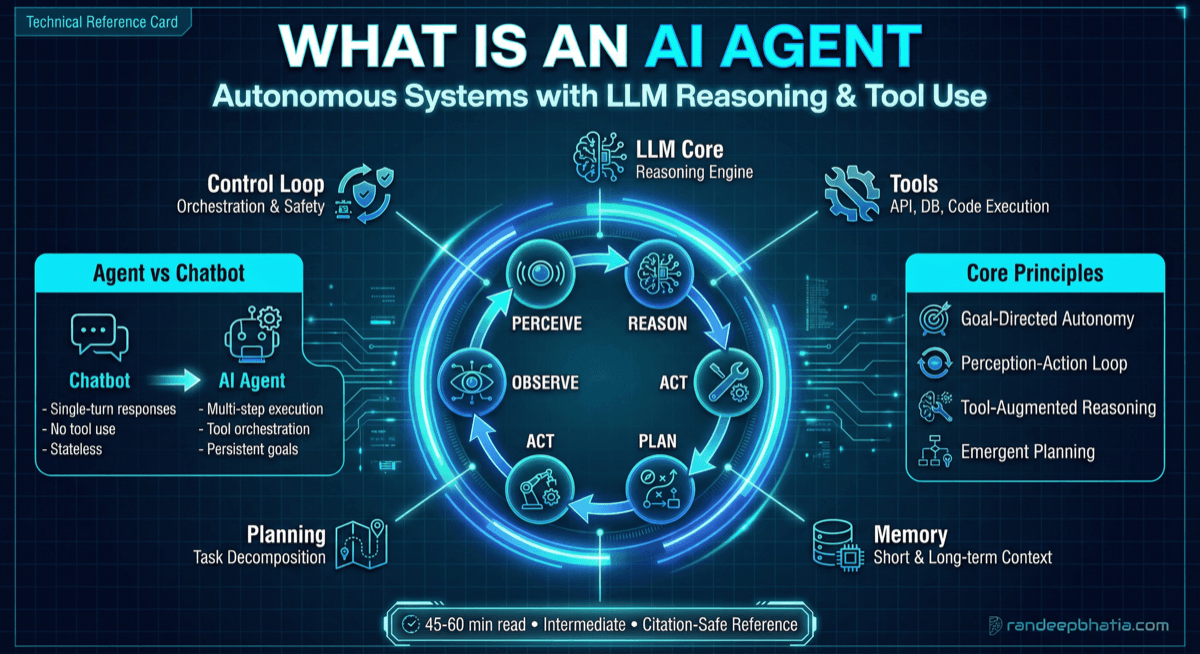
An AI agent is an autonomous software system that uses large language models to perceive its environment, reason about goals, make decisions, and execute multi-step actions to accomplish tasks without continuous human intervention.

1

AI agents combine LLM reasoning capabilities with tool use, memory systems, and planning mechanisms to autonomously pursue goals through iterative action-observation loops, distinguishing them from simple chatbots that only respond to single queries.

2

The core agent loop consists of perception, reasoning, planning, action execution, and observation, with the LLM serving as the cognitive engine that interprets context, selects appropriate tools, and determines next steps based on intermediate results.

3

Production AI agents require careful orchestration of multiple components including prompt engineering, tool integration, memory management, error handling, and safety guardrails to achieve reliable autonomous behavior at scale.

The Bottom Line

AI agents represent a paradigm shift from reactive AI systems to proactive autonomous systems capable of complex multi-step task completion. Organizations deploying AI agents must balance autonomy with control, implementing robust monitoring, safety mechanisms, and fallback strategies to manage the inherent unpredictability of autonomous decision-making.

Definition

An AI agent is an autonomous software entity that leverages large language models as its reasoning core to perceive environmental state, formulate plans, execute actions through external tools, and iteratively refine its approach based on observed outcomes until a specified goal is achieved.

Unlike traditional chatbots or single-turn AI assistants, AI agents maintain persistent context across multiple interaction cycles, possess the ability to invoke external capabilities such as APIs, databases, and code execution environments, and demonstrate goal-directed behavior that adapts dynamically to changing circumstances and intermediate results.

Extended Definition

AI agents operate through a continuous loop of observation, reasoning, and action that mirrors aspects of human cognitive processes but executes at machine speed and scale. The agent receives input from its environment, which may include user instructions, system state, tool outputs, or sensor data, and processes this information through an LLM that serves as its decision-making engine. Based on this reasoning, the agent selects and executes actions, typically through tool calls or API invocations, then observes the results and incorporates them into its ongoing context for the next iteration. This architecture enables AI agents to decompose complex tasks into manageable subtasks, handle unexpected situations through dynamic replanning, and maintain coherent pursuit of objectives across extended interaction sequences that may span minutes, hours, or even days.

Etymology & Origins

The term 'agent' in computing derives from the Latin 'agere' meaning 'to do' or 'to act,' and was first applied to software systems in the 1970s and 1980s within distributed computing and artificial intelligence research. The concept of 'intelligent agents' was formalized in AI literature during the 1990s, particularly through Russell and Norvig's influential textbook 'Artificial Intelligence: A Modern Approach' (1995), which defined agents as entities that perceive their environment through sensors and act upon it through actuators. The modern usage of 'AI agent' specifically referring to LLM-powered autonomous systems emerged in 2022-2023 following the release of GPT-4 and similar capable language models, with the term gaining widespread adoption through projects like AutoGPT, BabyAGI, and LangChain agents.

Also Known As

LLM agentAutonomous agentIntelligent agentAgentic AICognitive agentSoftware agentAI assistant with toolsReasoning agent

Not To Be Confused With

Chatbot

Chatbots are reactive systems designed for single-turn or simple multi-turn conversations without autonomous goal pursuit, tool use, or persistent task execution. AI agents actively pursue goals through multi-step reasoning and action, maintaining state and adapting strategies across extended interactions.

AI Assistant

AI assistants like Siri or Alexa respond to discrete commands and queries without autonomous planning or complex tool orchestration. AI agents independently decompose complex goals into subtasks and execute multi-step plans with minimal human intervention.

Robotic Process Automation (RPA)

RPA bots follow predetermined scripts and rules without reasoning capabilities, failing when encountering unexpected situations. AI agents use LLM reasoning to handle novel scenarios, make contextual decisions, and adapt their approach dynamically.

Multi-Agent System

Multi-agent systems involve multiple AI agents collaborating or competing, whereas a single AI agent is one autonomous entity. The term 'AI agent' refers to the individual unit, while multi-agent systems describe architectures where multiple such units interact.

Workflow Automation

Workflow automation executes predefined sequences of steps with fixed branching logic. AI agents dynamically determine their next actions based on reasoning about current state and goals, enabling handling of tasks that cannot be fully specified in advance.

Function Calling / Tool Use

Function calling is a capability where LLMs generate structured outputs to invoke external functions. AI agents incorporate function calling as one component within a broader architecture that includes planning, memory, and iterative execution loops.

Conceptual Foundation

Core Principles

(8 principles)

Mental Models

(6 models)

The Cognitive Loop

Visualize the agent as executing a continuous think-act-observe cycle similar to human problem-solving. The agent receives information, reasons about it, takes action, sees results, and incorporates those results into the next round of thinking. This model helps understand why agents can handle dynamic situations but also why they may get stuck in unproductive loops.

The Tool-Wielding Expert

Think of the LLM as a knowledgeable expert who can reason and plan but has no hands. Tools are the hands that allow the expert to interact with the world. The expert decides what needs to be done and which tool to use, but the tool performs the actual work and reports back results.

The Context Window as Desk Space

Imagine the context window as a physical desk with limited space. Everything the agent is actively working with must fit on the desk. As new items arrive, old items must be removed or summarized. The agent can only reason about what's currently on the desk, though it may have filing cabinets (external memory) for longer-term storage.

The Autonomous Employee

Consider the agent as a new employee given a task and access to certain resources. The employee will work independently, making judgment calls about approach and asking clarifying questions when stuck. Like a real employee, the agent needs clear objectives, appropriate permissions, and oversight mechanisms.

The State Machine with Fuzzy Transitions

View the agent as a state machine where states represent task progress and transitions are determined by LLM reasoning rather than fixed rules. Unlike traditional state machines, transition conditions are evaluated through natural language understanding, enabling flexibility but introducing non-determinism.

The Recursive Problem Solver

Understand agents as systems that recursively decompose problems until reaching actions they can directly execute. Complex tasks become trees of simpler subtasks, with the agent navigating this tree through reasoning. Leaf nodes are tool calls; internal nodes are planning decisions.

Key Insights

(10 insights)

The quality of an AI agent is determined more by its orchestration architecture, tool design, and prompt engineering than by the underlying LLM model, as the same model can exhibit dramatically different capabilities depending on how it is deployed.

Agent reliability decreases non-linearly with task complexity: doubling the number of required steps often more than doubles the probability of failure, making long-horizon tasks fundamentally challenging without sophisticated error recovery mechanisms.

Most agent failures stem from ambiguous goal specification, inadequate tool design, or context management issues rather than LLM reasoning limitations, indicating that engineering practices matter more than model capabilities for production systems.

Agents exhibit emergent behaviors not explicitly programmed, including creative problem-solving approaches, unexpected tool combinations, and novel failure modes, requiring extensive testing across diverse scenarios.

The boundary between agent autonomy and human oversight represents a critical design decision with no universal correct answer; optimal autonomy levels depend on task risk, reversibility, and organizational trust in the system.

Token costs for agentic workloads can exceed simple chat interactions by 10-100x due to iterative reasoning, tool output processing, and context accumulation, fundamentally changing the economics of LLM deployment.

Agents can develop effective strategies through in-context learning during execution, improving their approach based on intermediate results without any parameter updates, enabling adaptation to novel situations.

The observability requirements for agent systems far exceed those for traditional software, as understanding agent behavior requires tracking reasoning chains, tool invocations, and decision points across potentially thousands of steps.

Effective agent design requires treating the LLM as an unreliable component that will occasionally produce incorrect outputs, building systems that detect and recover from reasoning errors rather than assuming correctness.

The same agent architecture may perform excellently on some task types while failing completely on others, as agent capabilities are highly sensitive to the match between task structure and architectural assumptions.

When to Use

Ideal Scenarios

(12)

Complex research tasks requiring synthesis of information from multiple sources, where the agent can autonomously search, retrieve, analyze, and compile findings into coherent outputs.

Multi-step workflows with conditional logic that cannot be fully specified in advance, such as customer support escalation paths that depend on issue diagnosis.

Tasks requiring interaction with multiple external systems or APIs where the sequence of calls depends on intermediate results, such as booking travel across multiple providers.

Situations where human expertise is the bottleneck and tasks can be delegated to agents operating under defined constraints, enabling scaling of knowledge work.

Exploratory data analysis where the agent can iteratively query databases, generate visualizations, and refine hypotheses based on findings without predefined analysis scripts.

Code generation and debugging workflows where the agent can write code, execute tests, interpret errors, and iteratively refine implementations until tests pass.

Document processing pipelines requiring understanding, extraction, transformation, and routing decisions based on content analysis rather than fixed rules.

Personalized recommendation or advisory systems where the agent gathers user context through conversation and tool use before providing tailored guidance.

Monitoring and incident response systems where agents can detect anomalies, investigate root causes through log analysis and system queries, and execute remediation steps.

Content creation workflows requiring research, drafting, revision, and fact-checking cycles that benefit from autonomous iteration toward quality standards.

Integration testing and quality assurance tasks where agents can explore application functionality, identify edge cases, and document findings systematically.

Knowledge management tasks involving information retrieval, synthesis, and organization across large document collections with evolving query requirements.

Prerequisites

(8)
1

Clear definition of task boundaries, success criteria, and acceptable failure modes that can be communicated to the agent through prompts and constraints.

2

Reliable tool interfaces with well-documented inputs, outputs, and error conditions that the agent can invoke and interpret correctly.

3

Sufficient LLM context window capacity to maintain task state, relevant history, and tool outputs throughout the expected task duration.

4

Acceptable latency and cost tolerances for iterative LLM calls, as agent tasks typically require multiple reasoning cycles with associated delays and token consumption.

5

Robust error handling and recovery mechanisms that can detect agent failures and either retry, escalate, or gracefully degrade without catastrophic consequences.

6

Monitoring and observability infrastructure capable of tracking agent reasoning, tool invocations, and outcomes for debugging and audit purposes.

7

Appropriate security controls and sandboxing for tool execution, particularly for agents with access to sensitive systems or data.

8

Human oversight mechanisms for high-stakes decisions or situations where agent confidence is low, enabling escalation without complete task failure.

Signals You Need This

(10)

Users frequently request multi-step assistance that current chatbots cannot complete without extensive back-and-forth interaction.

Existing automation breaks down when encountering variations or edge cases that require judgment rather than rule application.

Knowledge workers spend significant time on repetitive research, synthesis, or coordination tasks that follow general patterns but vary in specifics.

Integration workflows require dynamic sequencing based on intermediate results rather than fixed execution paths.

Customer support tickets require investigation across multiple systems before resolution can be determined.

Data analysis requests follow unpredictable paths depending on initial findings, requiring adaptive exploration.

Content creation processes involve iterative refinement cycles that could be automated with appropriate feedback mechanisms.

System administration tasks require diagnostic reasoning and conditional remediation that exceeds simple runbook automation.

Users need personalized guidance that requires gathering context through multiple interactions before providing recommendations.

Existing RPA solutions fail to handle the variability and exceptions present in real-world process execution.

Organizational Readiness

(7)

Technical teams have experience with LLM integration, prompt engineering, and the operational characteristics of language model deployments.

Organization has established practices for testing non-deterministic systems and accepts that agent behavior will vary across executions.

Clear ownership exists for agent behavior, including responsibility for monitoring, incident response, and continuous improvement.

Stakeholders understand that agent capabilities are probabilistic and have calibrated expectations accordingly, accepting occasional failures.

Security and compliance teams have reviewed agent architectures and approved appropriate access controls and audit mechanisms.

Budget allocation accounts for the higher per-task costs of agentic workloads compared to simple LLM queries.

User training and change management plans address how humans will interact with and oversee agent systems.

When NOT to Use

Anti-Patterns

(12)

Using agents for tasks with well-defined, deterministic logic that can be implemented more reliably and efficiently with traditional programming or rule-based systems.

Deploying agents in high-frequency, low-latency scenarios where the iterative reasoning overhead makes response times unacceptable.

Applying agents to safety-critical systems where the non-deterministic nature of LLM reasoning creates unacceptable risk of harmful outcomes.

Using agents when simpler retrieval-augmented generation (RAG) would suffice, adding unnecessary complexity and cost to straightforward question-answering tasks.

Deploying agents without adequate monitoring, creating black-box systems where failures go undetected and debugging becomes impossible.

Implementing agents for tasks requiring perfect accuracy, as LLM reasoning inherently includes error rates that cannot be eliminated through architectural improvements alone.

Using agents in environments where tool failures are common and unpredictable, as agents struggle to reason about unreliable external dependencies.

Deploying agents to replace human judgment in ethically sensitive decisions without appropriate oversight and accountability mechanisms.

Applying agents to tasks with extremely long time horizons where context accumulation exceeds practical limits and coherence degrades.

Using agents when the cost per task execution exceeds the value generated, particularly for high-volume, low-value transactions.

Deploying agents in adversarial environments where malicious inputs could manipulate agent behavior through prompt injection or tool exploitation.

Implementing agents without clear success criteria, making it impossible to evaluate whether the agent is actually achieving intended outcomes.

Red Flags

(10)

Stakeholders expect 100% reliability or deterministic behavior from the agent system.

The task requires sub-second response times that cannot accommodate iterative LLM reasoning.

No clear mechanism exists for humans to review, correct, or override agent decisions.

The organization lacks experience with LLM systems and their operational characteristics.

Security review has not been conducted for the tools and data the agent will access.

Cost projections do not account for the multiplicative token consumption of agentic workloads.

The task domain involves high-stakes decisions with irreversible consequences and no human checkpoint.

Testing plans assume deterministic behavior and do not account for output variability.

No observability infrastructure exists to track agent reasoning and diagnose failures.

The agent would have access to sensitive systems without appropriate sandboxing or access controls.

Better Alternatives

(8)
1
When:

Simple question-answering over a document collection

Use Instead:

Retrieval-Augmented Generation (RAG)

Why:

RAG provides faster, more predictable responses for straightforward retrieval tasks without the overhead of agent reasoning loops. Agents add unnecessary complexity when the task is simply finding and presenting relevant information.

2
When:

Executing a fixed sequence of API calls with known inputs

Use Instead:

Traditional workflow orchestration (Airflow, Step Functions)

Why:

Deterministic workflows execute faster, cost less, and provide better reliability guarantees when the execution path is known in advance. Agent reasoning adds latency and unpredictability without benefit.

3
When:

Classifying inputs into predefined categories

Use Instead:

Single LLM call with structured output

Why:

Classification tasks do not require iterative reasoning or tool use. A single, well-prompted LLM call provides faster results at lower cost with equivalent accuracy.

4
When:

Generating content from a template with variable substitution

Use Instead:

Template engine with LLM for specific sections

Why:

Template-based generation is more predictable and efficient when the output structure is fixed. LLMs can fill specific creative sections without full agent orchestration.

5
When:

Real-time conversational interface with low latency requirements

Use Instead:

Streaming LLM response without agent loop

Why:

Agent reasoning loops introduce latency incompatible with real-time conversation. Direct streaming provides responsive user experience for interactive chat.

6
When:

Processing high volumes of similar items with consistent logic

Use Instead:

Batch LLM processing with deterministic post-processing

Why:

Batch processing amortizes overhead and provides consistent handling. Agent autonomy is unnecessary when items follow predictable patterns.

7
When:

Tasks requiring guaranteed completion within strict time bounds

Use Instead:

Time-boxed LLM calls with fallback logic

Why:

Agent execution times are unpredictable due to variable reasoning depths and tool latencies. Time-critical tasks need bounded execution with deterministic fallbacks.

8
When:

Compliance-critical processes requiring audit trails

Use Instead:

Rule-based systems with LLM assistance for edge cases

Why:

Rule-based systems provide deterministic, auditable decision paths. LLMs can handle exceptions while core logic remains verifiable and compliant.

Common Mistakes

(10)

Underestimating the complexity of reliable agent deployment, treating it as a simple extension of chatbot development rather than a distinct architectural challenge.

Providing agents with excessive tool access without considering security implications, creating attack surfaces for prompt injection and data exfiltration.

Failing to implement proper error handling, resulting in agents that silently fail or enter infinite loops without detection.

Neglecting context management, leading to agents that lose track of task state as conversations extend beyond context window limits.

Assuming agent behavior is deterministic and not testing for variability across multiple executions of the same task.

Deploying agents without monitoring, making it impossible to understand agent behavior, diagnose failures, or measure performance.

Over-specifying agent instructions, constraining the agent's ability to adapt to unexpected situations while not actually guaranteeing desired behavior.

Under-specifying success criteria, leaving agents without clear signals of task completion and causing unnecessary iteration.

Ignoring cost implications of iterative reasoning, resulting in unexpectedly high token consumption and API costs.

Treating agent development as a one-time effort rather than an ongoing process of refinement based on production behavior.

Core Taxonomy

Primary Types

(8 types)

Agents that interleave reasoning traces with action execution, explicitly articulating their thought process before each tool invocation. The reasoning step helps the agent plan its next action, while the action step grounds reasoning in real-world observations.

Characteristics
  • Explicit chain-of-thought reasoning before actions
  • Alternating think-act-observe pattern
  • Transparent decision-making process
  • Self-correcting through observation feedback
Use Cases
Research and information synthesis tasksMulti-step problem solvingTasks requiring explainable decision-makingDebugging and diagnostic workflows
Tradeoffs

Higher token consumption due to explicit reasoning, but improved accuracy and interpretability. May be slower than direct action approaches but provides better error recovery and auditability.

Classification Dimensions

Autonomy Level

Classifies agents by the degree of human involvement in their operation, from fully independent execution to continuous human oversight. Higher autonomy enables efficiency but increases risk.

Fully AutonomousSemi-Autonomous with CheckpointsHuman-in-the-LoopHuman-on-the-LoopSupervised Execution

Memory Architecture

Categorizes agents by how they maintain and access information across interactions. Memory architecture determines capability for long-running tasks and personalization.

StatelessSession MemoryPersistent MemoryHierarchical MemoryExternal Memory Systems

Tool Integration Depth

Classifies agents by the scope and impact of their tool capabilities, from pure language reasoning to agents that can modify external systems or interact with physical environments.

No Tools (Pure Reasoning)Read-Only ToolsRead-Write ToolsSystem-Level AccessPhysical World Interaction

Specialization

Distinguishes agents by their intended scope of application, from broadly capable general agents to highly specialized agents optimized for specific domains or tasks.

General PurposeDomain-SpecificTask-SpecificPersona-BasedRole-Based

Interaction Pattern

Categorizes agents by how they receive inputs and deliver outputs, affecting their suitability for different operational contexts and user interaction models.

Single-TurnMulti-Turn ConversationalBatch ProcessingEvent-DrivenContinuous Monitoring

Deployment Model

Classifies agents by their execution environment, impacting latency, privacy, cost, and capability constraints based on available compute and connectivity.

Cloud-HostedEdge-DeployedHybridOn-PremiseEmbedded

Evolutionary Stages

1

Prototype Agent

1-4 weeks of development

Basic agent loop implemented with minimal error handling, single tool integration, and limited testing. Demonstrates feasibility but not production-ready. Typically operates in controlled environments with human supervision.

2

Development Agent

1-3 months of development

Multiple tools integrated with basic error handling and retry logic. Initial prompt optimization completed. Testing covers happy paths and common edge cases. May be deployed to internal users for feedback.

3

Production Agent

3-6 months of development

Comprehensive error handling, monitoring, and alerting in place. Security review completed. Performance optimized for target latency and cost. Deployed to production with gradual rollout and human oversight mechanisms.

4

Mature Agent

6-18 months of operation

Extensive production history with well-understood behavior patterns. Continuous improvement based on production data. Advanced features like memory systems and multi-agent coordination. High reliability and user trust.

5

Enterprise Agent

12-24+ months of operation

Full integration with enterprise systems and workflows. Compliance and audit requirements met. Sophisticated access controls and governance. Handles high volumes with predictable performance. Part of critical business processes.

Architecture Patterns

Architecture Patterns

(8 patterns)

Simple ReAct Loop

The foundational agent pattern where the LLM alternates between reasoning about the current situation and taking actions through tool calls. Each iteration produces a thought explaining the agent's reasoning, followed by an action, followed by an observation of the action's result.

Components
  • LLM for reasoning and action selection
  • Tool executor for action invocation
  • Observation formatter for result processing
  • Prompt template with ReAct structure
  • Termination detector for completion
Data Flow

User input → Prompt construction → LLM reasoning → Action parsing → Tool execution → Observation formatting → Context update → Loop or terminate

Best For
  • Research and information gathering
  • Debugging and troubleshooting
  • Exploratory data analysis
  • Tasks requiring transparent reasoning
Limitations
  • High latency for complex tasks
  • Token consumption grows with iterations
  • May get stuck in reasoning loops
  • Limited planning horizon
Scaling Characteristics

Scales linearly with task complexity. Each additional step adds LLM latency and token cost. Context window becomes limiting factor for long tasks. Parallelization limited by sequential reasoning dependency.

Integration Points

LLM Provider API

Provides the reasoning capabilities that power agent decision-making, including text generation, function calling, and embedding generation.

Interfaces:
Chat completion APIFunction calling interfaceStreaming response APIEmbedding generation API

Rate limits, latency variability, cost management, model version stability, and fallback provider strategies must be addressed. API changes can break agent behavior.

Tool Registry

Maintains the catalog of available tools with their schemas, descriptions, and invocation methods, enabling the agent to discover and use appropriate capabilities.

Interfaces:
Tool discovery APISchema retrievalTool invocation interfaceTool health monitoring

Tool descriptions must be clear for LLM understanding. Schema validation prevents malformed calls. Tool versioning enables safe updates. Access control limits tool availability by context.

Memory System

Provides persistent storage and retrieval of information across agent sessions, enabling long-term context retention and learning from past interactions.

Interfaces:
Memory write APISemantic search interfaceMemory update/deleteMemory summarization

Retrieval latency impacts response time. Memory relevance scoring affects quality. Storage costs scale with retention. Privacy requirements may limit memory persistence.

Orchestration Layer

Manages the agent execution loop, handling state transitions, error recovery, and coordination between components.

Interfaces:
Execution control APIState management interfaceError handling hooksLifecycle management

Must handle partial failures gracefully. State persistence enables recovery. Timeout management prevents runaway execution. Logging integration enables debugging.

Monitoring System

Collects and analyzes agent behavior data for operational visibility, debugging, and continuous improvement.

Interfaces:
Metrics collection APITrace ingestionLog aggregationAlert management

High-cardinality metrics from agent variability. Trace correlation across async operations. Cost of comprehensive logging. Real-time alerting for critical failures.

Security Gateway

Enforces access controls, validates inputs, and prevents security violations in agent operations.

Interfaces:
Authentication/authorizationInput validationOutput filteringAudit logging

Prompt injection prevention critical. Tool access must be scoped appropriately. Sensitive data handling requires encryption. Audit trails for compliance.

External APIs and Services

Provide the external capabilities that agents invoke through tools, including databases, web services, and third-party APIs.

Interfaces:
REST/GraphQL APIsDatabase connectionsMessage queuesFile systems

Reliability varies across services. Rate limiting and quotas apply. Authentication credential management. Error handling for service failures.

User Interface

Enables human interaction with the agent for input, output, and oversight functions.

Interfaces:
Chat interfaceApproval workflowsProgress visualizationFeedback collection

Real-time updates for long-running tasks. Clear presentation of agent reasoning. Easy intervention mechanisms. Mobile and accessibility support.

Decision Framework

✓ If Yes

AI agent is likely appropriate; proceed to evaluate specific requirements.

✗ If No

Consider simpler alternatives like single LLM calls, RAG, or traditional automation.

Considerations

Multi-step dependency is the core differentiator of agents. Simple tasks with predictable flows rarely benefit from agent complexity.

Technical Deep Dive

Overview

AI agents operate through a continuous cycle of perception, reasoning, action, and observation that enables autonomous task completion. At the core of this cycle is a large language model that serves as the agent's cognitive engine, interpreting inputs, formulating plans, and generating outputs that drive tool invocations and responses. The agent maintains state through its context window, which accumulates information from user inputs, system prompts, tool outputs, and intermediate reasoning as the task progresses. The fundamental mechanism involves the LLM receiving a carefully constructed prompt that includes the agent's instructions, available tools with their schemas, relevant context from memory systems, and the current state of the task. Based on this input, the LLM generates output that may include reasoning about the situation, a decision about what action to take, and structured data for tool invocation. The orchestration layer parses this output, executes any requested tool calls, and formats the results for inclusion in the next iteration of the loop. This architecture enables emergent capabilities that exceed what the LLM or tools could achieve independently. The LLM provides flexible reasoning and natural language understanding, while tools provide grounded capabilities for interacting with external systems. The combination allows agents to handle tasks that require both cognitive flexibility and concrete actions, adapting their approach based on intermediate results in ways that static automation cannot match. Critically, the agent's behavior emerges from the interaction of multiple components rather than being explicitly programmed. The same underlying architecture can exhibit vastly different behaviors depending on the system prompt, available tools, and task context. This flexibility is both a strength, enabling rapid adaptation to new use cases, and a challenge, as behavior can be difficult to predict and control across all possible inputs.

Step-by-Step Process

The agent receives input from the user or triggering system, which may include a task description, relevant context, constraints, and any initial data. This input is parsed and validated to ensure it conforms to expected formats and does not contain malicious content. The input is then formatted for inclusion in the agent's prompt.

⚠️ Pitfalls to Avoid

Malformed inputs can cause parsing failures. Prompt injection attacks may be embedded in user input. Excessively long inputs may exceed context limits before processing begins.

Under The Hood

The LLM's role in an AI agent extends beyond simple text generation to encompass several sophisticated cognitive functions. When processing the agent prompt, the model performs implicit task decomposition, breaking down complex requests into manageable steps based on its training on human problem-solving patterns. This decomposition is not explicitly programmed but emerges from the model's learned representations of how tasks are typically approached. Tool selection involves a form of semantic matching where the model compares the current task requirements against tool descriptions to identify appropriate capabilities. The model's understanding of tool functionality comes entirely from the natural language descriptions and schemas provided in the prompt, making clear and accurate tool documentation critical for reliable agent behavior. Ambiguous or incomplete tool descriptions lead to incorrect tool selection or malformed arguments. The context window functions as the agent's working memory, but with important differences from human cognition. Information in the context is processed in parallel rather than sequentially, and the model has no inherent sense of recency or importance—all tokens in the context contribute equally to attention computations. This means that careful context management, including summarization, prioritization, and strategic truncation, is essential for maintaining coherent agent behavior over extended interactions. Error recovery in agents relies on the model's ability to interpret error messages and adjust its approach. When a tool call fails, the error information is added to the context, and the model must reason about what went wrong and how to proceed. This capability varies significantly across models and error types—clear, actionable error messages enable better recovery than cryptic failure codes. Agents may also develop unproductive patterns, repeatedly attempting the same failing approach, requiring explicit intervention or pattern detection. The non-deterministic nature of LLM outputs means that identical inputs can produce different agent behaviors across executions. Temperature settings control the degree of randomness, with lower temperatures producing more consistent but potentially less creative outputs. Production agents typically use low temperatures for reliability, but some tasks benefit from higher temperatures to explore diverse approaches. Understanding and managing this variability is essential for building reliable agent systems.

Failure Modes

Root Cause

Agent enters a cycle of repeated actions without progress, often due to unclear termination conditions, ambiguous task specifications, or inability to recognize completion.

Symptoms
  • Rapidly increasing token consumption
  • Repeated identical or similar tool calls
  • No progress toward task completion
  • Context window filling with repetitive content
Impact

Excessive cost from continued LLM calls, resource exhaustion, task failure, and potential downstream system impact from repeated tool invocations.

Prevention

Implement iteration limits, progress detection, and loop detection algorithms. Provide clear termination criteria in prompts. Monitor for repetitive patterns.

Mitigation

Hard iteration limits with graceful termination. Circuit breakers on repeated tool calls. Human escalation for stuck agents.

Operational Considerations

Key Metrics (15)

Percentage of initiated tasks that complete successfully without human intervention or error termination.

Normal85-95% for well-designed agents on appropriate tasks
AlertBelow 80% or sudden drop of >10%
ResponseInvestigate failure patterns, review recent changes, check external dependencies

Dashboard Panels

Task completion funnel showing initiated, in-progress, completed, and failed tasksReal-time latency distribution with p50, p95, and p99 percentilesToken consumption breakdown by component (reasoning, tool outputs, history)Tool usage heatmap showing call frequency and success rates by toolError rate timeline with categorization by error typeCost accumulation graph with budget threshold indicatorsActive agent instances and resource utilizationHuman escalation queue with wait times and resolution ratesMemory system health including retrieval latency and hit ratesSecurity event timeline with severity classification

Alerting Strategy

Implement tiered alerting with severity levels based on impact and urgency. Critical alerts for security events, complete failures, and budget breaches require immediate response. Warning alerts for degraded performance and elevated error rates allow for investigation during business hours. Informational alerts for trend changes and capacity planning support proactive management. Use alert aggregation to prevent notification fatigue while ensuring visibility into systemic issues.

Cost Analysis

Cost Drivers

(10)

LLM API Token Consumption

Impact:

Primary cost driver, typically 60-80% of total agent cost. Scales directly with task complexity, iteration count, and context size. Input tokens (prompts, context) and output tokens (reasoning, responses) priced differently.

Optimization:

Optimize prompts for conciseness. Cache repeated computations. Use smaller models for simple steps. Implement context management to reduce token accumulation. Consider self-hosted models for high volume.

Number of LLM Calls per Task

Impact:

Each iteration requires at least one LLM call. Complex tasks may require 10-50+ calls. Per-call overhead adds up for high-volume applications.

Optimization:

Optimize agent architecture to minimize iterations. Use planning to reduce trial-and-error. Implement early termination for completed tasks. Batch operations where possible.

Tool Execution Costs

Impact:

External API calls, database queries, and compute resources for tool execution. Varies widely by tool type. May include third-party API fees.

Optimization:

Cache tool results where appropriate. Batch tool calls when possible. Choose cost-effective tool implementations. Monitor and optimize expensive tools.

Memory System Infrastructure

Impact:

Vector database hosting, embedding generation, and storage costs. Scales with memory size and query volume. May include managed service fees.

Optimization:

Right-size memory retention. Implement tiered storage. Optimize embedding dimensions. Use efficient similarity search algorithms.

Compute Infrastructure

Impact:

Servers for orchestration, tool execution, and supporting services. May include GPU costs for local model inference.

Optimization:

Use serverless for variable workloads. Right-size instances. Implement auto-scaling. Consider spot instances for batch processing.

Model Selection

Impact:

Different models have vastly different pricing (10-100x range). Larger models cost more but may complete tasks in fewer iterations.

Optimization:

Match model capability to task requirements. Use smaller models for simple steps. Implement model routing based on task complexity.

Error and Retry Overhead

Impact:

Failed operations consume resources without producing value. Retries multiply costs. Error recovery may require additional iterations.

Optimization:

Improve reliability to reduce errors. Implement smart retry with backoff. Fail fast on unrecoverable errors. Monitor error rates closely.

Monitoring and Logging

Impact:

Observability infrastructure costs for log storage, metrics collection, and analysis tools. Scales with agent activity volume.

Optimization:

Implement log sampling for high-volume operations. Use tiered retention. Aggregate metrics efficiently. Choose cost-effective observability platforms.

Development and Maintenance

Impact:

Engineering time for agent development, testing, monitoring, and improvement. Often underestimated in total cost of ownership.

Optimization:

Use established frameworks and patterns. Invest in testing automation. Build reusable components. Document thoroughly to reduce maintenance burden.

Human-in-the-Loop Costs

Impact:

Human review and intervention time for escalated tasks. Scales with escalation rate and review complexity.

Optimization:

Improve agent capabilities to reduce escalations. Streamline review interfaces. Batch similar reviews. Use agent assistance for human reviewers.

Cost Models

Per-Task Cost Model

Cost = (input_tokens × input_price + output_tokens × output_price) × iterations + tool_costs + infrastructure_allocation
Variables:
input_tokens: Average tokens in prompt and contextoutput_tokens: Average tokens in LLM responseinput_price: Cost per 1K input tokensoutput_price: Cost per 1K output tokensiterations: Average iterations per tasktool_costs: Sum of tool execution costsinfrastructure_allocation: Per-task share of fixed costs
Example:

For a research task with 4000 input tokens, 1000 output tokens per iteration, 8 iterations, at $0.01/1K input and $0.03/1K output: (4×0.01 + 1×0.03) × 8 = $0.56 in LLM costs alone.

Monthly Operating Cost Model

Monthly_Cost = (task_volume × avg_cost_per_task) + infrastructure_fixed + memory_costs + monitoring_costs + human_costs
Variables:
task_volume: Number of tasks per monthavg_cost_per_task: Average LLM and tool costs per taskinfrastructure_fixed: Fixed compute and hosting costsmemory_costs: Vector DB and storage costsmonitoring_costs: Observability platform costshuman_costs: Escalation handling labor costs
Example:

10,000 tasks/month at $0.50 average = $5,000 variable + $500 infrastructure + $200 memory + $100 monitoring + $1,000 human review = $6,800/month total.

Cost per Outcome Model

Cost_per_Outcome = total_costs / successful_outcomes
Variables:
total_costs: All costs including failed taskssuccessful_outcomes: Tasks meeting success criteria
Example:

If total monthly cost is $6,800 and 8,500 of 10,000 tasks succeed, cost per successful outcome is $0.80, compared to $0.68 per task attempted.

Break-Even Analysis Model

Break_Even_Volume = fixed_costs / (value_per_task - variable_cost_per_task)
Variables:
fixed_costs: Infrastructure, development, and overheadvalue_per_task: Business value generated per taskvariable_cost_per_task: LLM and tool costs per task
Example:

With $2,000 monthly fixed costs, $5 value per task, and $0.50 variable cost: break-even at 2000 / (5 - 0.5) = 445 tasks/month.

Optimization Strategies

  • 1Implement aggressive caching for repeated queries and tool results to avoid redundant LLM calls
  • 2Use model routing to direct simple tasks to cheaper, smaller models while reserving expensive models for complex reasoning
  • 3Optimize prompts for token efficiency without sacrificing clarity, removing redundant instructions and examples
  • 4Implement context compression and summarization to reduce token accumulation over long interactions
  • 5Use streaming responses to enable early termination when sufficient information is received
  • 6Batch similar operations to amortize overhead and potentially qualify for volume discounts
  • 7Implement smart retry logic that avoids retrying clearly unrecoverable failures
  • 8Monitor and alert on cost anomalies to catch runaway tasks before they consume excessive resources
  • 9Negotiate volume pricing with LLM providers based on committed usage
  • 10Consider self-hosted open-source models for high-volume, lower-complexity tasks
  • 11Implement task complexity estimation to set appropriate resource budgets before execution
  • 12Use asynchronous processing for non-urgent tasks to enable better resource utilization

Hidden Costs

  • 💰Development time for prompt engineering, testing, and iteration often exceeds initial estimates
  • 💰Debugging and incident response for non-deterministic systems requires specialized skills and time
  • 💰User support costs increase when agent behavior is unpredictable or difficult to explain
  • 💰Technical debt accumulates from rapid iteration without proper architecture investment
  • 💰Compliance and security review costs for autonomous systems with external access
  • 💰Training costs for teams learning to develop and operate agent systems
  • 💰Opportunity costs from failed or suboptimal agent implementations
  • 💰Integration costs for connecting agents with existing systems and workflows

ROI Considerations

Return on investment for AI agents should be evaluated against the full cost of alternatives including human labor, traditional automation, and hybrid approaches. Agents excel in scenarios where task volume is high enough to amortize development costs, task value justifies the per-execution cost, and the flexibility of agent-based approaches provides value over rigid automation. Quantifying ROI requires measuring both cost savings (reduced human time, faster execution, 24/7 availability) and value creation (new capabilities, improved quality, better user experience). Many agent benefits are difficult to quantify precisely, such as the ability to handle novel situations or provide more natural user interactions. ROI typically improves over time as agents are refined based on production experience, reducing failure rates and optimizing costs. Initial deployments often have negative ROI during the learning period, with positive returns emerging as the system matures. Organizations should plan for this investment period and set realistic expectations for time to value. Comparison with alternatives should consider total cost of ownership including development, operation, and maintenance over the expected system lifetime. Agents may have higher initial development costs but lower marginal costs at scale compared to human-intensive alternatives.

Security Considerations

Threat Model

(10 threats)
1

Prompt Injection

Attack Vector

Malicious instructions embedded in user input or retrieved content that manipulate agent behavior by overriding system prompts or injecting unauthorized commands.

Impact

Agent may execute unauthorized actions, disclose sensitive information, bypass safety controls, or behave in ways contrary to intended purpose.

Mitigation

Input sanitization, prompt hardening with clear instruction boundaries, output filtering, least-privilege tool access, and monitoring for anomalous behavior patterns.

2

Data Exfiltration

Attack Vector

Attacker manipulates agent to extract sensitive information through responses, tool calls to external services, or encoded outputs.

Impact

Confidential data exposure, privacy violations, competitive intelligence loss, and regulatory penalties.

Mitigation

Output filtering for sensitive patterns, network egress controls, tool access restrictions, audit logging, and data classification enforcement.

3

Privilege Escalation

Attack Vector

Exploiting agent's tool access to perform actions beyond intended scope, potentially accessing systems or data the user should not reach.

Impact

Unauthorized system access, data modification, and potential lateral movement within connected systems.

Mitigation

Least-privilege tool design, per-user access controls, action validation against user permissions, and separation of agent and user privileges.

4

Denial of Service

Attack Vector

Crafted inputs that cause agent to consume excessive resources through infinite loops, expensive tool calls, or context explosion.

Impact

Service unavailability, excessive costs, and degraded performance for legitimate users.

Mitigation

Resource limits per request, iteration caps, timeout enforcement, rate limiting, and anomaly detection for resource consumption.

5

Tool Exploitation

Attack Vector

Manipulating agent to invoke tools with malicious parameters, exploiting vulnerabilities in tool implementations or connected systems.

Impact

Varies by tool capability; may include code execution, data corruption, or system compromise.

Mitigation

Tool input validation, sandboxed execution, security review of tool implementations, and monitoring of tool invocation patterns.

6

Memory Poisoning

Attack Vector

Injecting malicious content into agent memory systems that influences future interactions, potentially affecting multiple users.

Impact

Persistent manipulation of agent behavior, cross-user attacks, and difficult-to-detect compromise.

Mitigation

Memory input validation, content filtering, user isolation in memory systems, and regular memory auditing.

7

Model Extraction

Attack Vector

Systematic querying to extract information about system prompts, tool configurations, or model behavior for use in attacks.

Impact

Exposure of security-relevant configuration, enabling more targeted attacks.

Mitigation

Rate limiting, query pattern detection, avoiding disclosure of system details in responses, and monitoring for extraction attempts.

8

Supply Chain Compromise

Attack Vector

Malicious code or configurations introduced through dependencies, frameworks, or tool integrations.

Impact

Arbitrary code execution, data theft, or agent manipulation through compromised components.

Mitigation

Dependency scanning, vendor security assessment, code review, and integrity verification for components.

9

Insider Threat

Attack Vector

Malicious or negligent actions by individuals with legitimate access to agent systems or configurations.

Impact

Varies widely; may include data theft, sabotage, or introduction of vulnerabilities.

Mitigation

Access controls and audit logging, separation of duties, change management processes, and security awareness training.

10

Cross-Tenant Data Leakage

Attack Vector

In multi-tenant deployments, information from one user/organization leaking to another through shared context, memory, or caching.

Impact

Privacy violations, confidentiality breach, and regulatory non-compliance.

Mitigation

Strict tenant isolation, separate memory stores, cache partitioning, and regular isolation testing.

Security Best Practices

  • Implement defense in depth with multiple security layers rather than relying on any single control
  • Apply least-privilege principles to all tool access, granting only capabilities required for intended tasks
  • Sanitize and validate all user inputs before inclusion in prompts or tool parameters
  • Filter agent outputs for sensitive information patterns before returning to users
  • Use separate credentials for agent tool access distinct from user credentials
  • Implement comprehensive audit logging for all agent actions and decisions
  • Encrypt sensitive data at rest and in transit throughout the agent system
  • Regularly rotate credentials and API keys used by agent systems
  • Conduct security reviews for all tool implementations and integrations
  • Implement rate limiting and resource quotas to prevent abuse
  • Use network segmentation to limit agent access to necessary systems only
  • Monitor for anomalous behavior patterns that may indicate compromise
  • Maintain incident response procedures specific to agent security events
  • Conduct regular penetration testing including prompt injection attempts
  • Keep all dependencies updated and monitor for security advisories

Data Protection

  • 🔒Classify data processed by agents according to sensitivity levels and apply appropriate controls
  • 🔒Minimize personal and sensitive data in agent context to reduce exposure risk
  • 🔒Implement data retention policies that limit how long agent interactions are stored
  • 🔒Ensure data processed by agents remains within approved geographic boundaries
  • 🔒Use encryption for all data at rest and in transit within agent systems
  • 🔒Implement access controls ensuring only authorized personnel can access agent data
  • 🔒Maintain audit trails for data access and processing by agent systems
  • 🔒Establish data handling agreements with LLM providers covering data use and retention
  • 🔒Implement mechanisms for data subject requests (access, deletion, portability)
  • 🔒Regularly assess and document data flows through agent systems

Compliance Implications

GDPR (General Data Protection Regulation)

Requirement:

Lawful basis for processing personal data, data subject rights, data minimization, and appropriate security measures.

Implementation:

Implement consent mechanisms, data access/deletion capabilities, minimize personal data in agent context, and document processing activities.

CCPA (California Consumer Privacy Act)

Requirement:

Consumer rights to know, delete, and opt-out of sale of personal information.

Implementation:

Provide transparency about data collection, implement deletion mechanisms, and ensure agent does not facilitate unauthorized data sharing.

HIPAA (Health Insurance Portability and Accountability Act)

Requirement:

Protection of protected health information (PHI) with administrative, physical, and technical safeguards.

Implementation:

Ensure PHI is not exposed in agent context or logs, implement access controls, and obtain BAAs with LLM providers if PHI is processed.

SOC 2

Requirement:

Controls for security, availability, processing integrity, confidentiality, and privacy.

Implementation:

Document agent security controls, implement monitoring and incident response, and include agents in audit scope.

PCI DSS (Payment Card Industry Data Security Standard)

Requirement:

Protection of cardholder data with specific technical and operational requirements.

Implementation:

Ensure agents do not process or store cardholder data, or implement full PCI controls if payment data handling is required.

AI Act (EU Artificial Intelligence Act)

Requirement:

Risk-based requirements for AI systems including transparency, human oversight, and documentation.

Implementation:

Classify agent risk level, implement required controls for risk category, maintain technical documentation, and ensure human oversight mechanisms.

NIST AI Risk Management Framework

Requirement:

Voluntary framework for managing AI risks across the AI lifecycle.

Implementation:

Map agent development and operation to framework functions, document risk assessments, and implement recommended practices.

Industry-Specific Regulations

Requirement:

Various sector-specific requirements (financial services, healthcare, government, etc.).

Implementation:

Identify applicable regulations, assess agent compliance requirements, and implement necessary controls and documentation.

Scaling Guide

Scaling Dimensions

Concurrent Users

Strategy:

Horizontal scaling of agent instances with load balancing. Each agent instance handles one or more concurrent sessions. Stateless design enables easy scaling.

Limits:

Limited by LLM API rate limits, orchestration infrastructure capacity, and tool system throughput. May require multiple API keys or provider accounts.

Considerations:

Session affinity may be needed for stateful agents. Memory systems must scale with user count. Cost scales linearly with concurrency.

Task Complexity

Strategy:

Vertical scaling through more capable models, extended context windows, and sophisticated orchestration. May require hierarchical agent architectures.

Limits:

Bounded by model capabilities, context window size, and practical iteration limits. Very complex tasks may require human decomposition.

Considerations:

Complexity increases failure probability. Monitoring and debugging become more challenging. Cost per task increases significantly.

Task Volume

Strategy:

Horizontal scaling with parallel agent instances. Batch processing for non-interactive workloads. Queue-based architecture for load smoothing.

Limits:

LLM API throughput limits, cost constraints, and downstream system capacity. May require negotiated rate limits with providers.

Considerations:

High volume justifies optimization investment. Consider dedicated or self-hosted models. Implement cost controls and monitoring.

Response Latency

Strategy:

Optimize for speed through model selection, caching, parallel tool execution, and reduced iteration counts. Consider streaming for perceived responsiveness.

Limits:

Minimum latency bounded by LLM inference time. Complex tasks inherently require multiple iterations. Tool latency adds to total time.

Considerations:

Latency optimization often trades off against capability or cost. User expectations vary by use case. Consider async patterns for long tasks.

Tool Ecosystem

Strategy:

Modular tool architecture enabling addition of new capabilities. Tool registry with dynamic discovery. Versioned tool interfaces.

Limits:

Tool set size impacts context consumption and selection accuracy. Integration complexity grows with tool count.

Considerations:

Balance capability breadth against selection accuracy. Implement tool categorization. Consider specialized agents for tool subsets.

Memory Capacity

Strategy:

Scalable vector database infrastructure. Tiered storage with hot/warm/cold data. Efficient retrieval algorithms.

Limits:

Storage costs scale with retention. Retrieval latency may increase with scale. Embedding computation costs for new content.

Considerations:

Implement retention policies. Optimize embedding dimensions. Consider approximate search for large scales.

Geographic Distribution

Strategy:

Multi-region deployment for latency and compliance. Regional LLM endpoints where available. Distributed memory systems.

Limits:

Not all LLM providers offer regional endpoints. Data residency requirements may constrain architecture.

Considerations:

Compliance requirements drive regional needs. Latency benefits depend on user distribution. Increases operational complexity.

Reliability Requirements

Strategy:

Redundant components, failover mechanisms, and graceful degradation. Multi-provider LLM strategy. Comprehensive monitoring.

Limits:

Higher reliability increases cost and complexity. Some failure modes are inherent to LLM systems.

Considerations:

Define SLAs appropriate to use case. Implement circuit breakers. Plan for provider outages.

Capacity Planning

Key Factors:
Expected task volume and growth rateAverage iterations per task by task typeToken consumption patterns (input and output)Tool execution requirements and latenciesMemory storage and retrieval volumesConcurrent user expectationsLatency SLA requirementsBudget constraints and cost targets
Formula:Required_Capacity = (peak_tasks_per_second × avg_iterations × avg_llm_latency) / target_utilization, with headroom for bursts and growth
Safety Margin:

Plan for 2-3x expected peak load to handle bursts and growth. Maintain ability to scale quickly. Keep 30-40% headroom on rate limits. Budget for 50% cost increase from baseline for unexpected demand.

Scaling Milestones

Prototype (10-100 tasks/day)
Challenges:
  • Establishing baseline metrics
  • Identifying common failure modes
  • Validating core architecture
Architecture Changes:

Simple single-instance deployment. Manual monitoring. Focus on functionality over scale.

Pilot (100-1,000 tasks/day)
Challenges:
  • Handling increased variety of inputs
  • Managing costs as volume grows
  • Establishing operational procedures
Architecture Changes:

Add monitoring and alerting. Implement basic error handling. Begin cost optimization.

Production (1,000-10,000 tasks/day)
Challenges:
  • Ensuring reliability at scale
  • Managing LLM API rate limits
  • Scaling support and operations
Architecture Changes:

Horizontal scaling with load balancing. Implement caching. Add redundancy for critical components.

Growth (10,000-100,000 tasks/day)
Challenges:
  • Cost optimization becomes critical
  • Operational complexity increases
  • Performance consistency across scale
Architecture Changes:

Advanced caching and batching. Model routing for cost optimization. Dedicated infrastructure. Consider self-hosted models.

Enterprise (100,000+ tasks/day)
Challenges:
  • Multi-region deployment
  • Complex compliance requirements
  • Sophisticated cost management
Architecture Changes:

Global distribution. Custom model deployments. Advanced orchestration. Dedicated provider relationships.

Benchmarks

Industry Benchmarks

MetricP50P95P99 World Class
Task Completion Rate85%92%95%>97%
Average Iterations per Task854<3
End-to-End Latency (simple tasks)15 seconds8 seconds5 seconds<3 seconds
End-to-End Latency (complex tasks)120 seconds60 seconds45 seconds<30 seconds
Cost per Task (simple)$0.15$0.08$0.05<$0.03
Cost per Task (complex)$1.50$0.80$0.50<$0.30
Tool Call Success Rate92%96%98%>99%
Human Escalation Rate20%12%8%<5%
User Satisfaction (1-5 scale)3.84.24.5>4.7
Context Utilization70%55%45%<40%
Error Rate8%4%2%<1%
Time to First Token2.5 seconds1.5 seconds1.0 seconds<0.5 seconds

Comparison Matrix

ApproachTask FlexibilityReliabilityLatencyCostMaintenanceBest For
AI AgentHighMediumHighHighMediumComplex, variable tasks
Simple LLM CallMediumMedium-HighLowLowLowSingle-step generation
RAG SystemMediumHighLow-MediumMediumMediumKnowledge retrieval
Rule-Based SystemLowVery HighVery LowLowHighDeterministic workflows
RPALowHighLowMediumHighUI automation
Traditional WorkflowLowVery HighLowLowMediumFixed processes
Human OperatorVery HighHighVery HighVery HighN/ANovel, high-stakes tasks
Hybrid Agent+HumanHighHighMedium-HighHighHighCritical tasks with oversight

Performance Tiers

Basic

Simple agent loop with limited tools. Suitable for straightforward tasks with clear success criteria. Minimal error handling.

Target:

70% completion rate, <20 iterations average, basic monitoring

Standard

Robust agent with comprehensive tool suite. Good error handling and retry logic. Suitable for production use with human oversight.

Target:

85% completion rate, <10 iterations average, full monitoring and alerting

Advanced

Sophisticated agent with memory, planning, and reflection. Handles complex tasks with high autonomy. Comprehensive observability.

Target:

92% completion rate, <6 iterations average, predictive monitoring

Enterprise

Highly optimized agent with multi-model routing, advanced caching, and sophisticated orchestration. Meets strict SLAs.

Target:

97% completion rate, <4 iterations average, real-time optimization

World-Class

State-of-the-art agent pushing boundaries of capability. Custom models, novel architectures, and continuous learning.

Target:

>98% completion rate, minimal iterations, autonomous improvement

Real World Examples

Real-World Scenarios

(8 examples)
1

Customer Support Automation

Context

E-commerce company handling 10,000+ support tickets daily across order status, returns, and product questions. Human agents were overwhelmed, leading to long wait times and inconsistent responses.

Approach

Deployed conversational agent with access to order management system, knowledge base, and escalation tools. Agent handles initial triage, resolves straightforward issues autonomously, and prepares context for human agents on complex cases.

Outcome

65% of tickets resolved without human intervention. Average resolution time reduced from 4 hours to 15 minutes. Human agents focus on complex cases with better context. Customer satisfaction improved 20%.

Lessons Learned
  • 💡Clear escalation criteria prevent agent from attempting tasks beyond capability
  • 💡Integration with existing systems critical for useful responses
  • 💡Human agents need training on working with agent-prepared context
  • 💡Continuous monitoring essential for catching edge cases
2

Code Review Assistant

Context

Software development team spending significant time on routine code reviews, delaying feature delivery. Senior developers bottlenecked on review requests.

Approach

Implemented code-executing agent that analyzes pull requests, runs tests, checks style compliance, identifies potential issues, and provides detailed review comments. Human reviewers focus on architecture and design decisions.

Outcome

Review turnaround time reduced by 60%. Caught 40% more style and documentation issues. Senior developers freed for higher-value work. Consistent review quality across team.

Lessons Learned
  • 💡Agent reviews complement but don't replace human judgment on design
  • 💡False positive rate must be managed to maintain developer trust
  • 💡Integration with existing CI/CD pipeline essential for adoption
  • 💡Customization for team coding standards improves relevance
3

Research and Analysis

Context

Investment firm analysts spending 60% of time gathering and synthesizing information from multiple sources before analysis. Time-sensitive decisions delayed by research bottleneck.

Approach

Deployed research agent with access to financial databases, news sources, and document repositories. Agent gathers relevant information, synthesizes findings, and prepares structured briefs for analyst review.

Outcome

Research time reduced by 70%. Analysts can cover 3x more companies. More comprehensive coverage of relevant sources. Faster response to market events.

Lessons Learned
  • 💡Source quality and recency critical for financial applications
  • 💡Analysts need to verify key facts despite agent synthesis
  • 💡Structured output formats enable efficient human review
  • 💡Cost management important given high query volumes
4

IT Operations Automation

Context

IT team handling repetitive infrastructure tasks including user provisioning, access management, and routine maintenance. Manual processes error-prone and time-consuming.

Approach

Implemented operations agent with access to identity management, cloud infrastructure, and ticketing systems. Agent handles routine requests autonomously and assists with troubleshooting.

Outcome

80% of routine requests handled without human intervention. Provisioning time reduced from days to minutes. Fewer errors in access configuration. IT team focuses on strategic projects.

Lessons Learned
  • 💡Security review essential before granting infrastructure access
  • 💡Audit logging critical for compliance
  • 💡Gradual rollout builds trust and catches issues early
  • 💡Clear boundaries on what agent can modify autonomously
5

Content Creation Pipeline

Context

Marketing team producing high volumes of content across channels. Bottleneck in research, drafting, and consistency checking. Quality varied across team members.

Approach

Deployed content agent that researches topics, generates drafts following brand guidelines, checks for consistency, and prepares content for human review and approval.

Outcome

Content production capacity increased 4x. More consistent brand voice across content. Faster turnaround for time-sensitive content. Human creators focus on strategy and refinement.

Lessons Learned
  • 💡Brand guidelines must be explicit and comprehensive for agent use
  • 💡Human review essential for maintaining authenticity
  • 💡Fact-checking step critical for accuracy
  • 💡Integration with content management systems streamlines workflow
6

Data Pipeline Debugging

Context

Data engineering team spending significant time diagnosing pipeline failures. Root cause analysis required checking multiple systems and logs. On-call burden high.

Approach

Implemented diagnostic agent that monitors pipeline health, investigates failures by querying logs and metrics, identifies probable root causes, and suggests remediation steps.

Outcome

Mean time to diagnosis reduced by 75%. On-call engineers receive actionable context. Common issues resolved automatically. Better documentation of failure patterns.

Lessons Learned
  • 💡Agent needs comprehensive access to observability data
  • 💡Confidence levels help engineers prioritize investigation
  • 💡Automated remediation requires careful safeguards
  • 💡Historical pattern learning improves over time
7

Legal Document Review

Context

Legal team reviewing large volumes of contracts for specific clauses and risks. Manual review time-consuming and inconsistent. Important issues occasionally missed.

Approach

Deployed document analysis agent that extracts key clauses, identifies potential risks, compares against standard terms, and flags items requiring attorney attention.

Outcome

Review time reduced by 80% for routine contracts. More consistent identification of risk factors. Attorneys focus on negotiation and complex issues. Better audit trail of review process.

Lessons Learned
  • 💡Legal accuracy requirements demand high precision
  • 💡Attorney review remains essential for final decisions
  • 💡Training on firm-specific standards improves relevance
  • 💡Confidentiality controls critical for legal documents
8

Personal Productivity Assistant

Context

Knowledge workers overwhelmed by email, scheduling, and information management. Context switching reducing deep work time. Important items falling through cracks.

Approach

Implemented personal agent with access to email, calendar, and task management. Agent triages communications, suggests responses, manages scheduling, and surfaces relevant information proactively.

Outcome

Users report 2+ hours saved daily. Better response times on important communications. Fewer missed commitments. Improved work-life balance through better time management.

Lessons Learned
  • 💡Personalization essential for individual work styles
  • 💡Privacy concerns require careful data handling
  • 💡User control over agent actions builds trust
  • 💡Integration depth determines usefulness

Industry Applications

Financial Services

Automated research, compliance checking, customer onboarding, fraud investigation, and portfolio analysis. Agents assist analysts and compliance officers with information gathering and preliminary analysis.

Key Considerations:

Strict regulatory requirements, audit trail needs, data security, and accuracy requirements. Human oversight mandatory for decisions affecting customers or markets.

Healthcare

Clinical documentation, patient communication, appointment scheduling, insurance processing, and research assistance. Agents handle administrative tasks and support clinical decision-making.

Key Considerations:

HIPAA compliance, patient safety, clinical accuracy, and integration with EHR systems. Agents must not make clinical decisions without physician oversight.

Legal

Document review, legal research, contract analysis, due diligence, and client communication. Agents accelerate research and review while attorneys maintain decision authority.

Key Considerations:

Confidentiality requirements, accuracy standards, professional responsibility rules, and privilege protection. Attorney review required for client-facing work.

Technology

Code generation, testing, documentation, DevOps automation, and technical support. Agents assist developers and operators with routine tasks and complex debugging.

Key Considerations:

Code security, intellectual property, system access controls, and integration with development workflows. Human review for production changes.

Retail/E-commerce

Customer service, product recommendations, inventory management, pricing optimization, and content generation. Agents handle customer interactions and operational decisions.

Key Considerations:

Customer experience consistency, personalization, real-time requirements, and integration with commerce platforms. Balance automation with human touch.

Manufacturing

Quality control, supply chain optimization, maintenance scheduling, and process documentation. Agents analyze data and coordinate operations across systems.

Key Considerations:

Safety requirements, integration with OT systems, real-time constraints, and reliability needs. Human oversight for safety-critical decisions.

Education

Tutoring, content creation, assessment, administrative tasks, and research assistance. Agents provide personalized learning support and reduce administrative burden.

Key Considerations:

Pedagogical effectiveness, student privacy, accessibility requirements, and academic integrity. Human educators remain central to learning.

Government

Citizen services, document processing, policy analysis, and internal operations. Agents improve service delivery and operational efficiency.

Key Considerations:

Transparency requirements, accessibility, security clearances, and procurement constraints. Accountability for automated decisions.

Media/Entertainment

Content creation, personalization, rights management, and audience engagement. Agents assist creative processes and manage content operations.

Key Considerations:

Creative authenticity, copyright compliance, brand consistency, and audience trust. Human creativity remains essential.

Professional Services

Research, analysis, client communication, and project management. Agents augment consultant and advisor capabilities.

Key Considerations:

Client confidentiality, quality standards, professional liability, and relationship management. Human judgment central to advisory work.

Frequently Asked Questions

Frequently Asked Questions

(20 questions)

Fundamentals

A chatbot is a reactive system designed for conversation, responding to user messages without autonomous goal pursuit or complex tool use. An AI agent is a proactive system that autonomously pursues goals through multi-step reasoning and action, maintaining state across interactions and using tools to affect external systems. While chatbots answer questions, agents complete tasks.

Technical

Architecture

Operations

Cost

Use Cases

Safety

Security

Capabilities

Development

Compliance

Business

Glossary

Glossary

(26 terms)
A

Agent Loop

The iterative cycle of perception, reasoning, action, and observation that drives agent behavior. Each iteration involves the agent receiving input, reasoning about it, taking action, and observing results.

Context: The agent loop is the fundamental execution pattern for AI agents, determining how they process tasks and make progress toward goals.

Agentic AI

AI systems designed to operate autonomously in pursuit of goals, making decisions and taking actions without continuous human direction. Characterized by goal-directed behavior, tool use, and adaptive reasoning.

Context: Agentic AI represents a shift from reactive AI assistants to proactive autonomous systems capable of complex task completion.

C

Chain-of-Thought (CoT)

A prompting technique that encourages LLMs to show their reasoning process step by step, improving accuracy on complex tasks by making intermediate reasoning explicit.

Context: Chain-of-thought prompting is commonly used in agent systems to improve reasoning quality and provide transparency into decision-making.

Context Window

The maximum amount of text (measured in tokens) that an LLM can process in a single inference call. Includes both input (prompt) and output (response) tokens.

Context: Context window limits constrain how much information an agent can consider at once, requiring memory management strategies for long tasks.

F

Function Calling

LLM capability to generate structured outputs that specify function names and arguments, enabling reliable tool invocation. Also called tool use or tool calling.

Context: Function calling is the primary mechanism by which agents invoke external tools, translating reasoning into concrete actions.

G

Grounding

The process of connecting LLM reasoning to concrete, verifiable information from external sources, reducing hallucination and improving accuracy.

Context: Grounding through retrieval and tool use is essential for agents that need to provide accurate, current information.

H

Hallucination

When an LLM generates plausible-sounding but factually incorrect or fabricated information. A fundamental limitation of language models.

Context: Agent systems must account for hallucination risk through verification, grounding, and appropriate confidence calibration.

Human-in-the-Loop (HITL)

System design pattern where humans review and approve agent actions at defined checkpoints, maintaining oversight while enabling automation.

Context: HITL is essential for high-stakes agent applications where errors have significant consequences.

I

Iteration

A single cycle through the agent loop, typically involving one LLM call and potentially one or more tool executions.

Context: Iteration count is a key metric for agent efficiency and cost, with more iterations indicating more complex or difficult tasks.

M

Memory System

Infrastructure for storing and retrieving information across agent interactions, enabling context retention beyond the immediate context window.

Context: Memory systems are essential for long-running tasks, personalization, and agents that need to learn from experience.

Multi-Agent System

Architecture where multiple AI agents collaborate or coordinate to accomplish tasks, with each agent potentially having specialized capabilities.

Context: Multi-agent systems enable handling of complex tasks through division of labor and specialized expertise.

O

Observation

Information received by the agent about the results of its actions, typically including tool outputs, error messages, or environmental state changes.

Context: Observations close the agent loop, providing feedback that informs subsequent reasoning and action selection.

Orchestration

The coordination layer that manages agent execution, including prompt construction, LLM calls, tool invocation, state management, and error handling.

Context: Orchestration quality significantly impacts agent reliability and is often where production complexity resides.

P

Planning

The process by which agents decompose complex tasks into sequences of subtasks, determining what steps are needed to achieve goals.

Context: Planning capability distinguishes sophisticated agents from simple reactive systems, enabling handling of complex multi-step tasks.

Prompt Engineering

The practice of designing and optimizing prompts to elicit desired behavior from LLMs, including system prompts, few-shot examples, and output formatting.

Context: Prompt engineering is a critical skill for agent development, significantly impacting agent capability and reliability.

Prompt Injection

Security attack where malicious instructions in user input manipulate LLM behavior, potentially causing agents to bypass safety controls or take unauthorized actions.

Context: Prompt injection is a primary security concern for agent systems, requiring defensive measures in production deployments.

R

ReAct

Agent architecture pattern that interleaves Reasoning and Acting, with the agent explicitly stating its thought process before each action.

Context: ReAct is one of the most common agent patterns, providing transparency and improved accuracy through explicit reasoning.

Reflection

Agent capability to evaluate its own outputs and reasoning, identifying potential errors and refining responses before finalization.

Context: Reflection mechanisms can improve agent output quality at the cost of additional LLM calls and latency.

Retrieval-Augmented Generation (RAG)

Architecture pattern that augments LLM generation with retrieved information from external knowledge bases, grounding responses in specific content.

Context: RAG is commonly integrated into agent systems to provide access to current, domain-specific information.

S

System Prompt

Instructions provided to the LLM that define agent behavior, capabilities, constraints, and persona. Typically not visible to end users.

Context: System prompt design is fundamental to agent behavior and is a primary lever for controlling agent capabilities and safety.

T

Temperature

LLM parameter controlling randomness in output generation. Lower temperatures produce more deterministic outputs; higher temperatures increase variability.

Context: Temperature settings affect agent behavior consistency, with production agents typically using lower temperatures for reliability.

Token

The basic unit of text processing for LLMs, typically representing roughly 4 characters or 0.75 words in English. Used for measuring context size and pricing.

Context: Token consumption directly impacts agent costs and context management strategies.

Tool

External capability that an agent can invoke to perform actions beyond text generation, such as API calls, database queries, or code execution.

Context: Tools extend agent capabilities beyond pure reasoning, enabling interaction with external systems and real-world effects.

Tool Schema

Structured definition of a tool's interface, including name, description, parameters, and return types. Used by LLMs to understand how to invoke tools correctly.

Context: Tool schema quality directly impacts agent ability to use tools correctly, making clear documentation essential.

V

Vector Database

Database optimized for storing and querying high-dimensional vectors, commonly used for semantic search in agent memory systems.

Context: Vector databases enable efficient retrieval of semantically relevant information for agent context augmentation.

W

Working Memory

Information actively being used by the agent for current task processing, typically residing in the LLM context window.

Context: Working memory capacity limits constrain how much information agents can actively reason about at once.

References & Resources

Academic Papers

  • Yao, S., et al. (2022). 'ReAct: Synergizing Reasoning and Acting in Language Models.' ICLR 2023.
  • Wei, J., et al. (2022). 'Chain-of-Thought Prompting Elicits Reasoning in Large Language Models.' NeurIPS 2022.
  • Schick, T., et al. (2023). 'Toolformer: Language Models Can Teach Themselves to Use Tools.' NeurIPS 2023.
  • Park, J.S., et al. (2023). 'Generative Agents: Interactive Simulacra of Human Behavior.' UIST 2023.
  • Shinn, N., et al. (2023). 'Reflexion: Language Agents with Verbal Reinforcement Learning.' NeurIPS 2023.
  • Wang, L., et al. (2023). 'A Survey on Large Language Model based Autonomous Agents.' arXiv preprint.
  • Xi, Z., et al. (2023). 'The Rise and Potential of Large Language Model Based Agents: A Survey.' arXiv preprint.
  • Sumers, T.R., et al. (2023). 'Cognitive Architectures for Language Agents.' arXiv preprint.

Industry Standards

  • NIST AI Risk Management Framework (AI RMF 1.0)
  • ISO/IEC 42001:2023 - AI Management System Standard
  • EU AI Act - Regulation on Artificial Intelligence
  • OWASP Top 10 for LLM Applications
  • MITRE ATLAS - Adversarial Threat Landscape for AI Systems
  • IEEE P2894 - Guide for AI Governance

Resources

  • OpenAI Function Calling Documentation and Best Practices
  • Anthropic Claude Agent Documentation and Safety Guidelines
  • LangChain Documentation and Agent Modules
  • LlamaIndex Agent Documentation
  • Microsoft AutoGen Framework Documentation
  • Google DeepMind Agent Research Publications
  • Hugging Face Transformers Agents Documentation
  • AWS Bedrock Agents Documentation

Last updated: 2026-01-04 Version: v1.0 Status: citation-safe-reference

Keywords: AI agent, autonomous agent, LLM agent, agent architecture