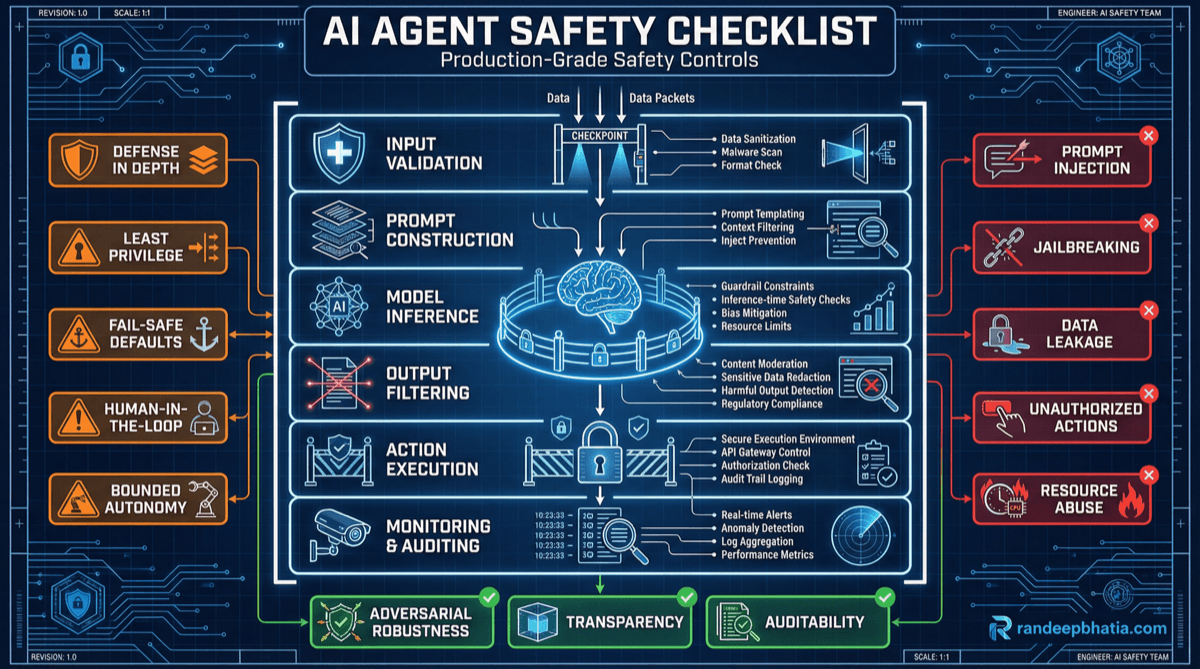
AI Agent Safety Checklist

Checklistscitation-safe-reference📖 45-60 minutesUpdated: 2026-01-05

Executive Summary

A comprehensive verification framework ensuring AI agents operate within defined safety boundaries, preventing harmful outputs, unauthorized actions, and uncontrolled autonomous behavior in production environments.

1

Agent safety encompasses input validation, output filtering, action constraints, resource limits, and human oversight mechanisms that collectively prevent agents from causing harm or operating outside intended boundaries.

2

Production-grade agent safety requires defense-in-depth with multiple independent safety layers, as single-point safety controls are insufficient against adversarial inputs, edge cases, and emergent agent behaviors.

3

Effective safety implementation balances restrictiveness with utility, requiring continuous monitoring, regular audits, and adaptive controls that evolve with agent capabilities and discovered vulnerabilities.

The Bottom Line

AI agent safety is not a feature but a foundational requirement that must be architected into every layer of agent systems from design through deployment. Organizations deploying agents without comprehensive safety controls face catastrophic risks including data breaches, financial losses, reputational damage, and potential regulatory violations that far exceed the cost of proper safety implementation.

Definition

An AI Agent Safety Checklist is a systematic verification framework comprising technical controls, operational procedures, and governance mechanisms that ensure autonomous AI agents operate within defined safety boundaries and cannot cause harm through their actions, outputs, or resource consumption.

This checklist encompasses pre-deployment validation, runtime monitoring, and incident response protocols designed to prevent, detect, and mitigate safety violations across all agent interaction surfaces including user inputs, tool executions, external API calls, and generated outputs.

Extended Definition

The AI Agent Safety Checklist extends beyond simple content filtering to address the unique risks posed by autonomous systems that can take actions, access tools, and make decisions without direct human intervention. It incorporates principles from traditional software security, AI alignment research, and operational safety engineering to create comprehensive protection against both intentional attacks and unintentional harmful behaviors. The checklist addresses safety at multiple abstraction levels: the foundational model layer, the agent orchestration layer, the tool integration layer, and the deployment environment layer. Each layer requires specific controls that work together to create defense-in-depth, recognizing that no single safety mechanism is sufficient against the full spectrum of potential failures and attacks.

Etymology & Origins

The concept of AI agent safety checklists emerged from the convergence of three disciplines: aviation safety checklists pioneered in the 1930s to prevent pilot error, software security checklists developed in the 1990s for secure development lifecycles, and AI safety research from the 2010s focused on alignment and control problems. The specific application to autonomous AI agents became critical with the deployment of LLM-based agents in 2023-2024, when organizations discovered that traditional software security measures were insufficient for systems capable of generating novel behaviors and taking autonomous actions.

Also Known As

Agent guardrails checklistAI safety verification frameworkAutonomous agent safety controlsLLM agent safety requirementsAgent boundary enforcement checklistAI safety audit frameworkAgent risk mitigation checklistSafe agent deployment guide

Not To Be Confused With

AI Ethics Guidelines

Ethics guidelines address moral principles and societal impact of AI systems broadly, while agent safety checklists focus on specific technical and operational controls preventing immediate harm from autonomous agent actions.

Model Safety Training

Model safety training refers to techniques like RLHF applied during model development to reduce harmful outputs, whereas agent safety checklists address runtime controls and deployment safeguards for agent systems built on top of models.

Content Moderation Policies

Content moderation focuses on filtering inappropriate text or media content, while agent safety encompasses broader concerns including action constraints, resource limits, tool access controls, and autonomous behavior boundaries.

AI Governance Framework

AI governance frameworks address organizational policies, accountability structures, and regulatory compliance at an enterprise level, while agent safety checklists provide specific technical implementation requirements for individual agent deployments.

Prompt Engineering Best Practices

Prompt engineering focuses on optimizing agent performance and output quality through instruction design, while safety checklists address preventing harm regardless of prompt quality or user intent.

AI Testing Frameworks

Testing frameworks validate functional correctness and performance of AI systems, while safety checklists specifically target harm prevention, boundary enforcement, and failure mode mitigation.

Conceptual Foundation

Core Principles

(8 principles)

Mental Models

(6 models)

The Airliner Cockpit Model

Like commercial aircraft with multiple redundant systems, checklists, and crew resource management, agent safety requires multiple independent verification systems, standardized procedures, and clear escalation paths. No single point of failure should be able to cause catastrophic outcomes.

The Sandbox Model

Agents operate within a constrained environment where they can take actions and access resources, but the sandbox boundaries prevent any action from affecting systems outside the defined scope. The sandbox is enforced at infrastructure level, not by the agent itself.

The Security Guard Model

Safety controls act as independent security guards that inspect every input and output, with authority to block suspicious activity regardless of what the agent or user requests. Guards cannot be convinced or manipulated by the subjects they monitor.

The Circuit Breaker Model

Like electrical circuit breakers that trip when current exceeds safe levels, agent safety systems should automatically disengage when anomalous patterns are detected, preventing cascading failures and limiting blast radius of safety incidents.

The Immune System Model

Agent safety should function like a biological immune system with multiple detection mechanisms, memory of past threats, and adaptive responses that improve over time. Novel threats trigger heightened scrutiny while known-safe patterns proceed efficiently.

The Blast Radius Model

Every agent action has a potential blast radius representing the maximum harm that could result if the action goes wrong. Safety controls should be proportional to blast radius, with higher-impact actions requiring more stringent verification.

Key Insights

(10 insights)

Agent safety failures often occur at integration boundaries where different systems make different assumptions about input validation, authentication, and authorization, making interface security critical.

The most dangerous agent behaviors often emerge from combinations of individually safe actions, requiring safety analysis at the workflow level rather than just individual action level.

Prompt injection attacks can transform safety-critical agents into attack vectors, meaning input sanitization must be treated with the same rigor as SQL injection prevention in traditional applications.

Agent memory and context accumulation can gradually shift agent behavior in unsafe directions even without explicit attacks, requiring periodic context resets and drift detection.

Human reviewers in approval workflows are vulnerable to automation bias and alert fatigue, meaning human-in-the-loop controls require careful UX design and workload management to remain effective.

Safety controls that significantly degrade user experience will be circumvented or disabled by operators under pressure, so safety must be designed to minimize friction for legitimate use cases.

The attack surface of agent systems includes not just direct user inputs but also data retrieved from tools, external APIs, and databases, all of which can contain injected instructions.

Agent safety requirements differ significantly based on deployment context, with internal enterprise agents requiring different controls than customer-facing agents or agents with access to production systems.

Testing agent safety requires adversarial red-teaming that specifically attempts to bypass controls, as standard functional testing rarely discovers safety vulnerabilities.

Regulatory requirements for AI safety are evolving rapidly, and safety architectures must be designed for adaptability to accommodate new compliance requirements without fundamental redesign.

When to Use

Ideal Scenarios

(12)

Deploying any autonomous AI agent to production environments where it will interact with real users, data, or systems without direct human supervision of every action.

Building agents with access to tools that can modify data, send communications, execute code, or interact with external services in ways that could cause harm if misused.

Integrating LLM-based agents into existing enterprise systems where the agent will have access to sensitive data, internal APIs, or business-critical processes.

Developing customer-facing AI assistants that will handle user queries across a wide range of topics with potential for generating harmful, misleading, or inappropriate content.

Creating multi-agent systems where agents interact with each other, potentially amplifying risks through agent-to-agent communication and coordinated actions.

Deploying agents in regulated industries such as healthcare, finance, or legal services where incorrect agent outputs could have legal, financial, or safety consequences.

Building agents that will operate continuously or at high volume where manual review of every interaction is impractical, requiring automated safety controls.

Implementing agents with learning or adaptation capabilities that could drift from intended behavior over time without proper monitoring and constraints.

Deploying agents in environments where adversarial users may actively attempt to manipulate agent behavior for malicious purposes.

Creating agents that will have access to personally identifiable information, financial data, or other sensitive information requiring privacy protection.

Building agents for use cases where incorrect outputs could cause physical harm, such as medical advice, safety instructions, or control of physical systems.

Deploying agents in multi-tenant environments where actions by one user's agent could potentially affect other users or shared resources.

Prerequisites

(8)
1

Clear definition of the agent's intended purpose, scope, and boundaries that can be translated into enforceable technical constraints.

2

Inventory of all tools, APIs, and data sources the agent will access, with understanding of the potential impact of each capability.

3

Risk assessment identifying potential harm scenarios, their likelihood, and their severity to prioritize safety control implementation.

4

Infrastructure capability to implement safety controls at multiple layers including input validation, output filtering, and action monitoring.

5

Logging and monitoring systems capable of capturing complete agent interaction traces for audit and incident investigation.

6

Incident response procedures and trained personnel to handle safety violations when they occur.

7

Testing infrastructure including adversarial test cases and red-team capabilities to validate safety controls before deployment.

8

Organizational commitment to maintaining safety controls even when they impact performance, user experience, or development velocity.

Signals You Need This

(10)

Your agent has access to tools that can modify production data, send external communications, or execute arbitrary code.

Users have reported unexpected or inappropriate agent behaviors that were not anticipated during development.

Your agent operates in a domain where incorrect outputs could cause financial, legal, reputational, or physical harm.

You are deploying agents to users outside your organization who may not understand agent limitations or may attempt to misuse them.

Your agent's context window includes data from external sources that could potentially contain adversarial content.

You have observed agents taking actions that, while technically permitted, were clearly outside the intended use case.

Regulatory requirements or customer contracts mandate specific safety controls for AI systems.

Your agent will operate at scale where manual review of every interaction is impossible.

You are building agents that will have access to sensitive personal, financial, or health information.

Your organization has experienced or is concerned about prompt injection attacks or jailbreaking attempts.

Organizational Readiness

(7)

Executive sponsorship for AI safety that prioritizes safety over speed-to-market and allocates appropriate resources.

Engineering team with expertise in both AI/ML systems and security engineering to implement effective controls.

Clear ownership and accountability for agent safety with defined roles for safety review, monitoring, and incident response.

Culture that treats safety incidents as learning opportunities rather than blame events, encouraging reporting and transparency.

Budget allocation for ongoing safety monitoring, testing, and improvement rather than treating safety as a one-time implementation.

Legal and compliance review capability to assess regulatory requirements and liability implications of agent deployments.

User research capability to understand how real users interact with agents and identify safety gaps not apparent in testing.

When NOT to Use

Anti-Patterns

(12)

Implementing safety controls as an afterthought after the agent is already in production, rather than designing safety into the architecture from the beginning.

Relying solely on the base model's safety training without implementing additional runtime controls specific to your use case and risk profile.

Using a generic safety checklist without customizing it for your specific agent's capabilities, data access, and deployment context.

Implementing safety controls that can be disabled by operators without proper authorization and audit trails.

Treating safety as a checkbox exercise rather than an ongoing operational concern requiring continuous monitoring and improvement.

Assuming that because an agent worked safely in testing, it will behave safely in production with real users and adversarial inputs.

Implementing human-in-the-loop controls without considering reviewer fatigue, automation bias, and the need for adequate context.

Relying on prompt-based safety instructions that can be overridden through prompt injection or jailbreaking attacks.

Implementing safety controls only at the output layer without addressing input validation, tool access, and action constraints.

Assuming that safety controls implemented for one agent can be directly reused for a different agent with different capabilities.

Treating safety testing as complete after a single round of evaluation rather than continuous adversarial testing.

Implementing safety controls without corresponding monitoring to detect when controls are bypassed or fail.

Red Flags

(10)

Safety controls are implemented in the same codebase as the agent and could potentially be modified by the agent itself.

No logging or audit trail exists for safety control activations and bypasses.

Safety controls have not been tested against adversarial inputs designed to bypass them.

Human reviewers in approval workflows are overwhelmed with requests and rubber-stamping approvals.

Safety controls significantly degrade user experience for legitimate use cases, creating pressure to disable them.

No incident response procedure exists for when safety controls fail or are bypassed.

Safety controls rely on the agent's own assessment of whether an action is safe.

Tool access permissions are static and do not adapt based on task context or risk level.

No mechanism exists to update safety controls in response to newly discovered vulnerabilities.

Safety metrics are not tracked or reported, making it impossible to assess safety posture over time.

Better Alternatives

(6)
1
When:

Simple, low-risk chatbot with no tool access and limited scope

Use Instead:

Basic content filtering and rate limiting without full agent safety framework

Why:

The overhead of comprehensive agent safety controls may not be justified when the agent has no ability to take actions beyond generating text responses in a narrow domain.

2
When:

Internal prototype or research experiment not exposed to real users

Use Instead:

Lightweight safety monitoring with manual review rather than automated controls

Why:

During early experimentation, understanding agent behavior may be more valuable than preventing all unsafe outputs, and manual review provides better learning opportunities.

3
When:

Agent with extremely limited, well-defined capabilities in a controlled environment

Use Instead:

Capability-specific safety controls rather than generic agent safety framework

Why:

When agent capabilities are tightly constrained, targeted controls for those specific capabilities may be more effective than generic safety frameworks.

4
When:

Agent operating in a fully sandboxed environment with no external access

Use Instead:

Environment-level isolation rather than agent-level safety controls

Why:

If the execution environment itself prevents any harmful actions, agent-level controls may be redundant.

5
When:

Human-in-the-loop workflow where every agent action is reviewed before execution

Use Instead:

Focus on reviewer tooling and context rather than automated safety controls

Why:

When humans review every action, investment in reviewer effectiveness may provide better safety outcomes than automated controls.

6
When:

Batch processing agent with no real-time user interaction

Use Instead:

Output validation and rollback mechanisms rather than real-time safety controls

Why:

When outputs can be validated before release and rolled back if problems are found, post-processing validation may be more practical than real-time controls.

Common Mistakes

(10)

Assuming that safety controls that work for one LLM will work equally well for a different model with different training and capabilities.

Implementing safety controls in a way that creates a single point of failure that, if bypassed, leaves no additional protection.

Not testing safety controls against the specific types of adversarial inputs likely to be encountered in the deployment context.

Implementing overly restrictive controls that block legitimate use cases, leading to user frustration and pressure to disable safety features.

Failing to monitor safety control effectiveness over time as user behavior, attack techniques, and agent capabilities evolve.

Not considering the safety implications of data retrieved by tools, which can contain adversarial content injected by external parties.

Implementing human review workflows without providing reviewers with sufficient context to make informed safety decisions.

Treating safety as a development-time concern rather than an operational concern requiring ongoing monitoring and response.

Not having a clear escalation path for safety incidents that require immediate response.

Assuming that because no safety incidents have occurred, the safety controls are working effectively rather than recognizing that incidents may be going undetected.

Core Taxonomy

Primary Types

(8 types)

Controls that validate, sanitize, and filter user inputs before they reach the agent, preventing prompt injection, jailbreaking attempts, and malicious payloads from influencing agent behavior.

Characteristics
  • Operate before agent processing begins
  • Cannot be influenced by agent reasoning
  • Must handle adversarial inputs designed to bypass detection
  • Should minimize false positives that block legitimate requests
Use Cases
Detecting and blocking prompt injection attemptsFiltering requests for prohibited content or actionsValidating input format and length constraintsIdentifying potential social engineering attempts
Tradeoffs

Aggressive input filtering reduces attack surface but may block legitimate edge cases; permissive filtering improves user experience but increases risk of successful attacks.

Classification Dimensions

Enforcement Timing

Safety controls can be classified by when they operate in the agent execution lifecycle, with different controls appropriate for different timing requirements.

Pre-execution controls (before agent acts)Runtime controls (during agent execution)Post-execution controls (after agent completes)Continuous controls (ongoing monitoring)

Enforcement Mechanism

Controls vary in their enforcement strength, from hard blocks that cannot be circumvented to advisory warnings that inform but don't prevent actions.

Hard controls (cannot be bypassed)Soft controls (can be overridden with authorization)Advisory controls (provide warnings but don't block)Monitoring controls (detect but don't prevent)

Control Scope

Safety controls can operate at different scopes, from individual requests to global policies affecting all agent operations.

Per-request controls (apply to individual interactions)Per-session controls (apply across a conversation)Per-user controls (apply to all interactions by a user)Global controls (apply to all agent operations)

Adaptation Capability

Controls vary in their ability to adapt to changing conditions, from static rules to sophisticated systems that learn from observed attacks.

Static controls (fixed rules)Configurable controls (adjustable parameters)Learning controls (adapt based on data)Adversarial controls (adapt to attack patterns)

Risk Level Addressed

Controls should be prioritized based on the severity of risks they address, with critical risk controls receiving the most rigorous implementation and testing.

Critical risk controls (prevent catastrophic harm)High risk controls (prevent significant harm)Medium risk controls (prevent moderate harm)Low risk controls (prevent minor issues)

Implementation Layer

Safety controls can be implemented at different layers of the technology stack, with defense-in-depth requiring controls at multiple layers.

Model layer (built into the LLM)Orchestration layer (in agent framework)Application layer (in business logic)Infrastructure layer (in deployment environment)

Evolutionary Stages

1

Ad-Hoc Safety

Initial deployment through first 3-6 months of production operation

Safety controls are implemented reactively in response to incidents, with no systematic approach. Controls are inconsistent across agents and may have gaps. No formal testing or monitoring of safety effectiveness.

2

Standardized Safety

6-18 months after initial agent deployments

Organization has adopted a standard safety checklist applied to all agent deployments. Controls are consistent but may not be customized for specific risk profiles. Basic monitoring exists but may not be comprehensive.

3

Risk-Based Safety

18-36 months of agent deployment experience

Safety controls are tailored to specific agent risk profiles based on formal risk assessment. Controls are proportional to potential harm. Regular adversarial testing validates control effectiveness.

4

Adaptive Safety

3+ years of mature agent operations

Safety systems learn from incidents and adapt controls based on observed attack patterns. Continuous monitoring detects novel threats. Safety is integrated into CI/CD with automated testing.

5

Proactive Safety

5+ years with dedicated safety research function

Organization anticipates safety risks before they manifest through threat modeling and red-teaming. Safety research informs control development. Industry leadership in safety practices.

Architecture Patterns

Architecture Patterns

(8 patterns)

Gateway Safety Pattern

All agent interactions pass through a centralized safety gateway that implements input validation, output filtering, and action approval before requests reach the agent or responses reach users. The gateway is independent of agent code and cannot be influenced by agent behavior.

Components
  • Input validation service
  • Output filtering service
  • Action approval service
  • Audit logging service
  • Configuration management
  • Alert and escalation system
Data Flow

User request → Input validation → Agent processing → Output filtering → Action approval (if needed) → Response delivery, with audit logging at each stage

Best For
  • Organizations with multiple agents requiring consistent safety controls
  • Deployments requiring centralized audit and compliance
  • Environments where safety controls must be managed independently of agent development
Limitations
  • Single point of failure if not properly redundant
  • May not have sufficient context for nuanced safety decisions
  • Latency impact may be unacceptable for real-time applications
Scaling Characteristics

Gateway can be horizontally scaled independently of agents. May become a bottleneck at very high volumes. Latency added is typically 50-200ms per request.

Integration Points

LLM Provider API

Primary inference endpoint for agent reasoning and generation

Interfaces:
Completion/chat APIEmbedding APIContent filtering APIUsage and billing API

Provider-side safety features should be enabled but not relied upon as sole protection. API keys must be protected. Rate limits and costs must be monitored.

Tool Execution Layer

Executes actions requested by the agent including API calls, database operations, and external integrations

Interfaces:
Tool registration APIExecution APIPermission checking APIResult validation API

Tool layer is a critical safety boundary. All tool calls must be validated against permissions. Tool outputs must be sanitized before returning to agent context.

User Interface

Handles user input and displays agent responses

Interfaces:
Input submission APIResponse streaming APIFeedback collection APISession management API

UI must not expose raw agent outputs without filtering. User inputs must be validated before reaching agent. Session context must be protected from manipulation.

Logging and Monitoring System

Captures all agent interactions for audit, debugging, and safety analysis

Interfaces:
Log ingestion APIQuery and search APIAlert configuration APIDashboard API

Logs must be immutable and tamper-evident. Sensitive data in logs must be handled according to privacy requirements. Real-time alerting must have low latency.

Identity and Access Management

Authenticates users and authorizes agent actions based on user permissions

Interfaces:
Authentication APIAuthorization APIRole management APIAudit API

Agent actions must be attributed to the requesting user. Privilege escalation through agent must be prevented. Service accounts for agents must have minimal permissions.

Data Storage Systems

Stores agent memory, conversation history, and operational data

Interfaces:
Read/write APISearch APIBackup/restore APIAccess control API

Agent access to data must be scoped appropriately. Sensitive data must be encrypted. Data retention policies must be enforced.

External APIs and Services

Provides agent access to external data sources and capabilities

Interfaces:
Various third-party APIsWebhook endpointsData feeds

External data can contain adversarial content. API credentials must be protected. Rate limits and costs must be managed. Responses must be validated.

Human Review System

Routes flagged items to human reviewers and captures their decisions

Interfaces:
Queue management APIReview interfaceDecision capture APIEscalation API

Reviewers must have sufficient context. Queue depth must be monitored. Reviewer decisions must be logged. Timeout handling must be defined.

Decision Framework

✓ If Yes

Implement comprehensive action safety controls including permission systems, approval workflows, and execution monitoring

✗ If No

Focus on input/output safety controls; action controls may be minimal

Considerations

Even read-only agents can cause harm through information disclosure or generating harmful content

Technical Deep Dive

Overview

AI agent safety operates through multiple coordinated control layers that inspect, validate, and constrain agent behavior at every stage of the interaction lifecycle. The safety system begins with input validation that examines user requests for potential attacks before they reach the agent, continues with behavioral constraints during agent execution, and concludes with output filtering that ensures responses meet safety requirements before delivery. Each layer operates independently, meaning a failure in one layer does not compromise the protection provided by other layers. The technical implementation typically involves a combination of rule-based systems for well-defined safety boundaries, machine learning classifiers for nuanced content analysis, and infrastructure-level controls for resource and access management. These components communicate through well-defined interfaces that allow safety decisions to be made without exposing the underlying agent to manipulation. The safety system maintains its own state, including threat intelligence, behavioral baselines, and incident history, which informs real-time safety decisions. Critically, the safety system must be architected to be tamper-resistant, meaning the agent cannot modify, disable, or circumvent safety controls through its own actions. This is achieved through process isolation, separate authentication, and infrastructure-level enforcement of safety boundaries. The safety system also implements comprehensive logging that creates an immutable audit trail of all safety-relevant events, enabling post-hoc analysis and continuous improvement.

Step-by-Step Process

When a user request arrives, the safety system first performs basic validation including authentication verification, rate limit checking, and format validation. This catches obvious attacks and prevents resource exhaustion before any significant processing occurs.

⚠️ Pitfalls to Avoid

Validation must be fast to avoid latency impact; overly strict validation may reject legitimate requests with unusual formatting

Under The Hood

The technical implementation of agent safety controls relies on several key architectural components working in concert. At the input layer, threat detection typically employs a cascade of increasingly sophisticated classifiers. Fast rule-based filters catch obvious attacks with minimal latency, followed by lightweight ML classifiers for common attack patterns, and finally more expensive deep learning models for sophisticated threats. This cascade architecture allows most requests to be processed quickly while still catching advanced attacks. The behavioral monitoring system maintains a statistical model of normal agent behavior including typical response lengths, tool usage patterns, reasoning chain characteristics, and resource consumption profiles. Real-time behavior is compared against this baseline using techniques like isolation forests or autoencoders that can detect anomalies without requiring labeled examples of attacks. When anomaly scores exceed thresholds, the system can trigger additional scrutiny, rate limiting, or automatic shutdown. Tool access control is implemented through a capability-based security model where each tool call requires a capability token that specifies exactly what operations are permitted. These tokens are generated by the safety system based on the current context and user permissions, and they cannot be forged or modified by the agent. The tool execution environment validates tokens before performing any operation, providing a cryptographically secure boundary between agent intent and actual execution. Output filtering employs multiple specialized classifiers for different types of harmful content including toxicity, misinformation, personal information, and policy violations. These classifiers operate on both the raw text and semantic representations, allowing detection of harmful content even when obfuscated through encoding or paraphrasing. The filtering system also maintains a database of known harmful patterns that is continuously updated based on new discoveries. The audit logging system is designed for immutability and completeness. Logs are written to append-only storage with cryptographic verification that prevents tampering. Each log entry includes a hash chain linking it to previous entries, making any modification detectable. The logging system captures not just final inputs and outputs but also intermediate reasoning steps, tool calls, and safety control activations, providing complete visibility into agent behavior for incident investigation.

Failure Modes

Root Cause

Adversarial input successfully overrides safety instructions in the agent's context, causing the agent to ignore safety constraints

Symptoms
  • Agent produces outputs that would normally be blocked
  • Agent executes tools it should not have access to
  • Agent behavior changes dramatically mid-conversation
  • Safety control activation logs show no activations despite harmful outputs
Impact

Complete loss of safety guarantees; agent may produce harmful content, leak sensitive data, or take unauthorized actions

Prevention

Defense-in-depth with safety controls independent of agent context; input sanitization; prompt injection detection; output filtering as final barrier

Mitigation

Immediate agent suspension; incident investigation; user notification if data was exposed; safety control updates

Operational Considerations

Key Metrics (15)

Percentage of requests that trigger at least one safety control activation

Normal1-5% for well-designed systems with legitimate users
Alert>10% may indicate attack; <0.1% may indicate controls not working
ResponseInvestigate cause of abnormal rate; review sample of activations; adjust thresholds if needed

Dashboard Panels

Real-time safety control activation heatmap by control type and severityHuman review queue depth and wait time trendSafety latency percentiles (p50, p95, p99) over timeAnomaly score distribution across active sessionsCircuit breaker status for all safety systemsTop blocked content categories and trendsPrompt injection attempt frequency and patternsTool execution authorization success/failure breakdownSafety incident timeline with severity indicatorsSafety system resource utilization and capacity headroom

Alerting Strategy

Implement tiered alerting with different severity levels and response requirements. Critical alerts (safety system failure, confirmed incidents) require immediate response and page on-call. High alerts (elevated attack activity, queue depth issues) require response within 1 hour. Medium alerts (threshold warnings, trend changes) require response within 4 hours. Low alerts (informational, minor anomalies) are reviewed in daily safety review. All alerts should include sufficient context for responders to take action without extensive investigation.

Cost Analysis

Cost Drivers

(10)

ML Classifier Inference

Impact:

Can add $0.001-0.01 per request depending on classifier complexity and number of classifiers

Optimization:

Use cascade architecture with cheap classifiers first; cache results for similar inputs; batch where latency permits

Human Review Labor

Impact:

Typically $0.10-1.00 per reviewed item depending on complexity and reviewer location

Optimization:

Improve pre-filtering to reduce review volume; use tiered review with junior reviewers for simple cases; implement efficient review interfaces

Audit Log Storage

Impact:

Can accumulate to significant storage costs at high volume; $0.01-0.10 per GB per month

Optimization:

Implement tiered storage with hot/warm/cold tiers; compress logs; implement retention policies; sample detailed logging for low-risk interactions

Safety System Infrastructure

Impact:

Dedicated infrastructure for safety systems adds 10-30% to base infrastructure costs

Optimization:

Right-size infrastructure based on actual load; use auto-scaling; share infrastructure across safety components where appropriate

Latency Impact on User Experience

Impact:

Indirect cost through reduced user engagement and satisfaction

Optimization:

Optimize critical path latency; use async processing where possible; cache safety decisions

False Positive User Impact

Impact:

Blocked legitimate requests cost user time and may drive users away

Optimization:

Tune thresholds to minimize false positives; implement appeals process; provide clear feedback on blocks

Security and Compliance Audits

Impact:

External audits can cost $10,000-100,000+ depending on scope

Optimization:

Maintain audit-ready documentation; automate compliance reporting; address issues proactively

Incident Response

Impact:

Safety incidents can cost $10,000-1,000,000+ depending on severity and scope

Optimization:

Invest in prevention; maintain incident response readiness; have insurance coverage

Safety Team Personnel

Impact:

Dedicated safety personnel cost $150,000-300,000+ per person annually fully loaded

Optimization:

Automate routine tasks; use shared services where possible; invest in tooling to improve efficiency

Third-Party Safety Services

Impact:

Content moderation APIs, threat intelligence feeds, etc. can cost $1,000-50,000+ monthly

Optimization:

Evaluate ROI of each service; build in-house capabilities for high-volume needs; negotiate volume discounts

Cost Models

Per-Request Safety Cost

Cost = (classifier_cost × num_classifiers) + (log_storage_cost × log_size) + (human_review_cost × review_rate)
Variables:
classifier_cost: cost per classifier inferencenum_classifiers: number of classifiers in pipelinelog_storage_cost: cost per byte of log storagelog_size: average log entry sizehuman_review_cost: cost per human reviewreview_rate: percentage of requests requiring review
Example:

At 1M requests/month with $0.002 classifier cost, 3 classifiers, 1KB logs at $0.02/GB, and 1% review rate at $0.50/review: (0.002 × 3 × 1M) + (0.02 × 1GB) + (0.50 × 10K) = $6,000 + $20 + $5,000 = $11,020/month

Safety Infrastructure Cost

Cost = base_compute + (scale_factor × request_volume) + redundancy_overhead
Variables:
base_compute: minimum infrastructure costscale_factor: additional cost per requestrequest_volume: number of requestsredundancy_overhead: cost of redundant systems for reliability
Example:

Base compute $2,000/month + $0.0001/request × 1M requests + 50% redundancy overhead = $2,000 + $100 + $1,050 = $3,150/month

Incident Cost Model

Expected_Cost = Σ(incident_probability × incident_cost) for each incident type
Variables:
incident_probability: likelihood of incident type per time periodincident_cost: total cost of incident including response, remediation, and consequences
Example:

Minor incident (10%/year × $10K) + Major incident (1%/year × $100K) + Critical incident (0.1%/year × $1M) = $1,000 + $1,000 + $1,000 = $3,000 expected annual incident cost

Total Cost of Ownership

TCO = infrastructure + personnel + services + incidents + compliance + opportunity_cost
Variables:
infrastructure: compute, storage, networkingpersonnel: safety team salaries and benefitsservices: third-party safety servicesincidents: expected incident costscompliance: audit and compliance costsopportunity_cost: revenue impact of safety friction
Example:

Infrastructure $50K + Personnel $300K + Services $30K + Incidents $10K + Compliance $20K + Opportunity $50K = $460K annual TCO for comprehensive safety program

Optimization Strategies

  • 1Implement classifier cascade with cheap fast filters before expensive deep analysis
  • 2Cache safety decisions for identical or similar inputs to avoid redundant processing
  • 3Use sampling for low-risk interactions rather than full safety analysis
  • 4Batch safety checks where latency permits to improve throughput efficiency
  • 5Implement tiered log storage with automatic archival of old logs
  • 6Automate routine safety tasks to reduce personnel costs
  • 7Build high-volume capabilities in-house rather than using per-request third-party services
  • 8Use risk-based resource allocation with more resources for high-risk interactions
  • 9Implement efficient human review interfaces to maximize reviewer throughput
  • 10Negotiate volume discounts with safety service providers
  • 11Share safety infrastructure across multiple agents where appropriate
  • 12Invest in prevention to reduce incident costs

Hidden Costs

  • 💰Developer time spent debugging safety control issues
  • 💰User support costs for handling safety-related complaints
  • 💰Opportunity cost of features not built due to safety constraints
  • 💰Reputational cost of safety incidents even when contained
  • 💰Legal costs for safety-related disputes
  • 💰Insurance premium increases after incidents
  • 💰Cost of safety expertise that is difficult to hire
  • 💰Technical debt from rushed safety implementations

ROI Considerations

The ROI of agent safety investment is primarily measured in risk reduction rather than direct revenue generation. A single major safety incident can cost millions in direct costs, regulatory fines, legal fees, and reputational damage, making comprehensive safety investment highly cost-effective when viewed through a risk lens. Organizations should calculate their risk exposure without safety controls and compare to the cost of implementing controls. Beyond risk reduction, effective safety controls enable business opportunities that would otherwise be too risky. Organizations with mature safety practices can deploy agents in sensitive domains, handle regulated data, and serve enterprise customers who require safety assurances. This expanded addressable market can significantly exceed the cost of safety investment. Safety investment also reduces operational costs over time by preventing incidents that require expensive response and remediation. The cost of preventing an incident is typically 10-100x less than the cost of responding to one. Additionally, well-designed safety systems reduce the operational burden of manual review and incident response, freeing resources for other priorities. When calculating ROI, organizations should consider both the probability-weighted cost of incidents prevented and the business opportunities enabled by safety capabilities. A comprehensive safety program costing $500K annually that prevents even one major incident or enables one significant enterprise deal typically delivers strong positive ROI.

Security Considerations

Threat Model

(10 threats)
1

Prompt Injection Attack

Attack Vector

Malicious instructions embedded in user inputs or retrieved content that override agent safety instructions

Impact

Agent may produce harmful outputs, leak sensitive data, or take unauthorized actions

Mitigation

Input sanitization, prompt injection detection, separation of instructions and data, output filtering as defense-in-depth

2

Jailbreaking Attack

Attack Vector

Carefully crafted prompts that convince the agent to ignore its safety constraints through roleplay, hypotheticals, or other techniques

Impact

Agent produces content it would normally refuse, potentially including harmful or prohibited material

Mitigation

Robust system prompts, jailbreak detection, output filtering, behavioral monitoring for constraint violations

3

Data Exfiltration via Agent

Attack Vector

Attacker uses agent to access and extract sensitive data through queries, tool calls, or output manipulation

Impact

Sensitive data exposed to unauthorized parties, potential regulatory violations

Mitigation

Data access controls, output filtering for sensitive data, query auditing, principle of least privilege for data access

4

Privilege Escalation via Agent

Attack Vector

Attacker manipulates agent to perform actions beyond the user's authorization level

Impact

Unauthorized access to systems, data, or capabilities

Mitigation

Action authorization tied to user permissions, capability-based access control, human approval for sensitive actions

5

Denial of Service via Agent

Attack Vector

Attacker causes agent to consume excessive resources through complex queries, infinite loops, or resource-intensive tool calls

Impact

Service unavailability, excessive costs, impact on other users

Mitigation

Resource limits, rate limiting, timeout enforcement, cost monitoring and alerts

6

Social Engineering via Agent

Attack Vector

Attacker uses agent to generate convincing phishing content, impersonate trusted entities, or manipulate users

Impact

Users deceived into harmful actions, credential theft, financial fraud

Mitigation

Output filtering for social engineering patterns, restrictions on impersonation, user education

7

Supply Chain Attack on Safety Components

Attack Vector

Compromise of third-party libraries, models, or services used in safety controls

Impact

Safety controls compromised or disabled, potentially undetected

Mitigation

Vendor security assessment, dependency monitoring, integrity verification, defense-in-depth with multiple vendors

8

Insider Threat to Safety Configuration

Attack Vector

Malicious or negligent insider modifies safety configuration to weaken controls

Impact

Safety controls disabled or weakened, enabling other attacks

Mitigation

Access controls on configuration, change auditing, separation of duties, configuration integrity monitoring

9

Model Extraction via Agent

Attack Vector

Attacker uses agent interactions to extract information about underlying model or training data

Impact

Intellectual property theft, privacy violations if training data exposed

Mitigation

Rate limiting, query pattern detection, output diversity limits, monitoring for extraction patterns

10

Adversarial Examples

Attack Vector

Inputs crafted to cause misclassification by safety classifiers while appearing benign to humans

Impact

Harmful content bypasses safety filters

Mitigation

Adversarial training of classifiers, multiple independent classifiers, human review sampling

Security Best Practices

  • Implement defense-in-depth with multiple independent safety layers
  • Apply principle of least privilege to all agent capabilities and data access
  • Sanitize all inputs before they reach agent context
  • Filter all outputs before they reach users or external systems
  • Implement strong authentication and authorization for all agent actions
  • Log all security-relevant events with tamper-evident storage
  • Regularly test safety controls with adversarial inputs
  • Keep all safety components updated with security patches
  • Implement rate limiting and resource quotas to prevent abuse
  • Use secure communication channels for all agent interactions
  • Separate safety control systems from agent systems to prevent tampering
  • Implement circuit breakers to limit blast radius of security incidents
  • Conduct regular security audits and penetration testing
  • Maintain incident response procedures specific to agent security
  • Train all personnel on agent security risks and procedures

Data Protection

  • 🔒Classify all data accessible to agents by sensitivity level
  • 🔒Implement access controls based on data classification
  • 🔒Detect and filter sensitive data in agent outputs
  • 🔒Encrypt sensitive data at rest and in transit
  • 🔒Implement data retention and deletion policies
  • 🔒Minimize data in agent context to what is necessary
  • 🔒Audit all access to sensitive data
  • 🔒Implement data loss prevention controls
  • 🔒Anonymize or pseudonymize data where possible
  • 🔒Obtain appropriate consent for data processing

Compliance Implications

GDPR (General Data Protection Regulation)

Requirement:

Protection of personal data, right to explanation, data minimization

Implementation:

PII detection and filtering in outputs, audit logging for data access, data retention limits, explainable safety decisions

CCPA (California Consumer Privacy Act)

Requirement:

Consumer rights over personal information, disclosure requirements

Implementation:

Data inventory including agent-accessible data, opt-out mechanisms, disclosure of AI use

HIPAA (Health Insurance Portability and Accountability Act)

Requirement:

Protection of protected health information (PHI)

Implementation:

PHI detection and filtering, access controls, audit logging, business associate agreements for third-party services

SOC 2

Requirement:

Security, availability, processing integrity, confidentiality, privacy controls

Implementation:

Comprehensive security controls, monitoring, incident response, access management, change control

PCI DSS (Payment Card Industry Data Security Standard)

Requirement:

Protection of cardholder data

Implementation:

Card data detection and filtering, network segmentation, access controls, encryption

EU AI Act

Requirement:

Risk-based requirements for AI systems, transparency, human oversight

Implementation:

Risk classification, documentation, human oversight mechanisms, conformity assessment

NIST AI RMF (AI Risk Management Framework)

Requirement:

Governance, mapping, measuring, managing AI risks

Implementation:

Risk assessment, continuous monitoring, incident response, stakeholder engagement

Industry-Specific Regulations (Financial, Healthcare, etc.)

Requirement:

Varies by industry; often includes model risk management, fair lending, etc.

Implementation:

Industry-specific controls, model validation, bias testing, regulatory reporting

Scaling Guide

Scaling Dimensions

Request Volume

Strategy:

Horizontal scaling of safety services with load balancing; implement caching for repeated safety decisions; use async processing for non-critical checks

Limits:

Practical limit depends on infrastructure; most organizations can scale to millions of requests per day with appropriate architecture

Considerations:

Ensure safety services scale proportionally with agent services; monitor for bottlenecks; implement graceful degradation

Number of Agents

Strategy:

Centralized safety services shared across agents; agent-specific configuration layered on common controls; standardized safety interfaces

Limits:

Hundreds to thousands of agents can share safety infrastructure with proper design

Considerations:

Balance standardization with agent-specific needs; manage configuration complexity; ensure isolation between agents

Safety Control Complexity

Strategy:

Modular safety architecture allowing controls to be added/removed; cascade architecture for efficient processing; async deep analysis for complex checks

Limits:

Complexity limited by latency budget and operational capacity to manage controls

Considerations:

More controls increase latency and operational burden; prioritize controls by risk reduction

Human Review Capacity

Strategy:

Tiered review with different levels for different risk; efficient review interfaces; automation of routine decisions; outsourced review for scale

Limits:

Human review does not scale linearly; focus on reducing review volume through better automation

Considerations:

Quality degrades under high volume; implement workload management; consider review quality metrics

Geographic Distribution

Strategy:

Regional deployment of safety services for latency; centralized policy management; consistent safety behavior across regions

Limits:

Data residency requirements may constrain architecture; latency increases with distance

Considerations:

Ensure consistent safety across regions; handle regional regulatory differences; manage configuration synchronization

Audit Log Volume

Strategy:

Tiered storage with hot/warm/cold tiers; log aggregation and summarization; sampling for low-risk interactions; efficient query infrastructure

Limits:

Storage costs scale linearly; query performance degrades with volume without proper indexing

Considerations:

Balance completeness with cost; implement retention policies; ensure query performance for investigations

Threat Intelligence

Strategy:

Centralized threat intelligence with efficient distribution; incremental updates; caching at edge; prioritized distribution of critical updates

Limits:

Update latency increases with distribution scope; storage scales with threat database size

Considerations:

Balance update frequency with system load; ensure critical updates propagate quickly

Multi-Tenant Isolation

Strategy:

Logical isolation with tenant-specific configurations; resource quotas per tenant; tenant-specific audit trails; cross-tenant monitoring

Limits:

Isolation overhead increases with number of tenants; configuration complexity grows

Considerations:

Ensure strong isolation; prevent cross-tenant impact; manage per-tenant customization

Capacity Planning

Key Factors:
Expected request volume and growth rateAverage and peak safety processing time per requestHuman review rate and reviewer capacityAudit log volume and retention requirementsNumber of agents and their individual requirementsGeographic distribution requirementsRedundancy and availability requirements
Formula:Required_Capacity = (Peak_Requests × Safety_Processing_Time × Safety_Factor) + (Review_Volume × Review_Time) + Redundancy_Overhead
Safety Margin:

Maintain 50-100% headroom above expected peak load for safety systems; safety systems should never be the bottleneck during traffic spikes or attacks

Scaling Milestones

1,000 requests/day
Challenges:
  • Establishing baseline safety controls
  • Setting up monitoring and alerting
  • Training initial reviewers
Architecture Changes:

Single-instance safety services acceptable; focus on correctness over scale

10,000 requests/day
Challenges:
  • Human review volume becoming significant
  • Need for automated safety metrics
  • Initial performance optimization
Architecture Changes:

Implement review queue management; add caching for common safety decisions; basic horizontal scaling

100,000 requests/day
Challenges:
  • Human review not sustainable for all flagged items
  • Latency optimization critical
  • Audit log storage becoming significant
Architecture Changes:

Implement sampling-based review; cascade classifier architecture; tiered log storage; dedicated safety infrastructure

1,000,000 requests/day
Challenges:
  • Safety services must be highly available
  • Complex operational requirements
  • Significant cost optimization needed
Architecture Changes:

Full horizontal scaling with auto-scaling; regional deployment; sophisticated caching; dedicated safety team

10,000,000+ requests/day
Challenges:
  • Safety at massive scale
  • Cost efficiency critical
  • Complex multi-region requirements
Architecture Changes:

Custom safety infrastructure; ML-based optimization of safety decisions; extensive automation; dedicated safety engineering team

Benchmarks

Industry Benchmarks

MetricP50P95P99 World Class
Safety Control Latency (p50)50ms150ms300ms<30ms p50
Input Validation False Positive Rate5%2%1%<0.5%
Output Filtering False Positive Rate8%3%1%<1%
Prompt Injection Detection Rate80%95%99%>99%
Human Review Turnaround Time30 minutes5 minutes2 minutes<1 minute
Safety System Availability99.5%99.9%99.99%>99.99%
Mean Time to Detect Safety Incident4 hours30 minutes5 minutes<1 minute
Safety Incident Rate (per million requests)1010.1<0.01
Safety Control Coverage70%90%98%>99%
Adversarial Test Pass Rate60%85%95%>98%
Safety Cost per Request$0.01$0.005$0.002<$0.001
Time to Deploy Safety Update1 week1 day1 hour<15 minutes

Comparison Matrix

ApproachSetup ComplexityLatency ImpactFalse Positive RateCoverageCostScalability
Provider Safety OnlyLowNoneMediumLimitedIncludedHigh
Rule-Based ControlsMediumVery LowHighLimitedLowHigh
ML Classifier ControlsHighMediumLowGoodMediumMedium
Human Review AllMediumVery HighVery LowExcellentVery HighVery Low
Hybrid Automated + HumanHighLow-MediumLowExcellentMedium-HighMedium
Third-Party Safety ServiceLow-MediumMediumMediumGoodMedium-HighHigh
Comprehensive In-HouseVery HighOptimizedVery LowExcellentHigh (upfront)High

Performance Tiers

Basic

Provider safety + basic rule-based controls; suitable for low-risk internal applications

Target:

Latency <100ms, False positive <15%, Coverage >60%

Standard

ML classifiers + human review for high-risk; suitable for customer-facing applications

Target:

Latency <200ms, False positive <8%, Coverage >80%

Advanced

Comprehensive controls + behavioral monitoring + adaptive systems; suitable for sensitive applications

Target:

Latency <150ms, False positive <3%, Coverage >95%

Enterprise

Full defense-in-depth + compliance + continuous red-teaming; suitable for regulated industries

Target:

Latency <100ms, False positive <1%, Coverage >99%

World-Class

Industry-leading safety with proactive threat anticipation and research; suitable for highest-risk applications

Target:

Latency <50ms, False positive <0.5%, Coverage >99.9%

Real World Examples

Real-World Scenarios

(8 examples)
1

Customer Service Agent Safety Implementation

Context

E-commerce company deploying AI agent to handle customer inquiries, with access to order information and ability to process refunds up to $100

Approach

Implemented tiered safety controls: input validation for prompt injection, output filtering for PII and inappropriate content, action controls limiting refund amounts with human approval above threshold, behavioral monitoring for unusual patterns

Outcome

Successfully handled 50,000+ customer interactions per day with <0.1% safety incidents, 95% customer satisfaction maintained

Lessons Learned
  • 💡Refund amount threshold required tuning based on fraud patterns
  • 💡Customer frustration with blocked legitimate requests required appeals process
  • 💡Behavioral monitoring caught several coordinated fraud attempts
  • 💡Human review queue needed dedicated staffing during peak hours
2

Healthcare Information Agent Safety

Context

Healthcare provider deploying agent to answer patient questions about conditions and medications, with access to patient records

Approach

Implemented comprehensive safety including medical disclaimer injection, PHI filtering, contraindication checking, human review for any treatment recommendations, strict scope limitations to information only

Outcome

Reduced call center volume by 40% while maintaining zero adverse events attributable to agent information

Lessons Learned
  • 💡Medical disclaimer placement critical for liability protection
  • 💡PHI filtering required extensive tuning to avoid false positives on medical terms
  • 💡Scope limitations frustrated some users but essential for safety
  • 💡Regular review by medical professionals essential for content accuracy
3

Code Assistant Agent Safety

Context

Software company deploying agent to help developers write code, with ability to execute code in sandboxed environment

Approach

Implemented sandbox isolation with resource limits, code review for security vulnerabilities before execution, output filtering for secrets and credentials, behavioral monitoring for unusual resource usage

Outcome

Improved developer productivity by 30% with no security incidents from agent-generated code

Lessons Learned
  • 💡Sandbox escape attempts more common than expected; required multiple hardening iterations
  • 💡Code review for vulnerabilities had high false positive rate initially
  • 💡Resource limits needed adjustment for legitimate complex computations
  • 💡Developers initially frustrated by restrictions; education improved acceptance
4

Financial Advisory Agent Safety

Context

Investment firm deploying agent to provide portfolio information and execute trades within defined limits

Approach

Implemented comprehensive controls including trade limits, human approval for large transactions, suitability checking, regulatory compliance validation, complete audit trail for all recommendations and trades

Outcome

Enabled 24/7 portfolio access for clients while maintaining regulatory compliance and zero unauthorized trades

Lessons Learned
  • 💡Regulatory requirements drove many safety decisions
  • 💡Trade limit thresholds required careful calibration with compliance team
  • 💡Audit trail requirements more extensive than initially anticipated
  • 💡Client education on agent limitations reduced support burden
5

Content Moderation Agent Safety

Context

Social media platform deploying agent to assist human moderators in reviewing reported content

Approach

Implemented agent as recommendation system only with human final decision, confidence thresholds for auto-action on clear cases, bias monitoring, appeals process for affected users

Outcome

Increased moderation throughput by 5x while maintaining accuracy and reducing moderator burnout

Lessons Learned
  • 💡Auto-action thresholds required extensive tuning to balance efficiency and accuracy
  • 💡Bias monitoring revealed unexpected patterns requiring classifier retraining
  • 💡Moderator trust in agent recommendations took time to develop
  • 💡Appeals process essential for user trust and catching errors
6

Enterprise Knowledge Agent Safety

Context

Large enterprise deploying agent to answer employee questions using internal knowledge base, with access to confidential documents

Approach

Implemented access control integration with enterprise IAM, document classification enforcement, output filtering for confidential information, audit logging for compliance, department-specific safety policies

Outcome

Reduced IT support tickets by 60% while maintaining data access controls and passing security audit

Lessons Learned
  • 💡IAM integration more complex than anticipated due to legacy systems
  • 💡Document classification was incomplete; required remediation project
  • 💡Department-specific policies created management complexity
  • 💡Security audit identified gaps in audit logging that required enhancement
7

Multi-Agent Research System Safety

Context

Research organization deploying multi-agent system for literature review and hypothesis generation

Approach

Implemented per-agent safety controls plus inter-agent communication monitoring, resource limits per agent and system-wide, human checkpoints at key decision points, emergent behavior detection

Outcome

Accelerated research process while maintaining scientific rigor and preventing runaway resource consumption

Lessons Learned
  • 💡Inter-agent communication created unexpected safety challenges
  • 💡Emergent behaviors required new detection approaches
  • 💡Resource limits needed system-wide coordination
  • 💡Human checkpoints critical for maintaining research quality
8

Customer-Facing Chatbot Jailbreak Defense

Context

Consumer brand experiencing coordinated jailbreaking attempts on public chatbot

Approach

Implemented multi-layer jailbreak detection, rate limiting for suspicious patterns, automatic escalation for novel attacks, rapid response capability for new attack patterns

Outcome

Reduced successful jailbreaks by 99% while maintaining positive user experience for legitimate users

Lessons Learned
  • 💡Attack patterns evolved rapidly requiring continuous updates
  • 💡Rate limiting effective but required tuning to avoid impacting legitimate users
  • 💡Community of attackers shared techniques; monitoring external sources valuable
  • 💡Rapid response capability essential; 24-hour update cycle too slow

Industry Applications

Healthcare

Patient-facing health information agents

Key Considerations:

HIPAA compliance, medical accuracy requirements, liability concerns, integration with clinical workflows, patient safety paramount

Financial Services

Investment advice and trading agents

Key Considerations:

Regulatory compliance (SEC, FINRA), fiduciary duty, transaction limits, suitability requirements, audit trail requirements

Legal

Legal research and document drafting agents

Key Considerations:

Attorney-client privilege, accuracy requirements, jurisdiction-specific rules, unauthorized practice of law concerns

Education

Tutoring and assessment agents

Key Considerations:

Age-appropriate content, academic integrity, accessibility requirements, student data privacy (FERPA)

Government

Citizen service agents

Key Considerations:

Accessibility requirements, multi-language support, transparency requirements, data sovereignty, security clearance requirements

Retail/E-commerce

Shopping assistant and customer service agents

Key Considerations:

Product accuracy, pricing integrity, fraud prevention, consumer protection compliance, return/refund policies

Manufacturing

Technical support and maintenance agents

Key Considerations:

Safety-critical information accuracy, equipment compatibility, warranty implications, technical precision requirements

Media/Entertainment

Content recommendation and creation agents

Key Considerations:

Copyright compliance, content rating enforcement, brand safety, misinformation prevention

Telecommunications

Customer support and service management agents

Key Considerations:

Service level agreements, billing accuracy, regulatory compliance, network security

Insurance

Claims processing and underwriting agents

Key Considerations:

Regulatory compliance, fair treatment requirements, fraud detection, privacy requirements, actuarial accuracy

Frequently Asked Questions

Frequently Asked Questions

(20 questions)

Implementation

The minimum viable safety implementation includes input validation to catch obvious attacks, output filtering to prevent harmful content, basic rate limiting to prevent abuse, and audit logging for incident investigation. However, this minimum is only appropriate for low-risk internal applications; customer-facing or high-risk agents require more comprehensive controls.

Performance

Architecture

Operations

Security

Maintenance

Compliance

Testing

Incident Response

User Experience

Cost

Data Protection

Monitoring

Internationalization

Reliability

Organization

Glossary

Glossary

(30 terms)
A

Adversarial Robustness

Ability of safety controls to maintain effectiveness against deliberate attempts to bypass them.

Context: Essential property; requires ongoing testing and improvement

Anomaly Detection

Techniques for identifying unusual patterns that may indicate attacks or safety issues.

Context: Catches novel attacks not covered by explicit rules

Audit Trail

Comprehensive, immutable log of all agent interactions and safety-relevant events for compliance and investigation.

Context: Essential for incident investigation and regulatory compliance

B

Behavioral Monitoring

Continuous analysis of agent behavior patterns to detect anomalies, drift, or emergent unsafe behaviors.

Context: Catches issues not visible in individual interactions

Blast Radius

The scope of potential harm from a safety failure or incident.

Context: Used to prioritize safety controls and design containment

C

Capability Token

Cryptographically signed authorization granting specific permissions for agent actions.

Context: Enables fine-grained, context-specific access control

Circuit Breaker

Safety mechanism that automatically disables agent functionality when anomalous behavior or error rates exceed thresholds.

Context: Borrowed from electrical engineering; limits blast radius of failures

Compliance

Adherence to regulatory requirements, industry standards, and organizational policies.

Context: Drives many safety requirements; varies by industry and jurisdiction

Content Filtering

Safety control that analyzes agent outputs to detect and block harmful, inappropriate, or policy-violating content.

Context: Final defense layer before content reaches users

Context Drift

Gradual shift in agent behavior over time due to accumulated context or manipulation.

Context: Can occur without explicit attacks; requires monitoring and periodic reset

D

Defense in Depth

Security strategy implementing multiple independent layers of protection so that failure of one layer does not compromise overall safety.

Context: Fundamental principle for agent safety architecture

F

Fail-Safe

Design principle where system failures result in safe state rather than unsafe state.

Context: Critical for safety systems; prefer blocking to allowing when uncertain

False Negative

Harmful content or action that bypasses safety controls without detection.

Context: More dangerous than false positives; represents safety failure

False Positive

Legitimate content or action incorrectly blocked by safety controls.

Context: Key metric for safety system quality; impacts user experience

G

Guardrails

Safety controls that constrain agent behavior within acceptable boundaries, preventing harmful outputs or actions.

Context: Common term for agent safety controls; may refer to specific framework or general concept

H

Human-in-the-Loop

Safety pattern requiring human approval for certain agent actions, ensuring human oversight of high-risk decisions.

Context: Essential for high-impact actions; does not scale for all interactions

I

Incident Response

Procedures for detecting, containing, investigating, and recovering from safety incidents.

Context: Essential operational capability; must be prepared before incidents occur

Indirect Prompt Injection

Attack where malicious instructions are embedded in external data sources retrieved by the agent.

Context: Particularly dangerous as attack content is not directly visible to users

Input Validation

Safety control that examines user inputs for attacks, policy violations, or malformed content before processing.

Context: First line of defense; operates before agent processing

J

Jailbreaking

Techniques used to convince an AI agent to ignore its safety constraints through roleplay, hypotheticals, or other manipulation tactics.

Context: Distinct from prompt injection; exploits model behavior rather than instruction override

M

Multi-Tenant

Architecture where multiple customers share infrastructure with logical isolation.

Context: Requires strong isolation to prevent cross-tenant safety impacts

P

PII (Personally Identifiable Information)

Data that can identify an individual, requiring special protection under privacy regulations.

Context: Common target for data leakage; requires detection and filtering

Prompt Injection

An attack technique where malicious instructions are embedded in user inputs or retrieved content to override the agent's intended behavior and safety constraints.

Context: Primary attack vector against LLM-based agents; requires multi-layer defense

R

Rate Limiting

Control that restricts the frequency of agent actions to prevent abuse and resource exhaustion.

Context: Basic but essential control for all agent deployments

Red Team

Security professionals who attempt to bypass safety controls through adversarial testing.

Context: Essential for validating safety control effectiveness

RLHF (Reinforcement Learning from Human Feedback)

Training technique used to align model behavior with human preferences, including safety preferences.

Context: Provides baseline model safety but insufficient for production deployment

S

Safety Regression

Reduction in safety effectiveness due to system changes, model updates, or configuration drift.

Context: Must be detected through testing and monitoring; requires rollback capability

Sandbox

Isolated execution environment that constrains agent capabilities and prevents actions outside defined boundaries.

Context: Critical for agents with code execution or system access capabilities

T

Threat Model

Systematic analysis of potential attacks, their likelihood, impact, and mitigations.

Context: Foundation for risk-based safety control design

Tool Calling

Agent capability to invoke external tools, APIs, or functions to take actions beyond text generation.

Context: Significantly increases agent capability and risk; requires careful access control

References & Resources

Academic Papers

  • Perez et al. (2022) - 'Red Teaming Language Models with Language Models' - Foundational work on automated adversarial testing
  • Greshake et al. (2023) - 'Not What You've Signed Up For: Compromising Real-World LLM-Integrated Applications with Indirect Prompt Injection' - Seminal paper on indirect prompt injection
  • Wei et al. (2023) - 'Jailbroken: How Does LLM Safety Training Fail?' - Analysis of jailbreaking techniques and model safety limitations
  • Zou et al. (2023) - 'Universal and Transferable Adversarial Attacks on Aligned Language Models' - Research on adversarial attacks against safety-trained models
  • Anthropic (2023) - 'Constitutional AI: Harmlessness from AI Feedback' - Approach to training safer AI systems
  • OpenAI (2023) - 'GPT-4 System Card' - Detailed safety evaluation and mitigation documentation
  • NIST (2023) - 'AI Risk Management Framework' - Government framework for AI risk management
  • Anil et al. (2024) - 'Many-shot Jailbreaking' - Research on context-based safety bypasses

Industry Standards

  • NIST AI RMF (AI Risk Management Framework) - Comprehensive framework for managing AI risks
  • ISO/IEC 42001 - AI Management System standard
  • EU AI Act - European regulation on artificial intelligence
  • OWASP Top 10 for LLM Applications - Security risks specific to LLM applications
  • SOC 2 Type II - Security and availability controls certification
  • IEEE P7000 series - Standards for ethical AI development

Resources

  • OWASP LLM Top 10 - Comprehensive list of LLM security risks and mitigations
  • Anthropic's Responsible Scaling Policy - Framework for safe AI capability scaling
  • OpenAI's Usage Policies and Safety Best Practices - Guidance from major LLM provider
  • Google's Responsible AI Practices - Enterprise AI safety guidance
  • Microsoft's Responsible AI Standard - Corporate AI safety framework
  • Partnership on AI - Multi-stakeholder AI safety research and guidance
  • Center for AI Safety - Research organization focused on AI safety
  • AI Incident Database - Collection of AI safety incidents for learning

Last updated: 2026-01-05 Version: v1.0 Status: citation-safe-reference

Keywords: agent safety, AI safety, guardrails, safety checklist