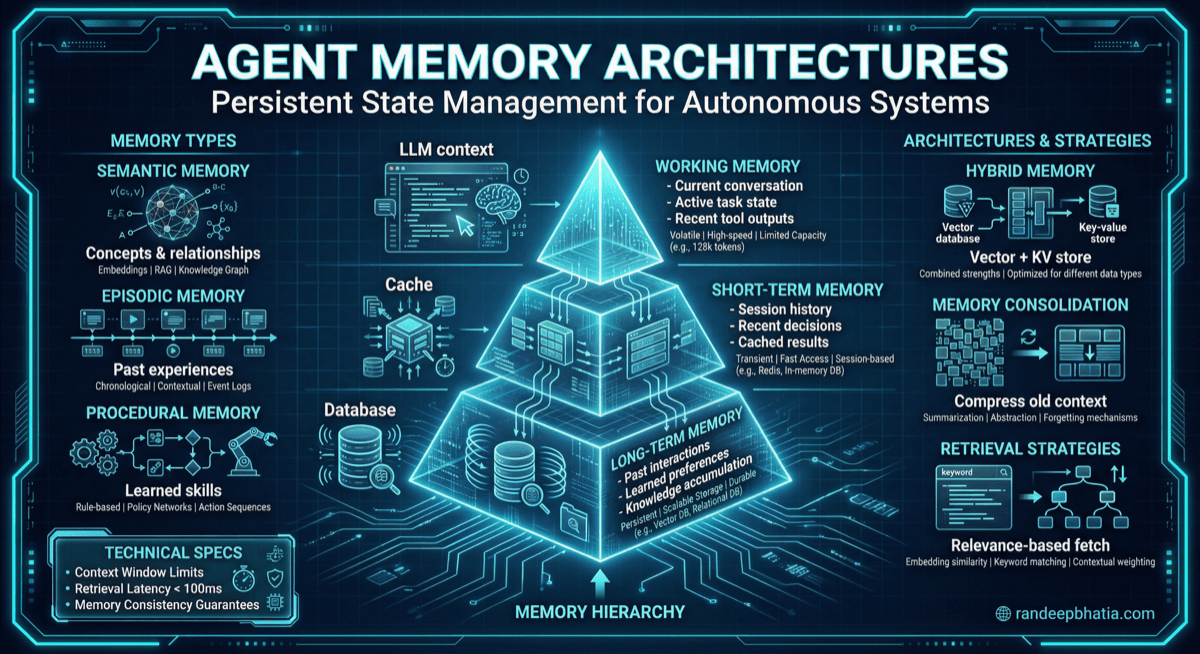
Agent Memory Architectures
Executive Summary
Executive Summary
Agent memory architectures are structured systems that enable AI agents to store, organize, retrieve, and utilize information across interactions, enabling persistent context, learning from experience, and coherent long-term behavior.
Memory architectures for agents typically comprise multiple specialized subsystems—working memory for immediate context, episodic memory for experience recall, semantic memory for factual knowledge, and procedural memory for learned behaviors—each optimized for different access patterns and retention requirements.
The choice of memory architecture fundamentally determines an agent's capabilities including context continuity across sessions, ability to learn from past interactions, personalization depth, and computational cost profile, making it one of the most critical architectural decisions in agent design.
Production memory systems must balance retrieval latency, storage costs, memory accuracy, and relevance ranking while implementing appropriate forgetting mechanisms to prevent unbounded growth and maintain response quality as memory stores scale.
The Bottom Line
Agent memory architectures transform stateless LLM interactions into coherent, learning systems capable of maintaining context across sessions and improving through experience. The architecture chosen directly impacts agent intelligence, operational costs, and scalability, requiring careful consideration of memory types, storage backends, retrieval mechanisms, and lifecycle management strategies.
Definition
Definition
Agent memory architectures are computational frameworks that define how autonomous AI agents encode, store, organize, retrieve, and utilize information across temporal boundaries, enabling persistent state and experiential learning beyond single interaction windows.
These architectures encompass the data structures, algorithms, storage systems, and retrieval mechanisms that collectively allow agents to maintain coherent identity, accumulate knowledge, recall relevant past experiences, and adapt behavior based on historical interactions.
Extended Definition
Agent memory architectures draw inspiration from cognitive science models of human memory while adapting to the unique constraints and capabilities of artificial systems. Unlike simple caching or database storage, these architectures implement sophisticated indexing, relevance scoring, temporal ordering, and selective forgetting mechanisms that mirror biological memory processes. The architecture must handle the fundamental tension between comprehensive recall and computational efficiency, implementing strategies for memory consolidation, compression, and prioritization. Modern implementations typically combine multiple storage backends—vector databases for semantic similarity search, key-value stores for exact recall, graph databases for relational knowledge—orchestrated by retrieval algorithms that balance relevance, recency, and importance.
Etymology & Origins
The term 'agent memory architecture' emerged from the convergence of two research traditions: cognitive architectures from artificial intelligence research (dating to systems like SOAR and ACT-R in the 1980s-1990s) and memory-augmented neural networks from deep learning research (particularly Neural Turing Machines and Memory Networks from 2014-2016). The application to LLM-based agents accelerated in 2022-2023 as practitioners recognized that context window limitations required external memory systems to enable sophisticated agent behaviors.
Also Known As
Not To Be Confused With
Context window
Context windows are the immediate token buffer within a single LLM call, limited by model architecture, while memory architectures are external systems that persist information across calls and sessions, potentially indefinitely.
RAG (Retrieval-Augmented Generation)
RAG typically retrieves from static document collections for knowledge augmentation, while agent memory architectures dynamically store and retrieve agent-generated experiences, interactions, and learned information that evolves over time.
Model fine-tuning
Fine-tuning permanently modifies model weights to incorporate knowledge, while memory architectures maintain knowledge in external stores that can be updated, queried, and managed without retraining the underlying model.
Conversation history
Conversation history is a simple chronological log of messages, while memory architectures implement structured storage with semantic indexing, importance weighting, summarization, and intelligent retrieval across multiple conversations and contexts.
Database caching
Caching optimizes repeated access to identical queries with TTL-based expiration, while memory architectures implement semantic retrieval, relevance-based recall, and sophisticated lifecycle management based on memory importance and utility.
Knowledge graphs
Knowledge graphs store structured factual relationships, while agent memory architectures encompass multiple memory types including experiential, procedural, and contextual memories that may or may not be represented as graphs.
Conceptual Foundation
Core Principles
(8 principles)Mental Models
(6 models)The Library with Multiple Catalogs
Think of agent memory as a library where books (memories) can be found through multiple catalog systems—a chronological catalog (when acquired), a subject catalog (semantic content), a frequently-accessed shelf (working memory), and a special collections section (important memories). Different queries use different catalogs, and the librarian (retrieval system) must choose the right catalog and combine results intelligently.
The Leaky Bucket with Filters
Memories flow into the system continuously like water into a bucket, but the bucket has limited capacity. Filters at different levels determine what gets retained—immediate filters for working memory (very selective, high throughput), medium-term filters for episodic storage (moderate selectivity), and long-term filters for permanent semantic knowledge (highly selective). Without proper filters, the bucket overflows and retrieval becomes impossible.
The Conversation Partner with Notes
Imagine a human assistant who takes notes during conversations, reviews them before meetings, and maintains organized files on different topics and people. The assistant doesn't remember everything verbatim but captures key points, can look up details when needed, and builds cumulative understanding over time. This mirrors how agent memory should function—selective capture, organized storage, and intelligent recall.
The Hierarchical Cache
Like computer memory hierarchies (registers → L1 cache → L2 cache → RAM → SSD → HDD), agent memory operates in tiers with different capacity, speed, and cost characteristics. Working memory is fast but tiny, recent episodic memory is quick but limited, and long-term storage is vast but slower to access. Effective architectures move information between tiers based on access patterns and importance.
The Evolving Knowledge Graph
Agent memory can be viewed as a graph where nodes represent entities, concepts, and events, while edges represent relationships, temporal sequences, and associations. The graph grows and evolves with each interaction—new nodes are added, edges are strengthened or weakened, and clusters of related memories emerge. Retrieval involves graph traversal from the current context to relevant memory nodes.
The Compression Pipeline
Raw experiences enter the memory system at full fidelity but undergo progressive compression as they age—detailed episodic memories become summarized events, which become abstracted patterns, which become general knowledge. This mirrors human memory consolidation and enables efficient long-term storage while preserving essential information.
Key Insights
(10 insights)The most common failure mode in agent memory systems is not forgetting too much but remembering too much indiscriminately, leading to retrieval pollution where relevant memories are buried under irrelevant ones.
Embedding-based semantic search alone is insufficient for production memory retrieval—it must be combined with temporal filtering, importance weighting, and entity matching to achieve acceptable precision.
Memory write operations are often more computationally expensive than reads due to embedding generation, indexing updates, and importance scoring, making write batching and async processing critical for responsive agents.
The optimal memory architecture varies dramatically based on interaction patterns—high-frequency short interactions favor aggressive summarization, while infrequent deep interactions benefit from detailed episodic retention.
User-specific memories and general knowledge should be stored and managed separately, as they have different privacy requirements, update patterns, and retrieval characteristics.
Memory retrieval latency directly impacts perceived agent intelligence—users interpret slow responses as the agent 'not knowing' rather than 'still searching,' making sub-second retrieval essential for conversational agents.
The boundary between working memory (in-context) and long-term memory (external) should be dynamic, with important context promoted to long-term storage and frequently-accessed long-term memories cached in working memory.
Memory systems require explicit versioning and migration strategies because memory schemas evolve as agent capabilities expand, and legacy memories must remain accessible after schema changes.
Effective memory architectures implement 'memory about memory' (metamemory)—tracking what the agent knows it knows, what it knows it doesn't know, and confidence levels for stored information.
The cost of memory operations scales non-linearly with memory store size, making early investment in efficient indexing and retrieval algorithms essential for long-term system viability.
When to Use
When to Use
Ideal Scenarios
(12)Building conversational agents that maintain context across multiple sessions, requiring the agent to remember user preferences, past discussions, and ongoing tasks without re-establishing context each interaction.
Developing personal assistant agents that learn user patterns over time, adapting recommendations, communication style, and proactive suggestions based on accumulated interaction history.
Creating customer service agents that need to recall previous support interactions, purchase history, and issue resolution patterns to provide personalized and efficient support.
Implementing autonomous agents that execute multi-step tasks over extended periods, requiring memory of completed steps, intermediate results, and decision rationale.
Building collaborative agents that work with multiple users, needing to maintain separate user models while sharing relevant organizational knowledge.
Developing agents that learn from feedback, storing successful and unsuccessful interaction patterns to improve future performance without model retraining.
Creating agents that operate in complex domains requiring accumulated domain knowledge, case histories, and learned heuristics beyond what fits in a single context window.
Implementing agents that must maintain compliance audit trails, storing interaction records with appropriate retention and retrieval capabilities for regulatory requirements.
Building research or analysis agents that accumulate findings over time, synthesizing information across multiple investigation sessions into coherent knowledge bases.
Developing game or simulation agents that maintain world state, character relationships, and narrative continuity across extended play sessions.
Creating educational agents that track learner progress, adapt to demonstrated knowledge levels, and maintain continuity in learning journeys.
Implementing agents that coordinate with other agents or systems, requiring shared memory for state synchronization and collaborative task execution.
Prerequisites
(8)Clear definition of what information the agent needs to remember, including explicit categorization of memory types (user preferences, factual knowledge, interaction history, task state) and their relative importance.
Understanding of expected memory growth rates and retention requirements, enabling appropriate capacity planning and lifecycle management strategy selection.
Infrastructure for persistent storage with appropriate durability, availability, and performance characteristics for the expected query patterns and data volumes.
Embedding model selection and deployment capability for semantic memory indexing, with consideration of embedding dimensionality, model quality, and inference costs.
Defined privacy and data governance requirements, including retention policies, access controls, and deletion capabilities that comply with applicable regulations.
Retrieval latency budget established based on user experience requirements, informing architecture decisions around indexing strategies and caching layers.
Team capability to operate and maintain memory infrastructure, including monitoring, debugging, and capacity management skills.
Integration points defined between memory systems and agent orchestration layer, including APIs for memory read/write operations and context injection.
Signals You Need This
(10)Users complain that the agent 'doesn't remember' previous conversations or repeatedly asks for information already provided.
Agent performance degrades as conversations grow longer because relevant context is pushed out of the context window by less relevant recent messages.
The agent cannot learn from corrections or feedback, repeating the same mistakes across sessions because learning isn't persisted.
Multi-session tasks fail because the agent loses track of progress, completed steps, and pending actions between interactions.
Personalization is limited to single sessions, with the agent treating returning users as strangers despite extensive interaction history.
Context window costs are excessive because entire conversation histories are included in every request to maintain continuity.
The agent provides inconsistent responses to similar queries because it lacks access to its own previous answers and reasoning.
Users must repeatedly re-establish context, preferences, and background information that a human assistant would remember.
Agent capabilities are artificially limited by context window size rather than by the underlying model's reasoning ability.
There's no way to audit what the agent 'knows' about users or to correct erroneous information it has accumulated.
Organizational Readiness
(7)Engineering team has experience with vector databases, embedding models, and semantic search systems, or has capacity to develop this expertise.
Infrastructure supports the storage and compute requirements for memory systems, including vector database hosting, embedding inference, and retrieval serving.
Data governance frameworks exist to handle the sensitive information that will accumulate in agent memories, including classification, retention, and access policies.
Product requirements clearly specify memory-dependent features, providing guidance on what to remember, how long to retain it, and how it should influence agent behavior.
Monitoring and observability capabilities can extend to memory system health, including retrieval latency, memory growth, and relevance quality metrics.
Incident response processes can handle memory-related failures, including corrupted memories, retrieval degradation, and privacy incidents.
Budget accommodates the ongoing costs of memory infrastructure, which scale with user base and interaction volume rather than being fixed development costs.
When NOT to Use
When NOT to Use
Anti-Patterns
(12)Implementing complex memory architecture for simple, stateless query-response agents where each interaction is independent and context continuity provides no value.
Using memory systems as a substitute for proper prompt engineering or model selection when the core issue is inadequate base model capability rather than missing context.
Storing all interaction data without selectivity, creating memory systems that grow unboundedly and degrade retrieval quality through noise accumulation.
Implementing memory before establishing clear requirements for what should be remembered, leading to architectures that store wrong information or miss critical data.
Using semantic memory retrieval for exact-match requirements where simple key-value lookup would be more reliable and efficient.
Building custom memory infrastructure when managed services would meet requirements at lower operational cost and complexity.
Implementing long-term memory for ephemeral use cases where information becomes stale quickly and historical context provides diminishing value.
Storing sensitive information in memory systems without appropriate security controls, creating privacy and compliance risks.
Using memory architecture to compensate for inadequate context window size when model upgrade or context compression would be more effective.
Implementing sophisticated memory retrieval before validating that memory-augmented responses actually improve user outcomes.
Building memory systems without forgetting mechanisms, assuming that more memory always improves performance.
Treating memory architecture as a one-time implementation rather than an evolving system requiring ongoing tuning and maintenance.
Red Flags
(10)Requirements specify 'remember everything' without prioritization or lifecycle management strategy.
No clear metrics defined for memory system success—unable to measure whether memories improve agent performance.
Privacy and data retention requirements are undefined or conflict with proposed memory persistence.
Expected interaction volume is low (< 1000 interactions/month) and doesn't justify memory infrastructure complexity.
Team lacks experience with vector databases and semantic search, with no plan for capability development.
Memory requirements could be met by simply increasing context window size with available models.
No budget allocated for ongoing memory infrastructure costs, only initial development.
Retrieval latency requirements (< 100ms) are incompatible with proposed storage backend capabilities.
Memory content is primarily structured data better served by traditional databases than semantic memory systems.
Agent use case is primarily generative (content creation) rather than interactive (conversation, assistance).
Better Alternatives
(8)Agent needs to maintain context within a single conversation but not across sessions
Conversation state management with in-context history and summarization
Simpler architecture with no external storage requirements, lower latency, and no persistence complexity. Modern context windows (128K+ tokens) can hold extensive conversation history.
Agent needs access to static knowledge base that doesn't change based on interactions
Standard RAG (Retrieval-Augmented Generation) with document retrieval
RAG is optimized for static document retrieval with mature tooling and established patterns. Agent memory adds unnecessary complexity when the knowledge base is interaction-independent.
Agent needs to remember small amounts of structured user data (preferences, settings)
Traditional database with user profile storage
Structured data with known schema is better served by relational or document databases with exact-match queries. Semantic retrieval adds latency and uncertainty for simple lookups.
Agent behavior should permanently change based on accumulated experience
Periodic fine-tuning or RLHF on interaction data
If the goal is permanent behavioral change rather than contextual recall, fine-tuning embeds learning in model weights, eliminating retrieval latency and memory infrastructure.
Agent operates in a domain with rapidly changing information
Real-time data integration with API calls and tool use
Memory systems store historical state, which becomes stale. For current information (prices, availability, status), direct API integration provides accurate data without staleness risk.
Memory requirements are primarily for audit and compliance rather than agent behavior
Logging and audit trail systems with separate compliance storage
Audit requirements have different access patterns, retention rules, and query needs than operational memory. Dedicated audit systems provide appropriate controls without impacting agent performance.
Agent interactions are short, transactional, and independent
Stateless agent design with session-scoped context only
Memory architecture adds complexity and cost. If interactions are genuinely independent, stateless design is simpler, more scalable, and eliminates memory-related failure modes.
Primary need is to share context between multiple agents
Shared state store or message passing between agents
Inter-agent communication has different requirements than agent memory—synchronization, consistency, and real-time updates matter more than historical recall and semantic retrieval.
Common Mistakes
(10)Implementing memory retrieval without relevance thresholds, injecting low-quality memories that confuse rather than help the agent.
Storing raw conversation text instead of extracted, structured memory representations, making retrieval noisy and storage inefficient.
Using a single embedding model for all memory types when different types (facts, events, procedures) have different semantic structures.
Neglecting memory deduplication, allowing the same information to accumulate multiple times and dominate retrieval results.
Implementing write-heavy architectures that block on memory storage, adding latency to every agent response.
Failing to version memory schemas, making it impossible to migrate or update memory representations as requirements evolve.
Over-relying on semantic similarity without temporal, entity, or importance filtering, retrieving semantically similar but contextually irrelevant memories.
Not implementing memory access logging, making it impossible to debug retrieval quality issues or audit memory usage.
Treating memory retrieval as deterministic when embedding similarity is inherently fuzzy, leading to inconsistent agent behavior.
Building memory systems without considering multi-tenancy, creating data isolation and scaling challenges when supporting multiple users or organizations.
Core Taxonomy
Core Taxonomy
Primary Types
(8 types)The immediate, active memory that holds information currently being processed by the agent, analogous to human working memory or a computer's RAM. This includes the current conversation context, active task state, and recently retrieved information that's immediately relevant to ongoing processing.
Characteristics
- Limited capacity, typically bounded by context window size
- Fastest access latency (in-context, no retrieval needed)
- Volatile—cleared or summarized when capacity is reached
- Contains both user input and agent-generated intermediate state
- Directly influences current response generation
Use Cases
Tradeoffs
Provides lowest latency but strictest capacity limits. Overflow requires either summarization (lossy) or promotion to longer-term storage (adds retrieval latency for future access). Management complexity increases with conversation length.
Classification Dimensions
Persistence Duration
Classification based on intended retention period, which influences storage backend selection, indexing strategy, and lifecycle management approach. Longer persistence requires more robust storage and explicit retention policies.
Access Pattern
Classification based on expected read/write ratio and patterns, which determines optimal storage backend, indexing strategy, and caching approach. Mismatched access patterns and storage choices cause performance problems.
Retrieval Method
Classification based on how memories are accessed, which determines indexing requirements and query capabilities. Most production systems require hybrid retrieval combining multiple methods.
Scope
Classification based on who can access and contribute to the memory, which determines isolation requirements, access control, and aggregation strategies.
Mutability
Classification based on whether and how memories can be modified after creation, which affects consistency guarantees, audit capabilities, and storage efficiency.
Structure Level
Classification based on the organization and schema of stored memories, which determines storage backend options and query capabilities.
Evolutionary Stages
Stage 1: Session Memory
Initial agent deployment, MVP phase. May persist indefinitely for simple use cases.Memory limited to single conversation sessions with no cross-session persistence. Context maintained through conversation history in context window. Simple implementation with no external storage requirements. Suitable for stateless or low-complexity agents.
Stage 2: Basic Persistence
3-6 months after initial deployment as cross-session requirements emerge.Simple key-value storage for user preferences and basic facts. Conversation summaries stored for cross-session continuity. Manual or rule-based decisions about what to store. Limited retrieval sophistication—mostly exact match.
Stage 3: Semantic Memory
6-12 months, triggered by retrieval quality requirements or memory volume growth.Vector database integration for semantic similarity search. Embedding-based retrieval enables flexible memory access. Multiple memory types distinguished (facts vs. events). Basic importance scoring and retrieval ranking.
Stage 4: Intelligent Memory Management
12-24 months, driven by scale challenges and quality requirements.Sophisticated lifecycle management with consolidation and forgetting. Multi-factor retrieval combining semantic, temporal, and importance signals. Memory quality monitoring and optimization. Automated memory maintenance processes.
Stage 5: Adaptive Memory Architecture
24+ months, representing mature memory systems in production at scale.Learning-based memory management that adapts to usage patterns. Predictive memory retrieval anticipating information needs. Cross-agent memory sharing and collective learning. Self-optimizing retrieval and retention strategies.
Architecture Patterns
(8 patterns)Tiered Memory Architecture
Organizes memory into multiple tiers with different capacity, latency, and cost characteristics, similar to computer memory hierarchies. Hot memories reside in fast, expensive storage while cold memories move to slower, cheaper tiers. Promotion and demotion policies manage tier transitions based on access patterns and importance.
Components
- Hot tier: In-memory cache or Redis for frequently accessed memories
- Warm tier: Vector database for semantic retrieval of recent memories
- Cold tier: Object storage or data warehouse for archived memories
- Tier manager: Service managing promotion/demotion decisions
- Access tracker: Monitors memory access patterns for tier optimization
Data Flow
New memories enter hot tier → access patterns monitored → inactive memories demoted to warm tier → aged memories archived to cold tier → retrieval queries check tiers in order → accessed cold memories may be promoted
Best For
- High-volume agents with varying memory access patterns
- Cost-sensitive deployments with large memory stores
- Systems with clear hot/cold access patterns
- Long-running agents with extensive history
Limitations
- Tier transition latency affects retrieval consistency
- Complex promotion/demotion logic requires tuning
- Cold tier queries significantly slower
- Tier boundaries create potential retrieval gaps
Scaling Characteristics
Scales cost-effectively by keeping only active memories in expensive tiers. Hot tier size bounded, warm tier scales with active user base, cold tier scales with total history. Retrieval latency varies by tier—design for acceptable p99 from coldest accessed tier.
Integration Points
Agent Orchestrator
Coordinates memory read/write operations as part of agent execution flow, determining when to retrieve memories, what to store, and how to inject memories into context.
Orchestrator must handle memory operation failures gracefully, implement timeouts for retrieval, and manage memory budget within context limits. Async memory writes preferred to avoid blocking agent responses.
Embedding Service
Generates vector embeddings for memory content and queries, enabling semantic similarity retrieval. May be shared with RAG or other embedding needs.
Embedding model choice significantly impacts retrieval quality. Latency and throughput requirements may necessitate dedicated embedding infrastructure. Model versioning affects embedding compatibility—re-embedding may be required on model change.
Vector Database
Stores and indexes memory embeddings for efficient similarity search. Primary backend for semantic memory retrieval.
Index configuration (HNSW parameters, quantization) affects latency/recall tradeoff. Metadata filtering capabilities vary by database. Scaling characteristics differ significantly between products. Consider managed vs. self-hosted based on operational capability.
LLM Service
Provides language model capabilities for memory summarization, importance scoring, entity extraction, and reflection generation.
Memory processing LLM calls add cost and latency. Consider smaller, faster models for memory operations vs. main agent reasoning. Batch processing can improve efficiency. Prompt engineering for memory tasks requires specific optimization.
User/Session Store
Maintains user identity and session state, providing context for memory scoping and access control.
Memory isolation depends on correct user/session identification. Multi-tenant deployments require strict isolation. Session boundaries affect memory lifecycle decisions.
Monitoring System
Collects metrics on memory system health, retrieval quality, and operational characteristics for observability and alerting.
Memory-specific metrics (retrieval latency, relevance scores, memory growth) require custom instrumentation. Distributed tracing should span memory operations. Alert thresholds need tuning based on baseline performance.
Background Job System
Executes async memory maintenance tasks including consolidation, summarization, cleanup, and index optimization.
Memory maintenance jobs can be resource-intensive—schedule during low-traffic periods. Job failures should not corrupt memory state. Idempotency important for retry safety. Consider job prioritization based on memory health metrics.
Data Pipeline
Handles bulk memory operations including initial loading, migration, export, and cross-system synchronization.
Bulk operations require careful rate limiting to avoid impacting online operations. Data validation essential during import. Schema transformation may be needed for migration. Consider incremental vs. full sync strategies.
Decision Framework
Decision Framework
Persistent memory architecture required. Proceed to evaluate memory type requirements.
Session-scoped memory may suffice. Consider in-context conversation history with summarization.
Cross-session memory adds significant complexity. Validate that the use case truly benefits from persistence before committing to external memory infrastructure.
Technical Deep Dive
Technical Deep Dive
Overview
Agent memory architectures operate through a continuous cycle of observation, encoding, storage, retrieval, and utilization. When an agent interacts with users or environments, observations are captured and processed through an encoding pipeline that extracts structured information, generates embeddings, and assigns metadata including timestamps, importance scores, and entity tags. These encoded memories are written to appropriate storage backends based on their type and characteristics. Retrieval is triggered when the agent needs context beyond its immediate working memory. A query is formulated based on the current interaction context, and the retrieval system searches across memory stores using a combination of semantic similarity, temporal relevance, and importance weighting. Retrieved memories are ranked, filtered, and formatted for injection into the agent's context, where they inform response generation. The memory lifecycle continues with maintenance processes that consolidate episodic memories into semantic knowledge, summarize detailed memories into abstractions, and remove or archive memories that are no longer valuable. These processes run continuously or on schedules, ensuring that memory stores remain healthy and retrieval quality is maintained as the system scales. The architecture must handle the fundamental tension between comprehensive memory (storing everything for potential future value) and efficient retrieval (finding relevant memories without being overwhelmed by irrelevant ones). This is achieved through careful design of encoding, indexing, and retrieval algorithms, combined with lifecycle management that prioritizes high-value memories.
Step-by-Step Process
Raw interaction data (user messages, agent responses, tool outputs, environmental signals) is captured as observations. Each observation includes the raw content, timestamp, session context, and any available metadata. Observations may be buffered for batch processing or processed immediately based on latency requirements.
Capturing too much raw data without filtering creates noise. Missing important observations due to overly aggressive filtering. Timestamp inconsistencies across distributed systems causing ordering issues.
Under The Hood
At the implementation level, agent memory systems are built on several key technical components that work together to enable efficient storage and retrieval. Vector databases like Pinecone, Weaviate, Milvus, or pgvector provide the foundation for semantic similarity search. These systems use approximate nearest neighbor (ANN) algorithms, typically HNSW (Hierarchical Navigable Small World) graphs, to enable sub-linear search complexity over millions of vectors. The HNSW algorithm constructs a multi-layer graph where each layer is a proximity graph with decreasing density, allowing search to quickly navigate from coarse to fine granularity. Embedding models transform text into dense vector representations that capture semantic meaning. Models like OpenAI's text-embedding-3, Cohere's embed, or open-source alternatives like BGE or E5 produce embeddings where cosine similarity correlates with semantic similarity. The choice of embedding model involves tradeoffs between quality (how well similarity reflects relevance), dimensionality (affecting storage and search cost), and inference cost. Production systems often use quantization (reducing precision from float32 to int8) to reduce storage and improve search speed with minimal quality loss. The retrieval pipeline typically implements a multi-stage approach: initial candidate retrieval using ANN search returns a larger set (e.g., top-100), followed by re-ranking using more sophisticated scoring that incorporates temporal decay, importance weights, and potentially cross-encoder models that score query-document pairs more accurately than embedding similarity alone. This two-stage approach balances efficiency (fast ANN for initial filtering) with quality (expensive re-ranking on smaller candidate set). Memory lifecycle management implements strategies inspired by cognitive science. Spaced repetition principles inform importance decay—memories accessed more frequently decay slower. Consolidation processes, often implemented as batch jobs, use LLMs to extract generalizations from episodic memories, similar to how human memory consolidates during sleep. Forgetting curves model the natural decay of memory importance over time, with exponential decay being a common choice: importance(t) = initial_importance × e^(-λt), where λ is tuned based on memory type and application requirements. For multi-tenant systems, memory isolation is typically implemented through metadata filtering rather than physical separation. Each memory entry includes a tenant identifier, and all queries include a mandatory tenant filter. This approach enables efficient resource sharing while maintaining logical isolation. However, for high-security requirements, physical isolation through separate indexes or databases may be necessary, trading efficiency for stronger guarantees.
Failure Modes
Failure Modes
Vector database or storage backend becomes unreachable due to infrastructure failure, network partition, or resource exhaustion.
- Retrieval requests timeout or return errors
- Agent responses lack expected context
- Memory write operations fail silently or with errors
- Increased error rates in monitoring
Agent operates without memory, providing degraded experience. New memories not stored, causing data loss. User trust eroded by inconsistent behavior.
Use managed services with SLAs. Implement redundancy for self-hosted. Monitor availability proactively. Design for graceful degradation.
Implement circuit breakers to fail fast. Cache recent memories locally. Queue writes for retry. Provide degraded but functional responses without memory.
Operational Considerations
Key Metrics (15)
Median latency for memory retrieval operations, measuring typical user experience.
Dashboard Panels
Alerting Strategy
Implement tiered alerting with severity levels based on user impact. P1 alerts for complete memory system failure or security incidents requiring immediate response. P2 alerts for significant degradation affecting user experience. P3 alerts for elevated metrics requiring investigation within hours. P4 alerts for trends requiring attention within days. Use anomaly detection for metrics without fixed thresholds. Implement alert aggregation to prevent alert storms. Ensure on-call rotation has runbooks for all alert types.
Cost Analysis
Cost Analysis
Cost Drivers
(10)Embedding API Calls
Per-token or per-request charges for embedding generation. Scales with write volume and query volume if query embedding not cached.
Batch embedding requests. Cache query embeddings. Use self-hosted models for high volume. Deduplicate before embedding.
Vector Database Storage
Per-GB storage charges plus index overhead. Scales with memory count and embedding dimensionality.
Use lower-dimension embeddings where quality permits. Implement aggressive lifecycle management. Use quantization to reduce storage. Tier storage by access frequency.
Vector Database Queries
Per-query charges or compute costs for similarity search. Scales with retrieval frequency.
Cache frequent queries. Batch queries where possible. Optimize index for query patterns. Use appropriate consistency levels.
LLM Calls for Memory Processing
Token-based charges for summarization, extraction, and consolidation. Can be significant for complex memory processing.
Use smaller models for memory tasks. Batch processing. Optimize prompts for efficiency. Cache extraction results.
Compute for Memory Operations
Server costs for memory service, background jobs, and retrieval serving.
Right-size compute resources. Use spot/preemptible for batch jobs. Implement auto-scaling. Optimize code efficiency.
Network Transfer
Data transfer costs between services, especially cross-region or to external APIs.
Co-locate services. Compress data in transit. Minimize cross-region traffic. Use regional endpoints.
Backup and Redundancy
Storage costs for backups, replication costs for high availability.
Tiered backup retention. Compress backups. Evaluate redundancy requirements vs. cost.
Monitoring and Logging
Costs for metrics storage, log aggregation, and observability tools.
Sample high-volume metrics. Implement log retention policies. Use cost-effective observability solutions.
Development and Operations
Engineering time for development, maintenance, and incident response.
Use managed services to reduce operational burden. Invest in automation. Build robust systems to minimize incidents.
Compliance and Security
Costs for encryption, audit logging, compliance certifications, and security tools.
Use built-in security features. Automate compliance checks. Right-size audit retention.
Cost Models
Per-User Monthly Cost
Cost = (avg_memories_per_user × storage_cost_per_memory) + (avg_writes_per_user × write_cost) + (avg_retrievals_per_user × retrieval_cost) + (user_share_of_fixed_costs)With 1000 memories/user at $0.001/memory/month storage, 100 writes at $0.002/write, 500 retrievals at $0.0005/retrieval: $1.00 + $0.20 + $0.25 = $1.45/user/month plus fixed cost share
Per-Interaction Cost
Cost = (embedding_cost × embeddings_per_interaction) + (retrieval_cost × retrievals_per_interaction) + (write_cost × writes_per_interaction) + (llm_cost × memory_processing_tokens)1 embedding at $0.0001, 1 retrieval at $0.0005, 0.5 writes at $0.002, 100 tokens at $0.00001: $0.0001 + $0.0005 + $0.001 + $0.001 = $0.0026/interaction
Infrastructure Monthly Cost
Cost = vector_db_cost + compute_cost + storage_cost + network_cost + monitoring_costPinecone $70/month + EC2 $200/month + S3 $50/month + Network $30/month + Datadog $100/month = $450/month base infrastructure
Total Cost of Ownership
TCO = infrastructure_cost + (interaction_volume × per_interaction_cost) + (engineering_hours × hourly_rate) + compliance_cost$450 infra + (100K interactions × $0.003) + (20 hours × $150) + $200 compliance = $450 + $300 + $3000 + $200 = $3950/month TCO
Optimization Strategies
- 1Implement aggressive caching for embeddings and frequent queries to reduce API calls
- 2Use tiered storage with hot/warm/cold tiers based on access patterns
- 3Batch embedding requests to maximize throughput and minimize per-request overhead
- 4Self-host embedding models for high-volume deployments where API costs exceed infrastructure costs
- 5Implement memory lifecycle management to prevent unbounded storage growth
- 6Use lower-dimensional embeddings (384 vs 1536) where retrieval quality permits
- 7Apply vector quantization to reduce storage costs with minimal quality impact
- 8Schedule resource-intensive jobs during off-peak hours for better pricing
- 9Implement write deduplication to avoid storing redundant memories
- 10Use spot/preemptible instances for batch processing jobs
- 11Optimize retrieval to minimize queries per interaction
- 12Implement cost allocation and budgets per user/tenant to identify optimization opportunities
Hidden Costs
- 💰Re-embedding costs when changing embedding models (can be substantial for large memory stores)
- 💰Migration costs when changing storage backends or architectures
- 💰Incident response costs for memory-related outages or data issues
- 💰Compliance audit costs for regulated industries
- 💰Training and onboarding costs for team members learning memory systems
- 💰Opportunity cost of engineering time spent on memory infrastructure vs. features
- 💰Technical debt costs from deferred maintenance or optimization
- 💰Vendor lock-in costs if switching providers becomes necessary
ROI Considerations
The return on investment for agent memory architecture depends heavily on the use case and how memory capabilities translate to business value. For customer service agents, memory enables faster resolution through context continuity, reducing handle time and improving satisfaction—measure ROI through reduced support costs and improved NPS. For personal assistants, memory enables personalization that increases engagement and retention—measure through user retention and feature adoption metrics. Memory systems have significant upfront and ongoing costs, so ROI analysis should consider the incremental value of memory-enabled features versus the simpler alternative of stateless agents. In many cases, a phased approach starting with simple memory and expanding based on demonstrated value provides the best risk-adjusted ROI. Consider also the competitive dynamics—if competitors offer memory-enabled agents, the cost of not implementing memory may be lost market share. Conversely, being early with sophisticated memory capabilities can be a differentiator. The ROI calculation should include both direct cost savings and strategic value.
Security Considerations
Threat Model
(10 threats)Memory Data Exfiltration
Attacker gains access to memory storage through compromised credentials, SQL injection, or infrastructure breach.
Exposure of sensitive user data, conversation history, and personal information stored in memories.
Encrypt data at rest and in transit. Implement strong access controls. Regular security audits. Minimize data retention. Monitor for unauthorized access.
Cross-Tenant Data Access
Application bug or misconfiguration allows queries to access memories belonging to other tenants.
Privacy violation, regulatory non-compliance, loss of user trust, potential legal liability.
Implement tenant isolation at storage layer. Mandatory tenant filters on all queries. Automated isolation testing. Regular penetration testing.
Memory Poisoning Attack
Attacker crafts inputs designed to create malicious memories that influence agent behavior when retrieved.
Agent produces harmful, biased, or incorrect outputs. Potential for spreading misinformation or causing user harm.
Input validation and sanitization. Content moderation on memory writes. Anomaly detection for unusual memory patterns. Output filtering.
Prompt Injection via Retrieved Memories
Malicious content in memories contains prompt injection payloads that manipulate agent behavior when retrieved.
Agent behavior hijacked, potential for unauthorized actions, data exfiltration through agent.
Sanitize memory content before context injection. Use structured memory formats. Implement prompt injection detection. Limit memory influence on critical actions.
Inference Attack on Memory Patterns
Attacker analyzes memory access patterns, timing, or metadata to infer sensitive information.
Privacy leakage even without direct data access. May reveal user behavior patterns or preferences.
Minimize metadata exposure. Add noise to timing. Implement access pattern obfuscation. Regular privacy impact assessments.
Denial of Service via Memory System
Attacker floods memory system with writes or expensive queries to exhaust resources.
Memory system unavailable, agent functionality degraded, potential cascade to other services.
Rate limiting on memory operations. Resource quotas per user/tenant. Query complexity limits. DDoS protection.
Unauthorized Memory Modification
Attacker gains write access to modify existing memories, corrupting agent knowledge or inserting false information.
Agent provides incorrect information, makes wrong decisions, user trust compromised.
Strict write access controls. Audit logging for all modifications. Immutable memory options. Integrity verification.
Embedding Model Exploitation
Attacker crafts adversarial inputs that produce embeddings designed to manipulate retrieval results.
Retrieval returns attacker-chosen memories regardless of actual relevance. Agent behavior manipulated.
Input validation before embedding. Adversarial robustness testing. Multiple retrieval signals beyond embedding similarity.
Insider Threat
Malicious or compromised employee with system access exfiltrates or manipulates memory data.
Large-scale data breach, targeted manipulation, difficult to detect.
Principle of least privilege. Access logging and monitoring. Background checks. Separation of duties. Regular access reviews.
Supply Chain Attack
Compromise of memory system dependencies (vector database, embedding service, libraries) introduces vulnerabilities.
Varies by compromised component—could range from data access to complete system compromise.
Vendor security assessment. Dependency scanning. Software bill of materials. Rapid patching capability.
Security Best Practices
- ✓Encrypt all memory data at rest using AES-256 or equivalent
- ✓Encrypt all data in transit using TLS 1.3
- ✓Implement tenant isolation at the storage layer, not just application layer
- ✓Apply mandatory tenant filters to all memory queries with no bypass capability
- ✓Use parameterized queries to prevent injection attacks
- ✓Implement comprehensive audit logging for all memory operations
- ✓Apply principle of least privilege for all system access
- ✓Conduct regular security audits and penetration testing
- ✓Implement rate limiting and resource quotas to prevent abuse
- ✓Validate and sanitize all input before memory storage
- ✓Implement content moderation for user-generated memory content
- ✓Use secure key management for encryption keys
- ✓Implement anomaly detection for unusual access patterns
- ✓Maintain incident response procedures for security events
- ✓Conduct regular access reviews and remove unnecessary permissions
Data Protection
- 🔒Implement data classification to identify sensitive memory content
- 🔒Apply appropriate protection levels based on data classification
- 🔒Minimize data collection—only store memories that provide clear value
- 🔒Implement retention limits and automatic deletion for expired memories
- 🔒Provide user access to view their stored memories
- 🔒Implement user-initiated memory deletion capability
- 🔒Anonymize or pseudonymize memories where possible
- 🔒Implement data masking for sensitive fields in non-production environments
- 🔒Maintain data processing records as required by regulations
- 🔒Conduct data protection impact assessments for high-risk processing
Compliance Implications
GDPR (General Data Protection Regulation)
Right to erasure, data minimization, purpose limitation, consent for processing personal data.
Implement memory deletion capability. Define and enforce retention limits. Document processing purposes. Obtain appropriate consent. Enable data export.
CCPA (California Consumer Privacy Act)
Right to know what data is collected, right to delete, right to opt-out of sale.
Provide memory inventory capability. Implement deletion. Ensure memories are not sold. Provide privacy notices.
HIPAA (Health Insurance Portability and Accountability Act)
Protection of protected health information (PHI), access controls, audit trails.
Encrypt PHI in memories. Implement strict access controls. Maintain comprehensive audit logs. Business associate agreements with vendors.
SOC 2
Security, availability, processing integrity, confidentiality, privacy controls.
Implement controls across all trust service criteria. Document policies and procedures. Regular audits and assessments.
PCI DSS (Payment Card Industry Data Security Standard)
Protection of cardholder data, access controls, encryption, monitoring.
Never store full card numbers in memories. Encrypt any payment-related data. Implement required access controls and monitoring.
AI Act (EU Artificial Intelligence Act)
Transparency, human oversight, data governance for AI systems.
Document memory system's role in AI decision-making. Implement explainability for memory-influenced decisions. Ensure data quality in memories.
COPPA (Children's Online Privacy Protection Act)
Parental consent for collecting data from children under 13.
Age verification before memory collection. Parental consent mechanisms. Enhanced deletion capabilities for children's data.
Data Localization Requirements
Various jurisdictions require data to remain within geographic boundaries.
Deploy memory infrastructure in required regions. Implement data residency controls. Prevent cross-border data transfer where prohibited.
Scaling Guide
Scaling Guide
Scaling Dimensions
Memory Volume
Horizontal scaling of storage through sharding by user/tenant. Implement tiered storage to manage costs. Use lifecycle management to bound growth.
Single-node vector databases typically handle 1-10M vectors. Sharded deployments can scale to billions. Storage costs become significant at scale.
Sharding strategy affects query patterns. Cross-shard queries are expensive. Plan sharding key carefully based on access patterns.
Query Throughput
Add read replicas for vector database. Implement caching layer. Use load balancing across retrieval instances.
Single vector database instance handles 100-1000 QPS depending on configuration. Cached queries can achieve 10K+ QPS.
Replication lag affects consistency. Cache invalidation complexity increases with write volume. Consider eventual consistency tradeoffs.
Write Throughput
Async write processing with queues. Batch embedding generation. Implement write-behind caching.
Embedding generation is often the bottleneck. Batch sizes and parallelism determine throughput. Index update speed limits sustained write rate.
Async writes mean retrieval may miss very recent memories. Queue depth monitoring critical. Backpressure handling needed.
User Count
Tenant-based sharding. Per-user resource quotas. Efficient multi-tenant indexing.
Depends on per-user memory volume and activity. Millions of users achievable with proper architecture.
User activity distribution affects resource allocation. Hot users may need special handling. Isolation overhead per tenant.
Retrieval Latency
In-memory indexes for hot data. Geographic distribution for global users. Query optimization and caching.
Sub-10ms achievable for cached queries. 50-200ms typical for vector search. Cross-region adds network latency.
Latency vs. cost tradeoff. Memory costs for in-memory indexes. Consistency challenges with geographic distribution.
Memory Complexity
Specialized stores for different memory types. Federated architecture. Optimized indexes per access pattern.
Complexity increases operational burden. Cross-store queries have performance implications.
Balance specialization benefits against operational complexity. Start simple, add complexity as needed.
Embedding Throughput
Batch embedding requests. Self-hosted embedding models. Multiple embedding service instances.
API-based: rate limits and costs. Self-hosted: GPU availability and cost.
Embedding is often the scaling bottleneck. Self-hosting requires ML infrastructure expertise.
Geographic Distribution
Regional deployments with data residency compliance. Global load balancing. Cross-region replication where permitted.
Data residency requirements may prevent replication. Cross-region latency for non-local data.
Compliance requirements drive architecture. Complexity increases significantly with multi-region.
Capacity Planning
Storage = users × memories_per_user × (embedding_size + metadata_size + overhead_factor). Query capacity = peak_users × interactions_per_user × retrievals_per_interaction × safety_margin. Write capacity = peak_users × interactions_per_user × writes_per_interaction × safety_margin.Plan for 2-3x current peak load to handle growth and traffic spikes. Maintain 30-40% headroom on storage and compute. Plan capacity 6-12 months ahead based on growth projections.
Scaling Milestones
- Establishing baseline architecture
- Initial performance tuning
- Defining operational procedures
Single-instance vector database sufficient. Simple key-value for metadata. Basic monitoring. Manual operations acceptable.
- Index performance optimization
- Cost management becoming important
- Operational automation needed
Consider managed vector database. Implement caching layer. Automate lifecycle management. Enhance monitoring.
- Storage costs significant
- Query latency at scale
- Operational complexity increasing
Implement tiered storage. Add read replicas. Consider sharding strategy. Dedicated operations support.
- Sharding required
- Multi-region considerations
- Cost optimization critical
Implement sharded architecture. Geographic distribution if global. Sophisticated lifecycle management. Dedicated infrastructure team.
- Distributed systems complexity
- Cost at massive scale
- Reliability at scale
Fully distributed architecture. Custom optimizations. Significant infrastructure investment. Large dedicated team.
Benchmarks
Benchmarks
Industry Benchmarks
| Metric | P50 | P95 | P99 | World Class |
|---|---|---|---|---|
| Memory Retrieval Latency (p50) | 50ms | 150ms | 300ms | <30ms |
| Memory Retrieval Latency (p99) | 200ms | 500ms | 1000ms | <200ms |
| Memory Write Latency | 100ms | 300ms | 500ms | <50ms (async) |
| Retrieval Relevance (MRR@10) | 0.65 | 0.80 | 0.90 | >0.85 |
| Memory System Availability | 99.5% | 99.9% | 99.99% | >99.99% |
| Storage Cost per Million Memories | $50/month | $20/month | $10/month | <$5/month |
| Embedding Generation Throughput | 100/sec | 500/sec | 2000/sec | >5000/sec |
| Memory Deduplication Rate | 10% | 20% | 30% | <5% (clean writes) |
| Cache Hit Rate | 60% | 80% | 90% | >85% |
| Time to First Memory (new user) | 1 interaction | 1 interaction | 1 interaction | Immediate |
| Memory Lifecycle Compliance | 90% | 98% | 99.9% | 100% |
| Cross-Tenant Isolation Violations | 0 | 0 | 0 | 0 (mandatory) |
Comparison Matrix
| Solution | Latency | Scale | Cost | Complexity | Managed Option | Best For |
|---|---|---|---|---|---|---|
| Pinecone | Low | High | Medium-High | Low | Yes (only) | Production deployments prioritizing simplicity |
| Weaviate | Low | High | Medium | Medium | Yes | Hybrid search requirements |
| Milvus | Low | Very High | Low-Medium | High | Yes (Zilliz) | Large-scale self-hosted deployments |
| pgvector | Medium | Medium | Low | Low | Via managed Postgres | Postgres-native environments, smaller scale |
| Qdrant | Low | High | Low-Medium | Medium | Yes | Performance-focused deployments |
| Chroma | Low | Medium | Low | Low | Limited | Development and prototyping |
| Redis Vector | Very Low | Medium | Medium | Low | Yes | Latency-critical applications |
| Elasticsearch | Medium | High | Medium-High | High | Yes | Existing Elasticsearch deployments |
| Custom Implementation | Variable | Variable | High (dev) | Very High | No | Unique requirements not met by existing solutions |
Performance Tiers
Simple setup, single instance, limited scale. Focus on functionality over performance.
Retrieval <1s, availability >95%, cost minimal
Reliable operation, basic redundancy, moderate scale. Suitable for initial production deployment.
Retrieval p99 <500ms, availability >99%, cost-effective
High reliability, good performance, significant scale. Suitable for most production workloads.
Retrieval p99 <300ms, availability >99.9%, optimized cost
Excellent performance, high availability, large scale. For demanding production requirements.
Retrieval p99 <200ms, availability >99.95%, justified cost
Best-in-class performance, maximum reliability, massive scale. For the most demanding applications.
Retrieval p99 <100ms, availability >99.99%, optimized at scale
Real World Examples
Real World Examples
Real-World Scenarios
(8 examples)Personal AI Assistant with Long-Term Memory
A consumer AI assistant application needs to remember user preferences, past conversations, and learned behaviors across months of interaction to provide personalized assistance.
Implemented tiered memory architecture with working memory (current session), episodic memory (conversation summaries), and semantic memory (extracted preferences and facts). Used importance scoring based on user feedback and topic relevance. Implemented weekly consolidation to extract patterns from episodic to semantic memory.
User retention improved 40% compared to stateless version. Personalization quality scores increased significantly. Storage costs managed through aggressive summarization of old conversations.
- 💡Users value being remembered but are sensitive to privacy—transparency about what's stored is essential
- 💡Importance scoring based on explicit user feedback (likes, corrections) is more reliable than implicit signals
- 💡Consolidation quality directly impacts long-term agent usefulness
- 💡Simple preference storage (key-value) handles 80% of personalization value with 20% of complexity
Customer Service Agent with Case History
Enterprise customer service platform needs agents that remember previous support interactions, purchase history, and issue patterns for each customer.
Implemented dual-store architecture with episodic store for interaction transcripts and semantic store for customer profile and issue patterns. Integrated with CRM for structured data. Used entity-centric retrieval keyed on customer ID with semantic search for similar past issues.
Average handle time reduced 25% through context continuity. First-contact resolution improved 15%. Customer satisfaction scores increased due to not repeating information.
- 💡Integration with existing CRM is critical—memory system should complement, not replace, structured data
- 💡Retrieval should prioritize recent interactions but surface relevant older issues
- 💡Privacy controls per customer (opt-out, deletion) are essential for enterprise
- 💡Agent training on how to use retrieved context improves outcomes more than retrieval quality alone
Research Assistant with Accumulated Knowledge
Research team uses AI assistant for literature review and analysis. Assistant needs to accumulate domain knowledge across multiple research sessions and projects.
Implemented hybrid RAG-memory architecture combining static paper database with dynamic research notes and findings. Used graph memory for tracking relationships between concepts, papers, and findings. Implemented project-scoped memory with ability to share across projects.
Researchers reported significant time savings in literature review. Cross-project knowledge transfer enabled new insights. Accumulated knowledge base became valuable team asset.
- 💡Structured extraction of findings (claims, evidence, relationships) more valuable than raw notes
- 💡Graph representation enables powerful 'what connects X and Y' queries
- 💡Version control for memories important when findings are updated or corrected
- 💡Shared memory requires careful access control and attribution
Game NPC with Persistent World Memory
Narrative game with AI-driven NPCs that remember player interactions, maintain consistent personalities, and evolve relationships over extended gameplay.
Implemented memory stream architecture inspired by Generative Agents paper. Each NPC maintains personal memory stream with observations, reflections, and plans. Retrieval combines recency, importance, and relevance. Daily reflection generates higher-level memories.
Player engagement increased significantly with memory-enabled NPCs. Emergent narratives from NPC memory interactions created unique gameplay moments. NPCs maintained consistent characterization across sessions.
- 💡Reflection/consolidation is essential for coherent long-term NPC behavior
- 💡Importance scoring should reflect narrative significance, not just interaction frequency
- 💡Memory capacity per NPC must be bounded—forgetting is necessary for performance and narrative
- 💡Cross-NPC memory sharing enables rich social dynamics but requires careful design
Healthcare Assistant with Patient Context
Healthcare organization deploys AI assistant to help patients manage chronic conditions. Assistant needs to remember patient history, preferences, and care plan while maintaining strict HIPAA compliance.
Implemented event-sourced memory with complete audit trail. Strict encryption and access controls. Retention policies aligned with healthcare regulations. Integration with EHR for clinical data. Patient-controlled memory visibility and deletion.
Patients reported feeling better supported between appointments. Care plan adherence improved. Compliance audit passed without issues. Patient trust maintained through transparency.
- 💡Compliance requirements must be designed in from start—retrofitting is extremely difficult
- 💡Patient control over their data is both regulatory requirement and trust builder
- 💡Clinical data integration requires careful validation—memory should not contradict EHR
- 💡Audit logging overhead is significant but non-negotiable
Sales Assistant with Account Intelligence
B2B sales team uses AI assistant to prepare for customer meetings. Assistant needs to remember account history, stakeholder preferences, and deal context across sales cycle.
Implemented account-centric memory with graph relationships between stakeholders, opportunities, and interactions. Integrated with CRM and email for automatic memory population. Implemented meeting prep retrieval that surfaces relevant context.
Sales reps reported better meeting preparation. Deal velocity improved through context continuity. New reps ramped faster with access to account memory.
- 💡Automatic memory population from existing systems (CRM, email) provides most value with least friction
- 💡Stakeholder relationship mapping is high-value memory type for B2B
- 💡Memory should surface not just facts but suggested talking points and warnings
- 💡Privacy considerations for contact information require careful handling
Educational Tutor with Learning Progress
Online learning platform with AI tutor that adapts to student learning style, tracks progress, and maintains continuity across learning sessions.
Implemented procedural memory for learned teaching strategies per student. Semantic memory for student knowledge state (what they know/don't know). Episodic memory for session history. Adaptive retrieval based on current learning objective.
Learning outcomes improved compared to non-adaptive tutoring. Student engagement increased with personalized approach. Tutors maintained appropriate difficulty progression.
- 💡Knowledge state tracking (what student knows) is more valuable than interaction history
- 💡Procedural memory for teaching strategies enables genuine adaptation
- 💡Forgetting curve modeling helps optimize review scheduling
- 💡Student agency over their learning profile increases engagement
Multi-Agent System with Shared Context
Complex workflow automation using multiple specialized agents that need to share context and coordinate on tasks spanning multiple interactions.
Implemented federated memory with agent-local episodic memory and shared semantic memory. Message-passing for real-time coordination. Eventual consistency for shared memory updates. Clear ownership model for memory entries.
Multi-agent workflows achieved coherent behavior across handoffs. Reduced redundant work through shared context. Debugging improved with unified memory view.
- 💡Clear memory ownership prevents conflicts—each memory has one authoritative source
- 💡Eventual consistency acceptable for most shared memory; critical coordination needs synchronous
- 💡Agent-local memory should be primary; shared memory for explicit coordination
- 💡Debugging multi-agent memory issues requires comprehensive tracing
Industry Applications
Financial Services
AI advisors that remember client financial goals, risk tolerance, and previous advice for personalized wealth management.
Strict regulatory requirements (SEC, FINRA). Audit trail mandatory. Suitability documentation. Data retention requirements. Fiduciary implications of memory-based advice.
Healthcare
Patient-facing assistants for chronic disease management, medication adherence, and care coordination.
HIPAA compliance mandatory. PHI handling requirements. Integration with clinical systems. Patient consent management. Clinical validation of memory-influenced recommendations.
E-commerce
Shopping assistants that remember preferences, past purchases, and browsing behavior for personalized recommendations.
Privacy regulations (GDPR, CCPA). Preference vs. behavior data distinction. Cross-session attribution. Recommendation explainability. Opt-out handling.
Legal
Legal research assistants that accumulate case knowledge, remember matter context, and track precedent relationships.
Attorney-client privilege implications. Matter isolation requirements. Knowledge currency (law changes). Citation accuracy critical. Jurisdictional variations.
Education
Adaptive learning systems that track student progress, identify knowledge gaps, and personalize instruction.
FERPA compliance for student data. Age-appropriate data handling (COPPA). Learning outcome measurement. Accessibility requirements. Parent/guardian access rights.
Human Resources
HR assistants that remember employee interactions, policy questions, and support history for consistent employee experience.
Employee data privacy. Discrimination risk from memory-based decisions. Retention limits for HR data. Works council requirements (EU). Grievance handling sensitivity.
Real Estate
Property search assistants that remember buyer preferences, viewed properties, and search evolution over extended home-buying journey.
Fair housing compliance. Long sales cycles requiring extended memory. Multi-party transactions. Market data currency. Agent-client relationship dynamics.
Travel & Hospitality
Travel assistants that remember traveler preferences, past trips, and loyalty status for personalized booking and recommendations.
Cross-border data transfer. Loyalty program integration. Real-time availability vs. memory. Group travel complexity. Cancellation/change handling.
Manufacturing
Maintenance assistants that remember equipment history, past issues, and technician knowledge for predictive maintenance.
Integration with IoT/sensor data. Safety-critical implications. Tribal knowledge capture. Multi-shift continuity. Regulatory compliance for certain industries.
Media & Entertainment
Content recommendation systems that remember viewing history, preferences, and engagement patterns for personalized content discovery.
Content licensing by region. Family/multi-profile handling. Spoiler avoidance. Engagement vs. well-being balance. Creator relationship management.
Frequently Asked Questions
(20 questions)Fundamentals
RAG (Retrieval-Augmented Generation) typically retrieves from static document collections to augment LLM knowledge, while agent memory stores and retrieves dynamic, agent-generated information from interactions and experiences. RAG knowledge is usually curated and updated through explicit processes, while agent memory grows organically through agent operation. Many production systems combine both: RAG for domain knowledge and agent memory for interaction history and learned information.
Cost
Technology
Operations
Architecture
Performance
Compliance
Security
Glossary
Glossary
Glossary
(29 terms)Context Injection
Process of inserting retrieved memories into the agent's prompt context to inform response generation.
Context: The interface between memory retrieval and agent reasoning.
Cross-Encoder
Model that scores query-document pairs together, typically more accurate than embedding similarity but more expensive.
Context: Used in re-ranking stage of retrieval pipeline for improved relevance.
Embedding Drift
Incompatibility between embeddings generated by different model versions, causing retrieval quality degradation.
Context: Requires re-embedding when changing embedding models.
Entity Extraction
Identification of named entities (people, places, concepts) from text for memory indexing and retrieval.
Context: Enables entity-centric memory organization and retrieval.
Episodic Memory
Memory of specific experiences and events with temporal and contextual metadata, enabling recall of what happened, when, and under what circumstances.
Context: Used for recalling past conversations, decisions, and their outcomes.
Event Sourcing
Pattern storing all changes as immutable events, with current state derived by replaying events.
Context: Provides complete audit trail and temporal query capability for memories.
Federated Memory
Architecture distributing memory across multiple specialized stores with unified access layer.
Context: Enables optimal storage backend for each memory type.
HNSW (Hierarchical Navigable Small World)
Graph-based algorithm for approximate nearest neighbor search, providing efficient similarity search over large vector collections.
Context: Primary indexing algorithm used by most vector databases for memory retrieval.
Importance Scoring
Assignment of importance weights to memories based on their perceived value for future retrieval and retention decisions.
Context: Influences both retrieval ranking and retention during cleanup.
Maximal Marginal Relevance (MMR)
Algorithm for selecting diverse results by balancing relevance with dissimilarity to already-selected items.
Context: Prevents retrieval of redundant memories.
Memory Budget
Allocation of context window tokens or retrieval count limits for memory content.
Context: Manages competition between memory and other context for limited context window.
Memory Consolidation
Process of extracting abstracted knowledge from detailed episodic memories, similar to how human memory consolidates during sleep.
Context: Essential for managing memory growth and extracting semantic knowledge from experiences.
Memory Deduplication
Process of identifying and handling duplicate or near-duplicate memories to prevent redundancy.
Context: Important for maintaining clean memory stores and efficient retrieval.
Memory Isolation
Ensuring memories belonging to one user or tenant cannot be accessed by another, critical for privacy and security.
Context: Fundamental requirement for multi-tenant memory systems.
Memory Lifecycle Management
Processes for managing memories through their lifecycle including creation, retrieval, consolidation, archival, and deletion.
Context: Essential for maintaining healthy memory stores at scale.
Memory Poisoning
Attack where malicious content is stored in memory to influence agent behavior when retrieved.
Context: Security threat requiring input validation and content moderation.
Memory Stream
Architecture pattern treating memory as a continuous stream of observations and reflections, with retrieval based on combined recency, relevance, and importance.
Context: Popularized by the Generative Agents paper for simulating human-like memory.
Meta-Memory
Memory about the agent's own memory capabilities and contents—what it knows it knows and doesn't know.
Context: Enables appropriate uncertainty expression and knowledge gap identification.
Procedural Memory
Memory of learned procedures, skills, and action sequences representing how to perform tasks.
Context: Enables agents to remember successful strategies and learned behaviors.
Prospective Memory
Memory of future intentions and scheduled actions that the agent needs to execute at appropriate times.
Context: Enables proactive agent behavior and task scheduling.
Quantization
Reducing precision of vector embeddings (e.g., float32 to int8) to decrease storage and improve search speed.
Context: Cost optimization technique with minimal quality impact.
Reflection
Process where agent generates higher-level insights or summaries from accumulated memories.
Context: Used in memory stream architectures to create abstracted memories from observations.
Relevance Score
Numerical measure of how relevant a retrieved memory is to the current query, typically combining semantic similarity with other factors.
Context: Used to rank and filter retrieved memories before context injection.
Retrieval-Augmented Generation (RAG)
Technique of retrieving relevant information from external sources to augment LLM context for response generation.
Context: Related to but distinct from agent memory—RAG typically uses static documents while memory uses dynamic agent-generated content.
Semantic Memory
Storage of factual knowledge, concepts, and relationships independent of when or how they were learned.
Context: Stores user preferences, domain knowledge, and abstracted facts extracted from experiences.
Temporal Decay
Reduction of memory relevance or importance over time, modeling the general principle that recent information is often more relevant.
Context: Implemented in retrieval scoring to balance recency with semantic relevance.
Tiered Storage
Architecture pattern organizing memory into tiers with different performance and cost characteristics (hot/warm/cold).
Context: Enables cost-effective scaling by matching storage tier to access patterns.
Vector Embedding
Dense numerical representation of text or other content in high-dimensional space where semantic similarity corresponds to geometric proximity.
Context: Foundation of semantic memory retrieval, enabling similarity-based search.
Working Memory
The immediate, active memory holding information currently being processed, analogous to human working memory or a computer's RAM. Limited capacity, fastest access.
Context: In agent architectures, working memory typically corresponds to the current context window contents.
References & Resources
Academic Papers
- • Park, J. S., et al. (2023). 'Generative Agents: Interactive Simulacra of Human Behavior.' Stanford University. Introduced memory stream architecture with recency, relevance, and importance scoring.
- • Graves, A., Wayne, G., & Danihelka, I. (2014). 'Neural Turing Machines.' DeepMind. Foundational work on memory-augmented neural networks.
- • Weston, J., Chopra, S., & Bordes, A. (2015). 'Memory Networks.' Facebook AI Research. Introduced memory networks for question answering.
- • Sukhbaatar, S., et al. (2015). 'End-To-End Memory Networks.' Facebook AI Research. Extended memory networks with end-to-end training.
- • Malkov, Y. A., & Yashunin, D. A. (2018). 'Efficient and Robust Approximate Nearest Neighbor Search Using Hierarchical Navigable Small World Graphs.' Foundational paper on HNSW algorithm.
- • Lewis, P., et al. (2020). 'Retrieval-Augmented Generation for Knowledge-Intensive NLP Tasks.' Facebook AI Research. Introduced RAG paradigm.
- • Borgeaud, S., et al. (2022). 'Improving Language Models by Retrieving from Trillions of Tokens.' DeepMind. RETRO model demonstrating retrieval at scale.
- • Zhong, Z., et al. (2022). 'Training Language Models with Memory Augmentation.' Explored memory augmentation during training.
Industry Standards
- • ISO/IEC 27001: Information Security Management - Relevant for memory system security controls
- • SOC 2 Type II: Trust Service Criteria - Framework for memory system security and availability
- • GDPR (General Data Protection Regulation): Data protection requirements for memory systems handling EU personal data
- • CCPA (California Consumer Privacy Act): Privacy requirements for memory systems handling California resident data
- • HIPAA (Health Insurance Portability and Accountability Act): Requirements for memory systems handling protected health information
- • NIST AI Risk Management Framework: Guidance on AI system risk management including memory components
Resources
- • LangChain Memory Documentation: Comprehensive guide to memory implementations in LangChain framework
- • LlamaIndex Memory Module: Memory abstractions and implementations for LlamaIndex
- • Pinecone Learning Center: Vector database concepts and best practices
- • Weaviate Documentation: Hybrid search and memory patterns
- • OpenAI Cookbook: Practical examples of memory-augmented applications
- • Anthropic Claude Documentation: Context management and memory patterns for Claude
- • Hugging Face Transformers: Embedding models and retrieval implementations
- • Microsoft Semantic Kernel Memory: Enterprise memory patterns and implementations
Continue Learning
Related concepts to deepen your understanding
Last updated: 2026-01-05 • Version: v1.0 • Status: citation-safe-reference
Keywords: memory architecture, episodic memory, semantic memory, working memory