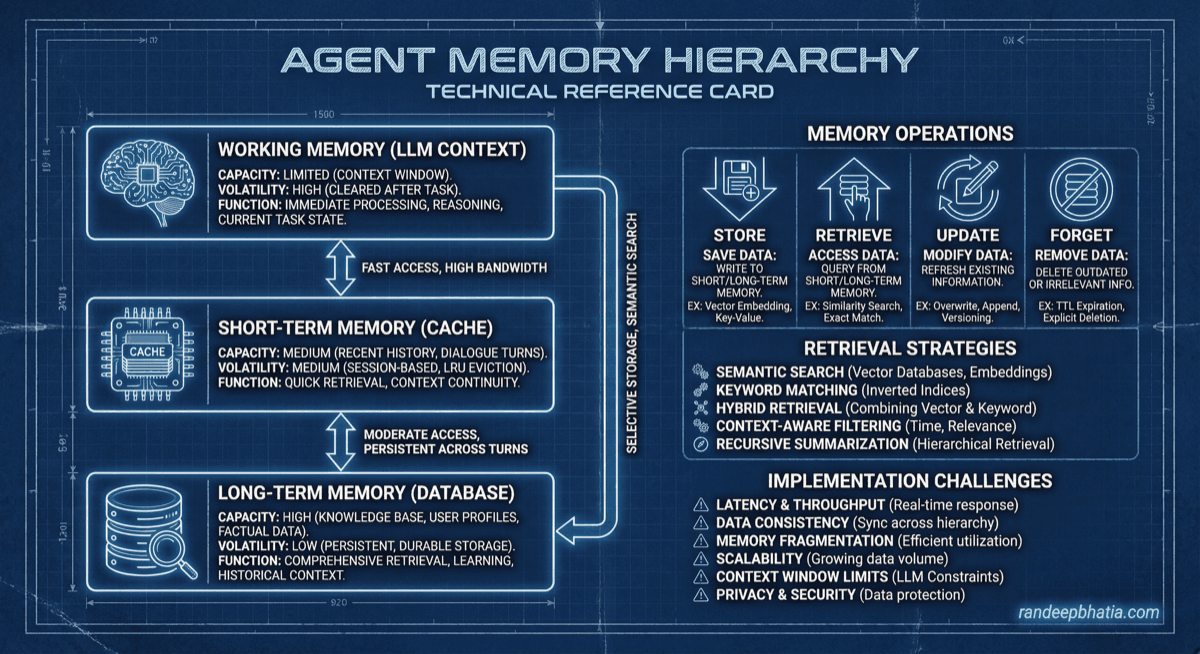
What is Agent Memory
Executive Summary
Executive Summary
Agent memory is the system of mechanisms that enable AI agents to store, organize, retrieve, and utilize information across interactions and time, extending beyond the limitations of a single context window.
Agent memory encompasses multiple memory types including working memory (active context), episodic memory (specific interactions and events), semantic memory (facts and knowledge), and procedural memory (learned behaviors and skills), each serving distinct functional purposes in agent operation.
Effective agent memory systems require careful architectural decisions around storage mechanisms, retrieval strategies, memory consolidation, and forgetting policies to balance recall accuracy, latency, cost, and relevance over extended operational periods.
Memory architecture directly impacts agent capabilities including personalization, task continuity, learning from experience, and maintaining coherent long-term relationships with users and environments.
The Bottom Line
Agent memory transforms stateless LLM interactions into persistent, contextually-aware agent experiences that can learn, adapt, and maintain continuity across sessions. Without robust memory systems, agents cannot build relationships, learn from mistakes, or handle complex multi-session tasks that require historical context.
Definition
Definition
Agent memory refers to the collection of systems, data structures, and retrieval mechanisms that enable AI agents to persist, organize, and access information beyond the immediate context window of the underlying language model.
These memory systems allow agents to maintain state across interactions, recall relevant past experiences, store learned knowledge, and exhibit continuity of behavior that mimics human-like memory capabilities.
Extended Definition
Agent memory architectures typically implement multiple memory tiers that mirror cognitive science models of human memory, including short-term working memory for immediate task context, episodic memory for storing specific interaction sequences and events, semantic memory for factual knowledge and relationships, and procedural memory for learned skills and behavioral patterns. These systems employ various storage backends including vector databases for semantic similarity retrieval, key-value stores for structured data, graph databases for relational knowledge, and traditional databases for transactional records. The effectiveness of agent memory depends not only on storage capacity but critically on retrieval mechanisms that surface relevant memories at appropriate times, memory consolidation processes that transform experiences into durable knowledge, and forgetting mechanisms that prevent memory systems from becoming overwhelmed with irrelevant or outdated information.
Etymology & Origins
The term 'agent memory' emerged from the convergence of two fields: autonomous agent research from artificial intelligence, where agents required state persistence for goal-directed behavior, and cognitive architecture research, which modeled human memory systems computationally. The application to large language model-based agents became prominent around 2022-2023 as practitioners recognized that context window limitations fundamentally constrained agent capabilities, necessitating external memory augmentation. The terminology draws heavily from cognitive psychology's classification of memory types (episodic, semantic, procedural) while adapting these concepts to the unique characteristics of neural language models.
Also Known As
Not To Be Confused With
Context window
The context window is the fixed-size input buffer of a language model that holds the current prompt and recent conversation, while agent memory refers to external systems that persist information beyond this window and selectively inject relevant memories into the context.
Model weights/parameters
Model weights represent learned knowledge encoded during training that is static at inference time, whereas agent memory is dynamic runtime storage that accumulates and changes during agent operation without modifying the underlying model.
RAG (Retrieval-Augmented Generation)
RAG typically refers to retrieving from static knowledge bases or document collections, while agent memory specifically concerns dynamic, agent-generated memories from interactions, experiences, and learned behaviors that evolve over time.
Caching
Caching is a performance optimization that stores computed results for reuse, while agent memory is a functional capability that stores meaningful information for reasoning and decision-making purposes.
Session state
Session state typically refers to temporary data maintained during a single user session, while agent memory encompasses persistent storage that survives across sessions and can span days, months, or years of interactions.
Fine-tuning
Fine-tuning permanently modifies model weights through additional training, while agent memory provides runtime knowledge augmentation without changing the base model, allowing for more flexible and reversible knowledge management.
Conceptual Foundation
Core Principles
(8 principles)Mental Models
(6 models)The Library with an Intelligent Librarian
Think of agent memory as a vast library where information is organized across different sections (memory types), with an intelligent librarian (retrieval system) who understands your current needs and fetches relevant books without you having to specify exact locations. The librarian also periodically reorganizes shelves, removes outdated materials, and creates summary cards for frequently accessed topics.
The Conversation Transcript with Highlights
Imagine every interaction as a transcript where certain passages are highlighted based on importance, with the highlights fading over time unless reinforced by relevance. The agent can quickly scan highlights rather than reading entire transcripts, and periodically, highlighted sections are consolidated into summary notes.
The Knowledge Graph Growing Organically
Visualize semantic memory as a graph that grows with each interaction, where new facts create nodes and relationships create edges. Some nodes become highly connected hubs while others remain peripheral, and the graph naturally clusters into topic regions that can be traversed during retrieval.
The Working Desk with Limited Space
Think of working memory as a desk with limited surface area where the agent can only have certain documents actively spread out. As new documents arrive, old ones must be filed away or discarded. The skill lies in predicting which documents will be needed and keeping them accessible.
The Personal Assistant with a Filing System
Imagine a personal assistant who maintains detailed files on every person, project, and topic you discuss. They know when to proactively surface relevant history and when to stay quiet, and they maintain separate files for facts versus events versus preferences.
The Sedimentary Rock Formation
Think of memory layers like geological strata where recent experiences sit on top in detailed form, while older experiences compress into denser, more summarized layers below. Occasionally, important deep memories get 'excavated' and brought to the surface when relevant.
Key Insights
(10 insights)The most common failure mode in agent memory systems is not storage limitations but retrieval failures where relevant memories exist but are not surfaced at the appropriate time due to poor indexing, inadequate query formulation, or overly restrictive filtering.
Memory systems that work well for single-user personal assistants often fail catastrophically in multi-user or multi-tenant scenarios due to privacy isolation requirements, cross-contamination risks, and the complexity of managing separate memory spaces.
The optimal memory retrieval strategy often combines multiple signals including semantic similarity, temporal recency, access frequency, explicit importance markers, and contextual relevance rather than relying on any single ranking factor.
Episodic memories are most valuable when they capture not just what happened but the context, emotional valence, and outcomes of events, enabling agents to learn from experience rather than merely recall facts.
Memory consolidation—the process of transforming raw experiences into durable knowledge—is often more important than raw storage capacity, as unconsolidated memories create retrieval noise and storage bloat.
The boundary between agent memory and external knowledge retrieval (RAG) is increasingly blurred, with modern systems treating agent-generated memories and external documents as unified retrieval targets with different provenance metadata.
Working memory management is often the binding constraint on agent capabilities, as even perfect long-term memory is useless if relevant information cannot be effectively injected into the limited context window.
Memory systems must handle the cold start problem where new users or new topics have no relevant memories, requiring graceful degradation to general knowledge without awkward acknowledgment of memory absence.
The most sophisticated memory systems implement memory about memory (metamemory), tracking what the agent knows it knows, what it knows it doesn't know, and confidence levels in stored information.
Privacy and security considerations often dominate memory architecture decisions in production systems, as stored memories may contain sensitive information that requires encryption, access control, retention limits, and audit trails.
When to Use
When to Use
Ideal Scenarios
(12)Building personal assistant agents that maintain ongoing relationships with users over weeks, months, or years, requiring recall of preferences, past conversations, and accumulated context about the user's life and work.
Developing customer service agents that need to maintain continuity across multiple support interactions, remembering previous issues, resolutions, and customer-specific context without requiring users to repeat information.
Creating autonomous agents that execute multi-step tasks spanning multiple sessions, where task state, intermediate results, and decision history must persist between invocations.
Implementing collaborative agents that work with teams and need to track different individuals' preferences, roles, communication styles, and relationship dynamics.
Building learning agents that should improve over time by remembering successful strategies, failed approaches, and feedback received across many interactions.
Developing agents for domains with evolving information where facts change over time and the agent must track the temporal validity of stored knowledge.
Creating agents that handle complex projects with many interrelated components, requiring memory of project structure, dependencies, decisions made, and rationale behind choices.
Implementing agents for regulated industries where interaction history must be maintained for compliance, audit, and accountability purposes.
Building agents that provide personalized recommendations based on accumulated understanding of user preferences, behaviors, and feedback over time.
Developing research or analysis agents that accumulate domain knowledge across many investigations and can leverage past findings in new contexts.
Creating agents for educational applications that track learner progress, adapt to individual learning patterns, and maintain continuity across learning sessions.
Implementing agents that coordinate with other agents or systems, requiring memory of commitments made, information shared, and coordination state.
Prerequisites
(8)Clear definition of what information types need to be remembered and for how long, as unbounded memory accumulation creates technical and compliance challenges.
Understanding of the user interaction patterns including session frequency, duration, and the typical time spans over which continuity is valuable.
Infrastructure for persistent storage that meets latency, reliability, and scalability requirements for the expected memory volume and access patterns.
Retrieval mechanisms capable of surfacing relevant memories from potentially large memory stores within acceptable latency budgets.
Privacy and security frameworks that address how sensitive information in memories will be protected, who can access it, and how long it will be retained.
Clear ownership model for memories in multi-user or multi-tenant scenarios, including how memories are isolated and how shared context is handled.
Monitoring and observability capabilities to track memory system health, retrieval quality, and storage growth over time.
Strategies for handling memory conflicts, contradictions, and corrections when users provide updated information that contradicts stored memories.
Signals You Need This
(10)Users frequently complain about having to repeat information they have already shared with the agent in previous conversations.
Agent responses lack personalization and treat every interaction as if it were the first, missing opportunities to leverage known user context.
Multi-step tasks fail because the agent loses track of progress, decisions, or intermediate results between sessions.
Users express frustration that the agent doesn't learn from corrections or feedback provided in earlier interactions.
The agent provides inconsistent responses to similar queries because it lacks memory of how it previously handled related situations.
Complex projects or ongoing relationships cannot be effectively supported because the agent has no continuity between interactions.
Users must maintain their own notes or records of agent interactions because the agent cannot recall relevant history.
The agent fails to recognize returning users or acknowledge the relationship history that should inform current interactions.
Task handoffs between sessions require extensive context re-establishment that wastes time and creates friction.
The agent cannot answer questions about its own past behavior, recommendations, or the reasoning behind previous decisions.
Organizational Readiness
(7)Data governance policies that address memory retention, user data rights, deletion requests, and compliance with relevant regulations like GDPR or CCPA.
Engineering capacity to build and maintain memory infrastructure including storage systems, retrieval pipelines, and monitoring dashboards.
Clear product requirements defining the memory capabilities users expect and the boundaries of what the agent should and should not remember.
Security review processes that can evaluate memory system designs for data protection, access control, and vulnerability risks.
Operational readiness to handle memory-related incidents including data corruption, retrieval failures, and privacy breaches.
User experience design that thoughtfully integrates memory capabilities including transparency about what is remembered and user control over their data.
Testing frameworks that can validate memory system behavior across extended time periods and complex interaction sequences.
When NOT to Use
When NOT to Use
Anti-Patterns
(12)Implementing complex memory systems for simple, stateless query-response applications where each interaction is independent and continuity provides no value.
Storing all interaction data indefinitely without clear retention policies, creating unbounded storage growth, compliance risks, and retrieval degradation.
Using memory as a substitute for proper knowledge base curation, storing facts in agent memory that should be maintained in authoritative external sources.
Implementing memory without retrieval quality validation, assuming that stored memories will be surfaced appropriately without testing and tuning.
Building memory systems without forgetting mechanisms, leading to accumulation of outdated, contradictory, or irrelevant information that degrades agent performance.
Storing sensitive information in memory without appropriate encryption, access controls, and audit capabilities.
Implementing memory for multi-tenant applications without proper isolation, risking cross-contamination of user data.
Using memory to compensate for inadequate base model capabilities, when fine-tuning or model selection would be more appropriate.
Building elaborate memory architectures before validating that memory capabilities actually improve user outcomes and satisfaction.
Implementing memory without user transparency or control, creating trust issues when users discover the agent remembers things they didn't expect.
Storing raw conversation logs as memory without extraction, summarization, or structuring, creating retrieval challenges and storage inefficiency.
Building memory systems that cannot be debugged or explained, making it impossible to understand why certain memories are or are not surfaced.
Red Flags
(10)The application has no clear use case for information that persists beyond a single conversation session.
Privacy requirements prohibit storing user interaction data, making memory systems fundamentally incompatible with constraints.
The expected interaction volume would create memory storage and retrieval costs that exceed the value provided.
Users interact anonymously or pseudonymously with no persistent identity to associate memories with.
The domain involves rapidly changing information where stored memories would quickly become outdated and misleading.
Regulatory requirements mandate that no conversation data be retained beyond immediate processing needs.
The application serves one-time or infrequent users where accumulated memory would rarely be leveraged.
Memory retrieval latency requirements cannot be met with available infrastructure and expected memory volumes.
The organization lacks the engineering capacity to properly maintain, monitor, and evolve memory systems over time.
User research indicates that memory capabilities are not valued or are actively concerning to the target user population.
Better Alternatives
(8)The agent needs access to factual knowledge that doesn't change based on user interactions
Retrieval-Augmented Generation (RAG) with curated knowledge bases
Static knowledge is better maintained in authoritative sources with proper curation workflows rather than accumulated in agent memory where it may become stale or inconsistent.
The agent needs to exhibit consistent personality and knowledge without per-user customization
Fine-tuning or system prompt engineering
Baked-in knowledge and behavior through training or prompting is more reliable and efficient than runtime memory retrieval for static agent characteristics.
Users need to maintain records of agent interactions for their own reference
Conversation export and user-controlled history
Giving users control over their own interaction history respects privacy, reduces system complexity, and places data ownership appropriately.
The application needs to track user preferences for a single session
Session state management without persistent storage
Temporary session state is simpler to implement, has no retention concerns, and is sufficient when continuity beyond the session is not needed.
The agent needs to handle complex multi-step tasks within a single session
Structured task state management with explicit state machines
Explicit task state is more reliable and debuggable than memory-based continuity for well-defined workflows.
The organization needs to analyze patterns across many user interactions
Analytics pipelines separate from agent memory
Analytical workloads have different requirements than agent memory retrieval and are better served by dedicated analytics infrastructure.
The agent needs to maintain consistency in a single long conversation
Context window management with summarization
Within-session consistency can often be achieved through careful context management without the complexity of persistent memory systems.
Users want to explicitly save and retrieve specific information
Explicit note-taking or bookmarking features
User-controlled explicit storage is more transparent and gives users agency over what is remembered rather than implicit memory accumulation.
Common Mistakes
(10)Treating memory as a simple key-value store without considering the complexity of retrieval, relevance ranking, and context injection.
Underestimating the importance of memory retrieval quality and over-investing in storage capacity that cannot be effectively utilized.
Failing to implement forgetting mechanisms, leading to memory systems that degrade over time as irrelevant information accumulates.
Not testing memory systems over realistic time spans, missing issues that only emerge after weeks or months of memory accumulation.
Implementing memory without user transparency, creating trust issues when users discover unexpected recall capabilities.
Storing memories without sufficient metadata for filtering, making it impossible to implement time-based, topic-based, or relevance-based retrieval.
Neglecting the cold start experience, creating awkward interactions when the agent has no memories to draw upon.
Over-injecting memories into context, crowding out space for current task information and degrading response quality.
Failing to handle memory conflicts when users provide information that contradicts stored memories.
Not implementing proper isolation in multi-tenant systems, risking privacy violations through memory cross-contamination.
Core Taxonomy
Core Taxonomy
Primary Types
(7 types)The active, limited-capacity memory that holds information currently being processed, typically implemented through the context window of the language model plus any scratchpad or state management mechanisms.
Characteristics
- Strictly limited capacity determined by model context window size
- Fastest access latency as information is already in the active prompt
- Volatile and cleared between sessions or when context is reset
- Requires active management to decide what information to include
- Directly impacts response quality as it forms the immediate reasoning context
Use Cases
Tradeoffs
Working memory provides the fastest access but is severely capacity-constrained, requiring careful curation of what information occupies this premium space versus what is stored in longer-term memory for retrieval when needed.
Classification Dimensions
Persistence Duration
Classification based on how long memories are retained before expiration or consolidation, with different storage and retrieval strategies appropriate for each duration.
Storage Mechanism
Classification based on the underlying storage technology, each with different characteristics for retrieval, scaling, and query capabilities.
Retrieval Trigger
Classification based on what initiates memory retrieval, affecting how memories are surfaced and integrated into agent responses.
Granularity Level
Classification based on the level of processing and compression applied to stored memories, trading off fidelity against storage efficiency and retrieval performance.
Ownership Model
Classification based on who owns and controls the memories, affecting privacy, access control, and data governance requirements.
Mutability
Classification based on whether and how memories can be modified after initial storage, affecting consistency guarantees and audit capabilities.
Evolutionary Stages
No Memory (Stateless)
Initial prototype or MVP stage, typically 0-2 months into developmentAgent treats each interaction as independent with no persistence, relying entirely on information provided in the current prompt. Simple to implement but severely limits agent capabilities for ongoing relationships or complex tasks.
Session Memory
Early production stage, typically 2-6 months into developmentAgent maintains context within a single conversation session through context window management and possibly summarization, but loses all state between sessions. Enables coherent conversations but no long-term continuity.
Basic Persistent Memory
Maturing product stage, typically 6-12 months into developmentAgent stores key information between sessions, typically user preferences and important facts, with simple retrieval mechanisms. Enables basic personalization and continuity but limited in scope and retrieval sophistication.
Structured Memory System
Mature product stage, typically 12-24 months into developmentAgent implements multiple memory types with appropriate storage backends, retrieval mechanisms, and memory management policies. Enables sophisticated personalization, learning, and long-term relationships.
Adaptive Memory Architecture
Advanced product stage, typically 24+ months into developmentAgent memory system continuously optimizes itself based on usage patterns, retrieval effectiveness, and user feedback. Implements sophisticated consolidation, forgetting, and retrieval ranking that improves over time.
Architecture Patterns
(7 patterns)Sliding Window with Summarization
Maintains a fixed-size context window with recent conversation history, periodically summarizing older content into condensed form that is prepended to the context. Balances recency with historical context within token limits.
Components
- Context window manager
- Summarization service (LLM-based)
- Summary storage
- Window size configuration
- Summarization trigger logic
Data Flow
New messages enter the context window, pushing older messages toward summarization threshold. When threshold is reached, oldest messages are summarized and the summary replaces them. Summaries may be hierarchically re-summarized as they age.
Best For
- Long-running conversations that exceed context limits
- Applications where recent context is most important
- Cost-sensitive deployments where full history storage is expensive
Limitations
- Information loss through summarization is irreversible
- Summarization quality depends on LLM capabilities
- Cannot retrieve specific details from summarized content
- Summarization adds latency to conversation flow
Scaling Characteristics
Scales well with conversation length as summarization bounds context size. Summarization latency becomes a factor in high-throughput scenarios. Storage scales linearly with summary retention policy.
Integration Points
Language Model
Consumes retrieved memories through context injection and generates content that may become new memories
Context window limits constrain memory injection volume. Memory formatting affects LLM comprehension. Token costs scale with injected memory size.
Vector Database
Stores and retrieves memory embeddings for semantic similarity search
Embedding model must match between storage and retrieval. Index configuration affects query performance. Metadata schema must be designed upfront.
User Identity System
Associates memories with user identities and enforces access control
Memory isolation must be enforced at storage level. User deletion must cascade to memory deletion. Anonymous users require special handling.
Conversation Manager
Tracks conversation state and triggers memory operations at appropriate points
Memory operations should not block conversation flow. Retrieval timing affects response latency. Storage can be asynchronous.
Analytics Pipeline
Collects memory system metrics and retrieval quality signals for optimization
Analytics should not impact memory system performance. Privacy considerations apply to logged data. Feedback loops enable retrieval optimization.
Background Processing
Executes asynchronous memory operations including consolidation, cleanup, and optimization
Background jobs should not impact foreground latency. Job failures must be handled gracefully. Processing windows should avoid peak usage times.
Monitoring System
Tracks memory system health, performance, and capacity
Monitoring overhead should be minimal. Key metrics must be identified and tracked. Alerting thresholds require tuning.
Compliance System
Enforces data retention policies, handles deletion requests, and maintains audit trails
Deletion must be complete and verifiable. Audit trails must not contain sensitive content. Retention policies vary by jurisdiction.
Decision Framework
Decision Framework
Persistent memory is required; proceed to determine memory types needed
Session-only memory through context management may be sufficient
Consider user expectations, task complexity, and relationship duration when evaluating persistence needs
Technical Deep Dive
Technical Deep Dive
Overview
Agent memory systems operate through a continuous cycle of observation, encoding, storage, retrieval, and utilization that mirrors cognitive memory processes. When an agent interacts with users or environments, relevant information is extracted and transformed into storable representations through encoding processes that may include embedding generation, entity extraction, summarization, or structured parsing. These encoded memories are persisted to appropriate storage backends based on memory type, with metadata including timestamps, importance scores, and contextual tags that enable later retrieval. Retrieval is triggered either explicitly by user queries, implicitly by context analysis, or proactively by the agent's reasoning process. The retrieval system formulates queries against memory stores, executes searches across potentially multiple backends, ranks and filters results based on relevance, recency, and importance, and formats selected memories for injection into the language model's context. The language model then generates responses that incorporate retrieved memories, and the cycle continues as new interactions create new memories. The effectiveness of this cycle depends critically on the quality of each stage: encoding must capture salient information without excessive noise, storage must be organized for efficient retrieval, retrieval must surface relevant memories without overwhelming the context, and utilization must appropriately integrate memories into responses. Failures at any stage propagate through the system, making end-to-end optimization essential.
Step-by-Step Process
The memory system observes agent interactions including user messages, agent responses, tool calls, and environmental observations. Raw interaction data is captured with full context including timestamps, participant identities, and session metadata.
Capturing too much raw data creates storage bloat; capturing too little loses important context. Observation must be selective based on memory policies.
Under The Hood
At the implementation level, agent memory systems typically comprise several interconnected subsystems that must work together seamlessly. The encoding subsystem interfaces with embedding models (often the same or similar to the base language model) to generate vector representations of memories. These embeddings capture semantic meaning in high-dimensional space where similar concepts cluster together, enabling retrieval based on meaning rather than exact keyword matching. The embedding process must balance dimensionality (higher dimensions capture more nuance but increase storage and computation costs) with practical constraints. The storage layer typically employs specialized databases optimized for different access patterns. Vector databases like Pinecone, Weaviate, Milvus, or Chroma implement approximate nearest neighbor (ANN) algorithms such as HNSW (Hierarchical Navigable Small World) or IVF (Inverted File Index) that enable sub-linear search time even with millions of vectors. These algorithms trade perfect recall for dramatic speed improvements, with tunable parameters that control the precision-speed tradeoff. Graph databases store relational knowledge as nodes and edges, enabling queries that traverse relationships. For example, finding all projects a user has worked on, then finding all documents related to those projects, requires multi-hop traversal that graph databases optimize through index structures and query planners. The challenge lies in translating natural language queries into graph query languages like Cypher or Gremlin. The retrieval orchestration layer coordinates queries across multiple backends, implements caching strategies to reduce latency for frequently accessed memories, and manages the ranking and fusion of results from different sources. This layer often implements a retrieval pipeline with multiple stages: initial broad retrieval, re-ranking with more expensive models, and final selection based on diversity and budget constraints. Memory consolidation processes run asynchronously to maintain memory system health. These include summarization jobs that compress old episodic memories into semantic knowledge, deduplication processes that identify and merge redundant memories, decay functions that reduce importance scores over time, and cleanup jobs that remove expired or irrelevant memories. These processes must be carefully scheduled to avoid impacting foreground latency while keeping memory systems performant. The context injection mechanism must carefully format memories for the language model, typically using structured templates that clearly delineate memory content from current conversation. Research suggests that memory placement in the prompt affects utilization, with memories placed closer to the current query often receiving more attention. Some systems implement dynamic memory formatting that adjusts based on memory type and current task requirements.
Failure Modes
Failure Modes
Storage backend failure, network partition, or service outage preventing memory access
- Memory retrieval timeouts
- Agent responses lack personalization
- Error logs showing connection failures
- Increased response latency from retry attempts
Agent operates without memory context, degrading to stateless behavior. User experience significantly impacted for personalization-dependent applications.
Implement redundant storage with replication, use managed services with SLAs, design for graceful degradation
Implement circuit breakers to fail fast, cache recent memories locally, provide meaningful responses without memory context
Operational Considerations
Key Metrics (15)
Time from retrieval request to results returned, measuring end-to-end retrieval performance
Dashboard Panels
Alerting Strategy
Implement tiered alerting with different severity levels and response expectations. Critical alerts (data loss risk, security issues, complete outages) should page on-call immediately. Warning alerts (degraded performance, approaching limits) should notify during business hours. Informational alerts (trends, anomalies) should be reviewed in regular operations reviews. Use alert aggregation to prevent alert fatigue during cascading issues. Implement alert dependencies so downstream alerts are suppressed when upstream causes are already alerted.
Cost Analysis
Cost Analysis
Cost Drivers
(10)Vector Storage
Scales linearly with memory count and embedding dimensions. Typically $0.01-0.10 per 1000 vectors per month depending on provider and index type.
Use appropriate embedding dimensions (smaller if quality permits), implement retention policies to limit growth, consider tiered storage for old memories
Embedding Generation
Cost per embedding varies by model ($0.0001-0.001 per embedding). High-volume systems can incur significant costs.
Cache embeddings for repeated content, batch embedding requests, use smaller models where quality permits, avoid re-embedding unchanged content
LLM Calls for Extraction/Summarization
Memory extraction and consolidation require LLM calls. Costs scale with interaction volume and summarization frequency.
Use smaller models for extraction tasks, batch consolidation operations, implement smart triggering to avoid unnecessary processing
Storage Backend Infrastructure
Database hosting, compute, and network costs. Can be significant for high-availability configurations.
Right-size infrastructure based on actual load, use reserved capacity for predictable workloads, implement auto-scaling for variable load
Retrieval Query Volume
Each retrieval incurs compute costs for embedding, search, and ranking. High-frequency retrieval multiplies costs.
Cache frequent queries, implement smart retrieval triggering, batch queries where possible
Data Transfer
Network egress costs for cloud-hosted storage, especially for large memory payloads.
Co-locate compute and storage, compress memory payloads, minimize unnecessary data transfer
Backup and Redundancy
Maintaining backups and replicas multiplies storage costs. Cross-region replication adds network costs.
Implement tiered backup strategies, use incremental backups, balance redundancy against cost
Monitoring and Logging
Observability infrastructure costs scale with log volume and metric cardinality.
Sample logs appropriately, aggregate metrics, retain detailed logs only for debugging periods
Compliance and Security
Encryption, audit logging, and compliance tooling add overhead costs.
Implement efficient encryption, optimize audit log retention, automate compliance processes
Development and Operations
Engineering time for building, maintaining, and operating memory systems.
Use managed services where appropriate, invest in automation, build reusable components
Cost Models
Per-User Memory Cost
Cost = (avg_memories_per_user × storage_cost_per_memory) + (avg_retrievals_per_user × retrieval_cost) + (avg_writes_per_user × write_cost)User with 1000 memories, 500 retrievals/month, 100 writes/month: (1000 × $0.0001) + (500 × $0.001) + (100 × $0.002) = $0.10 + $0.50 + $0.20 = $0.80/month
Infrastructure Baseline Cost
Cost = database_hosting + compute_instances + network_baseline + monitoring_toolsSmall deployment: $200 (DB) + $300 (compute) + $100 (network) + $150 (monitoring) = $750/month baseline
Scaling Cost Projection
Cost_at_scale = baseline_cost + (user_count × per_user_cost) + (user_count / users_per_shard × shard_overhead)10,000 users: $750 + (10000 × $0.80) + (10000/5000 × $500) = $750 + $8000 + $1000 = $9,750/month
Total Cost of Ownership
TCO = (infrastructure_cost × 12) + (engineering_hours × hourly_rate) + (incident_cost × expected_incidents) + (compliance_cost)Annual TCO: ($9750 × 12) + (500 hours × $150) + ($5000 × 4) + $10000 = $117,000 + $75,000 + $20,000 + $10,000 = $222,000/year
Optimization Strategies
- 1Implement aggressive retention policies that delete or archive old, low-value memories
- 2Use tiered storage with hot/warm/cold tiers based on memory access patterns
- 3Cache frequently accessed memories to reduce retrieval costs
- 4Batch embedding generation and consolidation operations for efficiency
- 5Use smaller embedding models where retrieval quality permits
- 6Implement smart retrieval triggering to avoid unnecessary queries
- 7Right-size infrastructure based on actual usage patterns
- 8Use spot/preemptible instances for batch processing workloads
- 9Compress memory content before storage where appropriate
- 10Implement per-user quotas to prevent runaway growth
- 11Use reserved capacity pricing for predictable baseline load
- 12Optimize embedding dimensions based on quality requirements
Hidden Costs
- 💰Re-embedding costs when embedding models are updated
- 💰Data migration costs when changing storage backends
- 💰Compliance audit and remediation costs
- 💰Incident response and recovery costs
- 💰User support costs for memory-related issues
- 💰Opportunity cost of engineering time on memory infrastructure versus features
- 💰Technical debt accumulation from deferred maintenance
- 💰Security breach costs including notification and remediation
ROI Considerations
The return on investment for agent memory systems depends heavily on the application domain and user expectations. For personal assistant applications, memory enables personalization that significantly improves user satisfaction and retention, with studies showing 20-40% improvement in user engagement for memory-enabled assistants. For customer service applications, memory reduces repeat information gathering, decreasing average handle time by 15-30% and improving customer satisfaction scores. For enterprise applications, memory enables complex multi-session workflows that would otherwise require manual context management. However, ROI must be weighed against implementation and operational costs. Simple applications may not justify the complexity, and poorly implemented memory systems can actually harm user experience through irrelevant retrieval or privacy concerns. The break-even point typically requires either high user engagement (many interactions per user) or high value per interaction (enterprise or premium consumer applications). Organizations should start with minimal viable memory implementations, measure impact on key metrics, and expand memory capabilities based on demonstrated value rather than assuming memory will automatically improve outcomes.
Security Considerations
Threat Model
(10 threats)Memory Data Breach
Unauthorized access to memory storage through compromised credentials, SQL injection, or infrastructure vulnerability
Exposure of sensitive user information stored in memories, potential regulatory violations, reputational damage
Encrypt memories at rest and in transit, implement strong access controls, regular security audits, intrusion detection
Cross-Tenant Memory Access
Exploitation of isolation vulnerabilities to access other users' memories through parameter manipulation or logic flaws
Privacy violation, exposure of confidential information, loss of user trust
Enforce tenant isolation at storage level, validate tenant context on all operations, regular isolation testing
Memory Injection Attack
Malicious content stored in memories designed to manipulate agent behavior when retrieved
Agent manipulation, prompt injection through memory, unauthorized actions
Sanitize memory content, implement content filtering, validate memory sources, monitor for suspicious patterns
Memory Exfiltration via Agent
Crafted queries designed to cause agent to reveal stored memories inappropriately
Information disclosure, privacy violation, potential for social engineering
Implement output filtering, monitor for unusual memory access patterns, limit memory disclosure in responses
Denial of Service via Memory
Flooding memory system with excessive writes or queries to exhaust resources
Memory system unavailability, degraded agent performance, increased costs
Implement rate limiting, quotas, and resource isolation; monitor for abuse patterns
Memory Poisoning
Deliberately storing false or misleading information to corrupt agent knowledge
Agent provides incorrect information, trust degradation, potential for manipulation
Implement memory provenance tracking, confidence scoring, contradiction detection
Insider Threat
Malicious or negligent employee accessing memory data inappropriately
Privacy violation, data theft, unauthorized modifications
Implement least-privilege access, audit logging, separation of duties, background checks
Memory Persistence After Deletion
Incomplete deletion leaving memory remnants in backups, caches, or derived data
Compliance violations, privacy concerns, potential data exposure
Implement comprehensive deletion across all storage locations, verify deletion completion, manage backup retention
Side-Channel Information Leakage
Inferring memory contents through timing attacks, error messages, or behavioral analysis
Indirect information disclosure, privacy erosion
Implement constant-time operations where feasible, sanitize error messages, monitor for inference attacks
Supply Chain Compromise
Compromised dependencies or third-party services used in memory pipeline
Data exposure, system compromise, integrity violations
Vendor security assessment, dependency scanning, isolation of third-party components
Security Best Practices
- ✓Encrypt all memory data at rest using strong encryption (AES-256 or equivalent)
- ✓Encrypt all memory data in transit using TLS 1.3
- ✓Implement row-level security for multi-tenant memory isolation
- ✓Use parameterized queries to prevent injection attacks
- ✓Implement comprehensive audit logging for all memory operations
- ✓Apply principle of least privilege for all memory system access
- ✓Regularly rotate encryption keys and access credentials
- ✓Implement rate limiting and quotas to prevent abuse
- ✓Sanitize and validate all memory content before storage
- ✓Monitor for anomalous access patterns and alert on suspicious activity
- ✓Implement secure deletion that covers all storage locations
- ✓Regular penetration testing of memory systems
- ✓Security review of memory-related code changes
- ✓Incident response plan specific to memory system breaches
- ✓Regular backup integrity verification and secure backup storage
Data Protection
- 🔒Classify memory content by sensitivity level and apply appropriate protections
- 🔒Implement data loss prevention (DLP) scanning for memories containing sensitive patterns
- 🔒Use tokenization or pseudonymization for highly sensitive data elements
- 🔒Implement access logging that captures who accessed what memories when
- 🔒Regular data protection impact assessments for memory systems
- 🔒Clear data processing agreements with any third-party memory service providers
- 🔒User consent mechanisms for memory collection and retention
- 🔒Transparency about what is stored in memory and how it is used
- 🔒Regular review and purge of unnecessary sensitive data in memories
- 🔒Incident response procedures specific to memory data breaches
Compliance Implications
GDPR (General Data Protection Regulation)
Right to erasure, data minimization, purpose limitation, data subject access rights
Implement complete deletion capability, retention policies, purpose tracking, data export functionality
CCPA (California Consumer Privacy Act)
Right to know, right to delete, right to opt-out of sale
Memory inventory capability, deletion workflows, opt-out mechanisms for memory collection
HIPAA (Health Insurance Portability and Accountability Act)
Protected health information safeguards, access controls, audit trails
PHI identification and special handling, enhanced encryption, comprehensive audit logging
SOC 2
Security, availability, processing integrity, confidentiality, privacy controls
Documented security controls, monitoring, incident response, access management
PCI DSS (Payment Card Industry Data Security Standard)
Cardholder data protection, access control, monitoring
Identify and exclude payment data from memories, or implement full PCI compliance for memory systems
FERPA (Family Educational Rights and Privacy Act)
Student education record protection
Special handling for educational context memories, parental access rights, disclosure limitations
AI-Specific Regulations (EU AI Act, etc.)
Transparency, human oversight, data governance for AI systems
Memory system documentation, explainability of memory usage, data quality controls
Data Localization Requirements
Data residency within specific jurisdictions
Region-specific memory storage, cross-border transfer controls, jurisdiction-aware routing
Scaling Guide
Scaling Guide
Scaling Dimensions
Memory Volume
Horizontal scaling of storage backends, sharding by user or time, tiered storage for different memory ages
Vector databases typically scale to billions of vectors; beyond that requires distributed architectures
Retrieval quality may degrade with volume; implement quality monitoring and adjust retrieval strategies
User Count
Partition memories by user for isolation and parallelism, implement per-user quotas, scale infrastructure proportionally
Practical limits depend on per-user memory volume and access patterns
Multi-tenant isolation becomes more critical at scale; implement robust tenant boundary enforcement
Query Throughput
Read replicas for query distribution, caching layers, query optimization, horizontal scaling of retrieval infrastructure
Embedding generation often becomes bottleneck; scale embedding services accordingly
Cache hit rates significantly impact cost and latency at scale
Write Throughput
Write buffering and batching, asynchronous processing, horizontal scaling of write path
Consistency requirements may limit write parallelism
High write volumes require efficient consolidation to prevent storage bloat
Memory Complexity
Specialized storage for different memory types, optimized indexes for complex queries
Graph traversal complexity grows with relationship density
Complex memory structures require more sophisticated retrieval and may have higher latency
Geographic Distribution
Regional deployments with data residency compliance, cross-region replication for availability
Cross-region latency affects retrieval performance; data residency may prevent replication
Global users may require regional memory instances with careful data placement
Retrieval Latency Requirements
Caching, index optimization, approximate search tuning, infrastructure proximity
Physical network latency sets floor; embedding generation adds irreducible delay
Stricter latency requirements may require tradeoffs in retrieval quality or memory volume
Compliance Scope
Modular compliance controls, jurisdiction-aware data handling, automated compliance verification
Conflicting regulations may require separate deployments
Compliance overhead scales with regulatory scope and may require specialized infrastructure
Capacity Planning
Required Storage = users × memories_per_user × bytes_per_memory × (1 + redundancy_factor) × (1 + growth_buffer). Required Compute = (queries_per_second × query_compute_cost) + (writes_per_second × write_compute_cost) × (1 + headroom_factor)Plan for 2x expected load for initial deployment, with ability to scale to 5x within acceptable timeframe. Maintain 30% headroom on storage and 50% headroom on compute for traffic spikes.
Scaling Milestones
- Validating memory value proposition
- Establishing baseline metrics
- Iterating on memory types and retrieval
Single-instance storage, simple retrieval, manual operations acceptable
- Ensuring reliability and availability
- Implementing proper monitoring
- Handling first scaling issues
Managed database services, basic redundancy, automated backups, monitoring dashboards
- Cost optimization becomes important
- Retrieval quality at scale
- Operational burden increases
Implement caching, optimize retrieval, add retention policies, automate operations
- Infrastructure costs significant
- Multi-region requirements emerge
- Team specialization needed
Sharded storage, regional deployments, dedicated memory team, sophisticated monitoring
- Distributed systems complexity
- Compliance at scale
- Cost efficiency critical
Fully distributed architecture, tiered storage, advanced cost optimization, compliance automation
- Custom infrastructure may be needed
- Global distribution complexity
- Organizational scaling
Custom-built components where needed, global architecture, dedicated platform team, continuous optimization
Benchmarks
Benchmarks
Industry Benchmarks
| Metric | P50 | P95 | P99 | World Class |
|---|---|---|---|---|
| Memory Retrieval Latency | 50-100ms | 150-300ms | 300-500ms | p50 < 30ms, p99 < 200ms |
| Retrieval Relevance (Precision@5) | 60-70% | 80-85% | 90%+ | >85% average precision |
| Memory Write Latency | 20-50ms | 100-200ms | 200-500ms | p50 < 20ms, p99 < 100ms |
| System Availability | 99.5% | 99.9% | 99.95% | >99.99% |
| Storage Efficiency (bytes per memory) | 20-50KB | 10-20KB | 5-10KB | <5KB with full functionality |
| Consolidation Ratio | 3:1 | 5:1 | 10:1 | >10:1 without quality loss |
| Cold Start to First Memory | 3-5 interactions | 1-2 interactions | First interaction | Meaningful memory from first interaction |
| Deletion Request Completion | 24-48 hours | 4-8 hours | 1-2 hours | <1 hour complete deletion |
| Cross-Tenant Isolation | 99.99% | 99.999% | 99.9999% | 100% (zero violations) |
| Memory Utilization in Responses | 40-50% | 60-70% | 80%+ | >70% of responses meaningfully use memory |
| User Satisfaction with Memory | 3.5/5 | 4.0/5 | 4.5/5 | >4.5/5 user rating |
| Cost per User per Month | $1-2 | $0.50-1 | $0.25-0.50 | <$0.25 at scale |
Comparison Matrix
| Approach | Retrieval Quality | Latency | Cost | Complexity | Scalability | Best For |
|---|---|---|---|---|---|---|
| Context Window Only | N/A | None added | Minimal | Low | Unlimited | Simple, stateless applications |
| Simple Key-Value Store | Exact match only | Very Low | Low | Low | High | Structured data, known keys |
| Vector Store (Single) | Good semantic | Low-Medium | Medium | Medium | High | General-purpose memory |
| Knowledge Graph | Excellent relational | Medium | Medium-High | High | Medium | Relationship-heavy domains |
| Hybrid (Vector + Graph) | Excellent | Medium-High | High | Very High | Medium | Complex enterprise applications |
| Memory Stream | Good temporal | Medium | High | High | Medium | Simulation, continuous agents |
| Hierarchical Memory | Good multi-level | Low-Medium | Medium | High | High | Long-term relationships |
| Managed Memory Service | Varies | Medium | Medium-High | Low | High | Quick deployment, limited resources |
Performance Tiers
Simple key-value or basic vector storage, single retrieval method, minimal optimization
Retrieval latency <500ms, basic relevance, manual operations
Optimized vector storage, relevance ranking, basic consolidation, monitoring
Retrieval latency <200ms, 70%+ relevance, automated operations
Multiple memory types, hybrid retrieval, sophisticated consolidation, full observability
Retrieval latency <100ms, 80%+ relevance, self-healing operations
Full-featured memory architecture, compliance controls, global scale, advanced optimization
Retrieval latency <50ms, 85%+ relevance, proactive operations
State-of-the-art retrieval, continuous learning, predictive capabilities, industry-leading efficiency
Retrieval latency <30ms, 90%+ relevance, autonomous optimization
Real World Examples
Real World Examples
Real-World Scenarios
(6 examples)Personal AI Assistant with Long-Term Memory
A consumer AI assistant application serving millions of users who expect the assistant to remember their preferences, past conversations, and personal context across months of interaction.
Implemented hierarchical memory with user preference store (semantic), conversation history (episodic with summarization), and task memory (procedural). Used vector database for semantic retrieval with aggressive summarization of old conversations. Implemented strict per-user isolation and GDPR-compliant deletion.
User engagement increased 35% after memory features launched. Average session length increased as users could continue complex tasks across sessions. Support tickets for 'assistant forgot' issues decreased 80%.
- 💡Users value memory but are sensitive to privacy; transparency about what is remembered is essential
- 💡Summarization quality directly impacts user perception of memory capability
- 💡Cold start experience requires careful design to avoid awkward 'I don't know you' interactions
- 💡Memory retrieval failures are more noticeable than no memory at all
Enterprise Customer Service Agent
A B2B customer service platform where agents handle complex technical support cases that span multiple interactions over days or weeks, with strict compliance requirements.
Implemented case-based memory that tracks all interactions within a support case, customer profile memory for cross-case context, and knowledge base integration for product information. Used structured storage for case data with vector search for similar past cases.
Average case resolution time decreased 25% due to reduced context re-gathering. Customer satisfaction scores improved as customers didn't need to repeat information. Compliance audits passed with comprehensive interaction logging.
- 💡Structured case memory is more valuable than general conversation memory for support scenarios
- 💡Similar case retrieval helps agents but requires careful relevance tuning to avoid misleading suggestions
- 💡Compliance requirements drove many architecture decisions; design for compliance from the start
- 💡Integration with existing CRM systems was more complex than anticipated
Educational Tutoring Agent
An AI tutor for K-12 students that needs to track learning progress, adapt to individual learning styles, and maintain continuity across study sessions over an academic year.
Implemented learner model memory tracking knowledge state, misconceptions, and learning preferences. Used spaced repetition principles for memory retrieval to reinforce learning. Implemented parent/teacher visibility into memory with appropriate access controls.
Learning outcome improvements of 20% compared to non-memory baseline. Students reported feeling 'understood' by the tutor. Teachers valued visibility into student progress.
- 💡Educational memory requires different retention strategies than general assistant memory
- 💡Tracking misconceptions is as important as tracking knowledge
- 💡Privacy considerations for minors require extra care and parental controls
- 💡Memory of emotional states and frustration helps adapt tutoring approach
Multi-Agent Research System
A research platform where multiple specialized AI agents collaborate on complex analysis tasks, requiring shared memory for coordination and individual memory for specialization.
Implemented shared memory space for coordination and findings, individual agent memory for specialization, and project memory for long-running research threads. Used graph database for relationship-heavy research knowledge.
Research tasks that previously required human coordination could be handled autonomously. Knowledge accumulated across projects improved efficiency over time. Audit trail of agent reasoning supported research validation.
- 💡Shared memory requires careful access control to prevent agents from overwriting each other
- 💡Conflict resolution for contradictory findings is a hard problem requiring human oversight
- 💡Memory provenance (which agent contributed what) is essential for debugging and trust
- 💡Graph-based memory excels for research but requires significant schema design effort
Healthcare Patient Companion
A patient-facing health companion that helps manage chronic conditions, track symptoms, and prepare for doctor visits, with strict HIPAA compliance requirements.
Implemented symptom tracking memory, medication and treatment memory, and conversation memory for emotional support continuity. All memory encrypted with patient-controlled access. Implemented comprehensive audit logging and retention policies.
Patients reported better preparation for doctor visits with memory-generated summaries. Symptom pattern detection improved early intervention. Compliance requirements met with documented controls.
- 💡Healthcare memory requires extreme care with data classification and protection
- 💡Patients value control over their health data; implement robust consent and access management
- 💡Integration with healthcare systems (EHR) is complex but valuable
- 💡Memory accuracy is critical; implement confidence scoring and verification
Gaming NPC with Persistent Memory
Non-player characters in an open-world game that remember player interactions, form relationships, and exhibit consistent personalities across play sessions.
Implemented relationship memory tracking player interactions and sentiment, world state memory for NPC awareness of game events, and personality memory for consistent character behavior. Optimized for low-latency retrieval to support real-time gameplay.
Player engagement metrics improved significantly with memory-enabled NPCs. Players reported more immersive experience. Emergent storytelling from NPC memories created viral moments.
- 💡Gaming memory requires very low latency; aggressive caching and optimization essential
- 💡Memory consistency across NPCs creates believable world; implement shared world memory
- 💡Players test memory limits; handle edge cases gracefully
- 💡Memory enables emergent gameplay that designers didn't anticipate
Industry Applications
Financial Services
Wealth management advisors with client relationship memory, investment preference tracking, and regulatory-compliant interaction logging
Strict regulatory requirements (SEC, FINRA), fiduciary responsibility implications, audit trail requirements, sensitive financial data protection
Healthcare
Patient engagement agents with health history memory, treatment plan tracking, and care coordination across providers
HIPAA compliance, clinical accuracy requirements, integration with EHR systems, patient consent management
Legal
Legal research assistants with case memory, client matter tracking, and precedent knowledge accumulation
Attorney-client privilege protection, conflict checking requirements, citation accuracy, document retention policies
Education
Adaptive learning systems with student progress memory, learning style adaptation, and curriculum personalization
FERPA compliance, age-appropriate interactions, parental visibility, learning outcome measurement
Retail/E-commerce
Shopping assistants with preference memory, purchase history integration, and personalized recommendation enhancement
Privacy regulations (CCPA, GDPR), recommendation explainability, cross-channel memory consistency
Human Resources
Employee support agents with policy memory, individual employee context, and HR process assistance
Employee data privacy, bias prevention, confidentiality of HR matters, integration with HRIS systems
Real Estate
Property search assistants with buyer preference memory, viewing history, and market knowledge accumulation
Fair housing compliance, preference sensitivity, transaction timeline tracking, multi-party coordination
Travel and Hospitality
Travel planning agents with traveler preference memory, trip history, and loyalty program integration
Preference accuracy for bookings, multi-traveler coordination, real-time availability integration
Insurance
Claims processing agents with policy memory, claim history, and customer relationship tracking
Regulatory compliance, fraud detection integration, sensitive claim information handling
Manufacturing
Maintenance assistants with equipment history memory, technician expertise tracking, and procedure knowledge
Safety-critical accuracy, integration with IoT/sensor data, shift handoff continuity
Frequently Asked Questions
(20 questions)Conceptual
While both involve retrieving information to augment LLM responses, RAG typically refers to retrieving from static, curated knowledge bases (documents, databases), whereas agent memory specifically concerns dynamic information generated through agent interactions and experiences. Agent memory accumulates and evolves over time based on the agent's operation, while RAG sources are typically maintained separately from the agent. In practice, modern systems often combine both, treating agent memories and external knowledge as unified retrieval targets with different provenance.
Technical
Operational
Compliance
Security
Performance
Architecture
UX
Testing
Best Practices
Strategy
Glossary
Glossary
Glossary
(30 terms)Approximate Nearest Neighbor (ANN)
Algorithms that find similar vectors quickly by accepting approximate rather than exact results
Context: ANN algorithms enable fast semantic search at scale
Cold Start
The state when an agent has no memories for a user or topic, requiring graceful handling
Context: Cold start handling affects first impressions for new users
Context Injection
The process of inserting retrieved memories into the LLM's prompt for use in response generation
Context: Context injection is how memories influence agent behavior
Cross-Lingual Retrieval
Retrieving memories in one language based on queries in another language
Context: Cross-lingual capabilities are important for multilingual applications
Episodic Memory
Memory of specific events and experiences with temporal context, preserving what happened, when, and in what circumstances
Context: Episodic memory enables agents to recall specific past interactions and learn from experience
HNSW (Hierarchical Navigable Small World)
A popular ANN algorithm that builds a hierarchical graph structure for efficient similarity search
Context: HNSW is commonly used in vector databases for memory retrieval
Importance Scoring
Assigning numerical importance values to memories for retrieval prioritization
Context: Importance scores help surface the most valuable memories
Knowledge Graph
A graph structure storing entities as nodes and relationships as edges
Context: Knowledge graphs enable relationship-based memory queries
Memory Consolidation
The process of transforming raw experiences into more durable, organized memory representations
Context: Consolidation prevents memory bloat and enables learning from experience
Memory Decay
The gradual reduction in memory importance or accessibility over time
Context: Decay functions help prioritize recent memories over old ones
Memory Deduplication
Identifying and merging duplicate or near-duplicate memories
Context: Deduplication prevents redundant storage and retrieval noise
Memory Extraction
The process of identifying and extracting memorable content from interactions
Context: Extraction determines what information becomes stored memories
Memory Isolation
Ensuring memories from one user or context cannot be accessed by another
Context: Isolation is critical for privacy and security in multi-tenant systems
Memory Poisoning
Deliberately storing false or misleading information to corrupt agent knowledge
Context: Memory poisoning is a security threat requiring validation and monitoring
Memory Provenance
Tracking the origin, source, and history of stored memories
Context: Provenance enables trust assessment and debugging of memory content
Memory Quota
Limits on memory storage or operations per user to prevent resource exhaustion
Context: Quotas protect system resources and ensure fair usage
Memory Retrieval
The process of searching memory stores and surfacing relevant information for use in current context
Context: Retrieval quality determines whether stored memories provide value
Memory Stream
A continuous log of agent observations and actions used as memory source
Context: Memory streams are common in simulation and continuous agent architectures
Memory Summarization
Condensing detailed memories into shorter representations while preserving key information
Context: Summarization manages memory growth and improves retrieval efficiency
Memory Versioning
Tracking changes to memories over time, preserving history of modifications
Context: Versioning enables audit trails and rollback capabilities
Metamemory
Memory about the agent's own memory capabilities and contents
Context: Metamemory enables appropriate uncertainty communication
Procedural Memory
Memory of how to perform tasks and skills, often implicit in behavior rather than explicitly retrievable
Context: Procedural memory enables consistent execution of learned behaviors
Reflection
The process of generating higher-level insights from accumulated memories
Context: Reflection enables learning and pattern recognition from experience
Relevance Ranking
Ordering retrieved memories by their relevance to the current query or context
Context: Ranking determines which memories are injected into limited context space
Retention Policy
Rules governing how long memories are kept before deletion or archival
Context: Retention policies manage storage growth and compliance requirements
Semantic Memory
Memory of facts, concepts, and knowledge independent of when or how they were learned
Context: Semantic memory stores accumulated knowledge that informs agent responses
Semantic Similarity Search
Retrieval based on meaning similarity rather than exact keyword matching, using vector embeddings
Context: Semantic search finds relevant memories even with different phrasing
Token Budget
The allocation of context window tokens for different purposes including memory injection
Context: Token budgets constrain how much memory can be utilized
Vector Embedding
A dense numerical representation of text that captures semantic meaning in high-dimensional space
Context: Embeddings enable semantic similarity search for memory retrieval
Working Memory
The active, limited-capacity memory holding information currently being processed, typically implemented through the LLM's context window
Context: Working memory is the bottleneck for how much information an agent can actively reason about at once
References & Resources
Academic Papers
- • Park, J. S., et al. (2023). Generative Agents: Interactive Simulacra of Human Behavior. arXiv:2304.03442 - Foundational work on memory architectures for believable agents
- • Lewis, P., et al. (2020). Retrieval-Augmented Generation for Knowledge-Intensive NLP Tasks. NeurIPS - Seminal paper on retrieval augmentation
- • Borgeaud, S., et al. (2022). Improving Language Models by Retrieving from Trillions of Tokens. ICML - Large-scale retrieval for language models
- • Izacard, G., & Grave, E. (2021). Leveraging Passage Retrieval with Generative Models for Open Domain Question Answering. EACL - Retrieval integration techniques
- • Karpukhin, V., et al. (2020). Dense Passage Retrieval for Open-Domain Question Answering. EMNLP - Dense retrieval foundations
- • Malkov, Y. A., & Yashunin, D. A. (2018). Efficient and Robust Approximate Nearest Neighbor Search Using Hierarchical Navigable Small World Graphs. IEEE TPAMI - HNSW algorithm paper
- • Zhong, W., et al. (2022). Training Language Models with Memory Augmentation. EMNLP - Memory-augmented training approaches
- • Wu, Y., et al. (2022). Memorizing Transformers. ICLR - Transformer architectures with explicit memory
Industry Standards
- • ISO/IEC 27001 - Information Security Management Systems requirements applicable to memory data protection
- • SOC 2 Type II - Trust Services Criteria for security, availability, and confidentiality of memory systems
- • GDPR Articles 17, 20 - Right to erasure and data portability requirements for memory systems
- • CCPA Section 1798.105 - Consumer right to deletion applicable to stored memories
- • NIST AI Risk Management Framework - Guidelines for AI system risk management including memory components
- • IEEE P2894 - Guide for AI System Data Quality applicable to memory data quality
Resources
- • LangChain Memory Documentation - Comprehensive guide to memory implementations in LangChain framework
- • LlamaIndex Memory Modules - Memory patterns and implementations for LlamaIndex
- • Pinecone Learning Center - Vector database concepts and best practices for memory storage
- • Weaviate Documentation - Knowledge graph and vector search for memory systems
- • OpenAI Cookbook - Practical examples of memory patterns with OpenAI models
- • Anthropic Claude Documentation - Memory and context management for Claude-based agents
- • Microsoft Semantic Kernel Memory - Enterprise memory patterns and implementations
- • Google Vertex AI Agent Builder - Memory capabilities in Google's agent platform
Continue Learning
Related concepts to deepen your understanding
Last updated: 2026-01-05 • Version: v1.0 • Status: citation-safe-reference
Keywords: agent memory, conversation memory, long-term memory, memory architecture