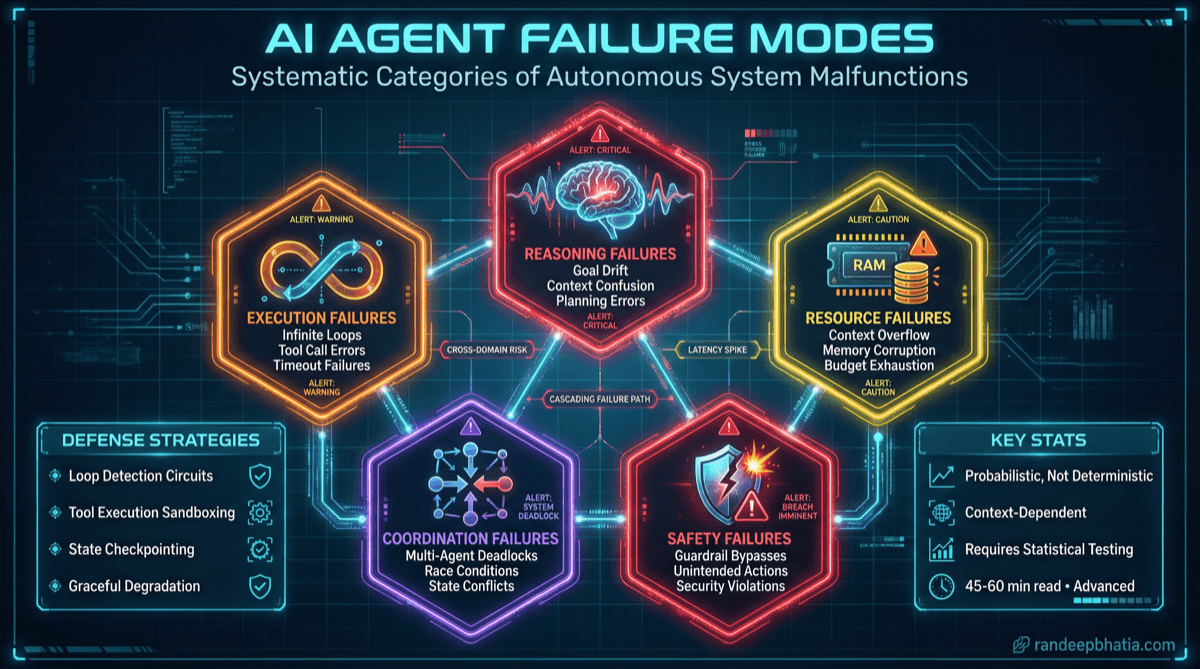
AI Agent Failure Modes

Technical Reference Tablescitation-safe-reference📖 45-60 minutesUpdated: 2026-01-05

Executive Summary

AI agent failure modes are the systematic categories of ways autonomous AI systems malfunction, degrade, or produce incorrect results during planning, reasoning, tool use, and execution cycles.

1

Agent failures manifest across five primary domains: reasoning failures (hallucination, goal drift), execution failures (tool errors, infinite loops), resource failures (context overflow, memory corruption), coordination failures (multi-agent deadlocks, race conditions), and safety failures (guardrail bypasses, unintended actions).

2

Unlike traditional software failures that are deterministic and reproducible, agent failures are often probabilistic, context-dependent, and can emerge from the interaction between the LLM's reasoning, external tools, and environmental state in ways that are difficult to predict or reproduce.

3

Production-grade agent systems require defense-in-depth strategies including loop detection circuits, tool execution sandboxing, state checkpointing, graceful degradation paths, and comprehensive observability to achieve acceptable reliability levels.

The Bottom Line

Agent failure modes represent a fundamentally different class of system failures than traditional software bugs because they emerge from the intersection of probabilistic reasoning, external tool interactions, and dynamic environmental state. Understanding and mitigating these failure modes is essential for deploying agents in production environments where reliability, safety, and predictability are required.

Definition

AI agent failure modes are the categorized patterns of malfunction that occur when autonomous AI systems fail to achieve their intended objectives due to errors in reasoning, planning, tool execution, resource management, or safety constraint adherence.

These failure modes span the entire agent lifecycle from initial goal interpretation through multi-step execution, encompassing both deterministic failures (such as tool API errors) and probabilistic failures (such as reasoning hallucinations or goal drift).

Extended Definition

Agent failure modes differ fundamentally from traditional software failures because they emerge from the complex interaction between a probabilistic language model's reasoning capabilities, external tool ecosystems, environmental state, and accumulated context. While a traditional software bug produces consistent, reproducible behavior given the same inputs, agent failures can be non-deterministic, context-sensitive, and emergent—meaning the same agent with the same initial prompt may succeed or fail depending on subtle variations in the LLM's sampling, the state of external systems, or the accumulated history of previous actions. This probabilistic nature makes agent failures particularly challenging to diagnose, reproduce, and prevent, requiring fundamentally different approaches to testing, monitoring, and error handling than deterministic software systems.

Etymology & Origins

The term 'failure mode' originates from reliability engineering and Failure Mode and Effects Analysis (FMEA), a systematic methodology developed in the 1940s for aerospace and military applications to identify potential failure points in systems. The application to AI agents emerged in the early 2020s as autonomous AI systems moved from research prototypes to production deployments, necessitating rigorous analysis of how these systems could fail. The compound term 'AI agent failure modes' specifically addresses the unique failure patterns that arise from the combination of large language model reasoning, tool use, and autonomous action-taking that distinguishes agents from simpler AI applications.

Also Known As

Agent malfunction patternsAutonomous system failure categoriesAgent error taxonomyLLM agent failure typesAgentic AI failure modesAgent reliability failuresAgent breakdown patternsAutonomous agent fault categories

Not To Be Confused With

LLM failure modes

LLM failure modes refer to failures in the underlying language model's text generation (hallucinations, refusals, format errors), while agent failure modes encompass the broader system including tool execution, planning, memory, and multi-step reasoning. An agent can fail even when the underlying LLM performs correctly, and vice versa.

Software bugs

Traditional software bugs are deterministic defects in code that produce consistent incorrect behavior given the same inputs. Agent failure modes are often probabilistic, context-dependent, and emergent from the interaction of multiple components, making them fundamentally harder to reproduce and fix.

Model errors

Model errors refer to incorrect predictions or outputs from a machine learning model due to training data issues, model architecture limitations, or distribution shift. Agent failure modes include model errors but extend to failures in the orchestration layer, tool integration, state management, and safety systems.

API failures

API failures are external service errors (timeouts, rate limits, authentication failures) that affect agent tool calls. While API failures can trigger agent failure modes, agent failures also include internal reasoning errors, planning mistakes, and coordination problems that occur independently of external service health.

Prompt injection attacks

Prompt injection is a security attack vector where malicious inputs manipulate agent behavior. While prompt injection can cause agent failures, agent failure modes also include non-adversarial failures from normal operation such as context overflow, goal drift, and resource exhaustion.

Hallucinations

Hallucinations are a specific type of LLM output error where the model generates plausible but factually incorrect information. Agent failure modes include hallucinations but also encompass execution failures, resource failures, and coordination failures that can occur even when the LLM output is factually correct.

Conceptual Foundation

Core Principles

(8 principles)

Mental Models

(6 models)

Swiss Cheese Model

Agent failures occur when holes in multiple defensive layers align, allowing a failure to propagate through the entire system. Each layer (input validation, reasoning checks, tool sandboxing, output validation) has gaps, and catastrophic failures occur when these gaps align.

State Machine with Fuzzy Transitions

Agents can be modeled as state machines where transitions between states are probabilistic rather than deterministic. Failure modes occur when the agent transitions to an unintended state or gets stuck in a state it cannot exit.

Resource Budget Model

Agents operate with finite budgets of context tokens, API calls, time, and cost. Failure modes occur when these budgets are exhausted before task completion or when budget consumption becomes pathologically inefficient.

Trust Boundary Model

Agent systems have multiple trust boundaries: between user input and agent reasoning, between agent decisions and tool execution, between tool outputs and agent state. Failures occur when untrusted data crosses boundaries without proper validation.

Feedback Loop Model

Agents operate in feedback loops where outputs affect future inputs through environmental changes, memory updates, and context accumulation. Failure modes include positive feedback loops (runaway behavior) and negative feedback loops (oscillation, deadlock).

Distributed System Failure Model

Multi-agent systems exhibit failure modes analogous to distributed systems: network partitions become communication failures, consensus failures become coordination deadlocks, and Byzantine failures become agent misbehavior.

Key Insights

(10 insights)

The majority of production agent failures are not caused by LLM reasoning errors but by integration issues: tool timeouts, malformed API responses, context overflow, and state management bugs that would be straightforward to fix in traditional software but are obscured by the agent abstraction layer.

Infinite loops in agents are qualitatively different from infinite loops in traditional software because they consume expensive resources (API calls, tokens) and may take actions with real-world consequences before being detected and terminated.

Goal drift—where an agent gradually shifts its objective during execution—is often undetectable from individual reasoning steps, each of which appears locally reasonable, requiring trajectory-level analysis to identify.

The most dangerous agent failures are those that produce plausible but incorrect results without any obvious error signals, as these failures may not be detected until they cause downstream damage.

Agent memory systems create a new class of failure modes where corrupted or poisoned memories can cause failures in future sessions long after the original corruption occurred, making root cause analysis extremely difficult.

Tool execution failures often cascade into reasoning failures as the agent attempts to interpret error messages, retry with variations, or work around the failure, potentially compounding the original problem.

Context window limits create hard boundaries that can cause sudden, catastrophic failures when exceeded, unlike gradual performance degradation in traditional systems, requiring proactive context management.

Multi-agent systems exhibit emergent failure modes that cannot be predicted from the failure modes of individual agents, including coordination deadlocks, conflicting actions, and resource contention.

The probabilistic nature of LLM reasoning means that agent failures can be intermittent and difficult to reproduce, requiring statistical approaches to testing and validation rather than deterministic test cases.

Recovery from agent failures is complicated by the difficulty of determining what state to restore to, as the agent's context and memory may have been corrupted before the failure became apparent.

When to Use

Ideal Scenarios

(12)

When designing new AI agent systems and need to anticipate potential failure modes during architecture and design phases to build in appropriate safeguards and monitoring from the start.

When debugging production agent issues and need a systematic framework for categorizing and diagnosing the root cause of observed failures.

When conducting failure mode and effects analysis (FMEA) for agent systems to identify high-risk failure modes and prioritize mitigation efforts.

When designing monitoring and alerting systems for agent deployments and need to understand what failure signals to capture and what thresholds to set.

When creating agent testing strategies and need to understand what failure scenarios to test for beyond simple functional correctness.

When evaluating agent frameworks and platforms and need to assess how well they handle various failure modes and what built-in protections they provide.

When writing incident response runbooks for agent systems and need to document diagnosis and recovery procedures for common failure scenarios.

When training engineering teams on agent reliability and need educational material on the unique failure characteristics of agentic systems.

When conducting post-incident reviews of agent failures and need a taxonomy to classify the failure and identify systemic improvements.

When designing graceful degradation strategies and need to understand how agents should behave when various components fail or become unavailable.

When setting SLOs and SLAs for agent systems and need to understand what failure rates are achievable and what factors affect reliability.

When designing multi-agent systems and need to understand coordination failure modes in addition to single-agent failures.

Prerequisites

(8)
1

Basic understanding of how LLM-based agents work, including the reasoning-action loop, tool calling mechanisms, and context management.

2

Familiarity with common agent architectures such as ReAct, Plan-and-Execute, and multi-agent orchestration patterns.

3

Understanding of LLM fundamentals including tokenization, context windows, temperature sampling, and prompt engineering.

4

Knowledge of distributed systems concepts including failure modes, recovery patterns, and observability practices.

5

Experience with production software systems and understanding of reliability engineering principles.

6

Familiarity with the specific tools and APIs that agents in your system interact with, including their failure modes and error responses.

7

Understanding of the business context and risk tolerance for agent failures in your specific deployment scenario.

8

Access to logging, monitoring, and tracing infrastructure sufficient to observe agent behavior and diagnose failures.

Signals You Need This

(10)

Agents are failing in production in ways that are difficult to diagnose or reproduce, suggesting systematic failure modes rather than simple bugs.

Agent behavior is inconsistent, succeeding sometimes and failing other times on similar tasks, indicating probabilistic failure modes.

Agents are getting stuck in loops, consuming excessive resources, or taking unexpected actions that suggest control flow failures.

Post-incident reviews are unable to identify clear root causes for agent failures, indicating a need for better failure categorization.

Agent reliability is below acceptable thresholds and you need a systematic approach to identifying and addressing failure modes.

You are scaling agent deployments and need to understand how failure modes change with increased load and complexity.

Security reviews have identified potential vulnerabilities in agent systems that need to be categorized and addressed.

You are designing new agent capabilities and need to anticipate what failure modes they might introduce.

Agent costs are higher than expected due to retries, loops, or inefficient execution patterns that suggest underlying failure modes.

Users are reporting unexpected agent behavior that doesn't match the intended functionality, suggesting goal drift or reasoning failures.

Organizational Readiness

(7)

Engineering team has sufficient experience with production AI systems to understand the unique challenges of agent reliability.

Organization has established incident response processes that can be adapted for agent-specific failure scenarios.

Monitoring and observability infrastructure is in place to capture the detailed telemetry needed to diagnose agent failures.

There is organizational commitment to investing in reliability engineering for agent systems, not just feature development.

Cross-functional collaboration exists between ML engineers, platform engineers, and SREs who all contribute to agent reliability.

Risk tolerance and reliability requirements are clearly defined for agent deployments, enabling appropriate tradeoff decisions.

Testing infrastructure supports the statistical testing approaches needed for probabilistic agent behavior.

When NOT to Use

Anti-Patterns

(12)

Using agent failure mode analysis as a substitute for basic software engineering practices—agents still need proper error handling, input validation, and testing.

Attempting to prevent all possible failure modes, which leads to over-constrained agents that cannot accomplish useful tasks.

Treating agent failures as purely LLM problems when the root cause is often in the integration layer, tool implementations, or system design.

Implementing complex failure detection without corresponding recovery mechanisms, resulting in systems that detect failures but cannot recover from them.

Over-engineering failure handling for prototype or experimental agents where rapid iteration is more valuable than reliability.

Applying production failure mode analysis to research or evaluation contexts where different failure modes are relevant.

Ignoring failure modes during design and attempting to address them only after production incidents occur.

Treating all failure modes as equally important rather than prioritizing based on likelihood and impact.

Implementing failure detection that is more expensive (in latency, cost, or complexity) than the failures it prevents.

Using generic failure mode frameworks without adapting them to the specific characteristics of your agent architecture and deployment context.

Focusing exclusively on technical failure modes while ignoring organizational and process failures that contribute to agent reliability.

Attempting to achieve zero failures rather than acceptable failure rates with graceful degradation.

Red Flags

(10)

Failure mode analysis is being used to justify not deploying agents rather than to improve their reliability.

The team is spending more time on failure mode documentation than on actually implementing mitigations.

Failure detection mechanisms are causing more incidents than they prevent due to false positives or added complexity.

Agent reliability requirements are set without understanding the baseline failure rates achievable with current technology.

Failure mode analysis is conducted once and never updated as the agent system evolves.

The focus is entirely on preventing failures rather than on detecting and recovering from failures gracefully.

Failure modes are being analyzed in isolation without considering how they interact and compose.

The team lacks the observability infrastructure to actually detect the failure modes being analyzed.

Failure mode mitigations are being implemented without measuring their effectiveness.

Analysis is focused on exotic failure modes while common, high-impact failures are ignored.

Better Alternatives

(8)
1
When:

Simple, single-turn LLM applications without tool use or multi-step reasoning

Use Instead:

LLM failure mode analysis focused on output quality, hallucination, and format compliance

Why:

Agent-specific failure modes like loops, tool errors, and coordination failures are not relevant for non-agentic LLM applications.

2
When:

Early-stage prototypes where the goal is to validate agent feasibility

Use Instead:

Rapid iteration with basic error handling and manual monitoring

Why:

Comprehensive failure mode analysis is premature for prototypes that may be significantly redesigned based on initial learnings.

3
When:

Agents operating in fully sandboxed environments with no real-world impact

Use Instead:

Simplified failure handling focused on task completion rather than safety

Why:

The cost-benefit of comprehensive failure mode mitigation is different when failures have no consequences beyond task failure.

4
When:

Batch processing agents where latency is not critical and retries are acceptable

Use Instead:

Simple retry-based error handling with eventual consistency

Why:

Complex failure detection and recovery may be unnecessary when simple retries can achieve acceptable reliability.

5
When:

Human-in-the-loop agents where all actions require human approval

Use Instead:

Focus on human oversight effectiveness rather than autonomous failure handling

Why:

Human oversight changes the failure mode landscape by catching many failures before they cause harm.

6
When:

Agents with very narrow, well-defined tasks and limited tool access

Use Instead:

Task-specific validation and error handling rather than generic failure mode frameworks

Why:

Narrow agents have a smaller failure mode surface that can be addressed with targeted mitigations.

7
When:

Research environments focused on capability exploration

Use Instead:

Capability-focused evaluation metrics rather than reliability engineering

Why:

Research priorities differ from production priorities, and over-constraining agents can limit capability discovery.

8
When:

Agents where the cost of failure is very low and recovery is trivial

Use Instead:

Accept higher failure rates in exchange for simpler systems and faster development

Why:

The appropriate level of failure mode mitigation depends on the consequences of failure.

Common Mistakes

(10)

Assuming that improving LLM quality will automatically reduce agent failures, when many failures originate in the orchestration and integration layers.

Implementing loop detection based on simple iteration counts without considering that some tasks legitimately require many iterations.

Setting timeouts that are too aggressive, causing failures on tasks that would have succeeded with more time.

Logging insufficient context to diagnose failures, making post-incident analysis impossible.

Treating all tool errors the same rather than distinguishing between transient errors (retry) and permanent errors (fail fast).

Implementing recovery mechanisms that can themselves fail, creating nested failure scenarios.

Focusing on preventing failures rather than on graceful degradation when failures occur.

Not testing failure handling code paths, which then fail when actually needed.

Assuming that failures in development/testing environments are representative of production failure modes.

Implementing complex failure handling that increases system complexity and introduces new failure modes.

Core Taxonomy

Primary Types

(8 types)

Failures that occur in the LLM's reasoning process, including incorrect logical inferences, hallucinated facts, misinterpretation of context, and failure to follow instructions. These failures originate in the language model's text generation and propagate into incorrect agent decisions and actions.

Characteristics
  • Probabilistic and non-deterministic
  • Often produce plausible but incorrect outputs
  • Difficult to detect without ground truth
  • Can be subtle and accumulate over multiple steps
  • Influenced by prompt design and context
Use Cases
Diagnosing incorrect agent decisionsImproving prompt engineeringEvaluating LLM selection for agent tasksDesigning output validation
Tradeoffs

Mitigating reasoning failures often requires additional LLM calls for verification, increasing latency and cost. Aggressive filtering can reduce capability by rejecting valid but unusual reasoning.

Classification Dimensions

Detectability

Classifies failure modes by how easily they can be detected, which affects monitoring strategy and time-to-detection.

Immediately detectable (clear error signals)Eventually detectable (requires outcome evaluation)Silently incorrect (no error signal, wrong result)Latent (corrupts state for future failures)

Recoverability

Classifies failure modes by the complexity of recovery, which affects incident response procedures and system design.

Self-recovering (agent can recover autonomously)Retry-recoverable (simple retry succeeds)Rollback-recoverable (requires state restoration)Manual intervention requiredUnrecoverable (requires restart or redesign)

Scope

Classifies failure modes by their blast radius, which affects impact assessment and isolation strategies.

Single-step (affects one action)Multi-step (affects a sequence of actions)Session-wide (affects entire agent session)Cross-session (persists across sessions)System-wide (affects multiple agents or users)

Causation

Classifies failure modes by their root cause origin, which affects prevention and mitigation strategies.

Internal (originates in agent reasoning)External (originates in tools or environment)Interaction (emerges from component interaction)Adversarial (caused by malicious input)Environmental (caused by system conditions)

Frequency

Classifies failure modes by how often they occur, which affects prioritization and testing strategies.

Systematic (occurs consistently under certain conditions)Probabilistic (occurs with some probability)Rare (edge cases and unusual conditions)One-time (unique circumstances)

Severity

Classifies failure modes by their impact severity, which affects prioritization and response urgency.

Critical (system unusable, data loss, safety violation)Major (significant functionality impaired)Minor (degraded experience, workarounds available)Cosmetic (incorrect but harmless)

Evolutionary Stages

1

Prototype Stage

0-3 months of development

Failure modes are dominated by basic integration issues, prompt engineering problems, and tool configuration errors. Failures are frequent but low-impact due to limited deployment. Focus is on achieving basic functionality rather than reliability.

2

Early Production Stage

3-12 months after initial deployment

Failure modes shift toward edge cases, resource management, and handling unexpected inputs. Basic failure handling is in place but gaps are discovered through production incidents. Monitoring is reactive rather than proactive.

3

Mature Production Stage

12-24 months of production operation

Common failure modes are well-understood and mitigated. Focus shifts to rare failures, performance optimization, and cost efficiency. Comprehensive monitoring and alerting is in place. Failure handling is proactive and automated.

4

Scale Stage

24+ months, high-volume deployments

New failure modes emerge from scale: coordination failures, resource contention, cascade failures. Focus on system-level reliability rather than individual agent reliability. Sophisticated failure prediction and prevention.

5

Multi-Agent Stage

Varies based on architecture complexity

Failure modes include coordination failures, emergent behaviors, and complex interactions between agents. Requires distributed systems approaches to reliability. Focus on system-level properties rather than individual agent behavior.

Architecture Patterns

Architecture Patterns

(8 patterns)

Circuit Breaker Pattern

Implements automatic failure detection and isolation by monitoring failure rates and temporarily disabling failing components when thresholds are exceeded. Prevents cascade failures by stopping requests to unhealthy components and allows time for recovery.

Components
  • Failure counter tracking recent failures
  • Threshold configuration for trip conditions
  • State machine (closed, open, half-open)
  • Recovery timer for automatic reset
  • Fallback handler for degraded operation
Data Flow

Requests flow through the circuit breaker, which monitors success/failure. When failures exceed threshold, circuit opens and requests are immediately failed or redirected to fallback. After timeout, circuit enters half-open state allowing test requests. Successful tests close the circuit.

Best For
  • Protecting against cascading failures from unhealthy tools
  • Providing graceful degradation when external services fail
  • Preventing resource exhaustion from repeated failed requests
  • Enabling automatic recovery when transient failures resolve
Limitations
  • Requires tuning of thresholds and timeouts for each context
  • Can cause unnecessary failures if thresholds are too sensitive
  • Does not address root cause of failures
  • Half-open state can cause inconsistent behavior
Scaling Characteristics

Circuit breakers should be scoped appropriately—too broad causes unnecessary failures, too narrow provides insufficient protection. Consider per-tool, per-user, or per-task circuit breakers depending on failure correlation patterns.

Integration Points

LLM API

Provides reasoning and decision-making capabilities for the agent through text generation

Interfaces:
Completion/chat API for reasoningStreaming API for incremental outputFunction calling API for structured outputEmbedding API for semantic operations

LLM API failures include rate limits, timeouts, content filtering, and model errors. Implement retry with backoff, fallback models, and graceful degradation for LLM unavailability.

Tool Execution Layer

Executes agent actions by calling external tools and APIs based on agent decisions

Interfaces:
Tool invocation APITool result parsingTool error handlingTool timeout management

Tool failures are a primary source of agent failures. Implement sandboxing, timeouts, result validation, and fallback tools. Consider tool health monitoring and circuit breakers.

Memory System

Stores and retrieves agent state, conversation history, and learned information

Interfaces:
Memory write APIMemory query APIMemory update APIMemory pruning API

Memory failures can cause state corruption and delayed failures. Implement memory validation, versioning, and recovery. Consider memory isolation between sessions.

Orchestration Layer

Manages the agent's reasoning-action loop and coordinates between components

Interfaces:
Step execution APIState management APIControl flow APITermination API

Orchestration failures cause control flow problems. Implement loop detection, progress monitoring, and stuck detection. Consider orchestration state persistence for recovery.

Monitoring System

Collects telemetry and provides visibility into agent behavior and health

Interfaces:
Metrics collection APILogging APITracing APIAlerting API

Monitoring system failures can blind operators to agent problems. Implement monitoring redundancy and ensure monitoring does not affect agent performance.

User Interface

Provides interaction channel between users and agents

Interfaces:
Input API for user messagesOutput API for agent responsesStatus API for progress updatesControl API for user interventions

UI failures can prevent user oversight and intervention. Implement UI fallbacks and ensure critical controls remain available during partial failures.

Safety System

Enforces safety constraints and prevents harmful agent actions

Interfaces:
Action validation APIOutput filtering APIGuardrail check APISafety override API

Safety system failures can allow harmful actions. Implement safety system redundancy and fail-safe defaults. Safety systems should fail closed (deny) not open (allow).

External Services

Provides data and capabilities from external systems that agents interact with

Interfaces:
Service-specific APIsAuthentication APIsData retrieval APIsAction execution APIs

External service failures are outside agent control. Implement service health monitoring, circuit breakers, and graceful degradation for service unavailability.

Decision Framework

✓ If Yes

Immediately terminate agent and escalate to human operator. Do not attempt automatic recovery.

✗ If No

Proceed to assess failure severity and recoverability.

Considerations

Safety failures take absolute priority over task completion. Define clear criteria for what constitutes a safety violation in your context.

Technical Deep Dive

Overview

Agent failure modes emerge from the complex interaction between four primary subsystems: the LLM reasoning engine, the tool execution layer, the state management system, and the orchestration controller. Each subsystem has its own failure characteristics, and failures can propagate between subsystems in complex ways. Understanding how these subsystems interact is essential for comprehensive failure mode analysis. The LLM reasoning engine is inherently probabilistic, producing different outputs for the same input based on sampling parameters. This non-determinism means that failures can be intermittent and difficult to reproduce. The reasoning engine can fail by producing incorrect logic, hallucinating facts, misinterpreting instructions, or generating malformed outputs. The tool execution layer interfaces with external systems that have their own failure modes including network errors, rate limits, authentication failures, and unexpected responses. Tool failures can cascade into reasoning failures when the agent attempts to interpret error messages or work around failed tools. The state management system maintains context, memory, and intermediate results. State failures include corruption, overflow, inconsistency, and loss. These failures can be latent, causing problems long after the original corruption occurred. The orchestration controller manages the agent's control flow, deciding when to reason, when to act, and when to terminate. Orchestration failures include loops, premature termination, and failure to make progress.

Step-by-Step Process

User input is received and validated for format, length, and safety. Input is preprocessed and formatted for the LLM. System prompt and context are assembled.

⚠️ Pitfalls to Avoid

Insufficient input validation can allow prompt injection. Overly strict validation can reject legitimate inputs. Context assembly errors can corrupt the prompt.

Under The Hood

At the implementation level, agent failure modes arise from the fundamental tension between the probabilistic nature of LLM reasoning and the deterministic requirements of reliable software systems. The LLM operates as a next-token predictor, selecting each token based on probability distributions that are influenced by the entire context. Small changes in context can lead to dramatically different outputs, making agent behavior inherently unpredictable. The tool execution layer typically implements a sandboxed execution environment that isolates tool calls from the main agent process. This sandbox enforces timeouts, resource limits, and security boundaries. However, the sandbox itself can fail, and the interface between the sandbox and the agent can introduce errors. Tool results must be serialized for transmission back to the agent, and this serialization can fail or lose information. State management in agents is complicated by the need to maintain coherent state across multiple reasoning steps while respecting context window limits. Most agents implement some form of context management that selectively includes or excludes historical information. This context management is a source of failures when important information is excluded or when irrelevant information crowds out useful context. The orchestration layer implements the agent's control flow as a state machine or loop structure. This orchestration must handle the inherent uncertainty of LLM outputs, which may not clearly indicate whether to continue or terminate. Orchestration failures often manifest as the agent getting stuck in states it cannot exit or transitioning to incorrect states. Memory systems add another layer of complexity by persisting information across sessions. Memory retrieval is typically based on semantic similarity, which can return irrelevant or misleading information. Memory writes can corrupt existing data or create inconsistencies. The interaction between short-term context and long-term memory creates opportunities for failures that span multiple sessions. Multi-agent systems introduce distributed systems failure modes including network partitions, consensus failures, and Byzantine behavior. Agents may have inconsistent views of shared state, leading to conflicting actions. Coordination protocols can deadlock or livelock. The emergent behavior of multiple interacting agents can be difficult to predict or control.

Failure Modes

Root Cause

Agent enters a reasoning or action loop that does not terminate, continuously consuming API calls, tokens, and time without making progress toward the goal

Symptoms
  • Rapidly increasing API call count
  • Repeated similar actions in logs
  • No progress toward goal despite activity
  • Context filling with repetitive content
  • Cost accumulation without results
Impact

Significant cost waste, resource exhaustion affecting other users, potential for unintended repeated actions with real-world effects, user frustration from non-responsive agent

Prevention

Implement iteration limits, progress monitoring, action deduplication, and semantic loop detection. Set hard resource budgets that cannot be exceeded.

Mitigation

Detect loops early through action history analysis. Terminate agent gracefully with explanation. Preserve state for debugging. Implement circuit breakers to prevent restart loops.

Operational Considerations

Key Metrics (15)

Percentage of agent tasks that complete successfully without errors or user abandonment

Normal85-95% depending on task complexity
AlertBelow 80% sustained for 15 minutes
ResponseInvestigate recent changes, check tool health, review error logs for patterns

Dashboard Panels

Real-time agent activity heatmap showing active agents, their states, and healthTask success/failure funnel showing where tasks fail in the agent pipelineTool health matrix showing status and error rates for all integrated toolsCost tracking with budget utilization and projected spendLatency distribution histograms for agent response timesError rate time series with anomaly detection highlightsLoop detection events with affected agent and task detailsSafety guardrail trigger log with severity classificationMulti-agent coordination status showing active coordinators and worker distributionMemory system health including storage utilization and operation latency

Alerting Strategy

Implement tiered alerting with P1 alerts for safety violations and system-wide failures requiring immediate response, P2 alerts for significant degradation requiring response within 1 hour, and P3 alerts for trends requiring investigation within 24 hours. Use alert aggregation to prevent alert storms during incidents. Implement alert routing based on failure type to appropriate responders. Include runbook links in all alerts.

Cost Analysis

Cost Drivers

(10)

LLM API Token Consumption

Impact:

Primary cost driver, scales with context size, reasoning verbosity, and number of steps. Can vary 10x between efficient and inefficient agents.

Optimization:

Optimize prompts for conciseness. Implement context management to reduce input tokens. Use smaller models for simple tasks. Cache common reasoning patterns.

Failed Attempt Costs

Impact:

Failed tasks still consume resources. Loops and retries multiply costs. Can represent 20-50% of total costs in poorly optimized systems.

Optimization:

Implement early failure detection. Reduce retry counts. Add circuit breakers. Improve first-attempt success rate through better prompts and validation.

Tool API Costs

Impact:

External tool calls may have per-call costs. Some tools (search, data APIs) can be expensive at scale.

Optimization:

Cache tool results where appropriate. Batch tool calls when possible. Use cheaper tool alternatives. Implement tool call budgets.

Checkpoint Storage

Impact:

Frequent checkpointing consumes storage. Long retention periods multiply costs. Large state sizes increase per-checkpoint cost.

Optimization:

Implement incremental checkpoints. Tune checkpoint frequency based on failure rates. Implement tiered retention. Compress checkpoint data.

Memory System Operations

Impact:

Memory reads and writes have compute and storage costs. Embedding generation for semantic memory is expensive.

Optimization:

Cache frequent memory reads. Batch memory operations. Use efficient embedding models. Implement memory size limits.

Monitoring and Logging

Impact:

Comprehensive observability generates significant data volume. Log storage and analysis tools have costs.

Optimization:

Implement log sampling for high-volume events. Use tiered log retention. Aggregate metrics to reduce cardinality. Filter low-value logs.

Recovery Operations

Impact:

Recovery from failures consumes additional resources. Checkpoint restoration, task restart, and re-execution add costs.

Optimization:

Reduce failure rates to minimize recovery. Implement efficient recovery paths. Avoid full restart when partial recovery possible.

Multi-Agent Coordination Overhead

Impact:

Coordination between agents requires communication and synchronization that adds latency and compute costs.

Optimization:

Minimize coordination points. Use async coordination where possible. Batch coordination messages. Optimize coordinator efficiency.

Safety and Validation Overhead

Impact:

Input validation, output filtering, and safety checks add compute costs to every operation.

Optimization:

Optimize validation algorithms. Use efficient filtering models. Cache validation results. Implement tiered validation based on risk.

Idle Resource Costs

Impact:

Resources provisioned for peak load but idle during low usage still incur costs.

Optimization:

Implement auto-scaling. Use serverless where appropriate. Right-size resource allocation. Implement resource sharing.

Cost Models

Per-Task Cost Model

Task_Cost = (Input_Tokens × Input_Price) + (Output_Tokens × Output_Price) + (Tool_Calls × Avg_Tool_Cost) + (Steps × Overhead_Per_Step)
Variables:
Input_Tokens: Total input tokens across all LLM callsOutput_Tokens: Total output tokens generatedInput_Price/Output_Price: Per-token pricing from LLM providerTool_Calls: Number of tool invocationsAvg_Tool_Cost: Average cost per tool callSteps: Number of reasoning stepsOverhead_Per_Step: Fixed costs per step (logging, validation)
Example:

A task with 50K input tokens ($0.01/1K), 5K output tokens ($0.03/1K), 10 tool calls ($0.001 each), and 8 steps ($0.0001 each) costs: $0.50 + $0.15 + $0.01 + $0.0008 = $0.66

Failure-Adjusted Cost Model

Effective_Cost = Base_Cost × (1 + Failure_Rate × Retry_Multiplier) + (Failure_Rate × Recovery_Cost)
Variables:
Base_Cost: Cost of successful task completionFailure_Rate: Probability of task failureRetry_Multiplier: Average retries before success or abandonmentRecovery_Cost: Cost of recovery operations per failure
Example:

With $0.50 base cost, 10% failure rate, 2x retry multiplier, and $0.20 recovery cost: $0.50 × (1 + 0.1 × 2) + (0.1 × $0.20) = $0.60 + $0.02 = $0.62 effective cost

Loop Cost Model

Loop_Cost = Iterations_Before_Detection × Cost_Per_Iteration × Loop_Frequency
Variables:
Iterations_Before_Detection: Average steps before loop is detectedCost_Per_Iteration: Cost of each loop iterationLoop_Frequency: Percentage of tasks that enter loops
Example:

With 20 iterations before detection, $0.05 per iteration, and 1% loop frequency: 20 × $0.05 × 0.01 = $0.01 additional cost per task on average

Total Cost of Ownership Model

TCO = Direct_Costs + Infrastructure_Costs + Operations_Costs + Failure_Costs
Variables:
Direct_Costs: LLM API, tool APIs, storageInfrastructure_Costs: Compute, networking, monitoring toolsOperations_Costs: Engineering time for maintenance and incidentsFailure_Costs: Customer impact, recovery, reputation
Example:

Monthly TCO might be: $10K direct + $2K infrastructure + $5K operations + $1K failure costs = $18K total, where direct costs are only 56% of TCO

Optimization Strategies

  • 1Implement prompt optimization to reduce token usage while maintaining quality
  • 2Use model routing to direct simple tasks to cheaper models
  • 3Cache common tool results and reasoning patterns
  • 4Implement early termination for tasks unlikely to succeed
  • 5Reduce checkpoint frequency based on actual failure rates
  • 6Use sampling for expensive validation on low-risk operations
  • 7Implement request batching for tool calls where possible
  • 8Optimize context management to minimize input tokens
  • 9Use async processing to improve resource utilization
  • 10Implement cost budgets per task with graceful termination
  • 11Monitor and alert on cost anomalies to catch runaway spending
  • 12Regular review of cost breakdown to identify optimization opportunities

Hidden Costs

  • 💰Engineering time spent debugging intermittent failures
  • 💰Customer support costs from agent misbehavior
  • 💰Reputation damage from public failures
  • 💰Opportunity cost of conservative guardrails limiting capability
  • 💰Technical debt from quick fixes to failure modes
  • 💰Compliance costs for audit trails and incident documentation
  • 💰Training costs for operations team on agent-specific issues
  • 💰Tool switching costs when APIs change or deprecate

ROI Considerations

The ROI of failure mode mitigation depends heavily on the cost of failures in your specific context. For agents handling high-value transactions or sensitive operations, even rare failures can have costs that dwarf the investment in prevention. For lower-stakes applications, the optimal investment in failure handling may be lower. Consider both direct costs (wasted API calls, recovery operations) and indirect costs (user trust, support burden, engineering time) when evaluating failure mode investments. A 1% reduction in failure rate might save $1000/month in direct costs but $10000/month in support and engineering time. Investments in observability often have the highest ROI because they enable faster diagnosis and resolution of failures, reducing both direct failure costs and engineering time. The ability to quickly identify and fix failure modes compounds over time as the system becomes more reliable. Prioritize failure mode mitigation based on frequency × impact analysis. A rare but catastrophic failure mode may warrant more investment than a common but low-impact failure mode, depending on risk tolerance.

Security Considerations

Threat Model

(10 threats)
1

Prompt Injection Attack

Attack Vector

Malicious instructions embedded in user input or tool outputs that manipulate agent behavior

Impact

Agent performs attacker's instructions, potentially exfiltrating data, taking unauthorized actions, or bypassing safety controls

Mitigation

Input sanitization, instruction hierarchy, output filtering, action confirmation for sensitive operations, regular red-teaming

2

Tool Output Poisoning

Attack Vector

Compromised or malicious tool returns crafted output designed to manipulate agent reasoning

Impact

Agent incorporates malicious content into reasoning, potentially leading to harmful actions or data exposure

Mitigation

Tool output validation, content filtering, tool authentication, limiting tool trust levels, sandboxing tool execution

3

Memory Poisoning

Attack Vector

Attacker causes malicious content to be written to agent memory, affecting future sessions

Impact

Persistent manipulation of agent behavior, affecting multiple users or sessions

Mitigation

Memory write validation, memory isolation, content scanning, memory versioning with rollback capability

4

Denial of Service via Resource Exhaustion

Attack Vector

Crafted inputs that cause agent to consume excessive resources (loops, expensive operations)

Impact

Service unavailability, excessive costs, degraded performance for other users

Mitigation

Resource limits, loop detection, cost budgets, rate limiting, input complexity limits

5

Data Exfiltration via Agent Actions

Attack Vector

Manipulating agent to include sensitive data in outputs or tool calls to attacker-controlled endpoints

Impact

Confidential data exposure, privacy violations, compliance failures

Mitigation

Output filtering, tool call validation, data classification, egress monitoring, least-privilege tool access

6

Privilege Escalation

Attack Vector

Exploiting agent's elevated permissions to perform actions user couldn't perform directly

Impact

Unauthorized access to resources, data modification, system compromise

Mitigation

Principle of least privilege, action authorization checks, audit logging, permission boundaries

7

Model Extraction

Attack Vector

Systematic querying to extract information about agent's prompts, tools, or capabilities

Impact

Intellectual property theft, vulnerability discovery, competitive intelligence

Mitigation

Query rate limiting, response filtering, prompt protection, anomaly detection on query patterns

8

Supply Chain Attack via Tools

Attack Vector

Compromised tool dependency introduces malicious behavior

Impact

Agent executes malicious code, data theft, system compromise

Mitigation

Tool vetting, dependency scanning, sandboxed execution, tool integrity verification

9

Session Hijacking

Attack Vector

Attacker gains access to another user's agent session

Impact

Access to user's data and conversation history, ability to take actions as user

Mitigation

Strong session authentication, session timeout, session binding to user identity

10

Confused Deputy Attack

Attack Vector

Tricking agent into using its permissions to perform actions on behalf of attacker

Impact

Unauthorized actions performed with agent's elevated permissions

Mitigation

Request origin validation, action attribution, permission scoping, explicit authorization checks

Security Best Practices

  • Implement defense-in-depth with multiple security layers
  • Apply principle of least privilege to all agent permissions
  • Validate and sanitize all inputs before processing
  • Filter and validate all outputs before delivery
  • Implement comprehensive audit logging for security events
  • Use strong authentication for all tool integrations
  • Encrypt sensitive data in transit and at rest
  • Implement rate limiting to prevent abuse
  • Regular security testing including red-teaming
  • Maintain incident response procedures for security events
  • Implement secure defaults that fail closed
  • Regular review and rotation of credentials
  • Monitor for anomalous behavior patterns
  • Implement session management with appropriate timeouts
  • Separate high-privilege operations with additional confirmation

Data Protection

  • 🔒Classify data by sensitivity and apply appropriate controls
  • 🔒Implement encryption for data at rest and in transit
  • 🔒Minimize data retention to what is necessary
  • 🔒Implement access controls based on need-to-know
  • 🔒Audit all access to sensitive data
  • 🔒Implement data masking for sensitive fields in logs
  • 🔒Secure deletion when data is no longer needed
  • 🔒Regular data protection impact assessments
  • 🔒Implement data loss prevention controls
  • 🔒Maintain data processing records for compliance

Compliance Implications

GDPR

Requirement:

Data protection, right to explanation, data minimization

Implementation:

Implement data retention limits, provide reasoning explanations, minimize data collection, enable data deletion

HIPAA

Requirement:

Protected health information security and privacy

Implementation:

Encrypt PHI, implement access controls, audit logging, business associate agreements with tool providers

SOC 2

Requirement:

Security, availability, processing integrity, confidentiality, privacy

Implementation:

Comprehensive security controls, monitoring, incident response, access management, encryption

PCI DSS

Requirement:

Payment card data protection

Implementation:

Isolate payment data, implement strong access controls, encryption, regular security testing

AI Act (EU)

Requirement:

Risk-based AI regulation, transparency, human oversight

Implementation:

Risk assessment, documentation, human-in-the-loop for high-risk decisions, explainability

CCPA

Requirement:

Consumer data rights, disclosure requirements

Implementation:

Data inventory, opt-out mechanisms, disclosure of AI use, data access requests

Financial Services Regulations

Requirement:

Model risk management, explainability, audit trails

Implementation:

Model documentation, validation, monitoring, comprehensive logging, human oversight

Accessibility Requirements (ADA, WCAG)

Requirement:

Accessible interfaces and outputs

Implementation:

Accessible UI, alternative formats, clear communication, accommodation for disabilities

Scaling Guide

Scaling Dimensions

Concurrent Agents

Strategy:

Horizontal scaling of agent execution infrastructure, load balancing across agent pools, resource isolation between agents

Limits:

Limited by LLM API rate limits, coordination overhead, shared resource contention

Considerations:

Monitor per-agent resource usage, implement fair scheduling, consider agent pooling for efficiency

Task Complexity

Strategy:

Larger context windows, more sophisticated planning, task decomposition, specialized agents for complex subtasks

Limits:

Context window limits, reasoning capability limits, cost constraints

Considerations:

Match agent capability to task complexity, implement graceful degradation for over-complex tasks

Tool Ecosystem

Strategy:

Tool registry for discovery, standardized tool interfaces, tool health monitoring, fallback tools

Limits:

Tool management complexity, integration maintenance burden, credential management

Considerations:

Implement tool abstraction layer, version tool integrations, monitor tool reliability

Memory Scale

Strategy:

Distributed memory storage, efficient retrieval indexes, memory partitioning, tiered storage

Limits:

Retrieval latency at scale, storage costs, index maintenance overhead

Considerations:

Implement memory lifecycle management, optimize retrieval algorithms, consider memory hierarchies

Geographic Distribution

Strategy:

Regional deployments, data residency compliance, latency optimization, disaster recovery

Limits:

Data synchronization complexity, regulatory constraints, operational overhead

Considerations:

Design for eventual consistency, implement regional failover, comply with data residency requirements

Multi-Tenancy

Strategy:

Tenant isolation, resource quotas, customization per tenant, tenant-specific monitoring

Limits:

Isolation overhead, customization complexity, noisy neighbor problems

Considerations:

Implement strong tenant boundaries, fair resource allocation, tenant-aware monitoring

Throughput

Strategy:

Request queuing, batch processing, async execution, caching

Limits:

LLM API throughput, tool API limits, latency requirements

Considerations:

Balance throughput against latency, implement priority queues, optimize for common cases

Reliability Requirements

Strategy:

Redundancy, failover, comprehensive monitoring, automated recovery

Limits:

Cost of redundancy, complexity of failover, recovery time objectives

Considerations:

Match reliability investment to requirements, implement graceful degradation, test recovery regularly

Capacity Planning

Key Factors:
Expected concurrent agent sessionsAverage task duration and complexityPeak-to-average load ratioLLM API rate limits and quotasTool API capacity and limitsStorage requirements for checkpoints and memoryMonitoring data volumeGrowth projections
Formula:Required_Capacity = (Peak_Concurrent_Sessions × Avg_Resources_Per_Session × Safety_Margin) + Overhead_For_Recovery + Monitoring_Overhead
Safety Margin:

Typically 1.5-2x expected peak load to handle bursts and provide headroom for failures. Higher margins for critical systems or unpredictable load patterns.

Scaling Milestones

10 concurrent agents
Challenges:
  • Basic monitoring and debugging
  • Manual incident response
  • Simple resource management
Architecture Changes:

Single-instance deployment acceptable. Basic logging and monitoring. Manual scaling.

100 concurrent agents
Challenges:
  • Resource contention
  • Monitoring data volume
  • Incident frequency increases
Architecture Changes:

Implement horizontal scaling. Add structured logging and metrics. Implement basic alerting. Consider agent pooling.

1,000 concurrent agents
Challenges:
  • LLM API rate limits
  • Tool API capacity
  • Coordination overhead
  • Cost management
Architecture Changes:

Implement rate limiting and queuing. Add circuit breakers. Implement cost controls. Consider multiple LLM providers. Add automated scaling.

10,000 concurrent agents
Challenges:
  • Distributed system complexity
  • Memory system scale
  • Monitoring at scale
  • Incident management
Architecture Changes:

Distributed architecture required. Implement sharding. Add sophisticated monitoring and alerting. Implement automated incident response. Consider regional deployment.

100,000+ concurrent agents
Challenges:
  • Global distribution
  • Multi-region consistency
  • Massive monitoring data
  • Complex failure modes
Architecture Changes:

Global architecture with regional deployments. Implement eventual consistency. Add ML-based anomaly detection. Implement sophisticated capacity planning. Consider dedicated infrastructure.

Benchmarks

Industry Benchmarks

MetricP50P95P99 World Class
Agent Task Success Rate90%95%98%99%+
Loop Detection Rate (% caught)80%95%99%99.9%
Mean Time to Detect Failure10 minutes5 minutes2 minutes<1 minute
Mean Time to Recovery60 minutes30 minutes15 minutes<5 minutes
False Positive Rate (failure detection)5%2%0.5%<0.1%
Cost Overhead from Failures30%15%5%<2%
Recovery Success Rate70%85%95%99%
Safety Incident Rate0.1%0.01%0.001%0%
Context Overflow Rate10%5%1%<0.5%
Tool Call Failure Rate8%3%1%<0.5%
Goal Drift Detection Accuracy60%80%90%95%+
Runbook Coverage50%80%95%99%

Comparison Matrix

ApproachDetection SpeedFalse Positive RateImplementation ComplexityMaintenance BurdenCoverage
Simple iteration limitsImmediateHighLowLowLoops only
Action history matchingFastMediumMediumMediumExact loops
Semantic loop detectionMediumLowHighHighSemantic loops
Progress monitoringSlowMediumMediumMediumStuck agents
Goal drift detectionSlowMedium-HighHighHighGoal alignment
Circuit breakersFastLowMediumLowTool failures
Comprehensive monitoringVariesTunableHighHighBroad
ML-based anomaly detectionMediumLow (trained)Very HighVery HighNovel failures

Performance Tiers

Basic

Simple iteration limits, basic error handling, minimal monitoring. Suitable for prototypes and low-stakes applications.

Target:

80% success rate, 50% loop detection, 30 minute MTTR

Standard

Comprehensive error handling, circuit breakers, structured monitoring, basic recovery. Suitable for production applications with moderate reliability requirements.

Target:

90% success rate, 90% loop detection, 15 minute MTTR

Advanced

Sophisticated detection including semantic analysis, automated recovery, comprehensive monitoring, graceful degradation. Suitable for business-critical applications.

Target:

95% success rate, 98% loop detection, 5 minute MTTR

World-Class

ML-based anomaly detection, predictive failure prevention, automated remediation, chaos engineering, continuous improvement. Suitable for mission-critical applications.

Target:

99% success rate, 99.9% loop detection, <2 minute MTTR

Real World Examples

Real-World Scenarios

(8 examples)
1

E-commerce Product Research Agent Loop

Context

An agent tasked with researching products for a customer entered a loop where it repeatedly searched for the same product with slightly different queries, never synthesizing results into a recommendation.

Approach

Implemented semantic similarity detection on search queries, identifying when queries were semantically equivalent despite syntactic differences. Added progress tracking requiring the agent to demonstrate forward progress toward the goal.

Outcome

Loop detection rate improved from 60% to 95%. Average task completion time decreased by 40% as loops were caught earlier. Cost per task reduced by 25%.

Lessons Learned
  • 💡Exact string matching is insufficient for loop detection
  • 💡Semantic similarity requires careful threshold tuning
  • 💡Progress metrics should be task-specific
  • 💡Users appreciate transparency about agent behavior
2

Customer Service Agent Goal Drift

Context

A customer service agent gradually shifted from helping customers solve problems to engaging in extended conversations about tangentially related topics, increasing costs without improving customer satisfaction.

Approach

Implemented goal monitoring that periodically compared agent focus to original customer intent. Added conversation steering to redirect off-topic discussions. Implemented session length limits with graceful handoff.

Outcome

Average conversation length decreased by 30% while customer satisfaction improved. Cost per resolution decreased by 35%. Agent stayed on-topic in 95% of conversations.

Lessons Learned
  • 💡Goal drift can be subtle and gradual
  • 💡Periodic goal restatement helps maintain focus
  • 💡Session limits prevent runaway conversations
  • 💡Customer satisfaction is the ultimate metric
3

Data Analysis Agent Context Overflow

Context

An agent analyzing large datasets would frequently fail partway through analysis when context window filled with intermediate results, losing track of the analysis goal and producing incomplete results.

Approach

Implemented proactive context management that summarized intermediate results before context overflow. Added external state storage for large datasets. Implemented task decomposition for complex analyses.

Outcome

Task completion rate improved from 70% to 95% for complex analyses. Context utilization stabilized at 70% average. User complaints about incomplete results decreased by 80%.

Lessons Learned
  • 💡Context overflow is predictable and preventable
  • 💡Summarization must preserve essential information
  • 💡External storage extends effective context
  • 💡Task decomposition improves reliability
4

Multi-Agent Coordination Deadlock

Context

A system using multiple specialized agents experienced deadlocks when agents waited for each other to complete subtasks, causing complete task stalls that required manual intervention.

Approach

Implemented timeout-based deadlock detection. Added coordinator agent to manage dependencies. Implemented fallback to single-agent mode when coordination failed. Added resource lock ordering to prevent circular waits.

Outcome

Deadlock incidents decreased by 90%. Automatic recovery handled 95% of remaining coordination failures. Manual intervention reduced from daily to monthly.

Lessons Learned
  • 💡Multi-agent systems need explicit coordination design
  • 💡Timeouts are essential for distributed systems
  • 💡Fallback modes maintain availability
  • 💡Lock ordering prevents many deadlocks
5

Financial Agent Safety Bypass Attempt

Context

Users attempted to manipulate a financial advisory agent into providing specific investment recommendations by framing requests in ways that bypassed safety guardrails designed to prevent unauthorized advice.

Approach

Implemented multi-layer guardrails with different detection approaches. Added output filtering in addition to input filtering. Implemented human review for borderline cases. Regular red-teaming to identify bypass techniques.

Outcome

Guardrail bypass attempts decreased by 95% as users learned boundaries. No unauthorized advice incidents. User trust improved as guardrails were seen as protective rather than restrictive.

Lessons Learned
  • 💡Single-layer guardrails are insufficient
  • 💡Users will probe boundaries
  • 💡Regular testing finds new bypass techniques
  • 💡Transparent guardrails build trust
6

Code Generation Agent Tool Failure Cascade

Context

A code generation agent experienced cascade failures when the code execution sandbox became unavailable, causing the agent to repeatedly attempt execution, fill context with error messages, and eventually fail completely.

Approach

Implemented circuit breaker on sandbox access. Added graceful degradation to code review mode without execution. Implemented error message summarization to prevent context pollution. Added fallback sandbox provider.

Outcome

Cascade failures eliminated. Agent maintained useful functionality during sandbox outages. User experience improved with clear communication about degraded mode.

Lessons Learned
  • 💡Tool failures need circuit breakers
  • 💡Graceful degradation maintains value
  • 💡Error messages can pollute context
  • 💡Redundancy improves availability
7

Research Agent Memory Poisoning

Context

A research agent's memory became corrupted with incorrect information from a compromised data source, causing the agent to provide incorrect information in subsequent sessions across multiple users.

Approach

Implemented memory content validation. Added source tracking for memory entries. Implemented memory isolation between users. Added anomaly detection on memory content. Implemented memory versioning with rollback.

Outcome

Memory poisoning incidents reduced to near zero. Affected memories identified and quarantined. Recovery time from memory issues reduced from days to hours.

Lessons Learned
  • 💡Memory systems need validation
  • 💡Source tracking enables accountability
  • 💡User isolation limits blast radius
  • 💡Versioning enables recovery
8

Scheduling Agent Timezone Confusion

Context

A scheduling agent consistently made errors when handling meetings across timezones, sometimes double-booking or scheduling at impossible times due to confusion about timezone conversions.

Approach

Implemented explicit timezone handling in all date/time operations. Added validation that checked for common timezone errors. Implemented confirmation step showing times in all relevant timezones. Added timezone-aware testing.

Outcome

Timezone-related errors decreased by 99%. User confidence in scheduling improved. Support tickets for scheduling issues decreased by 90%.

Lessons Learned
  • 💡Timezone handling needs explicit design
  • 💡Validation catches common errors
  • 💡User confirmation prevents mistakes
  • 💡Testing must cover timezone cases

Industry Applications

Healthcare

Clinical decision support agents that assist healthcare providers with diagnosis and treatment recommendations

Key Considerations:

Safety failures can have life-threatening consequences. Regulatory compliance (HIPAA, FDA) adds requirements. Human oversight is mandatory for clinical decisions. Audit trails must be comprehensive. Hallucination prevention is critical.

Financial Services

Trading agents, fraud detection agents, and customer service agents handling financial transactions

Key Considerations:

Financial losses from failures can be significant. Regulatory compliance (SEC, FINRA) requires explainability. Real-time performance requirements are strict. Audit requirements are extensive. Market manipulation risks must be addressed.

Legal

Legal research agents, contract analysis agents, and document review agents

Key Considerations:

Accuracy requirements are extremely high. Confidentiality of client information is paramount. Unauthorized practice of law concerns. Citation accuracy is critical. Bias in legal reasoning must be monitored.

Customer Service

Customer support agents handling inquiries, complaints, and service requests

Key Considerations:

User experience impact of failures is immediate. Escalation to human agents must be seamless. Brand reputation at risk from agent misbehavior. Handling of sensitive customer data. Multi-language support adds complexity.

Software Development

Code generation agents, code review agents, and DevOps automation agents

Key Considerations:

Generated code can introduce security vulnerabilities. Integration with development workflows required. Code execution risks in sandboxed environments. Intellectual property concerns. Version control integration.

Education

Tutoring agents, assessment agents, and educational content generation agents

Key Considerations:

Age-appropriate content filtering required. Learning outcome measurement needed. Accessibility requirements. Student data privacy (FERPA). Avoiding reinforcement of misconceptions.

Manufacturing

Process control agents, quality assurance agents, and supply chain optimization agents

Key Considerations:

Physical safety implications of control decisions. Real-time performance requirements. Integration with industrial control systems. Downtime costs from failures. Regulatory compliance for safety-critical systems.

Research

Literature review agents, experiment design agents, and data analysis agents

Key Considerations:

Scientific accuracy requirements. Reproducibility of agent-assisted research. Citation and attribution requirements. Handling of proprietary research data. Bias in research directions.

Government

Citizen service agents, policy analysis agents, and administrative automation agents

Key Considerations:

Transparency and explainability requirements. Equity and bias concerns. Public records and FOIA implications. Security classification handling. Accessibility requirements.

Media and Entertainment

Content generation agents, recommendation agents, and moderation agents

Key Considerations:

Content quality and originality requirements. Copyright and intellectual property concerns. Content moderation accuracy. Personalization vs. filter bubble concerns. Brand safety.

Frequently Asked Questions

Frequently Asked Questions

(20 questions)

General

The most common cause of production agent failures is not LLM reasoning errors but integration issues: tool API failures, timeout violations, malformed responses from external services, and context management problems. These integration failures account for 60-70% of production incidents in most deployments, while pure reasoning failures account for only 20-30%. This distribution surprises many teams who focus primarily on prompt engineering while neglecting robust integration handling.

Detection

Concepts

Mitigation

Operations

Prevention

Testing

Architecture

Cost

Strategy

Security

Design

User Experience

Implementation

Glossary

Glossary

(29 terms)
A

Agent

An AI system that uses a language model to reason about tasks, plan actions, and execute those actions through tool calls in a loop until a goal is achieved or termination conditions are met.

Context: In this document, 'agent' specifically refers to LLM-based autonomous systems, not traditional software agents or rule-based systems.

B

Blast Radius

The scope of impact when a failure occurs, ranging from a single operation to system-wide outage.

Context: Understanding blast radius helps prioritize failure mode mitigation and design isolation boundaries.

C

Cascade Failure

A failure that propagates from one component to others, potentially causing system-wide outage from an initial localized failure.

Context: Preventing cascade failures requires isolation boundaries and circuit breakers.

Checkpoint

A saved snapshot of agent state that can be used to restore the agent to that point, enabling recovery from subsequent failures.

Context: Checkpointing trades storage and overhead costs for improved recoverability.

Circuit Breaker

A design pattern that detects failures and prevents cascading failures by temporarily stopping requests to a failing component, allowing it time to recover.

Context: Used in agent systems to protect against tool failures and prevent resource exhaustion from repeated failed calls.

Context Window

The maximum number of tokens (input plus output) that a language model can process in a single inference call, representing the model's working memory.

Context: Context window limits are a primary constraint on agent capability and a common source of failures when exceeded.

D

Defense in Depth

A security and reliability strategy that implements multiple layers of protection so that failure of one layer does not result in complete failure.

Context: Essential for agent systems where single-layer protections are often insufficient.

Degraded Mode

A reduced-functionality operating state that maintains partial service when full functionality is unavailable due to failures.

Context: Graceful degradation to degraded modes improves availability compared to complete failure.

F

False Positive

An incorrect detection of a failure when no failure has actually occurred, potentially causing unnecessary intervention.

Context: High false positive rates in failure detection can cause more problems than they prevent.

G

Goal Drift

The gradual divergence of an agent's effective objective from its intended goal, often occurring through accumulated context, misinterpretation, or manipulation.

Context: A subtle failure mode that may not be apparent from individual reasoning steps but becomes clear from trajectory analysis.

Guardrail

A safety mechanism that constrains agent behavior to prevent harmful outputs or actions, typically implemented through input filtering, output filtering, or action validation.

Context: Guardrails are essential for production agents but must be balanced against capability requirements.

H

Hallucination

The generation of plausible but factually incorrect or fabricated information by a language model, including non-existent facts, citations, or capabilities.

Context: In agents, hallucinations can manifest as calls to non-existent tools, fabricated tool outputs, or incorrect reasoning.

I

Idempotency

The property of an operation where executing it multiple times has the same effect as executing it once.

Context: Idempotent operations are safer to retry and simplify recovery from failures.

L

Loop Detection

Mechanisms that identify when an agent has entered a repetitive pattern of actions that does not make progress toward the goal.

Context: Essential for preventing resource exhaustion and ensuring agents terminate in reasonable time.

M

Mean Time to Detection (MTTD)

The average time between when a failure occurs and when it is detected by monitoring systems.

Context: Reducing MTTD enables faster response and limits the impact of failures.

Mean Time to Recovery (MTTR)

The average time between when a failure is detected and when normal operation is restored.

Context: MTTR is a key reliability metric that reflects both detection speed and recovery effectiveness.

Memory Poisoning

The corruption of an agent's persistent memory with incorrect or malicious information that affects future sessions.

Context: A particularly dangerous failure mode because effects can persist long after the original corruption and affect multiple users.

O

Observability

The ability to understand the internal state of a system from its external outputs, typically through logs, metrics, and traces.

Context: Observability is essential for diagnosing agent failures, which often have complex, non-obvious causes.

Orchestration

The control layer that manages an agent's reasoning-action loop, deciding when to invoke the LLM, when to execute tools, and when to terminate.

Context: Orchestration failures manifest as control flow problems like loops, premature termination, or stuck states.

P

Prompt Injection

An attack where malicious instructions are embedded in input data to manipulate agent behavior by overriding legitimate system instructions.

Context: A security-related failure mode that can cause agents to perform unauthorized actions or bypass safety controls.

R

ReAct

A prompting paradigm where agents alternate between Reasoning (thinking about what to do) and Acting (executing tool calls), with observations from actions informing subsequent reasoning.

Context: One of the most common agent architectures, with specific failure modes related to the reasoning-action loop.

Rollback

The process of restoring an agent to a previous known-good state, typically using checkpoints, to recover from failures.

Context: Rollback is a key recovery mechanism but must account for external effects that cannot be undone.

Runbook

A documented procedure for responding to specific types of incidents, including diagnosis steps and resolution actions.

Context: Runbooks enable consistent, efficient incident response and reduce reliance on individual expertise.

S

Saga Pattern

A design pattern for managing multi-step operations where each step has a compensating action that can undo its effects, enabling recovery from partial failures.

Context: Useful for agents that perform sequences of actions with external effects that may need to be reversed.

Semantic Loop

A loop where actions are syntactically different but semantically equivalent, making detection more difficult than exact repetition.

Context: Requires embedding-based similarity analysis rather than simple string matching for detection.

State Corruption

The condition where agent state (context, memory, or internal variables) contains incorrect or inconsistent data that affects agent behavior.

Context: State corruption can cause immediate failures or latent failures that manifest later.

T

Tool Calling

The mechanism by which agents execute actions in the external world, typically by generating structured specifications that are parsed and executed by the orchestration layer.

Context: Tool calling is a primary interface between agent reasoning and external systems, and a common source of failures.

Transient Failure

A temporary failure that is likely to resolve on retry, such as rate limits, network timeouts, or temporary service unavailability.

Context: Distinguishing transient from persistent failures is critical for choosing appropriate error handling strategies.

W

Watchdog

An independent monitoring process that observes agent behavior and takes action (such as termination) when anomalies are detected.

Context: Provides a last line of defense against runaway agents that escape other detection mechanisms.

References & Resources

Academic Papers

  • ReAct: Synergizing Reasoning and Acting in Language Models (Yao et al., 2022) - Foundational paper on the reasoning-action paradigm for agents
  • Toolformer: Language Models Can Teach Themselves to Use Tools (Schick et al., 2023) - Key work on tool use in language models
  • Chain-of-Thought Prompting Elicits Reasoning in Large Language Models (Wei et al., 2022) - Foundation for understanding agent reasoning
  • Constitutional AI: Harmlessness from AI Feedback (Bai et al., 2022) - Relevant for understanding safety constraints in agents
  • Language Models are Few-Shot Learners (Brown et al., 2020) - GPT-3 paper establishing capabilities that enable agents
  • Attention Is All You Need (Vaswani et al., 2017) - Transformer architecture underlying modern agents
  • A Survey on Large Language Model based Autonomous Agents (Wang et al., 2023) - Comprehensive survey of agent architectures
  • Voyager: An Open-Ended Embodied Agent with Large Language Models (Wang et al., 2023) - Advanced agent architecture with failure handling

Industry Standards

  • NIST AI Risk Management Framework - Framework for managing AI system risks including failures
  • ISO/IEC 23894:2023 - Guidance on risk management for AI systems
  • IEEE P2817 - Guide for Verification of Autonomous Systems
  • OWASP Top 10 for LLM Applications - Security vulnerabilities relevant to agent systems
  • MLOps Maturity Model - Framework for production ML system operations
  • Site Reliability Engineering (Google) - Principles applicable to agent reliability

Resources

  • LangChain Documentation - Popular agent framework with failure handling patterns
  • AutoGPT Architecture Documentation - Early autonomous agent with documented failure modes
  • OpenAI Function Calling Guide - Official documentation on tool calling mechanisms
  • Anthropic Claude Documentation - Safety and reliability considerations for agents
  • Microsoft Semantic Kernel - Enterprise agent framework with reliability features
  • Hugging Face Transformers Agents - Open-source agent implementation reference
  • AWS Bedrock Agents Documentation - Cloud provider agent service with operational guidance
  • Google Vertex AI Agent Builder - Enterprise agent platform documentation

Last updated: 2026-01-05 Version: v1.0 Status: citation-safe-reference

Keywords: agent failures, loop detection, tool errors, agent debugging