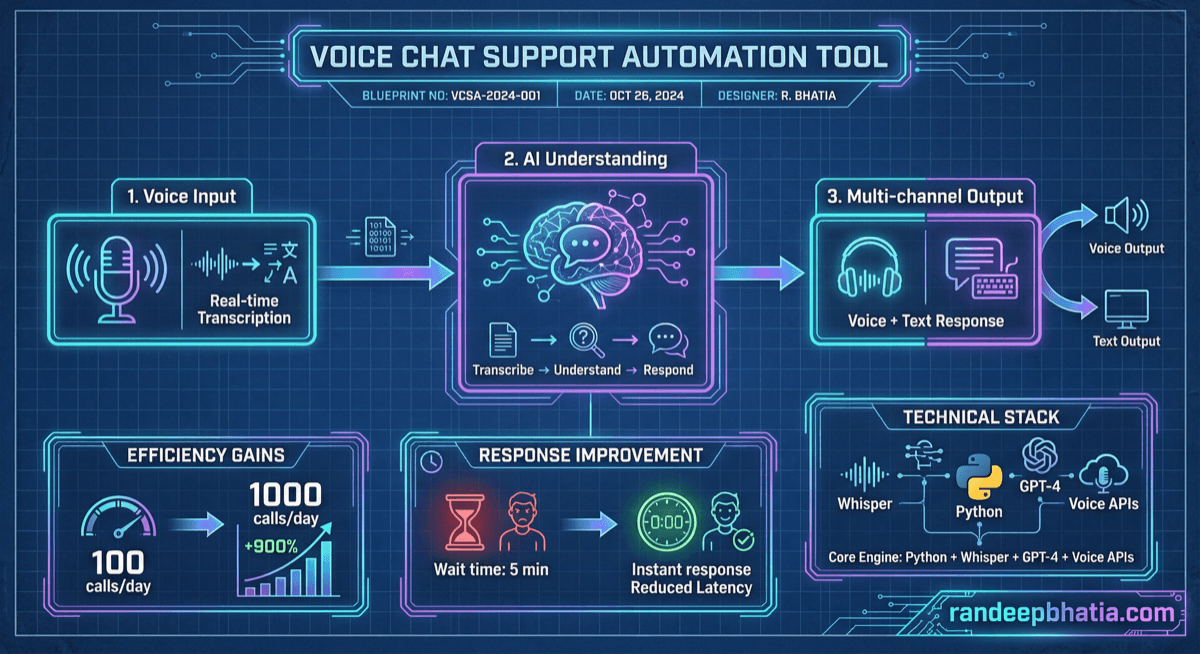
The Problem
On Monday you tested the 3 prompts in ChatGPT. Great! You saw how extract → validate → respond works for customer inquiries. But here's the reality: you can't ask your support team to copy-paste 500 times per day. One agent spending 3 hours running prompts manually? That's $90/day in labor costs. Multiply that across a busy support center and you're looking at $27,000/year just on manual AI prompting. Plus the copy-paste errors that lead to inconsistent responses and frustrated customers.
See It Work
Watch the 3 prompts chain together automatically. This is what you'll build.
Watch It Work
See the AI automation in action
The Code
Three levels: start simple, add reliability, then scale to production. Pick where you are.
Scaling Path
Simple API Calls
0-100 tickets/day
- Sequential prompt chaining
- Basic error logging
- Manual review of all responses
- Single API key
Async + Retries
100-1,000 tickets/day
- Async processing with queues
- Automatic retries with backoff
- Redis caching
- Response quality scoring
- Automated follow-ups
Multi-Agent System
1,000-5,000 tickets/day
- Specialized agents (extract, validate, respond)
- Intelligent routing and escalation
- Quality assurance checks
- Load balancing
- Real-time analytics
Enterprise Platform
5,000+ tickets/day
- Multi-model routing (GPT-4, Claude, custom)
- Advanced sentiment analysis
- Predictive escalation
- Custom knowledge base integration
- Multi-language support
- Compliance logging (GDPR, CCPA)
Customer Service Gotchas
Industry-specific challenges and solutions
Handling Angry Customers
Implement sentiment analysis with human escalation triggers. If sentiment score < 0.3 or explicit anger detected, route to human immediately.
# Sentiment-based routing
def should_escalate_to_human(sentiment_score: float, keywords: List[str]) -> bool:
anger_keywords = ['angry', 'furious', 'unacceptable', 'lawyer', 'sue']
if sentiment_score < 0.3:
return True
if any(keyword in ' '.join(keywords).lower() for keyword in anger_keywords):Multi-Channel Consistency
Maintain conversation history across channels with unique customer ID. Store in Redis with 24-hour TTL.
# Cross-channel context
async def get_customer_context(customer_id: str) -> Dict:
# Check Redis for recent interactions
context = await redis.get(f'customer:{customer_id}:context')
if context:
return json.loads(context)
Knowledge Base Drift
Version your knowledge base and track solution success rates. Auto-flag solutions with <70% success for review.
# Knowledge base versioning
class KnowledgeBase:
def __init__(self):
self.solutions = {}
self.success_rates = {}
async def get_solution(self, issue_type: str) -> Dict:
solution = self.solutions.get(issue_type)Response Time SLAs
Implement tiered response strategy: instant for simple issues, queue complex ones, set realistic expectations.
# Tiered response with SLA tracking
class ResponseManager:
def __init__(self):
self.sla_targets = {
'simple': 30, # 30 seconds
'moderate': 120, # 2 minutes
'complex': 300 # 5 minutes
}Privacy & Data Retention
Redact PII before sending to LLM, store original separately with encryption, implement automatic deletion after 30 days.
# PII redaction before AI processing
import re
from typing import Dict, Tuple
class PIIRedactor:
def __init__(self):
self.patterns = {
'email': r'\b[A-Za-z0-9._%+-]+@[A-Za-z0-9.-]+\.[A-Z|a-z]{2,}\b',Adjust Your Numbers
❌ Manual Process
✅ AI-Automated
You Save
2026 Randeep Bhatia. All Rights Reserved.
No part of this content may be reproduced, distributed, or transmitted in any form without prior written permission.