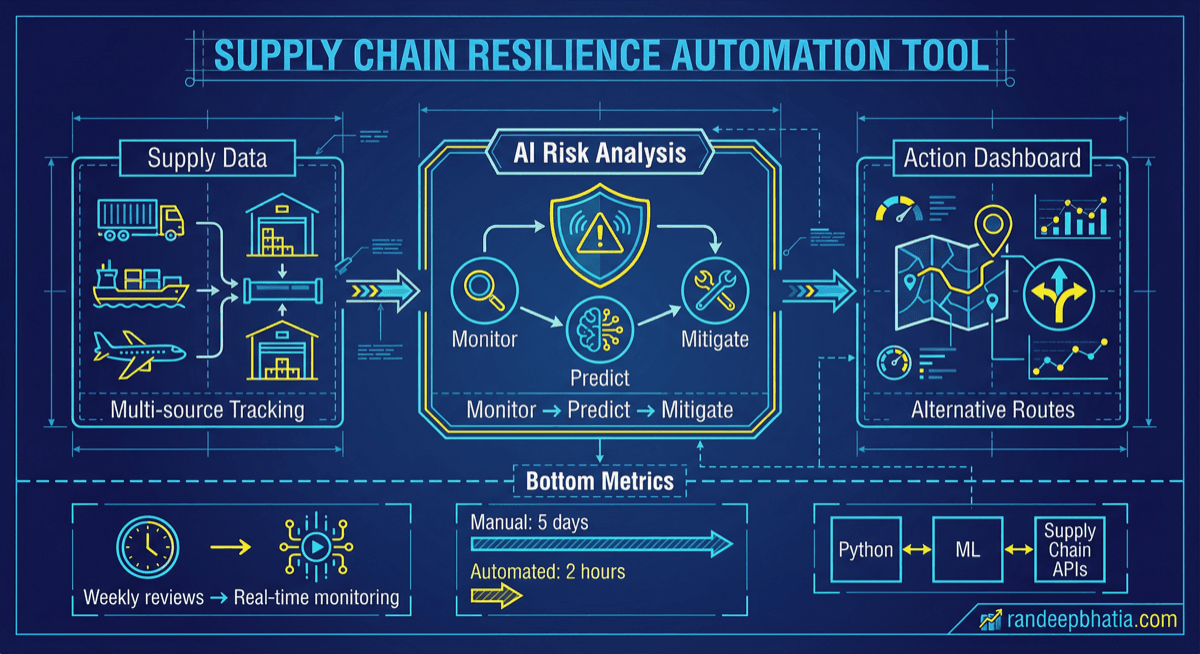
The Problem
On Monday you tested the 3 prompts in ChatGPT. Sweet! You saw how risk detection → supplier validation → mitigation planning works. But here's reality: your supply chain team can't manually process 200 news alerts per day. One analyst spending 4 hours copy-pasting events into prompts? That's $120/day in labor costs. By the time you've validated suppliers and generated mitigation plans manually, the disruption has already cascated through your supply chain. You're reacting 48 hours late to events that needed action in 4 hours.
See It Work
Watch the 3 prompts chain together automatically. This is what you'll build.
Watch It Work
See the AI automation in action
The Code
Three levels: start simple, add reliability, then scale to production. Pick where you are.
When to Level Up
Simple API Calls
10-100 events/day
- Sequential prompt chaining
- Basic error handling
- Manual supplier database queries
- Email notifications
Event Stream + Retries
100-1,000 events/day
- Event stream processing (Kafka)
- Redis caching for risk events
- Exponential backoff retries
- Database storage (Supabase/PostgreSQL)
- Parallel supplier validation
- Structured logging
Multi-Agent System
1,000-5,000 events/day
- LangGraph multi-agent workflow
- Specialized agents per task
- Conditional plan generation
- Prometheus metrics
- Async parallel processing
- Stakeholder notification system
- Advanced error recovery
Enterprise Platform
5,000+ events/day
- Load-balanced agent pools
- Custom fine-tuned models
- Real-time risk scoring ML
- Multi-region deployment
- Live monitoring dashboards
- Automated escalation workflows
- SLA-based processing queues
- Historical analytics and trends
Industry Gotchas
5 Logistics-specific challenges you'll hit (and how to solve them)
Real-Time Data Latency
Implement multi-source ingestion with confidence scoring. Weight real-time sources higher but validate against official channels.
# Multi-source event aggregation with confidence scoring
import asyncio
from typing import List, Dict
class EventAggregator:
async def aggregate_sources(self, event_id: str) -> Dict:
# Fetch from multiple sources in parallel
sources = await asyncio.gather(Cascading Impact Calculation
Build a supplier dependency graph. When validating exposure, traverse the graph to find indirect impacts.
# Supplier dependency graph for cascading analysis
import networkx as nx
from typing import Set
class SupplierGraph:
def __init__(self):
self.graph = nx.DiGraph()
Dynamic Routing Optimization
Cache common route alternatives. Use batch API calls. Implement smart fallbacks.
# Cached route optimization with batch processing
import redis
import asyncio
from typing import List, Dict, Tuple
class RouteOptimizer:
def __init__(self, redis_client: redis.Redis):
self.cache = redis_clientMitigation Cost Accuracy
Integrate with live pricing APIs. Factor in market conditions. Show cost ranges, not single numbers.
# Real-time mitigation cost calculator
import aiohttp
from typing import Dict, Tuple
from datetime import datetime
class MitigationCostCalculator:
async def calculate_air_freight_cost(self, shipment: Dict, urgency: str) -> Tuple[float, float]:
"""Get real-time air freight pricing with min/max range"""Supplier Data Completeness
Implement progressive validation. Use LLM to infer missing data from context. Flag high-confidence gaps for human review.
# Progressive supplier validation with inference
import openai
from typing import Dict, List, Optional
class SupplierValidator:
async def validate_and_enrich(self, supplier: Dict, risk_context: Dict) -> Dict:
"""Validate supplier data and infer missing fields"""
validation_result = {Adjust Your Numbers
❌ Manual Process
✅ AI-Automated
You Save
2026 Randeep Bhatia. All Rights Reserved.
No part of this content may be reproduced, distributed, or transmitted in any form without prior written permission.