The Problem
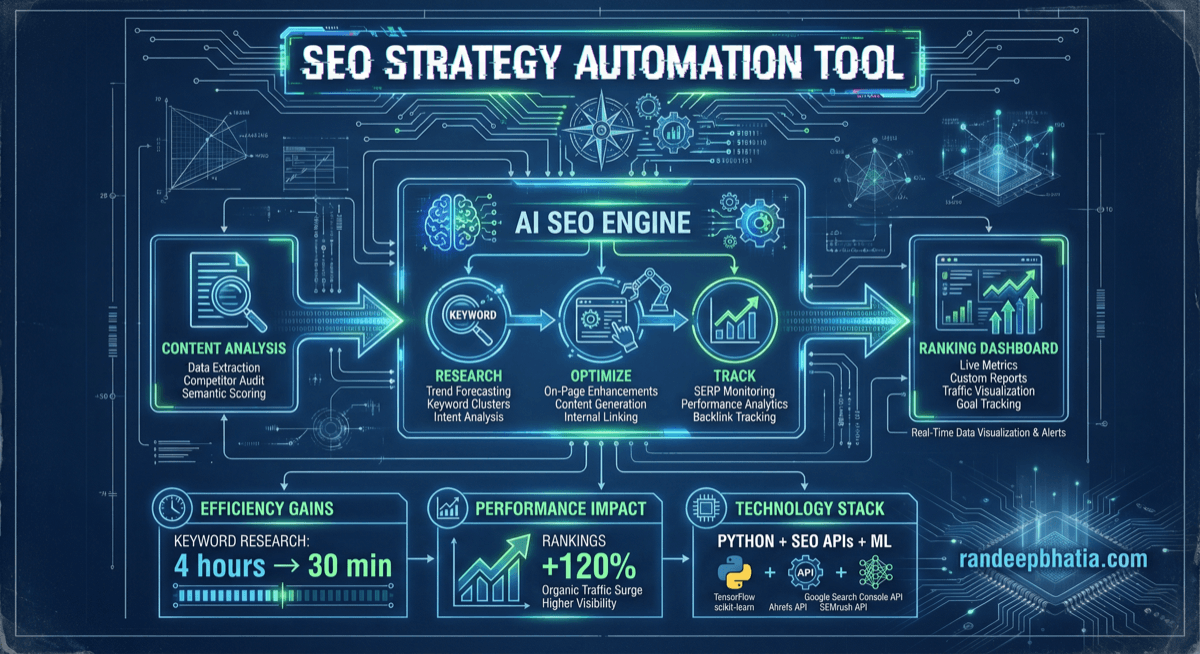
On Monday you tested the 3-prompt framework in ChatGPT. You saw how keyword research ā competitor analysis ā content brief generation works. But here's the reality: your SEO team can't manually analyze 500 keywords per day. One strategist spending 3 hours running prompts and copying data from Ahrefs? That's $150/day in labor costs. For an agency managing 20 clients, that's $3,000/day or $780,000/year just on manual research. Plus the inconsistency when different team members interpret data differently, leading to scattered content strategies.
See It Work
Watch the 3 prompts chain together automatically. This is what you'll build.
Watch It Work
See the AI automation in action
The Code
Three levels: start simple, add reliability, then scale to production. Pick where you are.
When to Level Up
Simple API Calls
0-100 keywords/day
- Sequential processing
- Basic error handling
- Manual result review
- Copy-paste code setup
Error Handling & Batch Processing
100-1,000 keywords/day
- Concurrent processing (5-10 keywords at once)
- Automatic retries with exponential backoff
- Structured logging and monitoring
- Batch processing capabilities
- Rate limiting to avoid API throttling
Production Pattern with LangGraph
1,000-5,000 keywords/day
- Orchestrated workflows with state management
- Automatic error recovery and retry logic
- Concurrent processing (10-50 keywords at once)
- Distributed task queues
- Real-time monitoring and alerting
- Checkpointing for resume on failure
Multi-Agent System
5,000+ keywords/day
- Specialized agents (research, analysis, writing)
- Auto-scaling based on load
- Multi-region deployment
- Advanced caching and deduplication
- Real-time collaboration between agents
- Custom ML models for intent classification
- Integration with CMS for auto-publishing
Marketing-Specific Gotchas
Edge cases that break automation if you don't handle them
Keyword Intent Misclassification
Add SERP feature analysis to validate intent. If you see shopping results or ads, it's commercial regardless of what the model says.
# Validate intent with SERP features
def validate_intent(keyword: str, gpt_intent: str, serp_features: List[str]) -> str:
"""Cross-check GPT classification with SERP signals"""
commercial_signals = ['shopping_results', 'ads', 'product_listings']
if gpt_intent == 'informational' and any(sig in serp_features for sig in commercial_signals):
logger.warning(f"Intent mismatch for {keyword}: GPT said informational but SERP shows commercial")
return 'commercial_investigation'Competitor Content Staleness
Check publish dates and prioritize recent content. For older pages, identify what's missing (new tools, updated stats, recent trends).
# Filter competitors by freshness
async def analyze_fresh_competitors(urls: List[str]) -> List[CompetitorAnalysis]:
"""Prioritize recently updated content"""
analyses = []
for url in urls:
# Scrape publish/update date
publish_date = await get_publish_date(url)API Rate Limits and Costs
Implement smart caching and request batching. Cache keyword data for 7 days. Batch related keywords into single API calls when possible.
# Smart caching for API requests
import redis
import hashlib
from datetime import timedelta
class CachedAPIClient:
def __init__(self, redis_url: str, cache_ttl_days: int = 7):
self.redis = redis.from_url(redis_url)Dynamic SERP Features
Re-check SERP features weekly for high-priority keywords. Store historical data to identify trends (e.g., 'people also ask' appeared 3 months ago).
# Track SERP feature changes
class SERPFeatureTracker:
def __init__(self, db_connection):
self.db = db_connection
async def track_features(self, keyword: str, current_features: List[str]):
"""Store and compare SERP features over time"""
# Get historical featuresContent Brief Length Creep
Set hard caps based on content type. Blog posts: 2,500-3,500 words max. Guides: 4,000-5,000 max. Anything beyond that needs manual review.
# Enforce word count caps
def normalize_word_count(recommended: int, content_type: str) -> Dict[str, int]:
"""Apply realistic word count caps based on content type"""
caps = {
'blog_post': {'min': 1500, 'target': 2500, 'max': 3500},
'guide': {'min': 2500, 'target': 3500, 'max': 5000},
'comparison': {'min': 2000, 'target': 3000, 'max': 4000},
'tutorial': {'min': 1500, 'target': 2000, 'max': 3000}Adjust Your Numbers
ā Manual Process
ā AI-Automated
You Save
2026 Randeep Bhatia. All Rights Reserved.
No part of this content may be reproduced, distributed, or transmitted in any form without prior written permission.