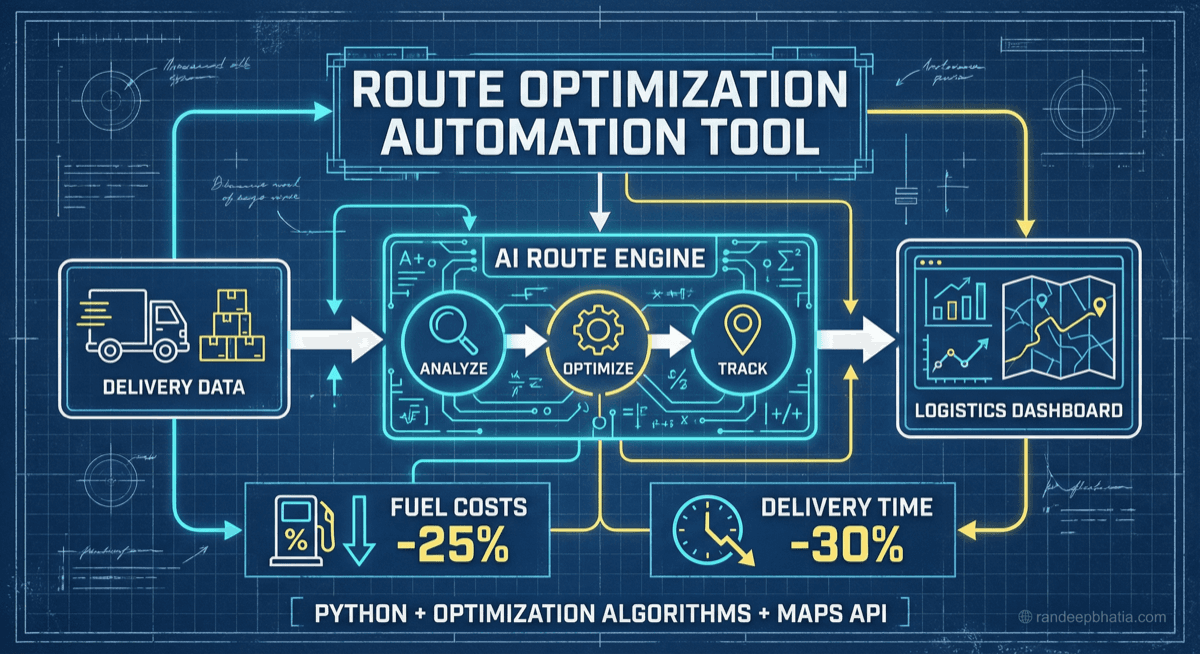
The Problem
On Monday you tested the 3 prompts in ChatGPT. You saw how extraction → validation → optimization works. But here's the reality: you can't ask dispatchers to copy-paste 200 times per day. One dispatcher spending 3 hours manually planning routes? That's $90/day in labor costs. Multiply that across a fleet operation and you're looking at $27,000/year just on route planning admin. Plus the human errors that lead to missed deliveries, wasted fuel, and unhappy customers.
See It Work
Watch the 3 prompts chain together automatically. This is what you'll build.
Watch It Work
See the AI automation in action
The Code
Three levels: start simple, add reliability, then scale to production. Pick where you are.
When to Level Up
Simple API Calls
- Direct OpenAI/Claude API calls
- Sequential processing (one route at a time)
- No caching or retries
- Manual error handling
- Results in memory (no database)
With Error Handling & Caching
- Retry logic with exponential backoff
- Redis caching (avoid re-processing same routes)
- Structured logging (Winston/Python logging)
- Request timeouts
- Basic monitoring
Production Pattern with Queue System
- RabbitMQ/SQS for job queuing
- PostgreSQL for job persistence
- Multiple workers (horizontal scaling)
- Dead letter queues for failed jobs
- Health checks and auto-recovery
- Prometheus metrics
Multi-Agent System
- LangGraph orchestration
- Specialized agents (extraction, validation, optimization, traffic)
- Real-time traffic data integration (Google Maps API)
- Dynamic re-routing based on delays
- Load balancing across multiple LLM providers
- Advanced monitoring (Datadog/New Relic)
- Cost optimization (model selection per task)
Logistics-Specific Gotchas
Things that will bite you if you don't handle them upfront.
Real-Time Traffic Integration
Integrate Google Maps Distance Matrix API with traffic data. Recalculate ETAs every 30 minutes during active deliveries.
# Integrate real-time traffic data
import googlemaps
from datetime import datetime, timedelta
gmaps = googlemaps.Client(key=os.getenv('GOOGLE_MAPS_API_KEY'))
def get_realistic_travel_time(origin: str, destination: str, departure_time: datetime) -> int:
"""Get travel time accounting for traffic"""Vehicle Capacity Constraints
Validate constraints BEFORE optimization. Use hard limits in prompts and double-check outputs programmatically.
# Enforce hard capacity constraints
from typing import List, Dict
def validate_route_capacity(route: Dict, max_weight: int, max_hours: int) -> Dict:
"""Validate route doesn't exceed vehicle capacity"""
total_weight = sum(stop['weight_lbs'] for stop in route['sequence'])
total_time = route['estimated_time_hours']
Time Window Conflicts
Pre-validate time windows. Flag conflicts. Ask LLM to prioritize or suggest alternatives.
# Detect and resolve time window conflicts
from datetime import datetime, timedelta
from typing import List, Dict, Tuple
def detect_time_conflicts(deliveries: List[Dict]) -> List[Dict]:
"""Find deliveries with overlapping time windows that can't both be met"""
conflicts = []
Address Geocoding Errors
Always geocode addresses. Validate coordinates. Flag ambiguous addresses for manual review.
# Robust address geocoding with validation
import googlemaps
from typing import Dict, Optional, List
import logging
logger = logging.getLogger(__name__)
gmaps = googlemaps.Client(key=os.getenv('GOOGLE_MAPS_API_KEY'))
Dynamic Re-Routing for Delays
Pre-compute backup routes. Use fast heuristics for minor adjustments. Only call LLM for major re-routes.
# Dynamic re-routing with fast heuristics from datetime import datetime, timedelta from typing import List, Dict, Optional import logging logger = logging.getLogger(__name__) class DynamicRouter:
Adjust Your Numbers
❌ Manual Process
✅ AI-Automated
You Save
2026 Randeep Bhatia. All Rights Reserved.
No part of this content may be reproduced, distributed, or transmitted in any form without prior written permission.