← Monday's Prompts

Automate Pricing Optimization 🚀

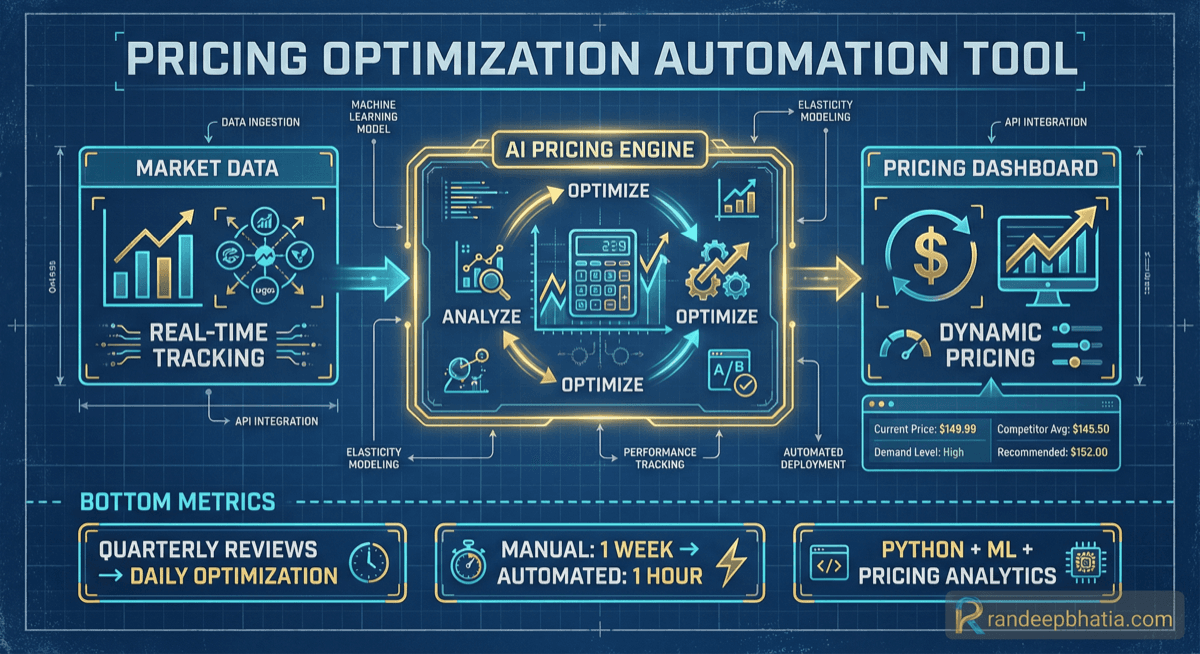
Turn Monday's 3 prompts into production-ready pricing engine

July 22, 2025
20 min read
💰 Fintech🐍 Python + TypeScript⚡ 10 → 10,000 SKUs

The Problem

On Monday you tested the 3 prompts in ChatGPT. You saw how competitor analysis → demand forecasting → price optimization works. But here's reality: you can't manually update 500 prices every day. One analyst spending 4 hours on pricing spreadsheets? That's $120/day in labor costs. Multiply that across a growing fintech platform and you're looking at $36,000/year just on pricing admin. Plus the missed revenue from outdated prices and slow competitor responses.

4+ hours
Per day on manual price updates
30% lag
Behind competitor price changes
Can't scale
Beyond 50-100 products manually

See It Work

Watch the 3 prompts chain together automatically. This is what you'll build.

Watch It Work

See the AI automation in action

Live Demo • No Setup Required

The Code

Three levels: start simple, add ML models, then scale to real-time optimization. Pick where you are.

Basic = Quick startProduction = Full featuresAdvanced = Custom + Scale

Simple API Calls

Good for: 10-100 products | Setup time: 30 minutes

Simple API Calls
Good for: 10-100 products | Setup time: 30 minutes
# Simple Pricing Optimization (10-100 products)
import openai
import json
import os
from typing import Dict, List, Optional
from datetime import datetime

# Set your API key
openai.api_key = os.getenv('OPENAI_API_KEY')

def optimize_pricing(product_data: str) -> Dict:
    """Chain the 3 prompts: analyze → forecast → recommend"""
    
    # Step 1: Analyze competitors and market
    analysis_prompt = f"""Analyze this product pricing data and extract key metrics as JSON.
Showing 15 of 100 lines

When to Level Up

1

Simple API Calls

10-100 products/day

  • Direct OpenAI/Claude API calls
  • Sequential processing
  • Manual trigger (cron job)
  • Basic error logging
  • No caching
Level Up
2

Add ML + Error Handling

100-1,000 products/day

  • ML models for baseline predictions
  • Retry logic with exponential backoff
  • Redis caching (1 hour TTL)
  • Comprehensive logging
  • Rate limiting
Level Up
3

Production Pattern

1,000-5,000 products/day

  • LangGraph orchestration
  • Async processing with queues
  • Validation checkpoints
  • Database persistence
  • Real-time monitoring
Level Up
4

Multi-Agent System

5,000+ products/day

  • Distributed processing
  • Specialized agents (competitor tracking, demand forecasting, price optimization)
  • Load balancing across regions
  • Advanced ML models (LSTM, Prophet)
  • A/B testing framework

Fintech Gotchas

Domain-specific challenges you'll hit. Here's how to handle them.

Real-Time Data Staleness

Implement TTL-based caching with Redis. Fresh data for high-priority products, cached for long-tail.

Solution
# Redis caching with TTL
import redis
from datetime import timedelta

redis_client = redis.Redis(host='localhost', port=6379, db=0)

def get_competitor_prices(product_id: str, force_refresh: bool = False):
    cache_key = f"competitor_prices:{product_id}"
Showing 8 of 23 lines

Price Elasticity Varies by Segment

Segment customers and use different elasticity models. Track response by cohort.

Solution
# Segment-specific elasticity
def calculate_elasticity(customer_segment: str, historical_data: List[Dict]):
    # Different elasticity by segment
    elasticity_map = {
        'enterprise': -0.5,  # Less price sensitive
        'smb': -1.8,         # More price sensitive
        'startup': -2.2      # Very price sensitive
    }
Showing 8 of 26 lines

Regulatory Constraints on Pricing

Build validation rules into your workflow. Fail fast if recommendation violates regulations.

Solution
# Regulatory validation
def validate_price_change(current_price: float, new_price: float, market: str) -> bool:
    # Market-specific rules
    rules = {
        'EU': {'max_change_pct': 0.15, 'min_margin': 0.20},
        'US': {'max_change_pct': 0.25, 'min_margin': 0.15},
        'APAC': {'max_change_pct': 0.20, 'min_margin': 0.25}
    }
Showing 8 of 25 lines

Subscription vs One-Time Pricing

Factor in LTV, churn, and retention in your pricing model. Don't just optimize for first purchase.

Solution
# LTV-aware pricing
def calculate_ltv_optimized_price(product_data: Dict) -> float:
    # For subscriptions, optimize for LTV not just first month
    if product_data['type'] == 'subscription':
        avg_lifetime_months = product_data.get('avg_lifetime_months', 12)
        monthly_churn = product_data.get('monthly_churn', 0.05)
        
        # Calculate expected LTV at different price points
Showing 8 of 35 lines

Competitor Price Matching Loops

Set floor prices and implement delay mechanisms. Don't react to every competitor move.

Solution
# Smart competitor response
def should_respond_to_competitor(competitor_change: Dict, product_data: Dict) -> bool:
    # Don't respond to every price change
    change_pct = abs(competitor_change['new_price'] - competitor_change['old_price']) / competitor_change['old_price']
    
    # Ignore small changes (< 5%)
    if change_pct < 0.05:
        return False
Showing 8 of 27 lines

Adjust Your Numbers

500
105,000
5 min
1 min60 min
$50/hr
$15/hr$200/hr

❌ Manual Process

Time per analysis:5 min
Cost per analysis:$4.17
Daily volume:500 competitors
Daily:$2,083
Monthly:$45,833
Yearly:$550,000

✅ AI-Automated

Time per analysis:~2 sec
API cost:$0.02
Review (10%):$0.42
Daily:$218
Monthly:$4,803
Yearly:$57,640

You Save

0/day
90% cost reduction
Monthly Savings
$41,030
Yearly Savings
$492,360
💡 ROI payback: Typically 1-2 months for basic implementation
💰

Want This Running in Your Fintech Platform?

We build custom pricing optimization systems that integrate with your stack. Real-time competitor tracking, ML-powered forecasting, and regulatory compliance built in.

©

2026 Randeep Bhatia. All Rights Reserved.

No part of this content may be reproduced, distributed, or transmitted in any form without prior written permission.