← Monday's Prompts

Automate Predictive Maintenance 🚀

Turn Monday's 3 prompts into production-ready anomaly detection

April 29, 2025
22 min read
🏭 Manufacturing🐍 Python + TypeScript⚡ 10 → 1000+ assets

The Problem

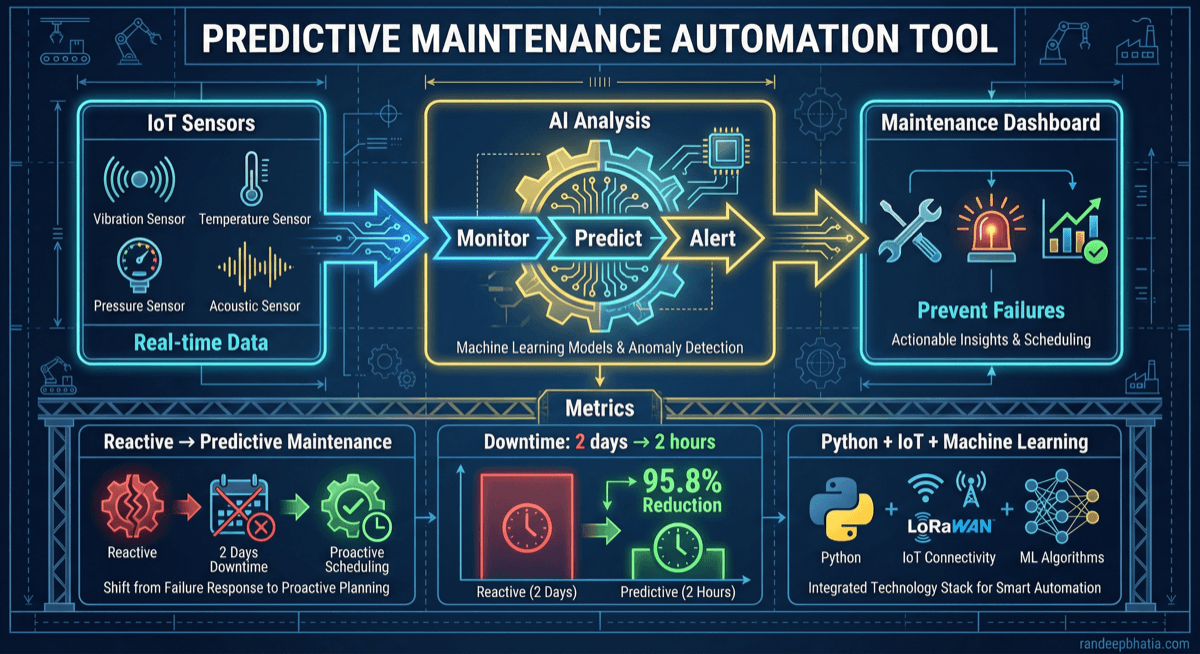
On Monday you tested the 3 prompts in ChatGPT. You saw how sensor analysis → anomaly detection → maintenance prediction works. But here's reality: you can't have technicians manually checking 500 sensors every hour. One maintenance engineer spending 4 hours/day reviewing logs? That's $120/day in labor costs. Multiply across a plant and you're looking at $36,000/year just monitoring equipment. Plus the unplanned downtime when failures surprise you anyway.

4+ hours
Per day manually checking sensors
70% reactive
Maintenance is after-the-fact repairs
Can't scale
Beyond 50-100 sensors manually

See It Work

Watch the 3 prompts chain together automatically. This is what you'll build.

Watch It Work

See the AI automation in action

Live Demo • No Setup Required

The Code

Three levels: start simple, add ML detection, then scale to real-time monitoring. Pick where you are.

Basic = Quick startProduction = Full featuresAdvanced = Custom + Scale

Simple Sensor Analysis

Good for: 10-100 sensors | Setup time: 30 minutes

Simple Sensor Analysis
Good for: 10-100 sensors | Setup time: 30 minutes
# Simple Sensor Analysis (10-100 sensors/day)
import openai
import json
import os
from datetime import datetime
from typing import Dict, List, Optional

# Set your API key
openai.api_key = os.getenv('OPENAI_API_KEY')

def analyze_sensor_data(sensor_reading: str) -> Dict:
    """Chain the 3 prompts: extract → detect anomalies → recommend"""
    
    # Step 1: Extract and structure sensor data
    extraction_prompt = f"""Extract sensor readings from this equipment data and format as JSON.
Showing 15 of 112 lines

When to Level Up

1

Simple API Calls

  • OpenAI/Claude API for analysis
  • Manual data input or CSV upload
  • Basic threshold detection
  • Email/Slack alerts
  • Simple logging
Level Up
2

Automated Monitoring

  • MQTT broker for real-time data
  • Automated anomaly detection
  • Redis caching for fast lookups
  • CMMS API integration (SAP PM, Maximo)
  • PagerDuty/Slack critical alerts
  • Basic trend analysis
Level Up
3

ML-Enhanced Pipeline

  • ML anomaly detection (Isolation Forest)
  • AWS SageMaker for model training
  • S3 for historical data storage
  • Prometheus metrics
  • Advanced trend analysis
  • Automated work order creation
  • Multi-level alerting
Level Up
4

Enterprise Multi-Agent System

  • LangGraph for complex workflows
  • Distributed processing (Kafka, RabbitMQ)
  • Custom fine-tuned models
  • Multi-site coordination
  • Advanced predictive analytics
  • Integration with ERP systems
  • Custom dashboards and reporting
  • 24/7 monitoring and support

Manufacturing Gotchas

Real challenges you'll face (and how to solve them)

Sensor Drift & Calibration

Track sensor calibration dates in your data model. Flag readings from sensors >90 days since calibration as 'needs_verification'. Use statistical baselines that adjust for known drift patterns.

Solution
# Python: Adjust for sensor drift
from datetime import datetime, timedelta

def adjust_for_drift(reading: float, sensor_id: str, last_calibration: datetime) -> float:
    days_since_cal = (datetime.now() - last_calibration).days
    if days_since_cal > 90:
        # Known drift: +0.5°C per 30 days for this sensor type
        drift_correction = (days_since_cal / 30) * 0.5
Showing 8 of 12 lines

Multi-Protocol IoT Integration

Use protocol adapters that normalize to a common format. MQTT is easiest for cloud integration. For Modbus/OPC-UA, use edge gateways (like AWS IoT Greengrass) to convert to MQTT.

Solution
# TypeScript: Protocol adapter pattern
interface SensorReading {
  sensor_id: string;
  timestamp: string;
  readings: Record<string, number>;
}

class ProtocolAdapter {
Showing 8 of 34 lines

Handling Noisy Industrial Data

Apply moving averages and filter transient spikes. Use 5-minute rolling windows for vibration, 15-minute for temperature. Only alert on sustained anomalies (3+ consecutive readings).

Solution
# Python: Noise filtering with pandas
import pandas as pd
import numpy as np

def filter_sensor_noise(df: pd.DataFrame, window_minutes: int = 5) -> pd.DataFrame:
    # Convert to time series
    df['timestamp'] = pd.to_datetime(df['timestamp'])
    df = df.set_index('timestamp')
Showing 8 of 22 lines

CMMS Integration & Work Order Automation

Use retry logic with exponential backoff. Queue failed requests in Redis/RabbitMQ for later retry. Log all CMMS API calls for audit trails.

Solution
# TypeScript: CMMS integration with retries
import axios from 'axios';
import retry from 'async-retry';

interface WorkOrder {
  equipment_id: string;
  priority: 'critical' | 'high' | 'medium' | 'low';
  description: string;
Showing 8 of 54 lines

Balancing Sensitivity vs False Positives

Start conservative (high thresholds) and tune based on feedback. Track false positive rate and adjust ML model contamination parameter. Use severity levels (info/warning/critical) instead of binary alerts.

Solution
# Python: Adaptive threshold tuning
from sklearn.metrics import precision_recall_curve
import numpy as np

class AdaptiveThresholdTuner:
    def __init__(self, target_precision: float = 0.85):
        self.target_precision = target_precision
        self.threshold = 0.5
Showing 8 of 34 lines

Adjust Your Numbers

500
105,000
5 min
1 min60 min
$50/hr
$15/hr$200/hr

❌ Manual Process

Time per item:5 min
Cost per item:$4.17
Daily volume:500 items
Daily:$2,083
Monthly:$45,833
Yearly:$550,000

✅ AI-Automated

Time per item:~2 sec
API cost:$0.02
Review (10%):$0.42
Daily:$218
Monthly:$4,803
Yearly:$57,640

You Save

0/day
90% cost reduction
Monthly Savings
$41,030
Yearly Savings
$492,360
💡 ROI payback: Typically 1-2 months for basic implementation
🏭

Want This Running in Your Factory?

We build custom manufacturing AI systems that integrate with your IoT sensors, CMMS, and existing infrastructure. From pilot to production in 4-8 weeks.

©

2026 Randeep Bhatia. All Rights Reserved.

No part of this content may be reproduced, distributed, or transmitted in any form without prior written permission.