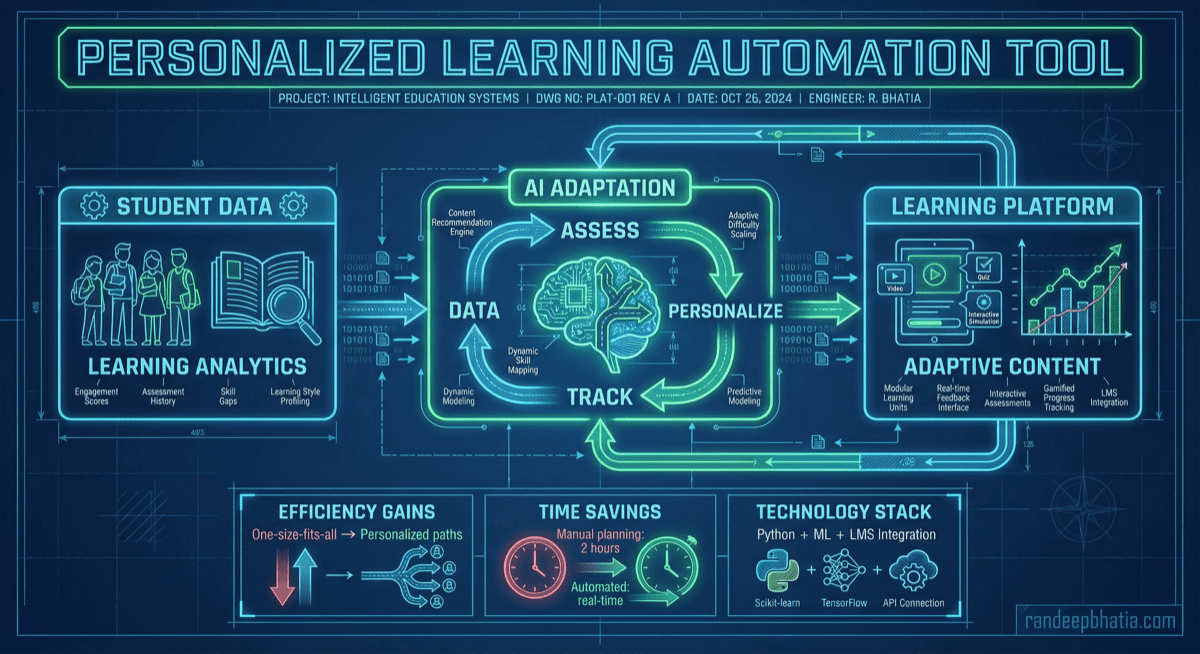
The Problem
On Monday you tested the 3 prompts in ChatGPT. You saw how analyzing student data → identifying gaps → generating adaptive content works. But here's the reality: one teacher spending 3 hours per week manually reviewing 30 student profiles and customizing lessons? That's $45/week in extra planning time. Multiply that across a school with 500 students and you're looking at $33,750/year just on differentiation admin. Plus the inconsistency when teachers use different criteria for identifying learning gaps.
See It Work
Watch the 3 prompts chain together automatically. This is what you'll build.
Watch It Work
See the AI automation in action
The Code
Three levels: start simple, add intelligence, then scale to production. Pick where you are.
When to Scale Up
Simple Scripts
- Basic API calls (Example 1)
- Manual review of all outputs
- Local file storage
- No database needed
- Run on-demand
Automated Pipeline
- Add error handling and retries (Example 2)
- Progress tracking database
- Scheduled batch processing
- Analytics dashboard
- Teacher review queue
Production System
- LangGraph orchestration (Example 3)
- Multi-student concurrent processing
- Historical trend analysis
- Real-time analytics
- LMS integration
- Automated alerts for at-risk students
Enterprise Platform
- Multi-agent system with specialized models
- Load balancing across regions
- Advanced predictive analytics
- Custom model fine-tuning
- Multi-language support
- Full LMS/SIS integration
- Dedicated support team
Education-Specific Gotchas
Real challenges you'll hit when automating personalized learning (and how to handle them):
FERPA Compliance & Student Privacy
Anonymize before processing. Use student IDs instead of names. Redact sensitive info.
# Anonymize student data before API calls
import hashlib
import re
def anonymize_student_data(raw_data: str, student_id: str) -> tuple[str, dict]:
"""Remove PII, keep learning-relevant data"""
# Create consistent anonymous IDInconsistent Assessment Data Formats
Normalize all scores to a common scale (0-1) before analysis. Store original format for display.
# Normalize different assessment formats
from typing import Union, Dict
def normalize_score(score: Union[int, float, str], format_type: str) -> float:
"""Convert any score format to 0-1 scale"""
if format_type == 'percentage':
# 0-100% → 0-1Learning Style Misconceptions
Focus on engagement patterns and mastery data instead. Use multiple modalities for all students.
# Focus on engagement patterns, not fixed 'styles'
def analyze_engagement_patterns(student_history: list) -> dict:
"""Identify what actually works for this student"""
engagement_data = {
'high_engagement_activities': [],
'low_engagement_activities': [],
'mastery_by_activity_type': {}Grade-Level Standards Alignment
Include standards database in prompts. Validate generated content against standards.
# Ensure alignment with grade-level standards
import json
# Load standards database (Common Core, state standards, etc.)
STANDARDS_DB = {
'grade_8_math': {
'fractions': {
'standard_id': 'CCSS.MATH.8.NS.A.1',Parent Communication & Transparency
Generate parent-friendly explanations alongside learning paths. Show the reasoning.
# Generate parent-friendly explanations
def create_parent_communication(learning_path: dict, gap_analysis: dict) -> dict:
"""Translate AI outputs into parent-friendly language"""
parent_message = {
'subject': f"Personalized Learning Plan for {learning_path.get('student_name', 'Your Child')}",
'overview': '',
'current_strengths': [],Adjust Your Numbers
❌ Manual Process
✅ AI-Automated
You Save
2026 Randeep Bhatia. All Rights Reserved.
No part of this content may be reproduced, distributed, or transmitted in any form without prior written permission.