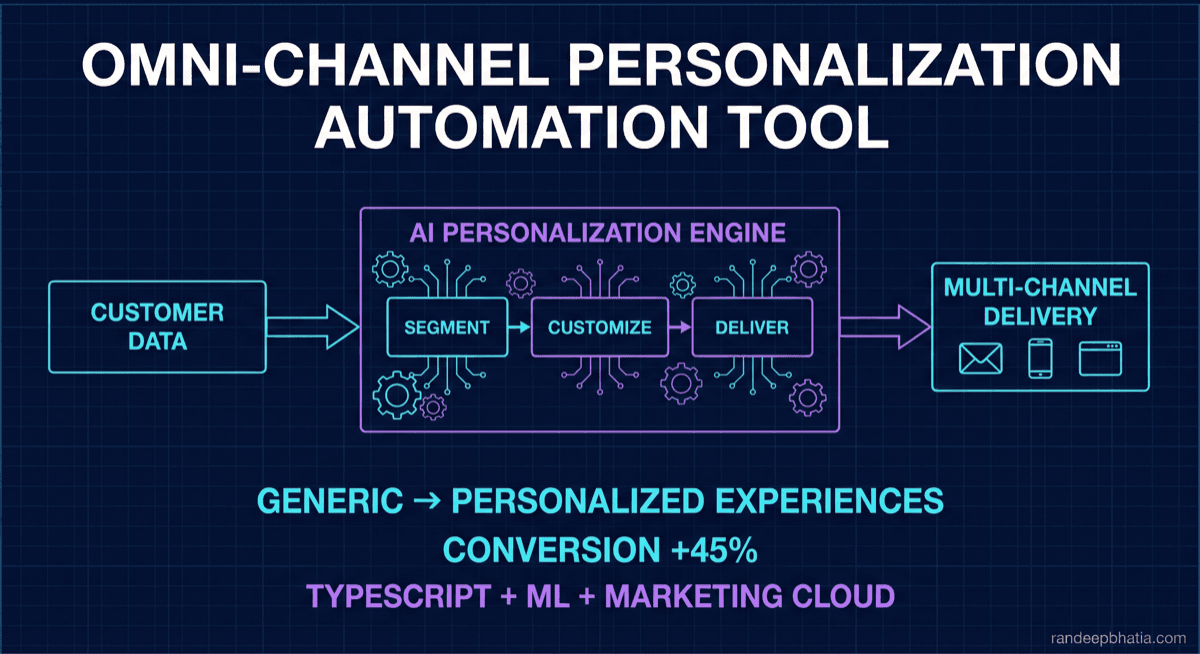
The Problem
On Monday you tested the 3 prompts in ChatGPT. You saw how profile extraction → behavior analysis → personalization works for a handful of customers. But here's the reality: your marketing team can't manually analyze 5,000 customer journeys per day. One analyst spending 3 hours running prompts and building segments? That's $90/day in labor costs. Multiply that across a growing e-commerce business and you're looking at $27,000/year just on manual segmentation. Plus the lag time means you're personalizing based on week-old data, not real-time behavior.
See It Work
Watch the 3 prompts chain together automatically. This is what you'll build.
Watch It Work
See the AI automation in action
The Code
Three levels: start simple, add intelligence, then scale to production. Pick where you are.
When to Level Up
Simple API Calls
- Direct OpenAI/Claude API calls
- Sequential processing (profile → analyze → personalize)
- Basic error handling
- Manual monitoring
- Local caching (optional)
With Real-Time Analytics
- Retry logic with exponential backoff
- Redis caching (1 hour TTL)
- Database storage for analytics (Supabase/Postgres)
- Structured logging (Winston)
- Request timeout handling
- Basic metrics tracking
Production Pattern
- LangGraph workflow orchestration
- Multi-model strategy (Claude for analysis, GPT-4 for content)
- Quality validation gates
- Prometheus metrics + Grafana dashboards
- Redis queue management
- Automated retry with circuit breakers
- A/B testing framework
Multi-Agent System
- Kubernetes deployment with auto-scaling
- Separate agents: Profiler, Analyzer, Content Generator, QA
- Apache Kafka for event streaming
- Real-time customer data sync (CDP integration)
- Advanced caching (Redis Cluster + CDN)
- ML-powered quality scoring
- Multi-region deployment
- 99.9% uptime SLA
Retail-Specific Gotchas
Edge cases that'll bite you if you don't handle them
Real-Time Inventory Sync
Integrate live inventory checks before personalization
# Check inventory before recommending
import requests
def get_available_products(product_ids: List[str]) -> List[str]:
"""Filter products by real-time inventory"""
inventory_api = os.getenv('INVENTORY_API_URL')
response = requests.post(
f"{inventory_api}/check-stock",Multi-Currency Price Display
Convert prices based on customer location with live exchange rates
# Multi-currency price conversion
import requests
from functools import lru_cache
@lru_cache(maxsize=1)
def get_exchange_rates() -> Dict[str, float]:
"""Fetch and cache exchange rates (1 hour TTL)"""
response = requests.get(Seasonal Product Relevance
Filter recommendations by season and customer location
# Seasonal product filtering
from datetime import datetime
import pytz
def get_customer_season(location: str) -> str:
"""Determine season based on customer location and date"""
# Map location to timezone
tz = pytz.timezone('America/Chicago') # Example: Austin, TXCart Abandonment Timing
Optimize timing based on customer behavior patterns
# Optimal cart abandonment timing
from datetime import datetime, timedelta
def calculate_optimal_reminder_time(customer_data: Dict) -> datetime:
"""
Calculate best time to send cart abandonment reminder
based on customer's historical behavior
"""Cross-Device Customer Tracking
Unify customer identity across devices and sessions
# Cross-device identity resolution
import hashlib
from typing import List, Dict, Optional
class CustomerIdentityResolver:
def __init__(self, redis_client):
self.redis = redis_client
Adjust Your Numbers
❌ Manual Process
✅ AI-Automated
You Save
2026 Randeep Bhatia. All Rights Reserved.
No part of this content may be reproduced, distributed, or transmitted in any form without prior written permission.