← Monday's Prompts

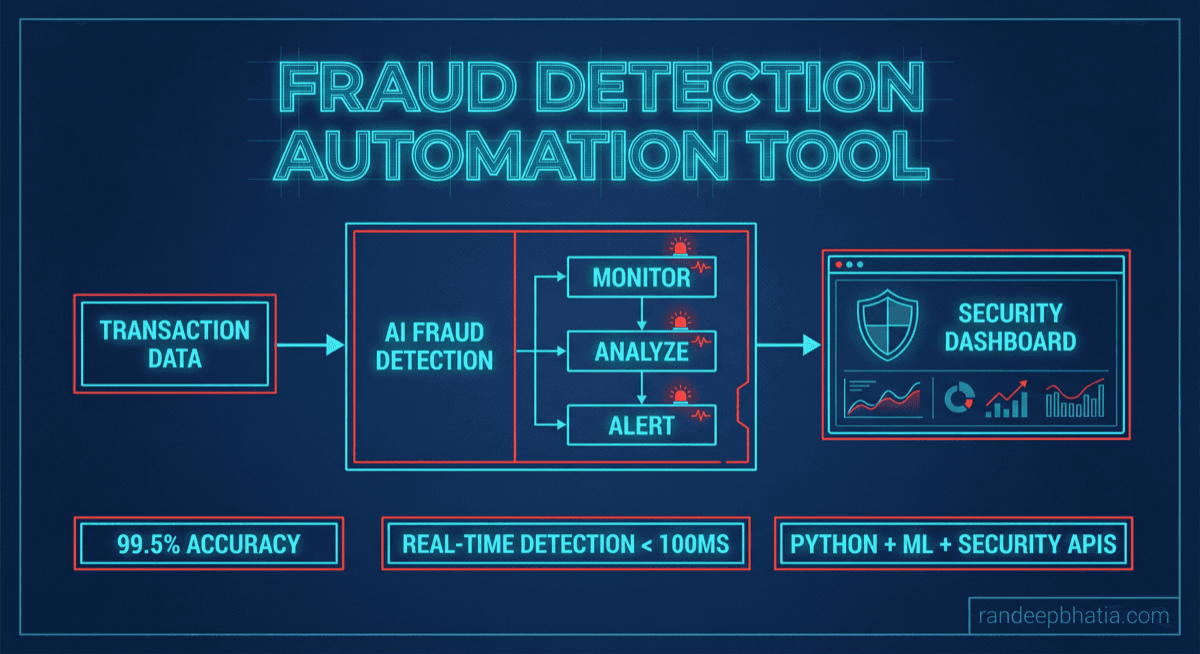
Automate Fraud Detection 🚀

Turn Monday's 3 prompts into production-ready code

September 9, 2025
26 min read
🏦 Banking🐍 Python + TypeScript⚡ 100 → 10K txn/day

The Problem

On Monday you tested the 3-prompt framework in ChatGPT. You saw how transaction analysis → risk scoring → alert generation works. But here's reality: your fraud team is drowning. Each analyst reviews maybe 50 transactions per day. That's 6 minutes per transaction. With 5,000 daily transactions, you need 100 analysts working full-time. The math doesn't work. Plus manual review misses patterns. One analyst can't remember that weird $47.23 charge from 3 weeks ago that matches today's suspicious activity. Your false positive rate is 60% because humans are guessing. Real fraud slips through while your team chases ghosts.

6 min/txn
Manual review time per transaction
60% false
False positive rate from manual review
Max 50/day
Transactions one analyst can review

See It Work

Watch the 3 prompts chain together automatically. This is what you'll build.

Watch It Work

See the AI automation in action

Live Demo • No Setup Required

The Code

Three levels: start simple, add reliability, then scale to real-time. Pick where you are.

Basic = Quick startProduction = Full featuresAdvanced = Custom + Scale

Simple API Calls

Good for: 0-100 transactions/day | Setup time: 30 minutes

Simple API Calls
Good for: 0-100 transactions/day | Setup time: 30 minutes
# Simple Fraud Detection (0-100 transactions/day)
import openai
import json
import os
from typing import Dict, List, Optional
from datetime import datetime
import hashlib

# Set your API key
openai.api_key = os.getenv('OPENAI_API_KEY')

def analyze_transaction(transaction_data: Dict) -> Dict:
    """
    Chain the 3 prompts: extract → risk score → generate alert
    
Showing 15 of 145 lines

When to Level Up

1

Simple API Calls

  • Basic prompt chaining (extract → risk → alert)
  • Manual review of all flagged transactions
  • Simple logging to files
  • No caching or optimization
  • Single-threaded processing
Level Up
2

With Error Handling & Caching

  • Retry logic with exponential backoff
  • Redis caching (1 hour TTL)
  • Rate limiting to prevent API overload
  • Structured logging (Winston)
  • Rule-based fallback if AI fails
  • Prometheus metrics
Level Up
3

Stream Processing Pipeline

  • Kafka stream processing
  • PostgreSQL for audit trail
  • Circuit breaker pattern
  • Async processing (100+ concurrent)
  • Automated alert routing
  • Historical pattern matching
  • Real-time dashboards
Level Up
4

Multi-Agent System

  • Multi-region deployment
  • Specialized agents (amount, geo, behavior, merchant)
  • ML model ensemble
  • Auto-scaling based on load
  • 99.9% uptime SLA
  • Regulatory compliance automation
  • Advanced analytics and reporting
  • A/B testing for model improvements

Banking-Specific Gotchas

Real challenges from production fraud detection systems. Learn from our mistakes.

PCI-DSS Compliance: Never Log Full Card Numbers

Mask sensitive data BEFORE logging. Use last 4 digits only.

Solution
# ❌ WRONG - Logs full card number
logger.error(f"Transaction failed: {transaction.card_number}")

# ✅ RIGHT - Mask before logging
def mask_card(card_number: str) -> str:
    return f"****{card_number[-4:]}"

logger.error(f"Transaction failed: {mask_card(transaction.card_number)}")
Showing 8 of 18 lines

Real-Time vs Batch: Don't Block Legitimate Transactions

Use async processing with timeout fallback. Approve low-risk immediately, queue high-risk for review.

Solution
# ❌ WRONG - Blocks customer while AI thinks
async def process_transaction(txn):
    risk_score = await analyze_fraud(txn)  # Takes 5-10 seconds
    if risk_score > 70:
        return "BLOCKED"
    return "APPROVED"

# ✅ RIGHT - Fast-path for low-risk, async for high-risk
Showing 8 of 31 lines

False Positives Kill Customer Trust

Tune thresholds based on REAL fraud rates. Track false positive rate as closely as fraud detection rate.

Solution
# ❌ WRONG - Blocks too aggressively
if risk_score > 50:  # 60% of transactions flagged
    return "BLOCKED"

# ✅ RIGHT - Graduated response with customer context
def determine_action(risk_score, customer_history):
    # Adjust thresholds based on customer
    if customer_history.get('years_active', 0) > 5:
Showing 8 of 42 lines

Geographic Patterns Change: Don't Hardcode Risk Lists

Use ML-based geographic risk scoring. Update patterns weekly based on actual fraud data.

Solution
# ❌ WRONG - Hardcoded risk countries
HIGH_RISK_COUNTRIES = ['nigeria', 'ghana', 'philippines']

if transaction.country.lower() in HIGH_RISK_COUNTRIES:
    risk_score += 50  # Huge penalty

# ✅ RIGHT - Dynamic risk scoring based on recent fraud
class GeographicRiskModel:
Showing 8 of 36 lines

Regulatory Reporting: Automate SAR Filing

Automate SAR generation and filing. Track deadlines. Never miss a report.

Solution
# ❌ WRONG - Manual SAR filing
if risk_score > 85:
    print("High risk transaction - someone should file a SAR")
    # (Nobody does)

# ✅ RIGHT - Automated SAR workflow
class SARManager:
    def __init__(self, db, fincen_api):
Showing 8 of 79 lines

Adjust Your Numbers

500
105,000
5 min
1 min60 min
$50/hr
$15/hr$200/hr

❌ Manual Process

Time per item:5 min
Cost per item:$4.17
Daily volume:500 items
Daily:$2,083
Monthly:$45,833
Yearly:$550,000

✅ AI-Automated

Time per item:~2 sec
API cost:$0.02
Review (10%):$0.42
Daily:$218
Monthly:$4,803
Yearly:$57,640

You Save

0/day
90% cost reduction
Monthly Savings
$41,030
Yearly Savings
$492,360
💡 ROI payback: Typically 1-2 months for basic implementation
🏦

Want This Running in Your Bank?

We build custom banking AI that handles your transaction volume, integrates with your systems, and meets regulatory requirements. From prototype to production in 4-6 weeks.

©

2026 Randeep Bhatia. All Rights Reserved.

No part of this content may be reproduced, distributed, or transmitted in any form without prior written permission.