The Problem
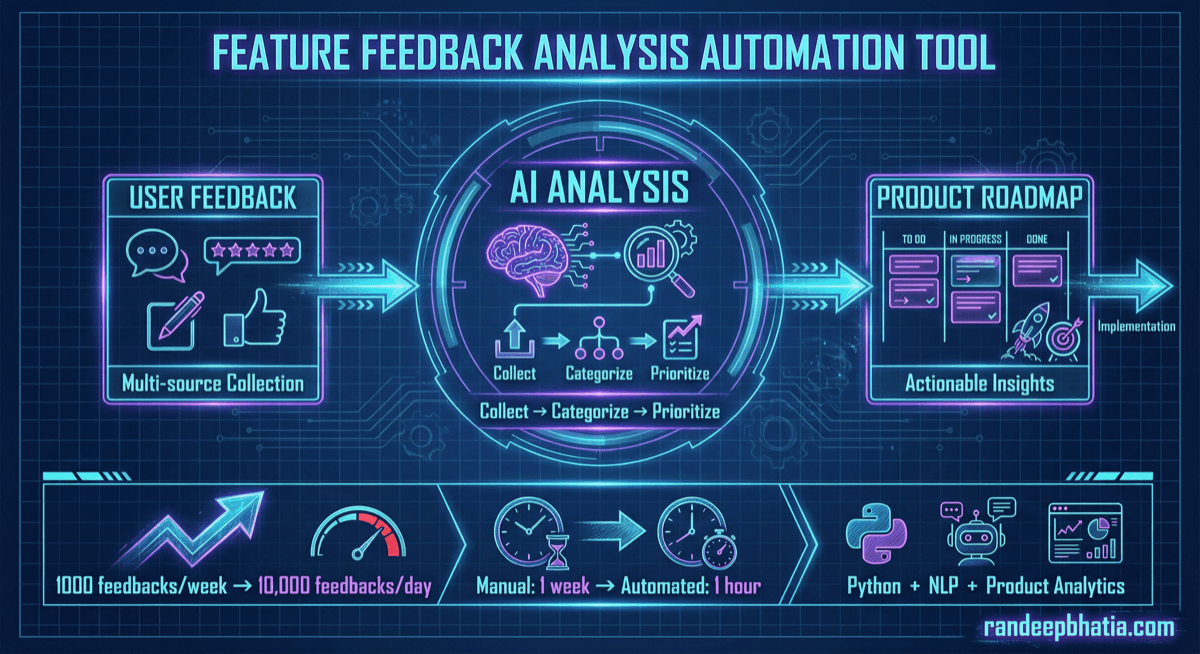
On Monday you tested the 3 prompts in ChatGPT. You saw how clustering → prioritization → roadmap works. But here's the reality: you can't ask your PM to copy-paste 500 feedback items daily. One product manager spending 3 hours manually reviewing feedback? That's $150/day in labor costs (assuming $50/hr PM salary). Multiply that across a growing SaaS company and you're looking at $54,000/year just on feedback admin. Plus the context-switching that leads to missed patterns and delayed roadmap decisions. Your competitors with automated pipelines ship features 2x faster because they spot trends in real-time.
See It Work
Watch the 3 prompts chain together automatically. This is what you'll build.
Watch It Work
See the AI automation in action
The Code
Three levels: start simple, add reliability, then scale to production. Pick where you are.
When to Scale
0-100 items/day
- Direct OpenAI/Claude API calls
- Sequential processing (no batching)
- Basic error handling
- Manual trigger (run on-demand)
100-1,000 items/day
- Batch processing (50 items/batch)
- Parallel API calls (3-5 concurrent)
- Exponential backoff retries
- Basic logging to files
- Scheduled runs (cron/lambda)
1,000-5,000 items/day
- Redis queue for async processing
- Result caching (1 hour TTL)
- Distributed workers (3-5 instances)
- Structured logging (CloudWatch/Datadog)
- Monitoring & alerts
- Dead letter queue for failures
5,000+ items/day
- LangGraph orchestration
- Specialized agents (clustering, prioritization, roadmap)
- Vector DB for semantic clustering (Pinecone/Weaviate)
- Real-time streaming updates
- A/B testing different clustering strategies
- Custom fine-tuned models
- Multi-region deployment
SaaS/Product Gotchas
Real challenges you'll hit when automating feedback analysis. Here's how to handle them.
Duplicate Feedback Across Sources
Use fuzzy matching (Levenshtein distance) to detect duplicates before clustering.
# Deduplicate feedback using fuzzy matching
from difflib import SequenceMatcher
def is_duplicate(text1: str, text2: str, threshold: float = 0.85) -> bool:
"""Check if two feedback items are duplicates using fuzzy matching"""
similarity = SequenceMatcher(None, text1.lower(), text2.lower()).ratio()
return similarity >= threshold
Vague Feedback Without Context
Enrich feedback with metadata (page URL, feature area, user segment) before clustering.
# Enrich vague feedback with context metadata
from typing import Dict, Optional
def enrich_feedback_context(item: Dict, metadata: Dict) -> Dict:
"""
Add context to vague feedback using metadata from source system.
Args:Sentiment Drift in Long Feedback
Split long feedback into sentences, analyze sentiment per sentence, flag negative sentences separately.
# Handle mixed sentiment in long feedback
import re
from typing import List, Dict
def analyze_sentence_sentiment(text: str) -> float:
"""
Placeholder for sentence-level sentiment analysis.
In production, use a proper sentiment model (transformers, etc.)Feature Request vs Bug Report Confusion
Add classification step before clustering. Tag as 'feature_request', 'bug', 'feedback', or 'question'.
# Classify feedback type before clustering
from typing import Dict, Literal
FeedbackType = Literal['feature_request', 'bug', 'feedback', 'question']
def classify_feedback_type(item: Dict) -> FeedbackType:
"""
Classify feedback into type using keyword patterns.Stale Feedback Skewing Priorities
Add time decay to feedback weight. Recent feedback (< 1 month) gets full weight, older feedback decays exponentially.
# Apply time decay to feedback weight
from datetime import datetime, timedelta
import math
def calculate_feedback_weight(item: Dict, decay_days: int = 30) -> float:
"""
Calculate weight for feedback based on recency.
Recent feedback (< decay_days) gets full weight (1.0).Adjust Your Numbers
❌ Manual Process
✅ AI-Automated
You Save
2026 Randeep Bhatia. All Rights Reserved.
No part of this content may be reproduced, distributed, or transmitted in any form without prior written permission.