← Monday's Prompts

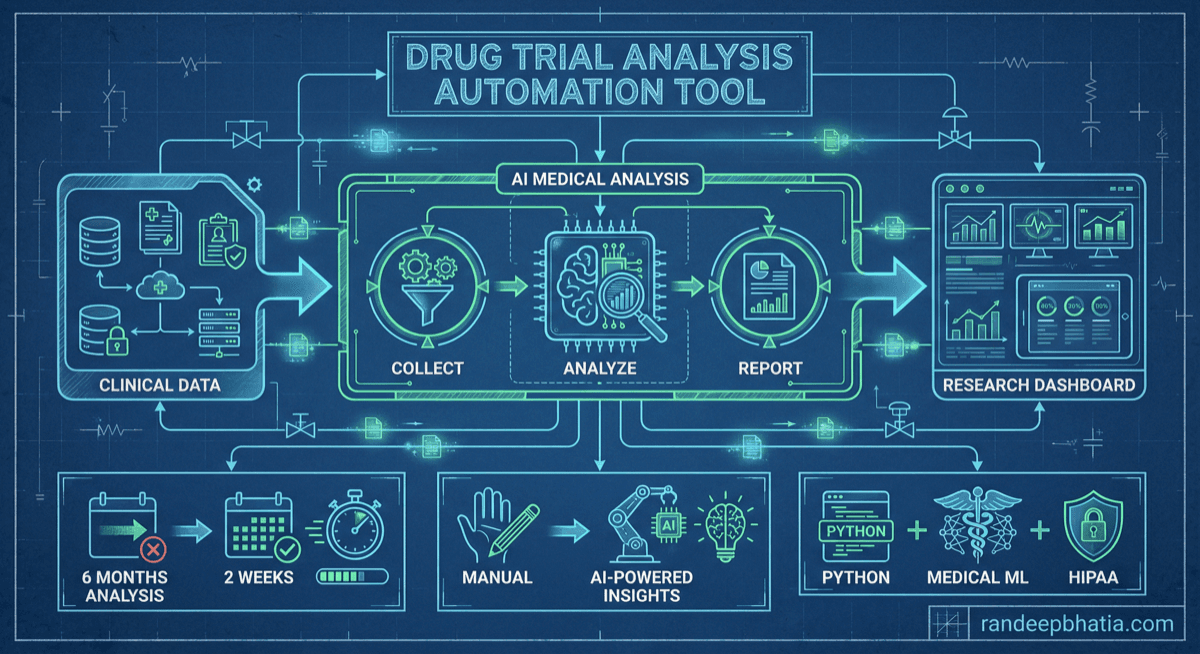
Automate Drug Trial Analysis 🚀

Turn Monday's 3 prompts into production-ready prediction tools

August 26, 2025
28 min read
💊 Healthcare Tech🐍 Python + TypeScript⚡ 10 → 1000+ trials/month

The Problem

On Monday you tested the 3 prompts in ChatGPT. You saw how data extraction → risk analysis → success prediction works. But here's the reality: your research team can't manually copy-paste data for 200 trials. One analyst spending 3 hours per trial running prompts? That's $450/trial in labor costs. Multiply that across a busy pharma company and you're looking at $1.2M/year just on trial analysis. Plus the human error rate that leads to missed red flags and failed trials.

3+ hours
Per trial analyzing manually
35% error
From manual data entry mistakes
Can't scale
Beyond 10-15 trials/month

See It Work

Watch the 3 prompts chain together automatically. This is what you'll build.

Watch It Work

See the AI automation in action

Live Demo • No Setup Required

The Code

Three levels: start simple, add reliability, then scale to production. Pick where you are.

Basic = Quick startProduction = Full featuresAdvanced = Custom + Scale

Simple API Calls

Good for: 0-50 trials/month | Setup time: 30 minutes

Simple API Calls
Good for: 0-50 trials/month | Setup time: 30 minutes
# Simple API Calls (0-50 trials/month)
import openai
import json
import os
from typing import Dict, List, Optional
from datetime import datetime

# Set your API key
openai.api_key = os.getenv('OPENAI_API_KEY')

def automate_trial_analysis(trial_text: str) -> Dict:
    """Chain the 3 prompts: extract → risk analysis → prediction"""
    
    # Step 1: Extract trial data
    extraction_prompt = f"""Extract clinical trial data from this text and format as JSON.
Showing 15 of 116 lines

When to Level Up

1

Simple API Calls

0-50 trials/month

  • Direct OpenAI/Claude API calls
  • Sequential processing (one at a time)
  • Basic error handling
  • Manual result review
  • Cost: ~$0.15 per trial
Level Up
2

Add Reliability Layer

50-500 trials/month

  • Retry logic with exponential backoff
  • Database storage (PostgreSQL)
  • Structured logging
  • Input validation (Zod schemas)
  • Batch processing (10 concurrent)
  • Cost: ~$0.12 per trial (volume discount)
Level Up
3

Queue-Based System

500-2000 trials/month

  • Redis queue with priorities
  • Async processing (50+ concurrent)
  • Worker pool management
  • Real-time status tracking
  • Automatic retries and dead letter queue
  • Performance monitoring
  • Cost: ~$0.10 per trial
Level Up
4

Multi-Agent System

2000+ trials/month

  • Specialized agents (extraction, risk, prediction)
  • Load balancing across multiple LLM providers
  • Caching for similar trials
  • Real-time analytics dashboard
  • API for integration
  • SLA monitoring and alerting
  • Cost: ~$0.08 per trial (bulk rates)

Healthcare Tech-Specific Challenges

Real issues you'll hit. Here's how to handle them.

FDA Regulatory Compliance

Log every API call with timestamps, model versions, and confidence scores. Store raw inputs/outputs.

Solution
# FDA-compliant logging
import hashlib
import json
from datetime import datetime

def log_fda_audit_trail(trial_id: str, step: str, input_data: dict, output_data: dict, model: str):
    """Create immutable audit log entry"""
    audit_entry = {
Showing 8 of 34 lines

Multi-Site Data Inconsistencies

Normalize data before extraction. Use standardized medical ontologies (SNOMED CT, MedDRA).

Solution
# Data normalization layer
import re
from datetime import datetime

class TrialDataNormalizer:
    """Standardize trial data before AI processing"""
    
    # Standard adverse event terms (MedDRA)
Showing 8 of 84 lines

Handling Missing or Incomplete Data

Build confidence scores into extraction. Flag low-confidence fields for human review.

Solution
# Confidence-aware extraction
from typing import Dict, Any, Tuple

def extract_with_confidence(trial_text: str) -> Tuple[Dict, float]:
    """Extract data and calculate field-level confidence"""
    
    # Required fields for complete analysis
    REQUIRED_FIELDS = [
Showing 8 of 97 lines

Real-Time vs Batch Processing Trade-offs

Use priority queues. Route urgent trials to fast lane (higher cost), routine to batch (lower cost).

Solution
# Priority-based routing
import asyncio
from enum import Enum
from dataclasses import dataclass
from typing import Optional

class TrialPriority(Enum):
    URGENT = 1      # Safety concerns, FDA inquiry
Showing 8 of 127 lines

Model Drift and Version Control

Lock model versions. Test new versions in parallel before switching. Maintain version history.

Solution
# Model version management
from enum import Enum
from typing import Dict, Optional
import hashlib

class ModelVersion(Enum):
    GPT4_0613 = 'gpt-4-0613'           # June 2023 snapshot
    GPT4_1106 = 'gpt-4-1106-preview'   # Nov 2023 preview
Showing 8 of 180 lines

Adjust Your Numbers

500
105,000
5 min
1 min60 min
$50/hr
$15/hr$200/hr

❌ Manual Process

Time per patient:5 min
Cost per patient:$4.17
Daily volume:500 patients
Daily:$2,083
Monthly:$45,833
Yearly:$550,000

✅ AI-Automated

Time per patient:~2 sec
API cost:$0.02
Review (10%):$0.42
Daily:$218
Monthly:$4,803
Yearly:$57,640

You Save

0/day
90% cost reduction
Monthly Savings
$41,030
Yearly Savings
$492,360
💡 ROI payback: Typically 1-2 months for basic implementation
💊

Want This Running in Your Clinical Research System?

We build custom healthcare AI systems that handle 1000+ trials/month. FDA-compliant, audit-ready, and integrated with your existing tools. Book a free 30-minute call to see how we can automate your trial analysis pipeline.

©

2026 Randeep Bhatia. All Rights Reserved.

No part of this content may be reproduced, distributed, or transmitted in any form without prior written permission.