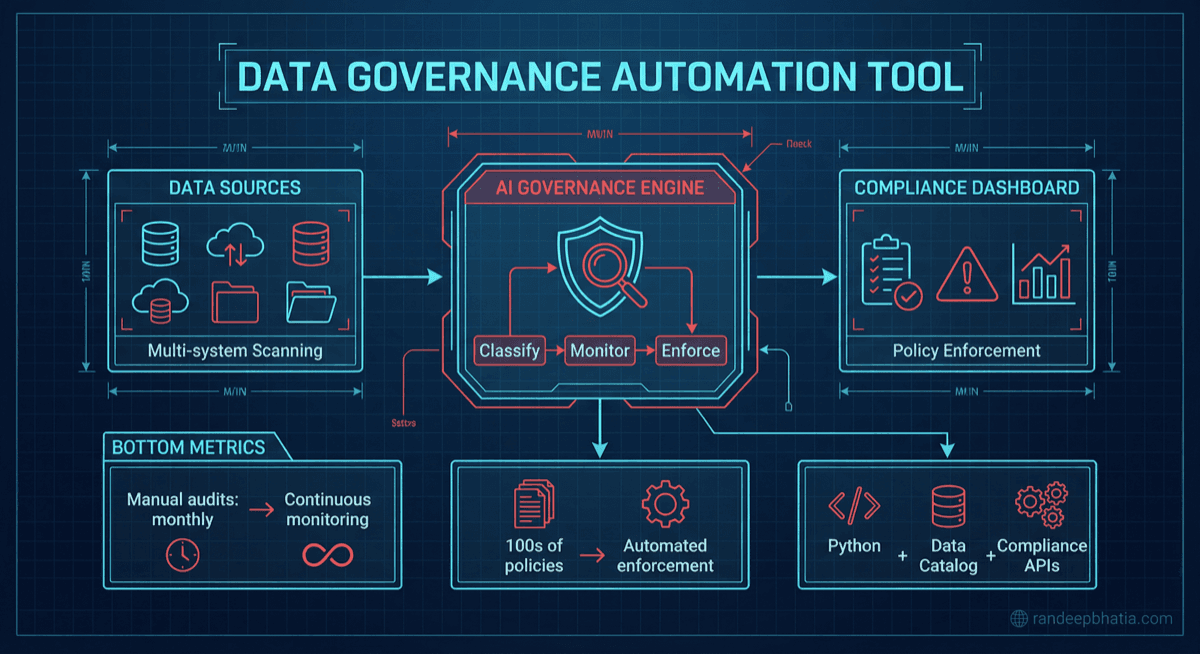
The Problem
On Monday you tested the 3 prompts in ChatGPT. You saw how lineage extraction → compliance validation → gap analysis works. But here's the reality: you can't ask your data team to manually track 500 tables across 20 systems. One data steward spending 3 hours per day updating lineage docs? That's $90/day in labor costs. Multiply that across an enterprise data team and you're looking at $270,000/year just on governance admin. Plus the compliance violations that slip through when lineage is 3 months out of date.
See It Work
Watch the 3 prompts chain together automatically. This is what you'll build.
Watch It Work
See the AI automation in action
The Code
Three levels: start simple, add reliability, then scale to production. Pick where you are.
When to Scale
Simple API Calls
- Direct OpenAI/Claude API calls
- Sequential processing (one table at a time)
- Basic error logging to files
- No caching or rate limiting
- Manual trigger via script
With Reliability
- Retry logic with exponential backoff
- Database integration for metadata enrichment
- Structured logging (Winston/Python logging)
- PostgreSQL for result storage
- Basic rate limiting
- Error handling and alerting
Production Pattern
- LangGraph workflow orchestration
- Redis caching (24hr TTL)
- Parallel processing (10+ workers)
- Token bucket rate limiting
- Comprehensive error recovery
- Webhook notifications
- Metrics and monitoring
Multi-Agent System
- Distributed agent architecture
- Kafka/RabbitMQ message queues
- Horizontal scaling (100+ workers)
- Multi-region deployment
- Real-time lineage updates
- ML-based anomaly detection
- Custom compliance rules engine
- SLA-based prioritization
Enterprise/Strategy Gotchas
Domain-specific challenges that will bite you if you don't plan for them.
Schema Evolution Tracking
Hook into database change events (DDL triggers in PostgreSQL, Snowflake streams) to auto-update lineage when schemas change.
-- PostgreSQL DDL trigger to capture schema changes CREATE OR REPLACE FUNCTION log_schema_change() RETURNS event_trigger AS $$ DECLARE obj record; BEGIN FOR obj IN SELECT * FROM pg_event_trigger_ddl_commands() LOOP
Cross-System Lineage
Use a unified lineage format (OpenLineage standard) and build adapters for each system. Store in a central lineage graph database (Neo4j).
# OpenLineage adapter for dbt
from openlineage.client import OpenLineageClient
from openlineage.client.run import RunEvent, RunState, Run, Job
from openlineage.client.facet import SqlJobFacet, SchemaDatasetFacet, SchemaField
def emit_dbt_lineage(dbt_manifest: dict, run_results: dict):
client = OpenLineageClient(url="http://lineage-api:5000")
PII Detection Accuracy
Combine AI classification with regex patterns + sample data analysis. Use confidence thresholds and human review for borderline cases.
# Hybrid PII detection
import re
from typing import Dict, Tuple
PII_PATTERNS = {
'email': r'\b[A-Za-z0-9._%+-]+@[A-Za-z0-9.-]+\.[A-Z|a-z]{2,}\b',
'ssn': r'\b\d{3}-\d{2}-\d{4}\b',
'phone': r'\b\d{3}[-.]?\d{3}[-.]?\d{4}\b',Compliance Framework Conflicts
Implement data segregation: separate PII from transactional data. Pseudonymize user IDs in financial records so you can delete PII while keeping audit trail.
# Data segregation pattern for compliance conflicts
-- Original problematic table (violates both GDPR and SOX)
CREATE TABLE transactions (
transaction_id BIGINT PRIMARY KEY,
user_id BIGINT, -- PII link
user_email VARCHAR(255), -- PII
amount DECIMAL(10,2), -- Financial data (SOX)Real-time vs Batch Lineage
Use event-driven lineage for streaming (emit OpenLineage events on each record) and snapshot-based lineage for batch (daily full refresh).
# Event-driven lineage for streaming pipelines
from openlineage.client import OpenLineageClient
from openlineage.client.run import RunEvent, RunState, Run, Job
from kafka import KafkaConsumer, KafkaProducer
import json
class StreamingLineageTracker:
def __init__(self, lineage_api_url: str):Adjust Your Numbers
❌ Manual Process
✅ AI-Automated
You Save
2026 Randeep Bhatia. All Rights Reserved.
No part of this content may be reproduced, distributed, or transmitted in any form without prior written permission.