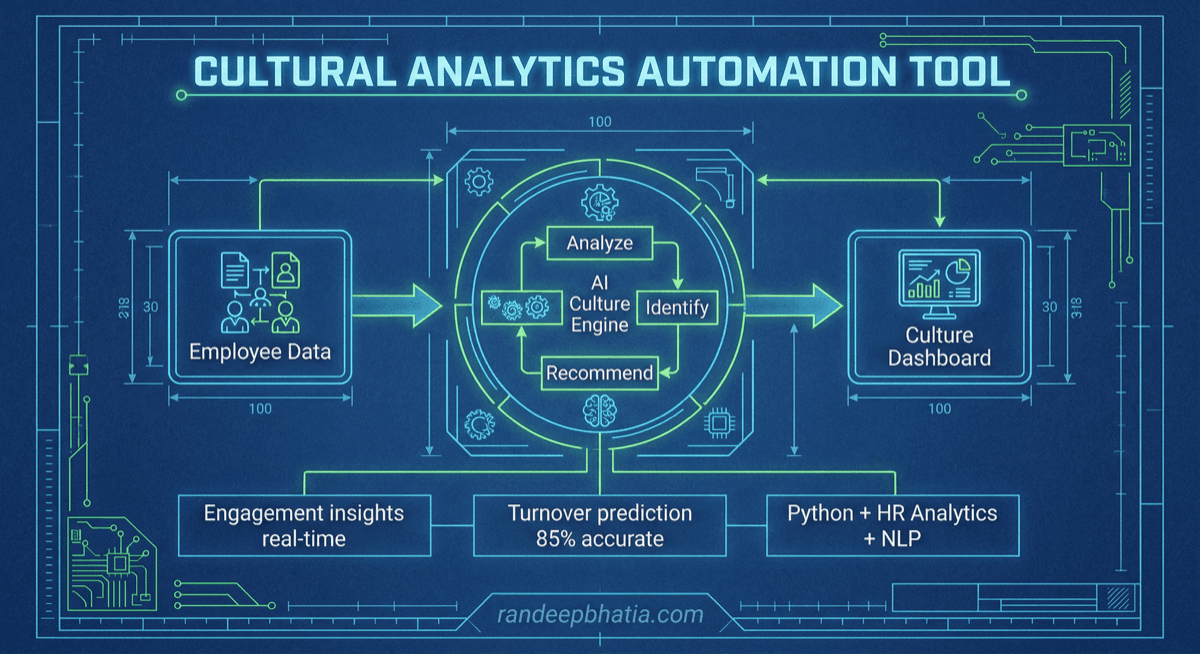
The Problem
On Monday you learned the 3-signal framework: detect → analyze → act. Great for a small team where you can read every Slack message and attend every 1-on-1. But what happens at 100 employees? 500? You're spending 10+ hours per week just reading messages, looking for patterns, trying to remember what someone said three weeks ago. One leadership team spent $40,000/year on quarterly culture surveys that were outdated before the results came back. By the time you knew there was a problem, half your engineering team had already started interviewing elsewhere.
See It Work
Watch the 3-signal framework chain together automatically. This is what you'll build.
Watch It Work
See the AI automation in action
The Code
Three levels: start simple, add intelligence, then scale to real-time. Pick where you are.
When to Scale
Simple Signal Detection
- Daily batch processing of messages
- Basic signal detection (sentiment, themes)
- Manual review of results
- Weekly pattern analysis
- Email/Slack alerts for urgent signals
Multi-Source Integration
- Real-time Slack/Teams monitoring
- Survey integration
- 1-on-1 notes processing
- Automated pattern detection
- Leadership dashboard
- Customizable alert thresholds
Production Real-Time System
- Multi-channel real-time monitoring
- Advanced pattern recognition
- Predictive risk modeling
- Role-based access control
- Custom integrations (HRIS, surveys)
- Automated action recommendations
- Historical trend analysis
Enterprise Multi-Agent System
- Multi-agent orchestration
- Custom ML models for signal detection
- Advanced anomaly detection
- Predictive analytics
- Integration with all HR systems
- Executive reporting
- Compliance and audit trails
- Multi-region support
Leadership-Specific Gotchas
Real challenges we've seen teams hit. Here's how to handle them.
Privacy and Consent
Get written consent. Anonymize data where possible. Be transparent about what you're monitoring.
# Anonymization example
def anonymize_message(message: Dict) -> Dict:
"""Remove PII while preserving signal value"""
# Hash user IDs
message['author'] = hashlib.sha256(
message['author'].encode()
).hexdigest()[:8]
Context Loss in Async Communication
Look for patterns over time, not single messages. Use thread context. Add human review for high-stakes signals.
# Context-aware signal detection
async def detect_with_context(
message: Message,
thread_messages: List[Message]
) -> Signal:
"""Include thread context in signal detection"""
context = "\n".join([
f"@{msg.author}: {msg.text}"Alert Fatigue
Use tiered urgency. Only alert on high-confidence, high-impact signals. Batch low-urgency items into daily digests.
# Smart alerting with thresholds
class AlertManager:
def __init__(self):
self.thresholds = {
'urgent': {'confidence': 0.85, 'impact': 'high'},
'high': {'confidence': 0.75, 'impact': 'medium'},
'medium': {'confidence': 0.65, 'impact': 'low'}
}Cross-Cultural Interpretation
Train models on your specific culture. Include cultural context in prompts. Have diverse human reviewers.
# Culture-aware signal detection
async def detect_with_culture(
message: Message,
author_culture: str
) -> Signal:
"""Adjust signal detection for cultural context"""
cultural_context = {
'direct': 'Direct communication style. Concerns stated explicitly.',Temporal Patterns vs One-Off Events
Track signals over time. Look for trends, not spikes. Compare to historical baselines.
# Temporal pattern detection
class PatternDetector:
def __init__(self, redis_client):
self.redis = redis_client
async def is_pattern(self, signal: Signal) -> bool:
"""Check if signal is part of a pattern"""
# Get signals from same author, last 7 daysAdjust Your Numbers
❌ Manual Process
✅ AI-Automated
You Save
2026 Randeep Bhatia. All Rights Reserved.
No part of this content may be reproduced, distributed, or transmitted in any form without prior written permission.