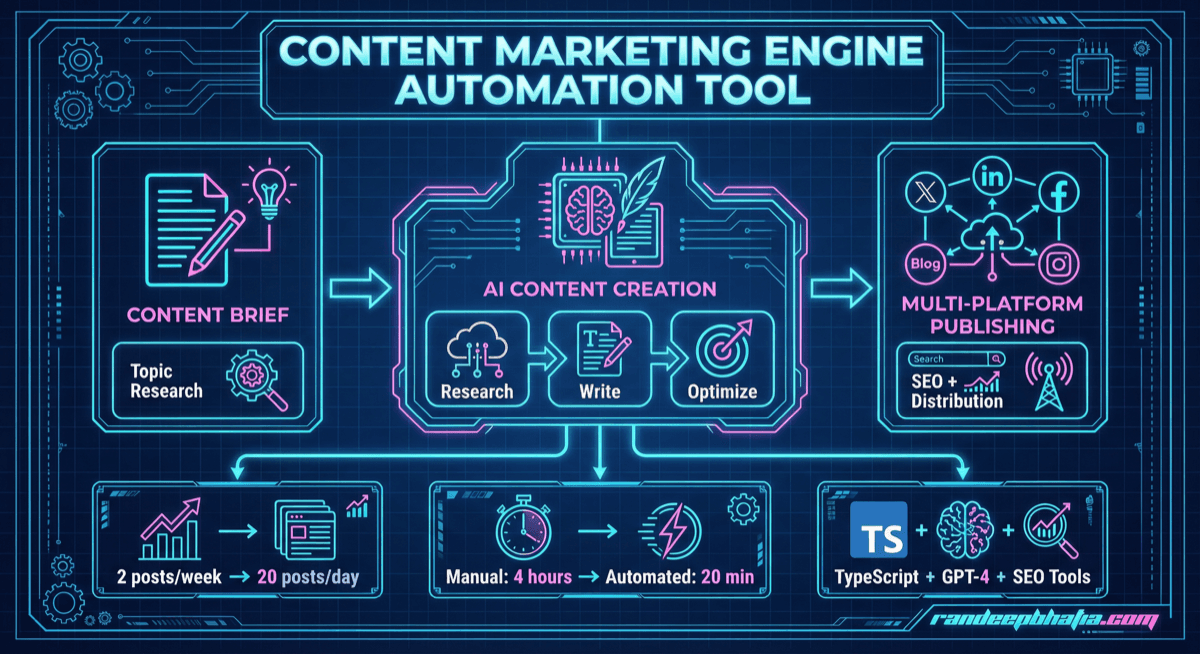
The Problem
On Monday you tested the 3 prompts: ideate topics β generate drafts β optimize for SEO. Great! You saw how the framework works. But here's reality: your marketing team can't spend 3 hours per day copy-pasting prompts into ChatGPT. One content manager manually running prompts for social posts, blog articles, and email newsletters? That's 15+ hours per week just on content generation. Multiply that across a marketing team and you're looking at $50,000+ per year in labor costs. Plus the inconsistency that comes from manual formatting, missed posting schedules, and zero analytics integration.
See It Work
Watch the 3 prompts chain together automatically. This is what you'll build.
Watch It Work
See the AI automation in action
The Code
Three levels: start simple, add reliability, then scale to production. Pick where you are.
When to Level Up
- Direct OpenAI/Claude API calls
- Manual content review before publishing
- Basic logging to files
- Simple retry logic (3 attempts)
- No caching or queue management
- Exponential backoff retries
- Rate limiting (50 req/min)
- Social API integration (LinkedIn, Twitter)
- Winston logging with error tracking
- Redis caching for repeated queries
- Automated publishing with scheduling
- LangGraph workflow orchestration
- Parallel processing of content types
- Redis queue management
- Analytics tracking and reporting
- Automated A/B testing
- Content performance optimization
- Multi-channel publishing with fallbacks
- Specialized agents (ideation, writing, SEO, publishing)
- Load balancing across API providers
- Real-time analytics dashboard
- Automated content calendar management
- Multi-language support
- Advanced A/B testing with ML optimization
- Custom CMS integrations
- 24/7 monitoring and alerting
Marketing-Specific Gotchas
Real challenges you'll hit when automating content marketing. Here's how to handle them.
API Rate Limits on Social Platforms
Twitter allows 300 posts per 3 hours. LinkedIn limits to 100 posts per day. Hit these limits and your entire publishing pipeline stops.
Implement distributed rate limiting across time windows. Use Redis to track API usage and queue posts for optimal distribution.
Content Duplication Across Channels
Publishing identical content to LinkedIn and Twitter kills engagement. Each platform has different audiences and expectations.
Use platform-specific prompts that adapt tone, length, and format. LinkedIn gets professional long-form, Twitter gets punchy threads.
SEO Keyword Stuffing vs Readability
AI loves to over-optimize for keywords. 'Marketing automation tools for marketing automation in marketing' sounds robotic and hurts engagement.
Set strict keyword density limits (1-2%) and use semantic variations. Validate readability score before publishing.
Inconsistent Brand Voice Across Content
AI-generated content can sound generic or inconsistent. One post sounds corporate, the next sounds like a startup bro.
Create a detailed brand voice document with examples. Use few-shot prompting to maintain consistency.
Analytics Integration and Attribution
Publishing content is easy. Proving ROI is hard. You need to track which posts drive demo bookings, not just likes.
Use UTM parameters for every link. Track conversions back to specific posts. Build a dashboard that shows content β lead β customer.
Adjust Your Numbers
β Manual Process
β AI-Automated
You Save
2026 Randeep Bhatia. All Rights Reserved.
No part of this content may be reproduced, distributed, or transmitted in any form without prior written permission.