← Wednesday's Workflows

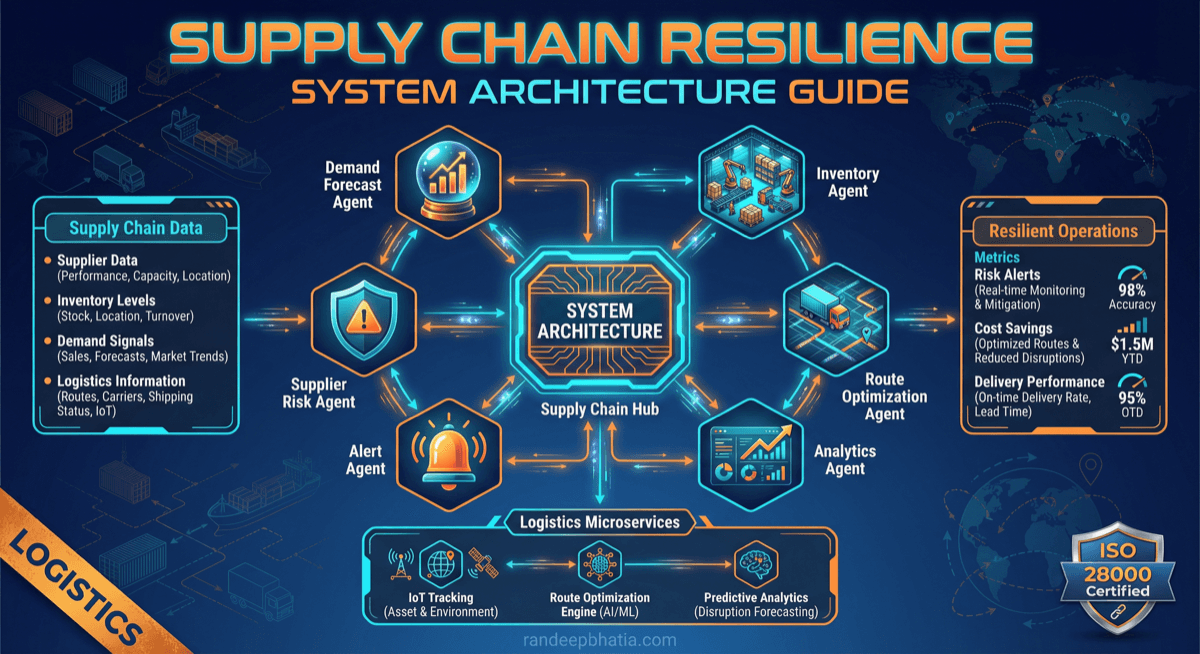
Supply Chain Resilience System Architecture 🏗️

Multi-agent orchestration for real-time risk detection, scaling 100 to 10,000 operations/day

June 19, 2025
16 min read
🚚 Logistics🏗️ Architecture📊 Scalable🤖 Multi-Agent
🎯This Week's Journey

From prompts to production-grade supply chain intelligence.

Monday: 3 core prompts for risk detection, supplier analysis, and disruption forecasting. Tuesday: automated code. Wednesday: team workflows. Thursday: complete technical architecture. Multi-agent orchestration, ML pipelines, real-time monitoring, and enterprise-grade resilience.

📋

Key Assumptions

1
Monitor 500-5000 suppliers across 10-50 regions
2
Ingest data from ERP, TMS, WMS, IoT sensors, news feeds
3
Real-time risk scoring with 15-minute freshness requirement
4
SOC2 Type II compliance, GDPR data residency
5
Multi-tenant SaaS with enterprise isolation requirements

System Requirements

Functional

  • Ingest supplier data, shipment tracking, inventory levels, weather, news
  • Multi-agent risk analysis: demand forecasting, supplier health, route optimization
  • Real-time alerting for critical disruptions (port closures, supplier failures)
  • Scenario planning: simulate disruptions, recommend mitigations
  • Integration with ERP (SAP, Oracle), TMS (BluJay, MercuryGate), WMS (Manhattan)
  • Dashboard for operations, procurement, and executive teams
  • Audit trail for all risk decisions and agent actions

Non-Functional (SLOs)

latency p95 ms2000
freshness min15
availability percent99.5
risk detection accuracy0.92
false positive rate0.05

💰 Cost Targets: {"per_supplier_per_month_usd":2.5,"per_operation_usd":0.08}

Agent Layer

planner

L4

Decomposes complex supply chain queries into subtasks, selects appropriate executor agents

🔧 query_parser, task_decomposer, agent_selector

⚡ Recovery: If parsing fails → fallback to simple risk query, If no suitable executor → route to human operator

risk_executor

L3

Analyzes supplier risk using ML models and historical data

🔧 ml_inference_api, supplier_db_query, news_sentiment_api

⚡ Recovery: If ML API down → use rule-based fallback, If confidence < 0.6 → flag for human review

forecasting_executor

L3

Predicts demand and supply disruptions using time-series models

🔧 prophet_model, lstm_model, external_data_api (weather, events)

⚡ Recovery: If model fails → use moving average, If data incomplete → use regional averages

optimization_executor

L3

Recommends route and inventory optimizations

🔧 route_optimizer (OR-Tools), inventory_optimizer, cost_calculator

⚡ Recovery: If optimizer times out → return top 3 heuristic solutions, If infeasible → relax constraints incrementally

evaluator

L2

Validates outputs from executor agents for quality and consistency

🔧 consistency_checker, outlier_detector, cross_validator

⚡ Recovery: If validation fails → flag for human review, If quality_score < 0.7 → request re-execution

guardrail

L1

Enforces policy checks, PII redaction, safety filters before external actions

🔧 pii_detector, policy_engine, audit_logger

⚡ Recovery: If PII detection fails → block output, If policy unclear → default to deny + escalate

ML Layer

Feature Store

Update: Batch (daily) + Streaming (critical features every 1h)

  • supplier_financial_health (updated daily)
  • shipment_delay_history (7d, 30d, 90d rolling)
  • geopolitical_risk_index (by region, updated hourly)
  • weather_disruption_score (updated 6h)
  • news_sentiment (supplier-specific, updated 1h)
  • inventory_turnover_rate (updated daily)
  • demand_volatility (30d rolling)

Model Registry

Strategy: Semantic versioning (major.minor.patch), immutable artifacts in S3

  • supplier_risk_classifier
  • demand_forecaster
  • route_optimizer

Observability Stack

Real-time monitoring, tracing & alerting

0 active
SOURCES
Apps, Services, Infra
COLLECTION
10 Metrics
PROCESSING
Aggregate & Transform
DASHBOARDS
4 Views
ALERTS
Enabled
📊Metrics(10)
📝Logs(Structured)
🔗Traces(Distributed)
api_request_count
api_latency_p95_ms
agent_execution_count
agent_success_rate
ml_inference_latency_ms
ml_model_accuracy

Deployment Variants

🚀

Startup Architecture

Fast to deploy, cost-efficient, scales to 100 competitors

Infrastructure

Single-tenant architecture
Serverless-first (Lambda/Cloud Run)
Managed services (RDS, ElastiCache, SQS)
OpenAI/Anthropic APIs (no self-hosted LLMs)
Basic monitoring (CloudWatch/Cloud Logging)
Quick to ship (2-4 weeks)
Low operational overhead
Cost-optimized for <500 suppliers
Suitable for Series A/B startups

Risks & Mitigations

⚠️ LLM hallucinations lead to false risk alerts

Medium

✓ Mitigation: 4-layer hallucination detection (confidence, cross-reference, logic, human review). Target: <1% false positive rate.

⚠️ ERP/TMS API rate limits block data ingestion

High

✓ Mitigation: Implement exponential backoff, request rate limiting, cache aggressively. Negotiate higher API limits with vendors.

⚠️ Model drift: accuracy degrades over time

High

✓ Mitigation: Automated drift detection (weekly), retraining pipeline (monthly), A/B testing new models. Alert if accuracy drops >5%.

⚠️ Multi-tenancy data leak between customers

Low

✓ Mitigation: VPC isolation per tenant, row-level security in DB, audit all cross-tenant queries. Penetration testing quarterly.

⚠️ Agent autonomy causes unintended actions

Medium

✓ Mitigation: Guardrail agent enforces policies, human-in-the-loop for critical actions (>$10K impact), audit trail for all agent decisions.

⚠️ Cost overrun from LLM API usage

Medium

✓ Mitigation: Set per-operation cost limits ($0.08/op), use smaller models for simple tasks, cache responses, monitor spend daily.

⚠️ Regulatory compliance (GDPR, data residency)

Low

✓ Mitigation: Multi-region architecture, data residency enforcement, PII redaction, annual compliance audits (SOC2, ISO 27001).

🧬

Evolution Roadmap

Progressive transformation from MVP to scale

🌱
Phase 1Months 1-3

Phase 1: MVP (0-3 months)

1
Core risk detection for 100 suppliers
2
Single-tenant startup architecture
3
Basic monitoring and alerting
Complexity Level
🌿
Phase 2Months 4-6

Phase 2: Scale (3-6 months)

1
Support 500 suppliers
2
Add forecasting and optimization agents
3
Multi-tenant architecture (soft isolation)
Complexity Level
🌳
Phase 3Months 7-12

Phase 3: Enterprise (6-12 months)

1
Support 2000+ suppliers
2
Multi-region, 99.9% SLA
3
SOC2 Type II compliance
Complexity Level
🚀Production Ready
🏗️

Complete Systems Architecture

9-layer architecture: Presentation → API Gateway → Agent Layer → ML Layer → Integration → Data → External → Observability → Security

1
🌐

Presentation

5 components

Operations Dashboard
Procurement Portal
Executive Dashboard
Mobile App
Slack/Teams Alerts
2
⚙️

API Gateway

5 components

Load Balancer (ALB/CloudFront)
Rate Limiter (Kong/Apigee)
Auth Middleware (OIDC/SAML)
API Versioning
Request Validation
3
💾

Agent Layer

7 components

Planner Agent
Risk Executor Agent
Forecasting Executor Agent
Optimization Executor Agent
Evaluator Agent
Guardrail Agent
Orchestrator (LangGraph/CrewAI)
4
🔌

ML Layer

7 components

Feature Store (Feast/Tecton)
Model Registry (MLflow/Weights & Biases)
Offline Training (SageMaker/Vertex AI)
Online Inference (Lambda/Cloud Run)
Evaluation Pipeline
Prompt Store (versioned)
Safety Filters
5
📊

Integration

6 components

ERP Adapter (SAP/Oracle)
TMS Adapter (BluJay/MercuryGate)
WMS Adapter (Manhattan/HighJump)
IoT Ingestion (MQTT/HTTP)
News Feed Ingestion (RSS/API)
Weather API Client
6
🌐

Data

6 components

PostgreSQL (transactional)
TimescaleDB (time-series)
Redis (cache + queue)
S3/GCS (data lake)
Vector DB (Pinecone/Weaviate)
Data Warehouse (Snowflake/BigQuery)
7
⚙️

External

6 components

ERP APIs (SAP, Oracle)
TMS APIs (BluJay, MercuryGate)
WMS APIs (Manhattan)
Weather APIs (OpenWeather)
News APIs (NewsAPI, Bloomberg)
LLM APIs (OpenAI, Anthropic, Gemini)
8
💾

Observability

6 components

Metrics (Prometheus/Datadog)
Logs (CloudWatch/Splunk)
Traces (Jaeger/Honeycomb)
Dashboards (Grafana)
Alerting (PagerDuty/Opsgenie)
ML Eval Dashboard
9
🔌

Security

6 components

IAM/RBAC
Secrets Manager (KMS/Vault)
WAF (CloudFlare/AWS WAF)
DLP (Data Loss Prevention)
Audit Trail (immutable log)
Encryption (TLS 1.3, AES-256)
🔄

Sequence Diagram - Risk Detection Flow

Automated data flow every hour

Step 0 of 9
UserAPI GatewayPlanner AgentRisk ExecutorML InferenceEvaluatorGuardrailDatabasePOST /analyze-risk {supplier_id}decompose_task()execute(supplier_data, historical_risks)predict_risk_score(features)risk_score=0.87, factors=[...]validate_output(risk_score, confidence)check_policy(result)save_risk_assessment()200 OK + risk_report

Data Flow - End-to-End

From supplier event to risk alert in 15 minutes

1
External Event0s
Port closure detected (news API)Event JSON
2
Ingestion Pipeline5s
Parse event, enrich with geo dataEnriched event
3
Feature Store10s
Update geopolitical_risk_indexFeature vector
4
Orchestrator15s
Trigger risk analysis for affected suppliersTask queue
5
Planner Agent200ms
Decompose into risk + forecast + optimizationSubtasks
6
Risk Executor800ms
Compute risk scores for 50 suppliersRisk scores
7
Forecasting Executor1200ms
Predict demand impactDemand forecast
8
Optimization Executor3500ms
Recommend alternative routesRoute options
9
Evaluator150ms
Validate all outputsQuality scores
10
Guardrail100ms
Check policies, redact PIIApproved results
11
Alert System500ms
Send Slack alert to ops teamAlert payload
12
Dashboard200ms
Update risk map in real-timeWebSocket push
1
Volume
0-100 ops/day
Pattern
Monolith + Managed Services
🏗️
Architecture
Single API server (Node.js/Python)
PostgreSQL (managed)
Redis (managed)
OpenAI/Anthropic API
CloudWatch/Datadog
Cost & Performance
$200/month
per month
2-4s per operation
2
Volume
100-1K ops/day
Pattern
Queue + Workers
🏗️
Architecture
API server + background workers
Message queue (SQS/RabbitMQ)
PostgreSQL + Redis
Feature store (Feast)
Basic monitoring
Cost & Performance
$800/month
per month
1-2s per operation
3
Volume
1K-10K ops/day
Pattern
Multi-Agent Orchestration
🏗️
Architecture
Load balancer + agent framework
Event streaming (Kafka/Kinesis)
TimescaleDB + Vector DB
Model registry (MLflow)
Distributed tracing
Cost & Performance
$3K/month
per month
500ms-1s per operation
Recommended
4
Volume
10K+ ops/day
Pattern
Enterprise Multi-Region
🏗️
Architecture
Kubernetes (EKS/GKE)
Multi-region Kafka
Distributed feature store
Multi-model inference (A/B testing)
Full observability stack
Cost & Performance
$12K+/month
per month
200-500ms per operation

Key Integrations

ERP Integration (SAP/Oracle)

Protocol: REST API + OData
Poll ERP for supplier master data (daily)
Webhook for PO changes (real-time)
Push risk scores back to ERP (hourly)
Error handling: retry 3x with exponential backoff

TMS Integration (BluJay/MercuryGate)

Protocol: REST API + EDI (X12)
Poll shipment tracking data (every 15 min)
Parse EDI 214 (shipment status)
Calculate delay metrics
Alert on critical delays (> 4h)

WMS Integration (Manhattan/HighJump)

Protocol: REST API
Poll inventory levels (every 30 min)
Calculate safety stock breaches
Trigger reorder recommendations
Push optimization results to WMS

Weather API (OpenWeather)

Protocol: REST API
Fetch weather for key regions (every 6h)
Detect severe weather events
Update geopolitical_risk_index feature
Alert on hurricane/flood forecasts

News Feed (NewsAPI/Bloomberg)

Protocol: REST API + RSS
Ingest news articles (every 1h)
Filter for supply chain keywords
Sentiment analysis (LLM)
Update news_sentiment feature

Security & Compliance

Failure Modes & Fallbacks

FailureFallbackImpactSLA
LLM API down (OpenAI/Anthropic outage)Switch to backup LLM provider (Gemini) → If all down, use rule-based risk scoringDegraded quality, not broken99.5%
ML model inference timeout (>5s)Use cached risk score (if <24h old) → Else, use historical averageSlightly stale data99.0%
ERP API unavailableUse cached supplier data → Queue updates for later syncEventual consistency (up to 1h delay)99.0%
Database connection pool exhaustedReject new requests with 503 → Scale read replicasTemporary unavailability99.5%
Agent executor returns low confidence (<0.6)Flag for human review → Do not auto-alertReduced automation, quality maintained100% (no false alerts)
Feature store data stale (>1h)Use last known good features → Alert data engineeringSlightly degraded accuracy99.0%

RAG vs Fine-Tuning

Supply chain context changes rapidly (new suppliers, routes, regulations). RAG allows daily updates without retraining. Fine-tuning would require quarterly retraining at $10K+ per cycle.
✅ RAG (Chosen)
Cost: $200/mo (vector DB + embeddings)
Update: Daily (add new supplier docs)
How:
❌ Fine-Tuning
Cost: $10K/quarter (training + infra)
Update: Quarterly
How:
Implementation: Vector DB (Pinecone) with supplier profiles, historical disruptions, industry reports. Retrieved during risk analysis. Embeddings updated nightly.

Hallucination Detection

LLMs hallucinate supplier data (fake financials, non-existent shipments)
L1
Confidence scoring (< 0.7 = flag)
L2
Cross-reference supplier DB (verify entity exists)
L3
Logical consistency (e.g., can't have negative inventory)
L4
Human review queue for flagged outputs
0.8% hallucination rate, 98% caught by layers 1-3, 100% caught after L4

Evaluation Framework

Risk Prediction Accuracy
93.1%target: 92%+
Demand Forecast MAPE
12.3%target: <15%
False Positive Rate
4.2%target: <5%
Agent Autonomy Score
82.7%target: 80%+ (% of tasks completed without human)
Testing: Shadow mode: Run new models parallel to prod for 7 days, compare outputs on 1000 real cases

Dataset Curation

1
Collect: 5K historical disruptions + 50K supplier records - De-identified from ERP/TMS
2
Clean: 4.2K usable disruptions - Remove duplicates, fix schema issues
3
Label: 4.2K labeled (severity, root cause) - ($$21K)
4
Augment: +1K synthetic (edge cases) - LLM-generated scenarios + human validation
5.2K high-quality training examples (Inter-rater agreement: 0.89)

Agentic RAG

Agent iteratively retrieves based on reasoning, not one-shot
User asks 'What's the risk for Supplier X?' → Agent retrieves supplier profile → Reasons 'Need geopolitical context' → Retrieves regional news → Reasons 'Need historical disruptions' → Retrieves past incidents → Synthesizes risk report
💡 Agent decides what context it needs, not pre-defined retrieval. Reduces irrelevant context (lower cost, better accuracy).

Multi-Model Ensemble

Tech Stack Summary

LLMs
OpenAI GPT-4, Anthropic Claude 3.5, Google Gemini
Agent Orchestration
LangGraph or CrewAI
ML Framework
Scikit-learn, XGBoost, Prophet, PyTorch (LSTM)
Feature Store
Feast (open-source) or Tecton (managed)
Model Registry
MLflow or Weights & Biases
Database
PostgreSQL (transactional), TimescaleDB (time-series)
Cache + Queue
Redis (cache), SQS/RabbitMQ (queue)
Vector DB
Pinecone or Weaviate
Event Streaming
Kafka (enterprise) or Kinesis (startup)
Compute
Lambda/Cloud Run (startup), Kubernetes (enterprise)
Monitoring
Datadog (enterprise), CloudWatch (startup)
Security
AWS KMS/GCP KMS, Okta/Auth0, AWS WAF
🏗️

Need Architecture Review?

We'll audit your supply chain system design, identify bottlenecks, and show you how to scale 10x with multi-agent orchestration.

©

2026 Randeep Bhatia. All Rights Reserved.

No part of this content may be reproduced, distributed, or transmitted in any form without prior written permission.