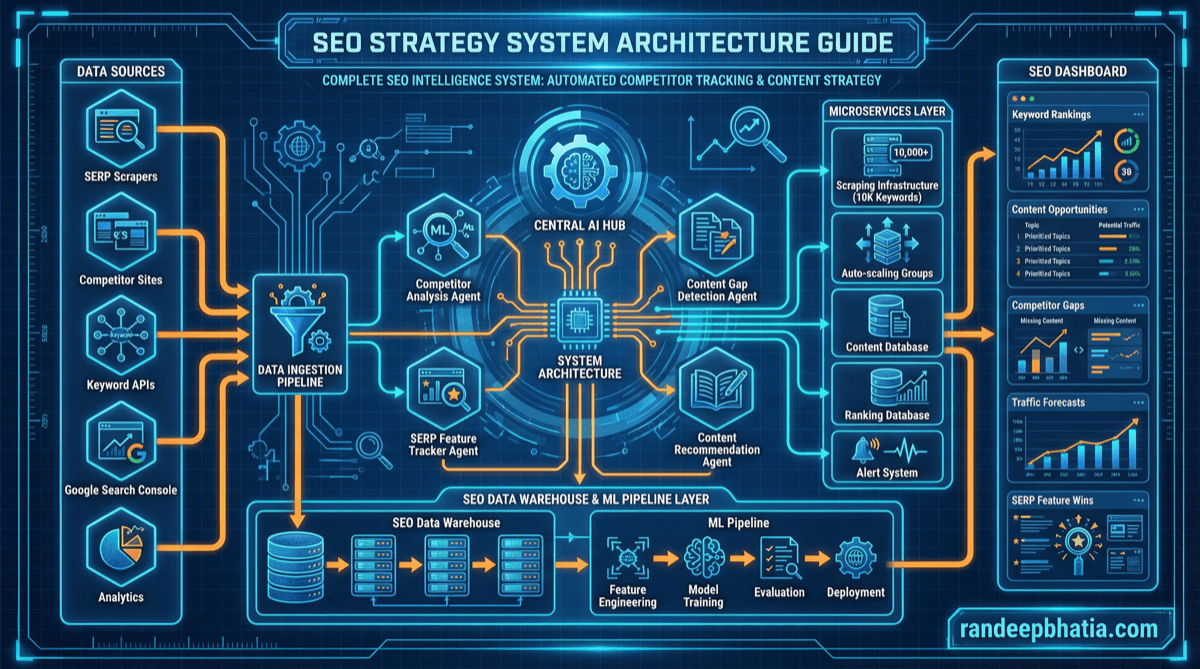
From prompts to production SEO intelligence system.
Monday: 3 SEO prompts (competitor analysis, content gaps, keyword tracking). Tuesday: automated agents. Wednesday: team workflows. Thursday: complete production architecture. Multi-agent orchestration, ML pipelines, SERP monitoring, and scaling to 10K+ keywords daily.
Key Assumptions
System Requirements
Functional
- Competitor SERP position tracking with historical trends
- Content gap detection using semantic similarity and keyword clustering
- Keyword opportunity scoring based on difficulty, volume, and relevance
- Automated content brief generation with structure, headings, and word count
- Backlink profile analysis and link-building opportunity identification
- Real-time alerts for ranking changes and competitor content updates
- Natural language query interface for strategy questions
Non-Functional (SLOs)
💰 Cost Targets: {"per_keyword_per_month_usd":0.5,"per_competitor_per_month_usd":5,"llm_cost_per_analysis_usd":0.15}
Agent Layer
planner
L4Decomposes user query into sub-tasks, selects appropriate tools and agents
🔧 Query parser, Task decomposer, Agent registry
⚡ Recovery: If query ambiguous → request clarification, If no matching agent → fallback to manual queue
scraper_executor
L2Fetches SERP data, competitor pages, backlink profiles via APIs and web scraping
🔧 SERP API (SEMrush, Ahrefs), Web scraper (Playwright/Puppeteer), Proxy rotation service, Rate limiter
⚡ Recovery: If API rate limit → queue for retry with backoff, If scrape blocked → rotate proxy + retry, If data incomplete → flag for manual review
analysis_executor
L3Analyzes SERP data, detects content gaps, scores keyword opportunities
🔧 Feature extraction pipeline, Semantic similarity model, Ranking prediction model, Clustering algorithm
⚡ Recovery: If low confidence score → request human review, If model drift detected → fallback to rule-based heuristics
content_generator
L3Generates content briefs, outlines, and optimization recommendations
🔧 LLM (GPT-4, Claude), Prompt templates, Content scoring model
⚡ Recovery: If LLM hallucination detected → regenerate with stricter prompt, If brief quality low → escalate to human editor
evaluator
L3Validates output quality, checks for hallucinations, enforces business rules
🔧 Evaluation rubric, Fact-checking model, Business rule engine
⚡ Recovery: If quality below threshold → reject + request regeneration, If critical error → alert human operator
guardrail
L4Enforces safety, compliance, and policy constraints across all operations
🔧 PII detection model, Rate limiter, Policy database, Audit logger
⚡ Recovery: If policy violation → block operation + alert admin, If PII detected → redact + log incident
ML Layer
Feature Store
Update: Hourly for critical keywords, daily for long-tail
- • keyword_volume_30d_avg
- • keyword_difficulty_score
- • serp_feature_presence (featured_snippet, people_also_ask, etc.)
- • competitor_authority_score
- • content_semantic_similarity
- • backlink_count_delta
- • ranking_velocity (change rate)
- • user_intent_classification (informational, transactional, navigational)
Model Registry
Strategy: Semantic versioning with A/B testing for production rollout
- • keyword_opportunity_scorer
- • content_gap_detector
- • ranking_predictor
Observability Stack
Real-time monitoring, tracing & alerting
0 activeDeployment Variants
Startup Architecture
Fast to deploy, cost-efficient, scales to 100 competitors
Infrastructure
Risks & Mitigations
⚠️ SERP API rate limits exceeded during peak usage
High (daily occurrence at scale)✓ Mitigation: Multi-provider failover (SEMrush → Ahrefs → custom scraper). Queue requests with exponential backoff. Cache recent SERP data (1h TTL). Alert if >10 failures/hour.
⚠️ LLM hallucinations in content briefs
Medium (0.5% of outputs)✓ Mitigation: Multi-layer validation: confidence scores, fact-checking model, human review queue. Block outputs with score < 0.8. Continuous eval with human feedback loop.
⚠️ Model drift as SEO landscape changes
High (quarterly algorithm updates)✓ Mitigation: Automated drift detection (KL divergence, accuracy monitoring). Retrain pipeline triggered by drift or quarterly schedule. A/B test new models. Rollback policy.
⚠️ Competitor detects scraping, blocks IPs
Medium (happens monthly)✓ Mitigation: Residential proxy rotation. Respect robots.txt. Add random delays. Fallback to SERP APIs. Legal review of scraping practices.
⚠️ PII leak in scraped content or outputs
Low (0.1% of content)✓ Mitigation: Guardrail agent with PII detection (AWS Comprehend). Automatic redaction. Block outputs with PII. Audit logs. Incident response plan. Encrypt all data at rest.
⚠️ Database failure during peak traffic
Low (1-2x per year)✓ Mitigation: Multi-AZ deployment. Automated failover to read replica. Write queue for eventual consistency. RTO <15min. Regular disaster recovery drills.
⚠️ Cost overrun from LLM API usage
Medium (can spike 2-3x)✓ Mitigation: Cost guardrails: max $X per customer per month. Cache LLM outputs (24h TTL). Use smaller models for simple tasks. Alert if cost >120% of budget. Monthly cost review.
Evolution Roadmap
Progressive transformation from MVP to scale
Phase 1: MVP (0-3 months)
Phase 2: Scale (3-6 months)
Phase 3: Enterprise (6-12 months)
Complete Systems Architecture
End-to-end layer view: 9 layers from UI to security
Presentation
4 components
API Gateway
4 components
Agent Layer
6 components
ML Layer
5 components
Integration
4 components
Data
4 components
External
4 components
Observability
4 components
Security
4 components
Sequence Diagram - Keyword Analysis Request
Automated data flow every hour
Data Flow - End-to-End
User query → actionable SEO strategy in 12 seconds
Key Integrations
SERP APIs (SEMrush, Ahrefs, Moz)
CMS Integration (WordPress, Webflow, HubSpot)
Analytics (Google Analytics 4, Adobe Analytics)
Social APIs (Twitter, LinkedIn, Reddit)
Security & Compliance
Failure Modes & Recovery
| Failure | Fallback | Impact | SLA |
|---|---|---|---|
| SERP API rate limit exceeded | → Queue requests with exponential backoff → Switch to secondary provider (Ahrefs if SEMrush fails) → Custom scraper as last resort | Delayed data (5-15 min), no data loss | 99.5% |
| LLM API timeout/error | → Retry with different model (GPT-4 → Claude → Gemini) → If all fail, queue for manual review | Degraded quality, increased latency | 99.0% |
| Low confidence content brief | → Evaluator flags for human review → Editor queue with context | Quality maintained, throughput reduced | 99.9% |
| Database connection lost | → Read from replica → Write to queue → Sync when primary recovers | Read-only mode, eventual consistency | 99.9% |
| Scraper blocked by anti-bot | → Rotate proxy → Add delay → Use residential proxies → Fallback to API | Increased cost, slower scraping | 98.0% |
| Model drift detected (accuracy drop >5%) | → Rollback to previous model version → Retrain with recent data → A/B test new model | Temporary accuracy loss, auto-recovery | 99.5% |
| PII leak in output | → Guardrail agent blocks output → Alert security team → Audit logs reviewed | Zero PII exposure, some outputs blocked | 100% (safety first) |
RAG vs Fine-Tuning Decision
Hallucination Detection
Evaluation Framework
Dataset Curation
Agentic RAG
Model Drift Detection
Tech Stack Summary
2026 Randeep Bhatia. All Rights Reserved.
No part of this content may be reproduced, distributed, or transmitted in any form without prior written permission.