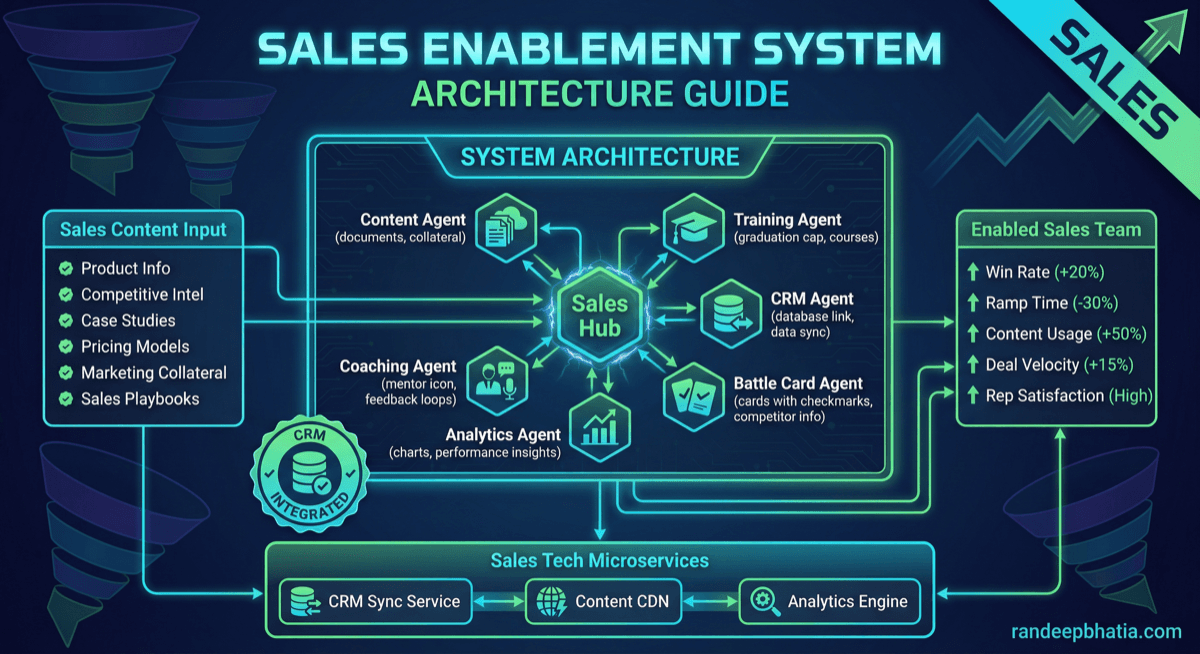
From prompts to production sales platform.
Monday: 3 core prompts for deal intelligence, email enrichment, and pipeline analysis. Tuesday: automated code with Salesforce sync. Wednesday: team workflows across sales, ops, and leadership. Thursday: complete technical architecture with AI agents, real-time CRM integration, and enterprise-grade security. Scale from 10 to 10,000 deals/month.
Key Assumptions
System Requirements
Functional
- Deal intelligence: score deals, identify risks, suggest next actions
- Email enrichment: extract contacts, companies, sentiment from threads
- Pipeline analysis: forecast close dates, revenue, and churn risk
- CRM sync: bidirectional updates with conflict resolution
- Analytics: dashboards for win rates, deal velocity, rep performance
- Notifications: Slack/email alerts for high-value deals and risks
- Search: semantic search across deals, emails, and notes
Non-Functional (SLOs)
💰 Cost Targets: {"per_deal_usd":0.15,"per_email_enrichment_usd":0.05,"per_user_per_month_usd":50}
Agent Layer
planner
L4Decomposes sales tasks into subtasks, selects appropriate agents and tools
🔧 CRM metadata API, User permission service, Task decomposition LLM
⚡ Recovery: If decomposition fails, fall back to single-agent execution, If tool unavailable, suggest manual workflow, Retry with simplified plan (max 2 retries)
deal_scorer
L3Scores deals based on historical data, engagement signals, and market context
🔧 ML scoring model (gradient boosting), Feature store (deal velocity, engagement score), Salesforce API (historical win rates)
⚡ Recovery: If ML model fails, fall back to rule-based scoring, If feature store unavailable, use cached features (max 1 hour old), If confidence < 0.6, flag for human review
email_enricher
L2Extracts contacts, companies, sentiment, and action items from email threads
🔧 Gmail/Outlook API, NER model (spaCy + custom), Sentiment classifier, Clearbit API (company enrichment)
⚡ Recovery: If NER fails, extract emails via regex, If sentiment model unavailable, default to neutral (0), If Clearbit rate-limited, queue for later enrichment
pipeline_forecaster
L3Predicts quarterly revenue, close dates, and churn risk using time-series models
🔧 Time-series model (Prophet or ARIMA), Feature store (deal velocity, stage duration), Salesforce reports API
⚡ Recovery: If model training fails, use last known good model, If data insufficient (<3 months), return wide confidence interval, If prediction outlier, flag for manual review
evaluator
L3Validates outputs from other agents, checks quality, detects hallucinations
🔧 Validation rules engine, Cross-reference with CRM data, Hallucination detector (consistency checks)
⚡ Recovery: If validation fails, route to human review queue, If ground truth unavailable, use heuristic checks, If quality < 0.7, block output and retry
guardrail
L4Enforces policies, redacts PII, checks for sensitive data leakage
🔧 PII detection (AWS Comprehend or custom NER), Policy engine (OPA or custom rules), Audit logger
⚡ Recovery: If PII detection fails, block output entirely (fail-safe), If policy check times out, apply strictest policy, If audit log unavailable, queue for later write
ML Layer
Feature Store
Update: Real-time for engagement metrics, daily batch for historical aggregates
- • deal_velocity (days in current stage)
- • engagement_score (email replies, meeting attendance)
- • contact_seniority (VP+, C-level, IC)
- • company_size (employees, revenue)
- • historical_win_rate (by rep, by industry)
- • email_sentiment_trend (last 30 days)
- • competitor_mentions (count, sentiment)
- • stage_duration_percentile (vs historical)
Model Registry
Strategy: Semantic versioning with A/B testing (10% traffic to new model)
- • deal_scorer_v3
- • email_sentiment_classifier
- • pipeline_forecaster
Observability Stack
Real-time monitoring, tracing & alerting
0 activeDeployment Variants
Startup Architecture
Fast to deploy, cost-efficient, scales to 100 competitors
Infrastructure
Risks & Mitigations
⚠️ LLM hallucinations lead to incorrect deal scores
Medium✓ Mitigation: 4-layer validation (confidence, cross-reference, consistency, human review). Shadow mode testing before production. Hallucination rate <1%.
⚠️ Salesforce API rate limits exceeded during peak hours
High✓ Mitigation: Request queue with priority (high-value deals first). Retry with exponential backoff. Cache frequently accessed data in Redis. Negotiate higher rate limits with Salesforce.
⚠️ PII leakage to LLM providers
Low✓ Mitigation: PII detection before every LLM call (fail-safe). Redaction service with 99.9% precision. Audit logs for all LLM requests. BYO keys for enterprise customers.
⚠️ Model drift reduces scoring accuracy over time
High✓ Mitigation: Weekly drift monitoring (KL divergence, rolling RMSE). Automated retraining pipeline. A/B testing before rollout. Human review for low-confidence predictions.
⚠️ Multi-tenant data leakage (Org A sees Org B's deals)
Low✓ Mitigation: Org-level sharding in database. Row-level security (RLS) policies. API gateway enforces org_id filtering. Quarterly penetration testing. Dedicated VPCs for enterprise.
⚠️ Email sync fails silently, missing critical deal updates
Medium✓ Mitigation: Webhook health checks every 5 minutes. Alerting if no emails received in 1 hour. Manual re-sync option in UI. Backup polling mechanism (hourly) if webhooks fail.
⚠️ Cost overruns from excessive LLM API calls
Medium✓ Mitigation: Per-org monthly token budget. Rate limiting (10 scores/min per user). Cache LLM responses (1-hour TTL). Cost dashboard with alerts at 80% of budget.
Evolution Roadmap
Progressive transformation from MVP to scale
Phase 1: MVP (0-3 months)
Phase 2: Scale (3-6 months)
Phase 3: Enterprise (6-12 months)
Complete Systems Architecture
9-layer architecture from presentation to security
Presentation
4 components
API Gateway
4 components
Agent Layer
6 components
ML Layer
6 components
Integration
4 components
Data
4 components
External
4 components
Observability
4 components
Security
4 components
Sequence Diagram - Deal Scoring Flow
Automated data flow every hour
Data Flow - Deal Scoring Workflow
Sales rep request → Salesforce update in 2.1 seconds
Key Integrations
Salesforce CRM
Gmail/Outlook Email APIs
Slack Notifications
Clearbit Enrichment
Security & Compliance
Failure Modes & Fallbacks
| Failure | Fallback | Impact | SLA |
|---|---|---|---|
| Salesforce API down | Queue updates in Redis, retry with exponential backoff (max 5 attempts) | Delayed sync (up to 30 min), no data loss | 99.5% |
| LLM API rate limit exceeded | Switch to backup LLM provider (Anthropic → OpenAI → Azure), queue requests if all exhausted | Increased latency (2-5s), no functionality loss | 99.9% |
| Deal scoring model returns low confidence (<0.6) | Route to human review queue, use rule-based scoring as interim | Manual review required, slower turnaround (hours vs seconds) | 95% |
| Email enrichment fails (NER model error) | Extract emails via regex, skip company enrichment, flag for manual review | Reduced data quality, no blocking errors | 99% |
| Database primary node failure | Promote read replica to primary (30s failover), redirect traffic | 30s downtime, read-only mode during failover | 99.95% |
| PII detection service unavailable | Block all LLM calls (fail-safe), queue requests for later processing | Degraded functionality, no PII leakage risk | 100% (safety first) |
| Feature store cache miss (Redis down) | Query PostgreSQL directly (slower), rebuild cache on recovery | Increased latency (500ms → 2s), no data loss | 99% |
RAG vs Fine-Tuning
Hallucination Detection
Evaluation Framework
Dataset Curation
Agentic RAG
Model Drift Detection
Tech Stack Summary
Need a Custom Sales Enablement System?
We'll architect, build, and deploy a production-grade sales platform tailored to your CRM, workflows, and compliance needs.
2026 Randeep Bhatia. All Rights Reserved.
No part of this content may be reproduced, distributed, or transmitted in any form without prior written permission.