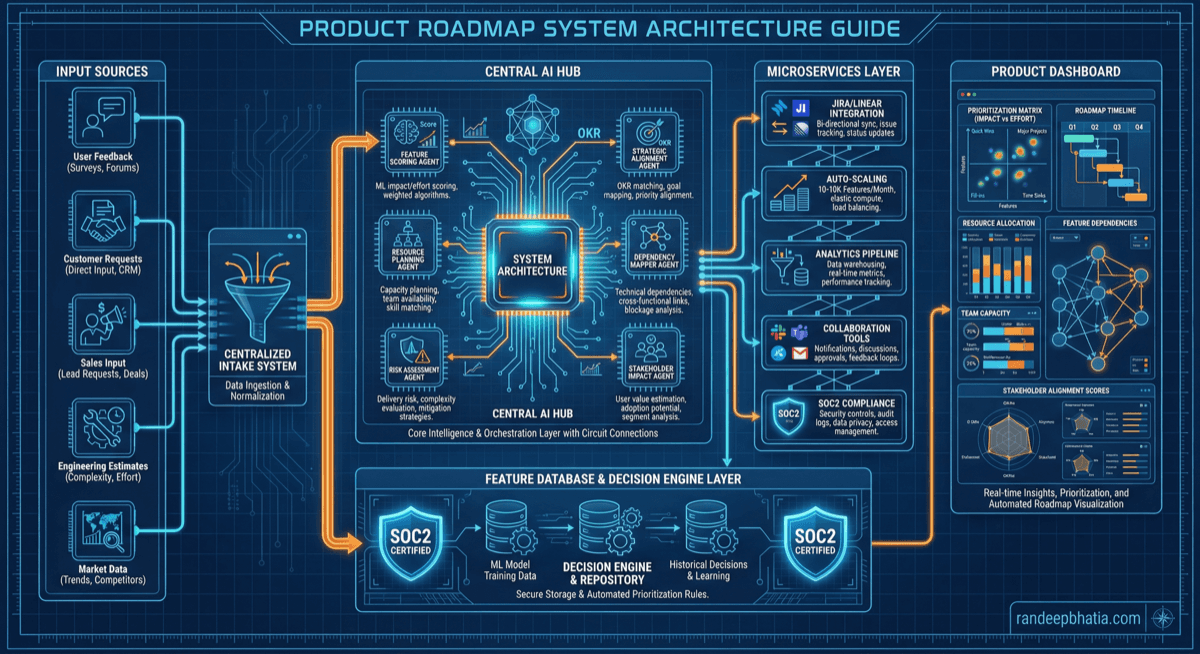
From prompts to production roadmap system.
Monday: 3 core prompts for scoring features. Tuesday: automated code to run them. Wednesday: team workflows (PM, Eng, Leadership). Thursday: complete technical architecture with 6 specialized agents, ML pipeline, and production deployment from 10 to 10,000 features per month.
Key Assumptions
System Requirements
Functional
- Ingest feature requests from multiple sources (Jira, Linear, Slack, email)
- Score features across 5 dimensions using AI agents
- Aggregate scores with weighted formulas and ML models
- Generate prioritized roadmap with confidence intervals
- Provide explanations for each score and ranking
- Support custom scoring criteria per organization
- Track score changes over time with audit trail
Non-Functional (SLOs)
π° Cost Targets: {"per_feature_scored_usd":0.05,"per_org_per_month_usd":200}
Agent Layer
planner
L3Decomposes feature scoring into subtasks and selects appropriate tools
π§ feature_parser, criteria_loader, context_retriever
β‘ Recovery: If parsing fails: use default criteria, If context unavailable: proceed without historical data, Retry up to 3x with exponential backoff
executor
L4Orchestrates the scoring workflow across all dimensions
π§ scorer_agent, parallel_executor, result_aggregator
β‘ Recovery: If one dimension fails: continue with others, flag incomplete, If all fail: route to manual queue, Timeout per dimension: 5 seconds
scorer
L2Scores individual dimensions using LLM reasoning
π§ claude_api, gpt4_api, prompt_formatter, score_normalizer
β‘ Recovery: If LLM timeout: retry with different model, If invalid score: use median of historical scores, If confidence < 0.5: flag for human review
evaluator
L3Validates output quality and detects anomalies
π§ statistical_validator, anomaly_detector, consistency_checker
β‘ Recovery: If validation fails: route to human review queue, If anomaly detected: flag and continue with warning, If quality < threshold: trigger re-scoring
guardrail
L4Enforces policy checks, PII redaction, and safety filters
π§ pii_detector, policy_engine, content_filter
β‘ Recovery: If PII detected: redact and log, If policy violation: block and alert, If uncertain: flag for manual review
aggregator
L3Combines dimension scores into final ranking with ML model
π§ weighted_average, ml_ranking_model, confidence_estimator
β‘ Recovery: If ML model fails: fall back to weighted average, If weights missing: use equal weights, If rank calculation fails: use score-only ordering
ML Layer
Feature Store
Update: Real-time for new features, batch daily for historical aggregates
- β’ feature_text_embeddings (768-dim)
- β’ historical_score_avg
- β’ historical_score_std
- β’ source_reliability_score
- β’ user_engagement_metrics
- β’ similar_feature_scores
- β’ org_scoring_patterns
Model Registry
Strategy: Semantic versioning with A/B testing for new versions
- β’ score_aggregator_v2
- β’ confidence_estimator_v1
- β’ anomaly_detector_v1
Observability Stack
Real-time monitoring, tracing & alerting
0 activeDeployment Variants
Startup Architecture
Fast to deploy, cost-efficient, scales to 100 competitors
Infrastructure
Risks & Mitigations
β οΈ LLM cost explosion (>$1K/day)
Mediumβ Mitigation: Set daily budget caps. Cache similar features. Use cheaper models for low-value features. Monitor cost per feature. Alert at $500/day threshold.
β οΈ Score accuracy degrades over time (concept drift)
Highβ Mitigation: Weekly evaluation against PM judgments. Retrain aggregation model monthly. A/B test new prompts. Human-in-the-loop for low-confidence scores.
β οΈ PII leakage to LLM providers
Lowβ Mitigation: PII detection before LLM calls. Redact all detected entities. Audit logs for all LLM requests. Use enterprise LLM plans with no training on customer data.
β οΈ Latency exceeds 5 seconds (user frustration)
Mediumβ Mitigation: Parallel scoring across dimensions. Cache common patterns. Use faster models for low-value features. Async processing with webhook callback.
β οΈ Agent orchestration bugs (infinite loops, deadlocks)
Mediumβ Mitigation: Timeout per agent (5 sec). Max retry count (3x). Circuit breaker pattern. Extensive testing with chaos engineering.
β οΈ Integration failures (Jira/Linear API down)
Mediumβ Mitigation: Queue-based architecture. Retry with exponential backoff. Manual upload fallback. Monitor integration health.
β οΈ Bias in scoring (favors certain types of features)
Highβ Mitigation: Diverse training data. Bias detection in evaluation. Human review of edge cases. Regular fairness audits.
Evolution Roadmap
Progressive transformation from MVP to scale
Phase 1: MVP (0-3 months)
Phase 2: Scale (3-6 months)
Phase 3: Enterprise (6-12 months)
Complete Systems Architecture
9-layer architecture from presentation to security
Presentation
4 components
API Gateway
4 components
Agent Layer
6 components
ML Layer
5 components
Integration
5 components
Data
4 components
External
5 components
Observability
5 components
Security
5 components
Sequence Diagram - Feature Scoring Flow
Automated data flow every hour
Data Flow
Feature request β Prioritized roadmap in 4 seconds
Key Integrations
Jira Integration
Linear Integration
Slack Integration
CRM Integration (Salesforce/HubSpot)
Analytics Integration (Mixpanel/Amplitude)
Security & Compliance
Failure Modes
| Failure | Fallback | Impact | SLA |
|---|---|---|---|
| LLM API down (Anthropic/OpenAI) | β Switch to backup LLM provider β If all fail, queue for retry | Degraded (slower), not broken | 99.5% |
| Scoring confidence < 0.5 | β Flag for human review β Use historical median score as placeholder | Quality maintained, some manual work | 99.9% |
| Database unavailable | β Read from replica β Write to queue for replay | Read-only mode, eventual consistency | 99.9% |
| PII detection service down | β Block all processing (safety first) β Alert on-call | Complete halt to protect privacy | 100% |
| Aggregation model fails | β Use weighted average of dimension scores | Slightly less accurate, fully functional | 99.0% |
| Queue depth > 1000 | β Scale up workers β Rate limit new submissions | Slower processing, no data loss | 99.5% |
| Cost budget exceeded ($500/day) | β Throttle LLM calls β Use cached scores for similar features | Slower, less fresh scores | N/A (cost control) |
ββββββββββββββββ
β Planner β β Decomposes task
ββββββββ¬ββββββββ
β
βΌ
ββββββββββββββββ
β Executor β β Orchestrates workflow
ββββββββ¬ββββββββ
β
βββββ΄βββββ¬βββββββββββ¬βββββββββββ
β β β β
ββββΌβββ βββΌβββ ββββββΌβββββ ββββΌβββββ
βScorerβ βScorerβ β Scorer β βScorer β (5 parallel)
β(Value)β β(Effort)β β(Alignment)β β(Impact)β
ββββ¬βββ βββ¬βββ ββββββ¬βββββ ββββ¬βββββ
β β β β
ββββββββββ΄βββββββββββ΄βββββββββββ
β
βββββΌβββββ
βGuardrailβ β Validates & sanitizes
βββββ¬βββββ
β
βββββΌβββββ
βAggregatorβ β Combines scores
βββββ¬βββββ
β
βββββΌβββββ
βEvaluatorβ β Quality check
ββββββββββπAgent Collaboration Flow
πAgent Types
Reactive Agent
LowScorer Agent - Responds to input, returns score
Reflexive Agent
MediumGuardrail Agent - Uses rules + context for validation
Deliberative Agent
HighPlanner Agent - Plans multi-step execution
Orchestrator Agent
HighestExecutor Agent - Coordinates all agents, handles loops
πLevels of Autonomy
RAG vs Fine-Tuning
Hallucination Detection
Evaluation Framework
Dataset Curation
Agentic RAG
Multi-Model Ensemble
Tech Stack Summary
2026 Randeep Bhatia. All Rights Reserved.
No part of this content may be reproduced, distributed, or transmitted in any form without prior written permission.