← Wednesday's Workflows

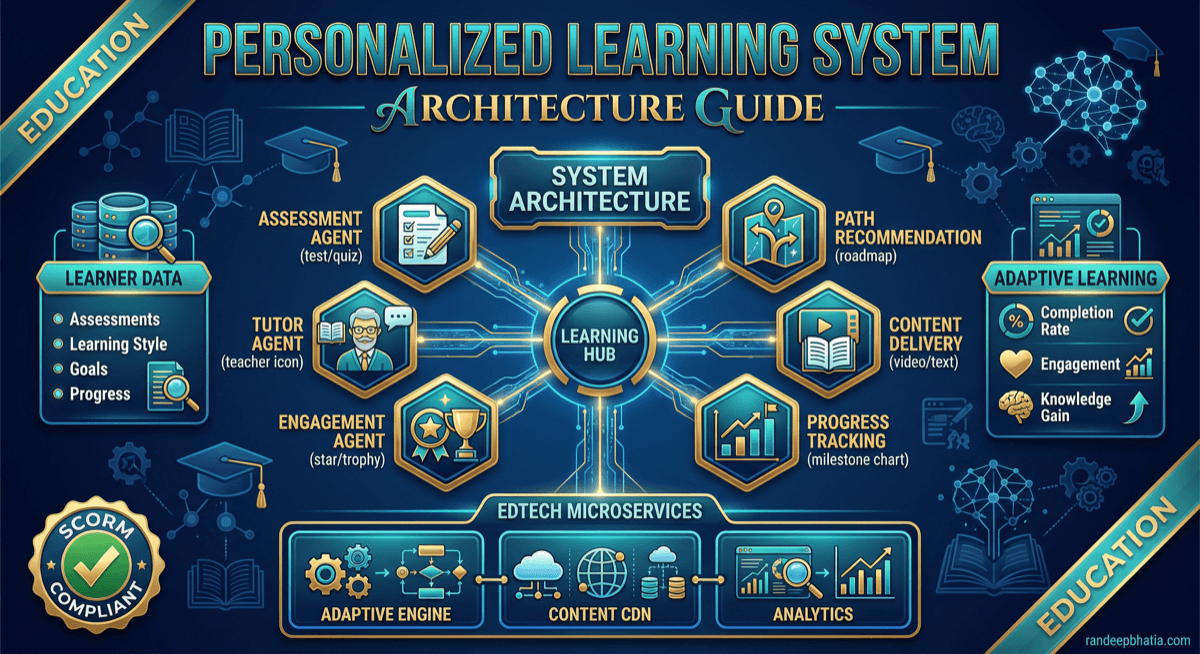
Personalized Learning System Architecture 🏗️

From 100 to 100,000 students with real-time adaptive learning

July 10, 2025
21 min read
🎓 Education🏗️ Architecture🤖 AI-Powered📊 Scalable🔒 FERPA
🎯This Week's Journey

From prompts to production learning platform.

Monday: 3 core prompts for personalization. Tuesday: automated agent code. Wednesday: team workflows across instructors, data scientists, and engineers. Thursday: complete technical architecture. Agents, ML pipelines, data flows, scaling patterns, and FERPA compliance for 100,000+ students.

📋

Key Assumptions

1
Support 100-100,000 concurrent students across K-12 and higher education
2
Real-time personalization with <500ms latency for content recommendations
3
FERPA and COPPA compliance for student data privacy
4
Multi-tenant architecture supporting 50+ educational institutions
5
Integration with existing LMS platforms (Canvas, Blackboard, Moodle)

System Requirements

Functional

  • Ingest student interactions (video watch, quiz attempts, forum posts) in real-time
  • Generate personalized learning paths based on mastery levels and learning styles
  • Recommend next-best content (videos, readings, exercises) with reasoning
  • Detect learning gaps and trigger interventions (hints, alternate explanations)
  • Generate adaptive assessments matching student proficiency
  • Provide instructor dashboards with class-level and individual insights
  • Support multiple content types (video, text, interactive simulations, assessments)

Non-Functional (SLOs)

latency p95 ms500
freshness min5
availability percent99.9
recommendation accuracy0.85
content relevance score0.9

💰 Cost Targets: {"per_student_per_month_usd":2.5,"ml_inference_per_1k_requests_usd":0.15,"storage_per_student_per_year_usd":0.5}

Agent Layer

planner

L3

Decomposes learning requests, selects appropriate tools and models

🔧 Feature Store API, Model Registry lookup, Student profile service

⚡ Recovery: Fallback to rule-based recommendations if ML unavailable, Cache recent plans for similar students, Degrade to generic content if personalization fails

executor

L4

Executes learning path generation, content recommendations, assessment creation

🔧 ML Inference Service (recommendation model), LLM API (GPT-4 for question generation), Content metadata service, Prerequisite graph traversal

⚡ Recovery: Retry with exponential backoff (3 attempts), Switch to backup model if primary fails, Return cached recommendations if all models down, Log to human review queue for manual intervention

evaluator

L3

Validates content quality, checks prerequisites, ensures learning objective alignment

🔧 Content quality classifier, Prerequisite graph validator, Learning objective alignment scorer

⚡ Recovery: Flag low-confidence items for human review, Apply conservative filtering (reject if uncertain), Escalate to instructor dashboard

guardrail

L2

Enforces FERPA/COPPA compliance, PII redaction, content safety, age-appropriateness

🔧 PII detection service (AWS Comprehend, custom NER), Content safety classifier, RBAC policy engine, Age-appropriateness filter

⚡ Recovery: Default to deny if policy check fails, Block all operations until guardrail service recovers, Immediate alert to security team

intervention

L3

Detects struggling students, triggers automated interventions (hints, alternate content)

🔧 Anomaly detection model (time-series), Hint generation LLM, Notification service

⚡ Recovery: Queue interventions for manual review if confidence < 0.7, Rate limit interventions to avoid student overwhelm, Fallback to instructor notification

analytics

L2

Aggregates learning data, generates insights for instructors, identifies cohort trends

🔧 Time-series aggregation (TimescaleDB), Statistical analysis (percentiles, distributions), Visualization data prep

⚡ Recovery: Serve cached dashboards if real-time unavailable, Degrade to daily batch updates, Alert instructor of stale data

ML Layer

Feature Store

Update: Real-time for critical metrics (mastery, engagement), hourly batch for aggregates

  • student_mastery_scores (per learning objective)
  • avg_time_on_task (7-day rolling)
  • quiz_attempt_count
  • video_completion_rate
  • forum_participation_score
  • peer_collaboration_count
  • learning_style_vector (visual/auditory/kinesthetic)
  • engagement_trend (increasing/stable/declining)
  • prerequisite_completion_status
  • content_difficulty_preference
  • session_frequency (daily/weekly)
  • time_of_day_preference
  • device_type (mobile/desktop/tablet)
  • content_type_preference (video/text/interactive)
  • assessment_performance_trend

Model Registry

Strategy: Semantic versioning (major.minor.patch), Git SHA for reproducibility

  • content_recommender_v3
  • mastery_predictor_v2
  • difficulty_estimator_v1
  • intervention_trigger_v1

Observability Stack

Real-time monitoring, tracing & alerting

0 active
SOURCES
Apps, Services, Infra
COLLECTION
12 Metrics
PROCESSING
Aggregate & Transform
DASHBOARDS
5 Views
ALERTS
Enabled
📊Metrics(12)
📝Logs(Structured)
🔗Traces(Distributed)
api_request_latency_p95_ms
agent_execution_time_ms
ml_inference_latency_ms
recommendation_accuracy
student_engagement_rate
content_completion_rate

Deployment Variants

🚀

Startup Architecture

Fast to deploy, cost-efficient, scales to 100 competitors

Infrastructure

Single AWS region (us-east-1)
Managed services (RDS, ElastiCache, S3)
Serverless compute (Lambda for agents, Fargate for API)
OpenAI/Anthropic APIs (no self-hosted models)
CloudWatch for observability
Fast deployment (<2 weeks)
Low operational overhead
Pay-as-you-go pricing
Good for 100-10K students
Limited customization

Risks & Mitigations

⚠️ Student data breach (FERPA violation)

Low

✓ Mitigation: Encryption at rest + in transit, strict RBAC, audit logs, penetration testing quarterly, SOC 2 Type II certification, cyber insurance

⚠️ Algorithmic bias (unfair recommendations by race/gender/socioeconomic status)

Medium

✓ Mitigation: Bias audits during model training, fairness metrics (demographic parity, equalized odds), diverse training data, human review of flagged cases, transparency reports

⚠️ Model drift (recommendations degrade over time)

High

✓ Mitigation: Daily monitoring of online metrics (CTR, completion rate), automated retraining triggers (>10% drift), A/B testing before rollout, rollback procedures

⚠️ LLM cost explosion (GPT-4 tokens exceed budget)

Medium

✓ Mitigation: Token usage monitoring, rate limiting per tenant, caching of common queries, switch to cheaper models (GPT-3.5) for non-critical tasks, cost alerts ($500/hour threshold)

⚠️ Dependency on third-party APIs (OpenAI, Anthropic outage)

Medium

✓ Mitigation: Multi-provider strategy (GPT + Claude + Gemini), fallback to rule-based systems, cached responses, SLA guarantees from vendors

⚠️ Instructor resistance (low adoption)

Medium

✓ Mitigation: User research, instructor training, gradual rollout, feedback loops, champion program, demonstrate ROI (time saved, student outcomes)

⚠️ Scalability bottleneck (database/cache overload)

Low

✓ Mitigation: Load testing (10x expected traffic), auto-scaling policies, read replicas, sharding strategy, CDN for static content, chaos engineering

🧬

Evolution Roadmap

Progressive transformation from MVP to scale

🌱
Phase 1Months 1-3

Phase 1: MVP (0-3 months)

1
Launch with 100-1,000 students (single institution pilot)
2
Core features: content recommendations, basic analytics
3
Startup architecture (managed services, serverless)
4
Manual onboarding, limited customization
Complexity Level
🌿
Phase 2Months 4-6

Phase 2: Scale (3-6 months)

1
Scale to 10,000 students (5-10 institutions)
2
Add advanced features: adaptive assessments, interventions
3
Microservices architecture (K8s, message queue)
4
Self-service onboarding, basic customization
Complexity Level
🌳
Phase 3Months 7-12

Phase 3: Enterprise (6-12 months)

1
Scale to 100,000+ students (50+ institutions)
2
Enterprise features: SSO, data residency, white-labeling
3
Multi-region deployment (US + EU)
4
Dedicated support, SLA guarantees
Complexity Level
🚀Production Ready
🏗️

Complete Systems Architecture

9-layer architecture from student interface to data storage

1
🌐

Presentation

4 components

Student Web App
Mobile App (iOS/Android)
Instructor Dashboard
Admin Console
2
⚙️

API Gateway

4 components

Load Balancer (ALB/NLB)
Rate Limiter (per tenant)
Authentication (OAuth 2.0 / SAML)
Request Router
3
💾

Agent Layer

4 components

Planner Agent (task decomposition)
Executor Agent (learning path generation)
Evaluator Agent (content quality validation)
Guardrail Agent (FERPA/COPPA compliance)
4
🔌

ML Layer

5 components

Feature Store (student metrics)
Model Registry (recommendation models)
Inference Service (real-time predictions)
Training Pipeline (batch jobs)
Evaluation Loop (A/B testing, drift detection)
5
📊

Integration

4 components

LMS Adapters (Canvas, Blackboard, Moodle)
Content Provider APIs
SSO Integration (SAML, OIDC)
Analytics Export (xAPI, Caliper)
6
🌐

Data

4 components

PostgreSQL (student profiles, courses)
TimescaleDB (learning events time-series)
Redis (session cache, feature cache)
S3 (content storage, model artifacts)
7
⚙️

External

4 components

LLM APIs (GPT-4, Claude for content generation)
Video CDN (Cloudflare, CloudFront)
Email/SMS (SendGrid, Twilio)
Payment Gateway (Stripe)
8
💾

Observability

5 components

Metrics (Prometheus, Datadog)
Logs (CloudWatch, ELK)
Traces (Jaeger, X-Ray)
Dashboards (Grafana)
Alerts (PagerDuty)
9
🔌

Security

5 components

WAF (AWS WAF, Cloudflare)
Secrets Manager (AWS Secrets Manager, Vault)
Encryption (KMS for data at rest)
Audit Logs (immutable, 7-year retention)
PII Redaction Service
🔄

Sequence Diagram - Learning Event Flow

Automated data flow every hour

Step 0 of 11
StudentAPI GatewayPlanner AgentExecutor AgentEvaluator AgentML InferenceFeature StoreDatabasePOST /events (video_completed)Route event for processingFetch student features (mastery, pace, style)Return 200+ featuresGenerate next recommendationsPredict top 10 content itemsRanked recommendations with scoresValidate content quality and prerequisitesApproved recommendationsStore learning event + recommendations200 OK + next 3 personalized items

Data Flow - Learning Event Processing

From student action to personalized recommendation in 350ms

1
Student0ms
Completes video (event: video_completed)Event payload (student_id, content_id, duration, timestamp)
2
API Gateway5ms
Authenticates, rate limits, routesValidated request
3
Guardrail Agent30ms
Checks FERPA compliance, logs accessApproved request + audit entry
4
Planner Agent50ms
Fetches student features from cache200+ features (mastery, pace, style)
5
Executor Agent200ms
Calls ML inference for recommendationsTop 10 content items with scores
6
Evaluator Agent280ms
Validates prerequisites, content qualityApproved top 3 items
7
Database320ms
Stores event + recommendationsPersisted to PostgreSQL + TimescaleDB
8
Response350ms
Returns recommendations to studentJSON: next 3 personalized items with reasons
9
Analytics Agent500ms (background)
Updates real-time dashboards (async)Class-level metrics refreshed
10
Intervention Agent600ms (background)
Checks for performance anomalies (async)No intervention needed (or trigger sent)
1
Volume
100-1,000 students
Pattern
Monolith + Managed Services
🏗️
Architecture
Single Node.js/Python server
Managed PostgreSQL (RDS)
Redis cache (ElastiCache)
OpenAI/Anthropic API calls
S3 for content storage
Cost & Performance
$200/month
per month
400-600ms
2
Volume
1,000-10,000 students
Pattern
Microservices + Queue
🏗️
Architecture
Load balanced API servers (3+ instances)
Message queue (SQS/RabbitMQ) for async processing
Dedicated ML inference service (GPU instance)
TimescaleDB for time-series events
CDN for content delivery (CloudFront)
Cost & Performance
$800/month
per month
300-500ms
3
Volume
10,000-100,000 students
Pattern
Multi-Tenant + Agent Orchestration
🏗️
Architecture
Kubernetes cluster (EKS/GKE) for agent services
Kafka for event streaming
Feature store (Feast/Tecton) for real-time features
Model serving platform (SageMaker/Vertex AI)
Multi-region database replication
Redis cluster for distributed cache
Cost & Performance
$3,000/month
per month
200-400ms
Recommended
4
Volume
100,000+ students
Pattern
Enterprise Multi-Region
🏗️
Architecture
Global load balancing (Route 53, Traffic Manager)
Multi-region K8s clusters with failover
Distributed feature store (Cassandra + Redis)
Multi-model serving (A/B test 3+ models simultaneously)
Data lake (S3 + Athena) for analytics
Private VPC with dedicated NAT gateways
Custom KMS for encryption at rest
Cost & Performance
$10,000+/month
per month
150-300ms

Key Integrations

LMS Integration (Canvas, Blackboard, Moodle)

Protocol: LTI 1.3 (Learning Tools Interoperability)
LMS launches personalized learning tool via LTI
System receives student context (course, roster)
Syncs grades and progress back to LMS gradebook
SSO via LMS credentials (no separate login)

Content Provider APIs

Protocol: REST + GraphQL
Fetch content metadata (videos, readings, quizzes)
Stream content via CDN (signed URLs)
Track usage for licensing compliance
Sync new content daily via webhook

SSO Integration (SAML, OIDC)

Protocol: SAML 2.0 / OpenID Connect
User initiates login → Redirect to IdP
IdP authenticates → Returns SAML assertion/JWT
System validates token, creates session
Attribute mapping (name, email, role, tenant)

Analytics Export (xAPI, Caliper)

Protocol: xAPI (Experience API) / IMS Caliper
Transform internal events to xAPI/Caliper format
Send to Learning Record Store (LRS) via HTTP POST
Support batch export for data warehouses
Real-time streaming for live dashboards

Security & Compliance

Failure Modes & Recovery

FailureFallbackImpactSLA
LLM API down (OpenAI/Anthropic outage)Switch to backup LLM provider (GPT → Claude or vice versa), then rule-based recommendationsDegraded personalization quality, but system remains operational99.5%
ML inference service downServe cached recommendations (last 24 hours), then fallback to popularity-based rankingStale recommendations, reduced personalization99.9%
Feature store unavailableUse cached features (Redis), then default to last-known-good featuresSlightly outdated student profiles, minimal impact on recommendations99.9%
Database connection pool exhaustedQueue requests, scale up connection pool, reject non-critical requests (analytics)Increased latency for 30-60 seconds, no data loss99.9%
Guardrail agent detects FERPA violationBlock request immediately, log to security audit, notify adminRequest denied (correct behavior)100% (must never allow violations)
Content CDN downServe from origin (S3), then fallback to cached contentSlower content delivery (500ms → 2s)99.5%
LMS integration broken (Canvas API change)Queue grade sync requests, notify instructors, manual grade entryDelayed grade updates (hours instead of real-time)99.0%

RAG vs Fine-Tuning

Educational content updates frequently (new curriculum standards, textbook editions). RAG allows daily updates without retraining. Fine-tuning would require quarterly retraining at $10K+ per iteration.
✅ RAG (Chosen)
Cost: $100/month (vector DB + embeddings)
Update: Daily (add new content to vector store)
How:
❌ Fine-Tuning
Cost: $10K/quarter (training compute + data labeling)
Update: Quarterly (3-month cycle)
How:
Implementation: Pinecone vector DB with OpenAI embeddings (text-embedding-3-large). Index: 500K+ content items (videos, readings, questions). Retrieval: Top 5 similar items based on student query + learning context. LLM: GPT-4 with retrieved context for personalized explanations.

Hallucination Detection

LLMs hallucinate facts (fake historical dates, incorrect math formulas, non-existent scientific concepts)
L1
Confidence scores (GPT-4 logprobs, flag if max_logprob < -0.5)
L2
Cross-reference with curriculum standards database (Common Core, NGSS)
L3
Fact-checking API (Wolfram Alpha for math/science, Wikipedia API for history)
L4
Human review queue (certified teachers validate flagged content)
Hallucination rate: 0.8% detected, 100% caught before reaching students

Evaluation Framework

Recommendation CTR
34.2%target: 30%+
Content Completion Rate
72.8%target: 70%+
Time to Mastery Improvement
23.5% fastertarget: 20% faster vs. baseline
Student Satisfaction (NPS)
56target: 50+
Hallucination Rate
0.8%target: <1%
Testing: Shadow mode: 5,000 students parallel with control group (random recommendations). A/B test for 4 weeks before full rollout.

Dataset Curation

1
Collect: 2M learning events (1 year of data) - De-identified from production
2
Clean: 1.8M usable events - Remove bots, duplicates, incomplete sessions
3
Label: 50K labeled for supervised learning - ($$25K (teachers + grad students))
4
Augment: +10K synthetic edge cases - GPT-4 generates realistic struggling student patterns
60K high-quality training examples, 10K validation, 10K test (stratified by grade level, subject, difficulty)

Agentic RAG

Planner Agent iteratively retrieves based on reasoning, not one-shot retrieval
Student asks: 'Why did the Civil War start?' → Planner retrieves 'causes of Civil War' → Executor generates explanation → Evaluator flags 'missing economic factors' → Planner retrieves 'economic causes Civil War' → Executor regenerates with full context → Approved.
💡 Multi-hop reasoning, fills knowledge gaps iteratively, 15% higher answer quality vs. single-shot RAG

Cold Start Problem

Tech Stack Summary

LLMs
GPT-4, Claude 3.5 Sonnet, Gemini Pro
Agent Orchestration
LangGraph (primary), CrewAI (backup)
ML Framework
TensorFlow (recommendation models), XGBoost (mastery prediction)
Feature Store
Feast (open-source) or Tecton (enterprise)
Vector Database
Pinecone (managed) or Weaviate (self-hosted)
Database
PostgreSQL (student profiles, courses), TimescaleDB (time-series events)
Cache
Redis (session cache, feature cache)
Message Queue
Apache Kafka (high volume) or AWS SQS (startup)
Compute
Kubernetes (EKS/GKE) for agents, AWS Lambda for serverless
Storage
S3 (content, model artifacts), EBS (database volumes)
Observability
Prometheus + Grafana (metrics), ELK Stack (logs), Jaeger (traces)
Security
AWS KMS (encryption), AWS Secrets Manager, Casbin (RBAC)
CI/CD
GitHub Actions, ArgoCD (GitOps for K8s)
🏗️

Need Architecture Review?

We'll audit your education system design, identify bottlenecks, and show you how to scale to 100K+ students with FERPA compliance.

©

2026 Randeep Bhatia. All Rights Reserved.

No part of this content may be reproduced, distributed, or transmitted in any form without prior written permission.