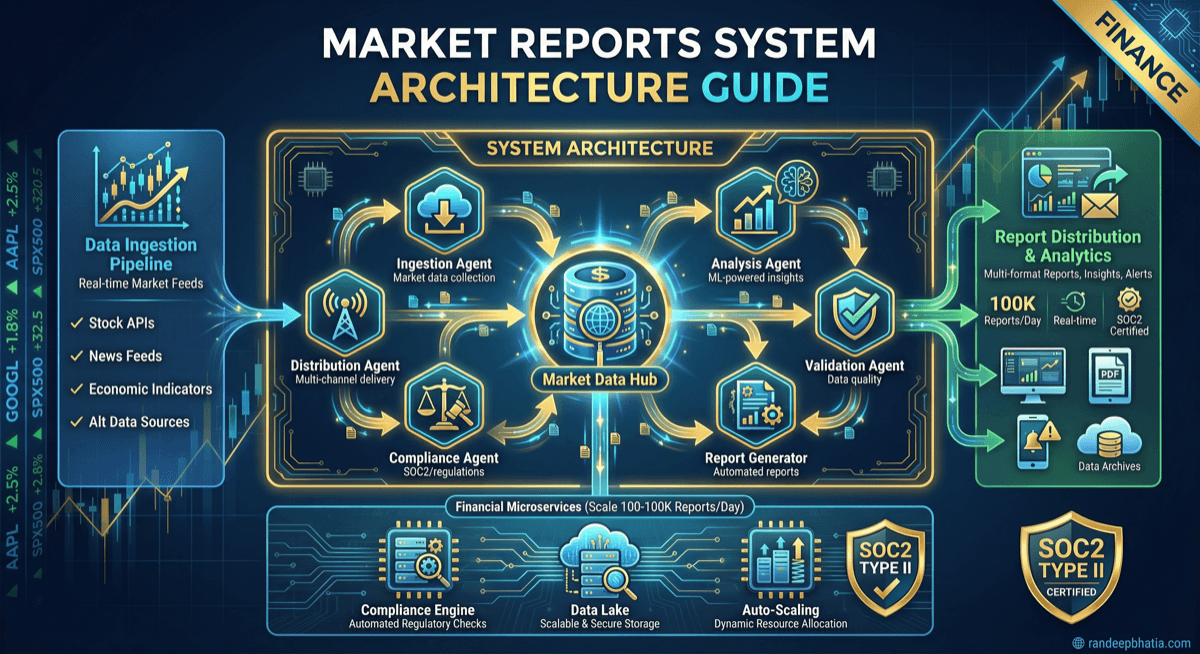
From prompts to production-grade market intelligence.
Monday: 3 core prompts for market analysis. Tuesday: automated report generation code. Wednesday: team workflows across analysts, engineers, and compliance. Thursday: complete technical architecture. Today we show you the full system design: data ingestion, AI agent orchestration, ML pipelines, and enterprise-grade compliance. Scale from 100 reports/day to 100K with SOC2 certification.
Key Assumptions
System Requirements
Functional
- Ingest real-time market data from APIs (prices, volumes, news, sentiment)
- Extract insights using AI agents (trend detection, anomaly alerts, summaries)
- Generate reports in multiple formats (PDF, Excel, interactive dashboards)
- Version control for prompts, models, and report templates
- Audit trail for all data access and report generation
- Role-based access control (analysts, clients, admins)
- Scheduled and on-demand report generation
Non-Functional (SLOs)
π° Cost Targets: {"per_report_usd":0.15,"per_user_monthly_usd":50,"data_ingestion_per_1k_records_usd":0.05}
Agent Layer
planner
L3Decomposes report request into tasks, selects tools and data sources
π§ market_data_selector, template_matcher, compliance_checker
β‘ Recovery: If data source unavailable β select backup source, If template missing β use default template, Log all failures to audit trail
executor
L4Executes analysis workflow, calls ML models, generates insights
π§ feature_extractor, ml_inference_service, insight_generator (LLM), chart_generator
β‘ Recovery: If ML model fails β use rule-based fallback, If LLM timeout β retry 3x with backoff, If partial data β flag as incomplete, proceed with available
evaluator
L3Validates output quality, checks for hallucinations, ensures compliance
π§ fact_checker, confidence_scorer, compliance_validator, hallucination_detector
β‘ Recovery: If quality < 0.7 β flag for human review, If compliance violation β block report, alert admin, If hallucination detected β regenerate with stricter prompts
guardrail
L2Enforces policies, redacts PII, applies safety filters, rate limits
π§ pii_detector, content_filter, rate_limiter, access_control_checker
β‘ Recovery: If PII detected β redact automatically, If rate limit exceeded β queue request, If policy violation β block and log
market_analyst
L4Domain-specific analysis: trend detection, volatility, correlation
π§ technical_indicators (RSI, MACD, Bollinger), sentiment_analyzer (LLM), correlation_calculator
β‘ Recovery: If insufficient data β use longer time window, If sentiment analysis fails β use neutral baseline, Always provide confidence intervals
report_generator
L2Formats analysis into PDF/Excel/dashboard, applies branding
π§ template_renderer, chart_generator, pdf_converter, branding_applier
β‘ Recovery: If template error β use fallback template, If chart generation fails β use table format, If PDF conversion fails β deliver HTML
ML Layer
Feature Store
Update: Real-time (streaming) + Daily batch refresh
- β’ price_change_1d, 7d, 30d
- β’ volume_ratio (current/avg)
- β’ rsi_14, macd, bollinger_band_position
- β’ news_sentiment_score
- β’ sector_correlation
- β’ volatility_index
Model Registry
Strategy: Semantic versioning (major.minor.patch), staged rollout
- β’ trend_predictor
- β’ volatility_forecaster
- β’ insight_generator
Observability Stack
Real-time monitoring, tracing & alerting
0 activeDeployment Variants
Startup Architecture
Fast to deploy, cost-efficient, scales to 100 competitors
Infrastructure
Risks & Mitigations
β οΈ LLM API cost explosion (token usage spikes)
Highβ Mitigation: Set hard cost limits ($500/day). Cache aggressively (Redis). Use cheaper models for non-critical tasks (GPT-3.5). Monitor token usage per request. Alert if anomaly detected.
β οΈ Market data API outage (Bloomberg/Reuters down)
Mediumβ Mitigation: Multi-provider strategy (Bloomberg + Reuters + Alpha Vantage). Cache recent data (5min). Fallback to cached data if all APIs down. SLA with providers (99.9% uptime).
β οΈ Hallucinated financial data (LLM invents numbers)
Mediumβ Mitigation: 4-layer hallucination detection (confidence, fact-check, logic, human review). Never deliver report with quality score <0.7. Audit all claims against ground truth.
β οΈ Compliance violation (FINRA, SEC regulations)
Lowβ Mitigation: Guardrail Agent enforces policies. Legal review of all prompts/templates. Audit trail (7yr retention). Annual compliance audit. Disclaimers on all reports.
β οΈ Data breach (unauthorized access to client reports)
Lowβ Mitigation: Encryption at rest + in transit. RBAC (least privilege). MFA for all users. Audit logs. Penetration testing (quarterly). SOC2 certification.
β οΈ Model drift (market behavior changes, accuracy drops)
Highβ Mitigation: Continuous monitoring (feature drift, prediction drift, performance drift). Automated retraining (weekly). A/B testing new models. Rollback if performance degrades.
β οΈ Vendor lock-in (OpenAI API dependency)
Mediumβ Mitigation: Multi-LLM strategy (OpenAI + Anthropic + self-hosted). Abstract LLM calls (interface pattern). Evaluate alternatives quarterly. Maintain self-hosted Llama as backup.
Evolution Roadmap
Progressive transformation from MVP to scale
Phase 1: MVP (0-3 months)
Phase 2: Scale (3-6 months)
Phase 3: Enterprise (6-12 months)
Complete Systems Architecture
9-layer end-to-end architecture
Presentation
4 components
API Gateway
4 components
Agent Layer
6 components
ML Layer
5 components
Integration
4 components
Data
4 components
External
5 components
Observability
4 components
Security
5 components
Sequence Diagram - Report Generation Flow
Automated data flow every hour
End-to-End Data Flow
From market data ingestion to report delivery in 8 steps
Key External Integrations
Bloomberg Terminal API
Reuters Eikon API
Alpha Vantage (backup)
Banking APIs (Plaid, Yodlee)
Compliance Systems (ComplyAdvantage)
Security & Compliance Architecture
Failure Modes & Recovery
| Failure | Fallback | Impact | SLA |
|---|---|---|---|
| Primary LLM API down (OpenAI outage) | Auto-switch to Anthropic Claude β If both down, queue requests β Notify users of delay | Degraded (slower response), not broken | 99.5% (5min/week downtime allowed) |
| Market data API timeout (Bloomberg) | Retry 3x with exponential backoff β Use cached data (up to 5min old) β Switch to Reuters β If all fail, use Alpha Vantage | Slightly stale data (acceptable for most reports) | 99.9% (data freshness <10min) |
| ML model inference error (prediction service crash) | Use rule-based fallback (technical indicators only) β Flag report as 'limited analysis' β Human review queue | Reduced insight quality, but report still generated | 99.0% (ML uptime) |
| Database unavailable (PostgreSQL crash) | Read from replica (read-only mode) β Queue write operations β Use cached data for report generation | Cannot create new reports, can view existing | 99.95% (database uptime) |
| Quality score below threshold (Evaluator rejects output) | Regenerate with stricter prompts β If still fails, route to human analyst β Do not deliver low-quality report | Delayed delivery (human review adds 30min-2hr) | 100% (never deliver bad reports) |
| Compliance violation detected (Guardrail blocks report) | Block delivery immediately β Alert compliance team β Log incident β Offer manual review | Report not delivered (safety first) | 100% (compliance must be enforced) |
| Cost spike (LLM token usage 10x normal) | Rate limit new requests β Use cheaper models (GPT-3.5 instead of GPT-4) β Alert finance team | Slower/lower-quality reports, but cost controlled | Cost per report <$0.30 |
ββββββββββββββββββββββββββββββββββββββββββββββββββββββββ
β API Gateway β
β (Auth, Rate Limit, Load Balance) β
ββββββββββββββββββββββ¬ββββββββββββββββββββββββββββββββββ
β
βββββββββββββΌβββββββββββ
β Planner Agent β β Receives request, creates plan
β (Task Decomposition)β
βββββββββββββ¬βββββββββββ
β
ββββββββββββββββΌβββββββββββββββ
β β β
βββββββΌββββββ ββββββΌβββββ βββββββΌβββββββ
β Guardrail β βExecutor β βMarket β
β Agent β β Agent β βAnalysis β
β (Policy) β β(Workflow)β βAgent β
βββββββ¬ββββββ ββββββ¬βββββ βββββββ¬βββββββ
β β β
β ββββββββΌβββββββ β
β β ML Layer β β
β β (Features, β β
β β Models) β β
β ββββββββ¬βββββββ β
β β β
βββββββββββββββΌβββββββββββββββ
β
βββββββββΌβββββββββ
β Evaluator β β Validates quality
β Agent β
βββββββββ¬βββββββββ
β
βββββββββΌβββββββββ
βReport Generatorβ β Formats output
β Agent β
βββββββββ¬βββββββββ
β
βββββββββΌβββββββββ
β Storage β
β (S3, DB) β
ββββββββββββββββββπAgent Collaboration Flow
πAgent Types
Reactive Agent
LowReport Generator - Responds to input (analysis data), returns output (PDF)
Reflexive Agent
MediumMarket Analysis Agent - Uses rules + context (technical indicators + news)
Deliberative Agent
HighPlanner Agent - Plans tasks based on request, selects tools, creates DAG
Orchestrator Agent
HighestExecutor Agent - Coordinates multiple agents, handles loops, makes routing decisions
πLevels of Autonomy
RAG vs Fine-Tuning Decision
Hallucination Detection
Evaluation Framework
Dataset Curation
Agentic RAG
Model Monitoring & Drift Detection
Technology Stack
2026 Randeep Bhatia. All Rights Reserved.
No part of this content may be reproduced, distributed, or transmitted in any form without prior written permission.