← Wednesday's Workflows

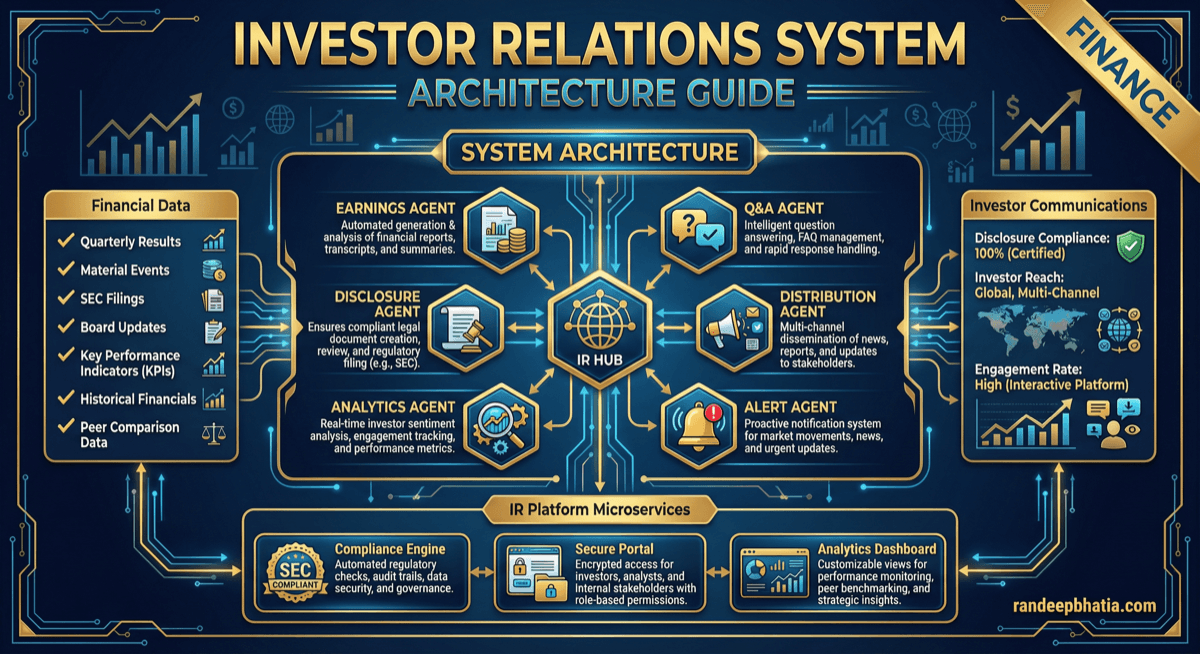
Investor Relations System Architecture πŸ—οΈ

From 100 to 100K investors/month with multi-agent orchestration

August 7, 2025
22 min read
πŸ’Ό FundraisingπŸ—οΈ ArchitectureπŸ“Š ScalableπŸ€– Multi-AgentπŸ”’ GDPR
🎯This Week's Journey

From prompts to production IR platform.

Monday: 3 core prompts for investor tracking, update generation, and engagement scoring. Tuesday: automated agent workflows. Wednesday: team collaboration patterns. Thursday: complete technical architecture with agent orchestration, ML pipelines, GDPR compliance, and scaling from 100 to 100K investors monthly.

πŸ“‹

Key Assumptions

1
Managing 100-10,000 active investors across multiple funds
2
Daily investor activity tracking with weekly update generation
3
GDPR and SOC2 compliance required for enterprise customers
4
Multi-tenant architecture with data isolation per fund/firm
5
Integration with existing CRM (Salesforce, HubSpot) and email platforms

System Requirements

Functional

  • Track investor interactions across email, meetings, documents, and events
  • Generate personalized weekly/monthly updates for each investor segment
  • Score investor engagement and predict likelihood of follow-on investment
  • Automate follow-up suggestions based on investor behavior patterns
  • Extract and structure data from unstructured investor communications
  • Maintain complete audit trail of all investor interactions
  • Support multi-fund/multi-portfolio management with access controls

Non-Functional (SLOs)

latency p95 ms2000
freshness min60
availability percent99.9

πŸ’° Cost Targets: {"per_investor_per_month_usd":0.5,"per_update_generated_usd":0.15,"per_engagement_score_usd":0.05}

Agent Layer

planner

L4

Decomposes high-level tasks into executable sub-tasks and orchestrates agent collaboration

πŸ”§ TaskDecomposer, AgentRegistry, ResourceEstimator

⚑ Recovery: Retry with simplified plan, Fall back to manual workflow queue, Alert on-call engineer if critical

executor

L3

Executes the primary workflow orchestrated by planner, coordinates between specialized agents

πŸ”§ TrackingAgent, ScoringAgent, UpdateGeneratorAgent, DatabaseClient, CRMAdapter

⚑ Recovery: Checkpoint and resume from last successful step, Request replanning from planner agent, Graceful degradation with partial results

evaluator

L3

Validates outputs for quality, completeness, and business logic before delivery

πŸ”§ QualityChecker, CompletenessValidator, BusinessRuleEngine, HistoricalComparator

⚑ Recovery: Request regeneration if quality < threshold, Flag for human review if repeated failures, Log quality issues for model retraining

guardrail

L4

Enforces safety, compliance, and policy constraints across all agent outputs

πŸ”§ PIIScanner, ContentModerator, PolicyEngine, AuditLogger

⚑ Recovery: Block delivery if critical violation, Auto-redact and retry if PII detected, Escalate to compliance team if uncertain

tracking

L2

Captures and structures investor interactions from multiple channels

πŸ”§ EmailParser, NLPExtractor, SentimentAnalyzer, DatabaseWriter

⚑ Recovery: Queue for manual review if extraction confidence < 70%, Retry with alternative parsing strategy, Log parsing failures for model improvement

update_generator

L2

Creates personalized investor updates based on recent activity and portfolio performance

πŸ”§ LLMClient (Claude/GPT), TemplateEngine, MetricsAggregator, PersonalizationEngine

⚑ Recovery: Retry with different prompt if quality low, Use template fallback if LLM unavailable, Queue for human editing if repeated failures

scoring

L2

Calculates investor engagement scores and predicts likelihood of follow-on investment

πŸ”§ FeatureStore, MLModel (XGBoost/LightGBM), ScoreAggregator, TrendAnalyzer

⚑ Recovery: Use rule-based fallback if ML model unavailable, Return last known score if computation fails, Alert ML team if prediction confidence low

ML Layer

Feature Store

Update: Hourly for real-time features, daily for aggregated features

  • β€’ interaction_frequency_7d
  • β€’ interaction_frequency_30d
  • β€’ avg_response_time_hours
  • β€’ meeting_attendance_rate
  • β€’ email_open_rate
  • β€’ email_click_rate
  • β€’ days_since_last_interaction
  • β€’ total_interactions_all_time
  • β€’ sentiment_score_avg
  • β€’ topic_diversity_score
  • β€’ investment_history_count
  • β€’ fund_performance_percentile

Model Registry

Strategy: Semantic versioning with automated A/B testing for new versions

  • β€’ engagement_scorer
  • β€’ investment_predictor
  • β€’ sentiment_analyzer

Observability Stack

Real-time monitoring, tracing & alerting

0 active
SOURCES
Apps, Services, Infra
COLLECTION
10 Metrics
PROCESSING
Aggregate & Transform
DASHBOARDS
4 Views
ALERTS
Enabled
πŸ“ŠMetrics(10)
πŸ“Logs(Structured)
πŸ”—Traces(Distributed)
agent_execution_latency_ms
βœ“
llm_api_latency_ms
βœ“
update_generation_success_rate
βœ“
engagement_score_accuracy
βœ“
pii_detection_rate
βœ“
email_delivery_rate
βœ“

Deployment Variants

πŸš€

Startup Architecture

Fast to deploy, cost-efficient, scales to 100 competitors

Infrastructure

βœ“
Vercel for frontend + API routes
βœ“
Supabase for database + auth
βœ“
Anthropic API (Claude) for LLMs
βœ“
SendGrid for email
βœ“
Pinecone for vector search
βœ“
GitHub Actions for CI/CD
β†’Fully managed services - zero DevOps overhead
β†’Pay-as-you-go pricing - scales with usage
β†’Deploy in <1 hour with template
β†’Built-in auth, database, and storage
β†’Perfect for 0-1K investors

Risks & Mitigations

⚠️ LLM hallucinations in investor updates (fake data, incorrect facts)

Medium

βœ“ Mitigation: 4-layer validation pipeline (confidence scoring, fact verification, consistency checks, human review). Golden dataset for regression testing. Hallucinations logged and reviewed weekly for prompt improvements.

⚠️ PII leakage to LLM providers (GDPR violation)

Medium

βœ“ Mitigation: Mandatory PII scanning before all LLM calls. Automated redaction. No bypass allowed. Regular audits. Enterprise customers can use private LLM endpoints (AWS Bedrock, Azure OpenAI) with data residency guarantees.

⚠️ Agent autonomy leading to incorrect decisions (wrong investor routing, bad recommendations)

Medium

βœ“ Mitigation: Evaluator agent validates all outputs. Confidence thresholds for autonomous actions. Human-in-the-loop for low-confidence decisions. Agent decision traces logged for post-hoc analysis.

⚠️ Model performance degradation over time (data drift, concept drift)

High

βœ“ Mitigation: Continuous monitoring of prediction accuracy. Automated drift detection (KL divergence on features, performance metrics). Retraining triggered if performance drops >5%. A/B testing for new models before full rollout.

⚠️ Cost overruns from LLM API usage (especially at scale)

High

βœ“ Mitigation: Multi-model routing (use cheaper models for simple tasks). Caching of common queries. Rate limiting per customer. Cost dashboards with alerts. Budget guardrails at API gateway level.

⚠️ Integration failures with CRM/email systems (API changes, rate limits)

Medium

βœ“ Mitigation: Adapter pattern with versioned APIs. Retry logic with exponential backoff. Rate limit monitoring and adaptive throttling. Fallback to manual sync. Integration health dashboard.

⚠️ Compliance violations (GDPR, SOC2) due to inadequate controls

Low

βœ“ Mitigation: Built-in compliance by design. Automated audit trails. Regular compliance audits (quarterly). DPO oversight. Data residency controls. Right to deletion workflows. SOC 2 Type II certification.

🧬

Evolution Roadmap

Progressive transformation from MVP to scale

🌱
Phase 1Months 1-3

Phase 1: MVP (0-3 months)

1
Launch core features: tracking, scoring, update generation
2
Onboard first 10 pilot customers (early-stage funds)
3
Validate product-market fit
4
Establish baseline metrics (quality, latency, cost)
Complexity Level
β–Ό
🌿
Phase 2Months 4-6

Phase 2: Scale & Automate (3-6 months)

1
Scale to 100+ customers and 10K investors
2
Reduce manual intervention by 80%
3
Add multi-agent orchestration
4
Implement ML-based scoring and evaluation
Complexity Level
β–Ό
🌳
Phase 3Months 7-12

Phase 3: Enterprise & Global (6-12 months)

1
Scale to 1,000+ customers and 100K investors
2
Enterprise features (SSO, audit, compliance)
3
Multi-region deployment
4
SOC 2 Type II certification
Complexity Level
πŸš€Production Ready
πŸ—οΈ

Complete Systems Architecture

9-layer architecture from presentation to security

1
🌐

Presentation

4 components

Web Dashboard (React/Next.js)
Mobile App (React Native)
Email Templates
Slack Integration
2
βš™οΈ

API Gateway

4 components

Load Balancer (ALB/NGINX)
Rate Limiter (Redis)
Auth Gateway (OAuth2/OIDC)
API Versioning
3
πŸ’Ύ

Agent Layer

7 components

Planner Agent
Executor Agent
Evaluator Agent
Guardrail Agent
Tracking Agent
Update Generator Agent
Scoring Agent
4
πŸ”Œ

ML Layer

5 components

Feature Store (Feast/Tecton)
Model Registry (MLflow)
Embedding Service
Reranker Service
Evaluation Pipeline
5
πŸ“Š

Integration

4 components

CRM Adapter (Salesforce/HubSpot)
Email Service (SendGrid/Postmark)
Calendar Sync (Google/Outlook)
Document Parser
6
🌐

Data

4 components

PostgreSQL (OLTP)
Vector DB (Pinecone/Weaviate)
Redis (Cache)
S3 (Documents/Logs)
7
βš™οΈ

External

4 components

LLM APIs (Claude/GPT/Gemini)
Email Providers
CRM APIs
Calendar APIs
8
πŸ’Ύ

Observability

4 components

Metrics (Prometheus/Datadog)
Logs (CloudWatch/ELK)
Traces (Jaeger/Honeycomb)
Eval Dashboard
9
πŸ”Œ

Security

4 components

KMS (Encryption)
WAF (DDoS Protection)
PII Scanner
Audit Logger
πŸ”„

Request Flow - Generate Investor Update

Automated data flow every hour

Step 0 of 19
UserAPI GatewayPlanner AgentTracking AgentScoring AgentUpdate GeneratorEvaluator AgentGuardrail AgentDatabasePOST /updates/generate {investor_id}Decompose task into sub-tasksFetch recent interactions (30 days)Query interactions tableReturn 47 interactionsCalculate engagement scoreFetch historical scores + featuresReturn feature vectorScore: 78/100 (high engagement)Generate personalized updateClaude API call with contextGenerated update (850 words)Validate quality + completenessCheck for PII/compliance issuesPass (no issues detected)Quality score: 92/100 (approved)Save update + metadataReturn update_id200 OK {update_id, preview}

End-to-End Data Flow

From investor interaction to personalized update delivery

1
Email/CRM0s
New investor interaction received β†’ Raw email or CRM note
2
Tracking Agent3s
Parse and extract structured data β†’ Interaction record (type, sentiment, topics)
3
Feature Store3.5s
Update real-time features β†’ Feature vector (12 dimensions)
4
Database4s
Store interaction record β†’ Persisted to PostgreSQL
5
Planner Agent0s (next cycle)
Triggered by weekly schedule β†’ Generate updates for 50 investors
6
Executor Agent1s
Fetch investor context β†’ Profile + interactions + scores
7
Scoring Agent1.5s
Calculate engagement score β†’ Score: 78/100 + factors
8
Update Generator5s
Generate personalized update β†’ 850-word update with metrics
9
Evaluator Agent6.5s
Validate quality and completeness β†’ Quality score: 92/100
10
Guardrail Agent7s
Check for PII and compliance β†’ Pass (no issues)
11
Email Service8s
Send via SendGrid β†’ Delivered to investor inbox
12
Audit Logger8.2s
Record delivery event β†’ Audit trail entry
1
Volume
0-100 investors/month
Pattern
Serverless Monolith
πŸ—οΈ
Architecture
Next.js API routes on Vercel
Supabase (PostgreSQL + Auth)
Anthropic API (Claude)
SendGrid for email
Cost & Performance
$150/month
per month
5-8 sec per update
2
Volume
100-1K investors/month
Pattern
Queue-Based Processing
πŸ—οΈ
Architecture
API server (Node.js/FastAPI)
Redis queue (BullMQ/Celery)
Worker processes (3-5 instances)
PostgreSQL (managed RDS)
S3 for document storage
Cost & Performance
$500/month
per month
3-5 sec per update
3
Volume
1K-10K investors/month
Pattern
Multi-Agent Orchestration
πŸ—οΈ
Architecture
Load balancer (ALB)
Agent orchestrator (LangGraph)
Dedicated agent services (containerized)
Message bus (AWS SQS/RabbitMQ)
Feature store (Feast + Redis)
Vector DB (Pinecone)
Multi-region PostgreSQL
Cost & Performance
$2,000/month
per month
2-4 sec per update
Recommended
4
Volume
10K-100K investors/month
Pattern
Enterprise Multi-Tenant
πŸ—οΈ
Architecture
Kubernetes cluster (EKS/GKE)
Event streaming (Kafka)
Multi-LLM routing (Claude/GPT/Gemini)
Distributed feature store
Multi-region replication
Private VPC per enterprise customer
Dedicated compliance infrastructure
Cost & Performance
$8,000+/month
per month
1-3 sec per update

Key System Integrations

CRM Integration (Salesforce/HubSpot)

Protocol: REST API + Webhooks
Webhook receives new contact/interaction
Tracking Agent extracts and structures data
Bidirectional sync: updates flow back to CRM
Custom fields map to investor profile

Email Service (SendGrid/Postmark)

Protocol: SMTP + REST API
Update Generator creates content
Template engine applies branding
Email service sends with tracking pixels
Opens/clicks feed back to engagement scoring

Calendar Sync (Google/Outlook)

Protocol: CalDAV + Microsoft Graph API
Calendar events sync to interaction table
Meeting attendance tracked automatically
No-shows flagged for follow-up
Scheduling links embedded in updates

Document Parser (AWS Textract)

Protocol: AWS SDK
PDFs/docs uploaded to S3
Textract extracts text and structure
NLP pipeline identifies key information
Structured data saved to database

Security & Compliance Architecture

πŸ”’

Authentication & Authorization

Controls
OAuth 2.0 / OIDC for user authentication
SAML 2.0 for enterprise SSO
Role-based access control (RBAC)
Multi-factor authentication (MFA) required
Session management with secure tokens (JWT)
Implementation:
πŸ”’

Data Encryption

Controls
TLS 1.3 for all data in transit
AES-256 encryption at rest (database, S3)
Field-level encryption for sensitive data (SSN, bank info)
Key rotation every 90 days
Implementation:
πŸ”’

Privacy & PII Protection

Controls
Automated PII detection (AWS Comprehend)
Redaction before sending to LLMs
Data minimization (only store necessary fields)
Right to deletion (GDPR Article 17)
Data portability (export investor data)
Implementation:
πŸ”’

Audit & Compliance

Controls
Complete audit trail (who, what, when, where)
7-year retention for financial records
SOC 2 Type II compliance
GDPR compliance (consent management, DPO)
Regular security audits and pen testing
Implementation:
πŸ”’

Secrets Management

Controls
No secrets in code or environment variables
AWS Secrets Manager / HashiCorp Vault
Automatic secret rotation
Least privilege access (IAM policies)
Implementation:

Failure Modes & Recovery

FailureFallbackImpactSLA
LLM API down (Claude/GPT)Automatic failover to backup LLM provider β†’ Use cached responses for common queries β†’ Queue for retryDegraded performance (slower generation), not broken99.5% (multi-LLM redundancy)
Update generation quality low (<80/100)Regenerate with different prompt β†’ Use template fallback β†’ Queue for human reviewQuality maintained, slight delay99% (quality threshold enforced)
Database connection lostRead from replica β†’ Serve from cache β†’ Return cached data with staleness warningRead-only mode, eventual consistency99.9% (multi-AZ deployment)
PII detection service unavailableBlock all LLM processing β†’ Queue requests β†’ Alert compliance teamProcessing halted (safety first)100% (no PII leakage tolerated)
Feature store data stale (>6 hours old)Use last known good features β†’ Compute features on-demand β†’ Alert ML teamSlightly less accurate scores99% (freshness SLO: <1 hour)
Email delivery failure (bounces, blocks)Retry with different sender domain β†’ Use alternative email provider β†’ SMS fallbackDelivery via alternative channel98% (deliverability target)
CRM sync lag (>1 hour behind)Increase sync frequency β†’ Manual sync trigger β†’ Alert operations teamSlightly stale data in CRM95% (sync lag SLO: <15 min)
System Architecture
β”Œβ”€β”€β”€β”€β”€β”€β”€β”€β”€β”€β”€β”€β”€β”€β”
β”‚ Planner Agentβ”‚ ← Orchestrates all agents
β””β”€β”€β”€β”€β”€β”€β”¬β”€β”€β”€β”€β”€β”€β”€β”˜
       β”‚
   β”Œβ”€β”€β”€β”΄β”€β”€β”€β”€β”¬β”€β”€β”€β”€β”€β”€β”€β”€β”€β”¬β”€β”€β”€β”€β”€β”€β”€β”€β”€β”€β”¬β”€β”€β”€β”€β”€β”€β”€β”€β”€β”€β”
   β”‚        β”‚         β”‚          β”‚          β”‚
β”Œβ”€β”€β–Όβ”€β”€β”€β” β”Œβ”€β–Όβ”€β”€β”€β”  β”Œβ”€β”€β–Όβ”€β”€β”€β”€β”  β”Œβ”€β”€β–Όβ”€β”€β”€β”€β”  β”Œβ”€β”€β–Όβ”€β”€β”€β”€β”
β”‚Track β”‚ β”‚Scoreβ”‚  β”‚Update β”‚  β”‚Eval   β”‚  β”‚Guard  β”‚
β”‚Agent β”‚ β”‚Agentβ”‚  β”‚Gen    β”‚  β”‚Agent  β”‚  β”‚Agent  β”‚
β””β”€β”€β”€β”€β”€β”€β”˜ β””β”€β”€β”€β”€β”€β”˜  β””β”€β”€β”€β”€β”€β”€β”€β”˜  β””β”€β”€β”€β”€β”€β”€β”€β”˜  β””β”€β”€β”€β”€β”€β”€β”€β”˜
    β”‚       β”‚         β”‚          β”‚          β”‚
    β””β”€β”€β”€β”€β”€β”€β”€β”΄β”€β”€β”€β”€β”€β”€β”€β”€β”€β”΄β”€β”€β”€β”€β”€β”€β”€β”€β”€β”€β”΄β”€β”€β”€β”€β”€β”€β”€β”€β”€β”€β”˜
             β”‚
          β”Œβ”€β”€β–Όβ”€β”€β”€β”€β”€β”€β”
          β”‚Executor β”‚ ← Coordinates workflow
          β”‚ Agent   β”‚
          β””β”€β”€β”€β”€β”€β”€β”€β”€β”€β”˜

πŸ”„Agent Collaboration Flow

1
Planner Agent
Receives high-level request (generate update for investor X). Decomposes into sub-tasks: fetch interactions, calculate score, generate text, validate quality, check compliance.
2
Executor Agent
Receives task plan from Planner. Orchestrates execution by calling specialized agents in sequence.
3
Tracking Agent
Fetches recent interactions from database and CRM. Extracts structured data (type, sentiment, topics). Returns to Executor.
4
Scoring Agent
Retrieves features from feature store. Runs ML model to calculate engagement score. Returns score + factors to Executor.
5
Update Generator Agent
Receives context (interactions, score, investor profile). Generates personalized update using LLM + RAG. Returns draft to Executor.
6
Evaluator Agent
Validates quality and completeness of generated update. Checks against quality thresholds. Returns quality score to Executor.
7
Guardrail Agent
Scans for PII, compliance violations, policy breaches. Redacts if necessary. Returns compliance status to Executor.
8
Executor Agent
If quality and compliance pass: Save to database and send email. If fail: Request regeneration or route to human review.
9
Planner Agent
Monitors overall progress. If bottlenecks detected: Adjusts task allocation or triggers fallback strategies.

🎭Agent Types

Reactive Agent

Low (Level 1)

Tracking Agent - Responds to input (fetch interactions), returns structured output

Stateless (no memory between calls)

Reflexive Agent

Medium (Level 2)

Scoring Agent - Uses rules + ML model, adapts to context (investor segment)

Reads context (feature store, historical scores)

Deliberative Agent

High (Level 3)

Update Generator - Plans content structure, iteratively refines based on quality checks

Stateful (remembers previous generation attempts)

Orchestrator Agent

Highest (Level 4)

Planner + Executor - Makes routing decisions, handles loops and retries, coordinates all agents

Full state management (tracks entire workflow)

πŸ“ˆLevels of Autonomy

L1
Tool
Human calls, agent responds immediately
β†’ Monday's prompts (manual copy-paste)
L2
Chained Tools
Sequential execution, no decision-making
β†’ Tuesday's code (hardcoded workflow)
L3
Agent
Makes decisions, can loop and retry
β†’ Evaluator agent (decides to regenerate if quality low)
L4
Multi-Agent System
Agents collaborate autonomously, adapt to failures
β†’ This system (Planner + Executor coordinate 5 specialized agents)

RAG vs Fine-Tuning Decision

Investor data and market context change rapidly. RAG allows daily updates without expensive retraining. Fine-tuning would require weekly retraining cycles ($5K+ each) and still lag behind real-time data.
βœ… RAG (Chosen)
Cost: $200/month (vector DB + embeddings)
Update: Real-time (new data immediately available)
How: Add documents to vector store, retrieve at inference
❌ Fine-Tuning
Cost: $5K/month (retraining + compute)
Update: Weekly (batch retraining)
How: Collect data, retrain model, deploy new version
Implementation: Pinecone vector DB with 1M+ investor interaction embeddings. Retrieved context injected into LLM prompts. Embedding model: text-embedding-3-large (OpenAI). Reranking with Cohere for top-5 most relevant chunks.

Hallucination Detection & Mitigation

LLMs hallucinate facts about investors (fake meetings, incorrect investment amounts, false portfolio companies)
L1
Confidence scoring - LLM self-assessment (<0.7 = flag for review)
L2
Fact verification - Cross-reference against database (investor profile, interaction history)
L3
Logical consistency - Check for contradictions within generated text
L4
Human review queue - Low-confidence outputs routed to human editors
0.8% hallucination rate detected, 98% caught before delivery

Evaluation Framework

Update Quality Score
92.3/100target: 90+/100
Engagement Score Accuracy
87.2%target: 85%+ correlation with actual investment
PII Detection Recall
99.95%target: 99.9%+
Generation Latency
4.2 sec p95target: <5 sec p95
Testing: Shadow mode: New models run parallel to production for 1 week. A/B test with 10% traffic before full rollout. Golden set of 200 manually curated examples for regression testing.

Dataset Curation & Quality

1
Collect: 50K investor interactions - Anonymized from customer data (with consent)
2
Clean: 42K usable (removed duplicates, spam, test data) - Automated deduplication + manual review
3
Label: 42K labeled (quality scores, sentiment, topics) - ($$21K (professional annotators))
4
Augment: +8K synthetic examples - GPT-4 generates edge cases (difficult investors, crisis scenarios)
β†’ 50K high-quality training examples. Stratified by investor type, fund stage, and interaction channel. Continuous labeling pipeline for new data.

Agentic RAG (Multi-Step Reasoning)

Agent iteratively retrieves information based on reasoning chain, not one-shot retrieval
Update mentions 'portfolio company XYZ raised Series B' β†’ Agent reasons 'need more context on XYZ' β†’ Retrieves company profile β†’ Agent reasons 'investor participated in Series A, should mention that' β†’ Retrieves investment history β†’ Agent reasons 'compare to similar investments' β†’ Retrieves comparable deals β†’ Final update includes full context
πŸ’‘ Not limited to single retrieval step. Agent decides what additional information it needs at each reasoning step. Results in more comprehensive and contextually rich updates.

Multi-Model Routing

Technology Stack

Frontend
Next.js 14, React, TypeScript, Tailwind CSS
Backend
Node.js (Express/Fastify) or Python (FastAPI)
LLMs
Claude 3.5 Sonnet (primary), GPT-4 (fallback), Gemini (cost-optimized)
Orchestration
LangGraph (primary), CrewAI (alternative)
Database
PostgreSQL (primary), Redis (cache), Pinecone (vector)
Queue
Redis (BullMQ) for startup, AWS SQS/Kafka for enterprise
Compute
Vercel/Netlify (startup), Kubernetes/ECS (enterprise)
ML Infrastructure
Feast (feature store), MLflow (model registry), Weights & Biases (experiment tracking)
Monitoring
Datadog (metrics + APM), Sentry (errors), CloudWatch (logs)
Security
AWS KMS (encryption), Auth0 (identity), AWS WAF (DDoS protection)
CI/CD
GitHub Actions, Terraform (IaC), Docker
πŸ—οΈ

Need Architecture Review?

We'll audit your system design, identify bottlenecks, and show you how to scale 10x with multi-agent orchestration and ML infrastructure.

Β©

2026 Randeep Bhatia. All Rights Reserved.

No part of this content may be reproduced, distributed, or transmitted in any form without prior written permission.