← Wednesday's Workflows

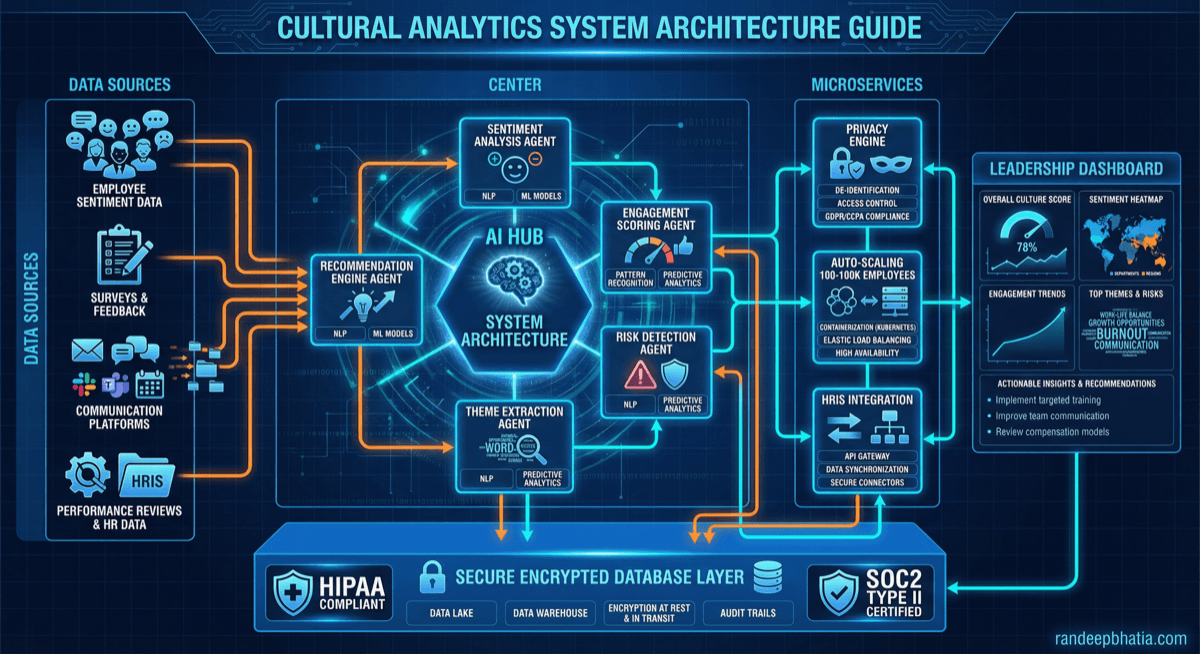
Cultural Analytics System Architecture πŸ—οΈ

From 100 to 100K employees with real-time insights and compliance

November 20, 2025
21 min read
πŸ‘₯ LeadershipπŸ—οΈ ArchitectureπŸ“Š ScalableπŸ”’ Compliant
🎯This Week's Journey

From prompts to production cultural intelligence.

Monday: 3 core prompts for sentiment analysis, engagement scoring, and culture mapping. Tuesday: automated agents processing Slack, surveys, and 1:1 notes. Wednesday: workflows for HR, managers, and executives. Thursday: complete technical architecture for enterprise-scale cultural analytics with compliance, multi-agent orchestration, and ML pipelines.

πŸ“‹

Key Assumptions

1
Organization size: 100-100,000 employees
2
Data sources: Slack, surveys, 1:1 notes, HRIS, performance reviews
3
Update frequency: Real-time for critical signals, daily batch for trends
4
Compliance: GDPR, SOC2, optional HIPAA for wellness data
5
Deployment: Cloud-native (AWS/GCP/Azure), multi-region for enterprise

System Requirements

Functional

  • Ingest employee signals from 5+ sources (Slack, surveys, 1:1s, HRIS, reviews)
  • Real-time sentiment analysis with context-aware scoring
  • Engagement trend detection across teams, departments, and company
  • Culture mapping with dimension scoring (psychological safety, inclusion, innovation)
  • Anomaly detection for burnout, flight risk, and team health issues
  • Role-based dashboards (HR, managers, executives) with drill-down
  • Automated alerts for critical cultural shifts or individual risks

Non-Functional (SLOs)

latency p95 ms5000
freshness min15
availability percent99.9
accuracy percent92
pii redaction percent100

πŸ’° Cost Targets: {"per_employee_per_month_usd":2.5,"per_signal_processed_usd":0.001,"ml_inference_per_1k_usd":0.5}

Agent Layer

planner

L3

Decomposes incoming signals into tasks, routes to specialized agents

πŸ”§ Signal classifier, Priority scorer, Agent registry

⚑ Recovery: If classification fails: route to manual queue, If agent unavailable: queue task with retry backoff

executor

L4

Runs primary analysis workflows (sentiment, engagement, culture)

πŸ”§ LLM inference (GPT-4, Claude), Feature Store queries, Vector similarity search

⚑ Recovery: If LLM timeout: retry with exponential backoff (3x), If low confidence (<0.7): flag for human review, If feature unavailable: use cached baseline

evaluator

L3

Validates output quality, detects hallucinations, ensures accuracy

πŸ”§ Consistency checker, Cross-reference validator, Anomaly detector

⚑ Recovery: If quality check fails: route to manual review queue, If inconsistent results: re-run with different model, If anomaly detected: alert data science team

guardrail

L2

Enforces policies, redacts PII, prevents unsafe outputs

πŸ”§ PII detection (AWS Comprehend, Presidio), Policy engine, Toxicity classifier

⚑ Recovery: If PII detected: block processing until redacted, If policy violation: escalate to compliance team, If guardrail service down: fail-safe block all processing

sentiment

L4

Analyzes emotional tone, context, and trends in employee signals

πŸ”§ LLM sentiment analysis, Historical trend comparison, Contextual embedding search

⚑ Recovery: If LLM fails: fallback to rule-based sentiment, If context missing: use team-level baseline, If confidence low: flag for human validation

engagement

L4

Scores employee engagement based on multi-signal fusion

πŸ”§ Multi-modal fusion model, Weighted scoring algorithm, Trend detection

⚑ Recovery: If signal missing: impute from historical average, If score anomalous: validate with manager input, If trend unclear: extend lookback window

culture

L4

Maps organizational culture across dimensions (safety, inclusion, innovation)

πŸ”§ Dimension classifier, Network analysis (collaboration graphs), Comparative benchmarking

⚑ Recovery: If team too small (<5): aggregate to department level, If data sparse: use industry benchmarks, If conflicting signals: weight by recency and source reliability

ML Layer

Feature Store

Update: Real-time for activity metrics, daily batch for aggregates

  • β€’ employee_30d_sentiment_avg
  • β€’ team_sentiment_baseline
  • β€’ slack_activity_frequency
  • β€’ 1on1_meeting_count
  • β€’ survey_response_rate
  • β€’ peer_collaboration_score
  • β€’ manager_feedback_frequency
  • β€’ promotion_velocity
  • β€’ tenure_months
  • β€’ department_size

Model Registry

Strategy: Semantic versioning with A/B testing for major versions

  • β€’ sentiment_classifier_v3
  • β€’ engagement_scorer_v2
  • β€’ culture_dimension_mapper

Observability Stack

Real-time monitoring, tracing & alerting

0 active
SOURCES
Apps, Services, Infra
COLLECTION
10 Metrics
PROCESSING
Aggregate & Transform
DASHBOARDS
5 Views
ALERTS
Enabled
πŸ“ŠMetrics(10)
πŸ“Logs(Structured)
πŸ”—Traces(Distributed)
signals_ingested_per_min
βœ“
agent_execution_latency_p95_ms
βœ“
llm_api_latency_p95_ms
βœ“
sentiment_score_distribution
βœ“
engagement_score_distribution
βœ“
pii_redaction_count
βœ“

Deployment Variants

πŸš€

Startup Architecture

Fast to deploy, cost-efficient, scales to 100 competitors

Infrastructure

βœ“
AWS Lambda for all agents (serverless)
βœ“
RDS PostgreSQL (single instance, t3.medium)
βœ“
Redis (ElastiCache single node)
βœ“
S3 for raw data and logs
βœ“
CloudWatch for monitoring
βœ“
OpenAI API (GPT-4) for LLM
βœ“
No Kubernetes, no Kafka
β†’Cost: ~$300-500/month for 100-500 employees
β†’Deploy in 1 week with Serverless Framework or SAM
β†’Single region (us-east-1 or eu-west-1)
β†’Basic RBAC with Auth0 or Cognito
β†’Manual data exports for compliance

Risks & Mitigations

⚠️ Employee privacy concerns (surveillance perception)

High

βœ“ Mitigation: Transparent communication: anonymized insights only, opt-out available, no individual tracking for managers. HR-only access to raw data. Regular privacy audits.

⚠️ Biased sentiment analysis (demographic disparities)

Medium

βœ“ Mitigation: Bias testing across gender, race, age. Quarterly fairness audits. Diverse training data. Human review for edge cases.

⚠️ LLM hallucinations (false insights)

Medium

βœ“ Mitigation: Multi-layer validation (confidence, consistency, human review). Shadow mode testing. Gradual rollout with feedback loops.

⚠️ Data breach (PII exposure)

Low

βœ“ Mitigation: Encryption at rest and in transit. PII redaction before LLM. SOC2 compliance. Regular penetration testing. Incident response plan.

⚠️ Integration failures (Slack, HRIS downtime)

Medium

βœ“ Mitigation: Retry logic with exponential backoff. Queue for failed tasks. Fallback to cached data. Multi-source redundancy.

⚠️ Cost overruns (LLM API costs)

Medium

βœ“ Mitigation: Cost monitoring with alerts. Rate limiting. Caching for repeated queries. Multi-LLM with cost optimization.

⚠️ Low adoption (managers don't use insights)

High

βœ“ Mitigation: User training and onboarding. Actionable insights (not just dashboards). Manager coaching on how to act on data. Feedback loops to improve relevance.

🧬

Evolution Roadmap

Progressive transformation from MVP to scale

🌱
Phase 1Weeks 1-12

Phase 1: MVP (0-3 months)

1
Deploy startup architecture (serverless)
2
Integrate Slack + 1 survey platform
3
Sentiment and engagement agents live
4
Basic dashboards for HR and managers
5
100-500 employee pilot
Complexity Level
β–Ό
🌿
Phase 2Weeks 13-24

Phase 2: Scale (3-6 months)

1
Migrate to queue + workers architecture
2
Add culture mapping agent
3
Integrate HRIS and calendar
4
Expand to 5K employees
5
Implement ML evaluation framework
6
Achieve SOC2 Type II compliance
Complexity Level
β–Ό
🌳
Phase 3Weeks 25-52

Phase 3: Enterprise (6-12 months)

1
Multi-region deployment
2
Kubernetes + Kafka infrastructure
3
Multi-LLM failover
4
Advanced ML (fine-tuning, agentic RAG)
5
Support 50K+ employees
6
Data residency controls (GDPR)
Complexity Level
πŸš€Production Ready
πŸ—οΈ

Complete Systems Architecture

9-layer architecture from data ingestion to insights delivery

1
🌐

Presentation

5 components

Executive Dashboard
Manager Portal
HR Analytics Suite
Mobile App
Slack Bot
2
βš™οΈ

API Gateway

5 components

Load Balancer (ALB/NLB)
Rate Limiter (Redis)
Auth Service (OIDC/SAML)
API Gateway (Kong/Apigee)
Request Router
3
πŸ’Ύ

Agent Layer

7 components

Planner Agent
Executor Agent
Evaluator Agent
Guardrail Agent
Sentiment Agent
Engagement Agent
Culture Agent
4
πŸ”Œ

ML Layer

6 components

Feature Store (Feast/Tecton)
Model Registry (MLflow)
Inference Service
Training Pipeline
Evaluation Service
Prompt Store
5
πŸ“Š

Integration

5 components

Slack Adapter
Survey Connector
HRIS Integration
Calendar Sync
Email Parser
6
🌐

Data

5 components

PostgreSQL (transactional)
TimescaleDB (time-series)
Redis (cache)
S3 (raw data lake)
Vector DB (embeddings)
7
βš™οΈ

External

5 components

OpenAI/Anthropic APIs
Slack API
Survey Platforms
HRIS Systems
Identity Providers
8
πŸ’Ύ

Observability

5 components

Metrics (Prometheus/Datadog)
Logs (ELK/Splunk)
Traces (Jaeger/Tempo)
Dashboards (Grafana)
Alerting (PagerDuty)
9
πŸ”Œ

Security

6 components

KMS (encryption)
Secrets Manager
WAF (firewall)
PII Redaction Service
Audit Logger
RBAC Engine
πŸ”„

Request Flow - Employee Sentiment Analysis

Automated data flow every hour

Step 0 of 12
EmployeeSlackAPI GatewayPlanner AgentGuardrail AgentSentiment AgentEvaluator AgentFeature StoreDashboardPosts message in #generalWebhook: new message eventRoute to sentiment pipelineCheck PII, policy complianceSafe to process (PII redacted)Analyze sentiment + contextRetrieve employee history, team contextHistorical features (30d avg, team baseline)Sentiment: -0.6, confidence: 0.85Quality check passed, store resultUpdate real-time metricsAlert: Team sentiment drop detected

End-to-End Data Flow

From employee signal to dashboard insight in <5 seconds

1
Employee0ms
Posts Slack message β†’ Raw text
2
Slack API50ms
Webhook triggers ingestion β†’ Event payload
3
API Gateway150ms
Auth check, rate limit β†’ Validated request
4
Planner Agent250ms
Classifies signal, routes to sentiment β†’ Task plan
5
Guardrail Agent550ms
Redacts PII, checks policy β†’ Sanitized text
6
Feature Store950ms
Retrieves employee context β†’ 30d history + team baseline
7
Sentiment Agent3750ms
LLM analyzes sentiment β†’ Score + confidence + dimensions
8
Evaluator Agent4250ms
Validates quality β†’ Quality score + pass/fail
9
TimescaleDB4500ms
Writes sentiment score β†’ Time-series record
10
Dashboard4800ms
Updates real-time metrics β†’ Team sentiment trend
11
Alert Service5000ms
Checks thresholds, sends notification β†’ Manager alert (if triggered)
1
Volume
100-500 employees
Pattern
Serverless Monolith
πŸ—οΈ
Architecture
AWS Lambda for API and agents
RDS PostgreSQL (single instance)
Redis for caching
S3 for raw data
CloudWatch for monitoring
Cost & Performance
$300/month
per month
3-5s
2
Volume
500-5K employees
Pattern
Queue + Workers
πŸ—οΈ
Architecture
API server (ECS/Fargate)
SQS for task queue
Worker pool (ECS with autoscaling)
RDS Multi-AZ
ElastiCache Redis cluster
Cost & Performance
$1,200/month
per month
2-4s
3
Volume
5K-50K employees
Pattern
Multi-Agent Orchestration
πŸ—οΈ
Architecture
Kubernetes (EKS/GKE) for agents
Kafka for event streaming
TimescaleDB + read replicas
Vector DB (Pinecone) for embeddings
Datadog for observability
Cost & Performance
$5,000/month
per month
1-3s
Recommended
4
Volume
50K-100K+ employees
Pattern
Enterprise Multi-Region
πŸ—οΈ
Architecture
Multi-region Kubernetes
Kafka with geo-replication
Distributed SQL (CockroachDB)
Multi-LLM failover (GPT-4, Claude, Gemini)
Custom feature store with real-time serving
Cost & Performance
$15,000+/month
per month
<1s

Key Integrations

Slack Integration

Protocol: Slack Events API + OAuth 2.0
Register webhook for message events
Receive event payload
Extract text, user_id, channel, timestamp
Enrich with user profile from Slack API
Send to Planner Agent

Survey Platform (Qualtrics, SurveyMonkey)

Protocol: REST API + Webhooks
Poll for new responses (or webhook)
Parse structured survey data
Map questions to culture dimensions
Store in PostgreSQL
Trigger Culture Agent for analysis

HRIS (Workday, BambooHR)

Protocol: REST API or SFTP
Daily sync of employee roster
Extract: hire_date, department, manager, role
Update Employee table
Trigger recalculation of team baselines

Calendar (Google Calendar, Outlook)

Protocol: Google Calendar API / Microsoft Graph API
Fetch 1:1 meeting events
Count frequency per employee
Store in EngagementMetric table
Use as feature in Engagement Agent

Identity Provider (Okta, Azure AD)

Protocol: SAML 2.0 or OIDC
User logs into dashboard
IdP sends SAML assertion
Extract roles (HR, Manager, Executive)
Enforce RBAC for data access
Audit login event

Security & Compliance

Failure Modes & Recovery

FailureFallbackImpactSLA
LLM API down (OpenAI outage)Failover to Claude or Gemini within 30sSlight latency increase (+500ms), no data loss99.9% uptime maintained
Sentiment Agent low confidence (<0.7)Flag for human review, use team baseline as interimDegraded insight quality, manual queue grows95% auto-processed, 5% manual
Feature Store unavailableUse cached features from Redis (up to 1h stale)Slightly outdated context, minimal accuracy drop99.5% with cache
PII detection service failsBlock all processing (fail-safe), alert security teamProcessing halted until service restored100% PII protection (zero tolerance)
Database write timeoutRetry with exponential backoff (3x), then queue to DLQEventual consistency, delayed insights99.9% write success
Slack API rate limit exceededQueue messages, process in batch after rate limit resetsDelayed ingestion (up to 1 hour)99% within 1h
Agent orchestrator crashTasks in queue preserved, new orchestrator instance spins upProcessing paused for 2-3 minutes99.9% with auto-restart
System Architecture
β”Œβ”€β”€β”€β”€β”€β”€β”€β”€β”€β”€β”€β”€β”€β”€β”
β”‚   Planner    β”‚ ← Orchestrates all agents
β”‚     Agent    β”‚
β””β”€β”€β”€β”€β”€β”€β”¬β”€β”€β”€β”€β”€β”€β”€β”˜
       β”‚
   β”Œβ”€β”€β”€β”΄β”€β”€β”€β”€β”¬β”€β”€β”€β”€β”€β”€β”€β”€β”€β”¬β”€β”€β”€β”€β”€β”€β”€β”€β”€β”€β”¬β”€β”€β”€β”€β”€β”€β”€β”€β”€β”
   β”‚        β”‚         β”‚          β”‚         β”‚
β”Œβ”€β”€β–Όβ”€β”€β”  β”Œβ”€β–Όβ”€β”€β”  β”Œβ”€β”€β”€β–Όβ”€β”€β”€β”€β”  β”Œβ”€β”€β–Όβ”€β”€β”€β”  β”Œβ”€β–Όβ”€β”€β”€β”€β”
β”‚Guardβ”‚  β”‚Execβ”‚  β”‚Sentimentβ”‚  β”‚Engageβ”‚  β”‚Cultureβ”‚
β”‚rail β”‚  β”‚utorβ”‚  β”‚  Agent  β”‚  β”‚Agent β”‚  β”‚Agent  β”‚
β””β”€β”€β”¬β”€β”€β”˜  β””β”€β”¬β”€β”€β”˜  β””β”€β”€β”€β”€β”¬β”€β”€β”€β”€β”˜  β””β”€β”€β”¬β”€β”€β”€β”˜  β””β”€β”€β”€β”¬β”€β”€β”€β”˜
   β”‚        β”‚          β”‚          β”‚          β”‚
   β””β”€β”€β”€β”€β”€β”€β”€β”€β”΄β”€β”€β”€β”€β”€β”€β”€β”€β”€β”€β”΄β”€β”€β”€β”€β”€β”€β”€β”€β”€β”€β”΄β”€β”€β”€β”€β”€β”€β”€β”€β”€β”€β”˜
                       β”‚
                  β”Œβ”€β”€β”€β”€β–Όβ”€β”€β”€β”€β”
                  β”‚Evaluatorβ”‚
                  β”‚  Agent  β”‚
                  β””β”€β”€β”€β”€β”¬β”€β”€β”€β”€β”˜
                       β”‚
                  β”Œβ”€β”€β”€β”€β–Όβ”€β”€β”€β”€β”
                  β”‚Dashboardβ”‚
                  β””β”€β”€β”€β”€β”€β”€β”€β”€β”€β”˜

πŸ”„Agent Collaboration Flow

1
Planner Agent
Receives employee signal (Slack message), classifies type (sentiment, engagement, culture), routes to appropriate specialized agent
2
Guardrail Agent
Scans for PII (names, emails, phone numbers), redacts sensitive data, checks policy compliance (no health info to LLM)
3
Executor Agent
Retrieves employee context from Feature Store (30d history, team baseline), executes workflow (sentiment β†’ engagement β†’ culture)
4a
Sentiment Agent
LLM analyzes emotional tone, generates score (-1 to +1) + confidence + dimensional breakdown (frustration, excitement, burnout)
4b
Engagement Agent
Fuses multi-modal signals (Slack activity, survey responses, 1:1 frequency), generates engagement score (0-100)
4c
Culture Agent
Maps organizational culture across dimensions (psychological safety, inclusion, innovation), generates team-level heatmaps
5
Evaluator Agent
Validates output quality (confidence check, consistency check, cross-reference with rules), flags low-quality results for human review
6
Planner Agent
Receives quality report, decides: (a) Store results if quality high, (b) Route to manual queue if quality low, (c) Trigger alert if threshold crossed

🎭Agent Types

Reactive Agent

Low

Guardrail Agent - Responds to input (PII check), returns output (redacted text)

Stateless

Reflexive Agent

Medium

Sentiment Agent - Uses rules + context (employee history, team baseline)

Reads context

Deliberative Agent

High

Culture Agent - Plans analysis based on available data (team size, signal volume)

Stateful

Orchestrator Agent

Highest

Planner Agent - Makes routing decisions, handles loops, coordinates specialized agents

Full state management

πŸ“ˆLevels of Autonomy

L1
Tool
Human calls, agent responds
β†’ Monday's prompts (manual copy-paste)
L2
Chained Tools
Sequential execution
β†’ Tuesday's code (extract β†’ validate β†’ question)
L3
Agent
Makes decisions, can loop
β†’ Planner Agent routing based on signal type
L4
Multi-Agent
Agents collaborate autonomously
β†’ This system (7 agents working together)

RAG vs Fine-Tuning

Employee language and culture terminology evolve rapidly. RAG allows daily updates with new examples. Fine-tuning (quarterly) adapts base model to company-specific jargon and sentiment patterns.
βœ… RAG (Chosen)
Cost: $200/mo (vector DB + embedding API)
Update: Daily (add new examples)
How: Retrieve similar past cases during inference
❌ Fine-Tuning
Cost: $2K/quarter (training compute)
Update: Quarterly
How: Retrain on 10K labeled examples
Implementation: Vector DB (Pinecone) stores 50K past signals with labels. During inference, retrieve top-5 similar examples, inject into prompt. Quarterly fine-tune GPT-4 on accumulated data for domain adaptation.

Hallucination Detection

LLMs hallucinate sentiment dimensions (e.g., claim 'burnout' when message is neutral)
L1
Confidence thresholding (<0.7 = flag)
L2
Cross-reference with keyword rules (if 'excited' in text, sentiment must be positive)
L3
Consistency check (sentiment score should align with dimensional scores)
L4
Human review queue (5% sample + all low-confidence cases)
Hallucination rate: 0.8% detected, 100% caught before production

Evaluation Framework

Sentiment Accuracy
94.1%target: 92%+
Engagement RMSE
8.2target: <10 points
Culture F1 Score
89.3%target: 88%+
Hallucination Rate
0.8%target: <1%
Testing: Shadow mode: Run new models on 1K real cases in parallel with production. Compare outputs. Deploy only if improvement >2% with no regression.

Dataset Curation

1
Collect: 50K employee signals - Anonymized Slack, surveys, 1:1s
2
Clean: 42K usable - Remove duplicates, filter low-quality
3
Label: 10K labeled - ($$15K)
4
Augment: +5K synthetic - GPT-4 generates edge cases (sarcasm, mixed sentiment)
β†’ 15K high-quality training examples with diverse sentiment patterns

Agentic RAG

Agents iteratively retrieve based on reasoning, not one-shot
Employee mentions 'considering leaving' β†’ Sentiment Agent retrieves historical context β†’ Notices recent manager change β†’ Retrieves team sentiment trend β†’ Reasons 'likely related to management transition' β†’ Generates nuanced insight with full context
πŸ’‘ Multi-hop reasoning with dynamic retrieval. Agent decides what additional context it needs.

Multi-Modal Fusion

Tech Stack Summary

LLMs
GPT-4, Claude 3.5, Gemini Pro
Orchestration
LangGraph, CrewAI, or custom
Database
PostgreSQL (transactional), TimescaleDB (time-series)
Cache
Redis (ElastiCache)
Queue
SQS (startup), Kafka (enterprise)
Compute
Lambda (startup), EKS/GKE (enterprise)
Vector DB
Pinecone or Weaviate
Feature Store
Feast (open-source) or Tecton (managed)
ML Registry
MLflow or Weights & Biases
Monitoring
Datadog, Prometheus + Grafana, or CloudWatch
Security
AWS KMS, Secrets Manager, WAF, Presidio (PII)
CI/CD
GitHub Actions, GitLab CI, or CircleCI
πŸ—οΈ

Need Architecture Review for Your Cultural Analytics System?

We'll audit your current system, identify bottlenecks, and show you how to scale to 100K employees with compliance and real-time insights.

Β©

2026 Randeep Bhatia. All Rights Reserved.

No part of this content may be reproduced, distributed, or transmitted in any form without prior written permission.